The Girl Who Is Getting Married

Title: The Girl Who Is Getting Married
Japanese Title: もうすく結婚する女 (Mō sugu kekkon suru onna)
Author: Aoko Matsuda (松田 青子)
Translator: Angus Turvill
Publication Year: 2010 (Japan); 2017 (United Kingdom)
Publisher: Strangers Press
Pages: 36

Aoko Matsuda’s The Girl Who Is Getting Married, published as a stand-alone chapbook by Strangers Press in the same series as Mikumari, is a lovely puzzle box of a short story. The unnamed narrator is going to visit “the girl who is getting married,” but who is the narrator, and what is her relationship with the girl who is getting married? Instead of revealing its answer, the question twists and turns in on itself as the possible answers fracture and multiply.

According to the “About the Author” section on the inside of the chapbook’s front flap, Aoko Matsuda has “translated into Japanese Karen Russell’s St. Lucy’s Home for Girls Raised by Wolves and Vampires in the Lemon Grove.” There are many similarities in the tongue-in-cheek yet still unsettling weirdness that characterizes the short fiction of both authors, and it’s appropriate that Russell has written a short foreword to The Girl Who Is Getting Married. She aptly summarizes the uncertainty that lingers between the narrator and the girl who is getting married by explaining, “Each new paragraph shifts our understanding of their relationship. At some points they seem to merge into one girl, amoeba-like; at other moments, it’s tough to believe that they have ever shared a word” (9). Are they childhood friends? College roommates? Cousins? Sisters? A mother and her daughter? Casual acquaintances? Complete strangers? The exact same person?

The mystery of the narrator’s identity is ultimately less compelling than the odd rhythm and tempo of her narrative voice, however. As she gradually climbs the stairs to a fifth-floor apartment, she takes the reader along with her, step by step by step, with the expression “the girl who is getting married” repeated like a talismanic refrain. Just as the relationship between the two women shifts and changes, so too does the architecture of the building, which gradually begins to take on its own character. For example…

Special mention must be made of the stone staircase that rises up in the centre. It is a very large staircase, with a smooth, pale sheen. Even if it were the case that some other stone was used, I would like to assert quite definitely that this is marble. Although the staircase is flanked by rooms on both sides, its presence is so powerful that there would seem no exaggeration in suggesting that it is the reason for the building’s existence. Followed up and up by an obedient black hand-rail, the staircase is an unobtrusive white, a little grey in places, brining to mind the bones of a dinosaur. I do not know a great deal about dinosaurs so I cannot identify the exact type, but I am thinking of one with a very long neck. One that looks as though it would eat vegetation rather than meat a comparatively gentle one.

This is a dinosaur that, stretching out its elegant neck, will take me to the room where the girl who is getting married will be. (11-12)

Just as it’s difficult to grasp the identity of the narrator, it’s also impossible to visualize the building whose staircase she climbs, which is described in terms of the sensations it evokes. The girl who is getting married could be anyone, but the ascent to her apartment is like a description of a surrealist painting.

Matsuda plays with words to create and reshape concrete images and abstract illusions; and, in many ways, this short story feels like an extended prose poem. That being said, it doesn’t demand any unnecessary work from the reader, who is invited to explore the evocative emotional chiaroscuro of its dreamspace along with the narrator. The story is carefully translated and delightfully easy to read, and it’s a lot of fun to get lost in its labyrinth.

The Girl Who Is Getting Married can be ordered directly from Strangers Press, which ships internationally.

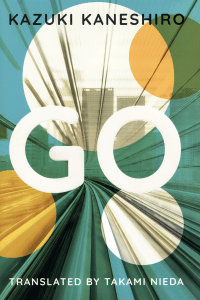
GO

Title: GO
Japanese Title: GO
Author: Kazuki Kaneshiro (金城 一紀)
Translator: Takami Nieda
Publication Year: 2000 (Japan); 2018 (United States)
Publisher: AmazonCrossing
Pages: 165

GO is an unabashedly sincere adolescent power fantasy. The novel’s teenage protagonist and first-person narrator, Sugihara, is not only intelligent and an intellectual, he’s also a powerhouse in a fight and respected by the other boys in his school. He reads weighty philosophical books and has an astounding knowledge of music and movies. A beautiful and popular girl named Sakurai is head-over-heels in love with him and has been since she first saw him. His father, an independent businessman and grizzled former boxer, treats him as an equal, and his mother and her friends adore him. Sugihara isn’t gay, but all of his close male friends still ask him out on dates and would do anything for him. There’s just something special about Sugihara, who is the perfect idealization of the teenage boy we’d like to think that we were or could have been.

The plot of GO is exceedingly simple. Sugihara switches schools between middle and high school, struggles to fit in to the new school’s culture, meets a beautiful girl and falls in love, starts studying to get into a good university, encounters a problem in his romantic relationship that leads to tension in his family life, overcomes his conflict with his father in a cathartic argument, and is then approached by his girlfriend with a sincere apology that repairs their relationship.

What makes GO interesting and worth reading, however, is the fact Sugihara is a Zainichi Korean, a person born and raised in Japan by Japanese-speaking parents who is not, legally speaking, Japanese.

Sugihara and his family begin the novel as Chōsenjin, or Zainichi Koreans who hold North Korean citizenship. Although his father was born on Jeju Island in South Korea, he was an active member of the North Korean Marxist Chongryon organization for most of his life and declared his family’s citizenship accordingly. The family officially switches their citizenship to South Korea when Sugihara is fourteen because his mother wants to visit Hawaii. Of course they can’t travel to the United States with North Korean passports, so they join the Mindan, the organization for South Korean residents.

Sugihara’s citizenship changes along with that of his family, but he wants nothing to do with what he calls “their Hawaii adventure.” What he decides to do instead is attend a Japanese high school. Up until that point he had gone to a Korean high school run by the Chongryon, where (male) students are given a strict Marxist education. Sugihara doesn’t care anything for Hawaii, but his citizenship changing overnight sparks a desire to be a part of the wider world. In his mind, this needs to start with attending a mainstream Japanese university. To do so, he needs to enter a Japanese high school, so he studies his butt off and, to the surprise of his classmates and the infuriation of his Chōsenjin teachers, he passes.

When he was younger, Sugihara toughened his fists against the Japanese boys who would chase after Koreans trying to pick fights, and he manages to earn the respect of his classmates at his Japanese high school by beating up a student who tries to pick a fight with him there. This student ends up being a yakuza boss’s son, and his defeat causes him to respect Sugihara as a peer. It’s at one of this young man’s lavish birthday parties that Sugihara meets Sakurai, who had once seen him playing basketball and decided to pursue him. Their relationship proceeds relatively normally, but Sugihara can’t quite bring himself to tell Sakurai and her family that he’s not actually Japanese.

I have to admit that I’m of two minds about this novel.

On one hand, I think Sugihara is obnoxious, and the story he tells about himself is utterly contrived. Every time a conflict arises, Sugihara handles it by being A Super Cool Guy™, which isn’t particularly interesting in terms of plot or character development. I’m also not a fan of Sugihara’s narcissism, which is so overwhelming that it doesn’t leave any room for him to acknowledge that any of the other characters might have an interior life of their own. Sugihara’s relationship with his girlfriend, for example, mainly consists of him lecturing her on his taste in entertainment media. When she expresses an extremely racist viewpoint at a critical moment, there is absolutely no reason for her to have done so save that her entire function is to serve as a plot device in a story that revolves entirely around Sugihara.

On the other hand, the author provides plenty of context for Sugihara’s bravado, citing numerous instances of discrimination that Sugihara and his family have to deal with within Japanese society, a difficult situation that isn’t made any easier by the harsh emphasis on ideological purity within the Chōsenjin community. If everything in Sugihara’s society is telling him that he’s literal garbage, can’t he be forgiven at least a little for indulging in a power fantasy as he narrates his own life?

Interspersed throughout Sugihara’s personal story of how he’s awesome and smart and tough and attractive is the story of his family circumstances. This secondary story begins at the start of the novel…

My father came to Japan with a brother who was two years younger than he was. This brother – my uncle, that is – returned to North Korea during the repatriation campaign that began in the late 1950s. The campaign essentially touted North Korea as an “earthly paradise,” encouraging persecuted North Koreans living in Japan to return to their homeland and forge a life with their compatriots. At the time, most North Koreans had a vague suspicion that nothing good ever came out of anything called a campaign, but thinking it might be better than Japan, where they faced discrimination and poverty, many went back to North Korea anyway. My uncle was among them. (5)

…and reaches something resembling a conclusion when Sugihara gets in a fistfight with his father after his girlfriend dumps him. To me at least, Sugihara’s parents are far more interesting characters than he is, and his relationship with his father is much more compelling than his relationship with Sakurai. Sakurai is a one-note airheaded racist because teenage girls only exist as plot devices, but Sugihara’s father provides a much more nuanced portrayal of the subtle tensions and outright conflict that can arise between national, ethnic, and personal identities.

As someone who belongs to a culture where immigrant literature is an established genre, it was an interesting experience for me to read the story of a second-generation immigrant in a society that is known for its relative ethnic homogeneity. I’ve encountered numerous discussions relating to Zainichi Koreans, but I’ve never read anything quite like GO. Kazuki Kaneshiro, a Zainichi Korean himself, is writing from a firsthand perspective, and his narrator’s deliberate resistance to received narratives about who Zainichi Koreans are and what their place in Japan is supposed to be is extremely powerful.

I suppose that GO can be read as a story of star-crossed lovers, but the relationships with the most emotional impact involve the friendships between high school boys, the frustrated affections between different generations within immigrant families, the misunderstandings between different socioeconomic classes, and the historical tensions between Korea and Japan. If you can get past the casual sexism of the central love story, GO has a lot to offer anyone interested in international literature or, more broadly speaking, coming-of-age stories in general. If nothing else, its narrator’s triumphantly oppositional attitude and cheerfully competitive shōnen manga-style life narrative is a refreshing alternative to more serious literary depictions of the helpless pathos and dysfunctionality of immigrant communities in Japan.

Mikumari

Title: Mikumari
Japanese Title: ミクマリ (Mikumari)
Author: Misumi Kubo (窪 美澄) 
Translator: Polly Barton
Publication Year: 2009 (Japan); 2017 (United Kingdom)
Publisher: Strangers Press
Pages: 30

Mikumari is one of the chapbooks published as part of the Keshiki series, which is intended to showcase “the work of some of the most exciting writers working in Japan today” and is “a unique collaboration between University of East Anglia, Norwich University for the Arts, and Writers’ Centre Norwich, funded by the Nippon Foundation.” A great deal of talent has gone into the creation of these beautiful chapbooks, and it shows in the high quality of the publication, the design, and the translation.

As the “About the Author” blurb at the beginning of this particular chapbook states, Misumi Kubo’s Mikumari “won the R-18 prize for erotic fiction” and then became “the first of five linked stories in her debut novel.” There is quite a bit of smut in this short story, but the translator handles it well, without any stilted phrasing or unnecessary awkwardness. To me, as someone who reads a lot (and I mean a lot) of fanfic, Mikumari didn’t actually strike me as particularly erotic. A kid in high school regularly meets a woman in her late twenties to have sex, and have sex they most surely do, but the story is about the evolution of the young man’s broader understanding of social maturity and adult human relationships. The sex, such as it is, is largely incidental.

The nameless first-person narrator initially encountered his partner, who calls herself Anzu, at the Comiket fan convention, and when they get together for sex they cosplay as characters from Anzu’s favorite anime. Meanwhile, the narrator works a summer job as a lifeguard at a pool, and he has a crush on one of his fellow teenage coworkers, Nana. In my reading of the story, however, the narrator’s strongest relationship is with his mother, a midwife who delivers babies in their apartment. After the narrator’s father left her with a young son, she raised him as a single mother, and she has occasionally asked him to help deliver babies when her regular assistants are unavailable. As it happens, he’s quite good at it.

What seems to be the selling point for Mikumari – namely, kinky otaku sex – is more of a veiled analogy for how the narrator is still in the process of growing up. There are still parts of him that are childlike, like his innocent schoolboy crush on his lifeguard coworker Nana, while there are parts of him that are already admirably mature, such as the fondness and protectiveness he feels for his mother, as well as the care he gives his mother’s clients, whom he views without the slightest bit of disgust. Even for a decent person like the narrator, however, growing up is never a smooth slope, and his final breakup with Anzu dramatizes the bumps along the way.

Lest the reader think that Anzu is nothing more than a narrative device to showcase the male narrator’s character development, however, it’s important to note that she has her own narrative arc, as well as a respectable sense of dignity. Misumi Kubo’s portrayal of her characters is nuanced but sympathetic; and, even though the short story doesn’t end in a way that’s easy draw lessons or even conclusions from, it’s a satisfying work of literary fiction.

Mikumari also has its fair share of bullet vibrators, frenzied against-the-wall sex, detailed accounts tongue-on-clitoris action, and lines like “Put your cock in me,” but who says literary fiction can’t be at least a little fun sometimes?

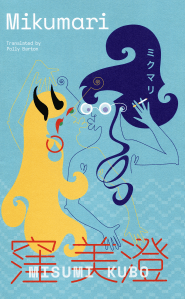
Kudos to Glen Robinson for the cover illustration and book design, because Mikumari is a really cool little chapbook. It can be ordered directly from Strangers Press, which ships internationally.

The Great Passage

Title: The Great Passage
Japanese Title: Fune o amu (船を編む)
Author: Shion Miura (三浦 しをん)
Translator: Juliet Winters Carpenter
Publication Year: 2017 (America); 2011 (Japan)
Publisher: AmazonCrossing
Pages: 217

The Great Passage is one of the kindest and most gentle books I’ve read during the past year. Despite the fact that it tells the story of a seemingly tedious enterprise, namely, the compellation of a dictionary, I found myself blazing through the novel because I had to find out whether or not the editors would manage to get their dictionary published. I then went back and read the book again so that I could take my time enjoying the quality of the writing and the translation.

The novel’s story is centered around Mitsuya Majime, a man who loves words but has trouble communicating with other people. Majime is initially placed into the Sales Department of Gembu Books, a large publisher based in Tokyo, but he flounders there like a fish out of water. His ineptitude comes to the attention of Masashi Nishioka, an extroverted and smooth-talking young man who, through a strange twist of fate, has been assigned to the Dictionary Editorial Department. Nishioka brings Majime to the attention of Kohei Araki, the editorial section chief, who immediately heads over to the Sales Department, notices Majime as soon as he steps into the room, and hires him on the spot.

By the end of the first chapter of The Great Passage, a dream team has been assembled. Majime is a philologist who is more than happy to check and double-check words and definitions, Nishioka recruits experts to write definitions for specialist words and placates the egos of grumpy professors, and Araki oversees the minutiae of editorial operations while running interference with the corporate bosses. Also on the team are Professor Matsumoto, an elderly academic who has devoted his life to the creation of a new dictionary, and Mrs. Sasaki, who is nominally an administrative assistant but pulls her weight around the office by picking up the slack of her male colleagues.

As Majime and his new coworkers deal with the mundane work and bureaucratic challenges involved in the compilation of a dictionary, a love story unfolds between Majime and a young chef named Kaguya, who lives in the same communal boarding house where Majime has rented a small room since college. Both Majime and Kaguya are shy and serious people, but they’re able to bond with each other through the auspices of Také, their chatty landlady, and Tora, the large tomcat that roams through the building at night. The couple is well-suited to one another, and their romance progresses quietly and without incident – with one major exception.

Majime, unsure of how to confess his feelings to Kaguya, decides to write her a love letter. As might be expected of the sort of person whose life’s passion is dictionary editing, his love letter is a garbled mess of rare words and convoluted literary allusions. Majime allows his extroverted colleague Nishioka to read the letter; and, although he tells Majime that the letter is perfect as it is, it causes Nishioka no small amount of amusement. It’s partially because of this ridiculous letter that Nishioka begins to feel a protective affection for Majime and resolves to do everything in his power to aid the budding dictionary editor in his goals. Later on in the story, when Nishioka is transferred to another department, he leaves a copy of the letter hidden in the dictionary editorial office so that his successor, a stylish young woman named Kishibe, will be better able to understand and appreciate Majime’s quirky but earnest personality. At the end of The Great Passage, after the main story concludes, there is a nine-page abbreviated excerpt of this letter with humorous annotations from Nishioka and Kishibe that are overflowing with silly jokes and heartfelt goodwill.

The dictionary itself, titled Daitōkai (translated as “The Great Passage”), eventually emerges as its own unique character in the story. The editorial staff regularly meets to discuss what sort of material belongs in an effective dictionary, as well as how an ideal definition should be structured. Unlike the numerous Japanese dictionaries that will have proceeded Daitōkai, Majime and his colleagues want their work to accurately reflect the concerns and interests of the people who live in contemporary Japan. To give an example…

“Dictionaries do tend to be written from the male perspective,” Professor Matsumoto said mildly. “They’re mostly put together by men, so they often lack words having to do with fashion and housework, for example. But that approach won’t work anymore. The ideal dictionary is one that everyone can join in using together, men and women of all ages, interested in all matters of life.” (34)

There is also some light discussion regarding the constructed nature of gender and sexuality implicit in certain words, and the staff ultimately takes a progressive view on many issues. They conclude, for example, that “love” need not be defined as the romantic attraction between a “man” and a “woman.” Kishibe, who initially worked in the editorial department of a women’s lifestyle magazine, is surprised to have been transferred to the staff of a dictionary, but she quickly realizes that what she considered to be common knowledge for a young professional woman serves as a valuable area of expertise to a staff largely comprised of middle-aged men. As she begins to devote herself to the project, Kishibe gains a mounting sense of appreciation for the endeavor…

Words were necessary for creation. Kishibe imagined the primordial ocean that covered the surface of the earth long ago – a soupy, swirling liquid in a state of chaos. Inside every person there was a similar ocean. Only when that ocean was struck by the lightning of words could all come into being. Love, the human heart… Words gave things form so that they could rise out of the dark sea. (164)

Special mention must also be made of the fine work of the translator, Juliet Winters Carpenter. The conversations surrounding Japanese words, their synonyms, and their cultural contexts never feel awkward or forced, and even a reader with no familiarity of Japanese language and culture will be able to enjoy the linguistic play and fine distinctions of meaning. Moreover, the oddities of Japanese corporate culture are glossed over masterfully so that the reader is able to understand the relationships and tensions between professionals without getting bogged down in a mire of titles and hierarchies and formal modes of address.

Although The Great Passage may seem like a novel that will only be of interest to a niche audience, its appeal is far more expansive. This is a book for people who love words. It’s a book for people who love reading. It’s a book for people who love translation. And, in the end, The Great Passage is a celebration of people who love books.

Oh, and also! The novel was adapted into an anime, which is available in the United States through Amazon’s streaming service.

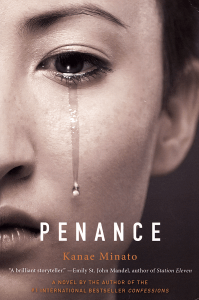
Penance

Title: Penance
Japanese Title: 贖罪 (Shokuzai)
Author: Kanae Minato (湊 かなえ)
Translator: Philip Gabriel
Publication Year: 2012 (Japan); 2017 (United States)
Publisher: Mulholland Books
Pages: 229

Fifteen years ago, in an unnamed rural town, a girl named Emily was raped and murdered. Although four of her friends saw the face of the man who tricked her into going off alone with him, he was never caught. Emily’s mother, driven half-crazy with grief, accused the four girls of being responsible for her daughter’s death, and they have all carried this burden with them into their adult lives. The statute of limitations on the murder is about to run out, yet its lingering effects have not yet faded. Is it possible that one of the surviving girls, now young women, holds a clue to solving the murder? If the murderer’s identity is revealed, will these women find peace, or is the cycle of violence impossible to halt?

The first four of Penance‘s five chapters are narrated from the perspectives of Emily’s friends, each of whom is haunted by the trauma of the incident.

The first narrator, Sae, is the girl who discovered Emily’s body, and the horror of what she saw has never been far from her mind. Of the four girls who survived, she’s been the most afraid that the killer will return, so she’s been determined to remain in the immature body of a child while keeping to herself and never dating. Not long after she’s hired by a firm in Tokyo, however, she’s presented with an offer of marriage she can’t refuse from a young man from her hometown. Although this man is too young to be the murderer, he possesses a significant and startling clue, and Sae comes to realize that he has a very good – and very creepy – reason for staying silent.

The second narrator, Maki, has become an elementary school teacher, and she’s recently found herself on national news after preventing a mentally ill young man from attacking her students. Far from being hailed as a hero, she is blamed for the young man’s death, and she does not deny that she took action to harm him. Addressing an assembly of parents, Maki explains what happened to her when she was a child, why she was able to act so quickly and decisively when threatened with violence, and why she bitterly regrets her behavior on the day that Emily died.

The third narrator, Akiko, is a precious human (I love her!) who sees herself as a “bear.” She has never moved out of her parents’ house, partially because of the trauma of Emily’s murder and partially because of outwardly imposed issues regarding her body image. “Boys have it easy,” she explains. “Even if they look like a bear they’re popular […] and being big isn’t a drawback the way it is for girls” (87). Akiko isn’t a shut-in, but she never went to high school and has since distanced herself from society. She now spends her days sleeping, helping her mother around the house, and working out. When her brother Koji gets married, she finds herself gradually being drawn out of her shell and becoming friends with her new sister-in-law’s child from a previous marriage, Wakaba. Wakaba’s mother Haruka has a dark past, however, and even the innocent and sweet-tempered Akiko senses that something isn’t quite right with the new family. She ends up becoming involved in their drama by accident, and disastrous consequences ensue.

The fourth narrator, Yuka, has lived her life in the shadow of her older sister, who was diagnosed with asthma at a young age. The older sister was doted on by their mother, while Yuka became the scapegoat for her mother’s frustrations. After Yuka indirectly witnessed Emily’s death, her mother began to alienate her even more, and Yuka has grown up feeling that she should have been the girl who died. Nevertheless, she has managed to achieve a modest amount of success in her life, but her resentment toward her sister has inspired her to enact a complicated plan of revenge. This brings her to the attention of the murderer, as well as Emily’s mother, who knows far more about why her daughter was killed than she has ever revealed to anyone.

The fifth narrator should perhaps remain a mystery for readers to discover for themselves. It seems as if this person will be able tie everything together… but then she doesn’t, not at all.

Penance had me enthralled from beginning to end. Although the story contains many mysteries, the identity of the murderer begins to feel irrelevant and inconsequential as the deeper tragedies of the narrators’ lives slowly unfold. The novel is are firmly grounded in contemporary Japanese society, but the characters’ anxieties are universally relatable. Penance has a lot to say about what it feels like to be an outsider, and what it feels like to live in fear of physical and social violence, and what it feels like to have difficulty communicating with the people who are close to you.

Penance is not a novel about vulnerability, however; it’s a story of resilience. It’s also a story about a group of women who learn where their breaking points lie and then purposefully put themselves into situations that trigger them to take action. By the end of the book, the narrators share more than one murder, and the loose conspiracy that arises between them is a beautiful development fashioned from intricate plot details. The strength of Kanae Minato’s writing is in her compassionate portrayal of her psychologically damaged yet intensely sympathetic characters, but that doesn’t get in her way of creating a compelling and suspenseful mystery in this brilliant literary thriller.

Ms Ice Sandwich

Title: Ms Ice Sandwich
Japanese Title: ミス・アイスサンドイッチ (Misu Aisu Sandoicchi)
Author: Mieko Kawakami (川上 未映子)
Translator: Louise Heal Kawai
Publication Year: 2013 (Japan); 2017 (United Kingdom)
Publisher: Pushkin Press
Pages: 92

Ms Ice Sandwich is a novella that gradually opens a door into the interior world of its protagonist, a boy living with his mother and grandmother in a commuter suburb. This boy is fascinated by a woman who sells sandwiches at the grocery store outside the train station, whom he calls “Ms Ice Sandwich” because of the ice-blue eyeshadow she always wears. Her makeup emphasizes her eyes, which she has had surgically altered to appear larger. The narrator, who is a strange little kid, becomes preoccupied with trying to capture Ms Ice Sandwich in art, obsessively drawing her facial features line by line and eyelash by eyelash.

The boy also gravitates toward Tutti, a girl in his class who was given this nickname (by the narrator himself, no less) after she once farted in class. Like the boy, Tutti is a bit strange, and she’s obsessed with gunfights. The boy learns that she lives alone with her father, who has filled their apartment with shelves of DVDs and makes time to sit down and watch a movie with her every week. Tutti’s love of gunfights stems from her interest in cinematic choreography, and the boy appreciates her ability to mimic calmness in the face of danger in the same way that he’s awed by the no-nonsense attitude of Ms Ice Sandwich in the face of customer rudeness.

Meanwhile, the boy’s mother is a weird one herself. Although the boy isn’t entirely sure what she does, she seems to be a self-employed spiritualist and fortune teller, and she’s recently had part of their house remodeled to resemble a caricature of a Western palace complete with a red carpet, foreign furniture, heavy curtains, and statues of angels. While the boy’s grandmother is bedridden in the back of the house, his mother spends an inordinate amount of time online, typing on her phone even when she’s out shopping. Like Tutti and Ms Ice Sandwich, however, the boy’s mother isn’t actually a bad person, and she loves her son in her own way.

The boy is perhaps ten or eleven years old, and Kawakami’s first-person narration skillfully captures his close attention to small and seemingly insignificant details, which are contrasted against a larger cluelessness concerning how the world works. The narrator doesn’t really know what’s going on with his mom, or his grandmother, or Tutti’s dad, or even Ms Ice Sandwich, but he nevertheless observes them with care and compassion. He is content to observe the movements of the people in his life until Tutti startles him out of his passivity, saying,

“When you say see you tomorrow to someone, it’s because you’re going to keep seeing them. It’s like at school you see everybody because they go to school every day. But when you graduate and you don’t go to school anymore, it stops and you don’t see everybody any more. If you want to see somebody, you have to make plans to meet, or even make plans to make plans, and next thing you end up not seeing them any more. That’s what’s going to happen. If you don’t see somebody, you end up never seeing them. And then there’s going to be nothing left of them at all.” (75)

Ms Ice Sandwich has no real plot or denouement, but Tutti’s words spark a small but significant shift in the narrator’s worldview that allows him to more fully appreciate the fact that his mother, his grandmother, and Ms Ice Sandwich all have lives that exist independently of his presence. Judging from the cover copy it might seem as if this is a novella about a boy’s sexual awakening, but the story actually hinges on a far more subtle emotional revelation. Thankfully, the narrator’s perspective is so singular and well-crafted that Ms Ice Sandwich‘s message about the ephemerality of human connection is never in any danger of becoming trite and sentimental.

According to the colophon, “This piece was published in the literary journal Shincho first in 2013, and in 2014 it was included in the novel Akogare, which is a combination of two stories: ‘Miss Ice Sandwich’ and ‘Strawberry Jam Minus Strawberry.'” At roughly ninety pages, Ms Ice Sandwich is short enough to read in one sitting, but it’s still substantial enough to feel like a self-contained world. I thoroughly enjoyed this story, and I’m impressed by the fantastic work that Pushkin Press has put into its ongoing series of translations of quirky Japanese novellas.

Heaven’s Wind

Title: Heaven’s Wind: A Dual-Language Anthology of Contemporary Japanese Writing
Editor and Translator: Angus Turvill
Publication Year: 2018
Publisher: The Japan Society
Pages: 200

Heaven’s Wind is a collection of five Japanese short stories published in parallel text, with the original Japanese on the left and the English translation on the right. Each of the stories selected by the editor and translator, Angus Turvill, has won an award in a translation competition, and the authors have all been critically recognized as well. Some of these stories are mimetic fiction, while others fall squarely into the mode of magical realism. The thread that ties these stories together is that each of them presents multiple case studies in the methods and challenges of Japanese-to-English translation.

The stories in Heaven’s Wind are followed by a 23-page essay in which Turvill identifies ten key areas where differences commonly arise between a Japanese text and its English translation. Without resorting to theory or philosophical abstractions, Turvill provides concrete examples from the preceding stories, which are explained in simple and commonsense terms. To given an example, whereas the tense of verbs can shift from sentence to sentence in Japanese, in English it usually makes more sense to pick one tense (often the past tense) and stick with it. Whether you agree or disagree with Turvill’s decisions, it’s easy to understand exactly why he’s made them. If you’re an aspiring translator, you’ll more than likely find this list of strategies to be immediately applicable to your own work. Even if you have no knowledge of Japanese, however, Turvill’s concise guide is a fascinating examination of some the nuts and bolts of how language operates in translation.

The stories themselves are fascinating as well. Kuniko Mukoda’s “The Otter” (1980) is about a man whose playful and charming wife doesn’t quite have his best interests at heart. Natsuko Kuroda’s “Ball” (1963) is about a young girl who steals a handball and, by doing so, opens her heart to the darkness of deceit. Kaori Ekuni’s “Summer Blanket” (2002) is about an heiress who is happy to live alone by the ocean until she is befriended by two beach bum college students. Each story offers an intimate portrait of human psychology that is firmly grounded in the rich details of its setting.

Mitsuyo Kakuta’s “The Child Over There” (2011) is a surreal story of a newlywed mother who recently lost a child to a miscarriage. She has moved to the village of her husband’s family, who tell her stories about a child-eating demon that inhabits a house she’s warned to stay away from. Even though she becomes pregnant again, she continues to visit the grave of the daughter she lost, who still visits her in dreams. One day she happens to overhear a rumor about Kukedo, the place where lost children go. Kukedo turns out to be an actual place, so the woman takes train there on a journey that is both mundane and deeply strange. Although she never fully comes to terms with the relationship between the demon and her miscarriage, the young woman is able to achieve something of a catharsis when she joins her daughter “over there.”

The last story in the collection, Aoko Matsuda’s “Planting” (2012), is an anthem to millennial disillusionment. A young woman who calls herself “Marguerite” is looking for the perfect job, ideally one that doesn’t require her to interact with other human beings. She eventually manages to find a position where boxes containing various materials are delivered to her apartment. She pleats whatever the box contains, repacks it, and then exchanges it for the next box. Some of these boxes contain loose fabric and pre-sewn garments, while others contain more disturbing contents, such as garbage, dead animals, and disembodied clumps of hair. Marguerite feels tired all the time, and she doesn’t understand the purpose of anything she does, but she has resolved to take all the negative feelings in her heart and plant them in the dirt outside, hoping that they will eventually grow into something beautiful.

Heaven’s Wind reminds me of the collections of contemporary Japanese literary fiction that used to be published a decade or two ago. The stories included in these collections were often edgy and avant-garde, and it wasn’t uncommon for their editors to focus on female authors. I’ve missed these short story collections, and Heaven’s Wind is a welcome contribution to the body of Japanese fiction available in English, regardless of whether you happen to be interested in its emphasis on the craft of translation. Because furigana pronunciation glosses are included in the Japanese text, it would be practical and easy to use Heaven’s Wind as a textbook for a translation seminar or as a guide to self-study. You can order a copy on the Japan Society online store or at Waterstones.

A review copy of Heaven’s Wind was kindly provided by The Japan Society.

your name.

Content warning: discussion of body swapping, gender dysmorphia, and social dysmorphia

Title: your name.
Japanese Title: 君の名は。(Kimi no na wa.)
Author: Makoto Shinkai (新海誠)
Translator: Taylor Engel
Publication Year: 2016 (Japan); 2017 (United States)
Publisher: Yen Press
Pages: 192

This guest review is written by L.M. Zoller (@odorunara on Twitter).

your name. is a novelization of director Makoto Shinkai’s your name., an animated film that tells the story of Mitsuha, a high school girl from rural Gifu prefecture who wishes she could be a boy in Tokyo in her next life. After an incredibly vivid dream in which she wakes up as Taki, a high school boy living in downtown Tokyo, she discovers it’s not a dream at all – and Taki is also switching bodies with her. As the two teenagers try to navigate each other’s lives and relationships, only able to communicate with each other by writing notes in each other’s cell phones when they switch, they begin to unravel a mystery involving Mitsuha’s town.

First, a note about the style of the book: the film was not created for an unfinished book series, nor was it a post-release novelization. Rather, the novel was written in the late stages of the film’s production but released before the film debuted in Japan. In his afterword, Shinkai writes,

In other words, it’s a novelization of the movie, but actually, as I’m writing this afterword, the movie hasn’t been finished yet. They tell me it will take another three months or so to complete. That means the novel will go out into the world first, so if you asked me which is the original work, the movie or the novel, I’d have to say, “It’s complicated.” (Kindle location 2177)

As a result, the novel doesn’t have to backfill the character’s internal monologue, nor does the film have to focus on getting the characters’ internal dialogue to come across visually; both works fill in gaps in the other.

The film’s biggest strength is, by and large, bringing the imagery and emotions of the characters to life. In a film, narrative exposition can get in the way of acting and using visual cues to explain emotions of the characters. While the movie is heavily visual and expresses the subtlety of its characters’ emotions by showing instead of telling, the novel (as well as the translation) gets off to a rough start because the writing style is overly descriptive in light novel/YA novel fashion. Shinkai’s attempts to describe physical reactions and facial expressions while simultaneously describing the characters’ underlying emotions sometimes make the opening chapters seem clunky. However, the novella really hits its stride after the third chapter. With the difficulty of the exposition out of the way and the setting and characters established, Shinkai’s writing shines and the pace picks up.

What I really love about the book, in addition to the mystery of why Taki and Mitsuha start and stop switching bodies, is how both characters come to experience themselves differently because of swapping bodies. Mitsuha gets to explore her sexuality – she, not Taki, is the one that sets up the date with his coworker Okudera-senpai in the hopes that she herself will get to go on it as Taki. This is a contrast to a common plot line in body-swap fiction: that one of the two swapped people has a date and is scared of being expected to kiss or have sex with the other person’s partner for a variety of reasons, chiefly the consent of all three parties.

Another body-swap trope that Shinkai averts is that Taki doesn’t learn to be more emotional just by being in Mitsuha’s body. Instead, he learns from her actions, especially how she treats Okudera-senpai while in his body. Eventually, he says, he’s given up on pretending to be her and just acts like himself when he’s in her body, though he notices that he has her memories and that he experiences emotional and visceral reactions to people in her life, such as feeling comforted by seeing her grandmother and friends and angry when meeting her father.

The book also deals with a number of existential questions. For example, what is consciousness and how tied to ones body is it? Does the spirit live on apart from the body? Related, but not explicitly spelled out, is to what degree sexuality and gender identity are consciousness or a physical body. As a queer nonbinary person who experiences social dysphoria (being read as the wrong gender in social contexts) but not usually body dysmorphia (the feeling that something about your body is wrong), the book and film versions of your name. raised a lot of questions for me. Would I experience body dysmorphia if my body looked differently than it does? Would I experience body dysmorphia if I woke up in someone else’s body? Would I experience social dysphoria to be called by the wrong pronouns but not the ones I was assigned at birth? Would it matter if the other person were built similarly to me or if they had a very different body shape? If I were in a binary person’s body, would it be weird to be called by the wrong pronouns? For cisgender people, who have the luxury of knowing their own gender and rarely have their gender questioned, would swapping bodies seem awkward but not dysmorphic or dysphoric?

Moreover, Taki and Mitsuha are two thin, conventionally attractive, and able-bodied cisgender teenagers. How would the narrative vary if one of them had a disability, or if one were trans or openly queer, or much younger or older? (For example, what if Taki and Mitsuha’s grandmother switched places?) your name. doesn’t answer Taki’s questions about memory or mine about gender, but the gentle manner in which it raises these questions is less of an existential crisis and more of a catalyst for self-reflection.

Along with the human characters, Mitsuha’s hometown Itomori is practically a character itself. Itomori is based on the city of Hida in Gifu prefecture, which is one of my favorite vacation spots. The descriptions of the town in the book and the visualization of the town in the film are vivid and gorgeously rendered, taking me right back to traveling to Hida-Takayama in the fall. While Mitsuha hates Itomori and dreams of moving to Tokyo, Shinkai avoids both painting rural Japan as either superior or inferior to urban Japan. Mitsuha’s complaints are ones many young people have: there are not many jobs, there are no cafes or places to hang out, and everyone knows your business, especially when your family is heavily involved in town politics (her estranged father is the mayor) and religious life (she and her sister are shrine maidens at her grandmother’s family shrine). However, there is merit in the traditions of the town, which preserve not just history for history’s sake, but important cultural and historical information.

Mitsuha’s grandmother, who is the head of the town shrine, repeatedly tells Mitsuha and her younger sister Yotsuha that the meaning underlying the shrine dances, braided cords, and festival rituals were lost when the original shrine and all its old records were destroyed in a fire two hundred years ago. What Taki realizes when he drinks ritual sake at a sacred location deeper in the mountains is that the braided cords and dances all told the story of how a meteorite created the crater lake in Itomori and destroyed the town a thousand years ago. With the records gone, the rituals survived without meaning, and this lacuna between history and folklore becomes crucial to the plot of Mitsuha and Taki’s story. As Shinkai’s focus expands beyond the two teenagers out into the larger environment they inhabit, I thought about not just the local dances of the places I had lived in and visited but also the tsunami markers on Aneyoshi.

your name., while not perfect, is an easy fantasy read that deals with open-ended questions of gender, memory, and rural depopulation. If possible, I recommend reading the novel as well as watching the movie, as Shinkai’s prose exploration of Mitsuha and Taki’s interiority complements and deepens the impact of the gorgeous artistry of his film.


L.M. Zoller is a nonbinary writer and former JET CIR with an MA in Japan Studies. All zir favorite manga and anime seem to involve gender fluidity and sword fighting. Ze blogs about media and gender at The Lobster Dance (@odorunara) and food, sexuality, and gender at I’ll Make It Myself! (@illmakeitmyself).

Apparitions

Title: Apparitions: Ghosts of Old Edo
Author: Miyuki Miyabe (宮部 みゆき)
Translator: Daniel Huddleston
Publication Year: 2000 (Japan); 2013 (United States)
Publisher: Haikasoru
Pages: 265

Apparitions: Ghosts of Old Edo is a collection of nine supernatural stories set in the Edo period (1603-1868), a historical era of relative peace that preceded Japan’s modernization. The author, Miyuki Miyabe, is known outside of Japan for her fantasy and suspense novels, but she also writes historical fiction informed by her love of the city of Tokyo.

Apparitions is a difficult book to break into, especially for someone who doesn’t have a great deal of background knowledge about Japan. Although the six-page thematic introductory essay by Masao Higashi situates Miyabe’s historical fiction within the tradition of Western horror, each of the stories in this collection is thoroughly suffused with what might be termed Japanese cultural odor. While this is far from a bad thing, the jumble of geographic and personal names that Miyabe employs to add color to her stories won’t carry the same narrative weight for most readers of this translation as it would for someone more familiar with the cultural and historical context she references.

The opening story, “A Drowsing Dream of Shinjū,” provides a good example of how these references work to create a sense of atmosphere – or, for many readers, may simply be strange and confusing. After the end of the Kyōhō era, in the fourth year of Bunka, a boy named Ginji is “sent off to work at a cotton wholesaler called the Daikoku’ya, in Tōri Setomono-chō” by an older man at the Mannen’ya, an employment agency “located in Ōdenma-chō Block 1” that places apprentices in the wholesale businesses “that dotted the way from Ōdenma-chō and the surrounding area on through Muromachi, Takara-chō, Suruga-chō, and Nihonbashitōri-chō” (18). Miyabe uses the names of these emperor reigns, businesses, and neighborhoods as a shorthand to create a sense of time and place. Unfortunately for those of us not already well versed in Edo-period historical fiction, this type of highly specific allusion is largely unaccompanied by any sort of explanation. As a result, to someone who isn’t a specialist in the Edo period, the stories in Apparitions can seem rather dry.

Even the broader cultural allusions that Miyabe uses to add flavor to her stories are only mentioned in passing without any sort of elaboration. To return to “A Drowsing Dream of Shinjū,” the premise of the story is that the fourteen-year-old protagonist Ginji is employed by Tōichirō, the son of the prosperous cotton wholesale business Daikoku’ya, to run errands, some of which involve carrying messages to Tōichirō’s various girlfriends. Meanwhile, the 21-year-old Tōichirō wants his family’s business to start selling tea towels printed with monogatari moyō, or scenes from literary romances such as The Tale of Genji. His father tells him that this is a bad idea, as such items have come to be associated with real-world cases of shinjū, or double suicide, in which several pairs of lovers tied their hands together with these towels so that they would have a greater likelihood of drowning when they jumped into a river.

One thing leads to another, and when Tōichirō gets married he moves his mistress O-Haru to the neighborhood of Ōshima-mura, which “was on the other side of the Ōkawa River, on past Fukagawa” (34). On being sent to O-haru’s villa one afternoon, Ginji arrives to find it empty, and as he dozes off in the foyer he dreams that he sees the lifeless bodies of Tōichirō and O-haru deeper inside the house, their wrists bound with a monogatari moyō tea towel.

To anyone familiar with Japanese drama, “A Drowsing Dream of Shinjū” is redolent of numerous other stories involving the ghosts of star-crossed lovers appearing in forgotten and out-of-the-way places. It’s precisely because Miyabe is confident in her reader’s familiarity with such ghost stories in the Noh, Bunraku, and Kabuki theatrical traditions, however, that she doesn’t go out of her way to deepen the eerie atmosphere by means of other literary devices. Perhaps a Western equivalent of this might be naming a character Horatio and thereby expecting the reader to associate him with chilly Scandinavian sea winds and dead princes without otherwise supplying the character with any personality traits. Unfortunately, Miybe’s allusions may pass entirely over the heads of unfamiliar readers.

Although two or three of the stories in Apparitions are strong enough to stand on their own, the book isn’t so much a collection of accounts of individual people and the ghosts they leave behind as it is a cumulatively growing narrative about the city of Edo itself. If the reader can tough out an initial sense of disorientation, however, the geography of the city and the character of its people gradually begin to take shape with each successive story.

That being said, the strongest pieces in the collection need no contextualization. In my favorite story, “The Oni in the Autumn Rain,” an older woman speaks to a younger woman and offers sound and canny advice that transcends time and place. Moreover, the cleverness of the surprise ending to the story, in which it is revealed that the circumstances of this conversation are not what they seemed, needs no cultural background knowledge to be appreciated.

I use another of the more accessible stories in the collection, “Cage of Shadows,” as one of the readings in my “Tokyo Stories in Japanese Fiction” seminar. “Cage of Shadows” serves as an excellent starting point for a discussion of Edo period fiction, as it evokes the themes and tone of popular stories from the eighteenth century while still employing conventions relating to psychologically astute characterization and linear plot progression that contemporary readers have come to take for granted. As an added bonus, the imagery of the story is deliciously grotesque, and the way it ends is downright creepy.

Overall, it’s difficult to recommend Apparitions to a casual thrill seeker; but, for a patient reader, allowing the stories enough time to build a gradual atmosphere of strangeness at the margins of human activity is akin to watching twilight deepen into darkness as an evening fog rises from the ground. Many readers may find themselves lost in the maze of foreign words and names; but, if you’re interested in Japanese ghost stories and looking for a nice collection of original and historically grounded horror fiction with lovely Gothic undertones, then Miyuki Miyabe has summoned a delightfully eerie group of ghosts.

The Nakano Thrift Shop

Title: The Nakano Thrift Shop
Japanese Title: 古道具 中野商店 (Furudōgu Nakano Shoten)
Author: Kawakami Hiromi (川上 弘美)
Translator: Allison Markin Powell
Publication Year: 2017 (United Kingdom); 2005 (Japan)
Publisher: Portobello Books
Pages: 260

Hitomi works at the Nakano Thrift Shop, which is run by a middle-aged man named, unsurprisingly, Mr. Nakano. While she watches the store and works the till, a young man around her age, Takeo, accompanies Mr. Nakano on buying trips. The trio is occasionally visited by Mr. Nakano’s sister Masayo, an artist of independent means. The twelve loosely connected stories in The Nakano Thrift Shop are about the strange and silly things that happen to this odd group of characters, whose small dramas for the most part seem to exist outside of the specifics of time and place.

Hitomi is short-tempered and cagey, Takeo is passive and uncommunicative, and Masayo is chatty and expansive, but it is the stubborn and befuddled Mr. Nakano whose mishaps and shenanigans serve as the focal point or punchline of each story. In the second story, “Paperweight,” Mr. Nakano bribes Hitomi to go visit Masayo and get gossip about her new lover, which sparks a friendship between the two women. In the third story, “Bus,” Mr. Nakano travels to Hokkaido on a buying trip and becomes involved in a one-sided love affair, amusing Hitomi with the messages he sends back to the shop. In other stories, an unusual customer provides a break from the store’s daily routine. For example, in the ninth story, “Bowl,” a young man tries to get rid of a valuable antique bowl, which he believes has been cursed by an ex-girlfriend. The Nakano Thrift Shop is more of a downmarket store, so Masayo forces Mr. Nakano to pass the bowl over to a specialist ceramics dealer with whom he happens to be in the process of breaking off a romantic relationship.

Over the course of the book, Hitomi enters into a romantic relationship of her own with Takeo. This romance never makes much progress, however, as Hitomi demands action and attention while Takeo doesn’t like talking on the phone and is content simply to allow life to happen to him. Like everything in The Nakano Thrift Shop, their relationship is lowkey and laidback, and it ebbs and flows without any sort of drama.

For the reader, the pleasure of these stories lies in peeking into the lives of these characters as they drift through the changing seasons while comfortable in the stability of their friendships. Even though unusual things occasionally happen, no one is ever strongly affected by these events. For instance, in the first story, “Rectangular #2,” an odd man named Takadokoro comes into the store to sell artistic nude photos. Masayo tells Hitomi that the pictures are of Takadoroko’s former student. Takadokoro has the potential to be a truly creepy (or pathetic) character, but the warm narrative tone of The Nakano Thrift Shop treats him as just another person in the neighborhood. He doesn’t bother anyone, and no one is bothered by him. After all, everyone is a little weird once you get to know them.

In the final story, “Punch Ball,” the Nakano shop has closed, and the characters have all gone their separate ways. Hitomi takes various office jobs as a temp worker while she studies for her bookkeeping certification exam. Her current distance from the carefree atmosphere that suffused the earlier stories puts them into perspective, and her former freedom from the pressures of the corporate world now seems much more meaningful. Now that she spends her days sitting at a desk in front of a computer, social interactions are no longer improvised and unique, and friendships are no longer so easily formed. There’s a playful innocence to Hitomi’s time in the Nakano shop that only becomes apparent in retrospect.

The Nakano Thrift Shop is a short and pleasant book that will appeal to anyone who enjoyed The Briefcase (which was published as Strange Weather in Tokyo in the UK). Although it’s a wide leap removed from the darker themes and imagery of some of Kawakami’s other work that has appeared in translation, it’s mercifully free of the sentimentality and melodrama of Yoshimoto Banana novels. As Hitomi seems to be in her mid to late twenties, it’s up for debate whether The Nakano Thrift Shop can be classified as “girls’ literature” (shōjo shōsetsu), but reading these stories conveys a vicarious sense of what it feels like to be a young woman chilling out and having fun in a trendy Tokyo suburb.