Ms Ice Sandwich

Title: Ms Ice Sandwich
Japanese Title: ミス・アイスサンドイッチ (Misu Aisu Sandoicchi)
Author: Mieko Kawakami (川上 未映子)
Translator: Louise Heal Kawai
Publication Year: 2013 (Japan); 2017 (United Kingdom)
Publisher: Pushkin Press
Pages: 92

Ms Ice Sandwich is a novella that gradually opens a door into the interior world of its protagonist, a boy living with his mother and grandmother in a commuter suburb. This boy is fascinated by a woman who sells sandwiches at the grocery store outside the train station, whom he calls “Ms Ice Sandwich” because of the ice-blue eyeshadow she always wears. Her makeup emphasizes her eyes, which she has had surgically altered to appear larger. The narrator, who is a strange little kid, becomes preoccupied with trying to capture Ms Ice Sandwich in art, obsessively drawing her facial features line by line and eyelash by eyelash.

The boy also gravitates toward Tutti, a girl in his class who was given this nickname (by the narrator himself, no less) after she once farted in class. Like the boy, Tutti is a bit strange, and she’s obsessed with gunfights. The boy learns that she lives alone with her father, who has filled their apartment with shelves of DVDs and makes time to sit down and watch a movie with her every week. Tutti’s love of gunfights stems from her interest in cinematic choreography, and the boy appreciates her ability to mimic calmness in the face of danger in the same way that he’s awed by the no-nonsense attitude of Ms Ice Sandwich in the face of customer rudeness.

Meanwhile, the boy’s mother is a weird one herself. Although the boy isn’t entirely sure what she does, she seems to be a self-employed spiritualist and fortune teller, and she’s recently had part of their house remodeled to resemble a caricature of a Western palace complete with a red carpet, foreign furniture, heavy curtains, and statues of angels. While the boy’s grandmother is bedridden in the back of the house, his mother spends an inordinate amount of time online, typing on her phone even when she’s out shopping. Like Tutti and Ms Ice Sandwich, however, the boy’s mother isn’t actually a bad person, and she loves her son in her own way.

The boy is perhaps ten or eleven years old, and Kawakami’s first-person narration skillfully captures his close attention to small and seemingly insignificant details, which are contrasted against a larger cluelessness concerning how the world works. The narrator doesn’t really know what’s going on with his mom, or his grandmother, or Tutti’s dad, or even Ms Ice Sandwich, but he nevertheless observes them with care and compassion. He is content to observe the movements of the people in his life until Tutti startles him out of his passivity, saying,

“When you say see you tomorrow to someone, it’s because you’re going to keep seeing them. It’s like at school you see everybody because they go to school every day. But when you graduate and you don’t go to school anymore, it stops and you don’t see everybody any more. If you want to see somebody, you have to make plans to meet, or even make plans to make plans, and next thing you end up not seeing them any more. That’s what’s going to happen. If you don’t see somebody, you end up never seeing them. And then there’s going to be nothing left of them at all.” (75)

Ms Ice Sandwich has no real plot or denouement, but Tutti’s words spark a small but significant shift in the narrator’s worldview that allows him to more fully appreciate the fact that his mother, his grandmother, and Ms Ice Sandwich all have lives that exist independently of his presence. Judging from the cover copy it might seem as if this is a novella about a boy’s sexual awakening, but the story actually hinges on a far more subtle emotional revelation. Thankfully, the narrator’s perspective is so singular and well-crafted that Ms Ice Sandwich‘s message about the ephemerality of human connection is never in any danger of becoming trite and sentimental.

According to the colophon, “This piece was published in the literary journal Shincho first in 2013, and in 2014 it was included in the novel Akogare, which is a combination of two stories: ‘Miss Ice Sandwich’ and ‘Strawberry Jam Minus Strawberry.'” At roughly ninety pages, Ms Ice Sandwich is short enough to read in one sitting, but it’s still substantial enough to feel like a self-contained world. I thoroughly enjoyed this story, and I’m impressed by the fantastic work that Pushkin Press has put into its ongoing series of translations of quirky Japanese novellas.

Heaven’s Wind

Title: Heaven’s Wind: A Dual-Language Anthology of Contemporary Japanese Writing
Editor and Translator: Angus Turvill
Publication Year: 2018
Publisher: The Japan Society
Pages: 200

Heaven’s Wind is a collection of five Japanese short stories published in parallel text, with the original Japanese on the left and the English translation on the right. Each of the stories selected by the editor and translator, Angus Turvill, has won an award in a translation competition, and the authors have all been critically recognized as well. Some of these stories are mimetic fiction, while others fall squarely into the mode of magical realism. The thread that ties these stories together is that each of them presents multiple case studies in the methods and challenges of Japanese-to-English translation.

The stories in Heaven’s Wind are followed by a 23-page essay in which Turvill identifies ten key areas where differences commonly arise between a Japanese text and its English translation. Without resorting to theory or philosophical abstractions, Turvill provides concrete examples from the preceding stories, which are explained in simple and commonsense terms. To given an example, whereas the tense of verbs can shift from sentence to sentence in Japanese, in English it usually makes more sense to pick one tense (often the past tense) and stick with it. Whether you agree or disagree with Turvill’s decisions, it’s easy to understand exactly why he’s made them. If you’re an aspiring translator, you’ll more than likely find this list of strategies to be immediately applicable to your own work. Even if you have no knowledge of Japanese, however, Turvill’s concise guide is a fascinating examination of some the nuts and bolts of how language operates in translation.

The stories themselves are fascinating as well. Kuniko Mukoda’s “The Otter” (1980) is about a man whose playful and charming wife doesn’t quite have his best interests at heart. Natsuko Kuroda’s “Ball” (1963) is about a young girl who steals a handball and, by doing so, opens her heart to the darkness of deceit. Kaori Ekuni’s “Summer Blanket” (2002) is about an heiress who is happy to live alone by the ocean until she is befriended by two beach bum college students. Each story offers an intimate portrait of human psychology that is firmly grounded in the rich details of its setting.

Mitsuyo Kakuta’s “The Child Over There” (2011) is a surreal story of a newlywed mother who recently lost a child to a miscarriage. She has moved to the village of her husband’s family, who tell her stories about a child-eating demon that inhabits a house she’s warned to stay away from. Even though she becomes pregnant again, she continues to visit the grave of the daughter she lost, who still visits her in dreams. One day she happens to overhear a rumor about Kukedo, the place where lost children go. Kukedo turns out to be an actual place, so the woman takes train there on a journey that is both mundane and deeply strange. Although she never fully comes to terms with the relationship between the demon and her miscarriage, the young woman is able to achieve something of a catharsis when she joins her daughter “over there.”

The last story in the collection, Aoko Matsuda’s “Planting” (2012), is an anthem to millennial disillusionment. A young woman who calls herself “Marguerite” is looking for the perfect job, ideally one that doesn’t require her to interact with other human beings. She eventually manages to find a position where boxes containing various materials are delivered to her apartment. She pleats whatever the box contains, repacks it, and then exchanges it for the next box. Some of these boxes contain loose fabric and pre-sewn garments, while others contain more disturbing contents, such as garbage, dead animals, and disembodied clumps of hair. Marguerite feels tired all the time, and she doesn’t understand the purpose of anything she does, but she has resolved to take all the negative feelings in her heart and plant them in the dirt outside, hoping that they will eventually grow into something beautiful.

Heaven’s Wind reminds me of the collections of contemporary Japanese literary fiction that used to be published a decade or two ago. The stories included in these collections were often edgy and avant-garde, and it wasn’t uncommon for their editors to focus on female authors. I’ve missed these short story collections, and Heaven’s Wind is a welcome contribution to the body of Japanese fiction available in English, regardless of whether you happen to be interested in its emphasis on the craft of translation. Because furigana pronunciation glosses are included in the Japanese text, it would be practical and easy to use Heaven’s Wind as a textbook for a translation seminar or as a guide to self-study. You can order a copy on the Japan Society online store or at Waterstones.

A review copy of Heaven’s Wind was kindly provided by The Japan Society.

your name.

Content warning: discussion of body swapping, gender dysmorphia, and social dysmorphia

Title: your name.
Japanese Title: 君の名は。(Kimi no na wa.)
Author: Makoto Shinkai (新海誠)
Translator: Taylor Engel
Publication Year: 2016 (Japan); 2017 (United States)
Publisher: Yen Press
Pages: 192

This guest review is written by L.M. Zoller (@odorunara on Twitter).

your name. is a novelization of director Makoto Shinkai’s your name., an animated film that tells the story of Mitsuha, a high school girl from rural Gifu prefecture who wishes she could be a boy in Tokyo in her next life. After an incredibly vivid dream in which she wakes up as Taki, a high school boy living in downtown Tokyo, she discovers it’s not a dream at all – and Taki is also switching bodies with her. As the two teenagers try to navigate each other’s lives and relationships, only able to communicate with each other by writing notes in each other’s cell phones when they switch, they begin to unravel a mystery involving Mitsuha’s town.

First, a note about the style of the book: the film was not created for an unfinished book series, nor was it a post-release novelization. Rather, the novel was written in the late stages of the film’s production but released before the film debuted in Japan. In his afterword, Shinkai writes,

In other words, it’s a novelization of the movie, but actually, as I’m writing this afterword, the movie hasn’t been finished yet. They tell me it will take another three months or so to complete. That means the novel will go out into the world first, so if you asked me which is the original work, the movie or the novel, I’d have to say, “It’s complicated.” (Kindle location 2177)

As a result, the novel doesn’t have to backfill the character’s internal monologue, nor does the film have to focus on getting the characters’ internal dialogue to come across visually; both works fill in gaps in the other.

The film’s biggest strength is, by and large, bringing the imagery and emotions of the characters to life. In a film, narrative exposition can get in the way of acting and using visual cues to explain emotions of the characters. While the movie is heavily visual and expresses the subtlety of its characters’ emotions by showing instead of telling, the novel (as well as the translation) gets off to a rough start because the writing style is overly descriptive in light novel/YA novel fashion. Shinkai’s attempts to describe physical reactions and facial expressions while simultaneously describing the characters’ underlying emotions sometimes make the opening chapters seem clunky. However, the novella really hits its stride after the third chapter. With the difficulty of the exposition out of the way and the setting and characters established, Shinkai’s writing shines and the pace picks up.

What I really love about the book, in addition to the mystery of why Taki and Mitsuha start and stop switching bodies, is how both characters come to experience themselves differently because of swapping bodies. Mitsuha gets to explore her sexuality – she, not Taki, is the one that sets up the date with his coworker Okudera-senpai in the hopes that she herself will get to go on it as Taki. This is a contrast to a common plot line in body-swap fiction: that one of the two swapped people has a date and is scared of being expected to kiss or have sex with the other person’s partner for a variety of reasons, chiefly the consent of all three parties.

Another body-swap trope that Shinkai averts is that Taki doesn’t learn to be more emotional just by being in Mitsuha’s body. Instead, he learns from her actions, especially how she treats Okudera-senpai while in his body. Eventually, he says, he’s given up on pretending to be her and just acts like himself when he’s in her body, though he notices that he has her memories and that he experiences emotional and visceral reactions to people in her life, such as feeling comforted by seeing her grandmother and friends and angry when meeting her father.

The book also deals with a number of existential questions. For example, what is consciousness and how tied to ones body is it? Does the spirit live on apart from the body? Related, but not explicitly spelled out, is to what degree sexuality and gender identity are consciousness or a physical body. As a queer nonbinary person who experiences social dysphoria (being read as the wrong gender in social contexts) but not usually body dysmorphia (the feeling that something about your body is wrong), the book and film versions of your name. raised a lot of questions for me. Would I experience body dysmorphia if my body looked differently than it does? Would I experience body dysmorphia if I woke up in someone else’s body? Would I experience social dysphoria to be called by the wrong pronouns but not the ones I was assigned at birth? Would it matter if the other person were built similarly to me or if they had a very different body shape? If I were in a binary person’s body, would it be weird to be called by the wrong pronouns? For cisgender people, who have the luxury of knowing their own gender and rarely have their gender questioned, would swapping bodies seem awkward but not dysmorphic or dysphoric?

Moreover, Taki and Mitsuha are two thin, conventionally attractive, and able-bodied cisgender teenagers. How would the narrative vary if one of them had a disability, or if one were trans or openly queer, or much younger or older? (For example, what if Taki and Mitsuha’s grandmother switched places?) your name. doesn’t answer Taki’s questions about memory or mine about gender, but the gentle manner in which it raises these questions is less of an existential crisis and more of a catalyst for self-reflection.

Along with the human characters, Mitsuha’s hometown Itomori is practically a character itself. Itomori is based on the city of Hida in Gifu prefecture, which is one of my favorite vacation spots. The descriptions of the town in the book and the visualization of the town in the film are vivid and gorgeously rendered, taking me right back to traveling to Hida-Takayama in the fall. While Mitsuha hates Itomori and dreams of moving to Tokyo, Shinkai avoids both painting rural Japan as either superior or inferior to urban Japan. Mitsuha’s complaints are ones many young people have: there are not many jobs, there are no cafes or places to hang out, and everyone knows your business, especially when your family is heavily involved in town politics (her estranged father is the mayor) and religious life (she and her sister are shrine maidens at her grandmother’s family shrine). However, there is merit in the traditions of the town, which preserve not just history for history’s sake, but important cultural and historical information.

Mitsuha’s grandmother, who is the head of the town shrine, repeatedly tells Mitsuha and her younger sister Yotsuha that the meaning underlying the shrine dances, braided cords, and festival rituals were lost when the original shrine and all its old records were destroyed in a fire two hundred years ago. What Taki realizes when he drinks ritual sake at a sacred location deeper in the mountains is that the braided cords and dances all told the story of how a meteorite created the crater lake in Itomori and destroyed the town a thousand years ago. With the records gone, the rituals survived without meaning, and this lacuna between history and folklore becomes crucial to the plot of Mitsuha and Taki’s story. As Shinkai’s focus expands beyond the two teenagers out into the larger environment they inhabit, I thought about not just the local dances of the places I had lived in and visited but also the tsunami markers on Aneyoshi.

your name., while not perfect, is an easy fantasy read that deals with open-ended questions of gender, memory, and rural depopulation. If possible, I recommend reading the novel as well as watching the movie, as Shinkai’s prose exploration of Mitsuha and Taki’s interiority complements and deepens the impact of the gorgeous artistry of his film.


L.M. Zoller is a nonbinary writer and former JET CIR with an MA in Japan Studies. All zir favorite manga and anime seem to involve gender fluidity and sword fighting. Ze blogs about media and gender at The Lobster Dance (@odorunara) and food, sexuality, and gender at I’ll Make It Myself! (@illmakeitmyself).

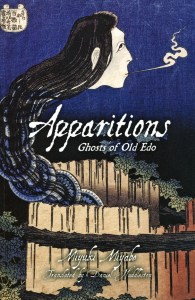
Apparitions

Title: Apparitions: Ghosts of Old Edo
Author: Miyuki Miyabe (宮部 みゆき)
Translator: Daniel Huddleston
Publication Year: 2000 (Japan); 2013 (United States)
Publisher: Haikasoru
Pages: 265

Apparitions: Ghosts of Old Edo is a collection of nine supernatural stories set in the Edo period (1603-1868), a historical era of relative peace that preceded Japan’s modernization. The author, Miyuki Miyabe, is known outside of Japan for her fantasy and suspense novels, but she also writes historical fiction informed by her love of the city of Tokyo.

Apparitions is a difficult book to break into, especially for someone who doesn’t have a great deal of background knowledge about Japan. Although the six-page thematic introductory essay by Masao Higashi situates Miyabe’s historical fiction within the tradition of Western horror, each of the stories in this collection is thoroughly suffused with what might be termed Japanese cultural odor. While this is far from a bad thing, the jumble of geographic and personal names that Miyabe employs to add color to her stories won’t carry the same narrative weight for most readers of this translation as it would for someone more familiar with the cultural and historical context she references.

The opening story, “A Drowsing Dream of Shinjū,” provides a good example of how these references work to create a sense of atmosphere – or, for many readers, may simply be strange and confusing. After the end of the Kyōhō era, in the fourth year of Bunka, a boy named Ginji is “sent off to work at a cotton wholesaler called the Daikoku’ya, in Tōri Setomono-chō” by an older man at the Mannen’ya, an employment agency “located in Ōdenma-chō Block 1” that places apprentices in the wholesale businesses “that dotted the way from Ōdenma-chō and the surrounding area on through Muromachi, Takara-chō, Suruga-chō, and Nihonbashitōri-chō” (18). Miyabe uses the names of these emperor reigns, businesses, and neighborhoods as a shorthand to create a sense of time and place. Unfortunately for those of us not already well versed in Edo-period historical fiction, this type of highly specific allusion is largely unaccompanied by any sort of explanation. As a result, to someone who isn’t a specialist in the Edo period, the stories in Apparitions can seem rather dry.

Even the broader cultural allusions that Miyabe uses to add flavor to her stories are only mentioned in passing without any sort of elaboration. To return to “A Drowsing Dream of Shinjū,” the premise of the story is that the fourteen-year-old protagonist Ginji is employed by Tōichirō, the son of the prosperous cotton wholesale business Daikoku’ya, to run errands, some of which involve carrying messages to Tōichirō’s various girlfriends. Meanwhile, the 21-year-old Tōichirō wants his family’s business to start selling tea towels printed with monogatari moyō, or scenes from literary romances such as The Tale of Genji. His father tells him that this is a bad idea, as such items have come to be associated with real-world cases of shinjū, or double suicide, in which several pairs of lovers tied their hands together with these towels so that they would have a greater likelihood of drowning when they jumped into a river.

One thing leads to another, and when Tōichirō gets married he moves his mistress O-Haru to the neighborhood of Ōshima-mura, which “was on the other side of the Ōkawa River, on past Fukagawa” (34). On being sent to O-haru’s villa one afternoon, Ginji arrives to find it empty, and as he dozes off in the foyer he dreams that he sees the lifeless bodies of Tōichirō and O-haru deeper inside the house, their wrists bound with a monogatari moyō tea towel.

To anyone familiar with Japanese drama, “A Drowsing Dream of Shinjū” is redolent of numerous other stories involving the ghosts of star-crossed lovers appearing in forgotten and out-of-the-way places. It’s precisely because Miyabe is confident in her reader’s familiarity with such ghost stories in the Noh, Bunraku, and Kabuki theatrical traditions, however, that she doesn’t go out of her way to deepen the eerie atmosphere by means of other literary devices. Perhaps a Western equivalent of this might be naming a character Horatio and thereby expecting the reader to associate him with chilly Scandinavian sea winds and dead princes without otherwise supplying the character with any personality traits. Unfortunately, Miybe’s allusions may pass entirely over the heads of unfamiliar readers.

Although two or three of the stories in Apparitions are strong enough to stand on their own, the book isn’t so much a collection of accounts of individual people and the ghosts they leave behind as it is a cumulatively growing narrative about the city of Edo itself. If the reader can tough out an initial sense of disorientation, however, the geography of the city and the character of its people gradually begin to take shape with each successive story.

That being said, the strongest pieces in the collection need no contextualization. In my favorite story, “The Oni in the Autumn Rain,” an older woman speaks to a younger woman and offers sound and canny advice that transcends time and place. Moreover, the cleverness of the surprise ending to the story, in which it is revealed that the circumstances of this conversation are not what they seemed, needs no cultural background knowledge to be appreciated.

I use another of the more accessible stories in the collection, “Cage of Shadows,” as one of the readings in my “Tokyo Stories in Japanese Fiction” seminar. “Cage of Shadows” serves as an excellent starting point for a discussion of Edo period fiction, as it evokes the themes and tone of popular stories from the eighteenth century while still employing conventions relating to psychologically astute characterization and linear plot progression that contemporary readers have come to take for granted. As an added bonus, the imagery of the story is deliciously grotesque, and the way it ends is downright creepy.

Overall, it’s difficult to recommend Apparitions to a casual thrill seeker; but, for a patient reader, allowing the stories enough time to build a gradual atmosphere of strangeness at the margins of human activity is akin to watching twilight deepen into darkness as an evening fog rises from the ground. Many readers may find themselves lost in the maze of foreign words and names; but, if you’re interested in Japanese ghost stories and looking for a nice collection of original and historically grounded horror fiction with lovely Gothic undertones, then Miyuki Miyabe has summoned a delightfully eerie group of ghosts.

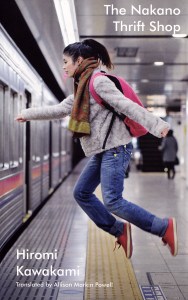
The Nakano Thrift Shop

Title: The Nakano Thrift Shop
Japanese Title: 古道具 中野商店 (Furudōgu Nakano Shoten)
Author: Kawakami Hiromi (川上 弘美)
Translator: Allison Markin Powell
Publication Year: 2017 (United Kingdom); 2005 (Japan)
Publisher: Portobello Books
Pages: 260

Hitomi works at the Nakano Thrift Shop, which is run by a middle-aged man named, unsurprisingly, Mr. Nakano. While she watches the store and works the till, a young man around her age, Takeo, accompanies Mr. Nakano on buying trips. The trio is occasionally visited by Mr. Nakano’s sister Masayo, an artist of independent means. The twelve loosely connected stories in The Nakano Thrift Shop are about the strange and silly things that happen to this odd group of characters, whose small dramas for the most part seem to exist outside of the specifics of time and place.

Hitomi is short-tempered and cagey, Takeo is passive and uncommunicative, and Masayo is chatty and expansive, but it is the stubborn and befuddled Mr. Nakano whose mishaps and shenanigans serve as the focal point or punchline of each story. In the second story, “Paperweight,” Mr. Nakano bribes Hitomi to go visit Masayo and get gossip about her new lover, which sparks a friendship between the two women. In the third story, “Bus,” Mr. Nakano travels to Hokkaido on a buying trip and becomes involved in a one-sided love affair, amusing Hitomi with the messages he sends back to the shop. In other stories, an unusual customer provides a break from the store’s daily routine. For example, in the ninth story, “Bowl,” a young man tries to get rid of a valuable antique bowl, which he believes has been cursed by an ex-girlfriend. The Nakano Thrift Shop is more of a downmarket store, so Masayo forces Mr. Nakano to pass the bowl over to a specialist ceramics dealer with whom he happens to be in the process of breaking off a romantic relationship.

Over the course of the book, Hitomi enters into a romantic relationship of her own with Takeo. This romance never makes much progress, however, as Hitomi demands action and attention while Takeo doesn’t like talking on the phone and is content simply to allow life to happen to him. Like everything in The Nakano Thrift Shop, their relationship is lowkey and laidback, and it ebbs and flows without any sort of drama.

For the reader, the pleasure of these stories lies in peeking into the lives of these characters as they drift through the changing seasons while comfortable in the stability of their friendships. Even though unusual things occasionally happen, no one is ever strongly affected by these events. For instance, in the first story, “Rectangular #2,” an odd man named Takadokoro comes into the store to sell artistic nude photos. Masayo tells Hitomi that the pictures are of Takadoroko’s former student. Takadokoro has the potential to be a truly creepy (or pathetic) character, but the warm narrative tone of The Nakano Thrift Shop treats him as just another person in the neighborhood. He doesn’t bother anyone, and no one is bothered by him. After all, everyone is a little weird once you get to know them.

In the final story, “Punch Ball,” the Nakano shop has closed, and the characters have all gone their separate ways. Hitomi takes various office jobs as a temp worker while she studies for her bookkeeping certification exam. Her current distance from the carefree atmosphere that suffused the earlier stories puts them into perspective, and her former freedom from the pressures of the corporate world now seems much more meaningful. Now that she spends her days sitting at a desk in front of a computer, social interactions are no longer improvised and unique, and friendships are no longer so easily formed. There’s a playful innocence to Hitomi’s time in the Nakano shop that only becomes apparent in retrospect.

The Nakano Thrift Shop is a short and pleasant book that will appeal to anyone who enjoyed The Briefcase (which was published as Strange Weather in Tokyo in the UK). Although it’s a wide leap removed from the darker themes and imagery of some of Kawakami’s other work that has appeared in translation, it’s mercifully free of the sentimentality and melodrama of Yoshimoto Banana novels. As Hitomi seems to be in her mid to late twenties, it’s up for debate whether The Nakano Thrift Shop can be classified as “girls’ literature” (shōjo shōsetsu), but reading these stories conveys a vicarious sense of what it feels like to be a young woman chilling out and having fun in a trendy Tokyo suburb.

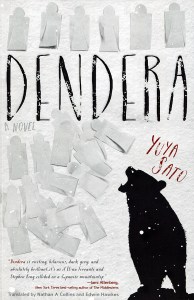
Dendera

Title: Dendera
Japanese Title: デンデラ (Dendera)
Author: Satō Yūya (佐藤 友哉)
Translators: Nathan A. Collins and Edwin Hawkes
Publication Year: 2015 (America); 2009 (Japan)
Publisher: Haikasoru
Pages: 360

Dendera is not an easy book to read. Although the cover copy describes the story as being set in “a utopian community” of old women, this is no tale of feminist empowerment. Rather, every page practically bleeds with suffering and human misery, and the only salvation for any of the characters lies in death.

In the Village, there is a strictly enforced rule that everyone must Climb the Mountain when they reach the age of seventy. Men and women who reach this age are carried on the back of their oldest child, who leaves them in the wilderness so that they may ascend to Paradise. That time has come for Kayu Saitoh, and she is ready – all she wants is to lie down and rest. As the snow falls around her on the Mountain, she embraces the sensation of her body becoming cold, knowing that when she sleeps, she will not wake in this world.

Right before she passes out, however, Kayu Saitoh is rescued and taken to Dendera, a settlement formed on the Mountain by all the women who were abandoned by their families and left to die of exposure. Dendera is little more than a collection of flimsy huts, but the community of fifty women has supported itself for more than three decades. These women don’t want to die, and so they rescue each other, eking out a meager living from the harsh environment.

The leader of Dendera is a woman named Mei Mitsuya, who founded the settlement because, as she says herself, “I had no intention of dying.” Mei Mitsuya hates the Village, but simply staying alive is not revenge enough for her. Her ultimate goal is therefore to accumulate enough resources to attack and destroy the Village. This is easier said than done, however, as life is not easy on the Mountain, especially for a small group of older women. They barely have enough to eat, and it is only by monitoring the community’s food supply that Mei Mitsuya is able to maintain her control over the other women.

Kayu Saitoh, who is resents being robbed of the opportunity to die a “pure” death, feels no gratitude toward Mei Mitsuya or any feeling of investment in Dendera. This sense of detachment allows her to see the power dynamics of the community, especially the tension between the “hawks,” which is what Mei Mitsuya’s faction calls itself, and the minority group of “doves,” who seem to want nothing more than for the village to prosper. This conflict is subtle, however, as the main concern of the Dendera inhabitants is feeding themselves. After all, no one has much energy to spare for anything besides hunting, scavenging, and rudimentary farming, not to mention the care of those too senescent to care for themselves.

Unfortunately, the old women aren’t the only ones going hungry, as this particular winter has been especially fierce. A large bear who has established her territory on the Mountain is starving, as is her cub. She eventually becomes desperate enough at attack the human settlement, which throws the tiny society into complete disarray. As Kayu Saitoh watches everything fall apart around her, she begins to catch glimpses of Dendera’s dark secrets. The bear is a terrible enemy, but this creature is far from the most frightening threat besieging the community.

If you want to read about old women being evil to each other in a wilderness setting, Dendera is your book. I found myself fascinated by this story, especially when it became clear that there was a deeper mystery underlying the basic struggle for survival. I appreciate just how unapologetically mean and selfish each of the women is, and this darkness of characterization served to render their rare moments of kindness and cooperation shine all the brighter. I also enjoyed the interludes of narration from the bear’s perspective, which don’t attempt to attribute her with human characteristics but still engender a strong sense of sympathy for her own struggle to survive.

Although the story isn’t set in any particular time or place, it might be possible to read Dendera as an allegory for the precarity faced by a rising number of older people in Japan, especially in the context of the plethora of (relatively) recent news media stories about people who fall out of touch with their families and effectively “disappear” only to then be found in their houses or apartments weeks after they die. That being said, the story has a certain quality of timelessness that allows it to function as a study of human character that transcends any specific social or historical context. I could easily recommend this book to anyone who enjoys highbrow horror fiction, regardless of whether they know or care anything about Japan.

Dendera is gritty and compelling human drama. The story takes a number of interesting turns before moving in a surprising direction as it builds up to an ending that is magnificently transcendent. The unrelenting unpleasantness of its subject matter may not be to everyone’s taste; but, if your stomach is strong enough, Dendera is a thoroughly satisfying novel.

Record of a Night Too Brief

Title: Record of a Night Too Brief
Japanese Title: 蛇を踏む (Hebi o fumu)
Author: Kawakami Hiromi (川上 弘美)
Translator: Lucy North
Publication Year: 2017 (United Kingdom); 1996 (Japan)
Press: Pushkin Press
Pages: 158

Record of a Night Too Brief collects three short stories that the book’s cover copy describes as “haunting” and “lyrical” in their depiction of young women experiencing “loss, loneliness and extraordinary romance.” This is a lovely sentiment, but it in no way describes the actual stories in question, which are less “haunting” than they are grotesque and less “lyrical” than they are unapologetically strange. Instead of trying to treat them as romance, I believe it’s much more fulfilling to approach their absurdity in the spirit of intellectual play.

The title story, “Record of a Night Too Brief,” is a sequence of nineteen of the unnamed narrator’s dreams. Each of these dreams is two or three pages long, and they are linked only in that every other scenario features a young woman whom the narrator is either pursuing or in the process of merging with. If there is a unifying theme or plot, it is lost on me, but the power of these dreams comes from their vivid imagery. To give an example (from page 11):

Several dozen ticket collectors stood in a row, and once we passed through, showing our tickets, the tall object came into view.

It was a singer, who stood as tall as a three-storey building. From where I was, I had a clear view of the beauty spot under her jaw, and the rise and fall of her breasts.

“The beauty spot is artificial,” the girl informed me, gazing up at the singer, enraptured.

The singer was producing notes at different pitches, as if she were warming up. When she sang high notes, flocks of birds took flight from the branches of the ginko trees. When she sang low notes, the earth heaved, and small furry creatures emerged from underground and crawled about.

…and so on. It’s all very random, but one can’t help but become swept up in the ebb and flow of the constantly shifting parade of surreal images.

The next story, “Missing,” is set in an apartment complex that functions according to its own arbitrary and bizarre set of customs and rituals. One of the rules of this community is that each household can only have five members. If a sixth member is added for any reason, then someone has to disappear. This recently happened to the narrator’s family after her older brother was engaged to be married. Because his fiancée would have become the sixth person, he disappeared, and the narrator’s other older brother stepped in to fill his position. His fiancée, Hiroko, has no idea that this has happened, as the rules are different in her own apartment complex, where certain members of certain families literally shrink. Meanwhile, the narrator continues to hear the voice of the older brother as he (or his spirit) skulks around the apartment. No explanation is given for any of this, as everyone takes these occurrences for granted.

The final story, which provides the title of the original Japanese publication, is “A Snake Stepped On.” This story is about a young woman who one day finds herself living with a snake. This snake takes the form of an older woman who insists that she is the narrator’s mother. As she accustoms herself to life with a snake, the narrator begins to realize that many of the people around her are also living with snakes, including the local Buddhist priest whom she thought of turning to for an exorcism. Following the conventions of magical realism, the tone of this story is mundane, with the possibility of being devoured by a snake – or becoming a snake oneself – treated as merely another everyday occurrence.

Record of a Night Too Brief is a short collection of curiosities that are fascinating in their novelty. The fantastical qualities of each story allow for various interpretations, and they will no doubt intrigue different readers for different reasons. As contemporary fairy tales, the stories in this collection spark and inspire the imagination.

Indian Summer

Title: Indian Summer
Japanese Title: 小春日和(インディアン・サマー)
Koharu biyori (Indian samā)
Author: Kanai Mieko (金井 美恵子)
Translators: Tomoko Aoyama and Barbara Hartley
Publication Year: 2012 (America); 1988 (Japan)
Publisher: Cornell East Asia Series
Pages: 149

Nineteen-year-old Momoko has managed to pass the entrance exam of a university in Tokyo, and her mother has decided that she will stay with her aunt, a middle-aged novelist who lives in the Meijiro neighborhood of West Tokyo. Momoko’s aunt is a free spirit with a difficult personality, but that’s just fine with Momoko, who is more than a little quirky herself. Momoko occasionally goes to class or goes out drinking, and her aunt occasionally gets her act together and publishes something, but mostly they hang around the house together being useless.

Kanai Mieko is known for her surreal and often disturbing fiction, but there are no dark or upsetting themes in Indian Summer. In their introduction to the novel, translators Tomoko Aoyama and Barbara Hartley describe it as “girls’ literature,” meaning “not simply the new or older ‘chick lit’ or the juvenile fiction and romance targeted at female audiences but more widely any literature that has attracted the sustained interest of (and has often been produced by) ‘girls’ (young women and their sympathizers).”

Indian Summer was published in 1988, the same year as Yoshimoto Banana’s famous girls’ literature novella Kitchen, and both stories reflect the heady energy of the consumer culture at the end of the bubble years. Unlike Kitchen, however, Indian Summer has more of a satirical bite, with Momoko expressing a lazy disdain for the sort of concerns celebrated by women’s magazines, such as clothing and romance. One target of Momoko’s annoyance is her divorced father, who lives in Tokyo and works as a hotel manager. He makes a series of clueless attempts to bond with his daughter by taking her out to nice stores and fancy restaurants and offering fashion advice, but Momoko is not impressed. Her main concern is avoiding the girlfriend for whom her father left her mother, but this “girlfriend” turns out to be a beautiful young man. To Momoko’s complete lack of surprise, gay romance turns out to be just as tawdry and boring as straight romance, for which she has zero patience.

Momoko lets off steam with her college friend Hanako, whose father is also an embarrassment, especially in his insistence that his precious daughter is too good for things like a part-time job. Neither of the girls particularly cares what any men think of them, however, and in their lack of concern they are passively supported by Momoko’s aunt, who just wants to drink and write. These three women drift through their days together, not marching to the beat of any drum at all as they enjoy each other’s company. Sometimes they talk about their lives, and sometimes they talk about books and movies, but mostly they just chill out. Because of the charm and wit of Kanai’s writing, this is a lot more interesting than it sounds, but there’s no denying that Indian Summer is a light and refreshing novel that isn’t meant to challenge its reader.

Interspersed between the chapters of the novel are Momoko’s aunt’s essays on everything ranging from motherhood to abortion to Roland Barthes to the foibles of bourgeois women. These short interludes are inspired by the aunt’s day-to-day life with her niece and provide a sort of parallax view on the events of the story. While Momoko tends toward a negative assessment of the world around her, her aunt’s opinions are more tongue-in-cheek, but the two women are still very much alike in their casual nonchalance.

Because of its inclusion of these “non-fiction” essays, and because of its lack of a clearly definable plot, Indian Summer is a strange little book that’s difficult to categorize. That being said, Kanai’s writing is a lot of fun and genuinely humorous. I would recommend this short novel to people who enjoy the breezy sort of fiction characteristic of 1980s Japan but who would appreciate something a bit more grounded and intelligent than the romance and science fiction from that decade that had previously appeared in translation.

Moshi Moshi

moshi-moshi

Title: Moshi Moshi
Japanese Title: もしもし下北沢 (Moshi moshi Shimokitazawa)
Author: Yoshimoto Banana (吉本 ばなな)
Translator: Asa Yoneda
Publication Year: 2016 (America); 2010 (Japan)
Publisher: Counterpoint
Pages: 209

A year after her father dies in a suicide pact, twenty-something Mitsuharu Yoshie moves to the hipster neighborhood of Shimokitazawa, where she works part-time at a small bistro. Everything is going reasonably well for her until her mother suddenly decides to move in with her. Yoshie had been looking forward to leaving the nest and striking out on her own, but her mother claims that her father’s ghost has begun to haunt their old apartment, so what can she do?

Moshi Moshi is like a glossy lifestyle magazine in the form of a novel. Yoshie and her mother float through their days in Shimokitazawa, eating delicious food, buying nice things, and gradually getting to know their neighbors. Yoshie is serious about her work in the Les Liens bistro, and her mother is serious about pulling herself out of the mire of her former role as a housewife, but they have no money worries and are quite comfortable together.

The only shadow on their bright days is the death of Yoshie’s father Imoto, who played keyboard in a rock band. The official story is that he committed suicide with a much younger woman, but neither Yoshie nor her mother has any idea why an otherwise grounded and stable man would have consented to such an extreme act of desperation. One day, Yoshie randomly runs into a frequent diner at her bistro. The man’s name is Shintani, and he happens to own a club where Imoto’s band often played. Shintani takes this opportunity to tell Yoshie that there was something very strange about the woman her father ran off with. He also tells Yoshie that he’s falling in love with her.

Shintani is a typical Yoshimoto male love interest who could have walked straight out of the pages of a shōjo manga magazine. He is gentle, kind, and attractive in a nonthreatening way:

Shintani-kun still ate beautifully, and the pot-au-feu disappeared into his mouth with dreamy alacrity. As he ate, he looked out the window peacefully. He always wore nice shoes. (96)

Once they start seeing each other, Yoshie and Shintani bond in the same way that Yoshie and her mother do, namely, by visiting cool restaurants and bars and eating tasty and unusual dishes. It is their shared consumption of trendy food and chic clothes and music that brings them together, and Shimokitazawa is the perfect backdrop for this featherlight drama of consumerism. Yoshie’s mother is also healed by her immersion in hipster paradise:

When I saw her reading manga with her belly out, shedding tears while murmuring, “I understand, of course you want to go back and live in the cave,” I was filled up with the thought that this woman hadn’t done anything wrong, and didn’t deserve any of this.

Yes, Shimokitazawa was a little like a mountain cave in the outlands, where people who found it difficult to keep up with the vagaries of the world could live quietly, as they wanted. Even people who’d been left behind, like me and Mom. (88)

This laid-back atmosphere is occasionally juxtaposed against Yoshie and her mother’s former home in Meguro, a pricey neighborhood just south of Shibuya. Meguro is too upscale for the two women to be true to themselves, but they’re finally able to relax and find a comfortable community in Shimokitazawa, which welcomes sweet and slightly quirky people into its patchwork of quaint stores and cafés. The last sentence in the author’s Afterword aptly sums up the message of the book: “I only pray for the survival of all the many fine shops that still quietly continue to exist” (206).

Moshi Moshi has something vaguely resembling a plot, but the story isn’t really the point of the novel. Rather, the reader is bathed in the warm flow of Yoshimoto’s words while experiencing of the charm of the Shimokitazawa neighborhood. The novel is comforting, like drinking hot chocolate on a cold day. Just don’t expect any bold or complicated flavors, and you won’t be disappointed.

The Graveyard Apartment

the-graveyard-apartment

Title: The Graveyard Apartment
Japanese Title: 墓地を見おろす家 (Bochi o miorosu ie)
Author: Koike Mariko (小池 真理子)
Translator: Deborah Boliver Boehm
Publication Year: 2016 (America); 1988 (Japan)
Publisher: Thomas Dunne Books
Pages: 325

Kano Misao and her husband Teppei have found the perfect apartment. It’s quiet and spacious with southern exposure, and it’s in a new, modern building. Sure, this building happens to be right next door to a graveyard, but it’s the 1980s, and the pleasant proximity to an open green space outweighs any sort of silly superstitious stigma. The only problem is that strange things always seem to be happening in the basement. It might be that the building is haunted, but why? And what would the ghosts want from Misao and Teppei?

Like many other haunted house stories, The Graveyard Apartment is, at its heart, a family drama. Misao and Teppei are happy together with their five-year-old daughter Tamao and their dog Cookie, but the bright little family is trailed by the dark shadow of Teppei’s first wife Reiko, who was driven to suicide by her husband’s affair with Misao. When the stress of the paranormal activity in their new apartment places stress on Misao and Teppei’s relationship, the fault lines of their marriage begin to crack. The novel opens inauspiciously with the death of Tamao’s pet bird Pyoko, who the girl claims now visits her in dreams. Misao and Teppei’s disagreement over how to handle their daughter’s insistence on the reality of the supernatural is the first of many arguments, which gradually escalate over the course of the story.

The Graveyard Apartment is not The Shining, however, and the ghosts troubling the family are not manifestations of buried psychosexual traumas – they are, most assuredly, actual vengeful spirits. The horror of the novel derives from the fact that, despite the lingering guilt over Reiko’s suicide, the malice of the building’s ghosts could not be directed at a more normal and easygoing family. If a sweet young mother and fledgling illustrator like Misao can find herself trapped in a claustrophobic basement while unknown things approach unseen in the darkness, it could happen to anyone.

It turns out that the apartment building is a remnant of a failed development project from the 1960s that would have resulted in an underground shopping plaza connecting the basements of several office and residence buildings to the local train station. The neighborhood temple resisted this development and refused to sell or subdivide its land, however, and so the tunnel under the graveyard was left unfinished, with the Kanos’ building the only part of the project that came to fruition. The link between the temple graveyard and the ghosts in the basement is extremely tenuous (especially since the point of Buddhist funerary rites is to pacify angry spirits), but the haunting can be more easily understood as the consequences of the era high economic growth, which has finally started to claim victims as the bubble economy begins to collapse in on itself.
The Kanos were led to believe that they could have it all – Teppei could divorce his old-fashioned wife and marry for love, Misao could have both a child and a freelance career in a creative field, and they could find a reasonably priced apartment in a convenient location to house their happy family. It had to be too good to be true, right?

Originally published in 1988, The Graveyard Apartment is a reflection of the anxieties concerning the optimistic consumerism of the 1980s, in which an ideal middle-class lifestyle was widely considered to be glossy and attainable as the magazines Misao illustrates. Although the real threat to families ended up being overinflated property values, Koike’s ghosts are creepy enough on their own even without any sort of economic allegory, and the end of the novel is genuinely disturbing. The Graveyard Apartment is a satisfying slow burn of a haunted house story perfectly suited to its setting in Tokyo, and I highly recommend it to my fellow fans of horror fiction.

( Review copy provided by Thomas Dunne Books. )