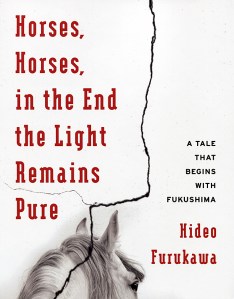
Horses, Horses, in the End the Light Remains Pure

Horses Horses

Title: Horses, Horses, in the End the Light Remains Pure
Japanese Title: 馬たちよ、それでも光は無垢で
(Umatachi yo, sore demo hikari wa muku de)
Author: Furukawa Hideo (古川 日出男)
Translators: Doug Slaymaker and Akiko Takenaka
Publication Year: 2016 (America); 2011 (Japan)
Publisher: Columbia University Press
Pages: 147

Furukawa Hideo, born in 1966 in Fukushima prefecture, is a prolific author who has won numerous awards for his work, which ranges from mystery to sci-fi to literary fiction. Horses, Horses, in the End the Light Remains Pure is a memoir that defies genre as it responds to the March 2011 triple disaster of earthquake, tsunami, and nuclear meltdown.

Horses is the story of a road trip that the author makes to Fukushima almost immediately after the disasters. Furukawa lives in Tokyo, and he was in Kyoto when the earthquake hit. He describes himself watching the news on the television in his hotel room, unable to process what he was seeing but unable to look away. “That’s when that period of steady gazing began,” he admits (19). Furukawa describes his continuing shock as living in “spirited-away time,” as if “the dates of the calendar disappeared” (6).

He is shaken from his torpor by the voice of a character from a novel he has recently published, The Holy Family (Seikazoku). This character, who is from the Tōhoku region, tells the author to go there and see it for himself. Furukawa therefore gets in a car with three other people who are identified only by letters (as in, “Young S was driving”) and heads north from Tokyo, all the while commenting on the seemingly normal state of traffic, gas stations, and convenience stores. When he arrives at the affected area, however, nothing is normal. As Furukawa explains it…

We were overwhelmed by the sense of how powerful it was. The scene spread out before us, everything wiped clean away. There are no words for it. We didn’t just feel it, we were pummeled by it. I am ashamed to admit it – I want to spit at myself in disgust – but I was looking at the scene as if it were a great spectacle. I thought of air raids. And atomic-bomb sites. It hit me like a smack to the side of the head: it’s just like a city in wartime. I couldn’t help it. I exploded: “This scale, it spreads too far.” (41-42)

Although the disasters are never far from Furukawa’s mind, descriptions of its aftermath don’t form a particularly large portion of his narrative. Instead, he is concerned with his identity as a writer and his responsibility in chronicling what has happened. Throughout the book, Furukawa seems almost narcissistic in the way he dwells on the process of writing, as well as the invitations he receives to discuss it. This is not unique to Furukawa, of course; very rarely is an artist’s statement anything other than a validation of the artist’s ego. It’s what these meditations evolve into halfway through Horses that makes the book so interesting. Specifically, Furukawa tries to pick apart the various strands of meaning tangled up in the knot of Japanese identity, repeatedly returning to the question of how to approach Japanese history and myth. For example, he ponders…

How does one sing praises to this national land? Especially now, given that there is a second sun in the nuclear core? A meltdown that has taken its name from Fukushima. Can a name be given to this particular sun deity? (65)

Furukawa goes on to discuss how the vaunted warrior class and the great military leaders of the sixteenth century were brutal and pitiless murderers. “Our history is nothing more than a history of killing people,” he concludes (78). When he reflects on how he wrote about Japanese history in The Holy Family, Furukawa claims that he was therefore writing “for the horses.” If the history of humans is a history of killing people, then the history of horses is a history of being killed in human wars. Just like the animals around the Fukushima reactor, the lives of horses are affected by events that are only tangentially related to them. Although the author never makes this parallel clear, he suggests that there isn’t a great deal of difference between the “otherness” of domestic animals and the “otherness” of the people who fall outside the political center of Japan.

Furukawa’s memoir is not challenging in the traditional sense of being difficult to understand, but reading it can be challenging at times, as the author follows his train of thought without stopping for a full 140 pages. His style is not quite stream-of-consciousness, but he makes no attempt to order his thoughts or to impose structure to any sort of argument he might be making. As a response to the disasters, then, Horses feels less like a polemic and more organic and sincere. Furukawa ends his narrative on a somewhat surreal note, but Doug Slaymaker’s concise “Translator’s Afterword” neatly ties together the disconnected themes of the work, and I would recommend that the reader glance over it before embarking on the main text.

Horses, Horses, in the End the Light Remains Pure is a trenchant and often surprising work of literary ecocriticism. Furukawa transforms both the immediate disasters in Fukushima and the broader historical currents that flow around them into deeply personal experiences, resisting large narratives as he argues for the validity of individual stories, especially those that rarely make it into official histories. The smooth and well-considered translation gives the text, in all its complexity, a compelling sense of forward momentum. Furukawa’s memoir is just as engaging as it is important, and it will be of immense interest to anyone concerned with how views regarding the relationship between human beings and the natural environment have shifted during the twenty-first century.

Log Horizon: The Beginning of Another World

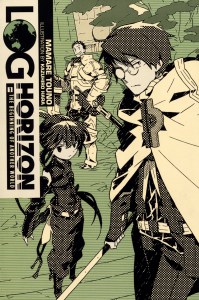
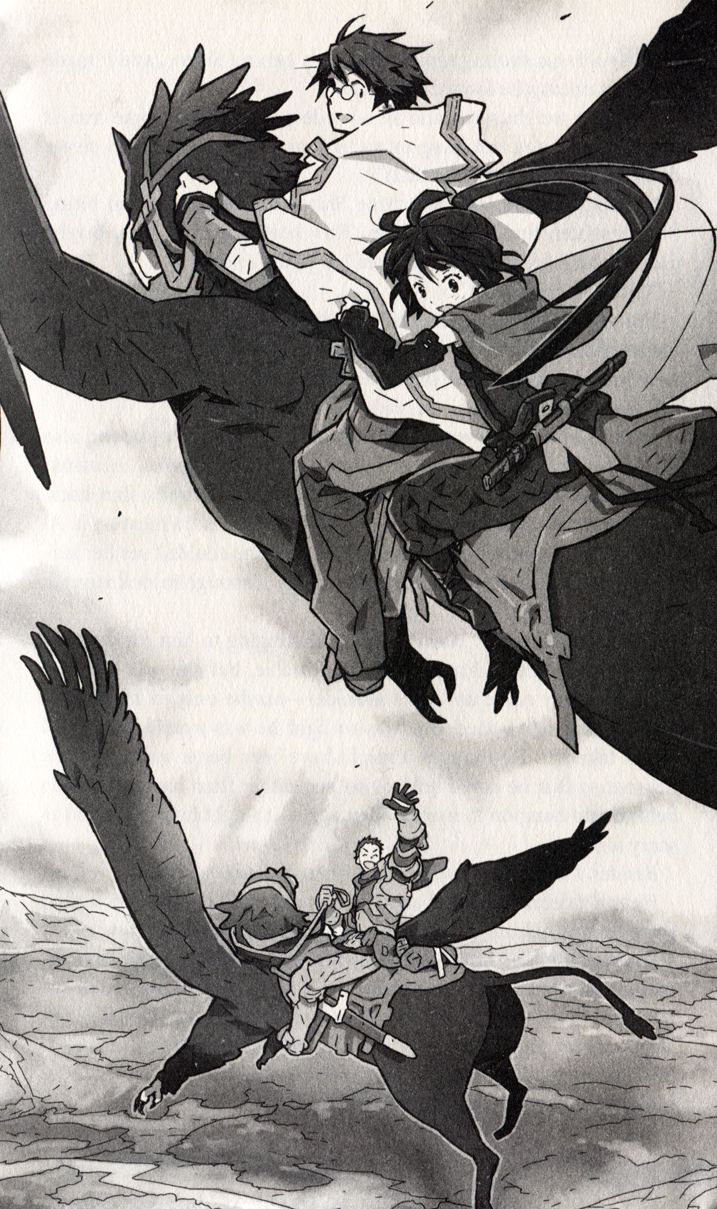
Log Horizon Volume 1 Cover

Title: Log Horizon: The Beginning of Another World
Japanese Title: ログ・ホライズン: 異世界のはじまり (Rogu Horaizun: Isekai no hajimari)
Author: Tōno Mamare (橙乃 ままれ)
Illustrator: Hara Kazuhiro (ハラ カズヒロ)
Translator: Taylor Engel
Publication Year: 2015 (America); 2011 (Japan)
Publisher: Yen On
Pages: 215

This guest review is written by Jeremy Anderson (@GameNightJeremy on Twitter).

Log Horizon: The Beginning of Another World is a light novel about people who become trapped in a fantasy video game world and must figure out what to make of themselves in this new environment as they navigate its dangers.

The plot is as follows: A young, intelligent, and socially awkward man named Shiroe finds himself physically inside a world roughly identical in form to the world of an online game he’s been playing for years, and he doesn’t know how to escape. He locates his friends, rambunctious but solid Naotsugu and quiet but reliable Akatsuki, and together they begin to explore the reality in which they’ve become trapped.

Log Horizon distinguishes itself from other entries in the “video game world” trope by changing the stakes. Other such stories, such as the light novel series Sword Art Online, tend to include comatose people who need to be woken up, a situation often nested with some hidden or overt moral about the importance of rejoining the real world. While Log Horizon‘s protagonist Shiroe ponders the possibility that everyone is comatose, he dismisses it as unlikely and doesn’t consider actively seeking an exit to be a productive use of time. Instead, the story is about taking life on its own terms and living life right now, where you are.

Log Horizon starts a little slow but builds on what it’s laid down early on to do more interesting things as it rolls along. I can tell you why I found it to start a little slow: I’m a gamer, and I’m already familiar with gaming terminology. Log Horizon devotes its first chapter to bringing readers up to date on this terminology. If you know what a guild is, how chat and friending functions work, what XP and HP mean, what a level cap is, what an MMORPG is, and so on and so forth, you may find yourself rolling your eyes and saying, “Yeah I get it.”

To me, this slow start is forgivable for two reasons. First, because I understand that not everyone is a gamer, and it’s better that I spend two seconds rolling my eyes than that another reader give up on the story because the writer never explained important terms. Second, because even within the first chapter the revelations about the way this MMO reality and the human-world reality interact are fascinating. That clash of worlds – the logical-but-unintuitive way new rules form from the known systems – is one of the main attractions of setting the story in a video game world. Log Horizon provides a number of clever details regarding world-building, and the protagonist spends a lot of time thinking about those details and responding to them.

In essence, the “video game world” trope provides an excuse to follow a set of strictures that will be easy for some to understand intuitively, and that will be easy to explain to the rest. The other value of setting the story in a video game world (instead of, say, Narnia) is that it allows our hero Shiroe to start off as intimately familiar with how the new world works. After all, he’s been playing the game for years, and he can approach the situation of becoming trapped within it with the calm and rational mind that distinguishes him as a player.

Whereas Sword Art Online explains the mystery behind how its characters have entered the game world almost immediately, Log Horizon doesn’t explain how this happened, might never explain how this happened, and tells the story in a way that makes this lack of information surprisingly acceptable. The story is about what the characters make of their situation, not how they got there.

The conflict in Log Horizon is a struggle for the soul – both the individual souls of the adventurers (Shiroe in particular), and the soul of the community. One of the most illuminating moments in the story is when Shiroe notes that the true threat to players in the game world is social. Thirty thousand people have been uprooted from their lives and transplanted into a new world, which does not have any government or laws. By the end of the novel, the reader sees how ugly this scenario becomes, with a major in-game city resembling a town run by a villain in a spaghetti western. In addition, Shiroe expresses concerns about sexism, such as the legitimate worry that female players, who form a distinct minority, will be harassed more than male players.

As fun as the fight scenes can be in Log Horizon, the novel’s most impressive moments aren’t when a dude is being cut in half or a building explodes; they’re when a man decides to stand up for someone he’s never met, because he knows he and his friends are best suited to get the job done. When his friends, new and old, push him to live more fully. When three people realize they’re the first ever to see the sunrise from a certain previously-unexplored hill. The fundamental question in Log Horizon is not, “How do we escape this false reality so we can get back to living our lives?” It’s a much simpler, broader, and deeper, “How do we live well?”

Log Horizon‘s story isn’t revolutionary in its interpretations of the “video game world” trope or the broader “team fantasy adventure” genre, but it does tell a story that is unique enough to keep the reader interested from cover to cover as it continues to chip away at the limitless edge of narrative possibility.

The story is also available in manga and anime formats.

. . .

Jeremy Anderson is a writer and game designer best known for the Shadowrift card game, and a consumer of far more comics and anime than anyone should have access to. He is currently on the design staff of Rise of the Eagle Princess, a JRPG set in a fantasy world based on the Mongolian empire.

Log Horizon Volume 1 Page 153

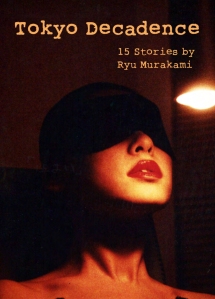
Tokyo Decadence

Tokyo Decadence

Title: Tokyo Decadence: 15 Stories by Ryu Murakami
Author: Murakami Ryū (村上 龍)
Translator: Ralph McCarthy
Publisher: Kurodahan Press
Publication Year: 2016
Pages: 280

Tokyo Decadence contains fifteen stories drawn from five of Murakami Ryū’s collections published between 1986 and 2003. As translator Ralph McCarthy explains in his acknowledgments, he has been translating his favorite Murakami stories since the late 1980s, and now he’s finally able to publish them thanks to the blessing of the author and the encouragement of Edward Lipsett of Kurodahan Press.

The first story in Tokyo Decadence, “Whenever I Sit at a Bar Drinking Like This,” has a passage at the beginning that reads as follows:

It’s probably safe to say that everyone sitting here is looking for some sort of sin tonight. The circumstances are different for each, of course, but everyone has the same general destination in mind. No one gets drunk in order to raise their moral standards.

It’s probably safe to say that no one opens a collection of Murakami Ryū’s short fiction in order to raise their moral standards. If you’re looking for some sort of sin, you’ve found yourself the right book. All of the stories in Tokyo Decadence are surprising and unique, but they all move toward the same general destination – sex and drugs and blood and tears.

This first story takes the form of an elaborate fetch quest across the seedy underbelly of Shinjuku in which the protagonist must exchange promises for favors. His goal is to get one of his former lovers to testify in court that they were sleeping together so that another of his former lovers doesn’t claim common law marriage and sue him for divorce. The point seems to be that people are terrible and selfish creatures, but it’s a lot more fun arriving at this conclusion than you’d expect.

The second story, “I Am a Novelist,” involves another strange situation in which a man posing as a bestselling writer gets a girl at a hostess club pregnant. When her manager insists that he meet the young woman, she quickly admits he’s not the person she slept with, but the writer still takes her out to dinner. She tells the writer that she’s a fan of his work, so he tries to get her to fall in love with him instead of his impersonator. It doesn’t work (obviously), and the novelist ends up finding out that he was just a minor character in someone else’s story.

In other stories, a trucker loses his wife and his job and becomes a host at a gay club, a guy with no self-esteem invades a woman’s home and smashes her television, and a young prostitute buys herself a topaz ring to remind herself of a musician whose world she can never enter. In “Penlight,” a call girl with serious issues talks about her imaginary friend to a guy she meets at a bar, who is interested in her body, but in the way you think (unless you happen to be thinking of horrific murder and cannibalism). A few of these stories are drawn from Murakami’s 1988 collection Topaz, which became the basis for the 1992 film Tokyo Decadence, which was directed by the author and banned in a handful of countries precisely because it’s the sort of movie you’d expect to have been directed by the author.

If you’ve read Murakami’s work before, you know what to expect. Since all of these stories are twenty pages or less, however, there’s no slow buildup to the carnage. That being said, the violence is tempered with irony, black humor, and intriguing characterizations that elevate the stories above simple splatterfests.

In contrast, the three stories drawn from the 1995 collection Ryu’s Cinematheque are vaguely autobiographical.

In “The Last Picture Show,” the 18-year-old narrator is living in Kichijōji and trying to make it big with his blues band. His upstairs neighbor, who is obviously a yakuza, wants to pay him to pick hydrangea leaves in Inokashira Park to dry and then sell as marijuana to American soldiers. In “The Wild Angels,” the 18-year-old narrator has started a relationship with a woman who works as a hostess, which makes him feel like less of a man, so he starts shooting heroin. In “La Dolce Vita,” the college student narrator hooks up with an older woman who lives in Yokosuka and gets her drugs from the American army base, which doesn’t end well.

To me, these coming-of-age stories were nowhere near as interesting or amusing as the murder stories, but they provide an interesting picture of the 1970s that serves as a counterpoint to the stories of the other Murakami; these stories forgo nostalgia in favor of an emphasis on the grittiness and despair and self-indulgent navel gazing of fringe counterculture.

The last third of Tokyo Decadence eases up on the drug use but maintains its focus on sex and emotional violence. Some of the stories reference each, and I got the sense that I was only being glimpses into a larger narrative. I dearly wish we lived in a world in which Ralph McCarthy was able to publish his translations of entire Murakami collections instead of selected stories, but each piece included in Tokyo Decadence shines brightly enough on its own merits that the reader is not disappointed by the relative lack of context.

I thoroughly enjoyed Tokyo Decadence. The collection portrays the Japan of the bubble and postbubble decades as a place where anything in your wildest dreams and darkest nightmares could happen. Murakami’s fiction is a love letter to the infinite possibilities of urban life delivered with style and panache. Just be warned – Tokyo Decadence is not for the faint of heart.

Tokyo Decadence will be released on March 15, 2016. A complete table of contents can be found on its page on the Kurodahan Press website.

Review copy provided by the noble and selfless people at Kurodahan Press.

Asura Girl

Ashura Girl

Title: Asura Girl
Japanese Title: 阿修羅ガール (Ashura Gāru)
Author: Maijō Ōtarō (舞城 王太郎)
Translator: Stephen Snyder
Publication Year: 2014 (America); 2003 (Japan)
Publisher: Haikasoru
Pages: 214

Asura Girl is narrated by Aiko, a seventeen-year-old student who just so happens to be a total badass of the sort we all wish we could have been in high school. She does what she wants, doesn’t apologize for anything, and isn’t interested in your shit. Sure, she’s a little messed up in the head, but what teenager isn’t?

If Aiko’s life were nothing more than maintaining her self-respect while dealing with bullying and subpar sex, she’d be okay, but there’s a serial killer on the loose. When a boy disappears almost immediately after she left him in a love hotel, she takes steps to lure the murderer to her, because she is pissed off and ready to lay down the law. She is inspired by her enviable collection of DVDs of American movies, especially after she picks up on a parallel between the abduction of her single-serving boytoy and the abduction in The Big Lebowski.

That’s right, The Big Lebowski – a perennial favorite of seventeen-year-old girls everywhere.

Asura Girl was written by a thirty-year-old man, and it shows. Aiko is more or less a cross between Uma Thurman, Samuel L. Jackson, and a basement-dwelling neckbeard. It makes very little sense to try to understand her as anything other than a construct. There is no sensitive or nuanced portrayal of girlhood in this novel, but that’s okay. Sometimes you’re just looking for a hardcore metal portrayal of a manic pixie murder girl.

To give you a sense of what this means, this is how Aiko interacts with her crush:

Still, it did sound a little like he was more worried about Maki than me, so as he was taking off his shoes in the doorway I kicked him – my patented Aiko whip kick, a roundhouse to the upper body that I learned from my brother. My bare foot struck his arm – chiban! – and he bent double, letting out a little yelp. Humpf. Drop dead. No, on second thought that might cause trouble. (53)

The boy is okay with it, because of course he is. Aiko is less of a girl power icon than she is a fantasy girlfriend for the author, but her ridiculous character is a perfect for this novel’s ridiculous story.

The family of one of the serial killer’s victims set up a website asking for help, a plea that went nowhere fast but still managed to inspire a great deal of internet discussion and speculation that coalesced into a vigilante group calling itself “Voice of Heaven.” The Voice of Heaven has convinced itself that the serial killer is a middle school boy, and so its members begin to engage in “middling,” or ganging up on middle school kids and beating the shit out of them. A grisly confirmation of a new murder sparks widespread riots, in the midst of which Aiko receives an unlikely visitor.

A hundred pages into the novel, there’s a vertiginous narrative shift as Aiko undergoes a near-death experience, and her already unstable imagination goes completely off the rails.

I don’t want to spoil what happens here, but it is insane.

When Aiko returns from her epic vision quest ninety pages later, she has learned nothing. Regardless, she understands that she’s been given a new lease on life to make a fresh set of terrible decisions, and she fully intends to make those decisions as terrible as possible.

And then there’s this weird bit at the end about making a sacred Buddhist statue of the warrior-god Asura out of human corpses. Should the reader understand these human corpses as literal, or are they the cast-off shells of Aiko’s identity as she constantly reinvents herself yet always stays essentially the same? Why choose when you can have both??

I just, what is this novel, what is it even.

Asura Girl is not for everyone, and I can imagine wide swaths of readers being confused and offended by it. But! If your heart went a little doki-doki when your eyes passed over the words “The Big Lebowski,” and if you always thought Reservoir Dogs could have used more Japanese schoolgirls, then Asura Girl is probably for you.

You know who you are.

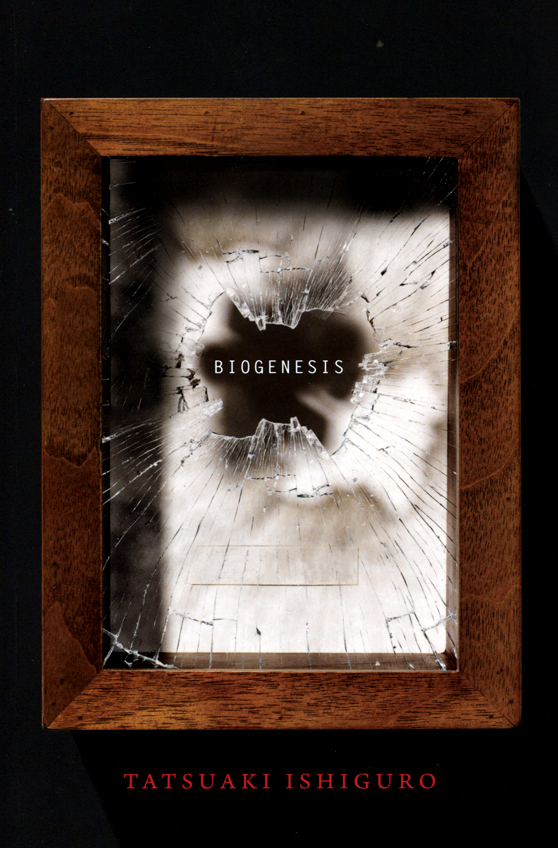
Biogenesis

Biogenesis

Title: Biogenesis
Author: Ishiguro Tatsuaki (石黒 達昌)
Translators: Brian Watson and James Balzer
Publication Year: 2015 (America); 1994, 2000, and 2006 (Japan)
Publisher: Vertical
Pages: 240

Biogenesis collects four stories by Ishiguro Tatsuaki, who is both a practicing medical doctor and an acclaimed writer of horror-themed science fiction.

The book is dominated by the first story, “It is with the Deepest Sincerity that I Offer Prayers…” which takes the form of a scientific report (tables and endnotes and all) on a species of winged mice that have suddenly disappeared from their habitat in Hokkaido. The report focuses on the activities of Dr. Akedera Nobuhiko, an AIDS researcher employed under somewhat shady circumstances to “preserve the cellular and genetic information” of the vanishing species. Akedera was apparently so fascinated by what he found in the process that he insisted on undertaking ecological research as well, recording accounts of sightings and deaths.

Akedera was able to draw a number of unsettling conclusions from this data. First, the winged mice seem to die in waves. Second, there are unusual patterns regarding their movements and seasonal behavior. Third, many of the people who have documented and captured winged mice attest to a strange glow either emanating from their bodies or otherwise present when and where they gather. Finally, live mice are most often found and photographed by or in the prescence of human children.

Akedera is sent back to Tokyo, but he continues to involve himself with research and preservation efforts, which result in the discovery that cultures of winged mice cells exhibit startling tendencies and may even possibly be immortal. What exactly is going on with this species – and what exactly drove Akedera’s intense interest?

The dry tone of the story’s scientific prose forms a gorgeous ironic contrast to the fantastic nature of what it relates, and the reader is encouraged to employ her own analytical acumen to excavate a number of details from between the lines. The typeface used for this story, which lends it the air of an unpublished manuscript, is a nice metadiegetic touch.

The second story in the collection, “Snow Woman,” begins with a clinical description of hypothermia. The narrative quickly moves to a discussion of a medical condition called “idiopathic hypothermia,” in which an individual’s stable body temperature is about 15°F lower than normal, which suggests “the possibility of an extended lifespan due to lower metabolism.” This information serves as an introduction to a scholarly account of the discovery of the condition and the mysterious death of the army doctor who published the first paper about it in the 1920s. This doctor, Koho Yuhki (which is the name he published under in German), had been stationed at a mountain clinic in Hokkaido, where he had been instructed to investigate cures for frostbite.

At a certain point during his studies, Yuhki was presented with a woman who had entered a coma after falling asleep in her woodshed in subzero conditions. Although she regained consciousness, her body temperature never rose above 86°F, and any attempts to return it to normal were met by a dangerous drop in her blood pressure. The scientific community considered Yuhki’s published findings a hoax; but, in 1997, a number of army documents were declassified, revealing that his case study was even stranger than it seemed.

“Snow Woman” is written almost exactly like a scholarly essay, so much so that Ishiguro almost managed to convince me that “idiopathic hypothermia” is real. Seriously, I had to google it.

The science fiction subgenre of providing rational explanations for seemingly supernatural phenomena is not new, but Ishiguro handles the “science” elements more deftly than any other writer I’ve encountered. The metadiegetic elements he incorporates into each story imbue the experience of reading them with an extra touch of thrill and wonder, as if you yourself have stumbled onto a rare and bizarre scientific breakthrough, perhaps by having slipped ever so slightly into a parallel universe in which such things were truly possible.

The third and fourth stories in Biogenesis are equally intriguing, but I’ll leave you the pleasure of discovering them for yourself. Ishiguro’s fiction is as much about the art of science as it is about the pleasures and potential of the unexplainable, and I’m keeping my fingers crossed that more of his work finds its way into English soon.

Last Winter, We Parted

Last Winter We Parted

Title: Last Winter, We Parted
Japanese Title: 去年の冬、きみと別れ (Kyonen no fuyu, kimi to wakare)
Author: Nakamura Fuminori (中村 文則)
Translator: Allison Markin Powell
Publication Year: 2014 (America); 2013 (Japan)
Publisher: Soho Press
Pages: 216

A 35-year-old photographer named Kiharazaka Yūdai is charged with the murder of two young women who acted as his models. Although his work was highly regarded, he had lived mainly off the inheritance from his maternal grandfather, who had distanced himself from his daughter to such an extent that Yūdai and his sister Akari ended up growing up in an orphanage after being abandoned by their parents. He is currently being held in prison in solitary confinement, where he’s waiting to appeal his death sentence.

The narrator, an unnamed writer who is working with his editor to put out a book about Kiharazaka, visits him in prison and then begins exchanging letters. He also meets with Akari and a salaryman named Katani, who had been Kiharazaka’s only friend. Both of them believe he’s innocent, and both want to know why the narrator cares so much about him.

It turns out that both Kiharazaka and the narrator were involved with a group that had formed around a man named Suzuki, a creator of full-size silicon sex dolls. When the narrator approaches Suzuki about Kiharazaka, the craftsman talks at length about his clients and the uncanniness of his art. He also discusses the similarities between his work and Kiharazaka’s photography, bringing up Akutagawa Ryūnosuke’s short story Hell Screen as a means of explaining the relationship between beauty and suffering. Suzuki doesn’t doubt that Kiharazaka murdered his photographic subjects by setting them and his studios on fire, but he suspects that there was something that drove the man’s madness other than the desire to lift himself out of an artistic slump.

There is in fact more going on, but it’s the reader who has to play detective. Interspersed between the short passages charting the narrator’s descent into an unhealthy relationship with the Kiharazaka siblings are various documents presented as numbered “archives.” Some are letters from Kiharazaka to his sister and to the narrator, while others are diary entries and Twitter feeds, and some are more difficult to classify. The relationships between the characters are not what they initially seem, with names being nothing more than empty signifiers of fractured identities, and the reader is forced to fit all of the clues together herself if she wants to understand what really happened between this small group of irreparably damaged people.

Last Winter, We Parted is misogynistic in that female characters seem to only be there to be photographed and/or fucked before being burned alive, but that comes with the territory. Let’s be real here, this is a crime novel written by a man who won the Ōe Prize, what were you expecting.

Standard literary sexism aside, Last Winter, We Parted is a small book of eerie beauty. Despite its gory subject matter, the prose is as light as falling ash. Allison Markin Powell’s translation is, as always, wonderful. This is the first book by Nakamura Fuminori I’ve read, but I’m definitely hooked on his writing.

10 Billion Days & 100 Billion Nights

10 Billion Days & 100 Billion Nights

Title: 10 Billion Days & 100 Billion Nights
Japanese Title: 百億の昼と千億の夜 (Hyakuoku no hiru to senoku no yoru)
Author: Mitsuse Ryū (光瀬 龍)
Translators: Alexander O. Smith and Elye J. Alexander
Publication Year: 2011 (America); 1967 (Japan)
Publisher: Haikasoru
Pages: 284

According to a 2006 poll published in Hayakawa SF Magazine, 10 Billion Days & 100 Billion Nights ranked at the top of the list of science fiction novels originally published in Japanese. I can’t say for certain whether 10 Billion Days is the “greatest” Japanese science fiction novel of all time (or what that would even mean), but it certainly is epic. The writing (and translation) are beautiful, and there are some interesting ideas floating around as well.

Also, 10 Billion Days has an entire chapter devoted to a cyborg deathmatch between Buddha and Jesus. It’s awesome.

This review will contain spoilers. The concept of “spoilers” doesn’t really apply to this novel, as its narrative tension is generated more by speculation and atmosphere than it is by plot, but be warned. If you’d like the point of the review here at the beginning, here you go: I love this book and you should totally read it. It’s not perfect, and it will try (and reward!) your patience, but it will stay in your memory for years. The short commentary by Oshii Mamoru (the director of the landmark animated sci-fi film Ghost in the Shell) is of interest as well, especially to fans of Japanese pop culture.

The premise of 10 Billion Days is that all life on earth has been painstakingly curated by an extraterrestrial (and possibly extradimensional) entity that may not be benevolent. Some characters are aiding it, some characters are opposing it, and some characters are merely trying to understand it. What is clear is that our world is very small and unimportant on the sort of cosmic scale suggested by the novel’s title.

After a prologue that sets the tone by emphasizing the eternal passage of time across aeons, the novel opens with a dramatic description of the struggles of the first fish to walk on land. At the end of the chapter, it is revealed that this creature is being monitored and gradually enhanced by highly advanced technology.

The next chapter skips to Plato, who is seeking the mysteries of Atlantis. What he finds is that the gods are real, and frighteningly so. The next chapter focuses on Siddhārtha, and the next on Jesus of Nazareth. Both God and the Buddha realms are real, but these early seekers of truth can only see a fraction of the picture and describe it in terms they can understand.

The first half of the book is dedicated to creating an air of mystery and adventure. For example, when Plato arrives at the village where the last descendants of the people who fled Atlantis live, this is how Mitsuse sets the scene:

Far across the sea of burnt yellow sand, the fading sun had set halfway, sending its rays upward to paint the high clouds blood red. Crimson spread out across the darkening sky even as night seeped from the eastern horizon toward the vault of heaven, reddish-gray melding with crimson blue. The wind was completely still, and the twilight pooled like heavy oil upon the sand. There was not a sound. Plato wondered what the people who lived inside the stone houses of the village must be doing for such silence to reign – not a single spoken word, no faint echo of evening song. All was filled with the barren quiet of the sand sea and the silence that comes with the death of something long forgotten, unchanged for thousands of years. (49)

This passage is interesting not only for its lovely imagery but also because of its treatment of one of the main themes of the novel, which is that all civilizations will eventually fade into shadows of their former selves. This theme is visually translated at key points in the story, in which the spotlessly clean metal of a future space city is just as desolate as an ancient desert.

The second half of the novel tessellates to the year 3905, in which the entire planet has become a wasteland. Just as the cyborg fish of the first chapter cautiously made its way onto land, cyborg Siddhārtha (yes, really!) emerges from the ocean into the ruins of Tokyo, where cyborg Plato (who is now calling himself Orionae) fills him in on the situation. As the two are talking, they are accosted by Jesus, who also turns out to be a cyborg – a dirty cyborg with rotting teeth a gross clothes. So a cyborg zombie, then. And then they fight! I promise this is just as ridiculous as it sounds. There are some great lines during this section, such as…

Siddhārtha gingerly extended his tri-D antenna from the crack in the wall, searching for his foe. (181)

…and…

Glumly, Jesus admitted to himself that his attack had probably failed to destroy his enemy. (194)

Just roll with it, okay?

Siddhārtha and Orionae (in other words, Buddha and Plato) are joined by a non-organic lifeform in the shape of an adolescent girl, who is called “Asura” after the eternally warring god-kings of the Hindu and Buddhist faiths. Asura had earlier revealed herself to Siddhārtha, claiming she is fighting the entity that Jesus understands to be God, and at the end of the novel she takes him and Orionae on a journey through space to meet and hopefully defeat this being. What follows is a series of battles and revelations that progressively mount in scope and impact throughout the last eighty pages of the book. Like the beginning of the universe itself, this novel is a massive explosion.

10 Billion Days is not a perfect book, and at times it moves through complicated and nuanced religious and philosophical topics quickly and with an absolute minimum of narrative grounding. I will also admit that I find the actual story unsatisfying. However, the strength of 10 Billion Days lies in the questions it raises in the mind of the reader. These questions are almost classically existential. In an uncaring and absurd universe, how can an individual find meaning and hope?

The weekly speculative fiction magazine Strange Horizons will be hosting a roundtable discussion of 10 Billion Days in October, and I’m honored to be one of the participants. I have strong feelings and opinions about this novel, and I’m looking forward to learning what the other discussants think. There’s a lot going on in this book; and, if nothing else, it’s a fantastic conversation starter.

The Book of Tokyo

The Book of Tokyo

Title: The Book of Tokyo: A City in Short Fiction
Editors: Michael Emmerich, Jim Hinks, and Masashi Matsuie
Publication Year: 2015
Publisher: Comma Press
Pages: 180

In his introduction to this collection of ten short stories, editor Michael Emmerich writes:

In a sense, you might say that the stories of this anthology unfold within a landscape more imagined than real – that they create a Tokyo of their own by drawing on a rather abstract sense of the moods of certain sections of the city, or on a vision of Tokyo and the smaller areas it comprises that is more conceptual than physical. (x)

This is a perfect description of The Book of Tokyo, which offers the reader less of a detailed illustration of an urban landscape than it does a vivid sense of the energy and potential generated by a city inhabited by 13.5 million people, every one of whom has a story.

In Furukawa Hideo’s “Model T Frankenstein,” a monster that may or may not be a shapeshifting goat escapes one of the Izu Islands on a ferry and makes his way to Tokyo to assume a new identity as a ‘Japanese.’ He has to kill a few people along the way, but he eventually makes a home for himself in Shinjuku. In “Picnic,” Ekuni Kaori sketches a relationship between a disaffected couple whose hobby is to have designer picnics in a park by their house, an activity that makes them marginally less alienated from one another. Kakuta Mitsuyo’s “A House for Two” is an ode to the trendy comforts of urban living. The pleasure the narrator derives from walking through the city has its roots in her relationship with her mother, whom she whom once bonded with over luxurious foreign clothes and who now commands a greater share of her affections than any man ever could.

The cosmopolitanism of Tokyo is on full display in Horie Toshiyuki’s “The Owl’s Estate,” in which the male narrator, a sushi chef and secondhand book dealer, finds himself in a strange rundown building in West Ikebukuro inhabited by foreign girls of dubious employ. In the end, though, there’s nothing particularly French or Australian or American about the way these girls enjoy drinking and laughing and being silly with each other. The single father protagonist of Yamazaki Nao-Cola’s “Dad, I Love You” must navigate his way through a maze of foreign brand names, cuisines, and business owners over the course of his day before coming home to his daughter, who encourages him to keep going with the joy she finds in things that transcend culture, such as how large the full moon looks in a clear night sky. The young woman who narrates Kanehara Hitomi’s “Mambo” doesn’t even care where she’s going when she gets into a taxi with a stranger; she’s just looking for adventure in the city.

Yoshimoto Banana’s “Mummy” encapsulates the theme of the entire collection, which is that every random encounter between strangers is accompanied by a galaxy of possibilities. A female undergrad agrees to be walked home by a male graduate student studying Egyptology. He cautions her that there’s a killer loose in the neighborhood, and it would be unsafe for her to go out alone. She suspects that he might be the murderer, but her physical attraction to him is so strong that she resigns herself to her fate. Although the grad student isn’t a criminal, he does turn out to be a complete weirdo, and the narrator has to forcibly restrain herself from judging him and the course his life takes after they go their separate ways. When surrounded by so many potential paths, she asks herself, how do you know that your own is “necessarily the correct and happiest one” (52)?

My favorite story in the collection is Kawakami Hiromi’s “The Hut on the Roof.” The main setting is an izakaya pub, where the divorced narrator, an English teacher, eats and drinks and hangs out with older men from her neighborhood. After becoming close to them through the process of exchanging casual but repeated interactions, she eventually learns the story behind the peculiar living arrangement of a local fishmonger who has befriended her. The story doesn’t have a plot, exactly, but it conveys an almost palpable sense of living your own individual life surrounded by people whom proximity has drawn into a loose yet friendly community.

Don’t let the cover fool you – despite the flying cranes and Shintō gate and temple and Chinese lanterns, the The Book of Tokyo is refreshingly contemporary. None of the stories translated for the collection was published before 2000, and reading them feels like walking through the twenty-first century just as much as it feels like walking around Tokyo. As Emmerich notes, it’s difficult to pin down the “Tokyo-ness” of these stories, but the reader who encounters them can’t help but be drawn into the living and breathing atmosphere of a huge and dynamic city.

The editing and story selection of The Book of Tokyo is excellent. I was so impressed that I ended up ordering several other titles in Comma Press’s “Reading the City” series, which include The Book of Gaza, The Book of Rio, and The Book of Liverpool.

Review copy provided by the wonderful people at Comma Press.

All You Need Is Kill

All You Need Is Kill

Title: All You Need Is Kill
Japanese Title: オール・ユー・ニード・イズ・キル (Ōru yū nīdo izu kiru)
Author: Sakurazaka Hiroshi (桜坂 洋)
Translator: Joseph Reeder with Alexander O. Smith
Publication Year: 2009 (America); 2004 (Japan)
Publisher: Haikasoru
Pages: 200

Although I read and very much enjoyed Sakurazaka Hiroshi’s virtual reality gaming novel Slum Online, I was not interested in All You Need Is Kill, even after watching Emily Blunt do endless sexy pushups in Edge of Tomorrow. I have trouble with prison stories, and army stories are like prison stories except worse.

After hearing Akiko Hirao give a paper titled “All You Need Is Kill: Deciphering the Game Elements in the Novel and Film” at the Japanese and Korean Mediascapes conference at the University of Oregon this summer, however, I knew I had to give the book a shot. Drawing on Henry Jenkins’s essay Game Design as Narrative Architecture, Hirao outlined how the structure of the novel’s narrative evokes the experience of playing a video game but ultimately bows to the demands of fiction as a storytelling medium.

The main protagonist of All You Need Is Kill is Kiriya Keiji, a recent high school graduate who enrolled in the United Defense Force after he was romantically rejected by an older woman. Since he has no other ambitions, he decides to prove himself by joining humanity’s fight against alien invaders called Mimics. After spending six months training to fight in a special armored exoskeleton called a Jacket, Keiji is deployed to the Flower Line Base at the southern tip of the Bōsō peninsula (in Chiba Prefecture, on the east side of Tokyo Bay). The novel opens with Keiji’s swift death in his first battle and continues when he wakes up alive and unharmed – but with all of his memories – that same morning. After falling in battle three more times, Keiji realizes that he is caught in a time loop that is reset by his death. He decides that the only way out is to not die, but that’s easier said than done.

I found Keiji to be a bit generic. Even though I just finished reading All You Need Is Kill, I couldn’t tell you exactly how old Keiji is, or where he grew up, or what his relationship with his parents was like, or whether he had any friends, or what his interests and hobbies are. For the first one hundred pages of the novel, all the reader gets is Keiji the soldier in a time loop. He is bitter, introverted, and fairly introspective, but he seems to act as more of a substitute for the reader than as a character in his own right. Keiji is a video game protagonist, and his musings are the musings of a video game character on the game world he occupies:

At the end of the day, every man has to wipe his own ass. There’s no one to make your decisions for you, either. And whatever situation you’re in, that’s just another factor in your decision. Which isn’t to say that everyone gets the same range of choices as everyone else. If there’s no one guy out there with an ace in the hole, there’s sure to be another who’s been dealt a handful of shit. Sometimes you run into a dead end. But you walked each step of the road that led you there on your own. (54)

As the passage above illustrates, the language used by Keiji and his fellow soldiers is rough; but, as far as military diction goes, it’s fairly tame. There’s “fucking” but no “cunting” or “cock-sucking,” for example. I feel like an especially good opportunity was missed in the author’s failure to assign a creative and obscene nickname for the Mimics. The banter between the soldiers is stale, and Keiji doesn’t take advantage of his consecutive time loops to come up with good one-liners to use against his superior officers or the jerks who try to pick fights with him in the cafeteria, which for some reason is actually referred to as a “cafeteria” instead of a “mess hall,” “cookhouse,” “DFAC,” or any number of other military slang terms. The blandness of the language is indicative of how uninterested the novel is in building a world beyond Keiji’s limited range of experience.

This all changes in the novel’s third chapter, which takes the American Major Rita Vrataski as its point-of-view character. The nineteen-year-old Rita became the Mimic-destroying “Full Metal Bitch” after being caught in a time loop of her own; and, unlike Keiji, she actually has a personality. Rita verbally spars with a war photographer named Ralph Murdoch, lets down her guard down around an engineer named Shasta Rayelle, and remembers her childhood in Pittsfield, Illinois, offering glimpses not just into her inner world but out onto the wider world as well. In her paper, Hirao referred to Rita as an NPC (“non-player character” in a game), and this description is apt, as it is through Rita that the player/reader learns more about the nature of the conflict that drives the novel. What are the Mimics? Where do they come from? How can they best be fought? What’s up with this time loop business anyway? Rita doesn’t have all the answers, but she’s got some pretty good guesses.

Rita also has some cool passages in her section, such as when Shasta says…

“America’s at war, and we still find the time to turn out terrible movies.”

Rita couldn’t argue with that. The UDF existed to protect a world obsessed with creating worthless piles of crap, Rita thought. (130)

Preach it, sisters.

The fourth and final section of the novel switches back to Keiji’s perspective, which is a shame, because at the end of the story he becomes the video game hero he was meant to be, which is to say that he is awarded his own tragic backstory. If you’ve ever played any video game ever, you can probably guess how this happens: A woman has to get fridged, and it has to be the woman Keiji falls in love with despite the fact that she doesn’t have a great deal of choice in the matter. It’s a really stupid ending. To make matters worse, the author is too lazy to expand on any of the implications of this ending beyond the fact that Keiji becomes the warrior he never wanted to be. He is a troubled teenager, hear his angst.

In his Afterword, the author explains how is inspiration for All You Need Is Kill did indeed come from a life spent playing video games, writing,

I’m just an ordinary guy, and I’m proud of it. I’m here because I put in the time. I have the blisters on my fingers to prove it. It had nothing to do with coincidence, luck, or the activation of my […] powers. I reset the game hundreds of times until my special attack finally went off perfectly. Victory was inevitable. (199)

The Afterword contains one of the more interesting passages in the entire book, as Sakurazaka is fairly negative both towards video games and the people who play them. Okay buddy, whatever.

If you’re curious about what a video game with all of its gameplay mechanics intact would look like in novel form, look no farther. I thought Slum Online was much more entertaining and skillfully constructed in its representation of what it means to be a video game protagonist, but All You Need Is Kill has the advantage of being short and fast-paced. Also, it’s got forty gorgeous pages full of Rita Vrataski, which is not enough but better than nothing.

I want to give a big thanks to Akiko Hirao for her wonderful and insightful paper on this novel, and I hope to encounter more of her work soon!

Ground Zero, Nagasaki

Ground Zero Nagasaki

Title: Ground Zero, Nagasaki
Japanese Title: 爆心 (Bakushin)
Author: Seirai Yūichi (青来 有一)
Translator: Paul Warham
Publication Year: 2014 (America); 2006 (Japan)
Publisher: Columbia University Press
Pages: 182

Although Seirai is a relative newcomer to the Japanese literary scene, having won the Akutagawa Prize for his story collection Seisui (Holy Water) in 2001, he was born in 1958 and was 47 years old when Ground Zero, Nagasaki was first published in November 2006. Although its stories are all set in contemporary Japan, Ground Zero, Nagasaki is deeply engaged with themes of personal and historical legacy.

Each of the six stories in this collection is about the physical and emotional damage suffered by Christians living in Nagasaki in the wake of the atomic bombing. The memory of the atomic bomb is extremely subtle in most of the stories, but it’s never completely absent. Even more powerful than any real or imagined trauma generated by the bomb, however, are the moral dictates of Christianity, which demands that its adherents bear witness to suffering.

The second story, “Stone,” is narrated from the perspective of the brother of a Diet member who is being forced to resign from office because he hired his girlfriend as his secretary. While his brother is giving a talk to local business association at a hotel in Nagasaki, the narrator, a 45-year-old man who calls himself “Adam,” waits in the lobby, where he is approached by a female journalist named Shirotani. Adam is on the autism spectrum, and his conversation with Shirotani is almost frustratingly elliptic.

It gradually becomes clear that Adam’s mother is dying. She has sent Adam to intercept his brother in order to ask that the politician care for him, as he can’t live by himself. Shirotani, who has a brother like Adam, is sympathetic, but the author does not allow this story to become sentimental. Instead, the reader is hit with the full force of Adam’s sexual attraction as he fantasizes about the journalist: “If she wouldn’t marry me, at least I could carry her smell around with me. I would bury my face in her panties and inhale her woman’s scent to my heart’s content” (33). Adam’s mother has punished him for such thoughts in the past, asking him how he could dare to entertain such un-Christian notions “‘after our ancestors went to the stake with pure thoughts and prayers on their lips'” (32).

Adam’s brother Kutani is caught in a the grips of a similar moral vise. He entered politics for the most noble of reasons: to ensure that a doctrine of peace was represented at the highest levels of the Japanese government. The woman with whom he has cheated on his wife had come to him looking for a job after her husband’s family cast her out with her newborn son, who was born severely handicapped. Kutani explains to Adam that he initially wanted to help her as he wants to help all of his constituents, but that he couldn’t help falling in love with her. He says: “‘As long as I had her in my arms, nothing else mattered. Even if war had broken out and nuclear bombs were exploding all over the world, I probably wouldn’t have cared'” (41). His adherence to Christian doctrine, which has guided him along his path as a politician, allows no leeway for his identity as an individual. His affair with his secretary is merely an indication of a deeper emotional dissonance that has also estranged him from his mother and brother, who need him to be a person instead of a politician.

As Kutani struggles with his conscience in the penthouse suite of the hotel where he will offer his resignation, his brother is overwhelmed by feelings he doesn’t understand. After Adam leaves the hotel, he is afraid that his body will turn to stone in response to the emotional overload as it has in earlier catatonic episodes triggered by stressful situations. The story ends with Adam begging God to not leave him alone without a family and without ever having experienced intimacy, his longing for comfort inseparable from his sexual desire.

Another story that I found especially trenchant is “Shells,” which is also told from the perspective of a highly unreliable narrator. Six months ago, the narrator’s daughter Sayaka suddenly came down with a fever and ended up dying of a brain hemorrhage. Since then, he has become convinced that the ocean has been rising during the night, covering entire sections of the city and leaving behind cowrie shells and other assorted sea creatures in his highrise apartment. His delusions became so powerful and persistent that his wife has left him and his brother has placed him under outpatient psychiatric care.

While walking in his neighborhood one day, the narrator encounters an old man named Nagai who tells him that his late sister used to be friends of a sort with Sayaka. His sister had become senile, and the narrator’s daughter was the only one who would listen to her rambling stories. The narrator, overcome with gratitude, invites Nagai back to his apartment, where the old man tells him that his sister spent her entire life trying to forget the day of the atomic bomb, when she was forced to leave her siblings behind in a burning house as she fled with her mother. Nagai’s sister had once spoken to him about the sea of flames engulfing the city, saying, “‘I wish the sea would wash over it all,'” suggesting that she wished her memories would be washed away as well (146).

The narrator, who has his own fantasies of the sea, feels a connection with this woman, but he is terrified of losing his memories, specifically his memories of his daughter and the love he felt for her, which he describes as “the best and brightest, the truest feeling I have ever had” (117). He realizes that the shells that the ocean leaves behind for him every evening after the flood recedes are akin to physical manifestations of his memories, but this insight does not weaken his conviction that the city of Nagasaki sleeps under the waves every night. He tries to convince Nagai that his visions are real but fails. The story ends with his understanding that the saltwater coming in from the bay is not a purifying force like the Biblical deluge but rather indicative of a spiritual wasteland in which God allows the innocent to suffer and perish.

Obviously Ground Zero, Nagasaki is not light reading, and I found that I had to let a week or two pass between the stories, each of which stayed with me long after I had closed the book. Reading Seirai feels a lot like reading Ōe Kenzaburō, yet his style is pellucid where Ōe’s is confoundedly literary. Seirai’s narrators are not philosopher poets citing The Great European Male Thinkers in casual conversation, but this does not make them any less complex and compelling; their proximity to the mundane and mimetic “realness” serves to emphasize how the lasting reverberations of Nagasaki’s violent history have touched the lives of even the most unassuming of its citizens.

I would be remiss if I did not conclude this review by stating that Ground Zero, Nagasaki has the best book design I have seen in a long time. A faded image of the black circle on the cover, an inverse of the red rising sun of the Japanese flag, is on every page of the book, a reminder that the proverbial gross insult to human dignity in the room can never be ignored. Each chapter begins with a progressive series of diagrams illustrating how to fold an origami crane, indicating that somewhere inside this terrible mess is hope. These illustrations suggest that the reader, by sharing the experiences of these stories with the author, is in effect performing a symbolic act of prayer resembling the dedication of a chain of paper cranes to the atomic bomb victims. Kudos to designer Julia Kushnirsky!

Is Ground Zero, Nagasaki worth the $35 asking price for the hardcover? Yes, I think so.

Will the stories in this book be of interest to anyone outside of the academic field of Japanese literary studies? Absolutely. It’s not easy to read this book, but that’s a major part of what allows it to dig so deeply into the reader.

Review copy provided by Columbia University Press.