Tokyo Apartment

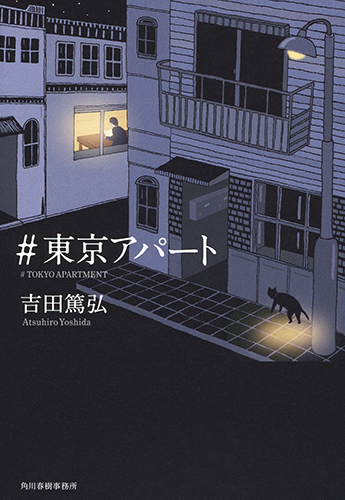
Atsuhiro Yoshida’s 2025 short fiction collection #Tokyo Apartment brings together 21 stand-alone stories about people living in and around Tokyo. The characters are usually living on their own, almost always in retro buildings removed from the city center. There’s very little wealth or glamor in these stories, but their protagonists nevertheless manage to become swept up in the magic of a densely populated megacity.  

A representative story is Tokage-shiki gomuin kaisha (“Lizard-style rubber stamp company”), whose narrator recalls a time when he lived in a building that was once famous for being the largest apartment complex in Japan. The building had multiple floors of businesses, and the narrator worked at one of them as an apprentice to an artisan who took commissions for document signature seals. While dining at his favorite pubs in the same building, the narrator grew friendly with a woman who also worked there. He courted her by sending letters to her apartment – which was naturally in the same building. This story perfectly captures the flavor of the comfortably chaotic retro spaces of the old business/residential complexes of West Tokyo.

Not all of the stories are so cozy, however. Sutorei kuriketto (“Stray cricket”) is about a young man with no money, no friends, and no real prospects for finding a decent job. For the time being, he washes dishes in a small diner. He doesn’t have much room in his life for hobbies, but every night he brings back scrabs of cabbage to feed to a cricket that has entered his tiny apartment through a ventilation shaft. While listening to the cricket chirp in the darkness, the narrator is inspired to help the tiny creature find its way back outside. He might have nowhere to go in his own life, but at least the cricket can be happy and free.

Many of the stories end on a more ambiguous note. In Heya o kimeta hi (“The day we decided on an apartment”), two single fathers become online friends as they swap stories and advice with one another. In time, they become real-life friends and begin sharing childcare responsibilities. They mutually arrive at the conclusion that their lives would be easier if they lived in the same apartment building, so they hire a realtor to find a suitable property. There’s something about this sort of housing decision that feels final, however, and this causes the two dads to wonder if they’re really ready to take such a momentous step into the beginning of middle age.

For the most part, the stories in #Tokyo Apartment are fairly mundane, but there are occasional touches of magical realism. In Yūrei no denwa (“Ghost telephone”), the character Moriizumi returns from Yoshida’s novel Goodnight, Tokyo. Moriizumi manages a service that helps people dispose of their old telephones, which often have too much sentimental value to throw away. In a conversation with a crow who makes nightly visits to her balcony, Moriizumi reflects on how analog technology can feel haunted by the ghosts of people with whom our connections have faded. The crow, who is a connoisseur of the unused objects people dispose of on their balconies, agrees with Moriizumi but prefers to focus on making new connections.

A word I often see in reviews of Atsuhiro Yoshida’s writing is yomi-yasui, or “easy to read.” Yoshida has spent more than a decade carefully cultivating a light and precise writing style, and #Tokyo Apartment is indeed a relaxed and chill reading experience. It’s entertaining to encounter such a wide range of variations on the theme of “apartments in Tokyo,” especially since the narrative voices of these stories are so distinct – which is no mean feat when accomplished within the simplicity of the author’s characteristic style.

As an aside, I might recommend the stories of #Tokyo Apartment to people studying Japanese language. Any one of them might be good for inclusion on the syllabus of an upper-level Japanese language class. In particular, the first and final stories of the collection are short, amusing, and easy to understand from context clues, and I imagine that either of them would be a nice treat for anyone just starting to read Japanese fiction.

Nishiogi Kitan

Nishi Ogikubo is a stop on the JR Chuo Line that runs through central Tokyo and out into the western suburbs. The neighborhood, known as “Nishiogi” to its residents, is right next door to Kichijōji, a trendy area filled with small restaurants, cafés, antique stores, art galleries, and beautiful green parks. Like Kichijōji, Nishiogi has an artsy and laid-back vibe…

…but it doesn’t exist. Not officially, anyway. So how do you get there? According to anonymous forum posts, if you take the Chuo local train that stops at every station, every so often it will stop at Nishi Ogikubo. If you choose to get off at the station that doesn’t exist, however, perhaps you shouldn’t be surprised by the people you encounter there!

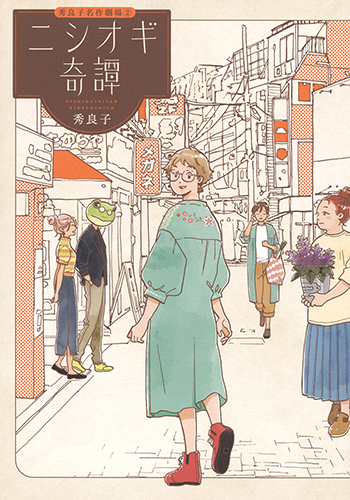
Hideyoshico’s 2025 manga Nishiogi Kitan (Strange Tales of Nishiogi) collects seven stories about a fictional neighborhood where anything can happen. Despite the oddness of some of the residents, Nishiogi is chill and pleasant, and the neighborhood is a lovely place to spend time.

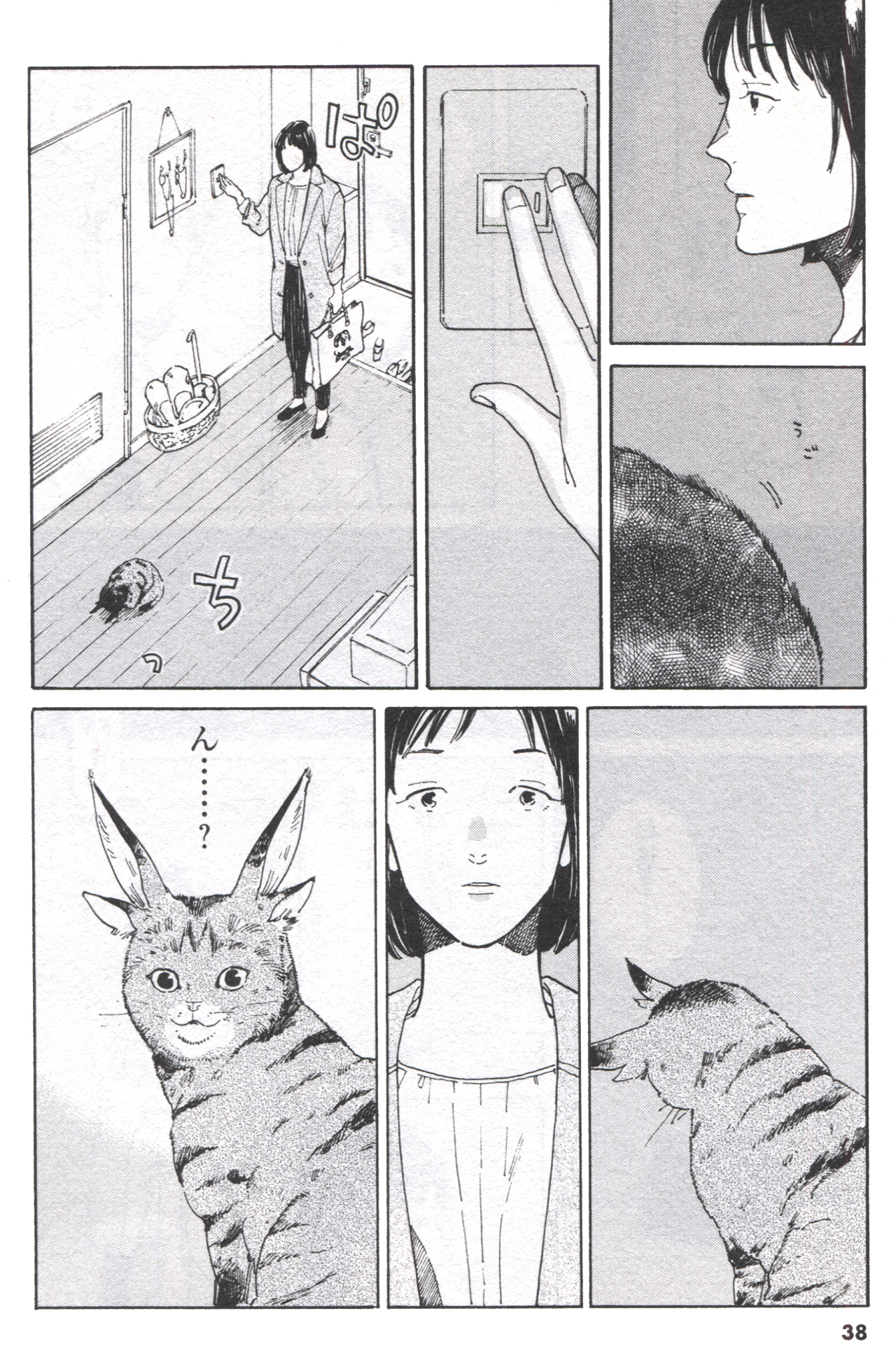
The second story in the collection, Mayonaka no hōmonsha (Late-night Visitor), is a great introduction to everyday life in Nishiogi. While walking home one night, an office worker named Kurata realizes that a cat is following her. It’s not like any cat she’s ever seen, but it seems to have taken a shine to her. She brings the cat home and names it Ohagi. Ohagi’s appearance changes every day, but the most noticeable shifts occur when Kurata is forced to stay late at the office.

When Kurata returns especially late one night, she finds her potted plant overturned and all sorts of leaves scattered across the floor. Hiding under her bedcovers is a big fat tanuki.

Kurata realizes that Ohagi has been exhausting itself while trying too hard to be something it’s not, and this causes her to realize that she’s more than a little tired herself. The next time her boss asks her to work late, she politely tells him that she has a pet at home to take care of, and that he can do the work himself. When given more love and attention, Ohagi becomes a little better at taking the shape of a cat… sort of.

Back in the day, Hideyoshico used to draw dōjinshi fancomics based on Yotsuba&!, and there are hints of the same themes in the collection’s fourth story, Natsu no ie (Summer House). While walking the family dog one afternoon, a young boy passes an abandoned house rumored to be haunted. As the dog frolics in the overgrown yard, an unkempt man eats instant noodles on the porch. Though the man claims to be a ghost, the boy doesn’t believe him, and the two become friends. The reader can never be entirely sure if the man isn’t in fact a ghost, but this is a very sweet and charming story.

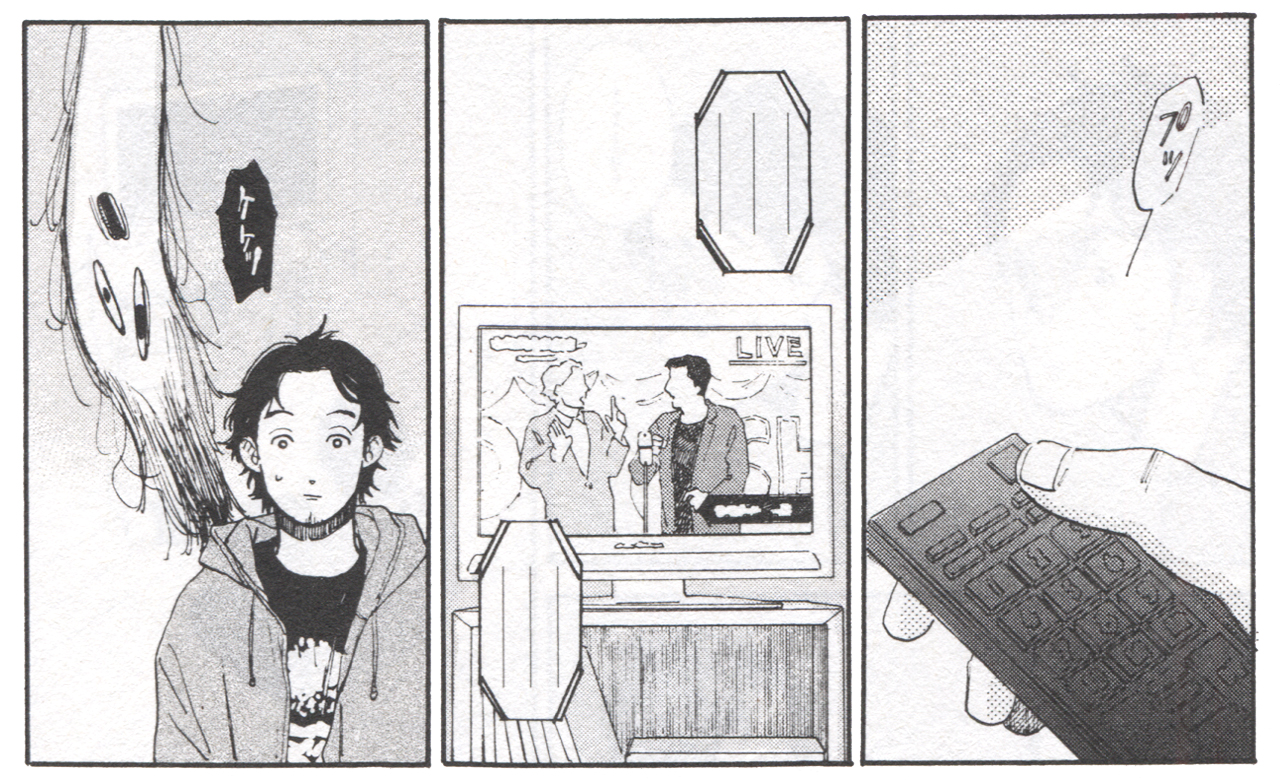
Because I love urban legends about cursed apartments in Tokyo, I’m a big fan of the story “New Heights Nishiogi Apt. 202,” in which a young musician befriends a horrorterror straight out of a Junji Ito manga. The man’s apartment may be haunted, but the rent is cheap, and the eldritch entity is a companionable and considerate flatmate, all things considered. This story isn’t about the man learning to accept his flatmate’s “difference,” as he doesn’t seem to mind that at all, but rather about him learning to respect the spirit’s feelings and boundaries despite his difficulties understanding someone who can’t communicate in human language. 

Hideyoshico is a veteran BL manga artist, and traces of the standard mid-2010s BL illustration style occasionally surface in Nishiogi Kitan. All of the adult male characters are attractive, and I’m not complaining. There’s a wider visual range in the female characters, who seem a bit more grounded in reality, and I’m also impressed by how the artist has portrayed the cluttered interiors and alleyways of West Tokyo. Some of the background architecture is traced (which is 100% valid), but most of the ambience is hand-drawn and lovely to see on the page.

Each story in Nishiogi Kitan is perfectly paced according to a four-part narrative structure, which makes the collection easily approachable despite its array of out-of-the-ordinary scenarios. Though not saccharine by any means, Hideyoshico’s tone is unflaggingly good-natured, and the good humor of the characters is contagious. Though the themes of the stories in Nishiogi Kitan don’t shy away from darkness and nuance, the collection is a weird but warm ray of sunshine.

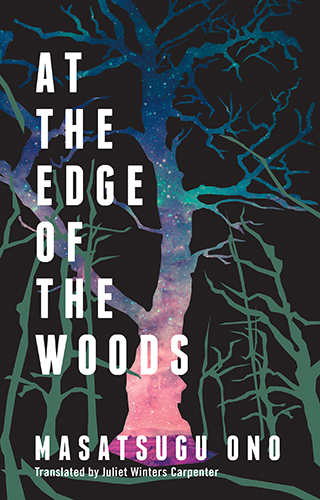
At the Edge of the Woods

In the woods, there is a castle. The castle was once the residence of the landowning family that ruled the area. During the war, it was the headquarters of a resistance movement. Now it sits empty and abandoned. The castle is so deep in the woods that most people couldn’t find it if they tried. No one tries, however, as the woods are filled with child-snatching imps. Strange noises come from the woods, and occasionally strange people as well.

Masatsugu Ono’s At the Edge of the Woods is a novel about dread and anxiety. There’s no plot, nor is there any sort of story. Instead, Ono presents four episodes in the life of a father left alone with his young son while his wife is away. There’s no chronological order to the four chapters, which all occur at roughly the same time, and there’s no meaningful change in the personalities of the characters. Rather, the story development involves the slow intensification of an atmosphere of foreboding.

The nameless father who serves as the narrator is Japanese, as is his wife, who is pregnant with their second child. The wife has flown back to Japan to visit her parents, leaving her husband and son in an unspecified European country that reads as Germany-coded. The family has taken up residence at the eponymous edge of a vast forest in a rural area dotted with small towns.

The country is now at peace, but its neighbors are not so lucky. Long lines of refugees stream across the borders, seemingly unhindered by local authorities. It’s entirely possible that some of these refugees have camped out in the woods next to the narrator’s house, but it’s difficult to say for sure. It’s equally difficult to specify the origin of the odd sounds constantly emerging in the forest.

Characters drift in and out of the narrative, leaving behind very little of themselves save for strong emotional impressions. The disabled daughter of a bakery owner has good intentions but struggles to make herself understood. The postal worker who delivers the mail relates grotesque stories to the father, who suspects the man might be reading and discarding his wife’s letters. A neighboring farmer has always been kind to the narrator’s family, but his son reports that he once saw the man tie a dog in a burlap sack and beat the poor creature to death.

Perhaps the most striking of these characters is an elderly woman that the narrator’s son invites into the house. She appears seemingly from nowhere, and she vanishes just as mysteriously. While she’s in the house, though, she becomes a living symbol of the narrator’s anxieties regarding his ill-fitting role as the solitary caretaker of a young child in a foreign land:

Overcome, the old woman buried her face in her hands. She trembled violently, and a sob escaped her. I looked up. The kitchen windows were all closed. And yet in the air there hovered the sour smell of decayed leaves from deep in the woods, leaves that would never dry out. Steam rose from the old woman. The steam was not from her tea. A puddle spread at her feet. (20)

In his “Introduction” to The Oxford Book of Gothic Tales, Chris Baldick neatly summarizes the genre as an expression of the fear that the horrors of prior eras will not remain comfortably in the past. At the Edge of the Woods presents the readers with a range of Gothic tropes to heighten the sense of uneasy suspicion that, even in the most progressive of European countries, there is no escape from misery and cruelty. While the back-cover copy of At the Edge of the Woods calls the novel “an allegory for climate catastrophe,” this feels like a bit of an interpretive reach. Instead, Ono seems to be suggesting more broadly that, even in our bright society sustained by futuristic technologies, we’re never that far away from the edge of a large and unknowable forest.

At the Edge of the Woods can be difficult to read, and it’s probably not for everyone. Speaking personally, though, I love this book, and I’ve read it on the winter solstice every year since it was published in 2022. Ono’s writing is gorgeously atmospheric, and the legendary Juliet Winters Carpenter has done a dazzling job with the translation. If you appreciate the sort of quiet, eerie, and darkly suggestive Japanese Gothic writing typified by Yoko Ogawa’s short story collections Revenge and The Diving Pool, I’d recommend At the Edge of the Woods as the next step on a shadowed path into the liminal spaces in the penumbra of modern civilization.

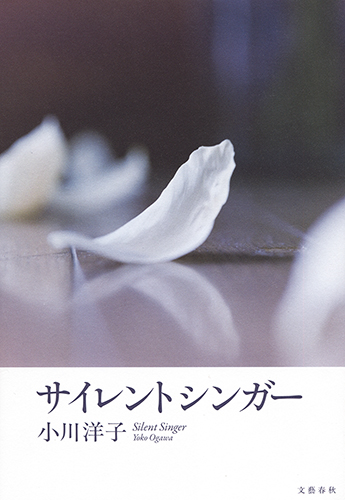
Silent Singer

Yōko Ogawa’s 2025 novel Silent Singer (Sairento Shingā) is a bittersweet story about a woman named Ririka who lives alone in a mountain forest near a community of people devoted to silence. Ririka is a professional singer, but she never makes a name for herself, only taking freelance jobs that require a performer with an anonymous voice. Though the singer and the silent community eventually fade into obscurity, Ogawa celebrates the beauty and dignity of their lives, as well as the significance of creativity that never finds an audience.

On an isolated mountain in the countryside, a group of people calling themselves “The Introverts’ Club” have bought a parcel of land and formed a community named Acacia Fields, which is devoted to quiet and simple living. The Acacia Fields community isn’t a religious organization; rather, they’re normal people committed to the philosophy that “silence soothes the soul.” Anyone can join as long as they’re content never to speak in the presence of others.

Ririka lives in an old house next to a forest adjoining Acacia Fields, where her grandmother is employed as the gatekeeper. The gatekeeper’s job is to communicate with people from the outside world while also managing a small store that sells produce, pastries, and other items produced by the community, which raises livestock and maintains extensive gardens.

While her grandmother manages in the gatehouse, Ririka has the run of Acacia Fields. She spends hours with the aging doctor of the community’s small clinic, who isn’t bound by a vow of silence and reads to her while teaching her “finger language,” a simple form of sign language used by the community. Though her mother committed suicide after being abandoned by her father, Ririka enjoys a happy childhood divided between the public school in the town below the mountain, the doting care of her loving grandmother, and the quiet but genuine affection of the people living at Acacia Fields.

Ririka discovers her path in life during a sheep shearing session at Acacia Fields, when she’s asked to sing a simple lullaby to help keep the animals calm. She performs beautifully and enjoys herself immensely. A town official who attended the event is impressed by Ririka’s singing, and he asks her to record a similar song to be played over the municipal loudspeakers every evening at 5pm. Though no one knows the singer is Ririka, the song is so well-received that the tradition continues indefinitely.

Shortly after she graduates from high school, Ririka’s grandmother passes away. Ririka remembers her grandmother by visiting her Puppet Garden, which the old woman created after a child went missing in the mountain forest one summer. To soothe the boy’s spirit, Ririka’s grandmother fashioned five dolls from discarded household objects and placed them at the center of a small grove. For Ririka, the Puppet Garden serves as a place of quiet meditation. 

Ririka takes over her grandmother’s position as the Acacia Fields gatekeeper while supplementing her income through various freelance jobs passed along by her voice instructor. In each case, Ririka is recommended because of her relative anonymity. Ririka sings jingles for television commercials, performs anime theme songs, records vocal tracks for idol groups, and even provides the voice of a talking children’s toy. Though she doesn’t seem to realize it, Ririka is quite successful as a professional singer, but she never leaves her home on the mountain.

As an adult, Ririka strikes up a romance with the security guard at the parking lot where she keeps her car. On their first date, Ririka takes him to the Puppet Garden, whose dolls are in a severe state of decay. Instead of being creeped out, the security guard is charmed. He’s a good match for Ririka, as he has an odd hobby of his own – piecing together carefully curated scrapbooks devoted to the lost works of famous authors.

The only shadow over the relationship is that Ririka finds herself unable to sing for her boyfriend. She can only sing, she explains, if her audience isn’t a living human. Meanwhile, with few young people moving to the mountain, the Acacia Fields community is in danger of being claimed by entropy and senescence.

Silent Singer resonates with echoes of the Studio Ghibli charm of Mina’s Matchbox; but, as is often the case with Yoko Ogawa’s work, a major theme of the novel is the gentle beauty of decay. Ririka’s house is slowly falling apart, as are the dolls in her grandmother’s Puppet Garden. The agricultural holdings of Acacia Fields are gradually diminishing, and the members of the community are growing old. Regardless, the village remains peaceful, as does the surrounding forest, especially in contrast to the absurdities of the freelance work Ririka takes as a singer. 

In many ways, Silent Singer reminds me of Haruki Murakami’s 2023 novel The City and Its Uncertain Walls, especially in its aggressive refusal to engage with contemporary technology. It could be the case that the nostalgic settings of the two novels are simply a product of the preoccupations of two aging writers, but that’s not how these stories feel to me.

At this point in the death spiral of our capitalist hellworld, I’m bone-tired of “progress” that dehumanizes everything it touches. Meanwhile, Murakami’s narrator leaves his corporate job to work in a small-town library in Fukushima prefecture, while Ririka remains loyal to her home in a quiet mountain forest, which provides a refuge from the profit-driven demands of the entertainment industry. And good for them! I am here for characters who do not give a single fuck about social media or self-branding.

While it might be a stretch to call Silent Singer “anticapitalist,” this is a story about the value of creativity at the margins, as well as the beauty of art without an audience. Ogawa’s obsession with the decay that creeps in at the edges of isolated communities and individual lives can sometimes feel uncomfortable, but let it be uncomfortable! There’s nothing cozy about the richness of human experience, and the care and attention Ogawa devotes to the slow endings of her stories is one of the great pleasures of her work. The work of Ogawa’s “silent” creatives may be unremarked, but it’s far from unremarkable.

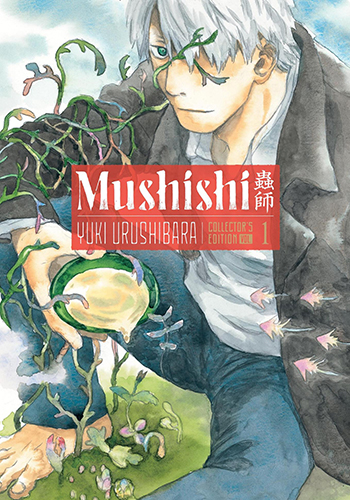
Mushishi

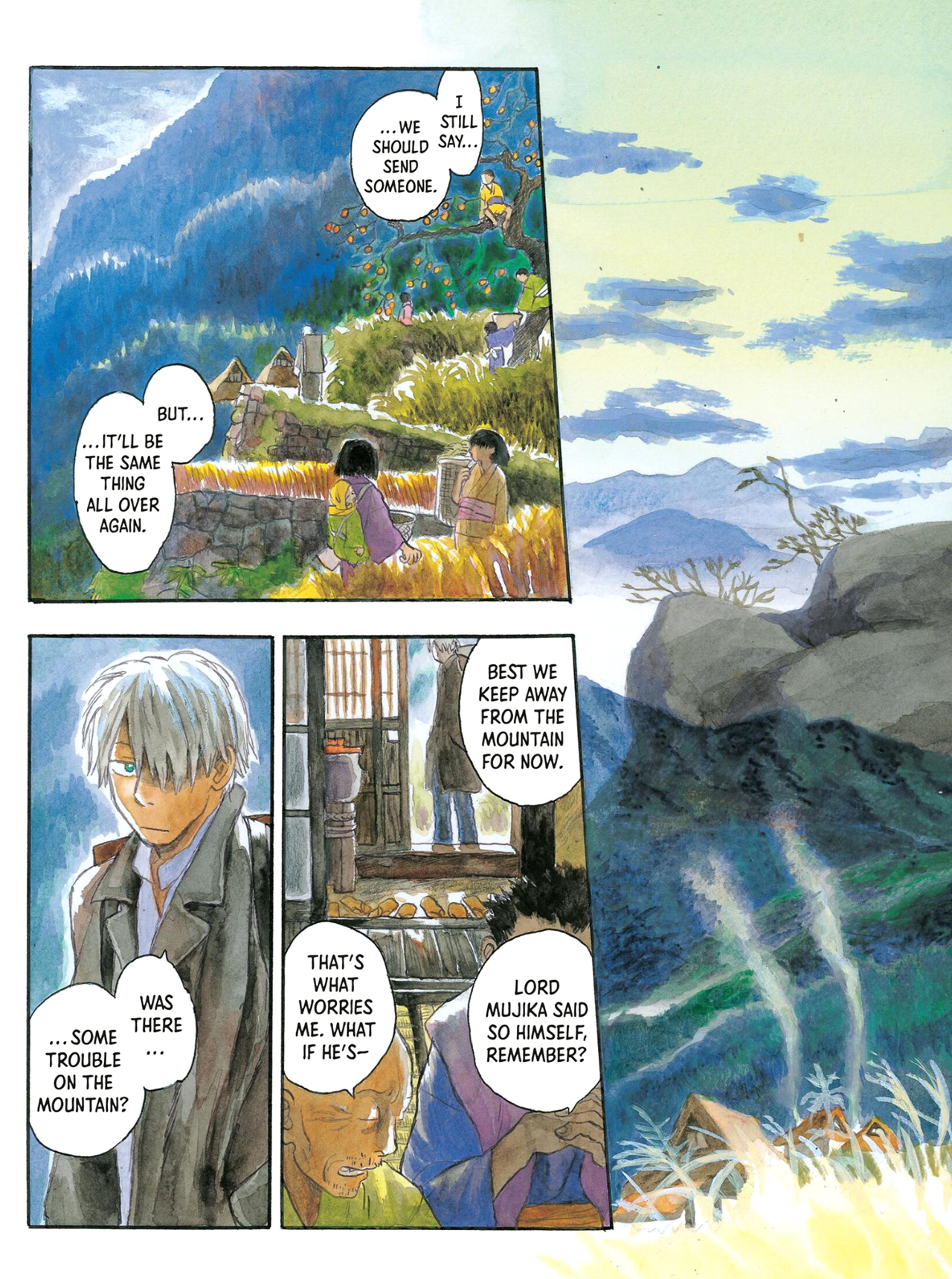
Yuki Urushibara’s ten-volume manga series Mushishi is a gentle but eerie collection of short stories about the uneasy relationship between humans and the natural world. Originally serialized between 1999 and 2008, Mushishi is now available in a series of hardcover Collector’s Editions from Kodansha, which has done a marvelous job with the release.

Mushishi is set in Japan during an unspecified time around the late nineteenth century. Some people wear Western clothing and smoke cigarettes, but traditional ways of life still persist in isolated rural areas, which seem untouched by time.

Ginko is a mushishi (“mushi scholar”) who travels to remote villages to study and document “mushi,” a collective term for a variety of lifeforms that exist partially in our world and partially in the realm of the supernatural. Like germs or bacteria, mushi are tiny and exist unseen by the vast majority of people. Problems arise when mushi form large colonies, especially within human bodies. Even as he studies and admires mushi, Ginko is often compelled to eliminate them in order to restore health to their human hosts.

As is the case with non-supernatural illnesses, people severely impacted by mushi often find themselves unable to return to normal life. In the manga’s second story, “The Tender Horns,” people living in a village deep in the mountains find that they go deaf in one ear when the snow falls. Ginko tells the village chief that this is the result of a mushi called “Un,” which lives in human ear canals and eats sound. This is a temporary inconvenience for most people, but one woman was so deeply impacted that she died. Now her son seems to bear the same affliction, which has manifested as a set of small horns on his forehead.

The tone of Mushishi occupies a liminal space somewhere between nostalgia and horror. Many of the stories have happy endings, but they’re nevertheless pervaded with the uneasiness of living at the edge of an unseen world that has little regard for human life. Mushi, which are something in between plants and animals and spirits, act in keeping with their nature, which is simply to grow and replicate. To most mushi, humans are little more than substrate.

Some species of mushi seem to possess something akin to sapience, however, and their relationship with humans is complicated. One of my favorite stories in the opening volume of Mushishi is “The Traveling Swamp,” in which a marshland appears and disappears seemingly at will. When Ginko studies the pattern of the manifestations on a map, he realizes that the colony of mushi is traveling through underground waterways. The young woman who appears and vanishes with the mysterious swamp has become saturated with the mushi, which have welcomed her as a companion on their journey to the sea.

What Ginko sees of mushi growth and behavior is akin to many written records of Japanese folklore, such as The Legends of Tono and Tales of Times Now Past, in which inexplicable things happen to people seemingly at random. In a time before modern science and infrastructure, the natural world was just as dangerous as it was awe-inspiring. As much as people in rural areas were dependent on nature for their livelihood, they were also at its mercy.

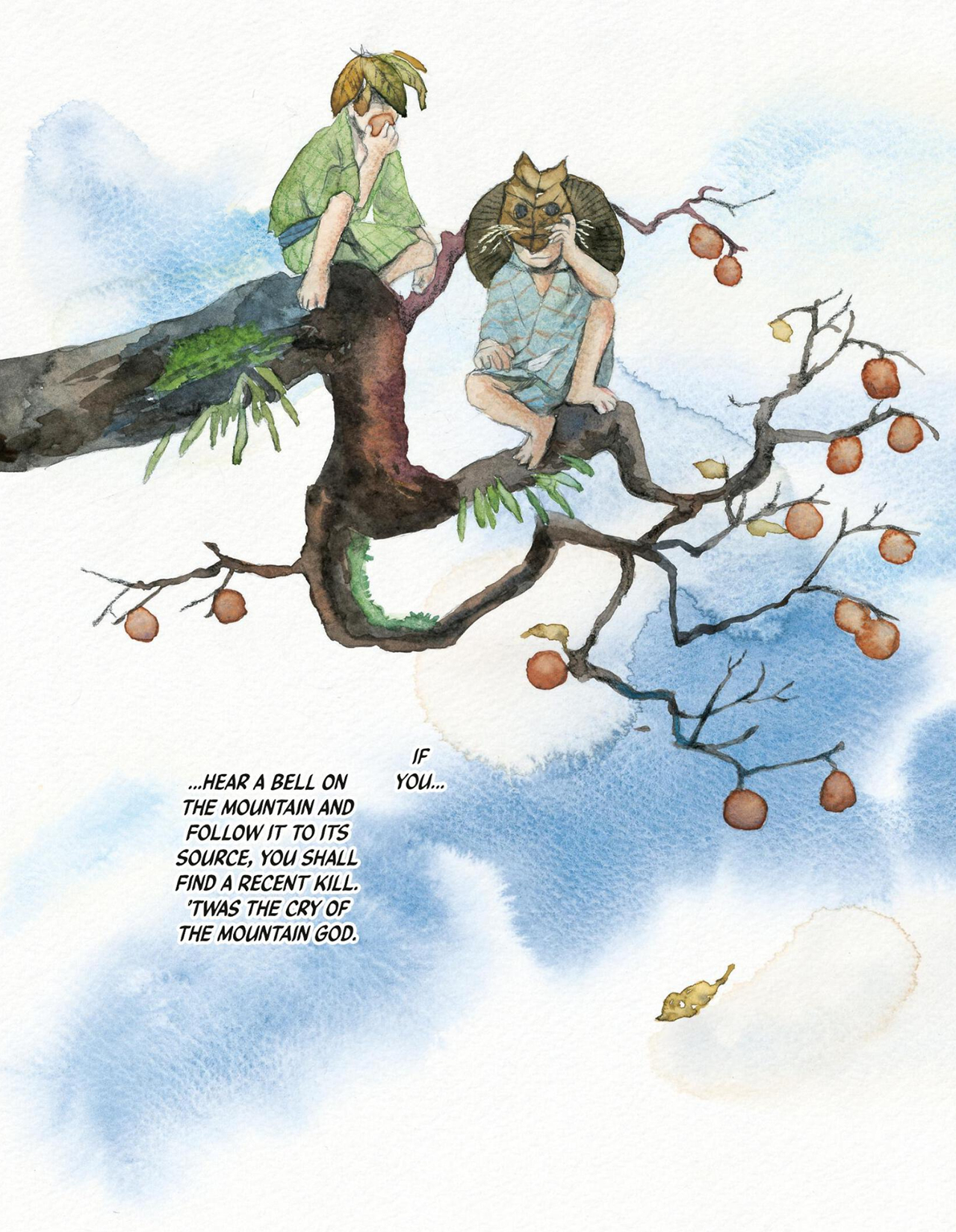
Yuki Urushibara’s artwork delights in wild spaces, from mountain roads to deep forests to ocean vistas to overgrown villages, and her depictions of premodern architecture and clothing are equally impressive. Urushibara is especially skilled with the use of etching and screentone to convey a sense of dim lighting while still using enough contrast to creatively highlight the focal points of each composition. The inkwork is truly impressive, as are the watercolor inserts, and Kodansha’s release of the manga allows Urushibara’s art to shine.

If you’d like to bask in the twilit atmosphere of a deep mountain forest, I might also recommend watching an episode or two of the Mushishi anime (available on Crunchyroll in the U.S.), which is extraordinarily well-produced. The anime is slow and quiet and isn’t for everyone, perhaps, but there’s really nothing else like it.  

Sympathy Tower Tokyo

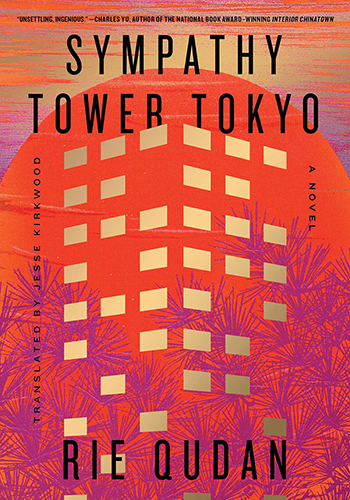
Rie Qudan’s short novel Sympathy Tower Tokyo, which was awarded an Akutagawa Prize in 2023, is a story about language, generative AI, and the culture war discourse surrounding the construction of a fictional prison facility in a high-rent area of Tokyo’s Shinjuku district. 

Sara Machina is an artist and architect who wants to win the bid to design and build the eponymous “Sympathy Tower Tokyo,” a prison right in the middle of metropolitan Tokyo that will operate according to a utopian vision of providing state-mandated shelter to “homo miserabilis,” or people driven by economic precarity to commit crimes because they had no other options, Les Misérables style.

The main problem, in Sara’s eyes, is the name of the building, which is written in English and a mouthful to pronounce: Shinpashii Tawaa Toukyou. It’s also somewhat meaningless, Sara reflects, as are a number of other politically correct English terms that have replaced native Japanese expressions. Amusingly, she provides a list that includes examples such as negurekuto (neglect), which has replaced the formal term ikuji hōki (child abandonment) in public discourse.

Most of these loanword expressions don’t really change the meaning or public perception of the concept itself, but some do. “Homo miserabilis” is one such (fictional) example, having replaced the word hanzaisha, meaning “criminal.” Which is all well and good, Sara admits, but she still can’t envision a structure called “Sympathy Tower Tokyo.” If the building were to have a name that was more euphonic in Japanese, that would be a different story.

An appropriate name is provided by a beautiful young man who goes by “Takt,” a loanword from German used for an orchestra conductor’s baton. Takt became Sara’s casual boyfriend after she saw him through the display window of a luxury fashion store in Aoyama and point-blank asked him out; and, despite the difference in their ages, he does genuinely care for her.

While Sara frets over the intricacies of language, Takt has no qualms about using AI-built, the novel’s version of ChatGPT, to address any questions he might have. Despite his casual use of AI to understand the world and communicate with other people, Takt naturally and organically comes up with the expression Tōkyō-to Dōjō-tō (Tokyo City Sympathy Tower), which rolls off the tongue “like a spell from Harry Potter” and turns out to be exactly the inspiration Sara needs. 

Sara’s design wins, and the tower is built on prime real estate for everyone to see. It is, she says, “the answer to the question posed by Zaha Hadid’s Olympic Stadium.” 

Sara narrates the first and fifth chapters of the novel, while Takt narrates the second and fourth. The third chapter belongs to Max Klein, an American journalist covering Japan who’s gone freelance after being accused of making racist cultural generalizations. Takt is charmed by Max and begins adopting his speech patterns, while Sara (bless her heart) is mainly concerned about Max being fat and stinky and sweaty.

Max himself is a budget version of Hunter S. Thompson who seems to want to “tell it like it is” but unfortunately doesn’t possess the political acumen to make it as a mainstream reporter. In particular, Max is frustrated by what he sees as the tendency of Japanese officials (and Japanese people in general) to use smooth and politically correct language to mask their actual views and agenda.

While Max’s tirade is admittedly gauche, it seems to partially echo the author’s own views regarding excessive linguistic masking, which she expressed succinctly in an interview with The Guardian (here):  

“There are people all around you who you would never think hold discriminatory views but actually do hold those views. A lot of Japanese people, on the surface, they know how to act in a way that makes them seem welcoming of diversity. And this discrepancy between what people think on the inside and what they say is a very distinctive feature.”

In other words, language is political, but the degree to which “correct” language can shape or reshape society is debatable. This question calls to mind the online conversations in 2022 surrounding Tetsuya Yamagami, the man who assassinated Shinzō Abe and attracted immediate widespread sympathy. While the murder itself was shocking, Yamagami’s motives were faultless. How, then, would it be appropriate to talk about him? Is someone like Yamagami truly a “criminal,” or rather a “homo miserabilis”? Regardless, the language we use to refer to people who commit crimes doesn’t change the fact that we feel compelled to incarcerate them, “Sympathy Tower Tokyo” though their prison may be. 

Sara Machina was the victim of an assault that was never punished or even acknowledged, and she can’t quite reconcile herself to rhetorical towers built with politically correct language. Max goes five steps farther and expresses open disdain for the sort of wokeness that dictates that people who caused so much suffering to others aren’t properly treated like criminals but are instead allowed to live rent-free in a gorgeous luxury tower.

In the middle is Takt, the son of a high-profile “homo miserabilis” who ultimately decides to become a PR representative for the tower. Perhaps because he’s so used to consulting AI-built, his speech soon becomes just as smooth and beautiful as his face. When he begins to write about Sara Machina’s architectural genius, however, he finds that AI is insufficient, yet he can find no words in himself. This is fine with Sara, who (relatably) doesn’t wish to be perceived after becoming the target of sustained abuse on social media. 

The plot summary I’ve given here doesn’t begin to do justice to the actual conflict of Sympathy Tower Tokyo, which revolves almost entirely around language. Both English-language and Japanese-language journalists have made a big deal about how “a portion of this award-winning novel was written by ChatGPT,” but this description is painfully misleading. When characters in the novel engage with AI-built, the program’s text was in fact generated by AI, as is appropriate. Although Qudan never has her viewpoint characters make a definitive statement about LLMs, the “smoothness” of machine-generated text is positioned as a mirror to the sort of “politically correct” language used by public officials to disguise and downplay critical issues in contemporary Japanese society.  

In any case, Jesse Kirkwood’s translation is brilliant, and I very much appreciate the brief and informative “Translator’s Note” at the beginning of the book. Also, for what it’s worth, though the diegetic AI-built text may have been generated by an LLM, I didn’t get the sense that it was translated by one. If there’s any criticism to be directed at Sympathy Tower Tokyo, it’s that its emotional core is ephemeral and difficult to pin down. Perhaps ironically, the characters aren’t sympathetic; rather, their role is to serve as viewpoints along a spectrum of opinion. Still, Sympathy Tower Tokyo is a remarkably playful and intellectually stimulating book, and you can’t help but admire Qudan’s boldness in standing up and speaking to the current moment of culture war discourse.

Swallows

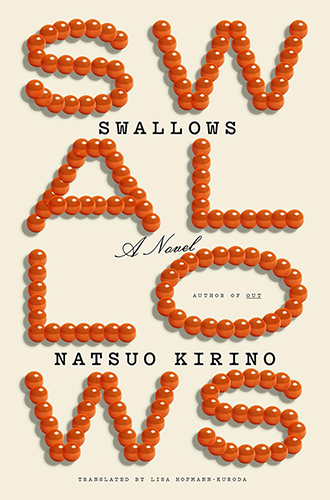
Natsuo Kirino’s 2022 novel Swallows follows an impoverished young woman who becomes a surrogate birthmother for a high-performing couple on the cusp of middle age.

Riki works a full-time temp job as a receptionist at a general hospital, but she can only barely make rent in an aging apartment building in Tokyo. Her parents back in Hokkaido don’t have any money, and she’s completely on her own after leaving a toxic romantic relationship. Her best friend at work, Teru, isn’t doing much better, especially not with an unreliable boyfriend who pressures her to do sex work on the side so she can pay the interest on his debts. 

To raise money, Teru registers to sell her eggs under the auspices of a Japan-based fertility service, and she attempts to persuade Riki to join her. Riki is tired of eating bargain convenience store food, wearing third-hand Uniqlo clothing she buys online, and being harassed by the shitty men who live in her garbage apartment building – so she agrees.

Riki’s application attracts the interest of a company representative who thinks she’d be the perfect fit for a married couple looking for a surrogate birthmother, Motoi and Yuko Kusaoke. Riki has doubts about this situation, which is only dubiously legal to begin with, but the Kusaokes offer her a life-changing amount of money. Once Riki has signed a contract, the husband, Motoi, becomes overbearing in his need to control Riki’s private life; and, to spite him, she has casual sex before receiving his sperm. When she becomes pregnant with twins, she can’t be entirely sure that Motoi is the father. To make matters even more complicated, Yuko feels more sympathy for Riki than she does for her husband, and she’s considering ending the marriage.

Swallows is more suspenseful than you might suspect. Who is the father of the children? Will Motoi and Yuko separate? Will Riki carry the pregnancy to term? And, if she does… what then?

Despite its strong forward momentum, the narrative pacing of Swallows is uneven. The story takes a while to get going, and the opening in particular feels like a series of political talking points in an essay about economic precarity in contemporary Japan, especially in relation to young women. Moreover, perhaps because the author is using the characters to present an argument, they seem to change their position every time a new circumstance arises. While it’s fair to harbor ambiguous feelings about a major life decision, this back-and-forth drags down the middle third of the novel, which feels about fifty pages too long.

Still, Kirino isn’t wrong about the challenges facing young women in Japan, nor is she exaggerating the absurdities surrounding fertility treatments and procedures. I’ve been watching these discussions evolve in academic circles for the past decade, and it’s cathartic to see Kirino come out swinging as she demonstrates the effects that abstract political policies can have on real people. Even as someone who doesn’t live in Japan and isn’t interested in pregnancy, I was still captivated by the human drama played out on the stage of individual lives.

For me, the star character of Swallows is Ririko, Yuko’s friend who works as a professional artist specializing in erotic shunga paintings. Ririko is asexual, aromantic, and only interested in sex as a visual motif in her art. As such, her perspective on romance and pregnancy feels original and refreshing, especially in contrast to the constant waffling of the other characters. 

In addition, the scenes with Ririko are where Lisa Hoffmann-Kuroda’s translation shines especially brightly, as Ririko’s rough language (especially concerning sex) is humorous and colorful without ever stumbling into the realm of coarse or cringe.

Ririko’s family owns a small suburban hospital, and she operates a studio on the property. After Yuko introduces her to the now-pregnant Riki, Ririko invites her to live in the hospital while doing light part-time work as her administrative assistant. This portion of the novel is almost utopian, as Riki is cared for in her pregnancy by what is essentially a commune – a community of (mostly elderly) people who provide companionship and support while Riki does untaxing but important work in exchange for room, board, and a small salary. 

I really enjoyed this part of Swallows not just because of the warm and cozy vibes (by which I mean the fourth-act narrative cooldown necessary to heighten the impact of the fifth-act narrative resolution), but also because I appreciate that Kirino offers a practical and viable solution to the very real issues pertaining to economic precarity that dissuade so many women from even considering pregnancy.

Swallows might be an interesting book to pair with Sayaka Murata’s novel Vanishing World; but, without getting into why Vanishing World’s treatment of pregnancy and Japan’s demographic shift is so disappointing, I have to admit that I infinitely prefer Kirino’s speculative but still grounded application of utopian imagination.

Even if you’re not interested in the topic of pregnancy in Japan, you might be surprised by how much suspense the author manages to generate with the question of whether or not the protagonist will carry her pregnancy to term. Swallows isn’t one of Kirino’s most plot-focused or psychologically astute novels, perhaps, but I still flew through this book, which keeps the reader guessing until the literal last page. Which is fantastic, by the way. Good for her.

The Place of Shells

Mai Ishizawa’s short novel The Place of Shells, which was awarded an Akutagawa Prize in 2021, follows a Japanese woman pursuing her PhD research in European art history at a university in the German town of Göttingen. For a year and a half, she’s shared an apartment with a fellow grad student named Agatha, as well as Agatha’s dog Hector.

Around the late-summer Obon festival, when the spirits of the dead visit the world of the living, the narrator talks to her old classmate Sawata, who studied art history with her as an undergrad at a university in Sendai and currently works as a museum curator. Over Skype, Sawata tells her that their friend Nomiya will be visiting Göttingen for a brief period. This is odd, the narrator admits, as Nomiya disappeared during the March 2011 tsunami and has been presumed dead for nine years.

Nomiya’s sudden appearance isn’t the only strange thing happening in Göttingen. One of the town’s landmarks is its Planetenweg, where memorials representing the sun and planets are placed according to scale. Now that Pluto is no longer a planet, however, its memorial has been sighted in odd places, seemingly at random. In addition, Agatha’s dog Hector has been digging up mysterious bits of rubbish in the forest, and each discarded item is connected to the secret memories of the people in the narrator’s circle of friends. To make matters even more bizarre, the narrator painlessly begins to grow a set of human teeth on her back.

The Place of Shells doesn’t really have a plot, and none of these surreal occurrences are mysteries to be solved. Instead, the narrator reflects on the nature of memory as she comes to terms with the March 2011 tsunami and what she lost in the disaster, as best illustrated by this passage toward the end:

What I had been afraid of was the distortions of memory caused by emotions and the passing of time. That was where forgetting began. What my feet had felt as they went tramping around that seaside town, the scenes my eyes had taken in, the smell of the sea that rushed into my nose – these memories didn’t remain with me as raw sensations, but morphed into a distant narrative. That oblivion concealed more than just the dead who hadn’t returned to land.

As the narrator comes to terms with the constructed nature of her memories of trauma, she encounters a number of ghosts that manifest in cozy apartments and relaxed strolls through the beautiful German town. For most of us, the ghosts of the past have little to do with darkness or shadows; rather, they walk casually beside us during the day. While giving the reader a beautiful environment to explore through careful and attentive prose, Ishizawa encourages reflection on grief as refracted through the passage of time.

I’d also like to mention an aspect of this novel that was immensely appealing to me personally. For various reasons, my frame of intellectual reference is skewed away from Europe, and I’ve always wanted someone who doesn’t assume a thorough knowledge of Christianity to teach me about Western art history. The Japanese narrator (and, I suppose, the academic author speaking through her) presents an accessible discussion of her research on German artistic portrayals of Christian saints that I found fascinating. The Place of Shells is a meditation on art as much as it is on memory, and I feel as though I gained a more grounded and relatable perspective on the sort of medieval European art that I always passed by without understanding in museums.

In doing a bit of research of my own, I realized that each of the women in the narrator’s circle of friends has a connection to her saintly namesake that Ishizawa communicates through imagery both mundane and fantastic. Over the course of the story, the narrator makes something of a pilgrimage through overlapping systems of symbols in a way that mirrors her own academic study of religious art. If a reader were to draw a map of these symbols, I imagine that the constellations would be quite dense, but I found it satisfying simply to follow that narrator’s meanderings without imposing a definitive sense of meaning.

Mai Ishizawa reminds me of Yoko Ogawa in her ability to create a subtle sense of atmosphere through mundane descriptions of calm and lovely places that gradually become eerie through an accumulation of otherworldly imagery. I’m also reminded of the quiet and gentle surreality of Haruki Murakami’s 1982 novel A Wild Sheep Chase, especially in terms of the narrator’s time in the woods and proximity to historical palimpsests overlaid onto daily life.

The Place of Shells is a slow novel to be savored. A spiraling shell is an apt analogy for the style of narration, which only gradually approaches its central theme through ever-smaller circles. Ishizawa’s writing, which Polly Barton has translated with pitch-perfect clarity, is gorgeous and well worth taking a page at a time as the reader, like the narrator, softly explores a world made beautiful and strange through art and memory. 

The Shadow Over Innsmouth Manga

The Shadow Over Innsmouth is a gothic horror story in four acts. A college student on a self-guided architectural tour of New England takes an inexpensive bus that stops over in the isolated port town of Innsmouth. The student explores the town, and an elderly resident tells him about a wealthy sea captain who made an unholy bargain with ocean-dwelling fishpeople generations ago. The student is forced to stay in the town overnight, and the town’s hidden half-human residents chase him from his hotel. After successfully escaping Innsmouth, the student begins to question his own family lineage.

The writing in Lovecraft’s original 1931 novella can be difficult to parse, and the xenophobia of the narrative isn’t attractive to contemporary eyes. Regardless, this is an extremely influential story in the field of speculative fiction, with adaptations ranging from Alan Moore’s strikingly upsetting graphic novella Neonomicon to the ruined Fishing Hamlet of Bloodborne, not to mention countless stage plays, radio dramas, television episodes, indie films, video games, tabletop games, and even delightfully bizarre Christmas songs. Many of these adaptations, though excellent, assume a familiarity with the original that may not exist in an audience that isn’t already embedded in the speculative fiction fandoms of the twentieth century.

If you’re curious about Lovecraft’s work but put off by his prose, Dark Horse’s release of Gou Tanabe’s manga adaptation is an artistic marvel presented with an excellent translation in a handsomely published single volume.

Tanabe’s adaptation of The Shadow Over Innsmouth brings the story to life with the distinctive visual language of horror manga while maintaining as much accuracy to the original as possible. Just like the story’s protagonist, Tanabe is fascinated by the architecture of the rotting Massachusetts town. The immaculately detailed cityscapes that sprawl across the pages encourage immersion into the horror of social and moral decay. Moreover, whereas Lovecraft only hints at what lies underwater, Tanabe is gleefully explicit in his depictions of throngs of fishpeople so horrific they’d make even Guillermo del Toro uncomfortable.

Tanabe’s The Shadow Over Innsmouth succeeds not only as a faithful retelling but also as a standalone work of gothic horror. By pairing Lovecraft’s oppressive atmosphere with his own meticulous draftsmanship, Tanabe bridges the gap between early twentieth-century weird fiction and contemporary horror manga. The manga adaptation of The Shadow Over Innsmouth preserves the unsettling allure of the original while offering both longtime fans and newcomers an invitation to experience Innsmouth’s decayed splendor in disturbingly compelling detail.

NonNonBa

Shigeru Mizuki was one of the twentieth century’s most prolific and influential manga artists. Today he’s known primarily for documenting the culture and folklore of his childhood in rural western Japan. The single-volume graphic novel NonNonBa, originally published in 1992, is perhaps Mizuki’s most accessible work, as well as a fantastic gateway into the study of indigenous Japanese religion and folklore.

NonNonBa tells a coming-of-age story about the artist’s childhood relationship with an elderly family friend, the poor but kind Nonnonba of the title. Nonnonba is a repository of local folklore, and she sincerely believes in yokai, a term that refers to any number of species of Japanese fantastical creatures. The world of NonNonBa is indeed populated with yokai, but the manga is primarily a realistic account of life during the early 1930s.

NonNonBa opens with an introduction to the coastal town of Sakaiminato in the Kansai-region prefecture of Tottori. Despite being a port on the East Sea, the town wasn’t wealthy, and most houses remained unchanged from the nineteenth century. Mizuki’s family was relatively comfortable, and he lived with his mother, his two brothers, and his father, who worked at a bank but had creative ambitions and operated a small cinema on the side. Nonnonba was occasionally employed by the family to help with housework and childcare, as she was by several families in town. 

The artist, who goes by the name of Shige, is a mediocre student but deeply fascinated by the natural world, often bringing home strange objects like animal bones in order to study and draw them. When he’s not at his desk, Shige plays at being a soldier in the “boy army” that roams around the town and beach staging pretend wars with other roving bands of children.  

Shige’s uncomplicated boyhood is disrupted by Chigusa, a cousin from Osaka who is sent to Sakaiminato to recover from tuberculosis. Nonnonba cares for Chigusa while she’s bedridden, and the girl is just as interested in Nonnonba’s yokai stories as Shige is himself. The two become friends, and Shige is heartbroken when his cousin succumbs to her illness. He begins drawing in earnest, no longer as invested in the boy army as he once was.

After losing Chigusa, Nonnonba begins working for a family from the city that has moved into a house rumored to be haunted. She’s charged with the care of Miwa, a young girl who lives in the family’s house and seems to be able to see and hear yokai. Shige believes the girl is a victim of human trafficking, which seems highly likely given the number of other young girls who have passed through the house. Regardless, there’s not much he can do about this as a young boy.

As he develops a close friendship with Miwa, Shige matures, and he understands that growing up isn’t growing away from yokai, but rather realizing that the stories of these creatures are part of a much larger world. Despite their flaws, Shigeru’s mother and father are both portrayed sympathetically, as are his brothers and friends. NonNonBa overflows with sympathy and compassion, gently poking fun at the characters while also encouraging the reader to see them in their best light.  

Despite being published more than thirty years ago, NonNonBa doesn’t feel dated. The stylizations of Mizuki’s artwork are timeless, and his character designs are clean and fresh. The high quality of Jocelyne Allen’s translation contributes to the contemplative yet entertaining tone of the story, whose episodes move briskly but never feel cartoonish. 

Through Mizuki’s sensitive storytelling and evocative artwork, NonNonBa celebrates how folklore inspires imagination and facilitates resilience in the face of loss and change. Despite the occasionally heavy subject matter, this graphic novel is accessible to readers of all levels, and I imagine it would be a fantastic text to spark discussion about history, family, and folklore in the classroom.