Under the Eye of the Big Bird

Hiromi Kawakami’s Under the Eye of the Big Bird is a book about the quiet end of the world. Despite its postapocalyptic setting, the story is gentle. The author’s background as a biology teacher shines through her writing as she imagines the diverse forms that humans and their societies might take in the far distant future.

Under the Eye of the Big Bird is structured as a collection of fourteen stand-alone stories that gradually form a larger narrative, and the reader is encouraged to put together a history from bits and pieces of individual lives. We never see the full picture, however, and I imagine that assembling a concrete timeline would take careful detective work.

This isn’t a plot-driven story that can have “spoilers,” necessarily, but any description of the book’s premise is going to contain analysis and speculation. Under the Eye of the Big Bird is one of the most intriguing works of speculative fiction that I’ve read in years, and this is partially due to its fragmented structure. You may want to venture into the collection on your own before reading any reviews, this one included.

.

Still with me? Let’s go!

Over the millennia, the number of people on the planet has steadily decreased, and the last remaining humans live in isolated settlements of various sizes. In order to ensure harmony, the settlements are discretely managed by “watchers” who have been cloned and genetically engineered to fulfil their duty. Unlike regular humans, watchers grow up in small communities with “mothers” that are all physical manifestations of the same AI.

Everyone takes this arrangement for granted, but their “normal” is not the same as ours. Whether a story is told from a first-person or third-person point of view, the reader can only see the world from a limited perspective. It can be difficult to understand what’s going on at first, but the opportunity to surf successive waves of strangeness is a major part of this book’s charm.     

My favorite story is “Testimony,” which is delivered as a statement to a watcher by one of the new phenotypes of humans to emerge from centuries of genetic isolation. A small number of people are born with the ability to photosynthesize, and the joy they take from the sunlight and changing seasons affects their behavior in surprising ways. If enlightenment exists, these people have attained it; and honestly, it sounds really nice.             

Not all of the future human phenotypes are so peaceful or self-assured, however, and other stories have a bit more conflict. Still, with one notable exception, there’s no violence in this book. If there are wars and explosions, they happen entirely offscreen. Like the watchers and mothers, it’s the reader’s job simply to observe the biology, ecology, and culture of the future.

On the front cover of the American edition, Kawakami is billed as the author of People from My Neighborhood, a loosely connected series of magical realist flash fiction that’s an excellent comparison for Under the Eye of the Big Bird. To me, Under the Eye of the Big Bird also feels like a natural development of Kawakami’s debut short story, Kamisama, in which the narrator has a lovely afternoon picnic with a literal bear. The bear, being a bear, is clearly nonhuman, but no one seems to be bothered by this. The same casual acceptance of difference pervades Under the Eye of the Big Bird, which invites the reader to imagine the mundane everyday reality of the final days of the human race.

I’ll admit that I felt the chilling touch of existential dread at a few points during the book; but, as in any encounter with real difference, this initial sense of discomfort is important. The gentle strangeness of Under the Eye of the Big Bird encourages the reader to confront their biases, and it also lends weight to the narrative theme of human extinction. Instead of presenting the apocalypse as a standard dystopian superhero story, Kawakami allows the reader to take all the time and space they need to consider whether it would really be so horrible if the people we currently think of as “human” were to slowly disappear from the earth.

Under the Eye of the Big Bird is a book about the end of the world, but it’s also one of the kindest and most hopeful works of speculative fiction I’ve had the pleasure to read. Reading this book for the first time was a unique experience, but the impact of its stories linger even after their novelty fades.

Dragon Palace

Dragon Palace collects eight surreal stories by award-winning and internationally celebrated author Hiromi Kawakami. These stories are contemporary fantasies about shapeshifters, talking animals, and interspecies romance that borrow from traditional folklore even as they express the psychological complexity of modern magical realism. Originally published in 2002, Dragon Palace is now available from Stone Bridge Press with a translation by Ted Goosen, who also translated Kawakami’s People From My Neighborhood.

The first story in Dragon Palace, “Hokusai,” is about the octopus who seduces the fisherman’s wife in the infamous ukiyo-e print. At least, that’s who the bum who persuades the narrator to go out drinking claims to be. The narrator is depressed and hates his life, so he easily falls under the sway of the stranger who tells him fanciful stories of his exploits as an octopus-turned-human as they drink their way across a shabby port town. At several points during the evening, the narrator sees his drinking companion shift and change. By the end of the night, the narrator’s own form isn’t as solid as it once was.

Although “Hokusai” defies allegory, I read it as a story about how sad men become shitty men as they gain confidence through the stories they tell one another about women. Despite his unapologetic misogyny, there’s an appealing earthiness – or saltiness, I should say – to the octopus man that I found oddly compelling. Like the narrator, I wanted to hear more of his stories, and I was happy to go along for the ride.

“Hokusai” holds a special charm for me as a fan of H.P. Lovecraft’s 1931 novella The Shadow over Innsmouth, a classic American horror story about a decaying New England town whose residents have started marrying with fishpeople. Like Lovecraft, Kawakami paints a detailed portrait of a grimy port town that has seen better days. Unlike Lovecraft, she offsets the strangeness of interspecies relations by focusing on the more mundane aspects of what it would be like to have an ocean-dwelling boyfriend who doesn’t pay rent. In fact, even more than The Shadow over Innsmouth, “Hokusai” reminds me of Yoko Tawada’s famous short story “The Bridegroom Was a Dog,” which transposes the persistent “beast husband” trope of East Asian folklore to everyday suburban life.

“Dragon Palace,” the title story of the collection, swims even deeper into fantastic waters. The narrator is a housewife visited by the pint-sized spirit of her great-grandmother, who was supposedly a medium at the center of a sex cult before she abdicated to become a wandering vagrant. “Dragon Palace” is a prose poem on heredity and generational legacies, and about how the seeds of mystery are buried in the heart of even the most prosaic housewife.

“The Kitchen God” is a more grounded exploration of the theme of the strangeness hidden in everyday life. A housewife named Izumi is having an affair with an older man named Sanobe. Along with her recreational shoplifting, Izumi believes this affair distinguishes her from the other housewives in her neighborhood. What she seems to take for granted, however, is that her thriving collection of houseplants has turned the inside of her apartment into a small ecosystem. Among the leaves and vines lives a creature Izumi calls “the kitchen god.” This god may or may not be one of the weasels said to have infested the apartment complex, but it’s clearly no ordinary creature.

Images of strange interior spaces continue in “The Fox’s Den,” which is about a middle-aged housekeeper who begins a quasi-romantic relationship with one of her clients, an elderly booklover who once owned a used bookstore and has since become a book hoarder. To the jaded eyes of the housekeeper, this man’s attachment to old books isn’t as remarkable as his foxlike tendencies.  

The housekeeper has been married twice before, once to someone she calls “completely human” and once to another man who had a tendency to behave like a fox. It’s never clear whether the animalistic traits of these characters are literal. Do they shapeshift like the octopus in “Hokusai,” or are these men animals only in the narrator’s imagination? This question is of no concern to Kawakami, who trusts the reader not to get caught up on minor details like “the nature of reality” as she explores the deep and essential weirdness of human beings.

The standout story in the collection is “Mole,” which was previously translated by Michael Emmerich in 2007 and published as “Mogera Wogura” in Kurodahan Press’s Speculative Japan anthology. In the slightly off-kilter world of the story, mole people live in human cities, where they go about their lives just like everyone else. “Mole” is narrated from the perspective of an adult male mole person, who lives with his wife in a hole. Although he’s a normal office worker, what’s unique about the narrator is that he collects humans who have lost the will to live:

The humans are bereft of energy—their faces are lifeless. Yet they are not dead. They live by eating away at their surroundings, at themselves, without ever moving. They remain with us in our hole without ever becoming moles themselves, waiting for the time when, still human, they can return to the world aboveground.

I’ve discussed this story in several of my literature classes, and it’s been my experience that students have a strong positive response. Although “Mole” could easily be read as horror, many students find it comforting to think that someone would pick them up and care for them during the days when they’re too tired to keep going. There’s a certain flavor of darkness to Kawakami’s writing that keeps her work out of the realm of being “wholesome,” but “Mole” comes the closest to a story that might be adapted into a short film by Studio Ghibli.  

I have to admit that I’m not a fan of modern retellings of fairy tales. I tend to find them tedious and awkward, especially when they’re pushed into the service of a political agenda. Don’t get me wrong – I’m all for feminism and gay pride and destroying monarchies. Still, what’s always been interesting to me about “traditional” folklore is how incredibly strange it is. Sigmund Freud was wrong about a lot of things, but I think he was onto something when he talked about how it’s the very absurdity of folktales that allows them to resonate with people regardless of time or place.

The stories in Dragon Palace lean into the more surrealistic elements of folklore in a way I find emotionally satisfying. For example, what does a story about bar-hopping with a shape-shifting octopus mean in literary terms? I’m not sure, but I’ve definitely had a few boozy nights like that myself, and “Hokusai” captures the truth of that experience in a way that a more mimetically realistic story couldn’t. Likewise, what does it mean that the narrator of “Dragon Palace” picks up the off-putting spirit of her great-grandmother and hugs her like a baby? I couldn’t say, but I’ve definitely felt that exact sense of unreality while playing with one of my nieces and realizing that she looks just like my grandmother.

What I appreciate most about Kawakami’s stories is that they’re marvelously entertaining to read. Although it can sometimes be difficult to relate to the characters, each new page holds a fresh surprise for the reader. Goosen’s translation perfectly captures the tone of the original Japanese, in which Kawakami writes the most outlandish things in the most casual and colloquial prose. The style conveys the sense that someone is telling you these stories directly, perhaps as you sit in a cozy bar filled with people whose shapes shift just out of the corner of your eye. Dragon Palace is a fascinating collection of oddities in which some stories are humorous and accessible while others are more poetic and surreal. I’d recommend this striking collection to anyone intrigued by the prospect of catching a glimpse of the wonders that lie just under the surface of everyday life.

People From My Neighborhood

People from My Neighborhood
Japanese Title: このあたりの人たち (Kono atari no hitotachi)
Author: Hiromi Kawakami (川上 弘美)
Translator: Ted Goosen
Publication Year: 2019 (Japan); 2020 (United Kingdom)
Publisher: Granta
Pages: 121

The unnamed first-person narrator of People From My Neighborhood lives in a town that was rural when they were a child but has since developed and gentrified as farmers sold their land. Young people now commute to Tokyo, but a number of interesting people – and creatures – remain in the area. Some of the stories in this collection of microfiction are about the supernatural, but many are about people who are just a little odd or different.

There’s the taxi driver, for example, who spends all night driving around the ghosts of three women who supposedly died in the old tenement housing he refuses to vacate. There’s the self-appointed principle of a dog training program who spends all day loafing around the local park and sharing gossip. A child named Hachirō rotates between families in three-month intervals determined by lottery, as his parents already have fourteen kids. An elderly man who lives in a dilapidated mansion on the outskirts of town is called “Grandpa Shadows” by the local children because he has two shadows, one of which is rowdier than the other.

Then there is the mysterious diplomat who comes to town and provokes panic by going fishing in a lake that doesn’t exist. A princess keeps a beautiful garden and may or may not be responsible for a handful of murders and mass poisonings. One day a temporary mountain of sand appears along with a temporary god, and one day gravity simply disappears for a few hours.

My favorite story is “The White Dove,” in which a high school student picks up a peculiar avian creature during a fieldtrip. She takes the creature home, and it undergoes several metamorphoses before transforming into a sweet-tempered middle-aged man. He has a great destiny to fulfill, but this is largely irrelevant to the girl, who has a healthy sex drive and can think of far better uses for the man-shaped creature who now lives in her house. Although I’m always a fan of monster romance, what I love about this story is the way it sidelines the spectacular in order to focus on the drama of the mundane.

Some characters appear in more than one story, such as the narrator’s friend Kanae, who has a strong personality and goes on to live a storied life. Kanae’s sister, whose dream is to become a psychic medium, also finds herself at the center of several strange occurrences, as do a number of the narrator’s friends and acquaintances. The progression of stories jumps backwards and forwards through time, but the reader is nevertheless able to develop a sense of the social landscape of the small town and its population.

Since each story is only about two to six pages long, it’s fun to dip into the collection a bit at a time to see what’s new in town. By the end of the book, you almost feel as though you live there yourself. If you’re in the mood for a vacation to a place where anything could happen, People From My Neighborhood is your ticket to a bizarre yet relaxing experience.

Parade

Parade
Japanese Title: パレード (Parēdo)
Author: Hiromi Kawakami (川上 弘美)
Illustrator: Takako Yoshitomi (吉富 貴子)
Translator: Allison Markin Powell
Book Design: Wah-Ming Chan
Publication Year: 2002 (Japan); 2019 (United States)
Publisher: Soft Skull Press
Pages: 82

Parade is a short story that takes place during Hiromi Kawakami’s 2001 novel Strange Weather in Tokyo, which is about a woman in her late thirties who falls in love with her former high school teacher, whom she still refers to as “Sensei.” Parade stands on its own, and it’s not necessary to be familiar with Strange Weather in order to appreciate Parade, which is strange and delightful.

Parade opens with the narrator, Tsukiko Omachi, preparing noodles at Sensei’s house. He asks her to tell him “a story of long ago,” and she responds by relating something that happened during her childhood as they spend a lazy afternoon together.

When she was a kid, Tsukiko woke up one day to find two small people sitting beside her bed. They were about her size, and they had long noses, small wings, and bright red skin. Tsukiko decided that they were probably creatures from Japanese folklore called tengu. The two tengu followed Tsukiko to school, but no one seemed to notice them.

When Tsukiko arrives at school, however, she realizes that a few of the other children are accompanied by creatures of their own, such as a badger and a long-necked rokurokubi. The children followed by these creatures can see them, but they remain invisible to everyone else. None of the children find this odd, and Tsukiko’s mother – who once had a fox of her own – treats the issue in a matter-of-fact manner.

These creatures turn out to have less of an impact on Tsukiko’s life than a bullying incident in which Tsukiko’s classmate Yuko is ostracized by the other girls at their school. Yuko has a healthy response to this, ignoring her classmates while still being friendly with other kids her age outside of class. Tsukiko is uncomfortable with the situation, however, and her tengu begin to fall ill.

The situation resolves itself, but there’s no sentimental moral or life lesson to the story, just children behaving in the way that children tend to behave. Instead, the otherness of the tengu serves as a means by which Tsukiko begins to understand her own subjectivity as someone who has never thought of herself as “a tengu person” yet has somehow come to be associated with them. At the same time, she becomes more aware of the subjectivity of other people who are paired with mythological creatures of their own, as well as the subjectivity of people who can’t see them but have no trouble accepting that they exist. There’s no direct allegory implied, but the imagery of Parade is compelling enough to resonate on multiple levels.

Soft Skull Press’s paperback publication of Parade is a lovely physical object, with a velvet-touch cover and finely textured pages. It also features creative interior design work by Wah-Ming Chan and a gallery of abstract illustrations by Takako Yoshitomi (who has also published work in a number of josei magazines, although you won’t see any manga influences in Parade). The book measures about 4 by 6 inches, the perfect size for a short commute or a small gift. Although younger children may not understand the implications of the frame story (namely, Tsukiko and Sensei’s relationship), Parade is suitable for all ages, and I can imagine that it might inspire a few fledgling writers to tell “a story from long ago” of their own.

The God of Bears

The God of Bears
Japanese Title: 神様 (Kamisama)
Author: Hiromi Kawakami (川上弘美)
Publisher: Chūōkōronsha (中央公論社)
Publication Year: 1998
Pages: 205

At the age of 36, Hiromi Kawakami submitted a story titled “The God of Bears” (Kamisama) to the Pascal Short Story Literary Newcomers Prize competition sponsored by Asahi Net, one of Japan’s largest internet service providers. “The God of Bears” was the winning entry, and it was first published online in 1994. “The God of Bears” was later published in print in 1998 in a collection of the same name, which won the prestigious Murasaki Shikibu Literary Prize of that year and the Bunkamura Deux Magots Literary Prize in the following year.

The God of Bears contains nine short stories set in contemporary Japan and connected by an unnamed narrator who encounters a variety of curious people and creatures during her daily life. In the title story, the narrator is invited out on a picnic by a bear who has just moved into their apartment complex. The narrator’s interactions with the bear over the course of a lazy afternoon illustrate both how familiar and how alien he seems as he attempts to adjust to life in human society. Other stories involve similarly supernatural yet mundane creatures, as well as normal people who find themselves in extraordinary situations.

In the second story, “Summer Break,” the narrator spends a few weeks working at a pear orchard, where she adopts a trio of small tree spirits. Like the other stories in The God of Bears, “Summer Break” operates according to the logic of magical realism, which is perhaps why the owner of the orchard tells the narrator not to worry about the small, talking creatures that run through the trees and devour fallen fruit. One of these creatures is introverted and oddly neurotic, and its anxiety over its short lifespan resonates with the worries of the narrator, who feels as if the world is slipping away from her. Both the pear spirit and the narrator grapple with depression, but the conclusion of “Summer Break” embraces healing and self-acceptance.

The stories collected in The God of Bears are suffused with symbolism and subtext, and their themes emphasize appreciation for the natural world and a nuanced understanding of difference. The narrator is an engaging presence whose mood hovers between gentle amusement and dry cynicism, and she leads the reader along a trail of strange experiences while sharing her unique perspective on the fantastic events that befall her.

The God of Bears has the potential to speak to a broad audience of both casual and serious readers. Readers of contemporary Japanese writers such as Haruki Murakami and Yoko Ogawa will be drawn in by the quiet elements of the fantastic and the distinctive but non-intrusive narrative voice. The folkloric nature of many of the stories, combined with the tongue-in-cheek attitude of the narrator, will also appeal to fans of anime and manga. Kawakami’s work is rich in visual imagery that lends itself to the development of a rich world for readers to explore, and the stories in this collection are filled with joy and wonder at the delightful weirdness of everyday life.

Aside from the title story, which can be found in the 2012 anthology March Was Made of Yarn, The God of Bears has not yet appeared in English translation.


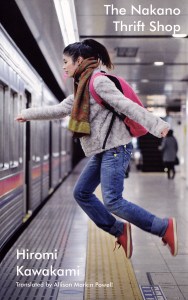
The Nakano Thrift Shop

Title: The Nakano Thrift Shop
Japanese Title: 古道具 中野商店 (Furudōgu Nakano Shoten)
Author: Kawakami Hiromi (川上 弘美)
Translator: Allison Markin Powell
Publication Year: 2017 (United Kingdom); 2005 (Japan)
Publisher: Portobello Books
Pages: 260

Hitomi works at the Nakano Thrift Shop, which is run by a middle-aged man named, unsurprisingly, Mr. Nakano. While she watches the store and works the till, a young man around her age, Takeo, accompanies Mr. Nakano on buying trips. The trio is occasionally visited by Mr. Nakano’s sister Masayo, an artist of independent means. The twelve loosely connected stories in The Nakano Thrift Shop are about the strange and silly things that happen to this odd group of characters, whose small dramas for the most part seem to exist outside of the specifics of time and place.

Hitomi is short-tempered and cagey, Takeo is passive and uncommunicative, and Masayo is chatty and expansive, but it is the stubborn and befuddled Mr. Nakano whose mishaps and shenanigans serve as the focal point or punchline of each story. In the second story, “Paperweight,” Mr. Nakano bribes Hitomi to go visit Masayo and get gossip about her new lover, which sparks a friendship between the two women. In the third story, “Bus,” Mr. Nakano travels to Hokkaido on a buying trip and becomes involved in a one-sided love affair, amusing Hitomi with the messages he sends back to the shop. In other stories, an unusual customer provides a break from the store’s daily routine. For example, in the ninth story, “Bowl,” a young man tries to get rid of a valuable antique bowl, which he believes has been cursed by an ex-girlfriend. The Nakano Thrift Shop is more of a downmarket store, so Masayo forces Mr. Nakano to pass the bowl over to a specialist ceramics dealer with whom he happens to be in the process of breaking off a romantic relationship.

Over the course of the book, Hitomi enters into a romantic relationship of her own with Takeo. This romance never makes much progress, however, as Hitomi demands action and attention while Takeo doesn’t like talking on the phone and is content simply to allow life to happen to him. Like everything in The Nakano Thrift Shop, their relationship is lowkey and laidback, and it ebbs and flows without any sort of drama.

For the reader, the pleasure of these stories lies in peeking into the lives of these characters as they drift through the changing seasons while comfortable in the stability of their friendships. Even though unusual things occasionally happen, no one is ever strongly affected by these events. For instance, in the first story, “Rectangular #2,” an odd man named Takadokoro comes into the store to sell artistic nude photos. Masayo tells Hitomi that the pictures are of Takadoroko’s former student. Takadokoro has the potential to be a truly creepy (or pathetic) character, but the warm narrative tone of The Nakano Thrift Shop treats him as just another person in the neighborhood. He doesn’t bother anyone, and no one is bothered by him. After all, everyone is a little weird once you get to know them.

In the final story, “Punch Ball,” the Nakano shop has closed, and the characters have all gone their separate ways. Hitomi takes various office jobs as a temp worker while she studies for her bookkeeping certification exam. Her current distance from the carefree atmosphere that suffused the earlier stories puts them into perspective, and her former freedom from the pressures of the corporate world now seems much more meaningful. Now that she spends her days sitting at a desk in front of a computer, social interactions are no longer improvised and unique, and friendships are no longer so easily formed. There’s a playful innocence to Hitomi’s time in the Nakano shop that only becomes apparent in retrospect.

The Nakano Thrift Shop is a short and pleasant book that will appeal to anyone who enjoyed The Briefcase (which was published as Strange Weather in Tokyo in the UK). Although it’s a wide leap removed from the darker themes and imagery of some of Kawakami’s other work that has appeared in translation, it’s mercifully free of the sentimentality and melodrama of Yoshimoto Banana novels. As Hitomi seems to be in her mid to late twenties, it’s up for debate whether The Nakano Thrift Shop can be classified as “girls’ literature” (shōjo shōsetsu), but reading these stories conveys a vicarious sense of what it feels like to be a young woman chilling out and having fun in a trendy Tokyo suburb.

Record of a Night Too Brief

Title: Record of a Night Too Brief
Japanese Title: 蛇を踏む (Hebi o fumu)
Author: Kawakami Hiromi (川上 弘美)
Translator: Lucy North
Publication Year: 2017 (United Kingdom); 1996 (Japan)
Press: Pushkin Press
Pages: 158

Record of a Night Too Brief collects three short stories that the book’s cover copy describes as “haunting” and “lyrical” in their depiction of young women experiencing “loss, loneliness and extraordinary romance.” This is a lovely sentiment, but it in no way describes the actual stories in question, which are less “haunting” than they are grotesque and less “lyrical” than they are unapologetically strange. Instead of trying to treat them as romance, I believe it’s much more fulfilling to approach their absurdity in the spirit of intellectual play.

The title story, “Record of a Night Too Brief,” is a sequence of nineteen of the unnamed narrator’s dreams. Each of these dreams is two or three pages long, and they are linked only in that every other scenario features a young woman whom the narrator is either pursuing or in the process of merging with. If there is a unifying theme or plot, it is lost on me, but the power of these dreams comes from their vivid imagery. To give an example (from page 11):

Several dozen ticket collectors stood in a row, and once we passed through, showing our tickets, the tall object came into view.

It was a singer, who stood as tall as a three-storey building. From where I was, I had a clear view of the beauty spot under her jaw, and the rise and fall of her breasts.

“The beauty spot is artificial,” the girl informed me, gazing up at the singer, enraptured.

The singer was producing notes at different pitches, as if she were warming up. When she sang high notes, flocks of birds took flight from the branches of the ginko trees. When she sang low notes, the earth heaved, and small furry creatures emerged from underground and crawled about.

…and so on. It’s all very random, but one can’t help but become swept up in the ebb and flow of the constantly shifting parade of surreal images.

The next story, “Missing,” is set in an apartment complex that functions according to its own arbitrary and bizarre set of customs and rituals. One of the rules of this community is that each household can only have five members. If a sixth member is added for any reason, then someone has to disappear. This recently happened to the narrator’s family after her older brother was engaged to be married. Because his fiancée would have become the sixth person, he disappeared, and the narrator’s other older brother stepped in to fill his position. His fiancée, Hiroko, has no idea that this has happened, as the rules are different in her own apartment complex, where certain members of certain families literally shrink. Meanwhile, the narrator continues to hear the voice of the older brother as he (or his spirit) skulks around the apartment. No explanation is given for any of this, as everyone takes these occurrences for granted.

The final story, which provides the title of the original Japanese publication, is “A Snake Stepped On.” This story is about a young woman who one day finds herself living with a snake. This snake takes the form of an older woman who insists that she is the narrator’s mother. As she accustoms herself to life with a snake, the narrator begins to realize that many of the people around her are also living with snakes, including the local Buddhist priest whom she thought of turning to for an exorcism. Following the conventions of magical realism, the tone of this story is mundane, with the possibility of being devoured by a snake – or becoming a snake oneself – treated as merely another everyday occurrence.

Record of a Night Too Brief is a short collection of curiosities that are fascinating in their novelty. The fantastical qualities of each story allow for various interpretations, and they will no doubt intrigue different readers for different reasons. As contemporary fairy tales, the stories in this collection spark and inspire the imagination.

The Briefcase

Title: The Briefcase
Japanese Title: センセイの鞄 (Sensei no kaban)
Author: Kawami Hiromi (川上 弘美)
Translator: Allison Markin Powell
Year Published: 2012 (America); 2001 (Japan)
Publisher: Counterpoint
Pages: 176

Kawakami Hiromi’s novel Manazuru, translated by Michael Emmerich and published in 2010 by Counterpoint, is a strange, dreamlike story told from the perspective of an otherworldly and unreliable narrator. Manazuru is about pain and bitterness, and broken hearts and broken families.

Kawakami’s newest novel in translation, The Briefcase, is a far cry from the atmospheric surrealism of Manazuru. Its narrator, Ōmachi Tsukiko, is a single woman in her late thirties who is firmly grounded in reality. The Briefcase is about her daily life and centers around her encounters with her former Classics teacher, Matsumoto Harutsuna, whom she still refers to as “Sensei.” Two decades after graduating from high school, Tsukiko meets Sensei by chance at a neighborhood bar, and the two strike up an easy friendship. Each of the ten-page chapters in The Briefcase details an episode in this friendship, such as a trip to an outdoor market or a mushroom hunting excursion with the owner of the bar Tsukiko and Sensei frequent. Seasons change, but not much else does. Nothing particularly dramatic or unexpected happens throughout the large majority of The Briefcase, and the novel’s close attention to detail provides much of its charm.

Although it doesn’t become apparent until a little more than halfway through the novel, Tsukiko gradually develops romantic feelings for Sensei. I would love to say something along the lines of “despite the significant age difference, the relationship between Tsukiko and Sensei blossoms beautifully;” but, in reality, it’s quite awkward. Not only is the situation itself awkward, but both Tsukiko and Sensei are awkward people. They’re not charmingly awkward, or amusingly awkward, or so awkward that want to hug them – they’re just awkward. Still, the gentle progression of their relationship is entertaining in its earnestness, and Kawakami describes it from Tsukiko’s perspective with commensurate delicacy:

At some point, sitting beside Sensei, I began to notice the heat that radiated from his body. Through his starched shirt, there came a sense of Sensei. A feeling of nostalgia. This sense of Sensei retained the shape of him. It was dignified, yet tender, like Sensei. Even now, I could never quite get a holf on this sense – I would try to capture it, but the sense escaped me. Just when I thought it was gone, though, it would cozy back up to me.

The quiet normalcy of The Briefcase is satisfying in and of itself, yet there are some disturbing undercurrents running through the novel. Why is Tsukiko alone? Why is Sensei alone? What happened to him? Why does he always carry around his briefcase? These uncertainties serve to make the story more intriguing, however, and don’t escalate into a full-blown crisis until the very end of the novel, when Tsukiko undergoes a startlingly surreal experience. During two of the final chapters of the novel, Tsukiko’s feelings for Sensei, as well as her fear of his rejection, are explored in a strange sequence titled “The Tidal Flat – Dream,” which may or may not have actually happen. This chapter is a unexpected break from the regular mundane atmosphere of The Briefcase, but it pulls the novel together thematically in a creative and unexpected way.

Allison Markin Powell, who also translated Dazai Osamu’s Schoolgirl, deftly conveys the lightness and humor occasional strangeness of Kawakami’s prose. Although Powell’s English is flawless (with the possible exception of a few out-of-place Britishisms), her style of translation leaves the reader with no doubt as to the Japanese setting of the novel. Passages like…

“Yes, today is a tomobiki day. But tomorrow is a red-letter day, a konoe-tora!”

…and…

Daikon, tsumire, and beef tendons, please, Sensei ordered. Not to be outdone, I followed with Chikuwabu, konnyaku noodles, and I’ll also have some daikon. The young man next to us asked for kombu and hanpen.

…are not uncommon. It’s an interesting style of translation that emphasizes the novel’s focus on peaceful daily life in a richly detailed environment, and it’s fun to read. The culturally specific words scattered throughout the text can be largely ignored if you’re not feeling up for a hyperlinked adventure on Google, though, so they shouldn’t be distracting for the reader.

The Briefcase is a gentle and quiet novel that’s enjoyable both for its story and for its atmosphere, and it’s much more accessible than Manazuru (which is not to say that Manazuru is bad, just very weird). It’s literature that doesn’t take itself too seriously, and I very much enjoyed reading it.