The Legend of Zelda: A Link to the Past

The Legend of Zelda A Link to the Past

Title: The Legend of Zelda: A Link to the Past
Japanese Title: ゼルダの伝説 (Zeruda no densetsu)
Artist: Ishinomori Shōtaro (石ノ森 章太郎)
Translator: Dan Owsen
Publication Year: 2015 (America, new edition); 1993 (America and Japan, original edition)
Publisher: Viz Media
Pages: 196

Full disclosure: I read this manga countless times as a kid, and the game it’s based on is one of the greatest loves of my life. This review is biased, because of course it is.

My own adoration aside, Viz Media’s new publication of manga giant Ishinomori Shintarō‘s adaptation of the 1991 Super Nintendo game The Legend of Zelda: A Link to the Past has been selling extremely well since it was released a month ago.

A Link to the Past on the NYT Bestseller List

This success makes perfect sense. Not only is The Legend of Zelda a major video game franchise with its own culture cachet, but Viz has also managed to put out a handsome publication, and manga’s story is easy to follow and immediately accessible to readers not familiar with the games.

The teenage orphan Link lives peacefully in a quiet village in “the pristine land of Hyrule” when, one stormy night, his uncle is summoned to the castle. Link is awoken by a voice claiming to be the princess Zelda, who telepathically tells him that she is being held prisoner in her own dungeons. Link, fearing shenanigans, rushes to the castle in the rain only to see his uncle put to death by a powerful wizard named Agahnim (whose dark skin and Orientalist stylings are how you know he’s a bad guy, yikes). Link manages to infiltrate the castle and rescue Zelda, only to have her immediately kidnapped once more by the wizard, who intends to use her to break the seal on an even greater evil. Before she’s spirited off to wherever princesses are stashed away in such situations, Zelda manages to tell Link that it’s his destiny to save Hyrule and that he must locate the legendary Master Sword, which is the only blade capable of defeating the powerful force controlling Agahnim. Off he goes, and adventure ensues.

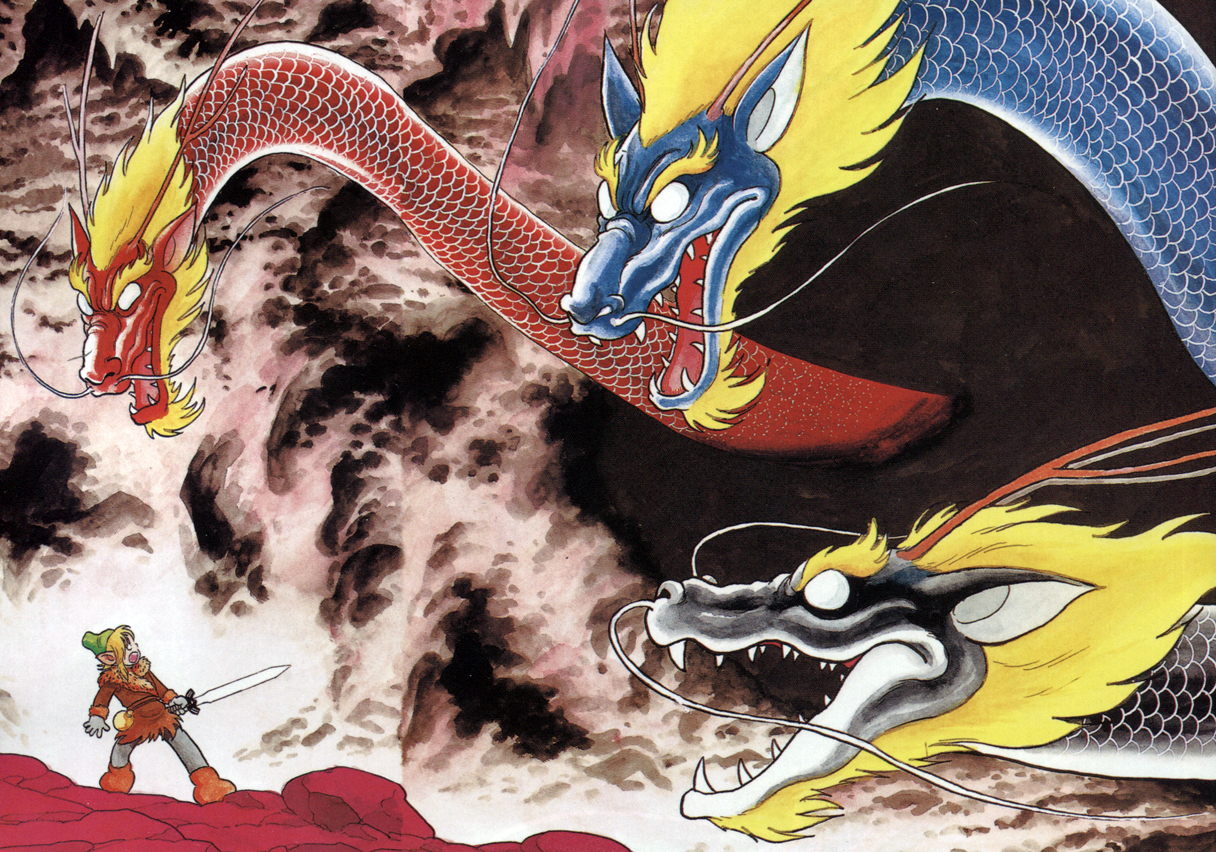
Video game adaptations into other media tend to be hit or miss, but Ishinomori, genius that he is, pulls off his manga rendering of A Link to the Past flawlessly. Although Link is never really alone in the game (as he is always accompanied by you, the player), his quest is a lonely one, as he bears the sole responsibility for delivering the land from a terrible fate. Ishinomori especially excels at portraying Link’s smallness in a vast world filled with hostile creatures. The action sequences – and there are a lot of them – are nicely choreographed, with a smooth flow facilitated by expert paneling. This flow is so dependable that, when it’s interrupted, the reader is instantly made aware that Link has encountered a true threat, as he does in his final battle with Ganon, the story’s ultimate villain.

A Link to the Past Link vs Ganon

The manga is also populated by friendly characters who aid Link along his journey. The most striking of these fellow wayfarers is a bird-like “mystery knight” named Roam (a classic Ishinomori archetype in both personality and visual characterization). The inhabitants of Ganon’s dark world, a mirror reflection of Hyrule that changes the shape of people based on the truest form of their hearts, are also given small roles that help raise the stakes of Link’s battle. For example, immediately after Link is exiled to the dark world by Agahnim, he encounters a talking tree who explains to him that there are many other people who, for whatever reason, followed Ganon into the dark world only to become trapped there, doomed to wander as beasts or serve an evil master until a hero can purify the land. Such accounts add layers of depth to the story that aren’t to be found in the original game, in which the player progresses from objective to objective simply to experience the next challenge.

Despite the assistance of friends he encounters, Link is still one boy caught up in a legend much larger than his own life, a theme Ishinomori emphasizes with splash panels depicting Link as a faceless dot at one corner of a daunting landscape. In the game on which the manga is based, the enemy the player must engage most frequently is the environment itself, and the artist’s translation of this element into menacing backgrounds and elaborate framing devices is beautiful to behold. Ishinomori’s interpretation of Ganon’s castle, the revelation of which is a climactic moment, is especially awe-inspiring.

I would be remiss if I didn’t mention that there are also some fun Easter eggs for Zelda fans scattered throughout the manga. I don’t want to spoil all of them; but, to give an example, Link flies to the Desert Ruins in a winged hang glider. As the villager who provides him with this contraption recounts, “They say these miracle wings belonged to a powerful bird that carried the knights of Hyrule into battle!” In retrospect, this statement seems to refer to the events alluded to in Skyward Sword. And yet, considering that this was written more than ten years ago, one can’t help but wonder how much of the lore explored in more recent games was already in place as the earliest titles were being developed. Or, conversely, was this manga perhaps a guiding influence for subsequent world building?

This manga was originally serialized in the American gaming magazine Nintendo Power from January to December 1992. The following year, it was published as a full-color collected volume by Nintendo of America and in a black-and-white tankōbon by Shōgakukan in Japan. As such, it’s an interesting slice of both manga and video game history. Manga was still relatively unknown in the United States in 1992, and Viz Media only started publishing its groundbreaking Animerica magazine the following year. Meanwhile, Gail Tilden (the marketing manager at Nintendo of America) and the editors of Nintendo Power, the first publication of its kind, were responding to the sudden appearance of a rabid gaming public in the wake of U.S. release of Super Mario Bros. 3 in 1991. (More information about the early years of the magazine can be found in Jon Irwin‘s excellent Super Mario Bros. 2.) It’s extremely interesting that Nintendo was already attempting a manga/game media mix marketing strategy through the burgeoning medium of English-language video game journalism. It’s also interesting that Viz seems to be using a similar strategy – using the popularity of a gaming franchise to promote manga – with this new release.

Even if you don’t usually care for video games or manga, Ishinomori Shōtaro is a force of nature and a credit to the human race. Since it’s difficult to find his work in English translation, Viz’s new edition of A Link to the Past is a fantastic opportunity to see a master artist and storyteller at the top of his game.

A Link to the Past Link's Battle Against Trinexx

Nickelodeon

Nickelodeon Blue

Title: Nickelodeon
Japanese Title: ニッケルオデオン (Nikkeruodeon)
Artist: Dowman Sayman (道満 清明)
Publisher: Shōgakukan (小学館)
Publication Dates: 11/2010 – 10/2014
Volumes: 3 (赤・緑・青)

I sometimes feel as if I’ve spent the past ten years of my life trying to find another Azumanga Daioh: a set of girl-centric stories that are weird and funny and touching without being male gazey. I love Azumanga Daioh‘s cute artwork and bizarre situations and perfect ratio of dark to sweet humor. Having read my way across a large swath of its many, many imitators, I’ve come to the conclusion that Azumanga Daioh is one of a kind. But I’ve found something close, yet different – and just as enjoyable.

Dowman Sayman’s Nickelodeon series is, on the surface, nothing like Azumanga Daioh. Each of the manga’s stand-alone stories is exactly eight pages long; and, aside from a few inconsequential crossover references, they have nothing to do with each other. Whereas Azumanga Daioh was all about the daily lives of high school girls, the subject matter of the stories in Nickelodeon ranges from grotesque fantasy to sci-fi spoofs to sarcastic magical realism. Unlike Azumanga Daioh, which has few male characters of note, the cute girls of Nickelodeon are more than adequately balanced by cute boys. What Nickelodeon does have in common with Azumanga Daioh is the tone of its unique style offbeat humor, as well as the artist’s ability to imbue stock characters with unexpected depth and feeling.

At the core of each of the stories in the series is a relationship between people, with “people” being a relative term. These relationships can be friendly, or romantic, or antagonistic, or a mix of all three. Boys are paired with girls, boys are paired with other boys, girls are paired with girls, girls are paired with tigers, boys are paired with flesh-eating demons, high school students are paired with clueless angels, conjoined twins are paired with blind dates, and ghosts of all sexes are all over the place. There are robots, giants, mad scientists, wish-granting devils, zombie princesses, and seemingly normal people with all manner of strange hobbies. The artist is like Scheherazade, spinning a seemingly infinite number of stories out of contemporary pop culture tropes, but all of his stories are refreshingly original.

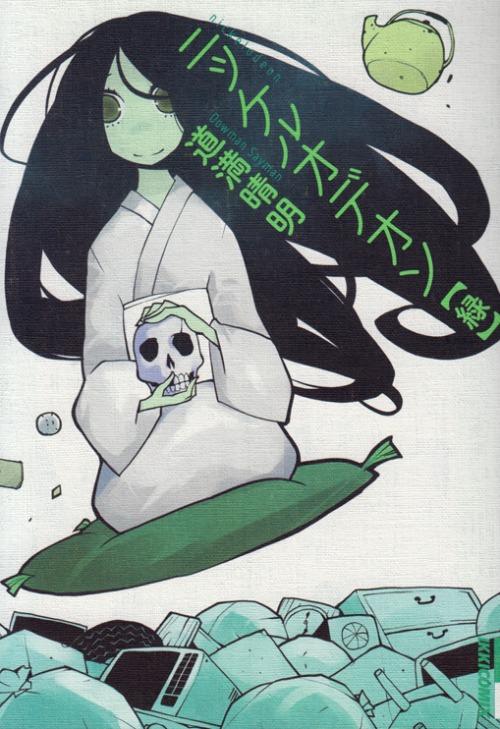
One of my favorites is the cover story of the “Green” volume (pictured below), “Hickey & Gackey” (Hikkī & Gakkī). The piece opens with a girl named Otowa delivering a set of handouts to her classmate Sengoku-san, who seems to have become a hikikomori some time ago. Sengoku-san lives alone in her house, which has become a gomi-yashiki (trash hoarder’s den). After speaking briefly with Sengoku-san, Otowa promises to come again next week, but Sengoku-san tells her that this is the last time they’ll meet, as the city is sending an enormous garbage disposal unit named “Duskin Hoffman” (Duskin is a Japanese company that makes Swiffer-like cleaning implements) to her house to dispose of her like the rubbish she is. Suddenly, the ground starts shaking, the blades start whirling, the trash starts flying, and Otowa reaches out to Sengoku-san, making a last desperate confession. It’s absurd and ridiculous but somehow manages to punch you right in the feels, and the ending is beautifully open to interpretation.

Nickelodeon was serialized in Shōgakukan’s recently defunct IKKI monthly alternative seinen magazine, and its readers were thus expected to be genre-saavy and open to weirdness. The manga also contains moments of overt sexuality – it’s nothing that could even remotely be considered pornographic, but some of the characters are shown engaging in adult thoughts and behaviors, and there is occasional cartoonish nudity. The humor is for the most part good-natured, and the author emphasizes and plays on the silliness and personality quirks of his characters, not the sizes and shapes of their bodies. However, because male and female humans are portrayed as having nipples (the horror!), I don’t foresee Nickelodeon being licensed in North America. If you can speak a little Japanese, though, it’s fairly easy to read. In fact, I assigned a chapter to my fourth-year Japanese class this past fall, and the students seemed to really enjoy it.

Nickelodeon is almost perfectly bespoke to my own personal tastes, so it may be that I’m biased, but I think the three-volume series represents many of the great pleasures of manga written for an adult audience. Downman Sayman is wonderfully talented, and I’m expecting great things from him in the future. Hopefully one day his work will find its way into English!

The artist has two other two-volume seinen series, The Voynich Hotel (Voinicchi Hoteru) and Paraiso (Para☆Iso), available on Amazon.co.jp, and you can also find him on Twitter. Although he hasn’t updated it in some time, he has an account on Tumblr, which is cute and hilarious (but not entirely safe for work).

Nickelodeon Green

Marshmallow Bungaku Girl

Marshmallow Bungaku Girl

Title: Marshmallow Bungaku Girl
Japanese Title: ましまろ文學ガール (Mashimaro bungaku gāru)
Alternate Title: Mädchen Marshmallow Literatur
Artist: Amano Taka (天乃 タカ)
Publisher: enterbrain (エンターブレイン)
Publication Dates: 6/27/2011 – 2/15/2013
Volumes: 2

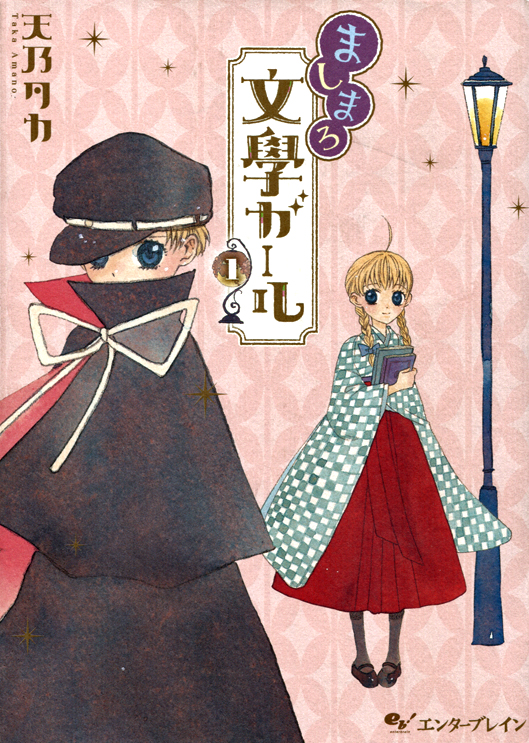
In the late Meiji Period, as Japan undergoes the process of modernization, Hoshino Mone is a student at an all-girls private high school in Tokyo, where she lives with her male guardian, Sei. Although a young woman’s duty is to be beautiful and modest so as to become a suitable bride, Mone has a different dream – she wants to write literature! Literature (the bungaku of the manga’s title) is believed to corrupt women, so Mone cuts off her braids, dons schoolboy clothing, and joins an all-male literature club. Although she must face a bit of drama concerning her choices, the friends Mone makes help her hone her talents and offer her inspiration as they take her on adventures around town. The handsome young literary illustrator Nasuhito knows Mone’s secret but believes in her potential. Nasuhito’s respect for Mone as a fellow artist is not the only source of his warm feelings for her, however.

Although Bungaku Girl was published in the seinen magazine Fellows! – the former name of Kadokawa’s prestige-format monthly serial Harta (ハルタ) – it reads like a shōjo manga from the 1990s, when the influence of series such as Fushigi Yûgi and Cardcaptor Sakura injected elements of gender bending and bishōnen harems into even the most prosaic romance stories. All of the young men in the literature club are impossibly gorgeous, and everyone is decked out in immaculate period dress. There’s a hint of yuri provided by the radiant high school princess Sono, another literature fan who becomes enamored of Mone’s courage and independent spirit, but there are no elements of the male gaze to be found in the manga’s story or art. Instead, there are touches of Mori Kaoru in the close attention paid to historically accurate fabrics, interiors, street scenes, and city vistas.

Bungaku Girl is less about Mone’s cross-dressing and gender identity than it is about her commitment to doing whatever it takes to find a supportive community for what she loves. Many of the story’s most powerful moments occur when the characters are being creative – when Mone is writing, or when Nasuhito is drawing, for instance – and these moments are reinforced by being framed within the sense of belonging to a group of people all working together to share their ideas and produce something tangible. For us nerds who have studied modern Japanese literary history, there are pleasurable echoes of the student groups, coterie magazines, and research trips into pleasure districts associated with real-life literary figures.

This two-volume series is only available in Japanese, but it would be really cool if someone were to license it in North America. The story is simple and charming, the characters are adorable, and the art is clean and attractive. Bungaku Girl offers love, drama, and interesting imagery, not to mention encouragement to leave your comfort zone and live your dreams!

Bungaku Girl Volume 1 Page 23

I… want to join your literature club!

From Five to Nine

From Five to Nine 1

Title: From Five to Nine
Japanese Title: 5時から9時まで (Goji kara kuji made)
Author: Aihara Miki (相原 実貴)
Publication Year: 2010 (ongoing)
Publisher: Shōgakukan
Pages (per volume): 190

From Five to Nine is the current project of Aihara Miki, whose manga Hot Gimmick and Honey Hunt have been published in English translation by Viz Media. Like Aihara’s earlier titles, From Five to Nine is a drama-filled exposé of the love lives of gorgeous young people going about their business in the trendy districts on the southwest side of Tokyo. From Five to Nine is serialized in Monthly Cheese!, an unfortunately named magazine that serves as a bridge between a shōjo readership of tweens captivated by stories of pure love and a josei readership of young women interested in the more physical aspects of romantic relationships. In accordance with the magazine’s house style, all of the characters in the manga are well dressed and ridiculously attractive, emotional and sexual tensions always run high, and chapters end on cliffhangers more often than not. In other words, From Five to Nine is highly entertaining, addictive reading. It’s designed to be.

What I think is interesting about this manga is the way it explores the conflicts between different gender roles and expectations of femininity through the love affairs of its main protagonist.

Sakuraba Junko, the leading lady, teaches during the evenings at an English language conversation school (Eikaiwa gakkō). Because of her friendly professionalism and almost native fluency, she’s considered to be one of the top instructors at her workplace, and her dream is to save up enough money to study abroad in America. Since Junko has passed through her early twenties without having settled down with a man, her grandmother has started to set her up on dates with potential marriage partners through a somewhat formalized process known as miai. To appease her grandmother, Junko spends her twenty-seventh birthday out on a miai date with a Buddhist monk named Hoshikawa Takane, who graduated from Tokyo University with a major in Indian philosophy. Junko is put off by what she sees as Hoshikawa’s snobbishness; but, thinking that their date is a one-time thing and that she’ll never see him again, Junko ends up sleeping with him on a lark. For Hoshikawa, however, that one night is the beginning of TRUE LOVE FOREVER.

Because this is a manga by Aihara Miki, Junko is fated to be the unfortunate object of nonconsensual manly persuasion concerning a relationship that she doesn’t particularly care for. Immediately after Junko gets back from her one night stand with Hoshikawa, she realizes that the deadline to move out of her apartment, whose building is slated for renewal, is fast approaching. When she goes to her grandmother for help, her grandmother suggests that she take temporary residence (geshuku) in a temple with connections to the family. Unfortunately, this temple is headed by Hoshikawa, who now wants to make Junko his temple wife (tera no yome). Being a temple wife is a full-time job, and a marriage to Hoshikawa would require Junko to give up her position at the English conversation school where she currently works, as well as her dream to study abroad. Essentially, if she were to marry Hoshikawa, Junko would have to give up the pleasures of her existence as an independent urbanite and spend her days cooking, cleaning, dressing herself in traditional clothing, setting out flower arrangements, and entertaining guests. Needless to say, she wants none of this. Hoshikawa won’t give up on her so easily, however, and he takes to stalking her, abducting her, and harassing her at both at home and at her workplace. One particularly unpleasant stunt Hoshikawa pulls is to lock Junko up in a small guesthouse separated from the main temple compound by an ornamental garden. In order to escape, Junko agrees to marry Hoshikawa; and, to keep him fooled regarding her true intentions, she makes a show of waking up early to devote herself to cleaning, all the while scheming of ways to get away from the temple.

Meanwhile, her college friend Mishima Satoshi, who has been assigned to his company’s branch office in America, shows up at Junko’s school in order to brush up on his English. Mishima has feelings for Junko and harbors a secret desire to take her to America with him; but, as Junko becomes more aware of Mishima’s intentions and her own reciprocal feelings for him, she surprises herself by becoming conflicted over leaving Hoshikawa and the life he’s offering her. Junko has also attracted the interest of one of her younger pupils, a wealthy student at an elite high school who cross dresses so effectively that only a small handful of his friends know that he’s actually male. This student, Satonaka Yuki, dislikes both Hoshikawa and Mishima and wants Junko to be able to stand on her own two feet outside of relationships with creepy stalker monks and alcoholic playboy salarymen.

This is high melodrama, of course, but what is interesting about Junko’s love life is how aptly it represents the push and pull between traditional and contemporary women’s roles. Should Junko give into social and sexual pressure and relinquish her independence and her dreams, or should she take advantage of a potential romantic partner’s kindness in order to break free of the constraints of living in Japan? Is it possible for her to somehow fend for herself without a social and economic safety net? Because of the romantic drama, the reader is able to experience the emotional attraction and anxiety of all of these possibilities. For example, when Hoshikawa does something ridiculous in order to (sometimes literally) lock Junko into a traditional gender role, the denial of agency that Junko suffers is viscerally upsetting to the reader. As it gradually becomes clear that Hoshikawa genuinely cares for Junko, however, it also becomes clear that Junko’s spirited resistance might be able change the way he sees the responsibilities and aspirations of the women of his generation. In this way, Hoshikawa serves as a representative of a society that is still primarily dominated by phallocentric interests. He’s scary, and his behavior is obviously psychologically unhealthy, but he can be persuaded to change by a woman smart enough and tough enough to take him on, even if she’s coming from a position of relative disadvantage. The sort of “he can change” mentality Junko comes to embrace is presented as being just as dangerous in the fictional world of the manga as it is in real life, but the alternative – “he will never change” – would be a bleak prognosis on the sort of patriarchal mentality Hoshikawa represents. The possibility that Hoshikawa can change himself as he learns that women are people too (gasp!) is an element of social optimism that serves as an emollient to the seemingly misogynistic sexual drama of the manga.

Two other female employees at Junko’s workplace, Yamabuchi Momoe and Mōri Masako, act as counterpoints to Junko’s situation by providing different attitudes towards employment, love, and marriage.

Along with Junko, Momoe is one of the most professional and sought after instructors at the conversation school, but she has a reputation for being standoffish and emotionally chilly. Although she’s all business in the office, she secretly loves yaoi manga. When Arthur Lange, a blond-haired foreign instructor from Britain, discovers Momoe’s hidden interests, he uses the threat of revealing her identity as a fujoshi to her boss to blackmail her into a relationship. Although Momoe enjoys fantasies of attractive, foreign-looking men being sexually aggressive and emotionally manipulative, the enactment of her fantasy is much more unpleasant in real life than it is in the pages of yaoi manga. Momoe is older than Arthur, but she has never had any romantic experience, and she constantly second-guesses her reactions to his teasing and bullying. She therefore often finds herself in the position of wondering how a woman her age should behave towards men, even though she wants nothing to do with them.

Masako, a receptionist at the English conversation school where Junko and Momoe teach, is a recent college graduate who, more than anything, wants to settle down with a boyfriend and become a housewife. Her coworkers tease her by calling her “Zexy,” a nickname taken from the title of a wedding and bridal magazine. Since Masako is attractive and intelligent, her standards for a partner are high, and she can’t find anyone her own age who meets them. Unfortunately, having cultivated an attitude of flirtatious approachability, she finds herself the constant target of unwanted male attention, especially in the form of sexual harassment from middle-aged men.

Junko’s English conversation school is thus a microcosm of Japanese society staffed by different women with different expectations, goals, and challenges concerning their futures. Although the manga focuses on its three main female characters, the male characters are also allowed enough interiority for the reader to see them working, talking to each other, and thinking about their own dreams and romantic problems. All of these characters work at cross purposes because of the artificial drama created by the manga artist, but their attitudes and emotional conflicts ring true to real social expectations and gender roles.

From Five to Nine is a fascinating exploration of contemporary Japan with enough intersecting plot lines, character development, and thematic subtlety to keep even the most demanding readers engaged. The obi bands around the manga covers tout the series as “a Tokyo version of Sex and the City,” and that should be recommendation enough for anyone seeking a fast-paced, hormone-fueled examination of gender roles in the twenty-first century.

From Five to Nine 2

Thermae Romae

Thermae Romae

Title: Thermae Romae
Japanese Title: テルマエ・ロマエ(Terumae Romae)
Artist: Yamazaki Mari (ヤマザキ マリ)
Translation: Stephen Paul
Publication Year: 2012 (America); 2009-2010 (Japan)
Publisher: Yen Press
Pages: 372

This manga is fantastic.

There’s a drawing of a naked man on the cover (you can see his penis under the removable acetate), and there’s a chapter about Roman and Japanese phallus worship. There’s also a chapter about the Bar Kokhba revolt that’s sympathetic to the Romans. The manga tacitly acknowledges Roman homosexuality (Emperor Hadrian is an important character) and Roman slavery (Emperor Hadrian thinks it’s funny that his pet crocodiles have bitten his slaves). All of this is in the background, however; and, if you can get around it, you will love this manga. It’s like reading a super-awesome issue of National Geographic, except with time travel.

Thermae Romae is about Lucius Modestus, a Roman architect living in the first half of the second century who specializes in designing baths and balnea, or bath houses. At the beginning of the story, he sees his own time as possessing an inferior bathing culture and wants to return Rome to the glory days of bathing, but his designs are considered old-fashioned and unmarketable. While taking a breather in a public bath house after being fired from his job at an architectural firm, Lucius slips and is sucked through a water vent into a sentō, or public bath, in twenty-first century Japan. Lucius thinks the Japanese are just slaves from one of the lands that Rome has conquered (he calls them “flat-faces”), and the Japanese think Lucius is just another clueless foreigner (they call him “gaijin-san”), and thankfully no gaping time-travel-related holes open in time and space. Lucius is taught the joys of contemporary Japanese baths; and, after being sucked through another hot water vent, he returns to Rome to share his own adaptations of certain aspects of this culture, which prove popular with his fellow romans.

Although the story gradually develops over the course of the manga, it remains largely episodic. In each chapter, Lucius encounters a problem, is transported to contemporary Japan, learns about Japanese bathing culture, returns to Rome, and implements his own versions of what he saw in Japan to the amazement and delight of everyone involved.

Through these episodes, the reader gets to visit various parts of the city of Rome, as well as locations such as Emperor Hadrian’s mansion in Tibur, Trastevere (a small city on the banks of the Tiber River), and the Roman province of Judea. Also on offer are the hot springs of the Tōhoku region, including monkey hot springs and therapeutic hot springs for convalescents. In his accidental journeys to Japan, Lucius also finds himself in the bathroom of a private residence, a corporate showroom for bathtubs, and even an aquarium that uses the water from a natural hot spring to create a habitat for crocodiles and banana trees.

If exploring contemporary Japan and ancient Rome is half the fun of this manga, the other half is watching Lucius in action. Lucius, earnest to a fault, is a classic straight man who is very serious about everything and responds to every situation he finds himself in with utmost sincerity. Although his upright personality isn’t directly exploited for laughs, it occasionally leads to humorous situations, such as when Lucius takes off his clothes in inappropriate places (for science!) in modern Japan. Mostly, however, Lucius’s personality allows him to act naturally in situations that would otherwise be extremely awkward or uncomfortable. He’s a sympathetic character, and his intelligence and curiosity allow the reader to see and experience more than would be possible if Lucius were a more cynical or self-conscious person.

At first glance there seems to be an undercurrent of “everything in Japan is the best thing ever” running throughout the manga, but I don’t think the artist ever takes the story seriously enough for her celebration of Japanese bath culture to come off as jingoistic. Through Lucius, who is by turns clueless and comically sincere, Yamazaki pokes fun at both ancient Rome and contemporary Japan. The Romans thought they were the most civilized people in the world, but their culture is capable of improvement through outside influences; and, while Japan has a fantastic bathing culture, it’s not flawless either. If Emperor Hadrian trying to recreate the scenery of the Egypt in his private estate is a bit silly, so too is a Japanese zoo that grows bananas. Whether it’s foreign live-in caregivers for elderly people in Japan or Lucius’s frustrated wife leaving him for another man after he runs off to spend three years in Judea, the manga always treats its subject with gentle good humor.

Yamazaki’s art isn’t hyper-detailed, but it is pleasantly realistic. Although she uses screen tone, most of the texture in her drawing, such as the roughness of cloth or the movement of water or the blush on freshly bathed skin, is conveyed by pen strokes. She slightly abbreviates both line and texture in about half of her panels to give the page a clean and open feel and to draw attention to the more visually dense panels. There are always several pages in each chapter that display nothing more than talking heads, but Yamazaki is capable of conveying such a wide and deep range of emotion with facial expressions and body language that these pages never become oppressive or boring.

Perhaps the most pleasant surprise for me in Thermae Romae were the two-page essays at the end of each chapter. These essays, which are always accompanied by a handful of captioned images, offer the reader a few more details about the cultural and historical elements of the preceding chapter. Yamazaki supplements factual information with her experiences travelling through Europe and Japan and anecdotes about famous figures of the ancient world, and her essays are entertaining without ever becoming too personal or pedantic.

Yen Press has done a beautiful job with Thermae Romae. Although the book is a bit too large to comfortably read in the bath, the extra size is worth the better print quality. It’s also worth mentioning that Stephen Paul’s translation is superb. When I read the manga in Japanese earlier this year, I wondered how certain aspects of the text (such as the Tōhoku dialect spoken by a handful of secondary characters) could be handled in translation, and I think the translator and editorial staff did a wonderful job; the language in Thermae Romae is beautifully smooth with no awkward translatorese or corny attempts to reproduce dialect.

Thermae Romae is fantastic. I’m so happy this manga finally made it to America.

Hatarake Kentauros

Title: はたらけ、ケンタウロス!(Hatarake, kentaurosu!)
Artist: est em (えすとえむ)
Year Published: 2011
Publisher: Libre Shuppan
Pages: 160

Hatarake Kentauros is a one-shot manga by the BL author est em that contains eight stories and a kaki-oroshi (a short afterward section created especially for the tankōbon publication). The subjects of these stories are centaurs trying to make a living in contemporary Japan. The first four stories are about a salaryman centaur named Kentarō, the challenges he faces at work and while commuting, and his relationship with his human co-worker. The fifth story is about a centaur who wants to apprentice at a soba shop but can’t fit into the kitchen and is assigned delivery work instead. The sixth story is about a centaur craftsman who makes shoes even though he can never wear them, and the seventh story is about a centaur model who becomes depressed because his lower half is always replaced with human legs in Photoshop. The eighth story is about a young centaur graduate who is nervous about moving to Tokyo and beginning work at his first job.

The world created by est em in Hatarake Kentauros is largely homosocial; and, although nothing is ever expressly stated, the reader is encouraged to think of the male protagonists of the stories as gay. The salaryman Kentarō misses a day of work due to a cold and is visited by his male coworker, who prepares noodles while making observations on Kentarō’s kitchen, which was built to accommodate a centaur. The apprentice soba chef ends up bonding with an attractive apprentice ramen chef, and the two decide to open a portable street stall together. The centaur shoemaker rescues the son of his employer from an arranged marriage, and the two grow old together while operating their own business in a different city. The bonds between these male characters are gentle and subtle but no less powerful for not including overtly romantic or sexual elements.

What I like about the stories in Hatarake Kentauros is that they avoid a facile allegorical application of social justice by disallowing a one-on-one correspondence between “centaur” and “gay.” Although they’re just as “human” as anyone else, the centaurs created by est em are most definitely “other.” They’re too large to fit into crowded elevators. There are special lanes for them on the streets because they can’t ride in cars. They need to eat large quantities of food, and they have separate toilets. Centaurs aren’t just different from humans in terms of the shapes and sizes of their bodies; they also live for hundreds of years and take almost fifty years to mature into adults. It is therefore difficult to map categories of real-world otherness, such as gender, race, ethnicity, and nationality, onto est em’s centaurs. The reader is thus able to understand the characters in Hatarake Kentauros not just as platonic symbols but also as individuals.

At its core, Hatarake Kentauros is about the stories of individuals. It’s not about social justice or about men in love with other men. est em’s Equus (released at the same time as Hatarake Kentauros), on the other hand, is much more raw. In my opinion, it’s also more artistic. Some of the book’s stories have almost no dialog, and the impressionistic yet forceful lines with which the centaurs of Equus are drawn emphasize their muscularity and masculinity. These centaurs are sexy – especially when they’re having sex with each other. The stories of Equus do not limit themselves to contemporary Japan but look back to other times and places in which centaurs lived freely in the wilderness apart from human habitation or were inherited from father to son like slaves. Equus makes a clear connection between otherness, sexiness, sexualization, and discrimination, and it’s not afraid to hit the reader where it hurts.

I could write much more about Equus and Hatarake Kentauros, but, to make a long story short, these two manga are brilliant, genius-level works. If you can read Japanese – and even if you can’t read Japanese – it’s absolutely worth the ridiculous shipping rates of Amazon.co.jp to import these two books from Japan.

ETA: Hatarake Kentauros will also be available via JManga starting on Thursday, April 19.

Gate 7

Title: Gate 7
Artist: CLAMP
Publication Year: 2011
Publisher: Shūeisha
Pages: 180 (per volume)

There is a haiku by Bashō that goes something like “even in Kyoto, I miss Kyoto” (Kyō nite mo kyō natsukashi ya hototogisu). I love Kyoto, and I think I know what Bashō was talking about. Kyoto is a special place. The food is delicious, the city is filled with countless shrines and temples, all sorts of interesting historical stories happened in Kyoto, the tea and vegetables grown just outside of Kyoto are amazing, there’s a vibrant nightlife catering to the students who come to the city’s numerous universities, tons of artists and craftsmen make their homes in Kyoto, and the local sake is out of this world.

Almost every grade-school student in Japan gets dragged on a class trip to Kyoto at least once, and even adults make pilgrimages to Kyoto to see the sights (especially during the spring and fall, when the cherry blossoms and maple leaves are at their best). Since Kyoto is only about two hours away from Tokyo by bullet train, the city also has a reputation as a good place to go for romantic getaways and weekend partying. Kyoto is totally awesome, and almost everyone in Japan has been there at least once, so it’s always been surprising to me that there aren’t more manga set there. CLAMP’s new fantasy series Gate 7, however, is like a love song to the ancient capital.

Gate 7’s teenage protagonist, Takamoto Chikahito, is just as much in love with Kyoto as I am, but he has somehow managed to make it almost all the way up to high school without having ever been there. He saves up enough money to make a solo visit to see the sites; but, on his very first trip to a famous Kyoto shrine called Kitano Tenmangū, he is suddenly transported onto a magical battlefield. Chikahito witnesses a beautiful young warrior with an enormous sword defeat a strange creature before passing out. He wakes in a house near the shrine, where he is attended by the child, named Hana, and her two older companions, Sakura and Tachibana. Sakura, a kind-hearted and cheerful young man involved in the world of geisha and maiko, and Tachibana, a serious and sullen college student, discuss how strange it is that Chikahito was able to enter the magical realm. Tachibana then attempts to erase Chikahito’s memory but fails. In the final coup of strangeness, the androgynous Hana kisses Chikahito and tells him that s/he’ll be waiting.

At the beginning of the second chapter (actually the first chapter, as the previous chapter is considered a “prelude”), Chikahito has somehow been transferred to a high school in Kyoto. As soon as he gets off the train that has brought him to the city, he sets off for a famous soba restaurant, where by chance he encounters Hana, who is as happy to see him as s/he is to eat bowl after bowl of noodles. Chikahito is soon dragged into another magical fight with Hana, in which it is revealed that all creatures are affiliated with either light (陽) or darkness (陰). Sakura is affiliated with darkness, Tachibana is affiliated with light, and Hana, for some mysterious reason, can fight using the power of either. By the end of the day, Chikahito finds himself invited to live with the trio in a traditional Kyoto townhouse in the Ura-Shichiken district (the hidden side of the Kami-Shichiken neighborhood around Kitano Tenmangū), an invitation which he ends up accepting, to his own consternation. It turns out that, during their first meeting, Hana had cast a spell on Chikahito that would cause him to return to the Ura-Shichiken.

The second and third chapters of the volume develop this fantasy version of Kyoto a bit further. The reader learns, for example, that major historical figures have been reincarnated in our own time, and that these personages are battling over both the position of head of their respective families and the possession of the legendary familiar spirits called “oni” that are connected to these positions. Chikahito also learns that Hana unique in not being affiliated with light or darkness, and that he is special in the same way. Furthermore, he can see oni, which normal humans cannot. In other words, there’s a lot going on behind the scenes in Kyoto that most people don’t know about, and Chikahito has somehow found himself right in the middle of a conflict spanning hundreds of years and multiple dimensions.

Gate Seven moves quickly through both plot points and battle scenes, but I found it to be a perfect balance between an action-oriented title like Tsubasa: Reservoir Chronicle and an exposition-oriented title like xxxHolic. Backgrounds, dialog bubbles, and movement between panels are all handled effectively and artistically. The character designs are appealing and seem to be drawn from a wide range of CLAMP styles, such as those on display in series like Legal Drug and Kobato. Veteran readers of CLAMP’s work should find themselves right at home:

Chikahito is appealing as a hapless yet loveable protagonist, much like Hideki from Chobits. Also reminiscent of Chobits is the character Hana, who occupies a strange liminal position between ontological dualities. Is Hana a boy or a girl? Is s/he a child or an adult? Is s/he a person or a pet? Is s/he innocent and weak or completely in command of the situation? Is s/he even remotely human?

There is a lot of magic and mystery contained between the pages of Gate 7, as well as some interesting historical revisionism. The series plays with questions such as: What if Buddhist magic (妙法), as well as the principles underlying Taoist divination and geomancy, were real? What if the Shinto gods were real? What if the major figures of Japanese history were somehow more than human?

The city of Kyoto, with its temples and shrines and traditional houses and narrow alleys and delicious soba restaurants, provides a pitch-perfect backdrop to the story. At the end of the volume is a section called “Wandering Around Kyoto” (ぶらり京めぐり), which provides addresses, websites, and other information about the real locations visited by the characters. Dark Horse has the North American rights to the manga, and I hope they’ll include lots of Kyoto trivia (as well as historical and cultural information) in their own translation notes when they release the first volume this October. Gate 7 is shaping up to be a good story, and it’s interesting just as much for its setting and its take on history as it is for its fights and its handsome male characters.

The Best of Tokyopop

I suppose, at this point, it’s not news to anyone that Tokyopop has shut down its manga publishing operations. At first I couldn’t believe this was really happening, but the website was just taken offline a few days ago (although the Facebook page still remains, oddly). People have been writing touching elegies for the company (and perhaps an even greater number of people have been castigating its president); but, for me, it’s really all about the books Tokyopop published – and getting my hands on the good ones before it’s too late.

Because there are some titles you don’t want to miss. Ships like Ai Yazawa’s Paradise Kiss have already sailed, unfortunately, but there are still some excellent Tokyopop manga available on Amazon. For example:

Castlevania: Curse of Darkness (Kou Sasakura)
A vampire manga based on a video game? Why yes, yes it is. And it’s really good, too. Even for someone who’s never played the games. The story is perfectly paced, and the artwork is gorgeous.

Dramacon (Svetlana Chmakova)
This is a really fun manga for anyone who’s ever been to an anime convention – or for anyone who’s ever been a teenager with an impossible crush and an even more impossible dream.

Eensy Weensy Monster (Masami Tsuda)
This (ridiculously-titled) manga is the perfect light-hearted shōjo romance. The art is clean and pretty, the characters are adorable and develop nicely, and the story ends exactly where it needs to end.

Gerard & Jacques (Fumi Yoshinaga)
Yoshinaga has drawn some crappy boys love manga, but this is not one of them, not by a long shot. Think Ellen Kushner-esque snarky historical drama, except with fewer swords and more sexy funtimes.

Goth (Kendi Oiwa)
Based on an intensely disturbing light novel by Otsuichi, this manga captures the darkness of its source material with artistically sophisticated illustrations. The pictures amp up the shock value exponentially, and that’s saying a lot.

Legal Drug (CLAMP)
This short (and tragically abandoned) series has been eclipsed by CLAMP’s more high-profile titles, but that doesn’t mean it’s not fun, clever, creepily gothic, and full of handsome boys flirting with each other.

Suppli (Mari Okazaki)
Besides Ai Yazawa’s Nana, this is probably the best long-form josei manga in translation that I know of. It’s mature, it’s honest, and it has more drama than you can shake a designer handbag at.

Speaking of josei manga, if you can find anything by Erica Sakurazawa or Mitsukazu Mihara, get it! The short story collections of both artists are unique, quirky, and not likely to be seen again after the last copies vanish from Amazon.

Unfortunately, most of the Tokyopop light novels I’d like to recommend have long since been out of print. Thankfully, there are two happy exceptions, and they are the paperback editions of the second and third books of Fuyumi Ono’s The Twelve Kingdoms series of young adult fantasy novels (their titles are Sea of Wind and The Vast Spread of Seas, respectively). Both of these novels stand on their own as stories, and both are excellent reads with lucid translations and interesting illustrations that add a great deal to the text.

Most of the opinion pieces I have read concerning Tokyopop’s demise either lament the company’s slow slide into irrelevance or reminisce about long-gone gateway series such as Love Hina or Fruits Basket. I’m not a Tokyopop apologist by any means, but I think the publisher was still coming out with quality titles right until the end. Although it’s no longer a question of supporting the company, manga fans should still be able to get their hands on many of these titles at Amazon discounts (as opposed to eBay markups). If they act quickly, that is…

The Walking Man

Title: The Walking Man
Japanese Title: 歩くひと (Aruku hito)
Artist: Taniguchi Jirō (谷口ジロー)
Publication Year: 2004 (England); 1992 (Japan)
Publisher: Fanfare / Ponent Mon
Pages: 155

Taniguchi Jirō is a popular manga artist that I’m always surprised more people don’t know about. His beautifully detailed, hyper-realistic artwork is simply amazing. The other day I stumbled across his one-volume manga The Walking Man in an independent bookstore, and the cover was so gorgeous that I went ahead and paid the import price for the book. It was worth it. As soon as I got home and finished reading it, I immediately read it again. That’s how wonderful and immersive the art is.

The Walking Man doesn’t tell a story, necessarily; it merely depicts a series of walks taken by its middle-aged protagonist. Each eight-page chapter has a broad theme, like taking the trash out at night or finding a shortcut through a narrow alley. The reader follows the protagonist on his walks, which are laid out in a beautiful use of paneling with a minimum of text and sound effects. The rich visual detail and minimalist storytelling make the reader almost feel as if he or she is actually walking along through the small-town Japanese cityscape inhabited by the protagonist. As a result, flipping through this manga is a thoroughly engaging experience.

For manga fans who might appreciate more conventional dramatic storytelling (and slightly less cartoonish character designs), Taniguchi’s later, two-volume A Distant Neighborhood (1999) is also a compelling read. Although the subject matter is quite different, readers who enjoy nostalgic slice-of-life manga featuring normal people moving through detailed visual depictions of Japanese cities might also consider checking out Kōno Fuyumi’s Town of Evening Calm, Country of Cherry Blossoms (2003), which follows several generations of Hiroshima survivors in a story that is touching but never overly political. Perhaps illustrations of everyday life such as those contained in the work of Taniguchi and Kōno don’t have the immediate, flashy appeal of more mainstream series, but there’s a lot to enjoy and appreciate in these manga, and I think every anyone who reads Japanese literature should at least give them a chance.

Ōoku

Title: Ōoku: The Inner Chambers
Japanese Title: 大奥 (Ōoku)
Artist: Yoshinaga Fumi (よしながふみ)
Translator: Akemi Wegmüller
Publication Year: 2005-2009 (Japan); 2009 (America)
Publisher: Viz Media
Pages: 215 (per volume)

I have been a huge fan of Fumi Yoshinaga ever since her two-volume series Gerard & Jacques (ジェラールとジャック) was released in translation by the boy’s love manga publisher Blu in 2006. Gerard & Jacques distinguishes itself from the vast body of boys’ love stories by allowing the personalities of its characters to gradually develop and by acknowledging that openly homosexual relationships have not been tolerated in most societies. Mixing homosexuality with heterosexuality, masters with servants, and sex with philosophy, Yoshinaga delivers romance and intrigue on the eve of the French Revolution. Gerard & Jacques is undeniably porn, but it is porn for adults. Antique Bakery (西洋骨董洋菓子店), one of Yoshinaga’s more recent series released in America by Digital Manga Publishing in 2005, eschews both heteronormativity and pornography in favor of character development and an engrossing and surprisingly sophisticated narrative.

Ōoku is an ongoing series that Yoshinaga first stared publishing in 2005. So far, two of the series’ five volumes have been released in America, and Viz Media has put an extraordinary deal of effort into their publication of the title, making sure that the books themselves are as elegant as their subject matter. In Yoshinaga’s historical revision, a plague has struck early seventeenth century Japan, decimating the male population but leaving women untouched. The only members of the Tokugawa ruling family to survive are female, so the position of shōgun is filled by a woman. Her ōoku, or “inner chambers,” are therefore not staffed by women but instead entirely by men. The ostensible purpose of these men is to do household chores like cooking and sewing, but a select few form the shōgun’s harem, as the production of an heir is essential for the continuation of stable rule.

The first volume follows a young man named Yunoshin, who sells himself into the ōoku so that his financially ailing family can survive. His entrance into Edo Castle coincides with the commencement of the reign of the eighth Tokugawa shōgun, Yoshimune. The relationship between Yunoshin, who continues to nurse his love for a childhood friend, and Yoshimune, a mature woman who is more concerned with government than sexual diversion, is complicated, and their story (which is one of friendship rather than of love) comes to a conclusion at the end of the volume. The affair inspires curiosity in the shōgun, however, and she begins to search through historical records to uncover the truth of the strange gender roles at work in the palace. The second volume opens at the time when the plague first struck Edo and details the ascension of the first female shōgun as orchestrated by the shrewd former head of the female ōoku, Lady Kasuga.

A gender-swapping manga like this may seem to invite a fantastic and comical tone. A veteran reader of manga, upon reading such a plot synopsis, may feel like he or she has read numerous titles like this before. I have never read anything like Ōoku, though. Were it not for Fuminaga’s signature style (which, in this particular work, seems to be greatly enhanced by her assistants), I would consider Ōoku more of a graphic novel than a manga. Although well-placed humor occasionally lightens the story, its tone is serious, and its themes are fairly dark. Although there is a bit of sex (as appropriate to the subject matter and not explicitly portrayed), the focus of Ōoku is political and interpersonal intrigue. Human drama also features prominently, and I feel that the characters’ responses to their unfortunate situations are believable and never one-sided or overly dramatic.

The artwork of the manga is lovely, with everything from robes to hairstyles to furniture detailed to an extraordinary degree. One gets the feeling that Yoshinaga (or at least her assistants) put a lot of effort into researching the time period. The translation of the dialog is initially somewhat off-putting, however. It’s a pseudo-Shakespearean mismash of thee’s and thou’s that takes some getting used to, but I was able to settle into it after a few dozen pages. Overall, this is one of the most original and thought-provoking manga that I have read recently. All My Darling Daughters (愛すべき娘たち), a single-volume series of inter-related stories just published this January, is more mainstream in its gender politics but just as engrossing to an adult reader, and I highly recommend it as well.