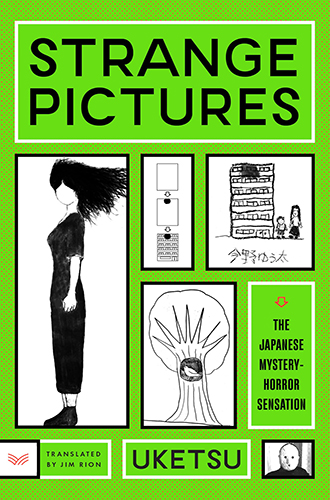
Strange Pictures

Strange Pictures is a compulsively readable horror mystery novel first published in 2022 by Uketsu, a mysterious masked YouTuber. This book is addictive, so much so that I accidentally spent an entire afternoon and evening reading it. So be warned – Strange Pictures is indeed strange, and it will hold you hostage.

In the five-page prelude that introduces the book’s premise, a psychology professor shows her class a photo of a picture drawn by a girl who killed her mother. The drawing is a childish self-portrait that shows the girl standing between her house and a tree. Although the picture seems completely normal at first, the professor zooms in on four small details that illuminate the girl’s inner state of mind. She makes the argument that, despite the abuse the girl suffered, she’s essentially a good person who never meant to hurt anyone. In retrospect, you can’t help but wonder how you didn’t notice these details of the drawing yourself.

This trick is an incredible sleight of hand. The same can be said of the following two chapters, both of which can be read as stand-alone short stories.

In the first chapter, “The Old Woman’s Prayer,” two college students in a small Paranormal Club discuss a curious blog they’ve found online. The blog is filled with cheerful observations of its writer’s everyday life. After a three-year hiatus, however, the blog closes with a mysterious post stating, “I can never forgive you.”

How did such a happy-go-lucky blog author arrive at such a mysterious statement? The five illustrations drawn by the author’s wife might just hold the key to the mystery. By themselves, they’re nothing special, but if you put them together in the right way…

The second chapter, “The Smudged Room,” features one of my favorite tropes, a creepy drawing made by a small child.

Five-year-old Yuta’s father recently passed away, and his preschool teacher is worried about the drawing he created for Mother’s Day. The picture shows a dark cloud hovering over the apartment building where Yuta lives with his mother, who is doing her best to care for Yuta with no family support. The matter comes to a crisis when Yuta suddenly disappears, and his teacher suspects that his mother may be keeping an unpleasant secret. What was Yuta trying to draw, exactly?

These two seemingly unrelated mysteries begin to coalesce in the third chapter, “The Art Teacher’s Final Drawing,” in which two sidelined newspaper employees become obsessed with the murder of a high school art teacher. The police dismissed the case due to a lack of evidence, but there is (of course) a drawing found in the teacher’s possession that was never fully analyzed. The younger reporter starts interviewing people who knew the teacher, thereby putting himself in grave danger.

Somewhere around the middle of this chapter, the story begins to strain credibility, but at this point I was fully invested and happy to be along for the ride. Uketsu has a gift for enabling the reader to suspend disbelief, and the Sherlock moment in the fourth and final chapter is incredible.

Strange Pictures is a bestselling cult hit in Japan and across Asia. I first heard about this book through word of mouth and read it in Japanese when it was first published. I was impressed by the clarity of Uketsu’s writing, which is simple and informative without being childish or condescending. Jim Rion has done an amazing job translating Uketsu’s distinctive style, with short declarative sentences pushing the reader forward at a brisk pace.

A large part of the mystery depends on the information that the narrative withholds from the reader, some of which is highly dependent on how Japanese works as a language. I’m impressed by how Rion manages to employ English to the same effect without the slightest trace of awkwardness. Reading Rion’s translation, I felt like I was encountering Uketsu’s story for the first time.

As long as you don’t mind losing a few hours to the addictive quality of the writing, I’d recommend Strange Pictures to anyone who enjoys puzzle box mysteries, creepy urban legends, and satisfying Sherlock Holmes style walkthroughs. I can’t overstate how much fun I had with this book, and I’m very much looking forward to Jim Rion’s upcoming translation of Uketsu’s debut novel, Strange Houses.

First Love

Rio Shimamoto’s 2018 novel First Love is a psychological mystery about a beautiful college student who has been arrested for the murder of her adoptive father. Although it tackles serious themes, this story is compulsively readable. All of the characters bring emotional baggage to the table, and Shimamoto teases out the reader’s sympathy as each of their histories is revealed.

Yuki Makabe is a clinical psychologist who specializes in parenting and childcare. She’s ambitious, and she’s on the verge of making a career transition to media appearances and popular audience articles. When Yuki’s brother-in-law, Kasho, is assigned to the high-profile case of Kanna Hijiriyama, a college student accused of killing her father, he asks Yuki to help him interview the young woman in order to ascertain her motive. Yuki’s prospective editor at a major publisher, a friendly young man named Tsuji, asks her to write about the case, so she agrees.

Yuki is happily married to an internationally famous photographer who supports her career by shouldering the majority of the responsibilities involved in the care of their son. Despite her loving relationship with her husband, Yuki has a troubled past with Kasho that neither of them is willing to discuss. While she and Tsuji work together on Kanna’s case, Yuki must navigate her strained relationship with Kasho, who is very charming but a bit of an asshole.

Kanna presents Yuki with another set of challenges. To begin with, Kanna can’t explain why she wanted to hurt her father, or even whether she intended to hurt him in the first place. But, if she never meant to attack him, what was she doing with a knife? To make matters more complicated, one of Kanna’s college boyfriends gives an interview to a tabloid magazine and says that Kanna went crazy after they broke up. Even Kanna’s own mother claims the young woman is crazy.

Yuki is convinced that Kanna is far from “crazy,” but the truth of the matter is elusive. Kanna is traumatized by the death of her father, and Yuki quickly realizes that the young woman’s trauma is much more extensive.

Based on the title of the novel and the relationship between Kanna and the person she may or may not have killed, a reader might suspect that there is underage incest involved. I hope I can be forgiven for spoiling the story by saying that, thankfully, this is not the case. Regardless, Kanna didn’t have a happy home life as a child. 

I’m afraid that some readers may find Kanna frustrating, but her portrayal feels extremely realistic to me. I definitely knew people like this in high school and college. Generally speaking, these girls (and occasionally boys) were intelligent and competent, but they had a habit of saying whatever they needed to say to diffuse an awkward situation. 

This behavior wasn’t “lying” or “being dishonest” so much as it was a manifestation of fawning, an alternative to the “fight or flight” response that’s common in young people who live in hostile home situations. Instead of fighting their parents or running away from home, “well-behaved” children and teenagers will contort their speech, emotions, and understanding of reality to ease tension. Issues often arise when this behavior carries over to romantic and professional relationships that would benefit from honesty.

Although this element of the story isn’t presented as a mystery to be solved, Yuki is confronted with the issue of whether Kanna truly consented to sex with two of the key romantic partners in her life. I can completely understand how the men involved might have understood Kanna’s words and behavior as expressing consent, but I also understand how Kanna could later admit that sex isn’t what she wanted, and that she was just going along with what was expected. As the author demonstrates, Kanna’s inability to understand her own boundaries is directly related to the emotional abuse she endured as a child.

Shimamoto doesn’t lean into an overtly feminist message, but there are multiple points in the story when Yuki comes into contact with the sort of ambient misogyny that might compel a vulnerable young person like Kanna to second-guess her own emotions and sense of self-worth. At the beginning of the novel, for example, Yuki reflects on a conversation between a male television producer and his younger female colleague that she overheard as she entered the studio.

As I was getting my makeup done, I examined my own features: not bad, but not particularly beautiful either. A face with no distinctive features. The only thing that stood out was my collarbone, protruding above my shirt.

I’d met that male producer several times previously, but he’d never once made eye contact with me. There were men like that everywhere in the television industry – men who wouldn’t engage in conversation with women they’d give less than an eight out of ten on looks. Men who thought nobody would notice this behavior. Or maybe they just thought it didn’t matter. These were men who had never suffered a single setback in their lives.

This is the sort of observation that, while eminently relatable to many people, would have Yuki called crazy if she spoke it out loud. It’s not “misogyny” or “sexism” if the male producer isn’t doing anything wrong, right? It’s not like he actually said anything offensive to Yuki, or to his younger colleague. This man’s behavior is rancid, but no one will ever call him out on it. Yuki has a supportive family and professional colleagues who aren’t human garbage, so she can cope. But what about Kanna, who hasn’t yet found a support network to replace her abusive family?

What Shimamoto criticizes in First Love are the gendered aspects of a social system that allows toxic men to flourish. First Love doesn’t offer easy solutions, but Shimamoto demonstrates that we can all be allies in pushing back.

Yuki’s husband is a prince from start to finish, and her editor Tsugi is able to see what happened to Kanna with clear eyes while re-evaluating his own perspective and never apologizing for the bad behavior of other men. Kanna’s defense lawyer Kasho has issues of his own due to childhood abuse at the hands of his mother, but he’s an adult who is capable of realizing his limitations – which is why he arranges for a series of meetings between Yuki and Kanna in the first place.

Without spoiling too much of the plot, First Love connects the stories of a number of characters who begin to question their past behavior in light of Kanna’s upcoming trial, and Shimamoto helps the reader to sympathize with these characters even when they behave badly. The point is not that men are evil or that women are innocent victims. Rather, it’s important to extend empathy instead of overlooking questionable behavior.

Putting the social relevance of the novel’s themes aside, First Love is a fun book to read. I got sucked into the story immediately. Like Yuki, I was instantly intrigued by the mystery presented by the death of Kanna’s father. Kasho’s defense argument during Kanna’s trial felt like a major revelation unfolding before my eyes, and I admire how carefully Shimamoto laid each brick in the wall. Louise Heal Kawai’s translation is featherlight and flawless and sets the tone perfectly.

I’d recommend First Love not just to fans of mystery and suspense, but to any reader interested in a compelling character drama that offers a number of different perspectives on family, mental health, and the darker aspects of everyday interactions that often go overlooked.

Mornings With My Cat Mii

Cats are adorable creatures, it’s true. It’s also true that they’re a little magical. Unfortunately, the experience of caring for a cat isn’t all sunshine and rainbows, and there’s a lot of cleaning involved. Mayumi Inaba’s autobiographical essay collection Mornings With My Cat Mii is a beautifully written attempt to capture the not-always-rosy reality of sharing your space with a cat while doing your best to manage your life as a human.

In the summer of 1977, Inaba follows the cries that drift in through her window and discovers a ball of fluff stuck at the top of a fence along the bank of the Tamagawa River in western Tokyo. Since it’s freezing outside, she takes the kitten home. Inaba names her “Mimi,” or “Mii” for short, after her constant crying. Despite her precarious childhood, Mii goes on to live for almost twenty years, accompanying the author through major developments in her personal life and career.     

Mayumi Inaba (1950-2014) worked in a number of creative industries while publishing stories, essays, and poetry. The opening essays in Mornings With My Cat Mii are about the milestones in Inaba’s life as she divorces her husband in Osaka to focus on her career in Tokyo. As time passes, Inaba begins to devote more attention to her friendships and psychological wellbeing, a shift in priorities represented by her growing love for Mii.

Mornings With My Cat Mii is far from wholesome, however. Inaba is nothing if not honest about the vicissitudes of life. Sometimes you and your partner grow distant. Sometimes you get kicked out of your house by your landlord. Sometimes people abandon animals. And sometimes you have to bear witness to your pet’s slow decline toward death.

A major element of Inaba’s commitment to honesty are her raw descriptions of the mess of keeping an animal in your house. Sometimes, for example, your entire apartment is going to smell like cat urine. Sometimes you have to scrub puke out of the carpet. Sometimes you have to extract your cat’s feces with your own hands.

Regardless, Inaba always finds a silver lining and an interesting story to tell. I especially enjoyed her essay “The Pet Sitter,” which provides an intriguing glimpse into the thriving industry of petcare services in Japan while digging its heels into the silliness of celebrity pet therapists. I also love “The Winter Break,” which describes a trip Inaba took to the countryside with her sister so Mii could touch grass and frolic in nature. The essay “Moving House” stands out as a playful description of a typical day in young Mii’s life in Inaba’s old house in the west Tokyo suburbs, which were still filled with pockets of nature in the 1970s.

Each essay is less than ten pages long, and most of them feature several verses of a poem as a postscript. Ginny Tapley Takemori has done a marvelous job translating Inaba’s poetry. Just be aware that some of these poems might make you a bit misty-eyed, especially if you’re feeling sentimental about the death of a pet of your own.

I’m generally not a fan of Japanese cat books, but Mornings With My Cat Mii isn’t bubblegum pop about how all of life’s problems can be magically solved by a cat. Rather, this is messy and honest nonfiction about the hardships of pursuing a creative career as a single woman. Still, Inaba manages to find moments of sweetness in life, which she generously shares with the reader in her soft and shining prose.

とんこつ Q&A

とんこつ Q&A collects four stories by Natsuko Imamura, the author of The Woman in the Purple Skirt. Each of these stories is built on a cute and wholesome premise that develops in a dark and strange direction.

The title story is about a woman with social anxiety who creates a written script to help her navigate her job as a server at a small diner called Tonkotsu. Her efforts are aided by the recently widowed owner and his young son, who teaches the narrator to speak in Osaka dialect like his late mother.

The narrator’s script gradually expands beyond professional dialogue into everyday pleasantries, and she ultimately becomes a ghostwriter for the diner owner’s new wife. This scenario seems like a perfect set-up for a sweet and gentle romantic comedy, but it gradually becomes more disturbing as the narrator cheerfully crafts the diner owner’s new wife into a living doll.  

The three other stories in the collection are about middle school bullies whose punishment is far worse than their crime, an aggressively clueless wife who gets away with murder, and a very sketchy coworker. Imamura’s prose is smooth but cuts like a knife, and the situations she crafts are never what they seem. I wouldn’t say that these stories have twist endings, necessarily, but the way their wholesome coziness slowly sinks into social horror is fascinating to watch.

52ヘルツのクジラたち

52ヘルツのクジラたち is a bestselling novel by Sonoko Machida that won the 2021 Japan Booksellers’ Award Grand Prize. In March 2024, the story was adapted into a feature film directed by Izuru Narushima, who worked with LGBTQ consultants in order to portray a key transgender character with the same compassion and sensitivity expressed by Machida’s novel.

Kiko Mishima has left Tokyo to move to a seaside town near Oita on the eastern coast of Kyushu. She’s inherited a house from her grandmother, and she gets along well with the contractors she hired for renovations. It’s difficult to adjust to life in a small community, however, and Kiko begins to withdraw into her house.

During a trip to the grocery store, Kiko encounters a 13yo boy who can’t speak and seems to have nowhere to go. The nameless boy bears undeniable signs of abuse and neglect, so Kiko invites him home and begins caring for him.

As the novel progresses, the reader learns more about Kiko, who was emotionally abused by her mother and stepfather. Circumstances relating to her stepfather’s health prevent Kiko from escaping from her family after high school, and she’s driven to the verge of suicide by her experience of serving as her stepfather’s primary caregiver.

Kiko is rescued by her high school friend Miharu, who also grew up in an abusive family. Miharu introduces Kiko to her colleague Ango, who sympathizes with Kiko and takes responsibility for her emotional support as he helps her move into a sharehouse and begin a new life.

From the beginning of the novel, the reader is confronted by numerous questions. Given how important Ango was to Kiko, what happened to him? Why did Kiko suddenly move to Kyushu without telling anyone? Where is she getting the money to renovate her house? And, most importantly, what can she do to help the abused boy whom the entire town has decided to ignore?

52ヘルツのクジラたち takes its title from the story of 52 Blue, a whale of an unidentified species that has never been sighted but only heard via hydrophones. It sings at a frequency 52 hertz, which is much higher than the calls of other migrating whales. Because of the highly unusual sonic signature of its call, the whale migrates alone.

Kiko compares her isolation during her childhood to that of the 52-hertz whale, and she once listened to recordings of its singing to calm and ground herself after she left her family. She shares these recordings with the seemingly wordless boy she takes under her wing, promising that she’ll wait patiently until she can understand his own 52-hertz voice.   

We live in a society, however, and it’s not strictly legal to assume care of a minor without the permission of the child’s guardians. Thankfully, Miharu manages to track down Kiko and pays her a visit in Kyushu. She once again comes to the rescue, helping Kiko to reach out to the community for the support that she and the boy desperately need. 

Make no mistake, 52ヘルツのクジラたち is an intensely melodramatic novel. Its characters are either saints or devils. It’s never explained why anyone would be abusive toward a child, or why most people who witness child abuse choose to ignore it. In addition, the story’s victims of abuse come off as perfect angels who suffer with dignity and almost never display any of the problematic behavior associated with a history of sustained childhood trauma.

I find this lack of psychological depth frustrating, as it glosses over many of the issues underlying child abuse, which is often known and tacitly tolerated by the larger community. Instead of serving as a meaningful model for how such abuse can be prevented, this novel feels more like a character drama that uses serious social issues for the sole purpose of generating heightened emotions. In addition, although the treatment of the central transgender character is sympathetic, I couldn’t help but shake my head at some of the tired narrative tropes applied to their story.

Still, I can’t deny that 52ヘルツのクジラたち is a lot of fun to read. The pacing is excellent, and I was swept along by the story’s strong forward momentum. Although bittersweet, the ending is emotionally satisfying, as is the conclusion of Kiko’s character arc. I’d especially recommend this novel to fans of Banana Yoshimoto, as it feels like a progressive development of many of the themes explored in Kitchen, from a universal concern with love and loss to a more specific push for the legal rights of minors and transgender people. 

While the message of 52ヘルツのクジラたち might have benefitted from more psychological nuance, Sonoko Machida makes a strong and compelling case for mutual aid and community action in which everyone in a society benefits by actively protecting the marginalized.

The City and Its Uncertain Walls

In The City and Its Uncertain Walls, Haruki Murakami returns to an earlier era of his writing. Although ostensibly set in the present, there’s a timeless quality to this story and its characters, who move through their lives entirely offline and largely cut off from contemporary society. In both the setting and scenario, Murakami borrows heavily from his own twentieth-century fiction, making The City and Its Uncertain Walls feel like more of a pastiche than an original work.

The first section of the novel alternates between the narrator’s recollections of the past and his descriptions of a low-fantasy dreamscape of the eponymous walled city. In the real world, the narrator recounts the progression of his teenage romance with a girl who eventually revealed that she was suffering from severe depression before sending a farewell letter and disappearing from his life. In the dream world, the adult narrator enters the walled city the girl once built from her imagination and encounters a ghost of her sixteen-year-old self.

At an almost detail-by-detail level of fidelity, the walled city is lifted directly from the “End of the World” segments of Murakami’s 1985 novel Hard-Boiled Wonderland and the End of the World, while the bittersweet teenage romance is strongly reminiscent of his 1987 novel Norwegian Wood.

This was a slow opening for me, as it’s territory Murakami has covered many times before. Perhaps a different reader might have a different impression; but, since I’ve already read Norwegian Wood and Hard-Boiled Wonderland and the End of the World many times during the past two decades, I often found myself skimming through this section.

The story becomes somewhat more interesting in the second section, when the forty-year-old narrator wakes from the dream of the walled city, leaves his job at a book distribution company, and moves to a small town in the mountains of Fukushima prefecture to manage a privately owned library. The narrator is welcomed by the former head librarian, a gentle elderly man named Mr. Koyasu. With the support of the library staff, the quiet days pass pleasantly enough, but there’s something strange about Mr. Koyasu, who seems to come from nowhere as he pleases before returning to nothing at the end of his visits.

In many ways, this second section feels like a retread of Murakami’s 2017 novel Killing Commendatore, whose narrator undergoes a similar midlife crisis and moves to a small town in the mountains. There are also echoes of the rural library in Shikoku that serves as the setting for the last half of the 2002 novel Kafka on the Shore. Thankfully, this section doesn’t exhibit the same fidelity of borrowing as the first, and I was intrigued by the gradual reveals concerning Mr. Koyasu’s life and interest in the narrator.

Toward the end of the second section, it seems the plot will finally move forward when the narrator is introduced to one of the library’s most faithful patrons, a teenage boy on the autism spectrum. The boy knows about the walled town, and he wants the narrator to take him there. Unfortunately, this is when the story begins to lose its threads, and it falls apart into a tangle of long conversations in which characters repeat the same information without actually saying anything. Even at the abstract metafictional level of Murakami’s beloved “symbols” and “metaphors,” the ending feels rushed and unsatisfying.

In his “Afterword,” Murakami explains that he began The City and Its Uncertain Walls during the pandemic as a return to a story of the same title that he originally published in 1980. I understand the drive to return to familiar themes in order to view them from unexplored angles, but the problem with this novel is that there’s nothing new or different in its approach. If I were feeling cynical, I might even say that The City and Its Uncertain Walls feels as though it’s been assembled as something of a “Best of Murakami” album intended to market the author’s work to new readers.

I enjoyed the experience of reading The City and Its Uncertain Walls, but it didn’t resonate with me emotionally. More than anything, this book inspires nostalgia for Murakami’s earlier novels. Given the story’s refusal to address any social, political, or cultural developments since 1980, I’d say that “nostalgia” is probably going to be its main appeal for many readers. There’s value to seeking shelter in the imagination as a defense against the demands of neoliberal capitalism, but The City and Its Uncertain Walls has nothing to do with resistance; this is pure self-indulgence. As in the walled city of the narrator’s dreams, nothing much happens here, and time passes comfortably but without meaning.

Nails and Eyes

Kaori Fujino’s Nails and Eyes collects a novella and two short stories whose crystal-clear prose is darkened by the shadow of creeping psychological horror. The theme of family lies at the heart of these stories, especially as it intersects with the fear that those closest to us may deliberately choose not to see obvious but unpleasant truths.

In the third story, “Minute Fears,” a woman named Mika plans to attend the wedding reception of a college friend. Since she’s started a family, Mika has rarely gone out on her own, and she’s been looking forward to the party. Her son Daiki begs her not to go, as he’s been disturbed by an urban legend surrounding a ghost rumored to haunt the local playground. After a brief struggle with Daiki, who doesn’t want to be left alone, Mika goes to the reception late and leaves early. When she comes home, Daiki confesses his fear of the ghost, and Mika resolves to take him to the playground herself to prove that the urban legend isn’t true.

Whether the ghost exists is left to the reader’s imagination. Instead, the true horror lies in the image of Mika dragging her terrified son into the night. Or perhaps, if your sympathies lie elsewhere, the horror is hidden in the homebound years that Mika has had to endure in order to care for her child while her friends enjoy their lives and careers in the outside world. 

The second story, “What Shoko Forgets,” is equally ambiguous yet just as disturbing. After a mild stroke, Shoko has been living in an elder care facility for almost half a year. Her family visits regularly, and she receives ample attention from the staff. A polite and energetic young man named Kawabata is especially gentle, and he seems to have a special fondness of Shoko.

There’s something strange about Kawabata’s behavior after dark, however; and, for some reason, Shoko finds herself thinking about sex in a way she hasn’t for years. It’s possible that there might be a connection between Kawabata and the man Shoko imagines lying next to her at night, but both her eyesight and her memory have grown hazy. In any case, it’s no use trying to explain her muddled thoughts about the situation to her daughter or granddaughter, who so kindly come to visit a forgetful old woman.

The collection’s centerpiece novella, “Nails and Eyes,” is narrated from the perspective of a young girl who lost her mother to an unexplained incident. Her father brings home his younger lover, and the narrator addresses this woman directly through the story. She recounts the minute details of the woman’s life, from her affair with a bookstore owner to her obsession with the home décor blog once maintained by the narrator’s mother.

The narrator also describes her own behavior as a child who has clearly been traumatized by her mother’s suicide but largely ignored by the adults in her life. The narrator refuses to be anywhere near the balcony where her mother died, and she sits in the corners of the apartment gnawing at her nails, which become serrated and sharp. To her credit, the woman responsible for the child’s care makes a clean break with her lover and begins to take a more active interest in her charge’s welfare. This change of heart comes too late, however, and the story ends with an incredibly upsetting psychological break.

To be clear: if you have phobias related to eyes and/or fingernails, this book might not be for you. 

At 140 pages, Nails and Eyes is easy to breeze through, especially in Kendall Heitzman’s smooth and weightless translation. Still, Fujino’s fiction rewards time and attention, as well as repeated readings. There are layers to her deceptively simple prose, and any one of these stories has the potential to generate multiple lines of speculation. Nails and Eyes is a fascinating and disquieting collection that will be appreciated by readers who enjoy literary short horror fiction like Yoko Ogawa’s Revenge and Mariana Enriquez’s Things We Lost in the Fire.

A Woman of Pleasure

Kiyoko Murata’s A Woman of Pleasure is a feminist novel about the self-liberation of Japanese sex workers in the early twentieth century. It’s also a vibrant window into a different world and a true pleasure to read. Murata’s work has won almost every major Japanese literary prize, and Juliet Winters Carpenter has crafted a beautiful translation of her writing.

A Woman of Pleasure is set in 1903 in the adult entertainment district of Kumamoto, where the fifteen-year-old Ichi has been sold by her impoverished family to a high-ranking brothel. While she apprentices under a senior geisha, Ichi also attends literacy classes run by a retired entertainer named Tetsuko.

Ichi’s honest yet playful diary entries are interspersed between third-person accounts of her everyday life, the mundanity of which comprises the bulk of the novel. Despite the unfairness of her situation, Murata portrays Ichi with sympathy and dignity, as well as with a welcome touch of light humor.  

While the last fifty pages of the book describe how the women at Ichi’s establishment decide to exercise their legal right to leave, the majority of the story explains – very gently – why they would choose to do so. For a contemporary reader, there’s a lot to be upset about, but Murata never degrades her characters or their agency in shaping the course of their lives.

A Woman of Pleasure reminds me a great deal of Jun’ichiro Tanizaki’s classic novel The Makioka Sisters. Despite several startling and high-tension incidents, the book doesn’t have much of a plot. This is to its benefit, I think, as what’s interesting about Ichi’s story would be ruined by melodrama. Murata’s project is first and foremost to celebrate the essential humanity of the women who lived in a different era, but she also presents a compelling demonstration of how normal, ordinary people are capable of powerful political action.

Idol, Burning

Rin Usami’s Idol, Burning is only 115 pages long, but this masterfully translated literary novella paints a vibrant portrait of a young woman’s search for community in online fandom.

School has always been tough for Akari, whose dyslexia makes writing Chinese characters by hand extremely difficult. Akari has no problem typing, however, and she pours all of her energy into a fanblog devoted to her oshi Masaki, an actor and member of a popular boy band. During the summer, Akari works as many shifts as she can pick up at her part-time job so that she can buy Masaki’s merch and attend his concerts.

Akari’s world begins to fall apart when Masaki punches an overeager fan, thus becoming the target of intense social media discourse. Akari, who has found friendship and personal fulfilment in her fandom, can’t help but take this abuse personally. To make matters worse, when she returns to high school, she’s informed that she’s failed her junior year.

Usami is unflinching in her portrayal of online cultures, and she’s refreshingly honest about the adverse effects that flamewars can have on vulnerable people seeking support in fandom communities. Akari is never presented as pathological, and the members of her family offer support despite not really understanding the life she leads online. If there’s a villain in this story, it’s the Japanese education system, which refuses to accommodate Akari’s learning style while constantly pressuring her to “try harder.”  

Usami’s writing shines during the quiet scenes of loneliness Akari experiences as she watches her communities crumble apart in real time. While it’s easy to mock the intensity of pop star fandom, Akari’s story helps the reader to understand how the power of a dream can keep a teenager moving forward, especially when they feel that their paths are limited in the offline world. Akari is a beautifully unique and well-realized character, but her failed attempts to find meaning and belonging carry much broader implications concerning how Japanese society views difference and disability.    

The English translation of the book includes short essays by the author and her translator Asa Yoneda, as well as short statements from the cover designer (surrealist photographer Delaney Allen) and the illustrator (comic artist Leslie Hung). The novel’s story stands on its own, but it’s a pleasure to read about the inspirations of the writers and artists who brought it to life.