52ヘルツのクジラたち

52ヘルツのクジラたち is a bestselling novel by Sonoko Machida that won the 2021 Japan Booksellers’ Award Grand Prize. In March 2024, the story was adapted into a feature film directed by Izuru Narushima, who worked with LGBTQ consultants in order to portray a key transgender character with the same compassion and sensitivity expressed by Machida’s novel.

Kiko Mishima has left Tokyo to move to a seaside town near Oita on the eastern coast of Kyushu. She’s inherited a house from her grandmother, and she gets along well with the contractors she hired for renovations. It’s difficult to adjust to life in a small community, however, and Kiko begins to withdraw into her house.

During a trip to the grocery store, Kiko encounters a 13yo boy who can’t speak and seems to have nowhere to go. The nameless boy bears undeniable signs of abuse and neglect, so Kiko invites him home and begins caring for him.

As the novel progresses, the reader learns more about Kiko, who was emotionally abused by her mother and stepfather. Circumstances relating to her stepfather’s health prevent Kiko from escaping from her family after high school, and she’s driven to the verge of suicide by her experience of serving as her stepfather’s primary caregiver.

Kiko is rescued by her high school friend Miharu, who also grew up in an abusive family. Miharu introduces Kiko to her colleague Ango, who sympathizes with Kiko and takes responsibility for her emotional support as he helps her move into a sharehouse and begin a new life.

From the beginning of the novel, the reader is confronted by numerous questions. Given how important Ango was to Kiko, what happened to him? Why did Kiko suddenly move to Kyushu without telling anyone? Where is she getting the money to renovate her house? And, most importantly, what can she do to help the abused boy whom the entire town has decided to ignore?

52ヘルツのクジラたち takes its title from the story of 52 Blue, a whale of an unidentified species that has never been sighted but only heard via hydrophones. It sings at a frequency 52 hertz, which is much higher than the calls of other migrating whales. Because of the highly unusual sonic signature of its call, the whale migrates alone.

Kiko compares her isolation during her childhood to that of the 52-hertz whale, and she once listened to recordings of its singing to calm and ground herself after she left her family. She shares these recordings with the seemingly wordless boy she takes under her wing, promising that she’ll wait patiently until she can understand his own 52-hertz voice.   

We live in a society, however, and it’s not strictly legal to assume care of a minor without the permission of the child’s guardians. Thankfully, Miharu manages to track down Kiko and pays her a visit in Kyushu. She once again comes to the rescue, helping Kiko to reach out to the community for the support that she and the boy desperately need. 

Make no mistake, 52ヘルツのクジラたち is an intensely melodramatic novel. Its characters are either saints or devils. It’s never explained why anyone would be abusive toward a child, or why most people who witness child abuse choose to ignore it. In addition, the story’s victims of abuse come off as perfect angels who suffer with dignity and almost never display any of the problematic behavior associated with a history of sustained childhood trauma.

I find this lack of psychological depth frustrating, as it glosses over many of the issues underlying child abuse, which is often known and tacitly tolerated by the larger community. Instead of serving as a meaningful model for how such abuse can be prevented, this novel feels more like a character drama that uses serious social issues for the sole purpose of generating heightened emotions. In addition, although the treatment of the central transgender character is sympathetic, I couldn’t help but shake my head at some of the tired narrative tropes applied to their story.

Still, I can’t deny that 52ヘルツのクジラたち is a lot of fun to read. The pacing is excellent, and I was swept along by the story’s strong forward momentum. Although bittersweet, the ending is emotionally satisfying, as is the conclusion of Kiko’s character arc. I’d especially recommend this novel to fans of Banana Yoshimoto, as it feels like a progressive development of many of the themes explored in Kitchen, from a universal concern with love and loss to a more specific push for the legal rights of minors and transgender people. 

While the message of 52ヘルツのクジラたち might have benefitted from more psychological nuance, Sonoko Machida makes a strong and compelling case for mutual aid and community action in which everyone in a society benefits by actively protecting the marginalized.

The City and Its Uncertain Walls

In The City and Its Uncertain Walls, Haruki Murakami returns to an earlier era of his writing. Although ostensibly set in the present, there’s a timeless quality to this story and its characters, who move through their lives entirely offline and largely cut off from contemporary society. In both the setting and scenario, Murakami borrows heavily from his own twentieth-century fiction, making The City and Its Uncertain Walls feel like more of a pastiche than an original work.

The first section of the novel alternates between the narrator’s recollections of the past and his descriptions of a low-fantasy dreamscape of the eponymous walled city. In the real world, the narrator recounts the progression of his teenage romance with a girl who eventually revealed that she was suffering from severe depression before sending a farewell letter and disappearing from his life. In the dream world, the adult narrator enters the walled city the girl once built from her imagination and encounters a ghost of her sixteen-year-old self.

At an almost detail-by-detail level of fidelity, the walled city is lifted directly from the “End of the World” segments of Murakami’s 1985 novel Hard-Boiled Wonderland and the End of the World, while the bittersweet teenage romance is strongly reminiscent of his 1987 novel Norwegian Wood.

This was a slow opening for me, as it’s territory Murakami has covered many times before. Perhaps a different reader might have a different impression; but, since I’ve already read Norwegian Wood and Hard-Boiled Wonderland and the End of the World many times during the past two decades, I often found myself skimming through this section.

The story becomes somewhat more interesting in the second section, when the forty-year-old narrator wakes from the dream of the walled city, leaves his job at a book distribution company, and moves to a small town in the mountains of Fukushima prefecture to manage a privately owned library. The narrator is welcomed by the former head librarian, a gentle elderly man named Mr. Koyasu. With the support of the library staff, the quiet days pass pleasantly enough, but there’s something strange about Mr. Koyasu, who seems to come from nowhere as he pleases before returning to nothing at the end of his visits.

In many ways, this second section feels like a retread of Murakami’s 2017 novel Killing Commendatore, whose narrator undergoes a similar midlife crisis and moves to a small town in the mountains. There are also echoes of the rural library in Shikoku that serves as the setting for the last half of the 2002 novel Kafka on the Shore. Thankfully, this section doesn’t exhibit the same fidelity of borrowing as the first, and I was intrigued by the gradual reveals concerning Mr. Koyasu’s life and interest in the narrator.

Toward the end of the second section, it seems the plot will finally move forward when the narrator is introduced to one of the library’s most faithful patrons, a teenage boy on the autism spectrum. The boy knows about the walled town, and he wants the narrator to take him there. Unfortunately, this is when the story begins to lose its threads, and it falls apart into a tangle of long conversations in which characters repeat the same information without actually saying anything. Even at the abstract metafictional level of Murakami’s beloved “symbols” and “metaphors,” the ending feels rushed and unsatisfying.

In his “Afterword,” Murakami explains that he began The City and Its Uncertain Walls during the pandemic as a return to a story of the same title that he originally published in 1980. I understand the drive to return to familiar themes in order to view them from unexplored angles, but the problem with this novel is that there’s nothing new or different in its approach. If I were feeling cynical, I might even say that The City and Its Uncertain Walls feels as though it’s been assembled as something of a “Best of Murakami” album intended to market the author’s work to new readers.

I enjoyed the experience of reading The City and Its Uncertain Walls, but it didn’t resonate with me emotionally. More than anything, this book inspires nostalgia for Murakami’s earlier novels. Given the story’s refusal to address any social, political, or cultural developments since 1980, I’d say that “nostalgia” is probably going to be its main appeal for many readers. There’s value to seeking shelter in the imagination as a defense against the demands of neoliberal capitalism, but The City and Its Uncertain Walls has nothing to do with resistance; this is pure self-indulgence. As in the walled city of the narrator’s dreams, nothing much happens here, and time passes comfortably but without meaning.

Nails and Eyes

Kaori Fujino’s Nails and Eyes collects a novella and two short stories whose crystal-clear prose is darkened by the shadow of creeping psychological horror. The theme of family lies at the heart of these stories, especially as it intersects with the fear that those closest to us may deliberately choose not to see obvious but unpleasant truths.

In the third story, “Minute Fears,” a woman named Mika plans to attend the wedding reception of a college friend. Since she’s started a family, Mika has rarely gone out on her own, and she’s been looking forward to the party. Her son Daiki begs her not to go, as he’s been disturbed by an urban legend surrounding a ghost rumored to haunt the local playground. After a brief struggle with Daiki, who doesn’t want to be left alone, Mika goes to the reception late and leaves early. When she comes home, Daiki confesses his fear of the ghost, and Mika resolves to take him to the playground herself to prove that the urban legend isn’t true.

Whether the ghost exists is left to the reader’s imagination. Instead, the true horror lies in the image of Mika dragging her terrified son into the night. Or perhaps, if your sympathies lie elsewhere, the horror is hidden in the homebound years that Mika has had to endure in order to care for her child while her friends enjoy their lives and careers in the outside world. 

The second story, “What Shoko Forgets,” is equally ambiguous yet just as disturbing. After a mild stroke, Shoko has been living in an elder care facility for almost half a year. Her family visits regularly, and she receives ample attention from the staff. A polite and energetic young man named Kawabata is especially gentle, and he seems to have a special fondness of Shoko.

There’s something strange about Kawabata’s behavior after dark, however; and, for some reason, Shoko finds herself thinking about sex in a way she hasn’t for years. It’s possible that there might be a connection between Kawabata and the man Shoko imagines lying next to her at night, but both her eyesight and her memory have grown hazy. In any case, it’s no use trying to explain her muddled thoughts about the situation to her daughter or granddaughter, who so kindly come to visit a forgetful old woman.

The collection’s centerpiece novella, “Nails and Eyes,” is narrated from the perspective of a young girl who lost her mother to an unexplained incident. Her father brings home his younger lover, and the narrator addresses this woman directly through the story. She recounts the minute details of the woman’s life, from her affair with a bookstore owner to her obsession with the home décor blog once maintained by the narrator’s mother.

The narrator also describes her own behavior as a child who has clearly been traumatized by her mother’s suicide but largely ignored by the adults in her life. The narrator refuses to be anywhere near the balcony where her mother died, and she sits in the corners of the apartment gnawing at her nails, which become serrated and sharp. To her credit, the woman responsible for the child’s care makes a clean break with her lover and begins to take a more active interest in her charge’s welfare. This change of heart comes too late, however, and the story ends with an incredibly upsetting psychological break.

To be clear: if you have phobias related to eyes and/or fingernails, this book might not be for you. 

At 140 pages, Nails and Eyes is easy to breeze through, especially in Kendall Heitzman’s smooth and weightless translation. Still, Fujino’s fiction rewards time and attention, as well as repeated readings. There are layers to her deceptively simple prose, and any one of these stories has the potential to generate multiple lines of speculation. Nails and Eyes is a fascinating and disquieting collection that will be appreciated by readers who enjoy literary short horror fiction like Yoko Ogawa’s Revenge and Mariana Enriquez’s Things We Lost in the Fire.

A Woman of Pleasure

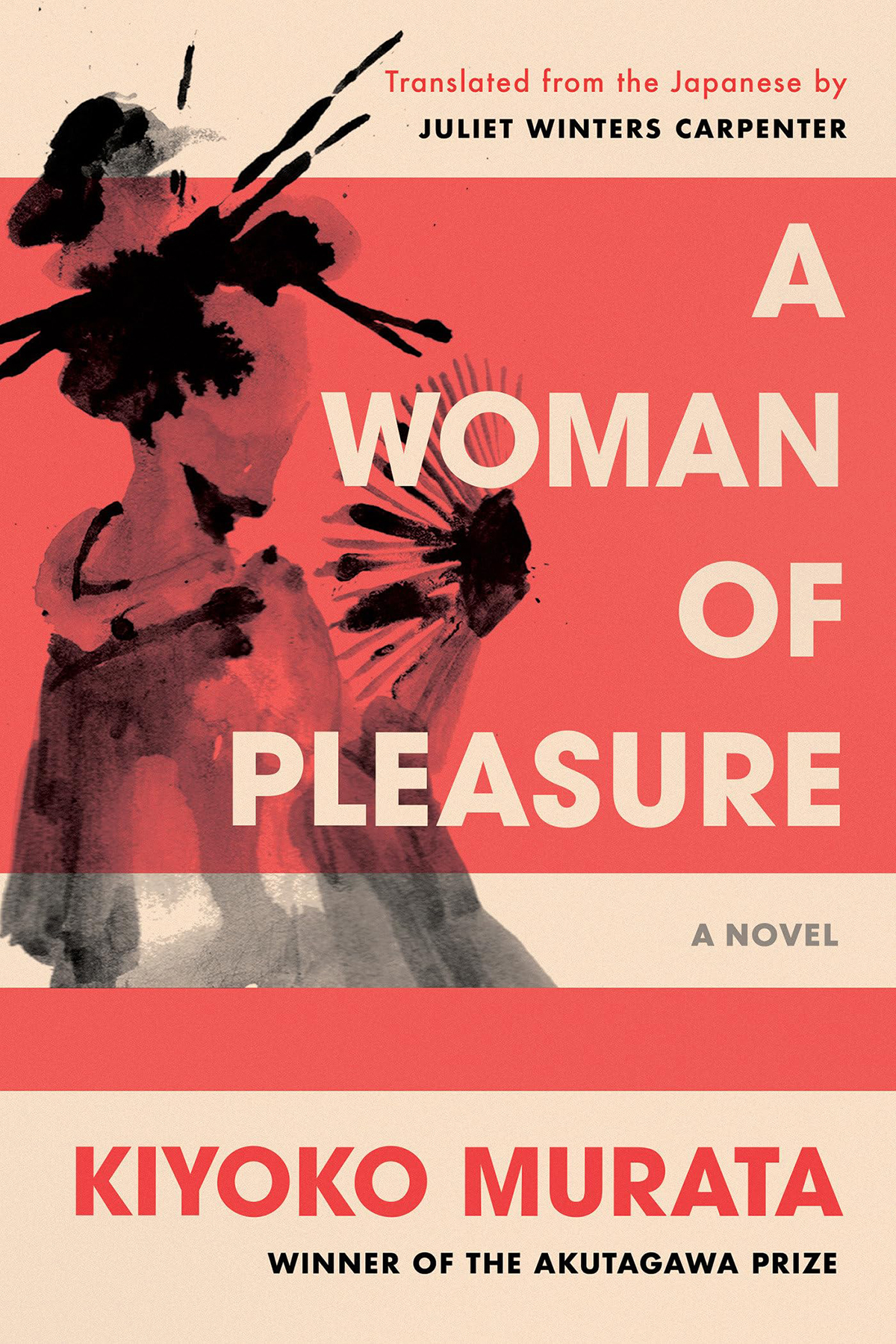
Kiyoko Murata’s A Woman of Pleasure is a feminist novel about the self-liberation of Japanese sex workers in the early twentieth century. It’s also a vibrant window into a different world and a true pleasure to read. Murata’s work has won almost every major Japanese literary prize, and Juliet Winters Carpenter has crafted a beautiful translation of her writing.

A Woman of Pleasure is set in 1903 in the adult entertainment district of Kumamoto, where the fifteen-year-old Ichi has been sold by her impoverished family to a high-ranking brothel. While she apprentices under a senior geisha, Ichi also attends literacy classes run by a retired entertainer named Tetsuko.

Ichi’s honest yet playful diary entries are interspersed between third-person accounts of her everyday life, the mundanity of which comprises the bulk of the novel. Despite the unfairness of her situation, Murata portrays Ichi with sympathy and dignity, as well as with a welcome touch of light humor.  

While the last fifty pages of the book describe how the women at Ichi’s establishment decide to exercise their legal right to leave, the majority of the story explains – very gently – why they would choose to do so. For a contemporary reader, there’s a lot to be upset about, but Murata never degrades her characters or their agency in shaping the course of their lives.

A Woman of Pleasure reminds me a great deal of Jun’ichiro Tanizaki’s classic novel The Makioka Sisters. Despite several startling and high-tension incidents, the book doesn’t have much of a plot. This is to its benefit, I think, as what’s interesting about Ichi’s story would be ruined by melodrama. Murata’s project is first and foremost to celebrate the essential humanity of the women who lived in a different era, but she also presents a compelling demonstration of how normal, ordinary people are capable of powerful political action.

Idol, Burning

Rin Usami’s Idol, Burning is only 115 pages long, but this masterfully translated literary novella paints a vibrant portrait of a young woman’s search for community in online fandom.

School has always been tough for Akari, whose dyslexia makes writing Chinese characters by hand extremely difficult. Akari has no problem typing, however, and she pours all of her energy into a fanblog devoted to her oshi Masaki, an actor and member of a popular boy band. During the summer, Akari works as many shifts as she can pick up at her part-time job so that she can buy Masaki’s merch and attend his concerts.

Akari’s world begins to fall apart when Masaki punches an overeager fan, thus becoming the target of intense social media discourse. Akari, who has found friendship and personal fulfilment in her fandom, can’t help but take this abuse personally. To make matters worse, when she returns to high school, she’s informed that she’s failed her junior year.

Usami is unflinching in her portrayal of online cultures, and she’s refreshingly honest about the adverse effects that flamewars can have on vulnerable people seeking support in fandom communities. Akari is never presented as pathological, and the members of her family offer support despite not really understanding the life she leads online. If there’s a villain in this story, it’s the Japanese education system, which refuses to accommodate Akari’s learning style while constantly pressuring her to “try harder.”  

Usami’s writing shines during the quiet scenes of loneliness Akari experiences as she watches her communities crumble apart in real time. While it’s easy to mock the intensity of pop star fandom, Akari’s story helps the reader to understand how the power of a dream can keep a teenager moving forward, especially when they feel that their paths are limited in the offline world. Akari is a beautifully unique and well-realized character, but her failed attempts to find meaning and belonging carry much broader implications concerning how Japanese society views difference and disability.    

The English translation of the book includes short essays by the author and her translator Asa Yoneda, as well as short statements from the cover designer (surrealist photographer Delaney Allen) and the illustrator (comic artist Leslie Hung). The novel’s story stands on its own, but it’s a pleasure to read about the inspirations of the writers and artists who brought it to life.

Asa: The Girl Who Turned into a Pair of Chopsticks

Natsuko Imamura’s Asa: The Girl Who Turned into a Pair of Chopsticks collects three short literary thought experiments that go to strange places. Each of the characters is missing something essential, and where that lack ultimately leads them is impossible for the reader to predict.

Asa, the eponymous “girl who turned into a pair of chopsticks,” has trouble getting other people to accept any sort of food that she’s touched with her hands. Meanwhile, Nami, the “Girl Who Wanted to Get Hit (and Eventually Succeeded),” is strangely unable to be touched by other people at all. Asa’s quest to understand what makes other people perceive her as unclean has fantastic consequences that become humorous in their absurdity, while Nami’s desire to be touched sinks her into a dark mire of self-harm.

In my favorite of the three stories, the protagonist of “A Night to Remember” claims to have spent fifteen years laying around and doing nothing after graduating from school. This woman is so lazy, in fact, that she spends the majority of the story casually slipping across the ontological boundary that separates human and animal. If “A Night to Remember” were a story about a cat, it would be super cute, but the narrator is definitely a person. The resulting uncanniness is superb.

It’s fitting that the collection’s Afterword is contributed by Sayaka Murata, the author of Convenience Store Woman and Life Ceremony. “These stories give the reader another way of seeing,” Murata writes, “transfiguring what you should be seeing, and sometimes contaminating it.” Like Murata, Imamura refuses to allow the reader to take “common sense” for granted. The stories in The Girl Who Turned into a Pair of Chopsticks thereby offer a glimpse into a strange world where socially acceptable normality doesn’t apply. Imamura’s visions are playfully surreal, occasionally upsetting, and never boring.

川のほとりに立つ者は

A young woman named Kiyose was recently promoted to the position of manager at an independent café. She devotes her love and attention to the business, but all is not well. One of her employees is a constant source of frustration, and she hasn’t spoken to her long-term boyfriend Matsuki since they had an argument about how Kiyose should handle the situation.

One day, Kiyose randomly gets a call from the hospital informing her that Matsuki is in a coma. The nurse in charge of his care informs her that she’s the closest thing he has to a next of kin, so she dutifully goes to confirm his identity. During her visit, Kiyose learns that Matsuki suffered a head injury sustained under mysterious circumstances, and his only other visitors are two unrelated people she’s never met.

川のほとりに立つ者は initially seems as though it’s going to be a mystery about crime, but it’s actually a character drama about living with invisible disabilities, specifically ADHD and dyslexia. As Kiyose begins digging into Matsuki’s life, she learns that, despite being alienated from his uptight family of professional calligraphers, Matsuki was teaching an adult with dyslexia how to write so that he could pass letters to a woman trapped in an abusive housing situating.

The novel’s title is taken from the proverb 川のほとりに立つ者は水底に沈む石の数を知り得ない, “Those who stand on the river’s shore can never know the number of stones under the water.” After learning about the discrimination faced by Matsuki’s friend, however, Kiyose begins to understand how unfair it is to tell someone with a disability that they’re just being lazy and irresponsible. She realizes that she was being cruel to her employee, who had come out to her as having ADHD, and she resolves to make her café a more accessible and welcoming space while being kinder to the people in her life.

Although her work hasn’t yet been translated into English, Haruna Terachi is a prolific writer who has won a number of literary prizes since her debut in 2014. This is my first encounter with Terachi’s writing, and I enjoyed this short novel, especially the chapters that were narrated from Matsuki’s perspective. I also found it satisfying to watch the mysteries presented at the beginning of the story slowly unravel. That being said, I was unsatisfied with the novel’s conclusion that the solution to systemic discrimination falls on individuals, who simply need to “walk at the same pace” as people with disabilities.

Still, it’s always good to see sympathetic stories about disability – especially invisible disability – and I appreciate Terachi’s pushback against the toxic misconception that disabled people simply aren’t trying hard enough. Along with people interested in the experience of living with disability in contemporary Japan, I’d recommend this book to anyone looking for a fast-paced and wholesome character drama driven by hidden secrets brought to light. 

The Night of Baba Yaga

The Night of Baba Yaga is two hundred pages of violence, torture, and rape. All of the novel’s descriptions of violence, torture, and rape are graphically explicit; and again, there are two hundred pages of them. I enjoyed this book, but it’s not for everyone.   

The bulk of The Night of Baba Yaga is set in Tokyo in 1979. A 22yo street brawler named Yoriko Shindo is pressed into the service of a notorious yakuza crime syndicate whose boss has ordered her to become the chauffeur for his precious only daughter, a prim-and-proper college student named Shoko. The yakuza boss assumes that, because Shindo is female, she won’t attempt to romance Shoko, but of course the two women fall in love and help each other escape the family.

I’d like to say that The Night of Baba Yaga is a love story, but it’s more of a series of fight scenes occasionally broken by scenes of torture and rape. The novel begins and ends with Shindo getting the shit beaten out of her, and most of the gaps in the fighting are created by the aforementioned torture and rape. I’m not saying this is a bad thing. The Night of Baba Yaga is what it is, which is a lesbian BDSM hurt/comfort fantasy in which male characters enact hurt so that female characters can provide comfort. Aside from the brief comfort scenes, there’s not much romantic chemistry or character development.

The Night of Baba Yaga is empowering for the woman who wrote it, no doubt, and I get the sense that there will be queer readers (such as myself) who will be amused to see this sort of openly horny fantasy in print. The Night of Baba Yaga isn’t empowering for any of the characters, however. Short interstitial chapters jump ahead in time, but I hope it’s not a spoiler to say that nobody gets a happy ending. Not in this sort of story. The tragedy is so over-the-top it’s Shakespearean.

Personally, I thought the ultraviolence was a lot of fun. The action is so gory and exaggerated that it’s difficult to take seriously, and The Night of Baba Yaga feels silly and campy in the same way that Takashi Miike movies like Ichi the Killer do. If you (like me) are a fan of the horror movie mindset that inspires you to cheer with delight when somebody’s hand gets chopped off, The Night of Baba Yaga delivers.

The translator, Sam Bett, has done an amazing job. Fight scenes are notoriously difficult to write, yet the translation is snappy and remarkably fast-paced. The character voices aren’t “natural” by any means, but they’re pitch-perfect for the genre. When it comes to descriptions of rape and violence, Bett doesn’t pull any punches. It’s an incredible translation, and I am in awe.  

I’ve seen social media reviews hailing The Night of Baba Yaga as “an inspirational queer romance,” and it 100% most definitely is not that. Nobody does any learning or growing in this story, which has exactly zero social commentary. Rather, The Night of Baba Yaga is an adrenaline-laced lesbian power fantasy about being the most badass fighter you can be until you die. If you’re not the target audience, The Night of Baba Yaga probably isn’t for you. Like Wolverine, it’s the best at what it does, and what it does isn’t very nice. This short and compulsively readable novel gets in, gets messy, and gets what it came for.

ハンチバック

Saō Ichikawa’s ハンチバック (Hunchback), which won the prestigious Akutagawa Prize for emerging writers, is about a woman with a congenital spinal condition who lives in a group home and posts her secret desires and frustrations on Twitter. It’s an amazing story and a brilliant piece of writing.

The protagonist, Shaka Izawa, has been provided for by her wealthy parents. Although she doesn’t need the money, Shaka works as a freelance writer, mainly penning reviews for stores and restaurants she’ll never be able to visit in person. She also writes explicit erotica, a selection of which opens the novella.

Hunchback is written in a playful and accessible style, but it asks serious questions about disability. Why shouldn’t Shaka create erotica? Why shouldn’t she experience desire? Why shouldn’t she have sex? These questions become less abstract when one of Shaka’s caretakers discovers her secret writing account, and she presents him with a proposition – she’ll pay him to have sex with her.

I was so intrigued by Shaka’s story that I read Hunchback (which is ninety pages long) in one sitting. Ichikawa’s description of the daily life of someone with severe mobility impairments is honest yet compassionate, and her anger at Japanese society’s ingrained ableism is powerful and resonant.