1Q84

Title: 1Q84
Author: Murakami Haruki (村上 春樹)
Translators: Jay Rubin and Philip Gabriel
Publication Year: 2011 (America); 2009-2010 (Japan)
Publisher: Knopf
Pages: 944

This review contains mild spoilers. Some might argue that warning for spoilers is missing the point, but I think that gradually figuring out what’s going on in this novel is one of the main pleasures of reading it. With that in mind, allow me to summarize the conclusion of my review for anyone trying to decide whether or not to start reading: 1Q84 is an engrossing book, and you more than likely won’t be able to separate yourself from it once you begin. It might be a good idea to save it for when you anticipate having lots of time on your hands. However, if you’ve read Murakami’s work before and don’t particularly like it, this book won’t turn you into a fan. The novel contains several graphic depictions of rape and child abuse. If you imagine that such descriptions might function as triggers, consider yourself warned for both the novel and this review.

IQ84 is about Kawana Tengo, a would-be writer who pays the bills by working as a math teacher at a cram school, and Aomame Masami, a semi-professional assassin who pays the bills by working as a personal trainer at a private gym. Tengo’s story kicks off when his literary agent, an eccentric editor named Komatsu Yuji, drafts him into rewriting a fantasy novella called “Air Chrysalis” written by a seventeen-year-old named Fukada Eriko. Fuka-Eri, as she calls herself, is a beautiful yet incommunicative girl who claims to have actually experienced the things she’s written about. When Tengo meets Fuka-Eri’s guardian, a retired academic named Ebisuno, the man explains that the girl’s biological father had founded a politically radical farming commune called Sakigake that has since reshaped itself into a religious compound closed to the outside world. Unfortunately for Tengo, when Fuka-Eri’s novella is published and becomes a bestseller, Sakigake takes notice. Meanwhile, Aomame works with an older woman referred to as “the Dowager,” who runs a battered women’s shelter called The Willow House. When no other recourse can free the women who take refuge there, the Dowager calls on Aomame to assassinate the men who have made their lives hell. The Dowager ends up rescuing a girl who has been horribly abused by the leader of Sakigake, and she requests that Aomame perform a job so dangerous that it may well be her last – the assassination of this powerful religious figure.

Alternate chapters are told from Aomame and Tengo’s perspectives, and their stories gradually become interwoven even though they never meet or interact with each other. They knew each other briefly as children, however, and it turns out that their bond runs deeper than mere casual coincidence. As the novel progresses, other characters with connections to Aomane and Tengo are introduced, such as Tengo’s strict and conservative father, Aomame’s gentle but romantically unlucky childhood friend Yasuda Kyoko, the Dowager’s personal bodyguard Tamaru Kenichi, an under-the-law private investigator named Ushikawa Toshiharu, and a diabolically relentless NHK fee collector. All of these secondary characters are interesting enough to be the protagonists of their own novels, and their stories and conflicts and motivations are just as engaging as those of Tengo and Aomame.

The novel is divided into three books, which are each characterized by distinctive plot developments and themes.

In the first book, Tengo meets Fuka-Eri. As he edits her novella, he learns more about and is drawn into the strange world she represents. Meanwhile, Aomame accidentally travels from 1984 into an alternate reality (in which two moons hang in the sky) that she calls 1Q84. As she attempts to figure out what happened to her, the reader learns about her daily life and her relationship with the Dowager. This first book is overtly political in its attitude concerning such issues as protest movements, new religions, publicly sanctioned sexism, and the business of literary publishing.

In the second book, both Tengo and Aomame are plunged headlong into the strange business with the Sakigake group. Even as the two characters are thrust forward into an uncertain future, the reader learns more about their pasts and the experiences they had as children. The second book seems primarily concerned with the unknowability of large swaths of reality and the challenges facing moral judgment and action in the face of absurdity. In my mind, this was the most “Murakami-esque” section of the book in that it revisited many of the themes and narrative devices present in the writer’s earlier work.

The third book concerns the aftermath of Aomame’s involvement in the Sakigake affair. Aomame has gone into hiding, and Tengo leaves Tokyo to tend to his catatonic father. Despite their adverse circumstances, the two have begun searching for each other. A chillingly aggressive NHK fee collector threatens Tengo’s neighborhood, and the private investigator Ushikawa stakes out Tengo’s apartment as Fuka-Eri comes and goes. The themes of the third book are fate and love or, more appropriately, the denial of coincidence and the belief that even the most tenuous bonds between people can be extraordinarily powerful. Because of its sentimentality, and because of the way in which the multiple pieces of the complicated plot all begin to fit together, I almost felt as if I were reading a Stephen King novel at certain points towards the end of 1Q84.

“Reading a Stephen King” novel is not necessarily a bad thing, however. One of the aspects of King’s writing that I admire most is his ability to get into the heads of even the most loathsome characters, and one of the most surprising and interesting developments of the third book is that the reader is now offered chapters from Ushikawa’s perspective. While Tengo and Aomame are being irrationally idealistic and swooning over their memories of each other, Ushikawa adds humor, realism, and a sense of tragedy to the novel’s conclusion. As he describes himself:

Maybe I am just an ugly, middle-aged, outdated man, Ushikawa thought. Nope, no maybes about it. I am, without a doubt, one ugly, middle-aged, outdated man. But I do have a couple of talents nobody else has. And as long as I have these talents, no matter what weird world I find myself in, I’ll survive.

But will he really survive if the happiness of the protagonists depends on him not surviving? Ushikawa keeps the novel from becoming too cut-and-dry towards its inevitable conclusion, and I felt that his sections allowed the reader to see the world of 1Q84 from the perspective of a true outsider.

Although 1Q84 is set in a time when most people went about their lives without knowing that computers existed, the novel clearly reflects the concerns of the digital age. Like George Orwell’s 1984, 1Q84 handles issues of identity formation and information control in a world that is unstable and confusing under its placid surface. Cult leaders, lines of power, rapidly shifting worldviews, and the creation and co-existence of multiple histories all factor into the novel, which ultimately questions what sort of agency an individual can have in an environment silently controlled by invisible systems. The subjective viewpoints of Aomame, Tengo, and Ushikawa allow the reader to approach this problem from different angles, and Murakami himself never seems to align his novel with any one political or philosophical perspective. Like Orwell, Murakami also exploits the dark humor implicit in any dystopian situation. For example, the NHK fee collector, who might be seen as a direct allegorical representative of Japanese postwar social control, is just as comic as he is frightening. When he positions himself outside of a victim’s door and starts ranting, his diatribes are gleefully malicious:

“Miss Takai, let’s not play hide and seek anymore, okay? I’m not doing this because I like to. Even I have a busy schedule. Miss Takai, I know you watch TV. And everyone who watches TV, without exception, has to pay the NHK subscription fee. You may not like it, but that’s the law. Not paying the fee is the same as stealing, Miss Takai, you don’t want to be treated as a thief because of something as petty as this, do you? This is a fancy building you live in, and I don’t think you will have any trouble paying the fee. Right? Hearing me proclaim this to the world can’t be much fun for you.”

And so on, and so on and so on, for pages. This character frightens and upsets the characters whenever he appears; but, as a reader, I couldn’t wait for him to show up again. Since he appears so often and at such length, I get the feeling that Murakami enjoyed writing the character as much as I enjoyed reading him.

Like most Murakami novels, 1Q84 is fairly dude-centric. The Aomame chapters alleviate the dudeliness to a certain extent; but, as Aomame is almost continually thinking about how in love with Tengo she is, the sex she wants to have with random men, and the sex she has had with other women, it’s difficult to completely separate her from her role as a female sex object and the object of Tengo’s sexual energy. Aomame may be a hard-boiled ninja assassin, but the reader is constantly reminded that she has a vagina. Then again, we hear a great deal about Tengo’s penis and scrotum, so the repeated descriptions of Aomame’s breasts and public hair may simply be par for the course in 1Q84. This is not to say that Aomame isn’t a fascinating character, but the way the author treats her is markedly different than the way he treats the Dowager (who is old, and thus not a sexual being) and Tamaru (who is gay, and thus not a sexual being).

1Q84 contains descriptions of underage rape and incest, which the text pardons and eroticizes. When Aomame is alone with the Leader of Sakigake, who is clearly guilty of child abuse, it turns out that he is not such a bad guy after all. Furthermore, he explains that, due to the workings of mysterious otherworldly beings known as “the Little People,” his body is sometimes completely paralyzed, at which point the pre-pubescent girls who attend him have sex with him. He can’t move or speak during these times; he can only ejaculate. The sexual activity is spiritual, and it is initiated by the girls. When he penetrated his ten-year-old daughter, the same thing happened: she had sex with him, and the bodies of both parties were controlled by the Little People. The reader finds out several chapters later that he is not lying, as an event occurs in which Tengo finds himself physically paralyzed and, as part of some ritual, mounted by Fuka-Eri (who at seventeen has never had her period and never developed sexually or mentally).

I’m not upset by the deviant sexual lives of fictional characters, and this is one of the more interesting and original plot devices I’ve encountered in serious literary fiction (although I can’t claim to have never seen it before in fan fiction). Still, I found the erotic descriptions of the young girls in question to be off-putting. For example, Tengo thinks Fuka-Eri’s hairless vagina is so beautiful and her lovely ears look just like her vagina and, as he thinks about the flat-chested ten-year-old Aomame while having sex with the childlike Fuka-Eri, he comes so hard and feels so good. It’s kind of gross.

There is a fair amount of sex and sexuality in 1Q84, and these themes are narrated from a perspective that is subtly yet undeniably male. To draw a parallel with a series I happened to be reading at the same time as 1Q84, in A Song of Fire and Ice, the narrative tone changes when the author switches between the perspectives of different characters. In 1Q84, it absolutely does not. The limited third-person narrator of the novel is definitely a heterosexual man, and this does not change when he narrates the story from the perspective of a female character or describes the rape of a young girl. However, I don’t think this type of narration ruins the story, and it’s quite interesting when accepted for what it is.

Issues of sex and gender aside, there’s a lot going on in this novel. The descriptions of Tokyo are wonderful. The descriptions of the suburbs and countryside surrounding Tokyo are also wonderful. The secondary characters are sympathetic and vividly portrayed. I loved Komatsu, and Ushikawa, and Professor Ebisuno, and Aomame’s friends Tamaki and Ayumi. The Dowager and Tamaru are a novel unto themselves. The allusions and parallels to political revolutionaries and religious cults in postwar and contemporary Japan are striking. The novel’s challenge to conventional notions of reality are intriguing. The connections between Murakami’s 1Q84 and Orwell’s 1984 (and in particular the transformation of “Big Brother” into “the Little People”) are fascinating.

As I mentioned at the beginning of this review, if you’re not a fan of Murakami’s writing, 1Q84 won’t change your opinion. The Murakami tropes established by his earlier novels – disappearing women, unsolvable mysteries, perpetually loose plot threads, passive protagonists, close descriptions of genitalia, endless references to jazz records, men cooking alone in sad bachelor kitchens – all appear in force in this novel, which is more of the same, except further up and further in.

If you haven’t read 1Q84 yet, then you definitely have something to look forward to. It’s an incredible novel that will give you the sort of reading experience that the word “spellbound” was created for. This a book that will make you wish your two-hour jog on the treadmill, your fourteen-hour plane ride, or your week-long illness were actually longer. Since 1Q84 will consume your life until you’re done with it, it might be good to save it for an occasion when you can take some time off so that real life doesn’t get in the way of this book.

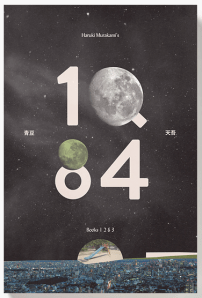
By the way, the cover image I used for this review was designed by Cory Schmitz.

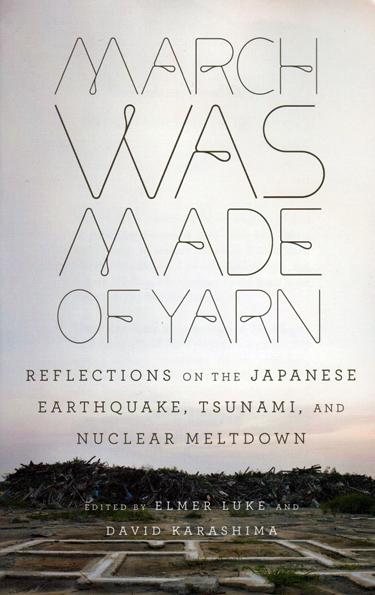
March Was Made of Yarn

Title: March Was Made of Yarn: Reflections on
the Japanese Earthquake, Tsunami, and Nuclear Meltdown
Editors: Elmer Luke and David Karashima
Publication Year: 2012
Publisher: Vintage
Pages: 216

As the March 11 anniversary of the 2011 Tōhoku earthquake and tsunami draws closer, Japanese bookstores have begun to promote retrospective magazine-books. These publications are filled with huge glossy photographs of destruction, and the number of people killed is printed in bold characters across their covers. Although such disaster porn is disturbing, it helps to illustrate a definite aspect of the reality of what happened a year ago in Japan.

March Was Made of Yarn helps to illustrate another aspect of the reality of the earthquake, tsunami, and resulting nuclear crisis. If pictures and body counts inform the physical reality, then this collection of fiction and nonfiction offers insight into the emotional reality. Thankfully, March Was Made of Yarn is infinitely more gentle and subtle than sensationalist reporting and sentimental recollections of heroism and despair.

Even though all of the short pieces brought together by this collection address the events of last year in some fashion, many do so obliquely, and the themes of the pieces are universal. What is it like to live through a crisis? What is it like to know that other people are living through a crisis? What does it feel like to worry about the future? What does it feel like when science fiction becomes reality? What happens when you’re so sick with worry that you can’t fall asleep at night? What happens when words can no longer express truth or meaning?

March Was Made of Yarn features the work of internationally renowned Japanese writers such as Ogawa Yōko, Murakami Ryū, Kakuta Mitsuyo, Furukawa Hideo, and Tawada Yōko. These writers don’t cut corners in their craft simply because they happen to be responding to a topical issue; and, although none of them are writing “happy” stories or essays, their work is a pleasure to read. Kawakami Hiromi, who rewrote her debut story “Kami-sama” (translated as “God Bless You”) to address the incidents at the Fukushima reactor, reminds us that, even though we live in a world shadowed by the fear of radiation and environmental poisoning, we still need to eat, and we still want to go outside. The title story, Kawakami Mieko’s “March Yarn,” deals with the strange ways in which people process their memories and their understanding of their relationships with each other. Tanikawa Shuntarō’s poem “Words,” which opens the book, poses the question of how we can even write about things for which there are no words (yet still “Words put forth buds / From the earth beneath the rubble”). The translators who contributed to this volume are among the best in the field, and their skill illuminates the entirety of the collection.

March Was Made of Yarn isn’t just an excellent anthology of work related to the Tōhoku disasters; it’s an excellent Japanese literary anthology period. The range of authors represented by the book has the most even distribution of gender, generation, and genre I’ve ever encountered, and the English-language contributors, such as David Peace and John Burnham Schwartz, bring an added level of flavor and diversity. This collection is also accessible to casual readers, as few of the stories are any longer than twenty pages, and it has been beautifully published by Vintage. I don’t know how so many good things were able to come together to create this amazing book, but I am extraordinarily grateful that it exits.

March Was Made of Yarn should be available at all major bookstores in North America, Britain, Australia, and Japan, and it’s available on the Kindle Store as well.

If you don’t mind reading entirely in PDF digital format, please consider checking out Waseda University’s Japan Earthquake Charity Literature Project, which has some overlap with March Was Made of Yarn. It’s free to download and read the PDF versions of the stories and essays on the website, and the reader is encouraged to make a donation to disaster relief efforts afterwards.

Speculative Japan

Title: Speculative Japan: Outstanding Tales of Japanese Science Fiction and Fantasy
Editors: Gene van Troyer and Grania Davis
Publication Year: 2007
Publisher: Kurodahan Press
Pages: 290

As a short story collection, Speculative Japan is a strange book. 200 of its 290 pages are comprised of short stories, and the other 90 pages are mainly short non-fiction essays about the book itself. These essays involve topics such as how the stories appearing in Speculative Japan came to be selected, edited, and translated. 20 of these 90 pages are author and translator biographies, and another 20 pages are filled by a translated essay by Shibano Takumi, the editor of the Japanese sci-fi magazine Uchūjin. For a reader who starts the book at the front cover and progresses in a linear fashion, Speculative Japan gets off to a somewhat rocky start with pages and pages of metatextual material.

Gene Von Troyer’s introduction jumps from topic to topic before finally summarizing Yamano Kōichi’s “three phases of Japanese science fiction” and settling into speculation concerning what makes Japanese science fiction “Japanese”:

We can’t say definitively, but can only point to trends and tendencies. Viewed through one facet of the jewel, we can say, as Tatsumi [Takayuki] does, that “what with the imperative of American democratization and the effect of indigenous adaptability, the postwar Japanese had simultaneously to transform and naturalize themselves as a new tribe of cyborgs” as reflected in the images from manga and anime. Japanese SF leans (or has leaned) more on robots and cyborgs than on stars and planets.

This generalization is certainly interesting, but I wonder if it’s really true. For example, the advertisements in the back of the book for Mayumura Taku’s Administrator (a collection of four short novels about “Terran colonies far from Earth”) and Night Voices, Night Journeys (the first of a series of collections of “Tales in the Cthulu Mythos from Japan”) seem oriented more towards “stars and planets” stories, and I can’t help but think of the “spaceships and galaxies” imagery of popular 1970s series such as Takemiya Keiko’s To Terra and Matsumoto Leiji’s Space Battleship Yamato, but perhaps it might simply be better to read Troyer’s introduction as an initial attempt to sketch a map of a huge and understudied body of literature.

In any case, the stories contained in Speculative Japan have less to do with either cyborgs or space than they do with hypothetical concepts. Toyota Artisune’s “Another Prince of Wales” concerns the question, “What if, in the future, war were a popular sport played on an international stage?” Yamano Kōichi’s “Where do the Birds Fly Now?” is an expansion of the question, “What if birds could fly between dimensions and take people with them?” Very few of these stories have serious, in-depth plots; but, then again, very few of these stories are more than twenty pages long. A reader familiar with the type of tightly plotted sci-fi stories published in Fantasy & Science Fiction Magazine is in for a surprise with Speculative Japan, which – as its title suggests – is more about “speculative fiction” than “science fiction.”

Five of the stories in the collection are recycled from the out-of-print The Best Japanese Science Fiction Stories. Of these five, Tsutsui Yasutaka’s Orwellian fable “Standing Woman” and Yano Tetsu’s “The Legend of the Paper Spaceship,” a lyric tale of a woman deep in the Japanese mountains who may or may not be an alien, are excellent and definitely worthy of republication. Making an appearance from the out-of-print Monkey Brain Sushi anthology is Ōhara Mariko’s “Girl,” a sex-saturated story of love and body modification in a decaying city on the eve of an apocalypse.

Three stories that have appeared for the first time in book form in Speculative Japan that really jumped out at me were Kajio Shinji’s “Reiko’s Universe Box,” Kawakami Hiromi’s “Mogera Wogura,” and Yoshimasu Gōzō’s “Adrenalin.” In “Reiko’s Universe Box,” a young woman copes with her negligent husband and failing marriage by becoming absorbed in a box containing an entire galaxy in miniature form. Like many of the stories in this collection, “Reiko’s Universe Box” is driven by strong elements of allegory, but its concept is delivered with cleverness, darkness, vivid description, and humor. When compared to the other stories in the collection, Kawakami’s “Mogera Wogura,” a description of a day in the life of a mole-like creature who lives among humans in contemporary Japan, is in a class of its own in terms of its gentle magical realism, its playfulness, and its removal from the themes and narrative style of more traditional science fiction and fantasy. “Adrenalin” is not a story but rather an abstract poem filled with evocative imagery conveyed through variations of a handful of short and catchy refrains, such as “To you, children of spirits, I send an immediate telegram / To drink milk / To memorize the names of flowers / Some day, I will return / That day, I will start fire.” I’m usually not a fan of Japanese poetry in translation, but I found myself captured and moved by Marilyn Mei-Ling Chin’s translation of Yoshimasu Gōzō’s verse. Each of these three selections stands on its own not simply as an illustration of a speculative concept but as a piece of writing that is fun to read, thought-provoking, and capable of multiple interpretations.

Of the collection’s fifteen stories, four were written in the sixties, eight were written in the seventies, and another was written in 1981. These thirteen stories, written during the period between 1962 and 1981, are all by men. The two more recent stories (published in 1985 and 2002) were written by female authors, but one can still say that this collection is mostly representative of science fiction written by men in the sixties and seventies. In the author biography section at the end of the book, the editors attempt to canonize many of the male authors (“without a doubt a Grand Master of Japanese science fiction and fantasy,” “one of the three pillars of Japanese SF,” “often referred to as ‘The King of Japanese SF,'” and so on), but I wonder if perhaps there wasn’t a hint of personal politics at play in the selection of authors. This suspicion seems to be corroborated by the collection’s metatextual essays, which detail the personal relationships between the authors and their translators.

Speculative Japan sometimes reads like a sci-fi literary fanzine in which the editors and regular contributors are just as concerned about themselves and their relationships with each other as they are with the fiction itself, and the essays in Speculative Japan demonstrate a certain geeky fixation on metatextual marginalia. If you happen to be outside of the small circle of authors, translators, and editors who all know each other and worked together on this collection, you might find these essays confusing and off-putting. If you’re already used to the style of the front (and back) material included in SF-themed literary magazines and fanzines, though, you’ll more than likely be able to see past (or even appreciate) the many pages of essays included in Speculative Japan.

The actual stories in the collection are interesting and well worth reading, and a few of them are truly excellent. Still, I want more work that doesn’t belong to a set clique of authors, more contemporary work, and more work by women. To be honest, I found Speculative Japan somewhat disappointing as a compilation. That being said, I am intrigued enough by the stories themselves to consider giving Speculative Japan 2 a shot in the near future.

Loups-Garous

Title: Loups-Garous
Japanese Title: ルー=ガルー (Rū=Garū)
Author: Kyōgoku Natsuhiko (京極 夏彦)
Translator: Anne Ishii
Year Published: 2010 (America); 2001 (Japan)
Publisher: Haikasoru
Pages: 450

Spoiler: There are no actual werewolves in this book.

The real shape-shifter is Loups-Garous itself, which wears multiple skins. The novel is a murder mystery and a sci-fi suspense thriller. It is a police procedural, a cyberpunk dystopia, and a high school drama. It can also be read as a series of philosophical musings on technology, authority, and human nature.

Loups-Garous is set in the not-too-distant future (the 2030s are referred to as if they were the 1990s) of Japan, in which many of the laws and social conventions concerning food, housing, education, communication, and privacy are no longer what they once were. For example, although minors are assigned guardians who may or may not be their parents, they are apparently not required to cohabitate with these adults. Furthermore, children learn from computer modules instead of from teachers, and their only physical contact with other people is through periodically scheduled meetings with selected peer groups and guidance counselors. The younger generation has gradually come to interact with the world almost exclusively through computerized devices called “moniters,” which range in size from wristband models to screens the size of bedroom walls. Cities are divided into carefully controlled zones, all food is artificial, and the movements and consumption patterns of every individual are recorded through omnipresent video cameras maintained in both public and private spaces by the corporation that controls the country.

Despite the fact that this micro-management of individual lives is supposed to keep people safe, a series of connected murders has broken out in an otherwise peaceful residential district. A possibly related set of school absences draws three high school girls, Hazuki, Mio, and Ayumi, to meet together in person. Meanwhile, the girls’ guidance counselor, Shizue, is pulled into a police investigation of several students who may be either suspects or victims. As Hazuki and Shizue are pulled deeper into the circumstances surrounding the murders, the grimy foundations of their seemingly utopian society are revealed, as is a major government conspiracy.

The cyberpunk gothic noir setup of Loups-Garous attracted me to the novel and kept me reading, but I will admit that I ultimately did not enjoy the experience. None of the plot devices are particularly original, the themes are spread too thin, and the pacing is uneven. Long passages of exposition and dialog are broken by fights and chase scenes in a way that seems random and frenetic, and the last fifty pages of the novel read like the two minutes of downhill careen that follow a very long and very slow slog up the first hill of a roller coaster ride. Furthermore, the big surprises at the end, such as the identity of the killer, have almost no foreshadowing. To give an example, there’s a giant mecha at the end of the novel. It comes out of nowhere. The lack of suspenseful buildup leading to its appearance is so total that mentioning it doesn’t even feel like a spoiler.

I also found the main characters infuriating. I understand that these characters, who have grown up in a world in which there is very little interpersonal interaction, are supposed to be socially maladjusted, but that doesn’t make their antisocial awkwardness any easier to read. To bring up a topical analogy, Sherlock Holmes is interesting (and bearable) as a character because he is juxtaposed against foils such as John Watson and Inspector Lestrade. These foils don’t just help to demonstrate what is so unique and fascinating about Holmes; they also serve to drive the story forward by providing a means to address the more commonplace concerns that exist for a reader who lives in a world governed more by social and accidental systems of cause and effect than by pure logic. A story with two Sherlocks and no Watson wouldn’t be nearly as readable. Loups-Garous has five Sherlocks and no Watson, and it’s painful to watch these characters bicker with each other endlessly. Besides being socially maladjusted, each of them is idiosyncratic in her own way (“I’m a genius, so I don’t have a sense of aesthetics.”), and the weird gaps in their knowledge of the world mean that each of them will often say things that can come off as inane to the reader (“You think you can actually eat animals? That’s stupid.”).

Speaking of the characters’ knowledge of their world, the author’s construction of the novel’s setting felt uneven to me. Specifically, the story is supposed to be set in a time in which people who were adults in the twentieth century still hold active positions of power, yet the main characters act completely ignorant of the history, economic systems, and technologies that existed before their own lifetimes (even though the reader is left to assume that such information is freely and easily available, such as in the form of entertainment media). For example, when the self-proclaimed genius Mio explains the concept of a “telephone” to Hazuki, Hazuki is completely flabbergasted over the fact that such a thing could ever exist, and Mio herself admits that she doesn’t know what language the word “telephone” comes from. There is thus a deep contradiction in the novel’s construction of its setting (which is either super-futuristic or not really futuristic at all) that prevents the reader from really understanding the novel’s worldview or becoming absorbed in its atmosphere.

Finally, perhaps partially as a result of the awkwardness of the characters and setting, the long philosophical passages that fill the novel are written in a style that is somewhat confusing. For example, a chain of logic might be set up like this:

“It goes without saying that scissors are good for cutting paper. Similarly, the best accounting software can’t make music. Computers are nothing more than calculators. It’s a system built to do the math necessary to accomplish a task. If humans were able to do several calculations at once there’d be no need for computers. No matter how grand the calculation, nothing but cutlery can cut paper.”

Or a theme of the novel might be expressed in a meaningless repetition of chichés and platitudes:

“The adults don’t know anything.” Don’t they? It wasn’t just the adults. Kids wouldn’t know anything about other people either. No one wanted to know and no one wanted to be known. So no one knew anything about anyone else. They weren’t bothered by not knowing. They weren’t bothered by not being known. Moreover… They actually hated being known.

Unfortunately, Loups-Garous is filled with many such pseudo-philosophical soliloquies, which detract from what little plot, character development, and world building the novel is able to offer.

In the end, I feel that Loups-Garous is a waste of a good premise that could have been vastly improved with either more judicious editing of the original text or more creative license on the part of the translator. I hate to bash anything published by Haikasoru, a press that has almost consistently put out quality material, but Loups-Garous weighs in towards the lower end of the publisher’s catalog (along with Mardock Scramble, another title that, like Loups-Garous, has an animated adaptation).

If you’re interested in the dystopian sci-fi premise of the novel, you might be better off watching either Fractale (streaming on Hulu) or No.6 (streaming on Crunchyroll), two anime that share similar themes but are much more intelligent and stylish in their execution of these themes. Also, while I was reading Loups-Garous, I kept wishing that I was reading Margaret Atwood’s Oryx and Crake instead. The story and premise of Oryx and Crake are similar to those of Loups-Garous, but the readability and literary flair of Atwood’s novel are much higher. Even though I didn’t like this novel, Kyōgoku Natsuhiko is a very interesting writer, and I definitely recommend his Summer of the Ubume. With so much other excellent reading and viewing material, why would you want to waste time on Loups-Garous? The novel wears many skins, but it doesn’t wear any one of them particularly well.

Fires on the Plain

Title: Fires on the Plain
Japanese Title: 野火 (Nobi)
Author: Ōoka Shōhei (大岡 昇平)
Translator: Ivan Morris
Publication Year: 1957 (America); 1951 (Japan)
Publisher: Tuttle
Pages: 246

The Pacific War is an uncomfortable subject for me. I don’t like war, and I don’t like watching movies about war, and I don’t like reading about war – especially the Pacific War. I’m also not entirely comfortable recommending a book written about the Pacific War. However, a friend of mine recently confided in me that he’s working on a novel about a Japanese soldier on a small island in the Pacific. The novel would have swords, he told me, and survival, and brilliant military strategies, and cherry blossoms. At the end of his novel, everyone would die a glorious and noble death.

I told my friend to go read Fires on the Plain.

Fires on the Plain is about a soldier named Tamura who is stationed on Leyte, an island in the Philippines. Ōoka himself was drafted and sent to Leyte in 1944, so one can plausibly assume that the novel is somewhat based on the author’s experiences. What distinguishes Fires on the Plain from many other Japanese fictional accounts of the war, however, is that it is not written in the style of proletarian literature or the semi-autobiographical shishōsetsu (“I-novels). Before he was drafted, Ōoka worked at a Franco-Japanese translation agency while working on his own translations of French literature. Far from being preachy or moralistic, Fires on the Plain is a tightly structured psychological novel written in the style of nineteenth-century French novelists such as Stendhal, Ōoka’s favorite author.

Fires on the Plain focuses on the psychological and emotional struggles of Tamura as the soldier is kicked out of his unit, sets off on his own, later rejoins the scattered remnants of the Japanese army still on the island, and then struggles for survival in the company of two men who have turned to cannibalism in order to stay alive. During his time on Leyte, Tamura ponders the nature of humanity, the relationship between God and man, and the workings of free will in the face of an almost certain fate. His primary concern, and the primary concern of every character that appears in the novel, however, is hunger. How long can you live on a handful of potatoes? How can you procure food from the native islanders without getting killed? Where can you find salt? What do you do after all the food is gone? Aside from the ranting of one half-dead and half-crazed man who appears towards the end of the novel, the glory of the Emperor and the nation of Japan have no place in the consciousness of Tamura and his fellow soldiers.

Because the story is recounted by a starving, traumatized, and unreliable narrator, there is little thematic closure in the novel. That being said, there are some lovely descriptive passages reflecting the beautiful tropic setting of the island:

The sun gleamed on the river’s surface, and clouds scudded across the dazzling sky to disappear over the mountain peaks. On the sloping banks of the river bamboos grew luxuriantly, their green leaves wafted by the breeze. Driftwood, which remains from the floods of the rainy season, lay drying on the sand and pebbles of the river’s edge. Now and then the water would strike the banks capriciously, or form deep pools, or spread out into frothy rapids. In the evenings by the shadows of the pools I could hear the river deer cry as they came down to drink, and at dawn the turtledoves cooed high on the river bank.

There are also harrowing passages describing the horrors of war:

How could I have failed to notice the objects lying at the foot of those steps – objects that must have been in my field of vision for some time? My sense of perception must have already changed during the weeks since I had left my company. Clearly the link between my consciousness and the outer world was greatly attenuated. A solitary alien in an enemy land, I had by this time come to notice only objects that warned me of immediate danger, or, as in this case, objects on which I literally stumbled.

I thought of them as “objects” though some might call them “people.” In one sense, to be sure, they were people, but their bodies had already become dehumanized objects. What lay below those steps were corpses.

Having been corpses for some time, they had lost all the individual conformations of their past lives. Only their army trousers revealed some slight trace of the time when their owners had belonged to humankind; yet even these were so discolored by mud and carrion slime that they no longer seemed like human clothing and were, indeed, barely distinguishable from the surrounding earth.

In the end, though, having been abandoned on Leyte and left to fend for himself during the closing days of the Pacific War, and having witnessed death and killed people himself, and having starved and eaten the flesh of his fellow soldiers, Tamura is no closer to solving the great mysteries of life than he was when at the beginning of the novel. The confusion of the narrator becomes the confusion of the reader; and, despite its brilliant imagery and powerful symbolism, it is difficult to draw any clear philosophical message from the novel – besides the painfully obvious.

Anyone interested in the Pacific War in any capacity should read Fires on the Plain. Ōoka demonstrates that the reality of the war was anything but honorable and glorious, but he does so through the vehicle of a disturbing yet highly readable novel that feels no need to shove its “war is evil” message into the reader’s face.

The Restaurant of Love Regained

Title: The Restaurant of Love Regained
Japanese Title: 食堂かたつむり (Shokudō Katatsumuri)
Author: Ogawa Ito (小川 糸)
Translator: David Karashima
Publication Year: 2011 (United Kingdom); 2008 (Japan)
Publisher: Alma Books
Pages: 193

The ad copy on the back cover of The Restaurant of Love Regained proclaims the book to be “for all fans of Kitchen by Banana Yoshimoto.” I think the comparison between the two books is apt. Both novels are short and fluffy stories of young women who attempt to ameliorate the pain caused by a recent loss through cooking. Both are meant to have a calming and healing effect on the reader. And finally, depending on the reader, the prose of both novels is either refreshingly light and bubbly or infuriatingly infantile. Before you read the rest of this review, you might first want to ascertain how Ogawa’s writing style affects you:

My dream of having my own place was now within reach. Things were still hard work, though. I still trod in [my pet pig]’s droppings at least once a day. I still had chestnuts falling on my head. And I still kept tripping over pebbles along the mountain paths and almost falling flat on my face. But the number of moments that filled my heart with joy far outnumbered those I’d felt while living in the city. Even the tiniest little thing had the power to make me feel happy. Like turning over a beetle struggling on its back and watching it walk away. Like feeling the warmth of a freshly laid egg against my cheek. Like seeing a droplet of water balance on a leaf’s surface, more beautiful than any diamond. Or like finding a Kinugasa mushroom at the entrance to the bamboo forest, carefully plucking it and taking it home to place in my miso soup, with its wonderful flavor and its underside as beautiful and intricate as hand-knitted lace. All of these things filled me with wonder and gratitude and made me want to kiss God on the cheek.

If you like this type of writing, the whole book is written like this. If you don’t like this type of writing, this whole book is written like this. Since the novel has apparently achieved “international bestseller status” and was even turned into a feature film, I suppose that enough people have found Ogawa’s prose charming. It struck me as both forced and superficial at times, and the overwrought analogies and smug statements of self-satisfaction that Ogawa tends to place at the end of her paragraphs occasionally made me cringe in second-hand embarrassment. It took me about thirty pages to get used to Ogawa’s writing; but, once I did, I started to enjoy the book for what it was: food porn. Ogawa’s narrator loves cooking, and she loves eating, and she talks about both incessantly. If nothing else, this novel will fill you with a powerful lust for food.

The Restaurant of Love Regained begins when its first person narrator, Rinko, returns to the apartment she shares with her boyfriend to find it empty. Everything – from her furniture to the food in the refrigerator to the money she had kept stashed away under her mattress – is gone. Since Rinko has neither a cell phone nor a debit card, she uses the last bit of money on her person to take a bus back to her rural hometown. Rinko had originally left this village as a teenager in order to get away from her mother, who works as a bar hostess. After moving to Tokyo and living with her grandmother for a few years, during which time she learned how to cook, Rinko started working at a Middle Eastern restaurant. She was planning on opening her own restaurant when she had saved enough money – or at least she was before her boyfriend absconded with all of her worldly possessions. The shock to Rinko is so great that she ends up losing her voice. Rinko thus can only communicate through writing, but this doesn’t stop her from convincing her mother to loan her enough money to open an “eatery” in the small mountain village where she now lives. Rinko names her eatery “The Snail” and decides to serve only one party of customers a day, a management strategy that will presumably allow her to put her entire heart and soul into each and every meal.

What follows this initial setup is an episodic series of stories about Rinko’s customers and the dishes she prepares for them. Through her cooking, Rinko brings couples and families together while healing sick pets and sick relationships. All of these stories have happy endings, and Ogawa seems to delight in detailing the ingredients and preparation of the food that makes these happy endings possible. Behind the fluffy chick lit and food porn, though, is the story of the complicated relationship between Rinko and her mother, which, in the end, gives the novel the kind of satisfying narrative closure that cannot be provided by erotic descriptions of crème fraiche alone. This mother-daughter relationship is also the only hint of character complexity in The Restaurant of Love Regained, which is otherwise entirely one-dimensional. If you happen to like that one dimension, though, you will love the novel. Ogawa’s formulaic prose and story patterns are enjoyable and relaxing, and her novel is a testament to culinary creativity.

… At least until the last forty-five pages. The first thirty pages of the novel’s closing sequence are grisly and horrific. In these pages, Rinko butchers her pet pig Hermes for her mother’s wedding reception. This process is described in hideously disturbing language. Nothing in the rest of the book will have prepared you for these scenes. Reading them is viscerally upsetting – it’s like biting into a sweet tropical fruit only to find that a many-legged creature has died there while its sickly white larva feast on the flesh of their mother.

Besides an older man named Kuma, who helps Rinko set up her restaurant, Hermes is Rinko’s only friend. Rinko variously describes the pig as her sister, her child, her foster mother, and her grandmother. Rinko has fed Hermes, slept beside Hermes, and taken care of Hermes when the pig was sick. Rinko celebrated her birthday with Hermes, and Rinko rang in the new year with only Hermes to share her joy. Rinko cried to Hermes when she was sad and tried out new recipes on Hermes when she was excited. Throughout the novel, Hermes has proven capable of a wide range of human emotions; and, in many ways, the pig is a more sympathetic character than Rinko herself.

It is therefore not a little upsetting when Rinko acquiesces to her mother’s request that she kill Hermes.

The end of the novel is composed of a series of scenes depicting Rinko preparing Hermes for her mother’s wedding reception dinner. The author uses cruelly precise language to explain everything from the fear in Hermes’s eyes when the pig realizes she will be killed, to the way the pig struggles against being lead to the slaughterhouse, to the pig’s panic and anger when she is strung upside-down from the ceiling, to the pig’s anguished cries when Rinko slits her throat, to the pig’s futile struggles as she slowly bleeds to death. This goes on for pages. What follows is a loving description of the instruments Rinko uses to skin, gut, and carve Harmes, as well as how these instruments cut and slice into the pig’s body. There is a lot of ripping and tearing and blood, which is all the more disturbing when coupled with Rinko’s tender prostrations of how precious Hermes is to her, and how Hermes is just like a child/sister/mother.

This book takes the preparation of food very seriously. However, whereas these food preparation scenes used to be innocent and appetizing…

The rice was cooked a little too soft for my liking, but that didn’t stop me from munching down several mouthfuls and imagining their energy rising from the bottom of my stomach; the energy had come from Kuma’s mother as I’m sure she prepared them with her heart, her soul and kind thoughts for us. So I wasn’t just eating rice. I was taking in her love.

…now they are cruel and disgusting:

Next, I said a final farewell to Hermes’s face and placed it in the middle of the work bench. I took a knife and cut off both ears, planning to use them in a salad. Then I cracked the head in two. As my knife went through her head, it let out a sound like a groan. I was surprised to see that her brain was a lot smaller than I’d expected, and with a different, pearl-like colour to it too.

Pretty gross, right? And this paragraph isn’t even the worst. That particular honor goes to the paragraph in which Rinko muses that Hermes was like a grandmother to her as she pulls out the pig’s intestines.

I think the point of these scenes is supposed to be that we should reflect on where our food comes from and respect the organisms that give their lives so that we may be nourished. In other words, I think the novel’s conclusion is supposed to be a joyous celebration of food and food cultures (oddly paired with a sense of sadness directed towards relationships that cannot last, such as Rinko’s relationship with her mother, who is dying of cancer). Unfortunately, the incestuous and cannibalistic overtones of the language used to describe this bloody and barbaric celebration cancel out any intended joy and thanksgiving. I am not a vegetarian, and I think pork bacon is delicious, but the slaughter and consumption of Hermes was too much even for me, especially since the one hundred and fifty pages proceeding it had lulled me into complacency with uncomplicated stories of delicious food and people being happy.

Such an ending could be interpreted in two ways. The first is that it is simply the incompetent icing on a cake of incompetent writing. The second is that Ogawa is a brilliant writer of subversive horror fiction who has been even more subtle in her project to shock and horrify her audience than director Miike Takashi was in a film like Audition. If we follow this second interpretation, Rinko’s one-dimensional personality takes on sinister overtones. In her mind, there is no distinction between food and family, and she finds just as much pleasure in the bloody butchering of flesh as she does in sipping imported hot chocolate. Such an interpretation, combined with the novel’s vaguely gothic setting, provides a chilling premonition of the grisly future of Rinko’s isolated restaurant in the mountains. Furthermore, what really happened to the lover who abandoned Rinko at the beginning of the novel?

Unfortunately, this second interpretation is somewhat improbable. What we have, then, is a novel about food that gets a little messy at the end. If you love food and can stomach an extended scene detailing the slaughter and butchering of a beloved pet for the sake of thematic closure, you can probably handle The Restaurant of Love Regained. You might even be glad you read it. If you’re looking for serious Literature-with-a-capital-L, an engaging plot, an interesting and multi-faceted cast of characters, and real human drama – or if you’re put out by the prospect of reading thirty pages of intense carnage – you should probably avoid this novel. Personally, I wish I could unread it.

The Girl Who Leapt Through Time

Title: The Girl Who Leapt Through Time
Japanese Title: 時をかける少女 (Toki o kakeru shōjo)
Author: Tsutsui Yasutaka (筒井 康隆)
Translator: David Karashima
Publication Year: 2011 (Britain); 1967 (Japan)
Publisher: Alma Books
Pages: 170

Three things are generally true of Tsutsui Yasutaka’s writing: it’s easy to read, it’s creative and fun, and it’s usually more about the concept than the characters. The Girl Who Leapt Through Time is no exception. The story is short, it’s entertaining, and the idea of time travel is more fleshed out than the characters.

Junior high school student Kazuko hears a crash in her school’s science lab while helping her friends Goro and Kazuo clean up after class. When she enters the room to investigate, she smells lavender and passes out. The next morning, she and Goro are run down by a bus while rushing to school. Right before the bus strikes them, however, Kazuko opens her eyes and finds herself back in bed. She discovers that she has somehow jumped back in time to the morning of the previous day. Kazuko tells Kazuo and Goro about her strange experience, and they suggest that she talk to their science teacher, Mr. Fukushima, after school. Surprisingly enough, Mr. Fukushima listens sympathetically before explaining that Kazuko needs to jump back in time to the incident in the science lab in order to figure out what happened. She does so and meets Kazuo, who explains everything to her before erasing her memory and returning to where he originally came from.

And that is the story. Nothing else really happens. Kazuo’s debriefing is interesting, but there is no on-screen adventuring or experimentation on the part of Kazuko. There is no narrative tension, just a bit of simple mystery solving. None of the characters really stand out. Kazuko is frightened and dependent on the help of others, Goro is childish and petty, and Kazuo drifts along without contributing anything until the last three or four chapters. The two other named characters, Mr. Fukushima and Kazuko’s friend Mariko, barely have any lines at all. Director Hosoda Mamoru’s 2006 animated adaptation is much richer in terms of storytelling and character development. Still, The Girl Who Leapt Through Time is a quick and easy read that should appeal to a younger audience.

A bit more interesting than the main novella is the shorter work “The Stuff Nightmares Are Made Of,” which is also included in the book. In this story, junior high school student Masako tries to get to the bottom of her fear of heights, which is somehow connected to the discomfort she feels around Prajna masks. Masako’s close friend Bunichi passes along what his therapist uncle tells him about the psychology of fear, and Masako uses this information to help not only herself but also her five-year-old brother Yoshio, who suffers from night terrors. The relationship between Masako and Yoshio is charming and sweet, as is the budding romance between Masako and Bunichi.

If I had to guess, I would say that the two stories in The Girl Who Leapt Through Time are meant for kids who are a bit younger than their protagonists, despite the adult woman adorning the book’s cover. They’re both entertaining, simple stories for the age seven to twelve crowd. If you’re an adult reader in North America who can’t seem to find a copy of this British publication, though, you’re not missing much. The movie is definitely better.

The Best Japanese Science Fiction Stories

Title: The Best Japanese Science Fiction Stories
Editors: John L. Apostolou and Martin H. Greenburg
Publication Year: 1997
Publisher: Barricade Books
Pages: 176

In the introduction of The Best Japanese Science Fiction Stories, editor John Apostolou informs the reader that, prior to the publication of this collection, it was very difficult to find Japanese science fiction in English translation. Translations of a few Abe Kōbō novels (such as The Ark Sakura and Inter Ice Age 4) had been published by Knopf, but the majority of translations of science fiction stories (such Arai Motoko’s A Ship to the Stars and Takachiho Haruka’s The Adventures of Dirty Pair) were only available from the Kodansha English Library, which was (and still is) virtually impossible to find outside of Japan. The purpose of The Best Japanese Science Fiction Stories, then, was to collect translations of short stories by major Japanese sci-fi authors such as Hoshi Shinichi, Hanmura Ryō, and Komatsu Sakyō.

Most of the thirteen stories in this collection are less than ten pages long. Some (like Abe Kōbō’s “The Flood” and Komatsu Sakyō’s “The Savage Mouth”) read like modern parables of the nastier aspects of human nature, while some (like Hanmura Ryō’s “Tansu” and Kōno Tensei’s “Triceratops”) are more dark fantasy than science fiction. Others, however, are examples of speculative fiction at its best. One of my favorite stories in the collection is Tsutsui Yasutaka’s “Standing Woman,” which is a window into a dystopian future in which anyone caught grumbling about the wrong thing – whether it’s high prices at the supermarket or too much overtime at work – is punished by being “vegetized” and planted next to a sidewalk or park bench. The story that closes the collection, Yano Tetsu’s “The Legend of the Paper Spaceship,” comes as close as a twenty-page short story can get to being a masterpiece of science fiction. It features a mysterious woman, a psychic son, an isolated village in the country, and strange legends that all come together to suggest secrets and cosmic mythologies that are illuminated just enough to capture the reader’s imagination.

Although the translation is a bit wonky in places (particularly in Kita Morio’s “The Empty Field”), I really enjoyed reading all of the stories in The Best Japanese Science Fiction Stories, and the foreword and introduction provided interesting glimpses into the process of how these stories were translated. If I am allowed one complaint, however, it would be that there are no female writers represented by this collection. I would recommend that anyone looking for an overview of the many female sci-fi writers in Japan should check out Kotani Mari’s essay “Alien Spaces and Alien Bodies in Japanese Women’s Science Fiction” in the essay collection Robot Ghosts and Wired Dreams. (If you can read Japanese, Kotani’s monograph Technogynesis is also fun and informative.) In any case, The Best Japanese Science Fiction Stories served its purpose by making me want to read more Japanese science fiction short stories, and from here I’m planning on moving on to Speculative Japan and Speculative Japan 2.

The Bamboo Sword

Title: The Bamboo Sword and Other Samurai Tales
Japanese Title: 藤沢周平短編集 (Fujisawa Shūhei tampenshū)
Author: Fujisawa Shūhei (藤沢 周平)
Translator: Gavin Frew
Publication Year: 2005 (America); 1976-1988 (Japan)
Publisher: Kodansha International
Pages: 253

The single sentence of text on the back side of this book’s dust jacket reads: “Evocative, exciting, and tender, these charming tales open a window onto life in Japan as it was four hundred years ago.” Although I am generally wary of the unironic use of the word “charming,” I have to agree that it’s the word that best describes The Bamboo Sword. These stories are charming. They’re light-hearted and don’t take themselves too seriously. Men are masculine, women are feminine, ideals like honor and virtue hold true, and the good guys always win in the end.

If I had to guess, I might say that the target audience for these stories are oyaji, older middle-aged men who are generally considered to just about the least cool people in Japan (unless they happen to be Kitano Takeshi). Oyaji are the workhorses of the Japanese economy but never get enough respect. They enjoy the simple pleasures of life, such as drinking and enka, and all they need is a little love to help them maintain their daily struggles for the sake of their families and their country. They can come off as grumpy sons of bitches, but really they’re all good people deep inside. I say that oyaji are the target audience for The Bamboo Sword because the protagonist of each of the book’s eight stories is an Edo-period oyaji. These (mostly) samurai protagonists are down on their luck, especially since there’s not much fighting to be done in the Edo period, but they shine when given a chance to prove themselves.

The stories in The Bamboo Sword tend to alternate between domestic pieces and action pieces. A good example of one of the domestic stories is “Out of Luck,” in which an out-of-work rake named Sanjiro seduces a girl and then dumps her. The girl’s dad tracks down Sanjiro, hauls him out of the bar he frequents with his friends, and forces him to come home and marry his daughter. The father is a rice merchant, and employs Sanjiro as his apprentice. Sanjiro hates the strict training, but his new father-in-law cheerfully chases him down every time he tries to escape. In the end, Sanjiro falls in love with his wife, takes over the family business, and wonders how he could have ever enjoyed the pathetic lifestyle he used to live before his father-in-law beat some sense into him.

My favorite action story is called “The Runaway Stallion,” which is about a samurai named Tsubuki Jubei who inadvertently becomes involved in a political plot. Jubei’s old rival, who has since become a Vice Councilor, volunteers Jubei as a bodyguard for a courier delivering extremely sensitive information. Jubei and the courier are ambushed, and Jubei, who had become more interested in drinking and grumping around than training as he got older, is almost killed. Jubei realizes that he really needs to get his act together and goes back to his old fencing teacher, begging him to whip him into shape. Thus begins a training montage, over the course of which Jubei stops a runaway horse with his bare hands and learns more about the political plot that almost got him killed. It turns out that the Vice Councilor is not such a good person and wants Jubei dead for his own petty reasons. By the end of the story, though, Jubei defeats his enemy and proves himself to be a badass. The woman who is living with him as a maid singlehandedly stops an assassin and is also a badass. If there were a dog in the story, you can bet that the dog would secretly be a badass too. It’s just that kind of story.

The Bamboo Sword is very light reading. Its stories are indeed “charming.” There is some tension between classes, some tension between political ideologies and social realities, and some classic samurai-style tension between giri and ninjō, but the main conflict in the book is between the protagonists’ alcoholic tendencies and their desire to be awesome. It’s not difficult to read these characters as the fictional embodiments of wish-fulfilling fantasies on the part of an older generation of salaryman corporate warriors. In short, The Bamboo Sword is like chick lit for old dudes. Even if its system of values is a bit stodgy, it’s still a lot of fun.

Hear the Wind Sing

Title: Hear the Wind Sing
Japanese Title: 風の歌を聴け (Kaze no uta o kike)
Author: Murakami Haruki (村上 春樹)
Translator: Alfred Birnbaum
Publication Year: 1979 (in Japanese); 1987 (in translation)
Publisher: Kodansha English Library (講談社英語文庫)
Pages: 130 (plus 15 pages of translation notes)

I love A Wild Sheep Chase. The narrator’s daily life in Tokyo, the narrator’s sojourn in Hokkaido, the mystery of the sheep, and the philosophical musings on genius and individuality all come together into an interesting and compelling story. There’s this one weird bit, though, after the narrator leaves Tokyo but before he reaches Sapporo. This is the chapter describing the narrator’s visit to a place called J’s Bar. He doesn’t visit J’s Bar in real time; rather, he remembers having visited it in the past. J’s Bar, we learn, is where he and a character called “the Rat” used to drink when they were younger. I always felt that there was something about the narrator’s relationship to the Rat and J’s Bar that Murakami wasn’t telling us. As a result, this short, atemporal section connecting Tokyo and Hokkaido felt disjointed and out of place. Perhaps the reason it felt this way to me is because I had never read Murakami’s earlier novels, Hear the Wind Sing and Pinball, 1973. A Wild Sheep Chase is part of a tetralogy (which is concluded by Dance Dance Dance), so it only makes sense that I would be missing something by having started in the middle.

Hear the Wind Sing is a short I-novel in the style of Shiga Naoya, by which I mean that it involves a young man who wanders around aimlessly while thinking about how pointless his life is. I don’t mean to imply that the novel isn’t worth reading, because it certainly is. There just isn’t much of a plot. The narrator, who is a college student majoring in biology, has returned from Tokyo to his hometown by the sea for the summer. He spends his days chilling out and his nights drinking in a small, run-down pub called J’s Bar. J is a middle-aged Chinese man who has befriended the narrator and his drinking buddy, a young college dropout nicknamed the Rat (“Nezumi”). One night, the narrator goes to the bathroom in J’s Bar and finds a young woman passed out on the floor. He gets her address from her purse, takes her home, puts her to bed, and then falls asleep in her apartment. The novel meanders between the sporadic interactions between the narrator and this woman, about whom neither the narrator nor the reader ever learns much before she disappears forever. Between these interactions, the narrator briefly reflects on his past romantic relationships and thinks about writing and literature, which he discusses with the Rat. The story is bookended at its beginning and end by sustained discussions of Derek Heartfield, a (fictitious) early twentieth-century writer of speculative fiction whose life and work, the narrator concludes, showed promise but ultimately went nowhere.

Hear the Wind Sing is a short novel, and it feels even shorter because of its frequent chapter breaks (about once every four or five pages) and frequent page breaks within chapters. There’s no real pattern to the narration, which includes conversations, reminiscences, literary speculation, song lyrics, and a bit of linear storytelling. Despite this lack of cohesion, everything flows together nicely, and the way that the main themes of the novel (such as the inability of any one person to really know any other person) are elliptically approached is fairly effective. The narrative voice contains far more humor than self-pity and keeps the reader moving easily through the novel. This narrative voice is broken a few times by the insertion of the voice of a radio rock station DJ, who has some of the best passages in the whole book. Such a fragmented narrative style effectively captures the experience of being a college student at home for the summer, moving through the days without a clear sense of purpose and half-heartedly wondering what the future will bring. There’s no grand mystery of the sort that forms the core of A Wild Sheep Chase, but the narrator is same amiable personality who sees the world through a perceptive yet detached perspective. If you can get your hands on this book (which is fairly easy to do at major Japanese bookstores or through Amazon.co.jp), it’s a quick and enjoyable read, especially for fans of Murakami’s writing style. Birnbaum’s translation notes at the end of the book are also a nice treat for people who are interested in that sort of thing.