Fujisan

Fujisan

Title: Fujisan
Japanese Title: 富士山 (Fujisan)
Author: Taguchi Randy (田口 ランディ)
Translator: Raj Mahtani
Year Published: 2012 (America); 2004 (Japan)
Publisher: AmazonCrossing
Pages: 191

In her Foreword, Taguchi states that she “wrote this anthology of stories as an expression of my veneration and appreciation for this life-affirming mountain; it is my personal tribute to Fujisan.”

Although Mount Fuji is in the background of each of the four stories collected in this volume, the main theme of these stories is an affirmation of life in the face of fairly extreme social maladjustment and malaise. “The Blue Summit” is about a convenience store worker who begins reflecting on his past experiences as a member of a religious cult after he survives an attempted robbery. “The Sea of Trees” is about three high school students with an interest in the occult who go hiking in the Aokigahara forest and come across a failed suicide. “Jamila” is about a public servant who is tasked with dealing with an old woman who lives in a house overflowing with garbage. “Child of Light” is about a nurse at a small gynecological clinic who ponders a teenage abortion patient she recently cared for as she climbs Mount Fuji with a group of older women. The characters of these stories all face death and the more unpleasant aspects of continuing to live and somehow manage to come out okay on the other side.

I liked the opening story, “Blue Summit,” for its description of the appeal of sanitized and familiar spaces like convenience stores and family restaurants to the broken people who seek refuge there in the small hours of the night. As the narrator says of the convenience store where he works as a night shift manager:

I like it here. This convenience store is my sanctuary. There’s a stillness here that’s like the stillness you find in the snowy, bleak plains of Siberia. […] The store’s open twenty-four hours and it’s menacingly bright. There’s no darkness. It’s all so gloriously digital. While intimacy and a sense of reality are effectively absent in the store, a minimum degree of comfort is always guaranteed. The convenience store is stabilized on a low-energy wavelength: it never betrays you. In a convenience store, you can silently snuggle up to the void. (3, 13)

In this story, the convenience store as a comforting space is juxtaposed against the nightmarish interior spaces of the people who enter it. The narrator is haunted by the memories of a friend he made when he was a member of a religious cult headquartered at the base of Mount Fuji who may have been killed by the group when he tried to defect. Kozue, one of the employees who works under the narrator, suffers from a fascination with dissection and enjoys watching herself bleed. As for the anonymous assailant who unsuccessfully attempts to rob the convenience store at the beginning of the story and later shows up with a baseball bat looking for revenge, the narrator suspects that what he’s ultimately after is a validation of his own existence, a concern that the narrator sympathizes with even as he is attacked.

My favorite story in Fujisan has to be “Jamila,” if only for its colorful descriptions of a gomi yashiki, or “garbage mansion,” in Susono City, a small municipality in the foothills of Mount Fuji. The narrator of the story, a native son who has left a corporate job in Tokyo to take a post at Susono’s Office of Environmental Quality, is tasked with dealing with a local hoarder’s residence. He hasn’t made much progress, partly because he is fascinated by the structure:

When I went to investigate the house of trash for the first time, a part of me was genuinely thrilled. I wanted to see for myself who the old garbage lady was, the one reputed to be a goblin, but when I arrived, the horror of it all simply defied imagination. It was a slice of nightmare lying exposed in the heart of a residential area lined with middle-class houses. What bothered me the most was the drabness of all the visible junk, especially in light of the fact that each and every one of the objects was at one time or another brand new. […] The trash, estimated to be sixty tons’ worth, was spilling over from the premises into the public road, where it bore an uncanny resemblance to the entrails of a road-killed cat. (108)

I really don’t find all this trash-hoarding that objectionable. I find it more interesting than, say, staying inside city hall. As I stood there, gazing vacantly, my eyes registered an entire universe of things: wire hangers, torn umbrellas, broken TVs, antennas, vacuum cleaners, plastic bags, tattered clothes, tricycles, flowerpots, bedpans, bamboo blinds, futons… The trash went beyond trash to become works of fantastic, sculptural art. (100)

As in “Blue Summit,” physical spaces have a close relationship with psychic spaces, and the narrator’s meditation on an old woman’s gomi yashiki reveals the disorganization of his own (possibly deranged) mind and the sociological state of a nation that produces and throws away so much physical, cultural, and human garbage.

If I had to describe these stories in one word, it would be “intense.” There’s a bit of navel gazing going on in Fujisan, but it’s never too cumbersome, and the collection’s four stories move quickly and capitalize on topical issues for emotional impact.

If you’re wondering about the publication quality of Amazon’s new translation publisher, AmazonCrossing, it’s actually fairly decent. The front and back covers of the physical version of Fujisan look like printouts of a mid-resolution PDF document, but the inside text is crisp and clear, and the page layout is clean and uncluttered. During the short promotional period when Amazon was offering the book for about as much money as a cup of tea at Starbucks, I also downloaded the digital version of the book from the Kindle store, and it looked great as well.

Several reviewers on Amazon have complained about the translation, but I didn’t mind it so much. There were a few sentences that were awkward (they mostly involved slang), but overall I think Raj Mahtani did a great job conveying the voices of Taguchi’s characters. I have read (and produced) a great deal of clunky awkward translatorese, and I know just how terrible it is, but nothing of the sort appears in Mahtani’s translation of Fujisan. The vast majority of the translated prose in the collection is clear and serviceable. It’s never going to win any literary awards, but Taguchi herself isn’t exactly a “literary” writer; she writes popular fiction, and her writing reads like popular fiction.

In any case, the translated narrative voices of Fujisan are similar to the translated narrative voice of Taguchi’s previously translated work, Outlet, and readers who appreciated the exploration of hidden spaces and raunchiness of Outlet will definitely enjoy Fujisan.

By the way, the author has her own website, which includes an interview translated into English. If you can read Japanese, her blog is also well worth browsing.

The Inugami Clan

The Inugami Clan

Title: The Inugami Clan
Japanese Title: 犬神家の一族 (Inugamike no ichizoku)
Author: Yokomizo Seishi (横溝 正史)
Translator: Yumiko Yamazaki
Publication Year: 2003 (America); 1951 (Japan)
Publisher: Stone Bridge Press
Pages: 309

Reading The Inugami Clan reminded me of sitting in my local public library as a kid in the early nineties and reading crime novels with yellowed pages and crappy covers that were always on the verge of falling off.

This novel is pure pulp. The sentences are short and declarative. The chapters are only a few pages long and always end with cliffhangers. The murders are fantastically improbable. The beautiful young female victim is always fainting. The ugly older women are pure evil. The men regularly walk around with assault weapons. The sexuality on display isn’t overt, but it’s always kinky. Someone gets murdered every five chapters. Even the paper Stone Bridge Press used for its publication of this translation has a deliciously pulpy smell. The pulp dial on this book goes up to eleven.

In other words, The Inugami Clan is both ridiculous and ridiculously entertaining.

The primary point-of-view character of the novel is Detective Kindaichi Kōsuke, an eccentric private investigator of strange appearance and stranger personal habits. (“Physically, he is a stammering, inconsequential fellow with nothing to recommend him, but his remarkable faculty for reasoning and deduction has been attested to,” the narrator says.) Because of the detective’s fame, he has been summoned to the Nasu Lake region (in Tochigi prefecture) by Wakabayashi Toyoichirō, a lawyer associated with the estate of the recently deceased Inugami Sahei, a local silk magnate. Before the lawyer arrives in Kindaich’s hotel room, however, the detective witnesses a beautiful woman going down with a sinking boat on the lake beside the hotel. This woman is Nonomiya Tamayo, who stands to inherit the entire Inugami fortune. Even though Tamayo is saved, Kindaichi returns to the hotel to find Wakabayashi dead from ingesting a poison that had been applied to the filter of one of his cigarettes. Someone is obviously out for blood, and it’s up to Kindaichi to figure out what’s going on before anyone else is killed.

Not that Kindaichi succeeds, of course. The detective’s “razor-sharp deduction skills” are no match for a long-held grudge, and the novel has plenty of time for an additional assortment of gruesome deaths. The Inugami family motto is “yoki koto kiku,” an expression that means “tidings of good fortune” but is also synonymous with the words “axe, koto, chrysanthemum” ( 斧・琴・菊 ), which is as good a set-up as any for a series of themed murders. The “axe” murder happens early on, and the reader is given the pleasure of anticipating what the “koto” and “chrysanthemum” murders will look like. It would be a shame if Kindaichi were to solve the case before the killer could complete the set, right?

Instead of pulling a “just add Sherlock” instant deduction, Kindaichi spends most of his time accompanying the family’s other lawyer, Furudate Kyōzō, to various formal meetings of the Inugami clan, which are full of drama.

It turns out that Inugami Sahei was a bit of an asshole. The man had three consorts who all lived with him, and each of these consorts bore him a daughter, each of whom in turn bore a son. Since none of these consorts was Sahei’s official wife, none of these grandsons is his official heir; and, in his will, Sahei leaves his entire fortune to Nonomiya Tamayo, provided that Tamayo marries one of his grandsons. Tamayo is the granddaughter of Nonomiya Daini, the head priest of Nasu Shrine, who took in Sahei when he was young and starving. Sahei had a very close relationship with Daini, and he had an even closer relationship with Daini’s wife, and he apparently loved Tamayo as if she were his own granddaughter. Sahei also had an (even more) illegitimate son with a much younger woman named Aonuma Kikuno (who apparently looked just like Tamayo); and, if Tamayo for some reason won’t marry one of Sahei’s other sons, then the majority of the fortune goes to this son, a man named Aonuma Shizukuma. Since both Aonuma Shizukuma and Inugami Kiyo, the oldest of Sahei’s grandsons, had problems with repatriation after the war ended, however, there are plenty of opportunities for confused identities.

As things stand, everyone has a motive to kill everyone else. It’s almost as if Sahei were trying to punish his three daughters for something – but for what? It quickly turns out that the Inugami clan is about as dysfunctional as families get, and there are plenty of family secrets for Kindaichi to uncover before he can figure out who’s trying to kill off everyone associated with Sahei’s will.

Even though most of action of the novel is generated by Sahei’s three grandsons, the three older Inugami daughters really steal the show. Inugami Matsuko, the reigning matriarch of the clan, is an especially powerful and compelling character. I can’t write too much about her without giving away the story, but let it suffice to say that she is awesome, and the social conflicts and historical crises that she represents add a layer of depth and thematic richness to the novel that it would otherwise have lacked had she been just another ugly and bitter old woman in a pulp mystery about silly murders.

I read The Inugami Clan while re-reading John Dower’s Embracing Defeat, and I found that Dower’s description of the political confusion and cultural liberation of the immediate postwar period in Japan resonated perfectly with the themes and atmosphere of Yokomizo’s novel. Dower’s chapter “Cultures of Defeat” (especially its sections on “Kasutori Culture” and the “Decadence and Authenticity”) was especially interesting in its discussions of postwar pulp magazines, the sexualization of literature, and the re-emergence of “erotic grotesque nonsense” as a mode of storytelling. As is the case with any good pulp novel, The Inugami Clan has its fair share of plot holes and obvious exaggerations, but an understanding of the book’s historical and cultural background goes a long way toward making these plot holes and exaggerations make sense. If you’re interested in classic Japanese mystery fiction, Sari Kawana’s Murder Most Modern: Detective Fiction & Japanese Culture, which was published back in 2008 by University of Minnesota Press, is an excellent cross-cultural study that’s a lot of fun to read (and, for an academic book, it’s actually fairly affordable). Even without all of the secondary literature, though, The Inugami Clan is a lot of fun to read. The novel is currently out of print, but it’s totally worth the effort to track down a copy.

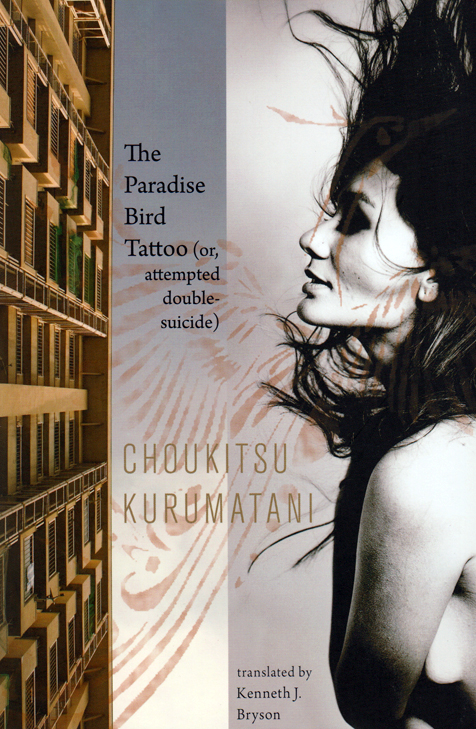
The Paradise Bird Tattoo

The Paradise Bird Tattoo

Title: The Paradise Bird Tattoo (or, Attempted Double-Suicide)
Japanese Title: 赤目四十八瀧心中未遂 (Akame Shijūyataki shinjū misui)
Author: Kurumatani Chōkitsu (車谷長吉)
Translator: Kenneth J. Bryson
Publication Year: 2010 (America), 1998 (Japan)
Publisher: Counterpoint
Pages: 225

I’m not going to lie – the first twenty pages of this book didn’t make me want to continue reading. The narrator of The Paradise Bird Tattoo, Ikushima Yoichi, is a graduate of an elite university who dropped out of society for reasons unknown, and he has all the charm of a thirty-three year old Holden Caulfield, which is to say not very much charm at all. Life sucks, he can’t get his shit together, he has no money, he goes from train station to train station with no rhyme or reason, people are disgusting, nobody likes him, he wants to assault salesgirls with scissors, and he might as well jump off a cliff.

On page twenty-one, Ikushima sits down for coffee with the woman who has agreed to temporarily employ and house him at the request of one of the narrator’s old friends. This woman, whom Ikushima refers to as “Seiko Nēsan,” owns a pub called Igaya in the Higashi-Naniwachō district of Amagasaki, an industrial suburb of Osaka located west of the Yodo River. As Seiko Nēsan tells Ikushima about how she used to be a pan-pan girl during the American occupation, the story begins to shift away from the narrator’s existential crisis and outwards to the other people who occupy the seedy little neighborhood where Ikushima now lives in a cheap backstreet apartment building.

Down the hallway is a room for by a prostitute for couplings that are oddly accompanied by what sounds like religious chanting. Across the hallway is a gruff tattoo artist named Horimayu who occasionally bursts into Ikushima’s apartment. An elementary school aged boy named Shimpei wanders around mostly unsupervised and alternately befriends and bullies Ikushima. A woman named Yi Mun-hyong, who goes by Ayako, lives in an apartment on the first floor and attracts Ikushima’s attention before entering into sexually charged yet emotionally complicated relationship with him.

As a an employee of Seiko Nēsan, Ikushima’s job is to sit in his apartment all day and skewer raw offal meat to be served later in her pub. Ikushima does so without complaining or seeking any sort of meaningful connection to the world around him, but he still ends up unwittingly getting pulled into the lives of the other people in the apartment complex and becomes trapped in relationships that he doesn’t fully understand. Seiko Nēsan asks him to retrieve a large amount of cash from the phone book in a public telephone booth, Horimayu pressures him into holding onto a mysterious sealed box, and Ayako enters his apartment one evening to have her way with him. By the second half of the book, Ikushima is way over his head into affairs about which he knows nothing.

The Paradise Bird Tattoo is a slow burning novel fueled mainly by the grungy atmosphere of the greater Osaka area of the late seventies. Ikushima’s narration contains details about his life in Amagasaki that make the book a pleasure to read. There’s a small sundries store in the same alley as Ikushima’s apartment that he doesn’t shop at because it’s too creepy for him, and the lady who runs it always gives him the evil eye from inside the store when she sees him. A group of cab drivers who spend most of the day gambling park their cars in an alley, but a woman whose house fronts the alley calls the police and has them tow all of the cars. Shimpei finds a toad and keeps it as a pet in one of the apartment drainage pipes until it dies. Seiko Nēsan comes over on a rainy day to have a beer, and she sings old Osaka folk songs rife with double entendre.

Kenneth Bryson’s tone and word choice captures the grittiness of the narrator’s style and attitude:

All I did day after day was cut up beef and pork organs and stick them on skewers. Sooner or later they would wind up in someone’s mouth, be digested inside his organs, and vanish into the toilet as excrement. I wasn’t sure what happened after that, but I assumed the reside would eventually be washed out into the ocean. It was just the same with the glamorous goods lining the shelves in the department stores and supermarkets; someday they would all become rubbish or shit. This was the essence of all human activity; this was why I could tell Seiko Nēsan in all honesty that I had no need for pleasurable pursuits.

The Paradise Bird Tattoo is a walk through the lives of people who live on the margins of society in a neighborhood that is as dangerous and desperate as those who inhabit it. Although the narrator can be a bit of a bore sometimes, the mindset that has led to his decision to abandon a middle class life is fascinating, as are the experiences he describes to the reader in full dirty detail.

Bødy

Bødy

Title: Bødy
Japanese Title: 躯 (Karada)
Author: Nonami Asa (乃波アサ)
Translator: Takami Nieda
Publication Year: 2012 (America); 1999 (Japan)
Publisher: Vertical
Pages: 192

If body horror makes you squeamish, you probably shouldn’t read this book.

If body horror fascinates you, you have come to the right place. Surgery, needles, public bathing, erectile dysfunction, heart attacks, concussions – Nonami Asa’s Bødy has it all.

Bødy collects five short stories, which are all about forty pages long. Each of these stories centers around the body-related neurosis of its protagonist. The short stories in Bødy remind me of the short stories of Patricia Highsmith (particularly those in The Animal-Lover’s Book of Beastly Murder and Little Tales of Misogyny) in that they feature tongue-in-cheek accounts of terrible things happening to people who probably deserve them. In “Blood,” a man who gets off on injuring others learns that he can also get off on injuring himself. In “Whorl,” a man planning on dumping his girlfriend is dumped by her after some mishaps involving an experimental treatment for baldness. In “Jaw,” a man consumed by his training to become a boxer is ultimately defeated by his own physical regimen. The opening story, “Navel,” is about a mother and her two daughters who blow through their savings in order to undergo a series of cosmetic surgical procedures. The last laugh, however, is on the husband and father who doesn’t notice that they look any different until it’s too late.

Although the tone of Bødy is far from jovial, it never takes its subject matter too seriously. With an escalating series of bad things happening to weak-willed and pathetic people, the humor in Bødy is as black as it gets. As soon as the reader thinks that things can’t get any worse for the characters, things get worse in the worst possible way. As a result, these stories are horrifying and fascinating at the same time.

Humor usually works best when the butt of the joke is in a position of power or otherwise represents the status quo, and an element of discomfort tends to creep in when the character being ridiculed truly is a victim. For this reason, the story “Buttocks” stands out for me as the most disturbing story in the collection.

Hiroe, the former queen bee teenage protagonist of “Buttocks,” suffers severe culture shock after she leaves her home in the country to attend a high school in Tokyo. She lives in a dorm, where she has trouble physically and mentally adjusting to a communal lifestyle. She didn’t want to leave home in the first place, her friends from middle school won’t talk to her anymore, and she learns that the only reason she’s able to live in Tokyo is because her father made a large donation to her school. When one of the other girls living in the dorm calls her fat, Hiroe develops an eating disorder. The reader, who is given intimate knowledge of Hiroe’s mindset and methods, sympathizes with the bulimic Hiroe’s improved self-image and sense of renewed control over her life. It actually seems as if the story will have a happy ending before Hiroe collapses and is revealed to be terrifyingly unhealthy. As her parents carry her out of the dorm, Hiroe overhears the same girl who had mocked her for having hips like a duck whispering how creepy she is now that she looks like a skeleton.

Hiroe may have bullied another girl in middle school, but she didn’t deserve this, and the punch line of “Buttocks” is chilling. In this story, the narrative pattern that characterizes the stories in Bødy is less tragicomic and more genuinely upsetting. It’s easy to laugh at the chauvinist pigs of the first three stories in the collection, but the teenage protagonists of the last two stories are genuine victims of forces beyond their control who receive no sympathy from other characters and turn to desperate measures in an attempt to exert some small measure control over their lives. The emotional range Nonami achieves within these stories is remarkable, as is the skill with which she treads the line between amusement and discomfort.

Nonami Asa is a fantastic writer, and I’m happy that more of her work is appearing in translation. She’s primarily known for her detective fiction in Japan, and Juliet Winters Carpenter’s translation of The Hunter is an good example of her gritty hardboiled style. Nonami’s other novel in translation, Now You’re One of Us, is creepy gothic horror that features the black humor and body horror of Bødy without the blunt, cringe-inducing needle-in-your-eye imagery. If you can handle literature with genuinely dark themes, it’s hard to go wrong with Nonami Asa, and Bødy is an excellent introduction to the writer’s work.

The Lord of the Sands of Time

Title: The Lord of the Sands of Time
Japanese Title: 時砂の王 (Tokisuna no Ō)
Author: Ogawa Issui (小川一水)
Translator: Jim Hubbert
Publication Year: 2009 (United States); 2007 (Japan)
Publisher: Haikasoru
Pages: 196

Sometimes you get to the end of a book and wonder what just happened.

The Lord of the Sands of Time was like that for me.

Allow me to spoil the ending:

The weakness of the aliens attacking the earth is salt water.

There is also time travel involved. Androids with highly advanced artificial intelligence are sent back in time to fight seemingly mindless mechanical extraterrestrials who for some reason are bent on wiping out the human race, and it takes the best among the androids several sweeps of human history to figure out that sea water kills the aliens.

I’ll be the first to admit that premise of the novel is kind of silly, but it’s still an engrossing tale of adventure across alternate histories.

The Lord of the Sands of Time is about Orville, an android who was created on Triton, one of the last outposts of human civilization in the year 2598. Orville is one of many Messengers, who were engineered with the purpose of going back in time and saving the humanity from destruction at the metallic tentacles of an alien force from beyond the solar system, which is collectively referred to as ET.

The novel begins in Japan in the year 248, a destination at which Orville has arrived after many timestreams of trial and error. With the cooperation of Himiko, the ruler of the Kingdom of Wa, Orville tries once again to rally the human race against the ET, but the situation is dire. The ET have already overwhelmed the Asian mainland, and many of Orville’s Messenger comrades have fallen over the course of their long journey. Even worse, the ET are also capable of time travel; and, unlike the Messengers, they have the capacity to attack from space.

Every alternate chapter tells a segment of Orville’s backstory. The Messengers first came to Earth in the twenty-second century, but humanity was too busy bickering with itself to launch an effective resistance against the ET. After failing to rescue humanity in that timestream, the Messengers try again, transporting themselves to the eve of the second World War. Once again, however, humanity is too busy bickering with itself to fight the ET. The Messengers thus try again, and again, and again, their numbers decreasing as the ET use their own version of time travel to thwart them.

Although it first appears that the humans of Himiko’s timestream will also fall victim to internecine warfare and thus prove incapable of marshaling a united front against the ET, Himiko is strong willed and politically savvy enough to keep the peoples of the Japanese archipelago from killing themselves long enough to realize the full extent of the threat the ET pose. Even though Orville lends Himiko his superhuman strength and knowledge of technological advances, the outcome of this timestream seems bleak as well, and the fight will be a close one.

For the first half of the novel, tension builds steadily as Himiko deals with political machinations and Orville comes into his own as a character. The descriptions of Japan in the late Yayoi period are just as fascinating as the descriptions of the doomed yet utopian society on Triton, and Himiko’s growth as a ruler is just as compelling as Orville’s blooming love affair with Sayaka, a human woman in the Triton Defense Force, as he learns about what he is trying to protect.

Unfortunately, things begin to fall apart in the last quarter of the novel. As the narrative rushes toward its conclusion, world building and character development are neglected in favor of battle scenes. In the midst of this fighting, Orville trips and falls into bed with Himiko. This is not quite as epic as it could be. In two short paragraphs, Orville tells Himiko about Sayaka, Himiko calls Orville by his first name, Orville cries, and Himiko hugs him. There’s a page break, and then the narrative is back to talk of fighting and armies.

“From that night on, Miyo [Himiko’s personal name] and Orville shared the same bed” is about the extent of the romance between them, but Himiko undergoes a startling personality shift after she begins sleeping with Orville. She becomes a background character in her own story and spends most of her time panicked and helpless. The following “newsflash,” which has been making the rounds on Tumblr recently, states:

If a strong, independent female character falls in love, it does not automatically mean that she has lost her values or that she’s become less strong and independent, and does not necessarily change her story into an anti-feminist one. The idea that all women should fall in love and get married IS sexist, but a woman actually falling in love and getting married of her own free will is NOT sexist. Thank you and good day.

Sometimes, however, a female protagonist will fall love with a male protagonist and suddenly cease to be a protagonist at all, and that’s what happens in The Lord of the Sands of Time. Himiko is barely even fully conscious throughout the final quarter of the novel, and Orville is too busy kicking ass and taking names off camera to have any real input in the story. With the two main characters out of the picture, the novel gears up for its big reveals – what the motive of the ET is, how time travel works and doesn’t work, how the ET will be defeated – but these big reveals are rushed don’t really make any sense. The weakness of the aliens is water, the power of love plays a role in this discovery, and the aliens don’t have any real motive for attacking the earth. The time travel mechanics are especially disappointing. To be fair, time travel never makes sense, but it’s as if the author got around all the problems implicit in time travel by simply pretending that they don’t exist.

The last sixty pages of The Lord of the Sands of Time thus pass by in a flurry of tropes and battle scenes that might have worked better if they were filmed instead of written. In the novel’s defense, though, the buildup to these last sixty pages is strong enough to carry the reader all the way to the end. Sure, the love story between Orville and Himiko/Miyo never goes anywhere, and sure, this flaccid non-relationship diverts the narrative focus away from the relationships between Orville and the other Messengers (which are infinitely more interesting), but the reader is still curious to see how it all ends (and don’t worry, I didn’t spoil everything).

The Lord of the Sands of Time is not high art or epic romance, but it’s a fun novel, especially if you have a soft spot for science fiction. Jim Hubbert’s translation doesn’t call attention to itself and allows Ogawa’s prose to flow quickly and seamlessly. (In fact, I’m so impressed by the eighties American sci-fi feel of Hubbert’s translation that I’ve already ordered a copy of his other translation for Haikasoru, Hayashi Jyōji’s The Ouroboros Wave.) As much as I make fun of science fiction tropes, I can’t get enough of them, and The Lord of the Sands of Time fully satisfied my holiday craving for a sci-fi novel of manageable length to chill out with over a relaxed weekend.

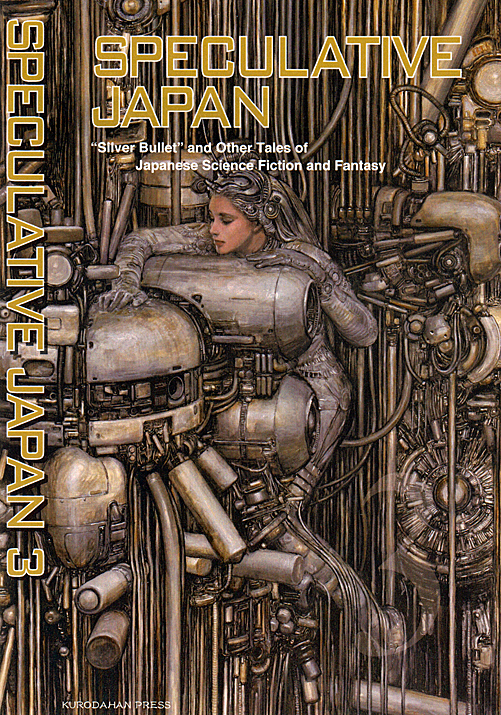
Speculative Japan 3

Title: Speculative Japan 3: “Silver Bullet” and Other Tales of Japanese Science Fiction and Fantasy
Editor: Edward Lipsett
Publication Year: 2012
Publisher: Kurodahan Press
Pages: 270

In my review of Speculative Japan 2, I said that I loved the anthology and couldn’t wait until the next installment was released. Speculative Japan 3 is finally here, and it’s everything I hoped it would be: a diverse collection of intelligent and beautifully translated short stories.

Speculative Japan 3 opens with several shorter pieces. These shorter pieces, which range in length from five to twenty pages, run the gamut from hard science fiction to magical realism to fantasy with a sci-fi twist to elegiac horror. Fujita Masaji’s “Angel French” is about the romance between two deep space robotic probes who began life as two college students hanging out in Mister Donut. “To the Blue Star,” written by Ogawa Issui (whose novels The Lord of the Sands of Time and The Next Continent are published in translation by Haikasoru), is another story about a self-aware technological entity. This entity, whose name is X, is a collective intelligence made up of a fleet of robotic star cruisers that represent the last remnants of human civilization. X tells its own story as it travels through the universe, watches civilizations rise and fall, fuses with other advanced life forms, and finally meets God. Matsuzaki Yuri’s “The Finish Line” is a thought experiment in the form of a short story and features a quiet but chilling scenario of the end of all life on earth. Kamon Nanami’s “A Piece of Butterfly’s Wing,” which is probably my favorite story in the collection, is a beautifully creepy ghost story in the literary tradition of writers like Kurahashi Yumiko and Kanai Mieko. Like the work of these masters of the poetics of horror, Kamon’s story is filled with beautiful, atmospheric imagery and resonant symbolism. It also features a delightfully disturbing twist at the end.

The longer stories of Speculative Japan 3 shine just as brightly as the shorter pieces. Even though none of these stories are more than thirty-five pages in length, they’re long enough to allow nuanced character development as they explore their premises in greater depth. Suga Hiroe’s “Five Sisters” is about a woman named Sonogawa Hanako who meets four clones of herself that have all been raised in different households. Each of these women has a different personality, and it’s fascinating to see how each has lived her life with the knowledge that she is a clone created to be harvested for organs. Ueda Sayuki’s “Fin and Claw” is a window into a future where humans have been genetically modified to be more adaptable to an environment covered in seawater. “Fin and Claw” is sort of like Jurassic Park with enormous sea creatures, and the moral of the story is the same. The last three pages of Ueda’s nightmarish vision are particularly terrifying in their visual imagery.

The title story, Yamada Masaki’s “Silver Bullet,” is a Japanese Cthulhu mythos story (more of which are collected in Kurodahan’s Night Voices, Night Journeys). In my experience, there are two main types of Cthulhu mythos stories: pseudo-Victorian and classy, and unabashedly pulpy. “Silver Bullet” belongs to the latter category. Its protagonist is sufficiently hard boiled, and the story contains more cheap sexuality than you can shake a flagella at. Still, all of the story’s thematic elements mesh together nicely, the ending is well earned, and the method used to summon Cthulhu is awesome (as is the instrument used to stop the summoner).

If there’s one story in the collection that feels out of place, it’s “Green Tea Ice Cream,” which is written by Mark Schultz. Perhaps it feels out of place because it’s merely good instead of excellent, but perhaps this is also because it bears the traces of awkwardness that often afflict stories written about Japan in English (a few of which have been recently collected in The Future Is Japanese). It’s difficult to pinpoint what the exact causes or sources of this awkwardness are, but it probably has to do with the writer feeling the need to explain certain “Japanese” things to the reader, as well as with the unstable balance between Japan as a real place and Japan as a fictional creation in these stories. “Green Tea Ice Cream” also revolves around a science fiction trope that I personally find silly and boring, namely, the unnecessary sexualization of a young woman who embodies fears concerning the changing relationship between human beings and technology. If the non-consensual impregnation and subsequent abduction of mindless machine girls is your cup of tea, though, knock yourself out. There are also some uncomfortably sexual father-daughter issues on display, if you’re into that sort of thing. That being said, the unsavory nature of the scenario and the characters of this story gives it greater depth and impact as a speculative commentary on contemporary bioethics.

To counter the sour taste of “Green Tea Ice Cream,” Mori Natsuko’s “It’s All Thanks to Saijō Hideaki” is made of pure sugar. To give a summary would be spoiling the fun, so let it suffice to say that this is one of those stories that you can’t believe you’re reading while you’re reading it and then can’t believe you’ve read once you’re finished. The experience of reading this story filled me with joy. If you’re a fan of yuri or bara stories (or brilliant parodies of such stories), then this is the story of the elegant, fabulous apocalypse you’ve been waiting for.

As in Speculative Japan 2, the translation is smooth and even throughout, with each story retaining the individual characteristics and quirks of its author. It’s a pleasure to read the stories in this anthology not just for the freshness and wonder of their ideas but also for the high quality of their writing and translation. As both an anthology of contemporary science fiction and an anthology of contemporary Japanese literature, Speculative Japan 3 succeeds brilliantly in collecting not the newest or the most popular, but rather the most interesting and the best written. Speculative Japan 3 is an excellent collection of short stories, and I highly recommend it to anyone looking for intelligent and exciting new fiction, speculative or otherwise.

Review copy provided by Kurodahan Press

The Briefcase

Title: The Briefcase
Japanese Title: センセイの鞄 (Sensei no kaban)
Author: Kawami Hiromi (川上 弘美)
Translator: Allison Markin Powell
Year Published: 2012 (America); 2001 (Japan)
Publisher: Counterpoint
Pages: 176

Kawakami Hiromi’s novel Manazuru, translated by Michael Emmerich and published in 2010 by Counterpoint, is a strange, dreamlike story told from the perspective of an otherworldly and unreliable narrator. Manazuru is about pain and bitterness, and broken hearts and broken families.

Kawakami’s newest novel in translation, The Briefcase, is a far cry from the atmospheric surrealism of Manazuru. Its narrator, Ōmachi Tsukiko, is a single woman in her late thirties who is firmly grounded in reality. The Briefcase is about her daily life and centers around her encounters with her former Classics teacher, Matsumoto Harutsuna, whom she still refers to as “Sensei.” Two decades after graduating from high school, Tsukiko meets Sensei by chance at a neighborhood bar, and the two strike up an easy friendship. Each of the ten-page chapters in The Briefcase details an episode in this friendship, such as a trip to an outdoor market or a mushroom hunting excursion with the owner of the bar Tsukiko and Sensei frequent. Seasons change, but not much else does. Nothing particularly dramatic or unexpected happens throughout the large majority of The Briefcase, and the novel’s close attention to detail provides much of its charm.

Although it doesn’t become apparent until a little more than halfway through the novel, Tsukiko gradually develops romantic feelings for Sensei. I would love to say something along the lines of “despite the significant age difference, the relationship between Tsukiko and Sensei blossoms beautifully;” but, in reality, it’s quite awkward. Not only is the situation itself awkward, but both Tsukiko and Sensei are awkward people. They’re not charmingly awkward, or amusingly awkward, or so awkward that want to hug them – they’re just awkward. Still, the gentle progression of their relationship is entertaining in its earnestness, and Kawakami describes it from Tsukiko’s perspective with commensurate delicacy:

At some point, sitting beside Sensei, I began to notice the heat that radiated from his body. Through his starched shirt, there came a sense of Sensei. A feeling of nostalgia. This sense of Sensei retained the shape of him. It was dignified, yet tender, like Sensei. Even now, I could never quite get a holf on this sense – I would try to capture it, but the sense escaped me. Just when I thought it was gone, though, it would cozy back up to me.

The quiet normalcy of The Briefcase is satisfying in and of itself, yet there are some disturbing undercurrents running through the novel. Why is Tsukiko alone? Why is Sensei alone? What happened to him? Why does he always carry around his briefcase? These uncertainties serve to make the story more intriguing, however, and don’t escalate into a full-blown crisis until the very end of the novel, when Tsukiko undergoes a startlingly surreal experience. During two of the final chapters of the novel, Tsukiko’s feelings for Sensei, as well as her fear of his rejection, are explored in a strange sequence titled “The Tidal Flat – Dream,” which may or may not have actually happen. This chapter is a unexpected break from the regular mundane atmosphere of The Briefcase, but it pulls the novel together thematically in a creative and unexpected way.

Allison Markin Powell, who also translated Dazai Osamu’s Schoolgirl, deftly conveys the lightness and humor occasional strangeness of Kawakami’s prose. Although Powell’s English is flawless (with the possible exception of a few out-of-place Britishisms), her style of translation leaves the reader with no doubt as to the Japanese setting of the novel. Passages like…

“Yes, today is a tomobiki day. But tomorrow is a red-letter day, a konoe-tora!”

…and…

Daikon, tsumire, and beef tendons, please, Sensei ordered. Not to be outdone, I followed with Chikuwabu, konnyaku noodles, and I’ll also have some daikon. The young man next to us asked for kombu and hanpen.

…are not uncommon. It’s an interesting style of translation that emphasizes the novel’s focus on peaceful daily life in a richly detailed environment, and it’s fun to read. The culturally specific words scattered throughout the text can be largely ignored if you’re not feeling up for a hyperlinked adventure on Google, though, so they shouldn’t be distracting for the reader.

The Briefcase is a gentle and quiet novel that’s enjoyable both for its story and for its atmosphere, and it’s much more accessible than Manazuru (which is not to say that Manazuru is bad, just very weird). It’s literature that doesn’t take itself too seriously, and I very much enjoyed reading it.

Speculative Japan 2

Title: Speculative Japan 2
Editor: Edward Lipsett
Publication Year: 2011
Publisher: Kurodahan Press
Pages: 269

Speculative Japanese 2 (subtitled “‘The Man Who Watched the Sea’ and Other Tales of Science Fiction and Fantasy”) is a collection of thirteen stories ranging in length from four to forty-eight pages. Half of the stories are from the late seventies and eighties, and the other half are from the past decade, with the most recent being published in 2007. These stories, which were selected for translation based on a Japanese SF magazine reader survey and the editor’s own taste, range from fantasy to magical realism to hardcore science fiction. In fact, the stories are so varied in genre that “speculative fiction” does indeed seem to the only label capable of describing them.

Speculative Japan 2 is an excellent anthology without even a single dull story. The premise or idea behind each story in the book is uniquely fantastic. In Enjoe Toh’s “Freud,” a family gathers at the house of the narrator’s recently deceased grandmother only to find twenty clones of Sigmund Freud hidden under the tatami mats and beneath the floorboards. In Issui Ogawa’s “Old Vohl’s Planet,” the inorganic life forms inhabiting a planet with an extremely volatile atmosphere are threatened with annihilation and must rely on the vast reserves of their hereditary memory to send a distress signal to the stars. Kajio Shinji’s “Emanon: A Reminiscence” tells of a man’s brief encounters with separate incarnations of a woman who is able to remember all of her former lives. Kobayashi Yasumi’s “The Man Who Watched the Sea” describes a world in which time flows differently at different altitudes from the perspective of two time-crossed lovers. Nakai Norio’s “Mountaintop Symphony” chronicles the tribulations and victories of an orchestra tasked with the performance of a piece of music that spans dozens of years and requires instruments that haven’t been invented yet.

The longest story in the collection, Tani Kōshū’s “Q-Cruiser Basilisk,” is told from the perspective of a petty officer on a spacecraft with a five-man crew. In the dead of space, the narrator’s ship encounters a much larger craft that seems to be a remnant of a war that ended two hundred years ago. The vessel is, as the narrator puts it, a “ghost ship,” and, despite his trepidation, the narrator finds himself recalling classic adventure tales by the likes of C.S. Forester and Robert Louis Stevenson. Despite the narrative static generated by detailed descriptions of naval battle maneuvers executed in space, the story is genuinely creepy as the narrator and his fellow crew members board the empty ship. As the narrator reads the captain’s log, the reader is drawn into an even stranger tale of uncertain fates and eerie distortions in space. Along with its echoes of the adventure tales alluded to by the narrator, “Q-Cruiser Basilisk” resonates with the plots and themes of postwar American space fiction, as well as with classic existential speculative fiction such as Nelson S. Bond’s “And Lo! The Bird.” The story is satisfyingly old school but fresh enough to feel like a plot from a contemporary animated short film.

My two favorite stories in the collection were more fantasy flavored. In Ōhara Mariko’s “The Whale that Sang on the Milky Way Network,” a young man on a backwater agricultural planet waits eagerly for a circus that visits a certain seaside town once every four years. When the circus finally comes again, the young man befriends one of its performers, a whale who can supposedly fly through space. He confesses his love for a local politician’s pop star daughter to his new friend, and he and the whale hatch a plan to leave the planet and become famous together, which succeeds spectacularly. Takagi Nobuko’s “Melk’s Golden Acres” at first seems like a normal work of realist fiction, as it opens with a Japanese traveler’s impressions of the Austrian countryside and the abbey above the town of Melk. The narrator recounts the history and treasures of the abbey, especially those of its library. After touring the library himself, the narrator is addressed by an old man who had been gazing at one of the room’s stained glass windows. The old man claims that his wife is in the window, and the narrator, intrigued, follows him to a nearby restaurant where he learns more about the old man’s life. The story then takes a slow turn towards the surreal before closing in an entirely unexpected fashion. Whereas I enjoyed “The Whale that Sang on the Milky Way Network” because of its whimsy and sense of adventure, I loved “Melk’s Golden Acres” for its grounded yet beautifully descriptive language and the way it toes the line between realism and fantasy, leaving a multitude of possibilities open to the reader.

Each of the stories in Speculative Japan 2 is worth reading, and each writer represented in the collection has a unique and engaging style of storytelling. The quality of the translation is uniformly excellent, and the goofiness and genre allusions and creative language of each respective writer comes through in sharp focus. The efforts of the editor have ensured that the overall readability of the translations maintains a high standard, so even the more interesting linguistic experiments of the original authors are conveyed in solid English that is fully aware of the idioms of Anglophone speculative fiction. As a result, a reader of Speculative Japan 2 can effortlessly jump from one world into another, and the experience is thoroughly enjoyable.

Speculative Japan 3 is slated for publication at the end of the year, and I’m already looking forward to it!

Review copy provided by Kurodahan Press.

The Columbia Anthology of Modern Japanese Literature, Abridged Edition

Title: The Columbia Anthology of Modern Japanese Literature, Abridged Edition
Editors: J. Thomas Rimer and Van C. Gessel
Poetry Editors: Amy Vladeck Heinrich, Leith Morton, and Hiroaki Sato
Publication Year: 2011
Publisher: Columbia University Press
Pages: 960

The Columbia Anthology of Modern Japanese is the most comprehensive anthology of Japanese literature since the mid-nineteenth century; but, with two enormous (and expensive) volumes, it’s a bit daunting for all but the most stalwart of readers. I was therefore excited to learn that an abridged softcover version of the text has been released. At almost a thousand pages, the anthology still isn’t for the casually interested. As it provides a much wider selection of writers and genres than every other anthology of modern and contemporary Japanese literature on the market, however, The Columbia Anthology is an invaluable resource not only for students of Japanese literature but also for anyone interested in Japan in any capacity.

The anthology is divided into six sections spanning from the beginning of the Meiji period in 1868 to the end of the twentieth century. The two sections devoted to the Meiji era include work by naturalists and playwrights such as Mori Ōgai, Shimazaki Tōson, Kunikada Doppo, and Nagai Kafū, as well as essays by Natsume Sōseki, including “The Civilization of Modern-Day Japan.” The anthology then proceeds into the interwar period, which includes the work of authors such as Akutagawa Ryūnosuke, Edogawa Rampo, Kawabata Yasunari, and Tanizaki Junichirō. The section titled “The War Years” is mercifully short but includes stories by Dazai Osamu, Ishikawa Tatsuzō, and Ōoka Shōhei.

The “Early Postwar Years: 1945-1970” section is the longest in the anthology and reads like a hit parade of famous postwar writers such as Abe Kōbō, Enchi Fumiko, and Mishima Yukio. Many well-known postwar joryū bungaku (“women’s literature”) writers, such as Hayashi Fumiko and Kōno Taeko, are represented as well. The last section collects contemporary literature from the seventies, eighties, and nineties by both internationally famous authors such as Murakami Haruki and Ogawa Yōko and writers who are prolific and well known in Japan, such as Hoshi Shinichi and Furui Yoshikichi.

What is wonderful about this anthology is that, unlike other anthologies of modern and contemporary Japanese literature, it includes lengthy selections of Japanese poetry, both in “traditional” forms (such tanka and haiku) and in more modern forms (such as free verse). Although I am not a connoisseur of poetry in translation and thus can’t vouch for the quality of The Columbia Anthology‘s selections, I am thankful that so many works of modern and contemporary Japanese poetry have been brought together in a single volume. The majority of the original publications in which these translations appeared have long since gone out of print, so The Columbia Anthology is perhaps the best way to familiarize oneself with a rich yet underappreciated body of literature. The anthology also includes dramatic scripts by playwrights and screenwriters such as Inoue Hasashi and Kara Jūrō, texts which are also difficult to find elsewhere.

My enthusiasm for The Columbia Anthology is genuine, but some of the editors’ comments in the Preface shed light on some of the more conservative politics of literary anthologization. For example, to justify the entry of their project into a field in which many anthologies already exist, Rimer and Gessel state:

One difference between this volume and some of the earlier collections is related to the evolving view of both Japanese and foreign scholars as to what constitutes “literature.” Many of the earlier collections sought, consciously or unconsciously, to privilege the long and elegant aesthetic traditions of Japan as they were transformed and manifested anew in modern works. […] But many other kinds of writing, ranging from detective stories to personal accounts – always valued by Japanese readers but neglected by translators in the early postwar decades – can now be sampled here.

Expanding the scope of what is considered literature through diversity in anthologization is always good, of course, but two paragraphs earlier, the editors also made this strange comment:

Whatever the level of young people’s interest in manga (comics) and video games may be, literature, as opposed to simple entertainment, often remains the best way to grapple with the problems, and ironies, of the present generation of Japan.

On reading this sentence, I somehow managed to raise an eyebrow and roll my eyes at the same time. The context of this statement was a defense of the strength of contemporary literature in the face of a weighty literary tradition, but I wonder why the editors needed to make the distinction between “literature” and “entertainment” at all. Some types of print culture (such as dramatic scripts) are literature, but others (such as the text portions of visual novels) are not? Edogawa Rampo’s grotesque short stories are literature, but Otsuichi’s horror fiction is not? Haiku are literature, but tweets are not? And – most importantly – manga is not literature? Seriously?

Despite the editors’ stated desire to expand the scope of what is considered literature, their literary politics are, as I stated earlier, quite conservative. Popular fiction by writers like Murakami Haruki and Yoshimoto Banana is included in the anthology, but the work of such writers has been so resolutely canonized by scholarly articles and inclusion in course syllabi that its anthologization comes as no surprise. It’s good to have “outsider” writers like Tawada Yōko and Shima Tsuyoshi included in the anthology, but all of the volume’s stories more or less fit neatly into the category of “literary fiction.” You will not find the cerebral science fiction of Kurahashi Yumiko, or the historical revisionings of Miyabe Miyuki, or the fantastical explorations of Asian-esque mythology of Uehashi Nahoko, or the socially conscious mystery stories of Kirino Natsuo in The Columbia Anthology. You also won’t find any prewar popular fiction, such as the short stories of Yoshiya Nobuko.

This leads me to another criticism I have concerning the anthology, which is that it is remarkably dude-centric. Until the last two sections of the text (“Early Postwar Literature” and “Toward a Contemporary Literature”), there are no female writers represented (save for Yosano Akiko, who has a few poems about flowers and vaginas); not even one of Higuchi Ichiyō’s short stories is included. In the anthology’s defense, many of the women writing before and during the Pacific War, such as Enchi Fumiko and Hirabayashi Taiko, are included in the “Early Postwar” section. Unfortunately, this means that their more overtly political work has been passed over for stories that focus more on “traditional” women’s issues like female sexuality and the family. Furthermore, even though I applaud the editors for including literary essays in their anthology, it frustrates me that not a single one these essays was written by a woman, despite the fact that many female authors – including those represented in this anthology – are extraordinarily well known for their essays. What the editors has done is the equivalent of collecting the most influential essays on literature in North America and leaving out something as important and groundbreaking as Margaret Atwood’s On Being A Woman Writer.

In the end, though, I stand by my assessment of the abridged edition of The Columbia Anthology of Modern Japanese Literature as an essential resource to students of Japan. The volume contains many excellent stories, poems, essays, and dramatic scripts that are difficult to find elsewhere, and the editors keep their introductions of writers and literary epochs brief and to the point. As long as this text is supplemented to bridge over its gaps and omissions, I can imagine it becoming the backbone of a respectable introductory course on modern and contemporary Japanese literature, as well as a source of out-of-print translations of the work of less widely taught authors.

Review copy provided by Columbia University Press.

Villain

Title: Villain
Japanese Title: 悪人 (Akunin)
Author: Yoshida Shūichi (吉田 修一)
Translator: Philip Gabriel
Year Published: 2010 (Britain); 2007 (Japan)
Publisher: Pantheon Books
Pages: 296

Yoshida Shūichi’s Villain is not a classy novel. It’s got sex scenes, murder scenes, chase scenes, masturbation scenes, scenes of mothers abandoning their children, scenes of fathers crying over their dead daughters in the rain, scenes of catty girls, and scenes of men and women being obnoxious to each other. It’s got poison love, pathetic love, tragic love, and codependent love built on unfulfilled ideals. It’s the most unapologetically pulpy book I’ve read recently, and I very much enjoyed reading it.

Villain is the story of the murder of Ishibashi Yoshino, a graduate of a junior college who worked as an insurance saleswoman and lived in her company’s dorms in Fukuoka City. Yoshino had been involved in online dating and had occasionally taken on clients as an amateur prostitute. When her dead body is found dumped alongside a highway running between Fukuoka and Saga prefectures, an investigation opens in search of the person who strangled her and left her on the side of the mountain underneath a lonely highway pass.

The novel is less concerned with the police and their investigation than it is with the social and emotional ripples that spread from Yoshino’s death. Villain jumps between the various people who end up becoming involved, no matter how tangentially. There is Yoshino’s friend Sari, a virgin who tells lies about having dated a certain boy in high school. Yoshino’s friend Mako is chubby and good-natured and profoundly gullible. Yoshino had lied to her friends that she was dating a business major and named Masuo Keigo, a playboy who has dropped out of college in all but name. Yoshino’s dad is a deadbeat who runs a barbershop outside of JR Kurume Station that is slowly going out of business. Shimizu Yuichi is a construction worker from Nagasaki who drives a flashy car and was one of Yoshino’s johns. Yuichi has a grandmother named Fusae, who is hassled by thugs, and an uncle named Norio, who is also Yuichi’s tough-guy boss. Yuichi ends up running away with a woman named Mitsuyo, who has reached thirty without marrying and works a crappy job in a crappy department store in a crappy suburb. There are also a handful of other characters who only appear briefly, such as Keigo’s dippy friend Koki and Mitsuyo’s spinster sister Tamayo.

The thread connecting these characters is that they are all pathetic sadsacks who are weak, petty, stupid, gross, and despicable. The forward momentum of Villain isn’t created by plot or mystery but rather by the reader’s compulsion to see just how nasty the novel’s characters can become. Over the course of the book, the author delves deeper and deeper into the individual, familial, and social dysfunction that makes up the world in which Ishibashi Yoshino lived. Villain is like a long, glorious train wreck in which terrible personalities are compounded by idiotic lies that are in turn compounded by bad decisions. The sheer maliciousness of this novel must be read to be believed.

The Japanese setting of the story, and in particular the geography of the Kansai area, constitutes a significant portion of its meaning and appeal, and I’m sure that an astute observer can find all manner of trenchant social commentary embedded in the novel. In the end, though, Villain is an engaging psychological thriller. It doesn’t take itself too seriously, and it’s great guilty pleasure reading for people who find the more unpleasant side of human nature amusing rather than upsetting.