Dreamland Japan

Title: Dreamland Japan: Writings on Modern Manga
Author: Frederik L. Schodt
Publication Year: 1996
Publisher: Stone Bridge Press
Pages: 360

In his write-up of this summer’s Otakon convention, Ed Sizemore briefly mentions a panel held by the Anime and Manga Research Circle, in which Frederik L. Schodt’s classic work on manga was discussed. “I was glad to see Fred Schodt’s Manga, Manga! The World of Japanese Comics mentioned,” Sizemore says. “For a while, it seemed like there was a concerted effort in academia to pretend Schodt’s book didn’t exist even though it’s foundational to the study of manga in America.”

I’ve never been able to get my hands on Manga! Manga!, but I love its updated successor, Dreamland Japan. In fact, I love it so much that I read it for the third time earlier this summer. I think Sizemore’s statement about the “concerted effort in academia to pretend Schodt’s book didn’t exist” perhaps betrays a difference in understanding concerning the academic value of Schodt’s work, and so I would like to offer my own assessment of Dreamland Japan.

Even though Dreamland Japan is full of interesting and useful information, it’s not an academic study. The book reads like journalism; and in fact, as Schodt explains in his introduction, he has drawn much of the material published in this volume from material published earlier in newspapers and magazines. As journalism, the writing in Dreamland Japan is marked by certain features that do not often appear in academic writing, such as personal anecdotes. For example, information about how Schodt once witnessed a certain manga artist enter a porn shop in San Francisco may add color to his description of the artist, but it doesn’t really serve as evidence to support Schodt’s argument that the work of the often overlooked artist contains substantial artistic merit. Some of Schodt’s statements also come off as contradictory over the course of the book, such as when he mentions towards the beginning of the book that most manga artists employ a studio system, yet argues later that a certain artist is unique because she employs a studio system.

Dreamland Japan is written in a very personal style, and the reader ends up learning all sorts of information about the author over the course of the book. Some of this information is completely random. For example, in his blurb about Okano Reiko’s manga Fancy Dance, Schodt reveals that one of his friends from high school has lived in a Zen monastery for almost twenty years. Um, okay. Some of this information is unintentionally hilarious. For example, in his chapter on Osamu Tezuka, Schodt brags that he is one of the only people to have seen Tezuka without his trademark beret – before mentioning a page or two later that Tezuka only takes off his beret in bed. Wow, okay. Some of this information is perhaps a little too much information, such as Schodt’s description of his physical reaction to all of the pretty ladies surrounding him at a major dōjinshi convention at the beginning of his second chapter, or how he feels like he knows the manga artist Uchida Shungicu intimately even though he has never met her. Uhh… okay.

To return to the point, Schodt’s writing is not academic. He’ll describe a certain artist as incredibly influential without giving any examples of who or what the artist influenced, he’ll refer to a certain art style as uniquely Japanese without explaining what such a thing might mean, and he takes the things people say in interviews as absolute fact without any further corroboration. He engages in hero worship. He does not consider alternate arguments or non-obvious interpretations of certain works. He’ll summarize complicated issues or topics in one sentence. There aren’t footnotes or references explaining where he got his data. None of this makes Schodt’s work any less interesting or informative, but it’s not “academic.”

This is not a bad thing, and it doesn’t mean that Schodt’s work isn’t worthwhile reading both for manga fans and for people with a more than casual interest in Japanese popular culture. Not only is Dreamland Japan an invaluable resource, but it’s also an absolute pleasure to read.

The book has an interesting layout. Five short chapters sandwich the bulk of the volume’s two longest chapters, a 54-page catalog of manga periodicals and a 96-page catalog manga artists.

The shorter chapters, which gather together bite-size essays on subjects such as “Modern Manga at the End of the Millennium” and “Manga in the English-Speaking World,” serve as informative editorials and snapshots of manga fandom as it existed in the early nineties. In his opening and closing chapters, Schodt covers topics such as censorship and self-regulation in the manga industry, the amateur comics scene in Japan, how manga can be used as propaganda, the panel layout and cinematism of manga, and the first generation of anime and manga fan conventions in the United States. Reading these shorter chapters is like listening to someone who is deeply knowledgeable give an informal lecture on a topic very near to his heart. Not only is Schodt remarkably well read and well informed about the manga industry and fandom on both sides of the Pacific at the time he was writing, but his opinions have also aged well. Schodt’s tone is urbane and polished; and, as I mentioned earlier, his essays are given flavor and texture by his personal anecdotes, many of which are quite fascinating. You have to respect a man who sought out the official store of Aum Shinrikyō after the Sarin gas attack on the Tokyo subway in order to investigate the manga the organization was creating to educate potential members, after all.

The essays contained in Schodt’s shorter chapters are fun and informative, and they don’t feel dated in the slightest. What about the two longer chapters, then?

As Schodt states in his introduction, “fans of manga should not expect to see many of their favorite works here. There are no extended commentaries on Ranma 1/2, Akira, or Pretty Soldier Sailor Moon.” Indeed, most of the manga creators Schodt profiles in his “Artists and Their Work” chapter would probably be unknown to Japanese manga fans. These artists create what might be called “independent comics” or “small press comics” in the West, and they are just as fascinating as they are obscure. There is at least one high definition example of each artist’s work accompanying his or her profile, with translations provided by Schodt. Even if it’s nigh impossible to get one’s hands on the work of these specific artists outside of Japan, Schodt’s discussions of them deal with broader topics, such as the more specialized genres of manga in Japan (like manga about Japanese law and business strategy).

The “Manga Magazine Scene” chapter, which provides information about ten specific manga periodicals and two subgenres of manga periodicals, was probably the most interesting to me, as Schodt’s treatment of each topic functions as a small case study of how the manga industry finds and grooms talent, targets a specific demographic, and then sends its content out into the world in the form of different types of media. Many of the manga magazines Schodt covers, such as Weekly Shōnen Jump, Nakayoshi, and Morning, are still industry leaders; so, even if the circulation data given for each publication is no longer current, the demographic and historical information is still pertinent to someone interested in contemporary manga.

In conclusion, while Dreamland Japan feels a bit dated and obscure at times, and while it’s not exactly a scholarly study, it’s a useful resource to anyone interested in manga in any capacity, and it doubles as entertaining reading material for anyone interested in popular culture in general.


Tokyo on Foot

Title: Tokyo on Foot
Author/Artist: Florent Chavouet
Publication Year: 2011
Publisher: Tuttle
Pages: 206

While I was in New York City for the New York Comic Con last weekend, I met a friend of mine for lunch. Accompanying her was her new fiancé, a really cool guy who’s lived and traveled all over Asia. All over Asia except for Japan, that is. He said that, based on the Japanese movies he’s seen, he’s a bit afraid of Tokyo. It seems too big, and too modern, and too noisy – hyperkinetic and almost like science fiction. I asked him what Japanese movies he’s seen. Akira and Lost in Translation, he told me.

I think that, for a lot of people who are familiar with Japan but haven’t actually been there, Japan exists not as a real place where real people live but rather as some sort of strange and exotic fantasy land called “Japan.” For some people, “Japan” consists of towering skyscrapers and flashing lights and all-night karaoke rooms, while for some people “Japan” is all about green mountains and cherry blossoms and Zen temples and tea houses. There is a touch of good old fashioned Orientalism at play here; but, then again, Japan actively markets itself in such a way as to encourage these assumptions, even domestically. Furthermore, the fantasy of “Japan” is perhaps not so fantastical – places like the 109 Building in Shibuya and the Philosopher’s Path in Kyoto really do exist.

In the end, though, Japan is a real place where real people live, and it’s not any more beautiful or ugly or modern or rural than, say, New Jersey. What I love about Florent Chavouet’s Tokyo on Foot is that it visually depicts Tokyo as a real city with many, many faces. Yes, there are huge buildings and busy intersections in West Shinjuku, but there are also tiny restaurants and old houses on the verge of falling apart in West Ikebukuro. And then there’s everything in between, from architectural oddities in Ueno to cute little bars in Daikanyama to Shintō shrines nestled between skyscrapers in Takadanobaba. Chavouet draws them all beautifully.

Tokyo on Foot is divided into neighborhoods, with each section opening with a drawing of the local kōban (police station) and a highly detailed annotated map. What follows this map are several pages of drawings of buildings, street corners, storefronts, landmarks, and occasionally people that the artist observed in the neighborhood. Most of these drawings occupy a full page, and all of them are in high-contrast full color. Chavouet’s drawings of people are caricatured, and his drawings of buildings and objects are almost photorealistic, but all of his subjects receive the same careful attention to detail. Chavouet’s medium of choice is colored pencils, and his pencil work really brings out the colors and textures of everything he draws. Really, it’s gorgeous.

Chavouet often accompanies his sketches with annotations. He’ll make small notes concerning the weather, how he got to a certain location, and what interactions he had with the people who watched him drawing. He’ll also include small cultural details, like the fact the Mr. Donuts offers free coffee refills. In each section, there is usually at least a page or two of smaller sketches illustrating concepts like the vast insect population of Tokyo or how to make a disco lamp using cheap materials from Tokyu Hands (“like Target, only better”). There is occasionally political commentary as well, such as when the artist draws the heads of conservative male politicians attached to the bodies of young women in bikinis or mocks the nonsense spewed by the right wing campaign trucks that tour the streets of Tokyo (“Down with kisses and TLC, long live war and mean people”). In a scattered and roundabout manner, Chavouet also turns a satirical eye on the police officers who repeatedly harassed him for parking his bike in the wrong place and/or loitering (in other words, staying in one place long enough to draw it).

What Chavouet draws is a Tokyo that isn’t some futuristic (or idyllic) alien city but rather a city where people live, work, drink, smoke, have trouble finding parking, chill out in coffee shops to get out of the rain, hang out with their friends, sometimes act like assholes or creeps in public, take lunch breaks in the park, and all the other things people do in a huge urban area filled with millions of people. Through his pencil work, Chavouet depicts the beauty of the monumental, the grimy, the quaint, and the pedestrian. Rows of potted plants outside of someone’s house in a small back alley just behind a major train station can be just as calming and peaceful as a painstakingly manicured Zen garden, and telephone poles covered in posters can be just as awe-inspiring as Corinthian columns.

I can’t wrap my head around how much I love this book. Get this book for yourself. Get this book for your hipster art school friends. Get this book for your mom who doesn’t understand why you care about Japan in the first place. And get this book for your friend’s fiancé who thinks Japan is exactly like Akira. At least, that’s what I plan on doing.

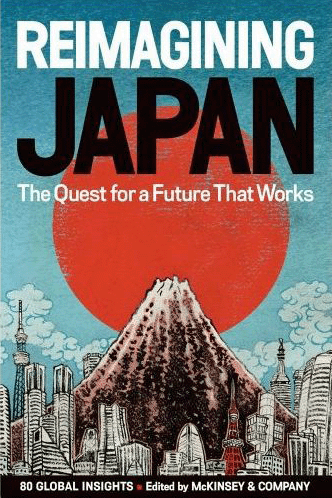
Reimagining Japan

Title: Reimagining Japan: The Quest for a Future That Works
Editors: Brian Salsberg, Clay Chandler, and Heang Chhor
Publication Year: 2011
Publisher: VIZ Media
Pages: 464

Reimagining Japan is a collection of eighty short essays on the future of Japan after an earthquake, a nuclear meltdown, and twenty years of economic stasis. The essayists brought together by this collection are mainly industry leaders and influential journalists, with a few academics and NPO-associated researchers thrown in for spice. In their essays, these luminaries speculate on what went wrong with Japan’s economic and social infrastructures and propose strategies to reinvigorate the country in the wake of the recent disasters.

I found this book to be infuriating. Here are five reasons why.

(1) The overgeneralizations. These generalizations tend to be made not about the economy, for which there are internationally recognized systems of characterization on the macro level, but rather about the Japanese people. Statistical demographic analysis is thrown to the wind as the reader is told, in essay after essay, that Japan is an aging society, that Japanese women don’t work, that there are no immigrants in Japan, and that the Japanese are a race of mindless automatons. Ironically, every other essay seems to offer the opposite set of generalizations. Women do work, Japan is filled with immigrants, and the Japanese are a highly individualistic people (everyone agrees that the population is aging, though). There are also generalizations about the relationship between the government and privately-owned industry and corporations. Government reliance on the private sector is good, government reliance on the private sector is bad. The government should regulate corporate activity, the government should not regulate corporate activity. This difference of opinion is not bad in and of itself, but when different people state radically different “facts” about the same issue, the validity of said facts is obviously called into question.

(2) The bad economics. Aside from a class in eighth grade and a class in my freshman year of college, I have never formally studied economics. I do not claim to be an expert on economic theory or practice. I genuinely respect people who do have this expertise. That being said, I don’t think telling an entire country of people how to behave constitutes a sound economic policy. An overwhelming number of the essayists in Reimaging Japan suggest that the Japanese economy will be revived if only “the Japanese” begin behaving in a radically different manner. There are some really strange examples of this type of thinking scattered throughout the book, such as when Pico Iyer obliquely blames the decline in Japanese economic productivity on women wearing makeup (with young women wearing makeup and older women wearing makeup being two separate economic issues, of course).

(3) Unchallenged assumptions. In an essay titled “Cool Is Not Enough,” Christopher Graves makes the following statement about Japan’s contents industry: “If Japan truly exports its wide array of anime and manga, foreign fans will discover that the content ranges from kawaii (super cute) to hentai (sexual perversion) interlaced with violence and dark apocalyptic visions. Real manga is not at all childlike and could cause an uproar in countries like the United States, whose people are likely to be outraged by scenes of rape or sex with an octopus.” In other words, most anime and manga in Japan is violent pornography, and Americans only tolerate Japanese popular culture because its true nature is hidden from them. I wonder, does Graves live in an alternate universe from our own, in which the vast majority of manga in Japan is indeed intended for a young audience, while a wide range of stories and genres are highly successful in America? How does the global CEO of a big-name international public relations firm make such silly and obvious mistakes, and why does anyone think it’s okay that his opinions and policy suggestions are based on such obvious and silly mistakes? These are questions I could ask regarding any number of the essayists in this book, who base their opinions on similarly ridiculous assumptions that they never question. A great deal of these assumptions come with no citations or corroborations, which is obviously problematic not just from an academic perspective but from the perspective of public and economic policy as well.

(4) An almost complete lack of concern over the environment. In an essay titled “Japan After People,” Alex Kerr goes off on one of his signature rants about how Japan is spoiling the beauty and sanctity of its natural heritage by lining its rivers with concrete and covering its mountains with sugi cypress trees. In the same essay, he laments the shrinking cities and rural depopulation caused by the country’s low birthrate. These two opinions, when placed side by side in a short essay, come off as somewhat contradictory. The last time I checked, fewer people means less strain on the environment, and more people along with less environmental destruction sounds an awful lot like having your cake and eating it too. Such environmental paradoxes appear throughout the book. Another remarkable contradiction is contained in the assertion, repeated across multiple essays, that Japan should emulate China. Not only are Chinese business practices not healthy on a social level, but they’re also terrifyingly destructive on an environmental level. The effects of global warming, such as extreme temperatures and drastically changing patterns of rainfall and drought, are very real and have a strong impact of economic stability. One might think that the incident at the Fukushima reactor would cause people to start taking environmental issues seriously, but all Reimagining Japan can offer is admiration of Chinese vitality and a call for more Japanese babies.

(5) Gender disparity. There are far, far more essays written by men in Reimagining Japan than essays written by women. While this may seem like a petty complaint on the surface, it becomes somewhat more troubling when one realizes that many of the issues addressed by these male essayists directly concern women. For example – where do all of those new Japanese babies that everyone wants come from? Also, I couldn’t help thinking how easy it would be to answer demands for a diverse and stable workforce if Japanese corporations made it easier for the female (more-than-)half of the population to be full-time employees. One might argue that, in an essay collection representing the opinions of industry and opinion leaders, that there are simply not enough high-profile women to go around, but this is simply not true. Honestly, I find it hard to believe that something so obviously useful as female opinions on gender issues would be overlooked by the editors.

There are a few diamonds in the rough (such as the essays by John Dower and Kumiko Makihara), but this collection as a whole is repetitive and a bit ridiculous. I don’t enjoy writing such negative reviews (and in fact I almost trashed this one unposted), but I thought someone should stand up and say that the sort of intellectual laziness that pervades Reimagining Japan is not okay. Let me repeat that: this is not okay. Still, there is enough that is good and interesting in this collection to make it worth browsing just so long as one remembers to think about what she reads instead of simply taking it at face value.

ETA: I really enjoyed reading this review of the collection, which echoes many of my criticisms but contains more information about the actual content. The author of the review seems to have enjoyed some of the essays I found particularly problematic (mainly because of their inherent sexism), but he does an excellent job of detailing the book’s strengths and weaknesses.

Schoolgirl Milky Crisis

Title: Schoolgirl Milky Crisis: Adventures in the Anime and Manga Trade
Author: Jonathan Clements
Publication Year: 2009
Publisher: Titan Books
Pages: 272

Do you love anime? Do you really love anime? Have you lived long enough to catch references to anime titles more than five to ten years old? Do you appreciate dry humor? Do you want to hear some great gossip about the anime industry? If so, you should seriously consider grabbing a copy of Schoolgirl Milky Crisis – or downloading one to your Kindle, which is what I did.

Schoolgirl Milky Crisis has been out for more than two years now, but I had put off reading it because I didn’t think I wanted to read a book “mixing reviews, cultural commentary, insights into classic manga and anime titles, interviews and profiles of Japan’s top creators, and hilarious insider stories from the anime trade.” I assumed such a description was advertising code for “short, unrelated blips of a journalistic nature crammed haphazardly together within an appealing bright yellow cover that will attract potential teenage buyers in the wake of the success of Japanamerica.” In other words, I thought it would be rubbish.

It’s not. Jonathan Clements is a fantastic writer, and the editing and organization of Schoolgirl Milky Crisis is equally well done. The result of this excellent writing and editing is a product that is intelligent and eminently readable. I downloaded the book on a whim during a short train ride yesterday afternoon and ended up doing several loads of laundry just so I would have an excuse to sit on my kitchen floor all night and continue reading it.

The essays in Schoolgirl Milky Crisis can be divided into three main categories. The first and foremost category is insider industry information and gossip. The gossip includes tidbits such as how fan-run conventions fail to respect their guests from Japan and how a famous director with a name suspiciously close to “Ōtomo Katsuhiro” was almost physically kicked out of the company that distributes his films in Britain. The insider industry information contains all the behind-the-scenes nuts and bolts that fans often aren’t aware of, such as how property rights are acquired, how difficult it is to get a show on television, and how people end up becoming voice actors (apparently, voice acting is not a job anyone actually wants). The second category concerns information on foreign markets for anime in countries like China, Korea, the United States, and Britain – and also places like Finland and Estonia. I imagine that this category might be genuinely interesting for anime fans (especially those in the States) who see anime as existing only in their own country and Japan (and who aren’t freaks like me who read anime magazines in three different languages). The third category involves extended analytical essays that were originally delivered as public lectures. “Five Girls Named Moe: The Anime Erotic,” for example, is about the porn industry in Japan, and “Highbrow Skills in a Lowbrow Medium” concerns the issue of “translation” versus “localization.” In my opinion, these longer essays in particular make the book worth reading and are well worth the price of admission.

Unfortunately, there were several sections that I found myself quickly clicking through after the first four or five pages. One was the chapter on Chinese animation, which begins with a brief overview and then launches into extended plot summaries of all of the titles mentioned in said overview (none of which could be found on Google). Another was the essay included as the liner notes in the re-release of the 1961 film Mothra, which lists name after name after name of a cast and crew I knew nothing about. Name dropping and plot summaries are rarely interesting, especially when the names are relatively unknown and the plots belong to films that are almost impossible to actually get one’s hands on. Speaking of which, even reviews that were interesting and fun to read could become frustrating, as the anime industry in the West moves quickly (and older titles have a tendency to become rare). For example, I was especially impressed by Clements’s liner notes for the anime series Saikano (released in 2002 in Japan, 2004 in America) but soon found that I couldn’t rent it from Netflix or Tsutaya or watch it on legally streaming sites like Hulu or Crunchyroll. What’s the point of reading about how great an anime is if you can never watch it?

In any case, what keeps the reader going through sometimes tedious and occasionally disjointed material is Clements’s wry and amusing narrative voice and common sense approach to the topic at hand. To illustrate this, I’d like to quote a paragraph from an essay titled “The Measure of Tape: The Lost World of VHS,” in which Clements describes a fantasy he had after witnessing a distributor throw out all the old review copies of VHS tapes he had gone through the trouble of returning:

So I decided that was it. I was going to liberate VHS. I was going to hoard my review copies until my office burst at the seams, and one day a grateful university library would come along and open the Jonathan Clements Wing, packed to the rafters with PAL copies of obscure titles like Ambassador Magma, and errant NTSC dubs of Fatal Fury. Researchers would then come from far and wide to leaf through my collection of ancient Japanese-language Newtypes and make notes for their dissertations. And once every few years, when I needed to check a scene in episode #8 of Ushio and Tora, I would pop back and visit my old tapes, just for the day. That was the plan.

I think this serves as a fitting analogy for Schoolgirl Milky Crisis itself. Sure, some of the titles Clements discusses may be old and obscure, and sure, maybe nobody cares about foreign markets and industry information besides the people actually involved in the process, but the essays in Schoolgirl Milky Crisis, when read as a whole, succinctly track the history of anime in Asia and the West, bit by tantalizing bit. The writing style is engaging enough to keep the reader invested in the process all the way until the end. If you’re not an anime fan, you probably won’t have much use for the book; but, if you are a fan and haven’t checked out Schoolgirl Milky Crisis yet, I highly encourage you to do so.

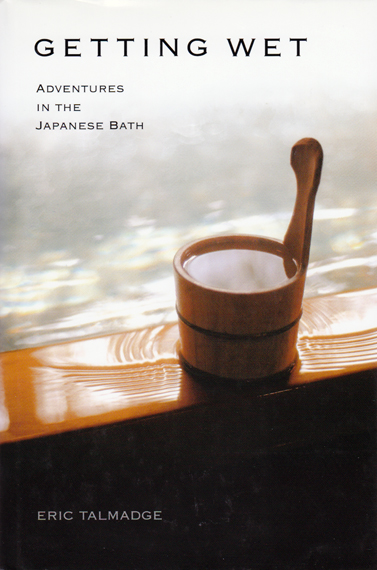
Getting Wet

Title: Getting Wet: Adventures in the Japanese Bath
Author: Eric Talmadge
Publication Year: 2006
Publisher: Kodansha International
Pages: 255

For the past two weeks, the internet has been deluged with people talking about how Tokyopop is going out of business. Somehow, in all the confusion, it seems that it’s slipped everyone’s mind that Kodansha International is closing its doors as well. At least, it’s ceasing all operations at the end of April. Which was yesterday, I realized a few hours ago – to my considerable dismay.

In my startled panic, I thought about writing a brief retrospective highlighting the excellent work the publisher has done with regards to promoting Japanese literature in America. I thought about how the company has put out the early novels of Murakami Ryū (such as Coin Locker Babies and Almost Transparent Blue) and the murder mystery novels of Miyabe Miyuki (such as The Devil’s Whisper and Shadow Family). I thought about how the company has published offbeat classics like Natsume Sōseki’s Botchan and Kawabata Yasunari’s House of the Sleeping Beauties. I thought about how the company has taken financial risks to publish niche-interest period dramas such as Ariyoshi Sawako’s The River Ki and Fujisawa Shūhei’s The Bamboo Sword, and then I thought about how the company has taken on even greater financial burdens to collect contemporary avant-garde short fiction in anthologies like Monkey Brain Sushi and Inside.

But really, I think what I’m going to miss the most are Kodansha International’s intelligent and beautifully published books about Japanese culture, like Diane Durston’s Old Kyoto, Kiyoko Morita’s The Book of Incense, and Jay Rubin’s Making Sense of Japanese. And of course Eric Talmadge’s Getting Wet, which is probably my favorite “foreigner writing about Japan” book ever.

As its title suggests, Getting Wet is about baths in Japan. Private baths, public baths, bathing resorts, and bathing theme parks. And of course you can’t talk about baths in Japan without talking about onsen, or hot spring baths. Talmadge covers onsen in Hokkaido, onsen in Nagano, onsen right in Tokyo, and onsen in the Izu Islands south of Tokyo. There are onsen with mineral water, onsen with radioactive water, onsen with electrified water, onsen on the lips of volcano craters, onsen so acidic that your eyes hurt for days afterward, and onsen with snow monkeys.

There are plenty of books on Japanese baths floating around, but what I like about Getting Wet is that it’s not a traveler’s resource like A Guide to Japanese Hot Springs or a coffee table design book like The Japanese Bath. It is instead a collection of eleven journalistic essays unified by the theme of bathing. These essays aren’t travel literature, per se, but rather memoirs (if such a stodgy word is actually appropriate) of life in Japan cradling a core of interesting contextual information. For example, the fourth chapter, “Under the Bridge,” is about a trip to the Oedo Onsen Monogatari theme park in Odaiba. Talmadge begins by admitting his reluctance to don a yukata (he claims that they always flip open at the front at inopportune moments – which they do) and then walks his readers through the park before comfortably sliding into an essay about the Arima springs in Kobe, where emperors and the Heian nobility used to bathe. Talmadge then compares the Japanese history of bathing to that of the West, storied as it is with the opulence of the Greeks and Romans and Moors. Elsewhere, when Talmadge talks about mineral springs, for instance, he explains how our skin works and how our bodies retain water. When he talks about the onsen in the north of Japan, he writes about economic depression and the drive towards international and regional tourism (and why these initiatives never work). All of this writing, both travelogue and journalism, flows together smoothly, as if it were a feature in National Geographic.

Except Getting Wet is a lot more interesting than National Geographic. The way its author writes reminds me of the way my favorite grad student drinking buddy tells stories. His vocabulary is colorful but not ostentatious, he’s done his research and knows his facts, and he’s not afraid to laugh at something that’s ridiculous or unpleasant. Talmadge’s language is crisp and clean and for the most part professional, but every once in awhile he’ll let a colloquialism slip in (“The bath was – excuse me – fucking hot. It was really fucking hot.”), which adds both spice and warmth to his narrative. To put it simply, Getting Wet is a pleasure to read. Even if you don’t care about hot springs or bathing. Even if you don’t care about Japan. In terms of interesting and enjoyable essays, Eric Talmadge is right up there with John McPhee and Annie Dillard.

The book is a pleasure for other reasons as well. What I have always loved about Kodansha International is the attention and care they put into each publication, from the font to the page layout to the beautiful cover and binding. Most of these small touches are up to the reader to discover, but I should mention, in the case of Getting Wet, that the photographic illustrations are especially stunning. I don’t mean “stunning” in the sense of “created by a professional photographer with professional software,” but rather that the pictures are unusually sharp, printed in soft yet high-contrast greyscale, and perfectly positioned beside the text. In other words, the high quality of the images is something that you don’t find often even in art books published by specialty presses.

Kodansha International’s Japanese parent company has recently invested quite a great deal of money in Vertical, so I think that perhaps it’s not unreasonable to assume that their fiction licenses will change hands at some point. I’m not so sure what will happen to their non-fiction, though. Kodansha International put out beautiful books, and it will be a shame to see publications like Getting Wet disappear. I have loved Kodansha International and its books for many years, and I’m going to miss them now that they’re gone. Thankfully, the international arm of the company is resurrecting itself as a high-profile manga publisher, so this story may just have a happy ending after all.

Japanese Schoolgirl Confidential

Title: Japanese Schoolgirl Confidential:
How teenage girls made a nation cool

Authors: Brian Ashcraft with Shoko Ueda
Publication Year: 2010
Publisher: Kodansha International
Pages: 191

When I first looked at the cover of this book, I thought, Wow, so this is the new Orientalism. The coyly smiling teenage schoolgirl with her bling-covered cell phone has replaced the coyly smiling teenage geisha with her understated yet elegant folding fan. A white guy with a Japanese wife tells us about the strange, mysterious, exotic land that is Japan. What is this world coming to, etc. But looks can be deceiving.

While recognizing the international icon status of the Japanese schoolgirl, the authors do their best to treat the girls not as fetishized cultural signifiers but as actual human beings. Even as they attempt to explain the collective power of the demographic as a symbol, Ashcraft and Ueda devote as much space as possible to giving a voice to the actual girls themselves. They accomplish this by interviewing female creators and performers whenever possible. This book is mainly a cultural history of the “Japanese schoolgirl” trope and is thus told primarily from the perspective of popular media, but I applaud the efforts of the authors to incorporate the actual people involved into this history as much as possible.

The book opens with a chapter on Japanese high school uniforms, giving a history of the tradition from its origins in the new educational code of 1872 through the sailor suits of the early Heisei period through the sukeban biker girl style of the 70’s through the designer socks and blazer-style nanchatte seifuku (professionally-designed fake uniforms that are cuter than real uniforms) popular with the after-school crowd today. Numerous photos, interviews with people like the curator of the Tombow Uniform Museum (Tombow being a major Japanese manufacturer of school uniforms), and details about cultural miscellanea (like boys giving their crushes buttons from their uniform jackets and the glue used to hold up the super-baggy socks popular with girls a decade ago) flesh out this chapter and take it well beyond the realm of tired stereotypes.

The rest of the eight chapters follow this model of history mixed with interviews, trivia, and tons and tons of pictures. The second chapter covers teenage idols (and legitimate rock stars, like the uniform-wearing musicians in the punk group Scandal), and the third chapter handles the depiction of schoolgirls in live-action film, including pornography and slashers like Battle Royale, Machine Girl, and, of course, Kill Bill. Chapters four and five are all about fashion, whether it’s on the street or on the cover of a magazine like egg. The sixth chapter begins the transition from reality into pure fantasy with its overview of the female artists in Murakami Takashi’s art collaborative Kaikai Kiki, with a focus on the schoolgirl-infused pop art of teenage prodigy Koide Akane.

The last two chapters handle girl games and anime, respectively. The final chapter on anime and manga is nothing special, although it admittedly does an admirable job of covering the distance from Rose of Versailles to Sailor Moon to The Melancholy of Haruhi Suzumiya. The chapter on “girl game” dating sims (like Air and Clannad) is pure gold, however, with its extended interview of prolific female graphic designer Itō Noizi incorporated skillfully into the main body of the chapter’s narrative. The authors’ explanation of the moe aesthetic is especially worth reading (as is their aside on otome games).

Overall, the topics of discussion and the specific examples used seem to have been very carefully chosen, and all of the facts and information flow together nicely. The prose is intelligent, witty, and easy to read. I would say the photography and illustrations are worth the price of the book by themselves, but Kodansha, in its infinite wisdom, chose to publish every other two-page spread in black-and-white instead of the glorious full color that graces the other half of the pages. That aside, the page layout is flawless, and there are numerous small details that I will leave as pleasant discoveries for future readers. Japanese Schoolgirl Confidential is not only lots and lots of fun but also manages to transcend the schoolgirl icon by coalescing into a rich and informative cultural history. If I were teaching a class about contemporary Japan, you can bet that this book would be required reading.

Anime Explosion!

anime-explosion

Title: Anime Explosion! The What? Why? & Wow! of Japanese Animation
Author: Patrick Drazen
Publication Year: 2003
Publisher: Stone Bridge Press
Pages: 369

When I got Anime Explosion! in the mail from Amazon, I was so excited. I had seen it on a friend’s bookshelf, and, silly cover illustration aside, it seemed like a fairly serious reference source on anime. Instead of merely listing one anime series after another, its chapters are structured around broad themes (portrayals of nature, anti-war messages, etc.), with chapters devoted to single works or directors at the end of the book. The chapters are filled with well-selected and well-formatted illustrations accompanied by captions that do not merely repeat what is in the text, and there are numerous footnotes, which are also well-formatted and easy to read. The bibliography at the end of the book references such serious scholarly works as Professor William LaFleur’s Liquid Life: Abortion and Buddhism in Japan as well as numerous creator interviews from the pages of the long defunct but still fondly remembered anime magazine Animerica. The book hits all the big bases, like Japanese folklore in anime, nudity in anime, the Pokémon phenomenon, Studio Ghibli, and even one of my personal favorite series, Revolutionary Girl Utena. What’s not to like?

The fact that Anime Explosion! is one of the more boring books I’ve ever read is not to like, actually. And you’ll have to believe me when I say that, during my six years in higher education, I have read some pretty boring books. During my two years in higher higher education, I have also read some pretty terrible student papers, and so I think I can put my finger on what I dislike about Anime Explosion! – it’s the plot summary. Pages and pages of it. All written in singularly uncreative and unevocative prose. Judging from the level of the language, I would say that, despite the occasional frank discussions of sex and sexuality, the target audience for this book is currently enrolled in middle school. The book also assumes that the reader knows nothing about Japan, which I suppose is fair; but, to those of us who have studied the country, the cultural clichés referenced over and over again come off as a little stale. There also isn’t much interpretation involved, and the little that does exist is tepid and sophomoric.

I hesitate to say this, as Drazen acknowledges this problem in both his introduction and his conclusion, but Anime Explosion! is also a bit dated. The individual works covered in the book are, for the most part, classics, and no amount of time is going to change that. In that sense, Drazen has done an excellent job of creating a reference work that will transcend the whims of an extremely capricious field. On the other hand, for having been published in 2003, this book feels like a relic from the mid-nineties. The internet? What is this strange thing? The Japanese bubble economy collapsed? Oh my god! Also, to me, a presumably serious scholar, many of the seventies and eighties era texts Drazen references (like Kitteridge Cherry’s Womansword: What Japanese Words Say About Women) can no longer be taken seriously. Also, for those fans curious about such recent phenomena as moe and hikikomori, there is nothing to be found.

All that being said, this is a solid book and may prove interesting to younger or more hard-core anime fans. And, to be fair, Drazen’s chapter on “Gay and Pseudo-Gay Themes in Anime” (which Drazen aptly titles “A Very Pure Thing”) is bold, insightful, and well ahead of its time. For those of us interested in how anime stereotypes came to be, chapters like “Shojodo: The Way of the Teenage Girl” are also useful. For older readers looking for thrills and entertainment, however, I would recommend an anime magazine like Otaku USA, which tends to function at a much higher level than Drazen’s well-meaning but regrettably prosaic reference work.

Yokai Attack!

yokai-attack

Title: Yokai Attack! The Japanese Monster Survival Guide
Authors: Hiroko Yoda and Matt Alt
Illustrations: Morino Tatsuya (森野達弥) 
Publication Year: 2008 (America)
Publisher: Kodansha International
Pages: 191

I was absolutely certain that I was not going to like Yokai Attack. I had fully expected it to be a boring and poorly organized mishmash of folklore, citations, and half-baked interpretation along the lines of Borges’s The Book of Imaginary Beings. But the illustrations for this book were commissioned from Morino Tatsuya, a famous apprentice of Mizuki Shigeru (a manga-ka known especially for his manga Hakaba no Kitarō, which was adapted into multiple versions of the anime franchise Ge Ge Ge no Kitarō), so I decided to give it a shot, despite the silly cover.

To my immense surprise, I fell in love with Yokai Attack right from the book’s dedication to Lafcadio Hearn and his wife, which I found apt and also quite touching. It is clear from the first few paragraphs of the preface that the authors have done their research and are extremely knowledgeable on the subject matter. In fact, the “Yokai Resources” section at the end of the book, with its extensive bibliography, is almost worth the price of the entire book itself for people interested in yōkai. Alt and Yoda draw on wide range of materials, from Nō plays to Edo-period collections of woodblock prints to Yoda’s memories of the ghost stories she heard as a child, to bring together about thirty-five detailed, four-page profiles of Japanese ghosts and goblins.

The joy of this book is not its wealth of information, however, but rather the lucid and witty style in which the information is presented. Alt and Toda obviously enjoy what they do, and they make sure their readers are just as amused as they are. I don’t mean to say that Yokai Attack is condescending or facetious; rather, the writing is exuberant and filled with small, good-natured jokes that make it a pleasure to read. The format and organization of the book are reader-friendly as well, and the captions, panels, and side notes are enjoyable and not distracting.

Yokai Attack seems to be targeted towards an audience of all ages, with perhaps a movie rating of “PG.” Although instances of people (or other strange and inappropriate things) getting eaten are directly referenced with much glee, all mention of grotesque violence and sexual activity has been struck from the text. This is something of a shame, as I’m sure the writers ran across enough upsetting and salacious material to fill another couple of books, but I suppose it’s for the best, as it will allow this gem of a book to reach a wider audience.

The one qualm I have with Yokai has nothing to do with the authors but rather with the publisher. Kodansha International, true to its Japanese origins, is known for going out of its way to publish beautiful books. It seems that it has shortchanged Alt, Yoda, and especially Morino by being only half full-color. Although the first two pages of each yōkai entry are full-color, the second two are not, and the publisher seemed to give up around page 145, when the full-color pages end. Since this book is beautifully formatted and filled with interesting images, I can’t even begin to imagine why Kodansha would cut corners like this. I am so disappointed in them! Such a fine book deserves better.

Another thing that bothers me is that I have not seen this book in bookstores anywhere – not even Kinokuniya in New York. Kodansha should get on the PR train and market Yokai Attack as a manga, so that it will be shelved with manga and reach its target audience. I kind of want to go to Kodansha and throw something at them for being so willfully ignorant.

But three cheers for Hiroko Yoda and Matt Alt! Yokai Attack is a wonderful book, and I highly recommend it to anyone interested in Japan in any capacity whatsoever.

Japanese Schoolgirl Inferno

Title: Japanese Schoolgirl Inferno: Tokyo Teen Fashion Subculture Handbook
Authors: Patrick Macias and Izumi Evers
Illustrations: Kazumi Nonaka
Publication Year: 2007 (America)
Pages: 147

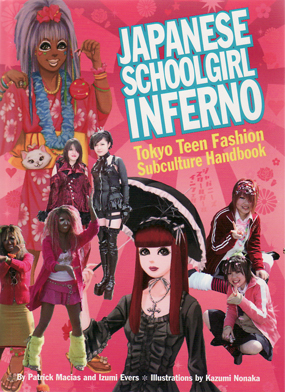
When a friend gave me this garishly pink little book as a present, I saw the name “Patrick Macias” on the cover and immediately prepared to be disappointed. Macias has authored and co-authored numerous books on Japanese popular culture. Two that might be familiar are Cruising the Anime City: An Insider’s Guide to Neo-Tokyo (2004) and TokyoScope: The Japanese Cult Film Companion (2001). These books are not only boring but were also outdated on the day they were published, primarily because Macias’s fascination with Japan’s popular culture during the seventies and early eighties fails to hold the attention of those of us who want to know what’s going on in Japan right now. In fact, I might even go so far as to say that Macias’s earlier books might have been better served if they were marketed as cultural histories instead of as guides to contemporary popular culture.

While it’s true that Japanese Schoolgirl Inferno is only up-to-date as of around 2005, and while it’s true that this book contains quite a bit of cultural history, I found it to be one of the most entertaining books I’ve read in a long time. Maybe it’s because of all of the bright and eye-popping photography. Maybe it’s because of Kazumi Nonaka’s fun and plentiful illustrations. Maybe it’s because of the concise prose and scandalous quotations. Or maybe it’s because of all the pink. In any case, once I picked up this cute and trim guidebook, I had a hard time putting it down.

One thing that I found especially charming about this book were all the suggestions the authors offer as to how to achieve these schoolgirl looks yourself. Far from being helpful, these sections actually serve to pinpoint how outrageous the fashions are. Another fun, recurring segment are the illustrated “A Day in the Life” inserts, which usually end with captions like “Mom says, ‘Take a shower! You two smell awful!’”

So, if you’ve always wanted to know what’s going on inside the heads of the Gothic-Lolita princesses, or if you’ve always been curious about how exactly the Mamba girls put on their makeup, this is the book for you. Even if you’ve never had the leisure to wonder about those things but have spent time in Tokyo, this is also probably the book for you. And if you really, really love pink, then I honestly can’t recommend this book enough. Go out and get it before it goes out of print. For the win. I’m serious.

Old Kyoto

Old Kyoto, by Diane Durston

Title: Old Kyoto
Author: Diane Durston
Photographs: Lucy Birmingham
Publication Year: 1986 (originally), 2005 (revised edition)
Pages: 244

Though I am in Kyoto
I miss Kyoto…
Cry of the cuckoo

This poem by Bashō begins the “Afterward” to Diane Durston’s guidebook to the ancient capital city of Kyoto. I believe it’s a fitting epigraph, as this book obviously wasn’t written for tourists. Even though it occasionally attempts to make provisions for day trippers or overnight guests who only speak a small amount of Japanese, I wouldn’t recommend this book to a casual traveler. To those of you who have lived in Kyoto but have since returned home, I would offer another epigraph: Ignorance is bliss.

I spent a year in Kyoto three years ago, and for me this book doesn’t evoke nostalgia as much as it inspires regret. The sembe store right next to the Starbucks. The bamboo weaver’s studio on the way to McDonald’s. The famous ramen stand right next to the movie theater. All the secrets and culture and history that I just didn’t see. If you still live in Kyoto, or if you’re planning on living in Kyoto, or if you’re never, ever going to even visit Kyoto, this is a wonderful book. If you’ve had your chance and can’t go back, or can only spend a day or two, I’d think twice before tempting yourself with Old Kyoto.

One of the nice things about this book, however, is that it’s not simply a travel guide. Durston has divided the book into sections of the city (central, east, north, west, and south) and divided each section into shop, restaurant, and ryokan listings. Each listing is fairly long (three pages), so Durston has plenty of space to explain what’s interesting about the particular location. If a certain ryokan is one of the most exclusive hotels in all of Japan, Durston is going to tell you what’s so amazing about it. If the owner of a particular restaurant has a strong personality, she’s going to tell you about what a character he is. If a craftsman’s shop has been in business for hundreds of years, she’s going to tell you about the shop’s history. If a ceramic dealer specializes in tanuki statues, she’s going to tell you all about the tanuki culture in Japan. Durston is supremely knowledgeable, yet always humble and engaging. Moreover, I think she has written a wonderful essay on the history of Kyoto, which serves as an introduction to the book.

Old Kyoto is so interesting and so well-written that I believe it’s something that should be read cover to cover. The numerous photographs that accompany each entry, although printed in black and white, are a lovely bonus. For anyone who enjoys reading about Japan, or for anyone who enjoys reading good travel writing, I highly recommend this book. Get it before it goes out of print again!