Moshi Moshi

moshi-moshi

Title: Moshi Moshi
Japanese Title: もしもし下北沢 (Moshi moshi Shimokitazawa)
Author: Yoshimoto Banana (吉本 ばなな)
Translator: Asa Yoneda
Publication Year: 2016 (America); 2010 (Japan)
Publisher: Counterpoint
Pages: 209

A year after her father dies in a suicide pact, twenty-something Mitsuharu Yoshie moves to the hipster neighborhood of Shimokitazawa, where she works part-time at a small bistro. Everything is going reasonably well for her until her mother suddenly decides to move in with her. Yoshie had been looking forward to leaving the nest and striking out on her own, but her mother claims that her father’s ghost has begun to haunt their old apartment, so what can she do?

Moshi Moshi is like a glossy lifestyle magazine in the form of a novel. Yoshie and her mother float through their days in Shimokitazawa, eating delicious food, buying nice things, and gradually getting to know their neighbors. Yoshie is serious about her work in the Les Liens bistro, and her mother is serious about pulling herself out of the mire of her former role as a housewife, but they have no money worries and are quite comfortable together.

The only shadow on their bright days is the death of Yoshie’s father Imoto, who played keyboard in a rock band. The official story is that he committed suicide with a much younger woman, but neither Yoshie nor her mother has any idea why an otherwise grounded and stable man would have consented to such an extreme act of desperation. One day, Yoshie randomly runs into a frequent diner at her bistro. The man’s name is Shintani, and he happens to own a club where Imoto’s band often played. Shintani takes this opportunity to tell Yoshie that there was something very strange about the woman her father ran off with. He also tells Yoshie that he’s falling in love with her.

Shintani is a typical Yoshimoto male love interest who could have walked straight out of the pages of a shōjo manga magazine. He is gentle, kind, and attractive in a nonthreatening way:

Shintani-kun still ate beautifully, and the pot-au-feu disappeared into his mouth with dreamy alacrity. As he ate, he looked out the window peacefully. He always wore nice shoes. (96)

Once they start seeing each other, Yoshie and Shintani bond in the same way that Yoshie and her mother do, namely, by visiting cool restaurants and bars and eating tasty and unusual dishes. It is their shared consumption of trendy food and chic clothes and music that brings them together, and Shimokitazawa is the perfect backdrop for this featherlight drama of consumerism. Yoshie’s mother is also healed by her immersion in hipster paradise:

When I saw her reading manga with her belly out, shedding tears while murmuring, “I understand, of course you want to go back and live in the cave,” I was filled up with the thought that this woman hadn’t done anything wrong, and didn’t deserve any of this.

Yes, Shimokitazawa was a little like a mountain cave in the outlands, where people who found it difficult to keep up with the vagaries of the world could live quietly, as they wanted. Even people who’d been left behind, like me and Mom. (88)

This laid-back atmosphere is occasionally juxtaposed against Yoshie and her mother’s former home in Meguro, a pricey neighborhood just south of Shibuya. Meguro is too upscale for the two women to be true to themselves, but they’re finally able to relax and find a comfortable community in Shimokitazawa, which welcomes sweet and slightly quirky people into its patchwork of quaint stores and cafés. The last sentence in the author’s Afterword aptly sums up the message of the book: “I only pray for the survival of all the many fine shops that still quietly continue to exist” (206).

Moshi Moshi has something vaguely resembling a plot, but the story isn’t really the point of the novel. Rather, the reader is bathed in the warm flow of Yoshimoto’s words while experiencing of the charm of the Shimokitazawa neighborhood. The novel is comforting, like drinking hot chocolate on a cold day. Just don’t expect any bold or complicated flavors, and you won’t be disappointed.

The Graveyard Apartment

the-graveyard-apartment

Title: The Graveyard Apartment
Japanese Title: 墓地を見おろす家 (Bochi o miorosu ie)
Author: Koike Mariko (小池 真理子)
Translator: Deborah Boliver Boehm
Publication Year: 2016 (America); 1988 (Japan)
Publisher: Thomas Dunne Books
Pages: 325

Kano Misao and her husband Teppei have found the perfect apartment. It’s quiet and spacious with southern exposure, and it’s in a new, modern building. Sure, this building happens to be right next door to a graveyard, but it’s the 1980s, and the pleasant proximity to an open green space outweighs any sort of silly superstitious stigma. The only problem is that strange things always seem to be happening in the basement. It might be that the building is haunted, but why? And what would the ghosts want from Misao and Teppei?

Like many other haunted house stories, The Graveyard Apartment is, at its heart, a family drama. Misao and Teppei are happy together with their five-year-old daughter Tamao and their dog Cookie, but the bright little family is trailed by the dark shadow of Teppei’s first wife Reiko, who was driven to suicide by her husband’s affair with Misao. When the stress of the paranormal activity in their new apartment places stress on Misao and Teppei’s relationship, the fault lines of their marriage begin to crack. The novel opens inauspiciously with the death of Tamao’s pet bird Pyoko, who the girl claims now visits her in dreams. Misao and Teppei’s disagreement over how to handle their daughter’s insistence on the reality of the supernatural is the first of many arguments, which gradually escalate over the course of the story.

The Graveyard Apartment is not The Shining, however, and the ghosts troubling the family are not manifestations of buried psychosexual traumas – they are, most assuredly, actual vengeful spirits. The horror of the novel derives from the fact that, despite the lingering guilt over Reiko’s suicide, the malice of the building’s ghosts could not be directed at a more normal and easygoing family. If a sweet young mother and fledgling illustrator like Misao can find herself trapped in a claustrophobic basement while unknown things approach unseen in the darkness, it could happen to anyone.

It turns out that the apartment building is a remnant of a failed development project from the 1960s that would have resulted in an underground shopping plaza connecting the basements of several office and residence buildings to the local train station. The neighborhood temple resisted this development and refused to sell or subdivide its land, however, and so the tunnel under the graveyard was left unfinished, with the Kanos’ building the only part of the project that came to fruition. The link between the temple graveyard and the ghosts in the basement is extremely tenuous (especially since the point of Buddhist funerary rites is to pacify angry spirits), but the haunting can be more easily understood as the consequences of the era high economic growth, which has finally started to claim victims as the bubble economy begins to collapse in on itself.
The Kanos were led to believe that they could have it all – Teppei could divorce his old-fashioned wife and marry for love, Misao could have both a child and a freelance career in a creative field, and they could find a reasonably priced apartment in a convenient location to house their happy family. It had to be too good to be true, right?

Originally published in 1988, The Graveyard Apartment is a reflection of the anxieties concerning the optimistic consumerism of the 1980s, in which an ideal middle-class lifestyle was widely considered to be glossy and attainable as the magazines Misao illustrates. Although the real threat to families ended up being overinflated property values, Koike’s ghosts are creepy enough on their own even without any sort of economic allegory, and the end of the novel is genuinely disturbing. The Graveyard Apartment is a satisfying slow burn of a haunted house story perfectly suited to its setting in Tokyo, and I highly recommend it to my fellow fans of horror fiction.

( Review copy provided by Thomas Dunne Books. )

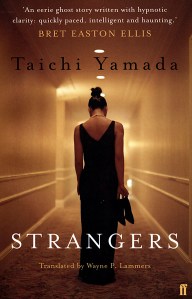
Strangers

Strangers

Title: Strangers
Japanese Title: 偉人たちとの夏 (Ijintachi to no natsu)
Author: Yamada Taichi (山田 太一)
Translator: Wayne P. Lammers
Publication Year: 2003 (America); 1987 (Japan)
Publisher: Vertical
Pages: 203

A 48-year-old television script writer named Harada is having a tough time of it. Having divorced his wife, he now lives by himself in a small apartment in a mostly empty building. A drama series he was supposed to work on has been canceled, and a friend and colleague has announced his intentions to pursue Harada’s ex-wife. After Harada’s friend informs him that they can no longer work together, he wanders in a haze until one day he decides to return to the Asakusa neighborhood of Tokyo where he grew up. On a whim he enters a rakugo performance, where he catches sight of a man who looks just like his late father. When the man goes out for a cigarette, Harada follows him and ends up being invited to the man’s home, where a woman who looks exactly like his late mother is waiting for them.

Around the same time, Harada has a strange encounter with a woman in her thirties whom he has nodded to a few times in the lobby of his building. Late one evening she shows up at his apartment with a bottle of champagne, remarking on how it’s eerie that the two of them are the only humans in the building. Because he’s still reeling from the emotional impact of his friend’s pronouncement regarding his wife, Harada tells her that he’s busy. When he calls her a week later, however, she gladly comes over. She makes romantic overtures and says she’ll sleep with him on the condition that he promises not to look at a mysterious wound on her chest. Is she just shy, or is something more sinister going on?

Harada’s ghost parents are charming and hospitable, so he continues visiting them. Harada’s father, a sushi chef, exhibits the charming gruffness and bluster of a stereotypical tradesman from the Shitamachi “old Tokyo” area in east Tokyo, and his mother is a sweet and gentle woman who loves her husband and son despite their flaws and amuses herself by playing old-fashioned games with hanafuda cards. Unlike Harada’s barren neighborhood in Shinjuku, Asakusa is full of warmth, and returning to his parents feels like stepping back into an idealized past in the postwar era.

Harada feels more alive than he has in years, but the people around him keep remarking on how terrible he looks. His new girlfriend seems especially concerned, and the intensity of her emotions is almost frightening. What does she want from him? What do his deceased parents want from him? Will he live long enough to find out?

Although Strangers plays with an interesting set of themes, the novel feels somewhat shallow. Harada is introspective but never arrives at any striking realizations about himself, and he’s too self-absorbed to make any serious attempts to understand the behavior of the people around him. Unfortunately, this Harada’s position as the point-of-view character renders the other characters as nothing more than stereotypes. Why do Harada’s parents return to the world of the living to see him? Because all parents love their children, of course. Why does Harada’s ex-wife pick fights with him? Because all women are crazy, of course. Why doesn’t Harada’s college-age son want to talk to him? Because all young people are ungrateful and temperamental, of course.

To me, Harada came off as an embodiment of male entitlement, and the books ends with his preconceptions justified and his place in the world reaffirmed. His seeming inability to change himself as the world changes around him is presented in a romantic light, as are the noble struggles of middle aged dudes everywhere. I didn’t find this story particularly engaging, but perhaps I’m simply not the intended audience.

Strangers is neither grisly nor subversive enough to inspire chills, but as a ghost story it offers an interesting theory on how different parts of Tokyo are haunted.

The Book of Tokyo

The Book of Tokyo

Title: The Book of Tokyo: A City in Short Fiction
Editors: Michael Emmerich, Jim Hinks, and Masashi Matsuie
Publication Year: 2015
Publisher: Comma Press
Pages: 180

In his introduction to this collection of ten short stories, editor Michael Emmerich writes:

In a sense, you might say that the stories of this anthology unfold within a landscape more imagined than real – that they create a Tokyo of their own by drawing on a rather abstract sense of the moods of certain sections of the city, or on a vision of Tokyo and the smaller areas it comprises that is more conceptual than physical. (x)

This is a perfect description of The Book of Tokyo, which offers the reader less of a detailed illustration of an urban landscape than it does a vivid sense of the energy and potential generated by a city inhabited by 13.5 million people, every one of whom has a story.

In Furukawa Hideo’s “Model T Frankenstein,” a monster that may or may not be a shapeshifting goat escapes one of the Izu Islands on a ferry and makes his way to Tokyo to assume a new identity as a ‘Japanese.’ He has to kill a few people along the way, but he eventually makes a home for himself in Shinjuku. In “Picnic,” Ekuni Kaori sketches a relationship between a disaffected couple whose hobby is to have designer picnics in a park by their house, an activity that makes them marginally less alienated from one another. Kakuta Mitsuyo’s “A House for Two” is an ode to the trendy comforts of urban living. The pleasure the narrator derives from walking through the city has its roots in her relationship with her mother, whom she whom once bonded with over luxurious foreign clothes and who now commands a greater share of her affections than any man ever could.

The cosmopolitanism of Tokyo is on full display in Horie Toshiyuki’s “The Owl’s Estate,” in which the male narrator, a sushi chef and secondhand book dealer, finds himself in a strange rundown building in West Ikebukuro inhabited by foreign girls of dubious employ. In the end, though, there’s nothing particularly French or Australian or American about the way these girls enjoy drinking and laughing and being silly with each other. The single father protagonist of Yamazaki Nao-Cola’s “Dad, I Love You” must navigate his way through a maze of foreign brand names, cuisines, and business owners over the course of his day before coming home to his daughter, who encourages him to keep going with the joy she finds in things that transcend culture, such as how large the full moon looks in a clear night sky. The young woman who narrates Kanehara Hitomi’s “Mambo” doesn’t even care where she’s going when she gets into a taxi with a stranger; she’s just looking for adventure in the city.

Yoshimoto Banana’s “Mummy” encapsulates the theme of the entire collection, which is that every random encounter between strangers is accompanied by a galaxy of possibilities. A female undergrad agrees to be walked home by a male graduate student studying Egyptology. He cautions her that there’s a killer loose in the neighborhood, and it would be unsafe for her to go out alone. She suspects that he might be the murderer, but her physical attraction to him is so strong that she resigns herself to her fate. Although the grad student isn’t a criminal, he does turn out to be a complete weirdo, and the narrator has to forcibly restrain herself from judging him and the course his life takes after they go their separate ways. When surrounded by so many potential paths, she asks herself, how do you know that your own is “necessarily the correct and happiest one” (52)?

My favorite story in the collection is Kawakami Hiromi’s “The Hut on the Roof.” The main setting is an izakaya pub, where the divorced narrator, an English teacher, eats and drinks and hangs out with older men from her neighborhood. After becoming close to them through the process of exchanging casual but repeated interactions, she eventually learns the story behind the peculiar living arrangement of a local fishmonger who has befriended her. The story doesn’t have a plot, exactly, but it conveys an almost palpable sense of living your own individual life surrounded by people whom proximity has drawn into a loose yet friendly community.

Don’t let the cover fool you – despite the flying cranes and Shintō gate and temple and Chinese lanterns, the The Book of Tokyo is refreshingly contemporary. None of the stories translated for the collection was published before 2000, and reading them feels like walking through the twenty-first century just as much as it feels like walking around Tokyo. As Emmerich notes, it’s difficult to pin down the “Tokyo-ness” of these stories, but the reader who encounters them can’t help but be drawn into the living and breathing atmosphere of a huge and dynamic city.

The editing and story selection of The Book of Tokyo is excellent. I was so impressed that I ended up ordering several other titles in Comma Press’s “Reading the City” series, which include The Book of Gaza, The Book of Rio, and The Book of Liverpool.

Review copy provided by the wonderful people at Comma Press.

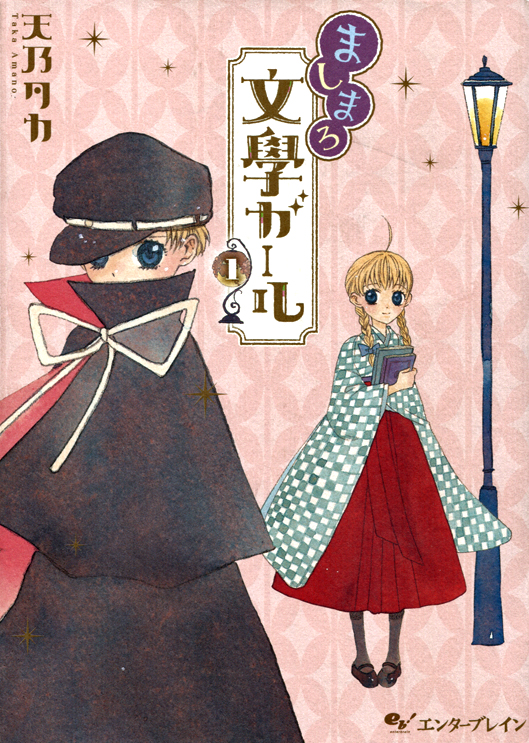
Marshmallow Bungaku Girl

Marshmallow Bungaku Girl

Title: Marshmallow Bungaku Girl
Japanese Title: ましまろ文學ガール (Mashimaro bungaku gāru)
Alternate Title: Mädchen Marshmallow Literatur
Artist: Amano Taka (天乃 タカ)
Publisher: enterbrain (エンターブレイン)
Publication Dates: 6/27/2011 – 2/15/2013
Volumes: 2

In the late Meiji Period, as Japan undergoes the process of modernization, Hoshino Mone is a student at an all-girls private high school in Tokyo, where she lives with her male guardian, Sei. Although a young woman’s duty is to be beautiful and modest so as to become a suitable bride, Mone has a different dream – she wants to write literature! Literature (the bungaku of the manga’s title) is believed to corrupt women, so Mone cuts off her braids, dons schoolboy clothing, and joins an all-male literature club. Although she must face a bit of drama concerning her choices, the friends Mone makes help her hone her talents and offer her inspiration as they take her on adventures around town. The handsome young literary illustrator Nasuhito knows Mone’s secret but believes in her potential. Nasuhito’s respect for Mone as a fellow artist is not the only source of his warm feelings for her, however.

Although Bungaku Girl was published in the seinen magazine Fellows! – the former name of Kadokawa’s prestige-format monthly serial Harta (ハルタ) – it reads like a shōjo manga from the 1990s, when the influence of series such as Fushigi Yûgi and Cardcaptor Sakura injected elements of gender bending and bishōnen harems into even the most prosaic romance stories. All of the young men in the literature club are impossibly gorgeous, and everyone is decked out in immaculate period dress. There’s a hint of yuri provided by the radiant high school princess Sono, another literature fan who becomes enamored of Mone’s courage and independent spirit, but there are no elements of the male gaze to be found in the manga’s story or art. Instead, there are touches of Mori Kaoru in the close attention paid to historically accurate fabrics, interiors, street scenes, and city vistas.

Bungaku Girl is less about Mone’s cross-dressing and gender identity than it is about her commitment to doing whatever it takes to find a supportive community for what she loves. Many of the story’s most powerful moments occur when the characters are being creative – when Mone is writing, or when Nasuhito is drawing, for instance – and these moments are reinforced by being framed within the sense of belonging to a group of people all working together to share their ideas and produce something tangible. For us nerds who have studied modern Japanese literary history, there are pleasurable echoes of the student groups, coterie magazines, and research trips into pleasure districts associated with real-life literary figures.

This two-volume series is only available in Japanese, but it would be really cool if someone were to license it in North America. The story is simple and charming, the characters are adorable, and the art is clean and attractive. Bungaku Girl offers love, drama, and interesting imagery, not to mention encouragement to leave your comfort zone and live your dreams!

Bungaku Girl Volume 1 Page 23

I… want to join your literature club!

Emily

Emily

Title: Emily
Japanese Title: エミリー (Emirii)
Author: Takemoto Novala (嶽本 野ばら)
Translator: Misa Dikengil Lindberg
Publication Year: 2013 (America); 2002 (Japan)
Publisher: Shueisha English Edition

There are two short stories and one novella included in Takemoto Novala’s collection Emily, which was nominated for the Mishima Yukio Prize (for popular established writers) in 2003. “Readymade,” which is only a few pages long, is written in the form of a confession of a young female office worker to an older male colleague who takes her on a date to an exhibition of French Cubist art at the Ueno Royal Museum. “Corset” is told from the perspective of a male illustrator in Kyoto who plans to indulge in a short romantic relationship with an engaged woman before committing suicide in honor of a deceased friend. The novella Emily is about two high school misfits devoted to street fashion.

The two short stories are wonderfully atmospheric and can be read as treatises on Lolita aesthetics. Both stories follow the pattern of an older and self-assured man aggressively offering instruction to a naïve younger woman characterized as a tabula rasa, and they’re less about suspense and development than they are about establishing a colorful and stylized worldview.

To give an example from “Corset”:

“Wouldn’t it have been great if you and I had been born in the nineteenth century?”

“Yes. Sometimes I really think so. But I also think that if you and I had been born in the nineteenth century, maybe we’d still be complaining, saying, ‘Wouldn’t it have been great if we’d been born in the eighteenth century?’ Perhaps it’s not this era that we dislike, but the state of being in the present that doesn’t agree with us.”

“You mean no matter what era we were born in, we’d always long for the past and have nothing but despair for the present? Maybe you’re right. So there’s no way out except death.”

“Regardless of how the times change, as long as you are alive, you’ll be full of nothing but discord with the world around you.”

Such sentiments provide a fitting prelude to the novella Emily, in which the narrator truly is out of sync with the world in which she lives. This is not her personal failing, but rather a failing on the part of a society that refuses to accommodate diversity and always seeks a scapegoat. Emily‘s narrator, who enjoys visiting the Laforet shopping center in Harajuku and dressing in cute street fashions, has become a target for the other girls in her high school, who subject her to bizarrely cruel forms of bullying:

They sometimes made me stand in the middle of the court with my hands bound, as they spiked balls at me. I had to take the hits directly to my body as the seniors spiked and then ordered others to spike. There was no way I could run. If the balls had been coming from one direction, I could have escaped, but they came from all directions. Every ball hit me. It was a game to them. If a ball hit my body, they scored one point. If it hit my face, they scored five points. And if it knocked me over, they scored ten points.

The narrator isn’t subject to abuse just from her classmates and volleyball club teammates, but also from her mother, who is disappointed that she was unable to become a child television star, a path the narrator refused to follow after she suffered abuse of another kind. Instead of becoming bitter or resentful, however, the young woman finds joy in the self-expression she realizes through clothing that flies in the face of conformity and social expectations. In fact, it seems only natural to the reader that she would use street fashion to carve out a comfortable refuge for herself away from her school and family.

Through a shared interest in the Emily Temple Cute brand, the narrator becomes friends with a boy who also hangs out around Laforet. It turns out that he’s a student at her high school, and he’s also being bullied because he came out as gay to another male student. After one particularly frightening incidence of bullying that threatens the life of the narrator, her friend flies into a rage and attacks her tormentors before fleeing the school grounds. The narrator tracks him down in Shibuya, and they have a long heart-to-heart conversation that is both touching and extremely painful.

Although Emily addresses real social issues, like the two other stories in the collection, its themes are exaggerated, and the style in which it is written is clearly stylized. Readers searching for absolute mimetic realism probably won’t be impressed, but fans of young adult fiction – including young adults – will be moved and swept away by the entire collection.

Included at the end of Emily is a lengthy and illuminating interview with the author, Takemoto Novala.

Although the translation is only available as an e-book, its short length (probably fewer than 150 pages) would make it a perfect classroom text should it ever become available in a paperback edition.

So, you’re intrigued by Emily. You should be! The publisher, Shueisha English Edition, has put up a lovely website to help promote the book. But you’ve searched on Amazon, on Barnes and Noble, on Kobo, and on iBooks, and it’s nowhere to be found. What gives?

It turns out that Shueisha English Edition titles were only available through the Sony Reader digital storefront, which was shut down earlier this year (2014). When the Sony Reader store closed, an announcement was posted stating that all Sony Reader titles would be transferred to Kobo. An April 2 post on the Shueisha English Edition Facebook page reads as follows:

We’re very sorry but our move to Kobo won’t happen very soon. We’re still talking with our possible representative in the States.

On June 29, the following update appeared:

Ours is an editorial team only working for Shueisha English Edition, and has no connection to Shueisha’s other operations. We’ll restart our publication soon when we reach an agreement to our next retailer. Please don’t send any inquiries about Shueisha’s other publications and rights/licensing business. We simply cannot answer to any such questions and requests. Thank you for your patience and we’re working hard on our future titles. Please wait for some more for our official announcements and new titles.

Since then, nothing.

It seems as though the publisher has disappeared, which is a shame, since it was off to a fantastic start, regularly putting out lovely digital books with excellent bonus materials and carefully crafted promotional websites (such as those for Shimizu Yoshinori’s Labyrinth and Makime Manabu’s The Great Shu Ra Ra Boom). In an interview on the SCBWI Japan Translation Group’s webpage, the Shueisha English Edition editor in chief, Yoshio Kobayashi, outlines the care and attention put into the translation, editing, and presentation of each of the publisher’s titles. Although I don’t have access to any of these other titles, Emily is a cool little book, and I imagine that it would have been able to find a sizeable audience through the appropriate distribution channels.

Although I understand that the collapse of the Sony Reader Store must have been a major blow, I can’t even begin to imagine what’s going on with Shueisha English Edition, especially since the publisher is working with such fantastic and high-profile authors and translators. I can only hope that good news is forthcoming from them soon.

Review copy provided by Shueisha English Edition.

Parade

Parade Novel

Title: Parade
Japanese Title: パレード (Parēdo)
Author: Yoshida Shūichi (吉田 修一)
Translator: Philip Gabriel
Year Published: 2014 (America); 2002 (Japan)
Publisher: Vintage Books
Pages: 230

Do you remember how, maybe around ten years ago, writers like Nick Hornby and Chuck Palahniuk were really cool? You’d read something like Bret Easton Ellis’s American Psycho or Don DeLillo’s Cosmopolis and go, Wow, that’s brilliant! And do you know how now, when you try to pick up one of those writers again, you’re too jaded by movie adaptations trying to make hard-line masculinity and sexual violence seem edgy to really appreciate what the writers were trying to say about urban culture and the weird bonds that form between people and what happens when you’re no longer young and suddenly running out of opportunities to make a fresh start? Have you ever thought it would be kind of awesome to re-experience the excitement of those stories without the nagging annoyance of an ever-present undercurrent of misogyny?

If so, then you need to read Parade. It’s by far the most enjoyable novel I’ve encountered this year. When I first sat down with it, I thought I would read twenty pages and then call it a day; but then, the next thing I knew, I was ninety pages in and terrified that I wouldn’t be able to stop. The novel’s five chapters are recounted by five different characters, each of whom is crazier than the last. I loved all of them, and I had to pace my progress through the book so that I could spend more time in their presence. Like its narrators, Parade is young, and it’s fun, and it’s clever, and it’s psychologically unbalanced (in a good way).

The story is about four people in their twenties who have no idea what they’re doing with their lives. Almost by accident, they’ve found themselves living together in a two-bedroom apartment, where they’ve established an easy and comfortable social space that one of them likens to an internet chat room. In short, each of them is free to be as dysfunctional as he or she wishes without incurring the judgment of the others, and they get along well.

Sugimoto Ryōsuke is a sophomore in college who adores a protective upperclassman and has found himself in a Sedgwickian love triangle with his friend’s girlfriend. When he’s not stalking this girl (with her tacit approval), he’s aimlessly driving around Tokyo in a derelict Nissan March that he’s named Momoko. Ōkochi Kotomi is twenty-three, unemployed, and may or may not be dating an up-and-coming young actor. She spends all day inside the apartment watching tv and waiting for her maybe-boyfriend to call. Sōma Mirai is only a year older than Kotomi but manages a branch of a boutique that sells clothes and accessories imported from places like India and Bali. She’s also an unrepentant alcoholic who frequents gay bars and stays up all night working on digital illustrations based on close-up photographs of male bodies. Ihara Naoki, the apartment’s last remaining original tenant, is pushing thirty and seems the most normal of the group. He works at a small but successful film licensing company and goes on jogs late in the evening while listening to classical music. Every so often Naoki’s nutty ex-girlfriend Misaki appears without warning, has a few drinks, and spends the night on the apartment couch.

One night, Mirai picks up an eighteen-year-old high school dropout named Kokubo Satoru on one of her pub crawls through Shinjuku. Satoru, who does speed in public restrooms and trolls for clients in parks, has no fixed residence and somehow ends up squatting in the shared apartment. His entry into the lives of the four tenants coincides with a string of assaults in the neighborhood that become increasingly violent over the course of the novel. Meanwhile, the unit next door – Apartment 402 – is fairly obviously serving as the headquarters for some sort of shady operation orbited by creepy old men and weeping teenage girls. Despite all this, Ryōsuke, Kotomi, Mirai, Naoki, and even Satoru continue to drift through life largely untroubled by anything that happens outside the confines of their apartment.

For the reader, there is a certain Gothic appeal in unearthing the secrets hidden under the placid comradery characterizing this pseudo-family, but the lack of concern on the part of the people in question drains most of the shock from each revelation. So Ryōsuke is stalking his older male buddy’s girlfriend because he has a weird father complex? It happens. Kotomi is obsessed with an actor not because of lust or emotional emptiness but because of a half-hearted sense of guilt over something that happened when she was a high school student? Whatever, it’s no big deal. By the time the reader uncovers the more sordid secrets of Parade‘s narrators, they’re become more amusing than upsetting; and, if nothing else, knowledge of these secrets only serves to render the continued companionship of the apartment’s tenants all the more touching.

I understand how some people might interpret Parade as a horror story, but it’s really more like an American sitcom about comically mismatched roommates. “Comically mismatched” happens to mean “weaving in and out of the borderlands of sanity” in this case, but the novel still has the potential to generate a lot of warm fuzzy feelings, at least in readers with a healthy tolerance for black humor and antisocial behavior.

Philip Gabriel’s translation is eminently readable, capturing the grit and immediacy of the narrators’ different styles without resorting to easily dated slang or stereotypes regarding urban speech patterns. Yoshida is a popular writer with a distinctive literary voice, which I feel comes across much more clearly in Parade than in Gabriel’s earlier translation of the author’s 2007 novel Villain. That being said, both books are a lot of fun, and I’m looking forward to more of Yoshida’s work appearing in English.

Isao Yukisada, who won a Japanese Academy Prize for his 2005 adaptation of Katayama Kyōichi’s bestselling romance Socrates in Love, directed a movie version of Parade. The film was well-received at the 2010 Berlin International Film Festival, winning a FIPRESCI Award and going on to screenings at festivals all over Europe and North America. I had a chance to catch the movie at a showing during that year’s Philadelphia Film Festival, and it was really good. I highly recommend Yoshida’s original novel, of course; but, if you get an opportunity to see Isao’s cinematic adaptation, go for it!

A review copy of Parade was kindly provided by Vintage Books.

Parade Movie Poster

In the Miso Soup

In The Miso Soup

Title: In the Miso Soup
Japanese Title: イン ザ・ミソスープ (In za miso sūpu)
Author: Murakami Ryū (村上 龍)
Translator: Ralph McCarthy
Publication Year: 2003 (America); 1997 (Japan)
Publisher: Penguin
Pages: 217

In the Miso Soup was serialized during 1997 in the Yomiuri Shimbun, the newspaper with the highest circulation in Japan (and perhaps in the world), and it won the 1998 Yomiuri Prize for Literature, an extremely prestigious award given to superlative works of writers who have already established themselves as leaders in their fields. The novel’s North American and Japanese publishers have marketed it as a “psycho thriller,” and its extreme and violent content will more than likely shock anyone who isn’t familiar with Murakami’s oeuvre, especially his other suspense novels from the 1990s, such as Piercing (1994) and Audition (1997).

The twenty-year-old protagonist of the novel, Kenji, is a high school graduate from Shizuoka Prefecture who makes his living by acting as a guide of Shinjuku’s Kabukichō neighborhood, which is internationally famous for its nightlife. Kenji specializes in sex tours for foreigners, who learn about his services through Tokyo Pink Guide, a publication helmed by a man named Yokoyama, who believes it is his calling in life to bring the people of the world together through something all human beings have in common. On the morning of December 29, Kenji is contacted by an American named Frank, who claims to be a distributer of Toyota car parts and meets Kenji while clutching a copy of Pink Guide in his meaty hands.

If you mention In the Miso Soup to anyone who’s read the novel, the conversation will instantly turn to how delightfully creepy Frank is. Frank is a pathological liar, for starters. If one of the bizarre things Frank says is challenged in any way, he becomes suddenly and irrationally furious, his expression transforming into a mask of rage that Kenji soon comes to refer to as “the face.” The skin on Frank’s neck and hands is loose and seems artificial, and a sex worker who services Frank at a peep show says that there is something inexplicably wrong with his penis as well. To make matters even more upsetting, the body of a high school junior named Takahashi Akiko had been found dismembered and distributed across Kabukichō early in the morning of the 27th; and, after Frank goes on a rant about killing homeless people during his first night out with Kenji, the charred corpse of a homeless man is found in Shinjuku Central Park the next morning. By the end of the first of the novel’s three chapters, both Kenji and the reader are supplied with ample evidence to suspect that there is something not quite right with Frank.

Although Kenji is understandably apprehensive about spending more time with Frank, he is even more worried about what Frank might do in retaliation if he were to break their agreement and stand him up. He thus goes out for a second night on the town with Frank, who now makes very little effort to appear normal. After an episode of highly concentrated weirdness at an underground shot bar, Kenji and Frank go to an omiai club, a bar where people hoping to hook up with a stranger can meet. The girls who enter the club are given numbers and chosen by the men, who must pay a cover charge to enter. If a girl is chosen, she will share a table and drinks with the man who selects her. If they hit it off, they can then proceed to a nearby love hotels, and it is understood that money will more than likely change hands after the encounter. It’s not quite prostitution, but the women do have a financial interest in convincing the men to leave the club with them, and they will put everything they have into flirting and appearing attractive. What could be a quirky comedy of errors in another novel becomes an absurdist drama in the bizarro realm of In the Miso Soup, and Frank puts an end to the staged and artificial interactions of the club’s patrons with a lengthy orgy of meticulously narrated ultraviolence. Although Kenji is clearly traumatized by this turn of events, he also takes tentative steps towards an acceptance of what has happened to the other people at the club, who have upset his fundamental faith in humanity with their superficiality:

They were like automatons programmed to portray certain stereotypes, these people. The truth is it bugged the hell out of me just to be around them, and I’d begun to wonder if they weren’t all filled with sawdust and scraps of vinyl, like stuffed animals, rather than flesh and blood. Even when I saw their throats slit and the gore oozing out, it hadn’t seemed real to me. I remembered thinking, as I watched the blood drip down from Lady #5’s throat, that it looked like soy sauce. Imitation human beings, that’s what they were.

Murakami therefore configures Frank’s dispassionate killing spree into a sort of social critique, a theme that comes to fore in the novel’s third chapter. After the bloodbath at the omiai club (which Kenji refers to as “The Great Omiai Pub Massacre,” as if it had happened years ago), Frank shanghaies Kenji into spending the night with him in the abandoned medical facility in which he has ensconced himself. While Kenji shivers in the darkness of the unheated building, Frank regales him with stories from his childhood in America. As might be imagined, Frank’s childhood is dysfunctional and disturbing enough to make Stephen King proud (Frank even grew up in Maine!), as it includes the creepiness of small towns, the killing of small animals, murder, institutionalization, and extreme body horror courtesy of American mental health practices. Frank is obviously a sociopath, and he has already been established as a pathological liar, so it’s not entirely certain that he’s telling the truth, but he does seem to be telling Kenji his life story for a reason. Frank is almost like an overweight Tyler Durden as he explains that society needs terror, discord, and disruption in order to evolve:

“I see myself as being like a virus. Did you know that only a tiny minority of viruses cause illness in humans? No one knows how many viruses there are, but their real role, when you get right down to it, is to aid in mutations, to create diversity among life forms. I’ve read a lot of books on the subject – when you don’t need much sleep you have a lot of time to read – and I can tell you that if it weren’t for viruses, mankind would never have evolved on this planet. Some viruses get right inside the DNA and change your genetic code, did you know that? And no one can say for sure that HIV, for example, won’t one day prove to have been re-writing our genetic code in a way that’s essential to our survival as a race. I’m a man who consciously commits murders and scares the hell out of people and makes them reconsider everything, so I’m definitely malignant, yet I think I play a necessary role in this world.

I won’t spoil what happens to Frank, Kenji, and Kenji’s girlfriend Jun at the end of the novel, as the suspense regarding the fate of the trio lends an air of immediacy to Frank’s metaphysical speculations and the moral decisions Kenji begins to make concerning Frank. Let it suffice to say that the shock horror of the first two-thirds of the novel are compounded by the social horror of its final chapter. In the Miso Soup is a short book and a blisteringly quick read, but it stays with the reader long after it draws to its conclusion on New Year’s Eve, at which point its seemingly nonsensical title takes on chilling connotations. In the Miso Soup is a sublime dose of nihilism and ultraviolence that illuminates the seedy side of Tokyo in its blindingly dark shadow that is sure to please fans of Japanese horror and readers of extreme literature.

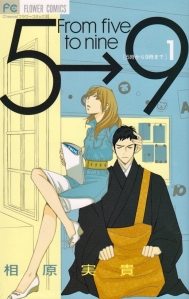
From Five to Nine

From Five to Nine 1

Title: From Five to Nine
Japanese Title: 5時から9時まで (Goji kara kuji made)
Author: Aihara Miki (相原 実貴)
Publication Year: 2010 (ongoing)
Publisher: Shōgakukan
Pages (per volume): 190

From Five to Nine is the current project of Aihara Miki, whose manga Hot Gimmick and Honey Hunt have been published in English translation by Viz Media. Like Aihara’s earlier titles, From Five to Nine is a drama-filled exposé of the love lives of gorgeous young people going about their business in the trendy districts on the southwest side of Tokyo. From Five to Nine is serialized in Monthly Cheese!, an unfortunately named magazine that serves as a bridge between a shōjo readership of tweens captivated by stories of pure love and a josei readership of young women interested in the more physical aspects of romantic relationships. In accordance with the magazine’s house style, all of the characters in the manga are well dressed and ridiculously attractive, emotional and sexual tensions always run high, and chapters end on cliffhangers more often than not. In other words, From Five to Nine is highly entertaining, addictive reading. It’s designed to be.

What I think is interesting about this manga is the way it explores the conflicts between different gender roles and expectations of femininity through the love affairs of its main protagonist.

Sakuraba Junko, the leading lady, teaches during the evenings at an English language conversation school (Eikaiwa gakkō). Because of her friendly professionalism and almost native fluency, she’s considered to be one of the top instructors at her workplace, and her dream is to save up enough money to study abroad in America. Since Junko has passed through her early twenties without having settled down with a man, her grandmother has started to set her up on dates with potential marriage partners through a somewhat formalized process known as miai. To appease her grandmother, Junko spends her twenty-seventh birthday out on a miai date with a Buddhist monk named Hoshikawa Takane, who graduated from Tokyo University with a major in Indian philosophy. Junko is put off by what she sees as Hoshikawa’s snobbishness; but, thinking that their date is a one-time thing and that she’ll never see him again, Junko ends up sleeping with him on a lark. For Hoshikawa, however, that one night is the beginning of TRUE LOVE FOREVER.

Because this is a manga by Aihara Miki, Junko is fated to be the unfortunate object of nonconsensual manly persuasion concerning a relationship that she doesn’t particularly care for. Immediately after Junko gets back from her one night stand with Hoshikawa, she realizes that the deadline to move out of her apartment, whose building is slated for renewal, is fast approaching. When she goes to her grandmother for help, her grandmother suggests that she take temporary residence (geshuku) in a temple with connections to the family. Unfortunately, this temple is headed by Hoshikawa, who now wants to make Junko his temple wife (tera no yome). Being a temple wife is a full-time job, and a marriage to Hoshikawa would require Junko to give up her position at the English conversation school where she currently works, as well as her dream to study abroad. Essentially, if she were to marry Hoshikawa, Junko would have to give up the pleasures of her existence as an independent urbanite and spend her days cooking, cleaning, dressing herself in traditional clothing, setting out flower arrangements, and entertaining guests. Needless to say, she wants none of this. Hoshikawa won’t give up on her so easily, however, and he takes to stalking her, abducting her, and harassing her at both at home and at her workplace. One particularly unpleasant stunt Hoshikawa pulls is to lock Junko up in a small guesthouse separated from the main temple compound by an ornamental garden. In order to escape, Junko agrees to marry Hoshikawa; and, to keep him fooled regarding her true intentions, she makes a show of waking up early to devote herself to cleaning, all the while scheming of ways to get away from the temple.

Meanwhile, her college friend Mishima Satoshi, who has been assigned to his company’s branch office in America, shows up at Junko’s school in order to brush up on his English. Mishima has feelings for Junko and harbors a secret desire to take her to America with him; but, as Junko becomes more aware of Mishima’s intentions and her own reciprocal feelings for him, she surprises herself by becoming conflicted over leaving Hoshikawa and the life he’s offering her. Junko has also attracted the interest of one of her younger pupils, a wealthy student at an elite high school who cross dresses so effectively that only a small handful of his friends know that he’s actually male. This student, Satonaka Yuki, dislikes both Hoshikawa and Mishima and wants Junko to be able to stand on her own two feet outside of relationships with creepy stalker monks and alcoholic playboy salarymen.

This is high melodrama, of course, but what is interesting about Junko’s love life is how aptly it represents the push and pull between traditional and contemporary women’s roles. Should Junko give into social and sexual pressure and relinquish her independence and her dreams, or should she take advantage of a potential romantic partner’s kindness in order to break free of the constraints of living in Japan? Is it possible for her to somehow fend for herself without a social and economic safety net? Because of the romantic drama, the reader is able to experience the emotional attraction and anxiety of all of these possibilities. For example, when Hoshikawa does something ridiculous in order to (sometimes literally) lock Junko into a traditional gender role, the denial of agency that Junko suffers is viscerally upsetting to the reader. As it gradually becomes clear that Hoshikawa genuinely cares for Junko, however, it also becomes clear that Junko’s spirited resistance might be able change the way he sees the responsibilities and aspirations of the women of his generation. In this way, Hoshikawa serves as a representative of a society that is still primarily dominated by phallocentric interests. He’s scary, and his behavior is obviously psychologically unhealthy, but he can be persuaded to change by a woman smart enough and tough enough to take him on, even if she’s coming from a position of relative disadvantage. The sort of “he can change” mentality Junko comes to embrace is presented as being just as dangerous in the fictional world of the manga as it is in real life, but the alternative – “he will never change” – would be a bleak prognosis on the sort of patriarchal mentality Hoshikawa represents. The possibility that Hoshikawa can change himself as he learns that women are people too (gasp!) is an element of social optimism that serves as an emollient to the seemingly misogynistic sexual drama of the manga.

Two other female employees at Junko’s workplace, Yamabuchi Momoe and Mōri Masako, act as counterpoints to Junko’s situation by providing different attitudes towards employment, love, and marriage.

Along with Junko, Momoe is one of the most professional and sought after instructors at the conversation school, but she has a reputation for being standoffish and emotionally chilly. Although she’s all business in the office, she secretly loves yaoi manga. When Arthur Lange, a blond-haired foreign instructor from Britain, discovers Momoe’s hidden interests, he uses the threat of revealing her identity as a fujoshi to her boss to blackmail her into a relationship. Although Momoe enjoys fantasies of attractive, foreign-looking men being sexually aggressive and emotionally manipulative, the enactment of her fantasy is much more unpleasant in real life than it is in the pages of yaoi manga. Momoe is older than Arthur, but she has never had any romantic experience, and she constantly second-guesses her reactions to his teasing and bullying. She therefore often finds herself in the position of wondering how a woman her age should behave towards men, even though she wants nothing to do with them.

Masako, a receptionist at the English conversation school where Junko and Momoe teach, is a recent college graduate who, more than anything, wants to settle down with a boyfriend and become a housewife. Her coworkers tease her by calling her “Zexy,” a nickname taken from the title of a wedding and bridal magazine. Since Masako is attractive and intelligent, her standards for a partner are high, and she can’t find anyone her own age who meets them. Unfortunately, having cultivated an attitude of flirtatious approachability, she finds herself the constant target of unwanted male attention, especially in the form of sexual harassment from middle-aged men.

Junko’s English conversation school is thus a microcosm of Japanese society staffed by different women with different expectations, goals, and challenges concerning their futures. Although the manga focuses on its three main female characters, the male characters are also allowed enough interiority for the reader to see them working, talking to each other, and thinking about their own dreams and romantic problems. All of these characters work at cross purposes because of the artificial drama created by the manga artist, but their attitudes and emotional conflicts ring true to real social expectations and gender roles.

From Five to Nine is a fascinating exploration of contemporary Japan with enough intersecting plot lines, character development, and thematic subtlety to keep even the most demanding readers engaged. The obi bands around the manga covers tout the series as “a Tokyo version of Sex and the City,” and that should be recommendation enough for anyone seeking a fast-paced, hormone-fueled examination of gender roles in the twenty-first century.

From Five to Nine 2

Hatarake Kentauros

Title: はたらけ、ケンタウロス!(Hatarake, kentaurosu!)
Artist: est em (えすとえむ)
Year Published: 2011
Publisher: Libre Shuppan
Pages: 160

Hatarake Kentauros is a one-shot manga by the BL author est em that contains eight stories and a kaki-oroshi (a short afterward section created especially for the tankōbon publication). The subjects of these stories are centaurs trying to make a living in contemporary Japan. The first four stories are about a salaryman centaur named Kentarō, the challenges he faces at work and while commuting, and his relationship with his human co-worker. The fifth story is about a centaur who wants to apprentice at a soba shop but can’t fit into the kitchen and is assigned delivery work instead. The sixth story is about a centaur craftsman who makes shoes even though he can never wear them, and the seventh story is about a centaur model who becomes depressed because his lower half is always replaced with human legs in Photoshop. The eighth story is about a young centaur graduate who is nervous about moving to Tokyo and beginning work at his first job.

The world created by est em in Hatarake Kentauros is largely homosocial; and, although nothing is ever expressly stated, the reader is encouraged to think of the male protagonists of the stories as gay. The salaryman Kentarō misses a day of work due to a cold and is visited by his male coworker, who prepares noodles while making observations on Kentarō’s kitchen, which was built to accommodate a centaur. The apprentice soba chef ends up bonding with an attractive apprentice ramen chef, and the two decide to open a portable street stall together. The centaur shoemaker rescues the son of his employer from an arranged marriage, and the two grow old together while operating their own business in a different city. The bonds between these male characters are gentle and subtle but no less powerful for not including overtly romantic or sexual elements.

What I like about the stories in Hatarake Kentauros is that they avoid a facile allegorical application of social justice by disallowing a one-on-one correspondence between “centaur” and “gay.” Although they’re just as “human” as anyone else, the centaurs created by est em are most definitely “other.” They’re too large to fit into crowded elevators. There are special lanes for them on the streets because they can’t ride in cars. They need to eat large quantities of food, and they have separate toilets. Centaurs aren’t just different from humans in terms of the shapes and sizes of their bodies; they also live for hundreds of years and take almost fifty years to mature into adults. It is therefore difficult to map categories of real-world otherness, such as gender, race, ethnicity, and nationality, onto est em’s centaurs. The reader is thus able to understand the characters in Hatarake Kentauros not just as platonic symbols but also as individuals.

At its core, Hatarake Kentauros is about the stories of individuals. It’s not about social justice or about men in love with other men. est em’s Equus (released at the same time as Hatarake Kentauros), on the other hand, is much more raw. In my opinion, it’s also more artistic. Some of the book’s stories have almost no dialog, and the impressionistic yet forceful lines with which the centaurs of Equus are drawn emphasize their muscularity and masculinity. These centaurs are sexy – especially when they’re having sex with each other. The stories of Equus do not limit themselves to contemporary Japan but look back to other times and places in which centaurs lived freely in the wilderness apart from human habitation or were inherited from father to son like slaves. Equus makes a clear connection between otherness, sexiness, sexualization, and discrimination, and it’s not afraid to hit the reader where it hurts.

I could write much more about Equus and Hatarake Kentauros, but, to make a long story short, these two manga are brilliant, genius-level works. If you can read Japanese – and even if you can’t read Japanese – it’s absolutely worth the ridiculous shipping rates of Amazon.co.jp to import these two books from Japan.

ETA: Hatarake Kentauros will also be available via JManga starting on Thursday, April 19.