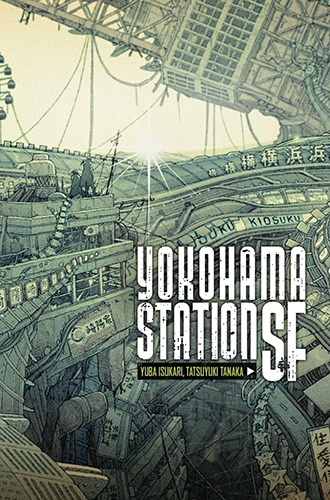
Two hundred years after the end of a devastating global conflict, Yokohama Station has expanded to cover almost all of Honshu, Japan’s central island. Once governed by artificial intelligence, the station now grows uncontrollably through ceaseless self-perpetuation. Most of what remains of Japan’s population lives inside the structure, where order is maintained by patrolling robots and automated systems that manufacture necessities.
Hiroto was born and raised in one of the small coastal communities of people who live outside the station. Since this village is able to subsist on the excess food and goods discarded from the station, Hiroto’s vague dreams of making something of his life have no target, especially since people who don’t a possess Suikanet registration are quickly ejected from the Yokohama Station structure by robotic constructs known as Automated Turnstiles.
This changes when an exile from inside the station washes up at Hiroto’s settlement. Before passing away, the man gives Hiroto an 18 Ticket, a digital pass that will allow him to remain inside the station for five days. He asks Hiroto to find and rescue the leader of the Dodger Alliance, a group of hackers that aims to shut down what remains of the artificial intelligence that governs Yokohama Station.
Another exile, an elderly man suffering from dementia known only as “the professor,” adds to the mystery by telling Hiroto to search for Exit 42, where all questions about the station’s history will be answered. Hiroto, who’s happy to have an excuse for adventure, wastes no time in leaving, assuming that he’ll simply see what he can see in the five days before his 18 Ticket expires.
With no access to digital currency or knowledge of the rules and customs that govern life inside the station, Hiroto quickly finds himself in trouble. Thankfully, luck is on his side, and he’s aided in his journey by Shamai, an android sent to gather intelligence from Hokkaido, which is still free from the station’s growth. Hiroto also crosses paths with a beautiful otaku techno-wizard named Keiha, who turns out to be the very resistance leader he was sent to rescue. Keiha is fine, as it turns out, and she remotely assists Hiroto’s journey to Exit 42 while mining Shamai for information about the ultimate goal of the organization that governs Hokkaido.
Hokkaido isn’t the only independent territory; and, about a third of the way through the novel, the perspective switches to a weapons specialist named Toshiru who is employed by the military government defending the island of Kyushu from the station’s encroachment. Toshiru is a lone wolf who isn’t suited for military bureaucracy, so his commanding officer gives him implicit permission to take a ferry to the island of Shikoku, which is partially occupied by the station.
On Shikoku, Toshiru meets a Hokkaido android named Haikunterke (whose name, like Shamai’s, is taken from the language of the Ainu people who once lived in northern Japan). Together they navigate the lawless territory on the fringes of Yokohama Station, where people who were unable to flee to Kyushu live in constant fear of starvation and roving gangs of brigands.
The horrors that Toshiru witnesses raise a moral dilemma. If the central A.I. core of Yokohama Station is shut down, and if the station loses its ability to maintain itself, what authority will rise to fill the power vacuum? And how will humans produce food on land that’s been so utterly destroyed?
Once Hiroto finds Exit 42, he’ll have to make a decision. In one of the most interesting scenes of the novel, it turns out that what remains of the original station A.I. has thoughts of its own, and the message it shares with Hiroto is kind, wise, and refreshingly unexpected.
For such an intriguing setting and premise, Yokohama Station SF contains surprisingly little worldbuilding, and its exposition is delivered in short conversations that are frequently interrupted by the hazards the characters encounter as they travel. A full-color illustrated insert at the beginning of the book helps to fill in some of the gaps, as does a short glossary at the end, but most of the information the reader picks up will be through osmosis.
Speaking personally, I appreciate that the steady clip of the plot progression isn’t unduly interrupted by lore, and I feel that the character-focused narration serves the story well. At the same time, though the writing and translation are both excellent, Yokohama Station SF feels a bit like Dark Souls in the way it obfuscates its background story in favor of immediate action. Even as the characters navigate an unmapped maze of corridors, the reader must find their own way through a labyrinth of words.
Yuba Isukari writes that Yokohama Station SF began as something akin to fanfiction based on the manga (specifically Blame!) of Tsutomu Nihei, who sets his stories in the interiors of infinitely sprawling sci-fi megastructures the size of small planets. Though the novel’s chapter-opening character illustrations by Tatsuyuki Tanaka are lovely and filled with charm and personality, they don’t really convey a sense of the setting.
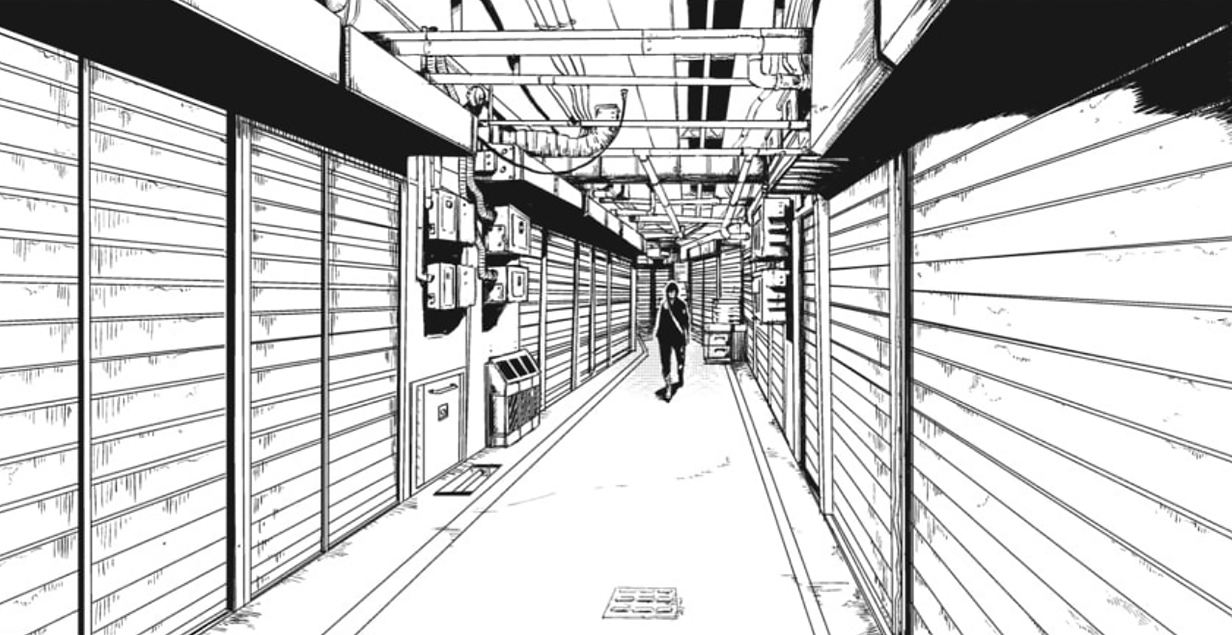
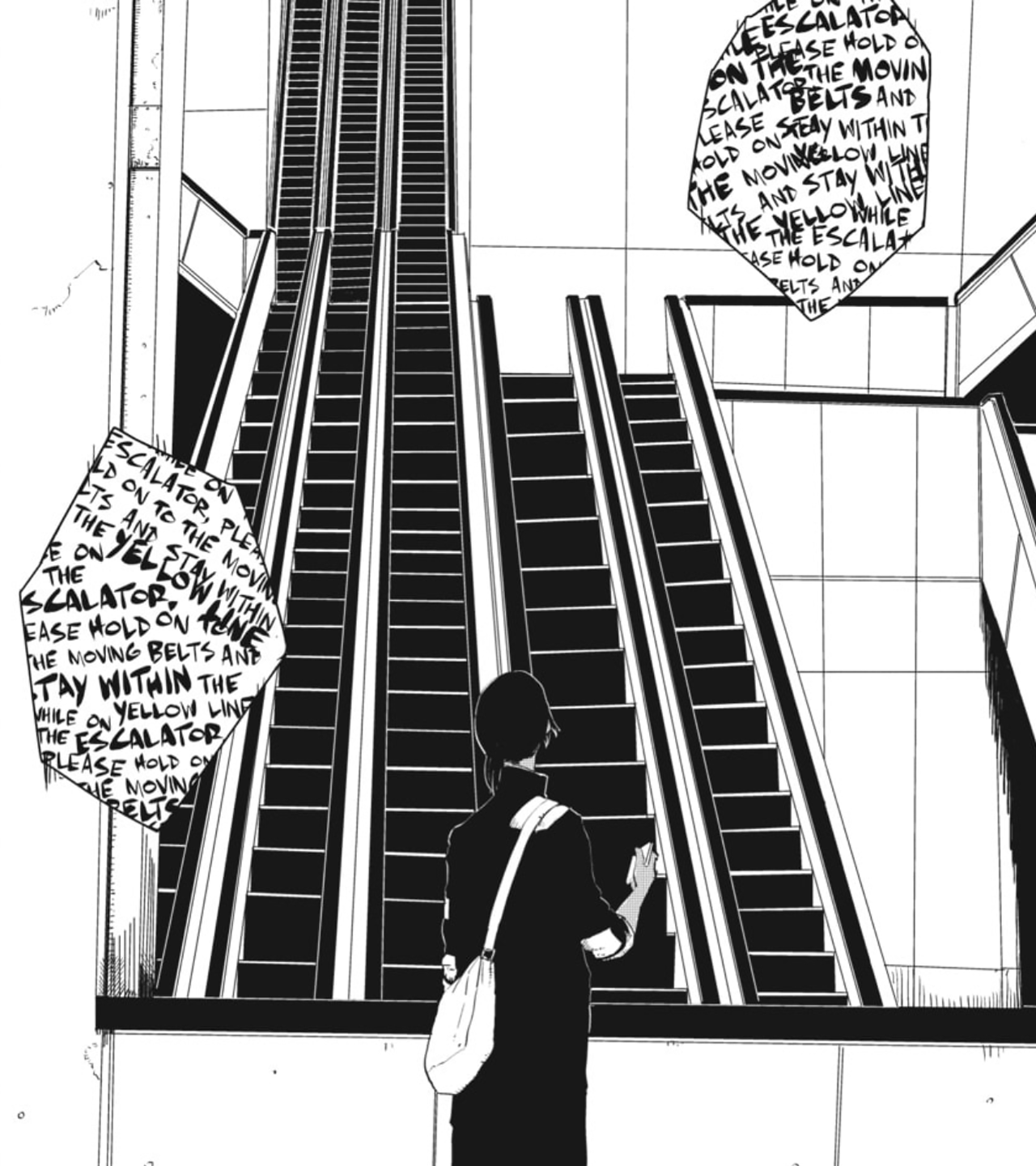
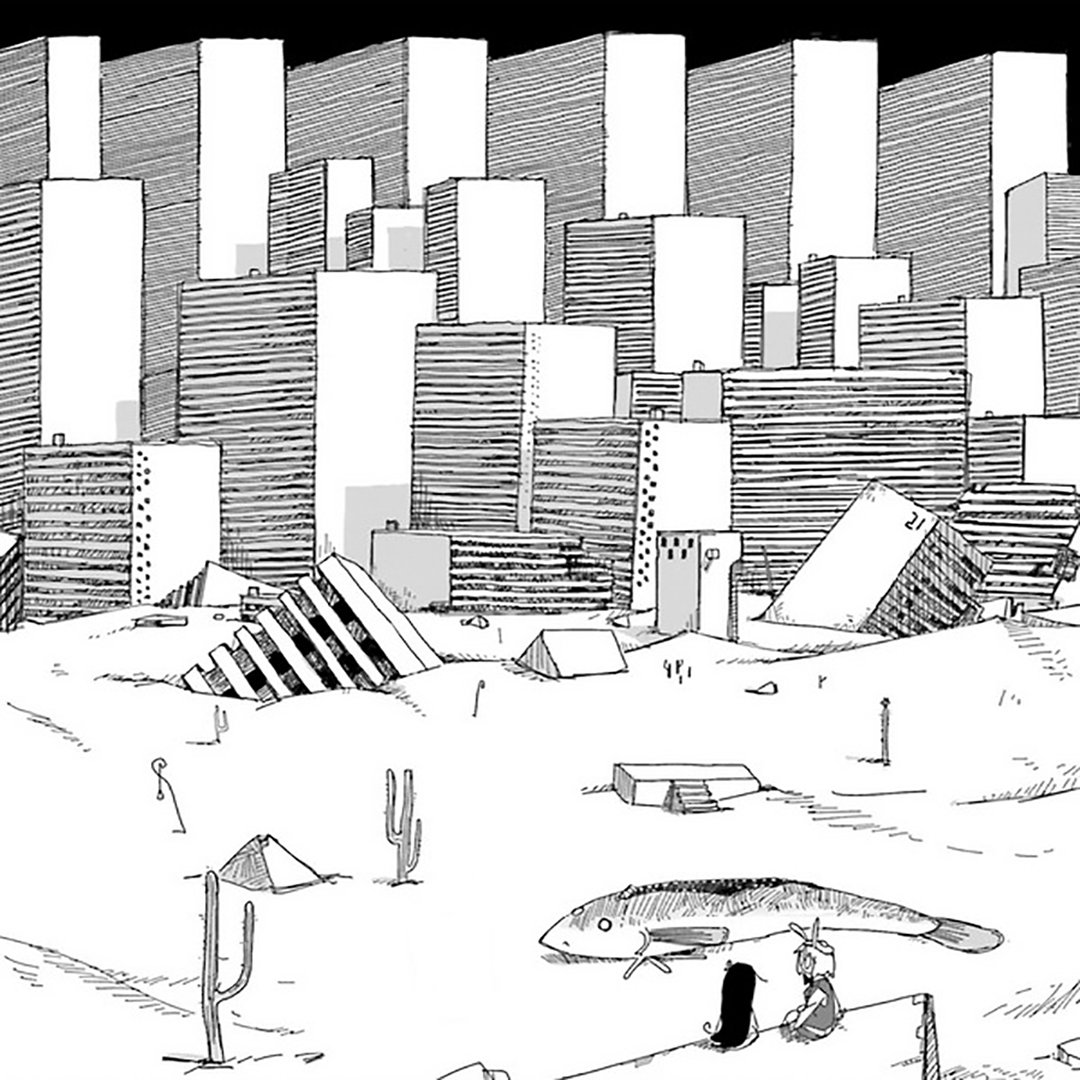
Along with the novel itself, I might therefore also recommend the three-volume manga adaptation drawn by Gonbe Shinkawa, which contains a number of fun architectural illustrations that convey the absurdity (and dead-mall liminality) of the station’s growth. The person who translated the novel, Stephen Paul, also translated the manga, and his notes at the end of each manga volume are extremely insightful.
As someone fascinated by the experience of navigating Japan’s monstrous urban train stations, I had a great time with Yokohama Station SF and its manga adaptation. Though the more technical details of Isukari’s writing may come off as opaque to readers who aren’t veterans of hard science fiction, the human stories at the center of the labyrinth make the journey worthwhile.





 Contemporary Japanese Literature