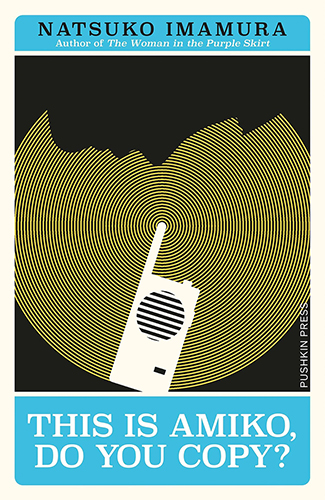
This Is Amiko, Do You Copy?

Natsuko Imamura’s novella This Is Amiko, Do You Copy? is about a neurodivergent preteen girl who’s neglected by her family and bullied at school. Though Amiko herself is quite charming, Imamura asks serious questions about the society that denies her support and understanding.

Amiko is ten years old and extremely friendly, but she has trouble fitting in. She speaks and behaves like someone much younger, and she often wanders away from class to read manga in the library. Her classmates avoid her when they can, but she’s oblivious to her alienation and remains cheerful and outgoing.

When her mother (who is actually her stepmother) has a miscarriage, Amiko does her best to comfort her, but her well-intentioned efforts are misinterpreted as malicious by both of her parents, who begin to neglect her. Without anyone to feed or bathe her, Amiko goes slightly feral, and she spends her early teenage years in almost total social isolation despite still attending school every day.

To protect Amiko from bullying, her older brother Kota toughens up, eventually joining a gang so that his reputation can shield his little sister. Kota loves Amiko and does his best to care for her, but he doesn’t have the emotional resources to deal with his clinically depressed stepmother or the lack of concern demonstrated by his workaholic father.

By the time she’s fifteen, Amiko still hasn’t matured, and she can barely read or write. She has trouble communicating and expressing herself, and she takes to singing made-up songs loudly and off-key whenever the mood strikes her. Torn between a child he can’t understand and a wife who never leaves the bed so that she’ll never have to see her stepdaughter, Amiko’s father sends her to live with her grandmother in the countryside.

The walkie talkies that Amiko’s parents give her as a gift at the beginning of the story are a chillingly direct analogy for her situation – she’s transmitting, but nobody’s responding. On a broader level, you can’t help but wonder why nobody ever reaches out to help Amiko or her parents.

This Is Amiko, Do You Copy? is narrated from a limited third-person perspective that shows the world as Amiko might see it, and Amiko is so happy and good-natured that it’s easy to skim through this short novella without really understanding the profound anger that Natsuko Imamura is expressing through the story. Amiko is a sweet and happy-go-lucky girl, but I could almost feel the author writing with clenched teeth. 

I’ve seen multiple reviews of this novella (and its 2022 cinematic adaptation Amiko) that shy away from identifying Amiko as being on the autism spectrum, maintaining instead that she transcends labels. I feel like a bit of critical thinking might be necessary here. Specifically, does not labeling Amiko as autistic help her (or her family) in any way? Because it sure seems like the lack of a formal diagnosis has resulted in nothing but neglect and abuse. On the other hand, would a greater awareness of neurodiversity, as made concrete through an imperfect but still useful label, perhaps help Amiko’s community understand and support her?

I enjoyed Imamura’s novel The Woman in the Purple Skirt, whose meaning also dwells in the seemingly empty spaces of what its alienated and unreliable narrator doesn’t say. Just as the label of “autistic” would presumably make life much easier for Amiko, I imagine that a formal diagnosis of “schizophrenia” would probably help the Purple Skirt narrator get the help she needs. Imamura’s project in these two stories is not to normalize neurodivergence, necessarily, but to demonstrate that neurodivergent people aren’t abnormal. It’s only when neurodivergent people are denied community support and resources that unfortunate things happen.

This isn’t to say that This Is Amiko is didactic or unpleasant. It’s actually quite lovely, and I hope it doesn’t make me sound like a bad person to say that I genuinely enjoyed this book. Still, Natsuko Imamura is staging a serious critique through what may initially seem like a light and breezy story, and it’s important not to ignore the subtext.   

Kudos to Hitomi Yoshio (and her seven-year-old daughter) for creating a fantastic translation of the distinctive narrative voice of this novella, and much love to Pushkin Press for bringing it to a wider audience. I’ve got my fingers crossed that Imamura’s 2017 novel Hoshi no ko (Child of the Stars), which is something of a sibling to This Is Amiko, finds a home in translation too.
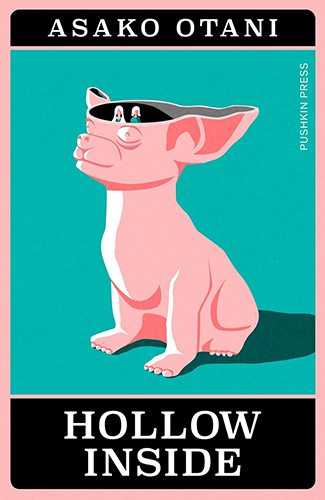
Hollow Inside

There’s an expression in Japanese that I really appreciate: shikata ga nai, which essentially means “what can you do.” Shikata ga nai is the verbal equivalent of a shrug of resignation. Sure, the situation may not be ideal, but shikata ga nai. What can you do.

Asako Otani’s 2023 novella Hollow Inside is about as close to a literary expression of shikata ga nai as you can get. Otani was born in 1990, which makes her a little younger than I am, but I feel like we’re part of the same Millennial generation that came of age right in time for the 2008 global economic recession and then got our feet kicked out from under us by the pandemic. This situation isn’t ideal, obviously. But what can you do.

Hirai, the narrator of Hollow Inside, has recently moved from a small and inconvenient flat into a nicer two-bedroom apartment. She’s able to afford a better place by splitting the rent with her friend Suganuma, who proposed the idea to Hirai because she was tired of her own tiny apartment. Both women are around 40, and neither has any real desire to get married.

Hirai works in the accounting office of a printing company, while Suganuma formerly worked for the consulting division of a company specializing in administration systems. The two women met through their jobs but became friends when they realized that they were both fans of the same idol group, KI Dash. Their social circles narrowed during the pandemic, but their friendship with each other survived.

After working more than twenty years in corporate jobs, neither has enough money to afford a decent apartment in the city. That’s not great, but what can you do. Suganuma confesses to being “desperately lonely” while working from home during the pandemic, and Hirai knows exactly what she means. The pandemic wasn’t great, but again – what can you do.

What they can do, it turns out, is to move in together. Perhaps this isn’t how either of them imagined that their lives would turn out, and perhaps this isn’t what society in general expected of them. Hirai confesses to feeling shy about explaining her situation to her colleagues at work, knowing that two women in their forties sharing a home together isn’t the usual situation. And indeed, when she gets a chance to explain her living arrangements at a work dinner with colleagues, everyone makes polite noises and before swiftly changing the topic of conversation.

Still, Hirai and Suganuma get along well together, and they support one another through the small tragedies of their lives, such the marriage of Suganuma’s favorite idol from KI Dash and Hirai’s disastrous date with a man who wants to induct her into a pyramid scheme. The two women eat out together, cook dinner for each other, take a spur-of-the-moment holiday to the beach, and fall asleep while watching DVDs of KI Dash concerts on an old PlayStation 2.

The title of Hollow Inside comes from Suganuma’s post-pandemic freelance job as a manufacturer of custom figurines memorializing the deceased pets of her clients. She’s set up a 3D printer in a corner of the living room, which also houses a wastebin of defective models. Hirai feels a kinship with these rejected memorial figurines, as she herself feels somewhat hollow during the transition between the life she assumed she’d live and the unmapped territory ahead.

This sense of hollowness isn’t necessarily a bad thing, however. As Hirai explains about a fantasy she occasionally indulges in when she’s stressed out after work… 

I let all the strength drain from my body. I gave myself over to gravity and sharpened all my awareness right up to my fingertips. I lay on the bed not moving an inch. Pretending to be dead. I sometimes did this.

I was dead. Nothing in the world had anything to do with me. I thought about the dead dogs. The dead dogs that had been doted on by their owners. They had left fake bodies in the world as figurines, and their souls were running in the other worlds wagging their tails. My soul joined them frolicking there.

…there’s a certain lightness that allows her to imagine herself as free and unburdened.

There are a range of different readings of Hollow Inside, of course. Some readers might find this novella depressing; but, to me, it’s a breath of fresh air.

In Japan and elsewhere, fewer women are getting married; and, as much as I enjoy the fantasy of romance, the reality of single life as an adult is no less interesting. Hollow Inside captures a moment in the transition of one woman’s life that happens to be representative of a major demographic shift. To me, this novella also serves as an eerily accurate reflection of the economic realities of the 21st century. We might not be able to enjoy the stability and middle-class lifestyles that our parents did, but what can you do. Shikata ga nai.

And you know what? It’s not so bad, actually.

Nails and Eyes

Kaori Fujino’s Nails and Eyes collects a novella and two short stories whose crystal-clear prose is darkened by the shadow of creeping psychological horror. The theme of family lies at the heart of these stories, especially as it intersects with the fear that those closest to us may deliberately choose not to see obvious but unpleasant truths.

In the third story, “Minute Fears,” a woman named Mika plans to attend the wedding reception of a college friend. Since she’s started a family, Mika has rarely gone out on her own, and she’s been looking forward to the party. Her son Daiki begs her not to go, as he’s been disturbed by an urban legend surrounding a ghost rumored to haunt the local playground. After a brief struggle with Daiki, who doesn’t want to be left alone, Mika goes to the reception late and leaves early. When she comes home, Daiki confesses his fear of the ghost, and Mika resolves to take him to the playground herself to prove that the urban legend isn’t true.

Whether the ghost exists is left to the reader’s imagination. Instead, the true horror lies in the image of Mika dragging her terrified son into the night. Or perhaps, if your sympathies lie elsewhere, the horror is hidden in the homebound years that Mika has had to endure in order to care for her child while her friends enjoy their lives and careers in the outside world. 

The second story, “What Shoko Forgets,” is equally ambiguous yet just as disturbing. After a mild stroke, Shoko has been living in an elder care facility for almost half a year. Her family visits regularly, and she receives ample attention from the staff. A polite and energetic young man named Kawabata is especially gentle, and he seems to have a special fondness of Shoko.

There’s something strange about Kawabata’s behavior after dark, however; and, for some reason, Shoko finds herself thinking about sex in a way she hasn’t for years. It’s possible that there might be a connection between Kawabata and the man Shoko imagines lying next to her at night, but both her eyesight and her memory have grown hazy. In any case, it’s no use trying to explain her muddled thoughts about the situation to her daughter or granddaughter, who so kindly come to visit a forgetful old woman.

The collection’s centerpiece novella, “Nails and Eyes,” is narrated from the perspective of a young girl who lost her mother to an unexplained incident. Her father brings home his younger lover, and the narrator addresses this woman directly through the story. She recounts the minute details of the woman’s life, from her affair with a bookstore owner to her obsession with the home décor blog once maintained by the narrator’s mother.

The narrator also describes her own behavior as a child who has clearly been traumatized by her mother’s suicide but largely ignored by the adults in her life. The narrator refuses to be anywhere near the balcony where her mother died, and she sits in the corners of the apartment gnawing at her nails, which become serrated and sharp. To her credit, the woman responsible for the child’s care makes a clean break with her lover and begins to take a more active interest in her charge’s welfare. This change of heart comes too late, however, and the story ends with an incredibly upsetting psychological break.

To be clear: if you have phobias related to eyes and/or fingernails, this book might not be for you. 

At 140 pages, Nails and Eyes is easy to breeze through, especially in Kendall Heitzman’s smooth and weightless translation. Still, Fujino’s fiction rewards time and attention, as well as repeated readings. There are layers to her deceptively simple prose, and any one of these stories has the potential to generate multiple lines of speculation. Nails and Eyes is a fascinating and disquieting collection that will be appreciated by readers who enjoy literary short horror fiction like Yoko Ogawa’s Revenge and Mariana Enriquez’s Things We Lost in the Fire.

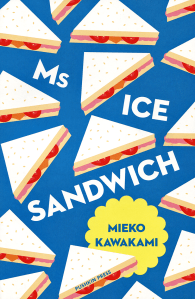
Ms Ice Sandwich

Title: Ms Ice Sandwich
Japanese Title: ミス・アイスサンドイッチ (Misu Aisu Sandoicchi)
Author: Mieko Kawakami (川上 未映子)
Translator: Louise Heal Kawai
Publication Year: 2013 (Japan); 2017 (United Kingdom)
Publisher: Pushkin Press
Pages: 92

Ms Ice Sandwich is a novella that gradually opens a door into the interior world of its protagonist, a boy living with his mother and grandmother in a commuter suburb. This boy is fascinated by a woman who sells sandwiches at the grocery store outside the train station, whom he calls “Ms Ice Sandwich” because of the ice-blue eyeshadow she always wears. Her makeup emphasizes her eyes, which she has had surgically altered to appear larger. The narrator, who is a strange little kid, becomes preoccupied with trying to capture Ms Ice Sandwich in art, obsessively drawing her facial features line by line and eyelash by eyelash.

The boy also gravitates toward Tutti, a girl in his class who was given this nickname (by the narrator himself, no less) after she once farted in class. Like the boy, Tutti is a bit strange, and she’s obsessed with gunfights. The boy learns that she lives alone with her father, who has filled their apartment with shelves of DVDs and makes time to sit down and watch a movie with her every week. Tutti’s love of gunfights stems from her interest in cinematic choreography, and the boy appreciates her ability to mimic calmness in the face of danger in the same way that he’s awed by the no-nonsense attitude of Ms Ice Sandwich in the face of customer rudeness.

Meanwhile, the boy’s mother is a weird one herself. Although the boy isn’t entirely sure what she does, she seems to be a self-employed spiritualist and fortune teller, and she’s recently had part of their house remodeled to resemble a caricature of a Western palace complete with a red carpet, foreign furniture, heavy curtains, and statues of angels. While the boy’s grandmother is bedridden in the back of the house, his mother spends an inordinate amount of time online, typing on her phone even when she’s out shopping. Like Tutti and Ms Ice Sandwich, however, the boy’s mother isn’t actually a bad person, and she loves her son in her own way.

The boy is perhaps ten or eleven years old, and Kawakami’s first-person narration skillfully captures his close attention to small and seemingly insignificant details, which are contrasted against a larger cluelessness concerning how the world works. The narrator doesn’t really know what’s going on with his mom, or his grandmother, or Tutti’s dad, or even Ms Ice Sandwich, but he nevertheless observes them with care and compassion. He is content to observe the movements of the people in his life until Tutti startles him out of his passivity, saying,

“When you say see you tomorrow to someone, it’s because you’re going to keep seeing them. It’s like at school you see everybody because they go to school every day. But when you graduate and you don’t go to school anymore, it stops and you don’t see everybody any more. If you want to see somebody, you have to make plans to meet, or even make plans to make plans, and next thing you end up not seeing them any more. That’s what’s going to happen. If you don’t see somebody, you end up never seeing them. And then there’s going to be nothing left of them at all.” (75)

Ms Ice Sandwich has no real plot or denouement, but Tutti’s words spark a small but significant shift in the narrator’s worldview that allows him to more fully appreciate the fact that his mother, his grandmother, and Ms Ice Sandwich all have lives that exist independently of his presence. Judging from the cover copy it might seem as if this is a novella about a boy’s sexual awakening, but the story actually hinges on a far more subtle emotional revelation. Thankfully, the narrator’s perspective is so singular and well-crafted that Ms Ice Sandwich‘s message about the ephemerality of human connection is never in any danger of becoming trite and sentimental.

According to the colophon, “This piece was published in the literary journal Shincho first in 2013, and in 2014 it was included in the novel Akogare, which is a combination of two stories: ‘Miss Ice Sandwich’ and ‘Strawberry Jam Minus Strawberry.'” At roughly ninety pages, Ms Ice Sandwich is short enough to read in one sitting, but it’s still substantial enough to feel like a self-contained world. I thoroughly enjoyed this story, and I’m impressed by the fantastic work that Pushkin Press has put into its ongoing series of translations of quirky Japanese novellas.

Record of a Night Too Brief

Title: Record of a Night Too Brief
Japanese Title: 蛇を踏む (Hebi o fumu)
Author: Kawakami Hiromi (川上 弘美)
Translator: Lucy North
Publication Year: 2017 (United Kingdom); 1996 (Japan)
Press: Pushkin Press
Pages: 158

Record of a Night Too Brief collects three short stories that the book’s cover copy describes as “haunting” and “lyrical” in their depiction of young women experiencing “loss, loneliness and extraordinary romance.” This is a lovely sentiment, but it in no way describes the actual stories in question, which are less “haunting” than they are grotesque and less “lyrical” than they are unapologetically strange. Instead of trying to treat them as romance, I believe it’s much more fulfilling to approach their absurdity in the spirit of intellectual play.

The title story, “Record of a Night Too Brief,” is a sequence of nineteen of the unnamed narrator’s dreams. Each of these dreams is two or three pages long, and they are linked only in that every other scenario features a young woman whom the narrator is either pursuing or in the process of merging with. If there is a unifying theme or plot, it is lost on me, but the power of these dreams comes from their vivid imagery. To give an example (from page 11):

Several dozen ticket collectors stood in a row, and once we passed through, showing our tickets, the tall object came into view.

It was a singer, who stood as tall as a three-storey building. From where I was, I had a clear view of the beauty spot under her jaw, and the rise and fall of her breasts.

“The beauty spot is artificial,” the girl informed me, gazing up at the singer, enraptured.

The singer was producing notes at different pitches, as if she were warming up. When she sang high notes, flocks of birds took flight from the branches of the ginko trees. When she sang low notes, the earth heaved, and small furry creatures emerged from underground and crawled about.

…and so on. It’s all very random, but one can’t help but become swept up in the ebb and flow of the constantly shifting parade of surreal images.

The next story, “Missing,” is set in an apartment complex that functions according to its own arbitrary and bizarre set of customs and rituals. One of the rules of this community is that each household can only have five members. If a sixth member is added for any reason, then someone has to disappear. This recently happened to the narrator’s family after her older brother was engaged to be married. Because his fiancée would have become the sixth person, he disappeared, and the narrator’s other older brother stepped in to fill his position. His fiancée, Hiroko, has no idea that this has happened, as the rules are different in her own apartment complex, where certain members of certain families literally shrink. Meanwhile, the narrator continues to hear the voice of the older brother as he (or his spirit) skulks around the apartment. No explanation is given for any of this, as everyone takes these occurrences for granted.

The final story, which provides the title of the original Japanese publication, is “A Snake Stepped On.” This story is about a young woman who one day finds herself living with a snake. This snake takes the form of an older woman who insists that she is the narrator’s mother. As she accustoms herself to life with a snake, the narrator begins to realize that many of the people around her are also living with snakes, including the local Buddhist priest whom she thought of turning to for an exorcism. Following the conventions of magical realism, the tone of this story is mundane, with the possibility of being devoured by a snake – or becoming a snake oneself – treated as merely another everyday occurrence.

Record of a Night Too Brief is a short collection of curiosities that are fascinating in their novelty. The fantastical qualities of each story allow for various interpretations, and they will no doubt intrigue different readers for different reasons. As contemporary fairy tales, the stories in this collection spark and inspire the imagination.