From Five to Nine

From Five to Nine 1

Title: From Five to Nine
Japanese Title: 5時から9時まで (Goji kara kuji made)
Author: Aihara Miki (相原 実貴)
Publication Year: 2010 (ongoing)
Publisher: Shōgakukan
Pages (per volume): 190

From Five to Nine is the current project of Aihara Miki, whose manga Hot Gimmick and Honey Hunt have been published in English translation by Viz Media. Like Aihara’s earlier titles, From Five to Nine is a drama-filled exposé of the love lives of gorgeous young people going about their business in the trendy districts on the southwest side of Tokyo. From Five to Nine is serialized in Monthly Cheese!, an unfortunately named magazine that serves as a bridge between a shōjo readership of tweens captivated by stories of pure love and a josei readership of young women interested in the more physical aspects of romantic relationships. In accordance with the magazine’s house style, all of the characters in the manga are well dressed and ridiculously attractive, emotional and sexual tensions always run high, and chapters end on cliffhangers more often than not. In other words, From Five to Nine is highly entertaining, addictive reading. It’s designed to be.

What I think is interesting about this manga is the way it explores the conflicts between different gender roles and expectations of femininity through the love affairs of its main protagonist.

Sakuraba Junko, the leading lady, teaches during the evenings at an English language conversation school (Eikaiwa gakkō). Because of her friendly professionalism and almost native fluency, she’s considered to be one of the top instructors at her workplace, and her dream is to save up enough money to study abroad in America. Since Junko has passed through her early twenties without having settled down with a man, her grandmother has started to set her up on dates with potential marriage partners through a somewhat formalized process known as miai. To appease her grandmother, Junko spends her twenty-seventh birthday out on a miai date with a Buddhist monk named Hoshikawa Takane, who graduated from Tokyo University with a major in Indian philosophy. Junko is put off by what she sees as Hoshikawa’s snobbishness; but, thinking that their date is a one-time thing and that she’ll never see him again, Junko ends up sleeping with him on a lark. For Hoshikawa, however, that one night is the beginning of TRUE LOVE FOREVER.

Because this is a manga by Aihara Miki, Junko is fated to be the unfortunate object of nonconsensual manly persuasion concerning a relationship that she doesn’t particularly care for. Immediately after Junko gets back from her one night stand with Hoshikawa, she realizes that the deadline to move out of her apartment, whose building is slated for renewal, is fast approaching. When she goes to her grandmother for help, her grandmother suggests that she take temporary residence (geshuku) in a temple with connections to the family. Unfortunately, this temple is headed by Hoshikawa, who now wants to make Junko his temple wife (tera no yome). Being a temple wife is a full-time job, and a marriage to Hoshikawa would require Junko to give up her position at the English conversation school where she currently works, as well as her dream to study abroad. Essentially, if she were to marry Hoshikawa, Junko would have to give up the pleasures of her existence as an independent urbanite and spend her days cooking, cleaning, dressing herself in traditional clothing, setting out flower arrangements, and entertaining guests. Needless to say, she wants none of this. Hoshikawa won’t give up on her so easily, however, and he takes to stalking her, abducting her, and harassing her at both at home and at her workplace. One particularly unpleasant stunt Hoshikawa pulls is to lock Junko up in a small guesthouse separated from the main temple compound by an ornamental garden. In order to escape, Junko agrees to marry Hoshikawa; and, to keep him fooled regarding her true intentions, she makes a show of waking up early to devote herself to cleaning, all the while scheming of ways to get away from the temple.

Meanwhile, her college friend Mishima Satoshi, who has been assigned to his company’s branch office in America, shows up at Junko’s school in order to brush up on his English. Mishima has feelings for Junko and harbors a secret desire to take her to America with him; but, as Junko becomes more aware of Mishima’s intentions and her own reciprocal feelings for him, she surprises herself by becoming conflicted over leaving Hoshikawa and the life he’s offering her. Junko has also attracted the interest of one of her younger pupils, a wealthy student at an elite high school who cross dresses so effectively that only a small handful of his friends know that he’s actually male. This student, Satonaka Yuki, dislikes both Hoshikawa and Mishima and wants Junko to be able to stand on her own two feet outside of relationships with creepy stalker monks and alcoholic playboy salarymen.

This is high melodrama, of course, but what is interesting about Junko’s love life is how aptly it represents the push and pull between traditional and contemporary women’s roles. Should Junko give into social and sexual pressure and relinquish her independence and her dreams, or should she take advantage of a potential romantic partner’s kindness in order to break free of the constraints of living in Japan? Is it possible for her to somehow fend for herself without a social and economic safety net? Because of the romantic drama, the reader is able to experience the emotional attraction and anxiety of all of these possibilities. For example, when Hoshikawa does something ridiculous in order to (sometimes literally) lock Junko into a traditional gender role, the denial of agency that Junko suffers is viscerally upsetting to the reader. As it gradually becomes clear that Hoshikawa genuinely cares for Junko, however, it also becomes clear that Junko’s spirited resistance might be able change the way he sees the responsibilities and aspirations of the women of his generation. In this way, Hoshikawa serves as a representative of a society that is still primarily dominated by phallocentric interests. He’s scary, and his behavior is obviously psychologically unhealthy, but he can be persuaded to change by a woman smart enough and tough enough to take him on, even if she’s coming from a position of relative disadvantage. The sort of “he can change” mentality Junko comes to embrace is presented as being just as dangerous in the fictional world of the manga as it is in real life, but the alternative – “he will never change” – would be a bleak prognosis on the sort of patriarchal mentality Hoshikawa represents. The possibility that Hoshikawa can change himself as he learns that women are people too (gasp!) is an element of social optimism that serves as an emollient to the seemingly misogynistic sexual drama of the manga.

Two other female employees at Junko’s workplace, Yamabuchi Momoe and Mōri Masako, act as counterpoints to Junko’s situation by providing different attitudes towards employment, love, and marriage.

Along with Junko, Momoe is one of the most professional and sought after instructors at the conversation school, but she has a reputation for being standoffish and emotionally chilly. Although she’s all business in the office, she secretly loves yaoi manga. When Arthur Lange, a blond-haired foreign instructor from Britain, discovers Momoe’s hidden interests, he uses the threat of revealing her identity as a fujoshi to her boss to blackmail her into a relationship. Although Momoe enjoys fantasies of attractive, foreign-looking men being sexually aggressive and emotionally manipulative, the enactment of her fantasy is much more unpleasant in real life than it is in the pages of yaoi manga. Momoe is older than Arthur, but she has never had any romantic experience, and she constantly second-guesses her reactions to his teasing and bullying. She therefore often finds herself in the position of wondering how a woman her age should behave towards men, even though she wants nothing to do with them.

Masako, a receptionist at the English conversation school where Junko and Momoe teach, is a recent college graduate who, more than anything, wants to settle down with a boyfriend and become a housewife. Her coworkers tease her by calling her “Zexy,” a nickname taken from the title of a wedding and bridal magazine. Since Masako is attractive and intelligent, her standards for a partner are high, and she can’t find anyone her own age who meets them. Unfortunately, having cultivated an attitude of flirtatious approachability, she finds herself the constant target of unwanted male attention, especially in the form of sexual harassment from middle-aged men.

Junko’s English conversation school is thus a microcosm of Japanese society staffed by different women with different expectations, goals, and challenges concerning their futures. Although the manga focuses on its three main female characters, the male characters are also allowed enough interiority for the reader to see them working, talking to each other, and thinking about their own dreams and romantic problems. All of these characters work at cross purposes because of the artificial drama created by the manga artist, but their attitudes and emotional conflicts ring true to real social expectations and gender roles.

From Five to Nine is a fascinating exploration of contemporary Japan with enough intersecting plot lines, character development, and thematic subtlety to keep even the most demanding readers engaged. The obi bands around the manga covers tout the series as “a Tokyo version of Sex and the City,” and that should be recommendation enough for anyone seeking a fast-paced, hormone-fueled examination of gender roles in the twenty-first century.

From Five to Nine 2

Dreamland Japan

Title: Dreamland Japan: Writings on Modern Manga
Author: Frederik L. Schodt
Publication Year: 1996
Publisher: Stone Bridge Press
Pages: 360

In his write-up of this summer’s Otakon convention, Ed Sizemore briefly mentions a panel held by the Anime and Manga Research Circle, in which Frederik L. Schodt’s classic work on manga was discussed. “I was glad to see Fred Schodt’s Manga, Manga! The World of Japanese Comics mentioned,” Sizemore says. “For a while, it seemed like there was a concerted effort in academia to pretend Schodt’s book didn’t exist even though it’s foundational to the study of manga in America.”

I’ve never been able to get my hands on Manga! Manga!, but I love its updated successor, Dreamland Japan. In fact, I love it so much that I read it for the third time earlier this summer. I think Sizemore’s statement about the “concerted effort in academia to pretend Schodt’s book didn’t exist” perhaps betrays a difference in understanding concerning the academic value of Schodt’s work, and so I would like to offer my own assessment of Dreamland Japan.

Even though Dreamland Japan is full of interesting and useful information, it’s not an academic study. The book reads like journalism; and in fact, as Schodt explains in his introduction, he has drawn much of the material published in this volume from material published earlier in newspapers and magazines. As journalism, the writing in Dreamland Japan is marked by certain features that do not often appear in academic writing, such as personal anecdotes. For example, information about how Schodt once witnessed a certain manga artist enter a porn shop in San Francisco may add color to his description of the artist, but it doesn’t really serve as evidence to support Schodt’s argument that the work of the often overlooked artist contains substantial artistic merit. Some of Schodt’s statements also come off as contradictory over the course of the book, such as when he mentions towards the beginning of the book that most manga artists employ a studio system, yet argues later that a certain artist is unique because she employs a studio system.

Dreamland Japan is written in a very personal style, and the reader ends up learning all sorts of information about the author over the course of the book. Some of this information is completely random. For example, in his blurb about Okano Reiko’s manga Fancy Dance, Schodt reveals that one of his friends from high school has lived in a Zen monastery for almost twenty years. Um, okay. Some of this information is unintentionally hilarious. For example, in his chapter on Osamu Tezuka, Schodt brags that he is one of the only people to have seen Tezuka without his trademark beret – before mentioning a page or two later that Tezuka only takes off his beret in bed. Wow, okay. Some of this information is perhaps a little too much information, such as Schodt’s description of his physical reaction to all of the pretty ladies surrounding him at a major dōjinshi convention at the beginning of his second chapter, or how he feels like he knows the manga artist Uchida Shungicu intimately even though he has never met her. Uhh… okay.

To return to the point, Schodt’s writing is not academic. He’ll describe a certain artist as incredibly influential without giving any examples of who or what the artist influenced, he’ll refer to a certain art style as uniquely Japanese without explaining what such a thing might mean, and he takes the things people say in interviews as absolute fact without any further corroboration. He engages in hero worship. He does not consider alternate arguments or non-obvious interpretations of certain works. He’ll summarize complicated issues or topics in one sentence. There aren’t footnotes or references explaining where he got his data. None of this makes Schodt’s work any less interesting or informative, but it’s not “academic.”

This is not a bad thing, and it doesn’t mean that Schodt’s work isn’t worthwhile reading both for manga fans and for people with a more than casual interest in Japanese popular culture. Not only is Dreamland Japan an invaluable resource, but it’s also an absolute pleasure to read.

The book has an interesting layout. Five short chapters sandwich the bulk of the volume’s two longest chapters, a 54-page catalog of manga periodicals and a 96-page catalog manga artists.

The shorter chapters, which gather together bite-size essays on subjects such as “Modern Manga at the End of the Millennium” and “Manga in the English-Speaking World,” serve as informative editorials and snapshots of manga fandom as it existed in the early nineties. In his opening and closing chapters, Schodt covers topics such as censorship and self-regulation in the manga industry, the amateur comics scene in Japan, how manga can be used as propaganda, the panel layout and cinematism of manga, and the first generation of anime and manga fan conventions in the United States. Reading these shorter chapters is like listening to someone who is deeply knowledgeable give an informal lecture on a topic very near to his heart. Not only is Schodt remarkably well read and well informed about the manga industry and fandom on both sides of the Pacific at the time he was writing, but his opinions have also aged well. Schodt’s tone is urbane and polished; and, as I mentioned earlier, his essays are given flavor and texture by his personal anecdotes, many of which are quite fascinating. You have to respect a man who sought out the official store of Aum Shinrikyō after the Sarin gas attack on the Tokyo subway in order to investigate the manga the organization was creating to educate potential members, after all.

The essays contained in Schodt’s shorter chapters are fun and informative, and they don’t feel dated in the slightest. What about the two longer chapters, then?

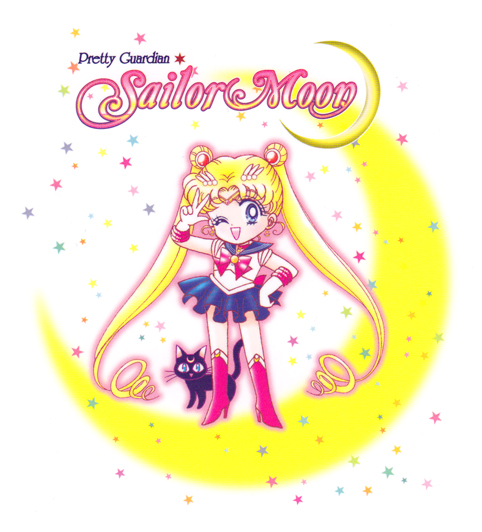
As Schodt states in his introduction, “fans of manga should not expect to see many of their favorite works here. There are no extended commentaries on Ranma 1/2, Akira, or Pretty Soldier Sailor Moon.” Indeed, most of the manga creators Schodt profiles in his “Artists and Their Work” chapter would probably be unknown to Japanese manga fans. These artists create what might be called “independent comics” or “small press comics” in the West, and they are just as fascinating as they are obscure. There is at least one high definition example of each artist’s work accompanying his or her profile, with translations provided by Schodt. Even if it’s nigh impossible to get one’s hands on the work of these specific artists outside of Japan, Schodt’s discussions of them deal with broader topics, such as the more specialized genres of manga in Japan (like manga about Japanese law and business strategy).

The “Manga Magazine Scene” chapter, which provides information about ten specific manga periodicals and two subgenres of manga periodicals, was probably the most interesting to me, as Schodt’s treatment of each topic functions as a small case study of how the manga industry finds and grooms talent, targets a specific demographic, and then sends its content out into the world in the form of different types of media. Many of the manga magazines Schodt covers, such as Weekly Shōnen Jump, Nakayoshi, and Morning, are still industry leaders; so, even if the circulation data given for each publication is no longer current, the demographic and historical information is still pertinent to someone interested in contemporary manga.

In conclusion, while Dreamland Japan feels a bit dated and obscure at times, and while it’s not exactly a scholarly study, it’s a useful resource to anyone interested in manga in any capacity, and it doubles as entertaining reading material for anyone interested in popular culture in general.

An Otaku Tour of Kansai

If you’re an otaku, Tokyo is the best place to be. No other city on the face of the earth can hold a candle to Tokyo in terms of vibrant subcultures and amazing subcultural experiences that are completely open to anyone who stumbles upon them.

Kansai is awesome in its own right, however, and the region is well worth visiting, even if you’re not interested in rich cultural traditions, gorgeous architecture, and delicious food. There are plenty of things for an otaku to do in Kyoto, Osaka, and Takarazuka.

If you’re headed to Kansai, do yourself a favor and get an Icoca card from the JR automated ticket machines as soon as you exit the Shinkansen into the station. The Icoca is the Kansai equivalent of Kantō’s Suica card. Like the Suica, you pay need to pay 2000 yen for an Icoca. 500 of that yen is a deposit that will be returned to you if you turn in the card at a station office, and the rest can be used to go anywhere, anytime, on any vehicle. You can put more money on your Icoca at any station, and your remaining balance will be returned to you along with your deposit when you return the card. If you already have a Suica, you can use it for all JR rail lines in Kansai, but it doesn’t work anywhere else. Since the best way to get around Kyoto is by bus or taxi, and since the best way to get around Osaka is by subway, it’s definitely worth getting yourself an Icoca.

Kyoto

Besides being filled with temples and famous historic sites and traditional Japanese arts and so on, Kyoto is a tech hub and a college town populated by students, artists, and young professionals. The infinite alleyways snaking behind the main boulevards are lousy with ultra-modern restaurants, tiny theme bars, hostess clubs, host clubs, crazily decorated clothing boutiques, and art spaces the size of a hotel room. Alcohol of all types is cheap, plentiful, and delicious, and strange and fascinating things happen on the streets and along the Kamo River after dark, especially on the weekends. Kyoto is a great city to get lost in.

The top Kyoto attraction for otaku is the Kyoto International Manga Museum. This place is amazing. As an added bonus, it’s also bilingual and Anglophone-friendly. The permanent exhibit is a hyper-illustrated walkthrough of the history and development of manga, the tools and artistic techniques used to create manga, the publishing culture of manga, the genres of manga, and the internationalization of manga. The museum also hosts special exhibits showcasing the work of specific manga artists and illustrators, many of whom are local to Kyoto.

All along the walls of the museum are bookcases on which are shelved the most massive collection of manga I’ve ever seen (and I have seen some massive collections, such as the one housed in the Yoshihiro Yonezawa Memorial Library). Most of this manga is Japanese, but a sizable portion is foreign, including all sorts of North American and European translations and originals. The best part about this library is that you can take anything down from the shelves and read it for as long as you want. The museum also has a smaller library of academic materials dedicated to manga. Again, most of these materials are in Japanese, but there’s also a ton of stuff in English and other European languages. Was there some obscure manga exhibition in Germany? They have the catalog. Was there an issue of The Comics Journal from ten years ago that mentioned shōjo manga? They have that issue. The museum also publishes a few high quality pamphlets and periodicals that you’re free to take as you please (my favorite is a small magazine highlighting the areas of Kyoto featured in recent anime and manga).

To get to the museum, take the subway to the Karasuma-Oike Station, which is served by the Karasuma and the Tōzai lines. Take Exit 2 out of the station, turn to your right at the top of the staircase, and walk for a minute or two until you see the museum on your left. The museum is a converted primary school building, and you’ll know it when you see it. The pennants hanging from the telephone poles along the street in front of it help. Because the museum is awesome, they’ve posted an illustrated map explaining how to get there.

There are also a small handful of otaku specialty stores clustered along Teramachi between Sanjō and Shijō (these are all the names of streets/walkways). If you’d like to get to this area from the Manga Museum, go back to the intersection where you came out of the subway, cross the street, and turn left on Oike to go towards the Kamo River. Walk for about ten blocks (which actually isn’t that far) and enter the Teramachi covered shopping arcade on your right. To get to this area from anywhere else, start at the Sanjō-Keihan Station and cross over the Kamo River on the Sanjō bridge. Keep heading west on Sanjō for about two blocks until the street dead-ends into a covered pedestrian shopping arcade called “Sanjo Cupola.” Keep going straight through the Sanjo Cupola until you emerge into the open air (there will be a giant mechanical crab ahead on your right), and immediately turn left into the Teramachi covered shopping arcade.

After walking for awhile, you’ll see a Melon Books above a drugstore to your right. Melon Books sells hardcore pornographic manga and doujinshi for men, so enter at your own risk. Further ahead on your right you’ll see a bookstore called Manga・Can (漫画館), which is a great place to browse and discover new manga titles. A bit further ahead on your right is the Kyoto branch of Gamers, which has games (mainly of the erotic variety) on the fourth floor and manga and doujinshi on the fifth floor. Most of the merchandise stocked by Gamers is targeted at men, but the store isn’t as hardcore as Melon Books and caries many things of interest to female otaku as well.

Running parallel to Teramachi to the east (one street over to your left if you’re walking towards Shijō) is another shopping arcade called Shinkyogoku. Right before you emerge onto Shijō while walking along Shinkyogoku, there will be an Animate to your right on the second-floor level above a small open plaza. Like all Animate branches, the Kyoto store is distinctive. It has a large and well-stocked manga section that showcases work by local artists, work that has won regional manga prizes, and work appealing to yuri sensibilities.

If cross Shijō on Teramachi, you’ll find yourself on a small, uncovered street. Several dozen feet past Shijō, there will be a five-story Tora no Ana on your left and a five-story bookstore called Shinchō Shoten (信長書店) on your right. Both stores are custom-made for otaku.

Right next to Shinchō Shoten, in a tiny alley about twelve feet past the bookstore and leading off the right, is one of the best-kept secrets of Kyoto: a tiny vegetarian restaurant and sake bar called Mikōan (彌光庵). The food is cheap and delicious and varied enough that no two people will get the same meal even if they order the same thing. The décor and atmosphere are like something out of an urban fantasy novel. There are also several adorable, fluffy cats wandering around the restaurant at any given time, and they don’t mind being friendly if you engage them. Mikōan is all about how awesome Kyoto can be if you wander off the beaten path.

Osaka

Osaka never gets enough credit. Sure, it’s not as rich or as populous as Tokyo, but it’s still a huge city filled with interesting places to go. The urban landscape of Osaka resembles that of Tokyo, but it’s different in all sorts of neat ways. You really will hear people speak Osaka dialect here, which is lots of fun if you’re learning Japanese.

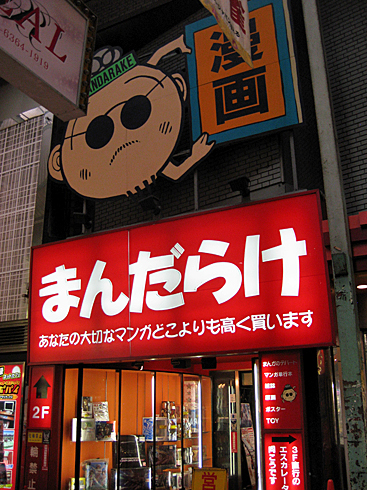
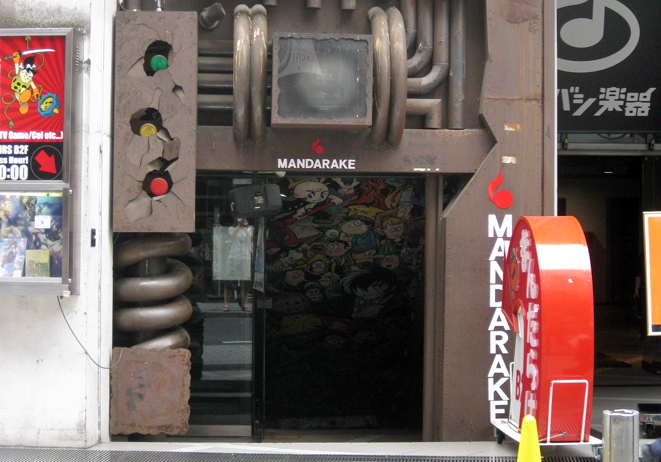
Nanba is the Osaka equivalent of Akihabara. This neighborhood runs alongside a broad avenue called Yotsuhashi-suji or, more appropriately, in the smaller streets and alleys branching off from either side of Yotsuhashi-suji. Nanba Station is an epic mess of stores and restaurants and hotels, and there are many ways to navigate your way outside, but the area you want to be in is on the northeast side of the station. Depending on what train line you’re coming from, it might be easiest to walk through the Takashimaya department store and exit the building from the main entrance. In any case, a small street called Nansan-dōri snakes along the west side of the station. Follow it until you see a Taito Station, and turn left past the arcade. If you keep walking west along the small road (which is still called Nansan-dōri even after if veers away from the station), you’ll begin to see otaku-related stores on your right. The area between Nanba Station, Nansan-dōri, and Yotsuhashi-suji is where all of the electronics stores, maid cafés, used video game stores, and specialty book stores are. You will find a Melon Books and a Yellow Submarine along these backstreets, but, if you want to go to the K-Books and Animate, follow Nansan-dōri until the big intersection and turn right on Yotsuhashi-suji. The K-Books and Animate will be down the street to your right, and the Mandarake will be across the street on your left.

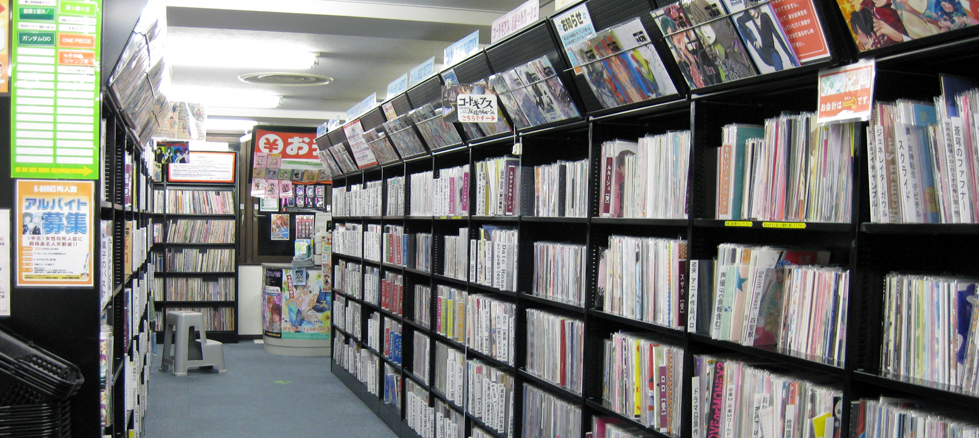
If you’re looking for doujinshi, it’s definitely worth your while to visit the K-Books here, which stocks tons of work produced by Kansai artists. Doujinshi for large fandoms are more or less equally distributed across Kantō and Kansai, but work for small fandoms from small regional conventions doesn’t always make it to Tokyo. There are also a number of original doujinshi at the Nanba K-Books that don’t fall into pre-established genres and resemble nothing so much as they do North American indie comics.

For an otaku, I think the major attraction of Osaka is the Umeda Mandarake. According to fanlore, this is *the* Mandarake, the Mandarake to end all Mandarakes, and the One True Mandarake. The Umeda Mandarake is a sprawling three-story building stuffed to the gills with crap, garbage, and treasure. The building itself looks (and smells) like it should be condemned, and the soft, creaky floor literally sags under the weight of all the junk in the store. Otaku relics are lovingly displayed in glass showcases, while the dim overhead lighting flickers and throws shadows around the piles of unopened cardboard boxes stacked in the corners. The clerks cosplay, and there is a small stage for performances on the second floor that also serves as a dais for life-size renditions of pop culture icons. This place must really been seen to be believed.

Also, if you’re looking for original doujinshi drawn by artists like Yuki Kaori and CLAMP, this is the place to go. In addition, on the staircase landing between the second and third stories, there is a table with a few stacks of “Mandarake Note” notebooks in which visitors to the store can draw and scribble away to their hearts’ content with the art tools provided. If you take the time to flip through some of the old notebooks, you might be lucky enough to catch a glimpse of some really familiar names and art styles. If you’re an a creative mood, you can take over your own notebook page.

Fittingly for a quest of such magnitude, it’s a pain in the ass to get to the store. The easiest method is to take one of the south exists out of the JR Osaka Station (or the Hankyū Umeda Station across the street), get in a taxi, and pay the driver ¥660 to take you to the Osaka Tokyu Inn hotel. If you’re facing the Tokyu Inn, you’ll notice a Small Alley of Ultimate Sketchiness running alongside the right side of the hotel building. Turn left into the alleyway and keep walking until you emerge into a shopping arcade with the Mandarake right in front of you.

If you want to be adventurous, you can go on foot. Take the Mitōsuji South Exit from JR Osaka Station (which can be accessed from JR rail lines and the subway lines) and cross the street under the huge pedestrian bridge. Alternately, take the South Central Exit from JR Osaka Station and climb the stairs to get on top of the huge pedestrian bridge. Either way, you’re heading for the Umeda Hankyū Building. What you’re going to want to do, either by going around, going under, or going through, is to get to the other side of this building. At street level on the other side of the building you’ll see an intersection with a concrete island in the middle of it, and, on the far side of the intersection, a covered shopping arcade called “E Street.” This shopping arcade goes on for a few blocks and in the middle crosses over an open street and changes its name to Hankyū Tōtsū Shōtengai (阪急東通商店街). The Mandarake is on towards the end of the shopping arcade on the left. The shopping arcade itself is tacky and raucous, and any of the restaurants lining the passage can provide you with a ticket out of Sober City on the Cheap Alcohol Express, if you’re interested in that sort of cultural experience.

While you’re in the area, the Osaka Pokémon Center is on the thirteenth floor of the Daimaru department store above the South Central Exit of JR Osaka Station. The store has all sorts of special goods connected to Osaka and the Johto region that you can’t get anywhere else, as well as special Spot Pass promotions for fans who bring their Nintendo DS with them.

Takarazuka

Takarazuka is a mid-sized suburb located about a twenty minute train ride away from Osaka (and a forty-five minute ride from Kyoto, with one transfer in the middle). Not only is the area around the station interesting (it’s like an exaggerated fantasy version of the Europe described by Marcel Proust), but the city is also home to two major otaku-related attractions.

These two attractions are the Takarazuka Grand Theater building and the Osamu Tezuka Memorial Museum. Finding your way around is half the fun of an excursion to Takarazuka, so I won’t give directions. Let it suffice to say that you’re looking for the Hana no Michi (花のみち). This is an actual street divided by a raised walking path lined with flowers. It’s just as romantic as it sounds, and the Takarazuka Revue themed bronze statues along the path add to its charm.

The Takarazuka Grand Theater is the home base of the Takarazuka Revue, which is fabulousness incarnate. Even if you can’t catch a performance (if you do want to see a performance, you’ll want to book your seat well in advance), it’s fun to wander around the massive theater complex just to drink in the atmosphere. If you’re lucky, you’ll get to see a fan club; and, if you’re even luckier, you might get to spot a performer. The Quatre Rêves gift shop, which is easily accessible from the Hana no Michi, stocks all sorts of CDs and DVDs, as well as tons of glossy print material. Of special interest are “bromides,” which are laminated photos of Takarazuka actresses dressed in the costumes of their famous roles. If you’re not interested in spending money on pictures of glamorous ladies, you can get all sorts of material for free in the form of pamphlets, leaflets, and promotional fliers. There are also television screens set up around the theater complex where you can chill out and enjoy videotaped awesomeness at your leisure.

At the end of the Hana no Michi and down the street a bit is the Osamu Tezuka Memorial Museum, which is marked by a giant sculpture of Tezuka’s Phoenix just outside the main entrance. The museum hosts rotating exhibitions in a spacious and well-designed gallery space, but the permanent exhibition of Tezuka memorabilia is also interesting. Not only does the museum display the usual array of photographs and animation stills, but it also showcases the notebooks that Tezuka kept as a young adult. Even if you’re not a Tezuka fan, it’s difficult not to be awed by the range and scope of the artist’s imagination as represented in these notebooks. The museum has a handful of interactive installations, but my favorite is the Animation Studio (アニメ工房) on the basement floor, where anyone can sit at a computer station, draw pictures with the tablet and stylus provided, and then animate them. There’s also an open library with editions of Tezuka manga from around the world, as well as ample space to sit down, relax, and read. You’ll see visitors dressed in Tezuka cosplay (with floopy berets and seventies glasses), and the entire building is covered with images, murals, etchings, and sculptures. Visiting the museum is a unique experience and well worth the trip out to Takarazuka.

In conclusion, Kansai is a great area to visit, and not just for temples and historical sites. Kyoto and Osaka and Takarazuka can be just as edgy, quirky, and fun as Tokyo, and there’s no reason for a short-term or a long-term visitor with otaku inclinations not to make the trip down to Kansai.

Hatarake Kentauros

Title: はたらけ、ケンタウロス!(Hatarake, kentaurosu!)
Artist: est em (えすとえむ)
Year Published: 2011
Publisher: Libre Shuppan
Pages: 160

Hatarake Kentauros is a one-shot manga by the BL author est em that contains eight stories and a kaki-oroshi (a short afterward section created especially for the tankōbon publication). The subjects of these stories are centaurs trying to make a living in contemporary Japan. The first four stories are about a salaryman centaur named Kentarō, the challenges he faces at work and while commuting, and his relationship with his human co-worker. The fifth story is about a centaur who wants to apprentice at a soba shop but can’t fit into the kitchen and is assigned delivery work instead. The sixth story is about a centaur craftsman who makes shoes even though he can never wear them, and the seventh story is about a centaur model who becomes depressed because his lower half is always replaced with human legs in Photoshop. The eighth story is about a young centaur graduate who is nervous about moving to Tokyo and beginning work at his first job.

The world created by est em in Hatarake Kentauros is largely homosocial; and, although nothing is ever expressly stated, the reader is encouraged to think of the male protagonists of the stories as gay. The salaryman Kentarō misses a day of work due to a cold and is visited by his male coworker, who prepares noodles while making observations on Kentarō’s kitchen, which was built to accommodate a centaur. The apprentice soba chef ends up bonding with an attractive apprentice ramen chef, and the two decide to open a portable street stall together. The centaur shoemaker rescues the son of his employer from an arranged marriage, and the two grow old together while operating their own business in a different city. The bonds between these male characters are gentle and subtle but no less powerful for not including overtly romantic or sexual elements.

What I like about the stories in Hatarake Kentauros is that they avoid a facile allegorical application of social justice by disallowing a one-on-one correspondence between “centaur” and “gay.” Although they’re just as “human” as anyone else, the centaurs created by est em are most definitely “other.” They’re too large to fit into crowded elevators. There are special lanes for them on the streets because they can’t ride in cars. They need to eat large quantities of food, and they have separate toilets. Centaurs aren’t just different from humans in terms of the shapes and sizes of their bodies; they also live for hundreds of years and take almost fifty years to mature into adults. It is therefore difficult to map categories of real-world otherness, such as gender, race, ethnicity, and nationality, onto est em’s centaurs. The reader is thus able to understand the characters in Hatarake Kentauros not just as platonic symbols but also as individuals.

At its core, Hatarake Kentauros is about the stories of individuals. It’s not about social justice or about men in love with other men. est em’s Equus (released at the same time as Hatarake Kentauros), on the other hand, is much more raw. In my opinion, it’s also more artistic. Some of the book’s stories have almost no dialog, and the impressionistic yet forceful lines with which the centaurs of Equus are drawn emphasize their muscularity and masculinity. These centaurs are sexy – especially when they’re having sex with each other. The stories of Equus do not limit themselves to contemporary Japan but look back to other times and places in which centaurs lived freely in the wilderness apart from human habitation or were inherited from father to son like slaves. Equus makes a clear connection between otherness, sexiness, sexualization, and discrimination, and it’s not afraid to hit the reader where it hurts.

I could write much more about Equus and Hatarake Kentauros, but, to make a long story short, these two manga are brilliant, genius-level works. If you can read Japanese – and even if you can’t read Japanese – it’s absolutely worth the ridiculous shipping rates of Amazon.co.jp to import these two books from Japan.

ETA: Hatarake Kentauros will also be available via JManga starting on Thursday, April 19.

Sailor Moon and Femininity

It would be many years before I would understand that femininity, the practice of femininity, and the fetishization of femininity degrades all women. That femininity is not a “choice” when the alternative is derision, ridicule, workplace sanctions, or ostracization. That femininity is a set of degrading behaviors that communicates one’s level of commitment to male authority and women’s oppression. That femininity is coerced appeasement, regardless of how successfully it is now marketed to young women as feminism.

So says Jill Twisty at her blog I Blame the Patriarchy.

I agree with her. So much has been written on this topic that I don’t need to be convinced that such a statement is true.

But… What if there were no men?

Or what if men existed, but simply weren’t that important? What if we didn’t live in a patriarchy? What if we didn’t live in a world where men are assumed to be the standard normative subjects and the ultimate bearers of political, legal, social, economic, religious, and sexual power? What if “femininity” didn’t need to be defined according to its deviations from “masculinity” (which connotes maturity, power, authority, and rationality), and what if “femininity” weren’t something to be performed for a presumed audience of men (and women who wield a male gaze)? Would femininity still be perceived as a submission to oppressive phallocentric interests?

These questions form the core of why the manga Sailor Moon is so fascinating to me. A story about women, created by a woman, edited by a woman, written for a popular female audience, and enthusiastically embraced by an adult female fandom, Sailor Moon is an example of a homosocial female space in which women can talk about women and femininity without having to worry about what men are thinking.

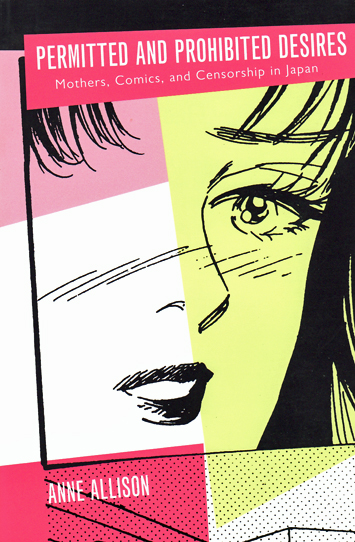
Because the early volumes of the series are about young girls – and beautiful young girls (bishōjo) at that – their reception has not always been feminist-positive, however. For example, in his monograph Beautiful Fighting Girl, psychologist and cultural theorist Saitō Tamaki discusses the anime version of Sailor Moon as a prime example of why the “beautiful girl” trope appeals so much to men. In America, cinema scholar Susan Napier and anthropologist Anne Allison both take issue with the series, finding it a stale mash-up of tropes characteristic of the mahō shōjo (magical girl) genre as it has existed since the mid-seventies. Both scholars also view the anime series in particular as catering to a male audience eager for sexual titillation. Napier, for instance, finds the Sailor Scouts “lacking in psychological depth,” while Allison finds it troubling that the “girl heroes tend to strip down in the course of empowerment, becoming more, rather than less, identified by their flesh,” a trademark visual feature of Sailor Moon that “feeds and is fed by a general trend in Japan toward the infantilization of sex objects.”

Unfortunately, these evaluations do not take into account the female fans of the series, who seem to be less interested in the sexual aspects of the short-skirted female warriors and more eager to identify with the empowered femininity they represent. These fans are also willing to tolerate the weak characterization in the opening volumes of the series in order to enjoy the opportunities presented later in the story for the female heroes to develop their individual talents, personalities, and bonds with each other. In Sailor Moon, the female heroes begin as girls, but they gradually mature into capable and competent young women who must shoulder great responsibility and make difficult choices, usually without the support or interference of men.

To celebrate the recent North American release of a new translation of the Sailor Moon manga, an eighteen-year-old blogger on LiveJournal wrote of the series that:

[Sailor Moon] is a world where femininity is not something to be ashamed of, it’s the source of POWER. The girls don’t use their pretty clothes and jewels and compacts as playthings to impress men – these things are all weapons against evil, and powerful ones. They declare themSELVES pretty, needing approval from no one. Our hero possesses all the typical “chick” attributes – emotional, tearful, forgiving, loving, nurturing – and she uses these attributes to triumph and kick ass. She burns monsters alive with the purity of her love, sends out supersonic waves that shake the villains down when she bursts into tears, and her friendship and forgiveness is the most effective superpower one could ask for. The “girly” emotions and affectations are not something to be ashamed of or suppressed, but the source of the power these girls wield. They don’t have to imitate guy heroes at all or act “masculine” to be taken seriously – girliness is just as powerful.

Although someone like Saitō might see Sailor Moon as nothing more than a smorgasbord of tropes that can be endlessly combined and recombined to suit any male fetish, and although prominent critics such as Napier and Allison echo his reading, female readers find something entirely different in the series: they see a group of young women who fight not for the approval of a father or a boyfriend (or a male reader), but rather to achieve their own goals and ambitions. Moreover, they learn that being female isn’t something to be ashamed of; and, according to later developments in the series, neither is homosexuality or a transgendered identity.

Far from regurgitating the tropes of the magical girl genre, Sailor Moon creator Takeuchi Naoko overturned the conventions of both shōjo romance for girls and bishōjo fantasy for boys. Furthermore, the female fans of Sailor Moon aren’t invested in the series merely in order to lose themselves in fantasy (and spin-off merchandise), but rather because they find that the series empowers them to combat real-world problems directly related to the assumption that young women and the femininity associated with them exist only to please men. The fantasy created by Sailor Moon is not an escape from the gendered conventions and restrictions of reality, but rather a safe space in which these aspects of reality can be tested and challenged. Perhaps this is why Sailor Moon has appealed to so many women outside of its target demographic, and perhaps this is why it has appealed to so many boys and men as well.

If you haven’t read Sailor Moon, the Kodansha Comics re-release is beautifully published and contains a wealth of translation and cultural notes that help make sense of the story and characters. The first two or three volumes of the series can come off as a bit childish; but, as the characters grow and mature, the story does as well. If you’re a girl or a guy, or if you’re a serious manga reader or don’t read many manga at all, Sailor Moon is worth reading simply for the experience of entering a world in which femininity is indeed ” is not something to be ashamed of” but instead “the source of POWER.” The manga is also an excellent introduction to an alternative realm of discourse (common in Japanese manga and spreading to Western comics – partially due to the influence of Sailor Moon) in which female writers and artists can tell their own stories without really worrying about how men are reading and looking at them.

If you’re intrigued, check out the Sailor Moon Manga Moveable Feast hosted by Sean Gaffney’s at A Case Suitable for Treatment over on Manga Bookshelf.

Schoolgirl Milky Crisis

Title: Schoolgirl Milky Crisis: Adventures in the Anime and Manga Trade
Author: Jonathan Clements
Publication Year: 2009
Publisher: Titan Books
Pages: 272

Do you love anime? Do you really love anime? Have you lived long enough to catch references to anime titles more than five to ten years old? Do you appreciate dry humor? Do you want to hear some great gossip about the anime industry? If so, you should seriously consider grabbing a copy of Schoolgirl Milky Crisis – or downloading one to your Kindle, which is what I did.

Schoolgirl Milky Crisis has been out for more than two years now, but I had put off reading it because I didn’t think I wanted to read a book “mixing reviews, cultural commentary, insights into classic manga and anime titles, interviews and profiles of Japan’s top creators, and hilarious insider stories from the anime trade.” I assumed such a description was advertising code for “short, unrelated blips of a journalistic nature crammed haphazardly together within an appealing bright yellow cover that will attract potential teenage buyers in the wake of the success of Japanamerica.” In other words, I thought it would be rubbish.

It’s not. Jonathan Clements is a fantastic writer, and the editing and organization of Schoolgirl Milky Crisis is equally well done. The result of this excellent writing and editing is a product that is intelligent and eminently readable. I downloaded the book on a whim during a short train ride yesterday afternoon and ended up doing several loads of laundry just so I would have an excuse to sit on my kitchen floor all night and continue reading it.

The essays in Schoolgirl Milky Crisis can be divided into three main categories. The first and foremost category is insider industry information and gossip. The gossip includes tidbits such as how fan-run conventions fail to respect their guests from Japan and how a famous director with a name suspiciously close to “Ōtomo Katsuhiro” was almost physically kicked out of the company that distributes his films in Britain. The insider industry information contains all the behind-the-scenes nuts and bolts that fans often aren’t aware of, such as how property rights are acquired, how difficult it is to get a show on television, and how people end up becoming voice actors (apparently, voice acting is not a job anyone actually wants). The second category concerns information on foreign markets for anime in countries like China, Korea, the United States, and Britain – and also places like Finland and Estonia. I imagine that this category might be genuinely interesting for anime fans (especially those in the States) who see anime as existing only in their own country and Japan (and who aren’t freaks like me who read anime magazines in three different languages). The third category involves extended analytical essays that were originally delivered as public lectures. “Five Girls Named Moe: The Anime Erotic,” for example, is about the porn industry in Japan, and “Highbrow Skills in a Lowbrow Medium” concerns the issue of “translation” versus “localization.” In my opinion, these longer essays in particular make the book worth reading and are well worth the price of admission.

Unfortunately, there were several sections that I found myself quickly clicking through after the first four or five pages. One was the chapter on Chinese animation, which begins with a brief overview and then launches into extended plot summaries of all of the titles mentioned in said overview (none of which could be found on Google). Another was the essay included as the liner notes in the re-release of the 1961 film Mothra, which lists name after name after name of a cast and crew I knew nothing about. Name dropping and plot summaries are rarely interesting, especially when the names are relatively unknown and the plots belong to films that are almost impossible to actually get one’s hands on. Speaking of which, even reviews that were interesting and fun to read could become frustrating, as the anime industry in the West moves quickly (and older titles have a tendency to become rare). For example, I was especially impressed by Clements’s liner notes for the anime series Saikano (released in 2002 in Japan, 2004 in America) but soon found that I couldn’t rent it from Netflix or Tsutaya or watch it on legally streaming sites like Hulu or Crunchyroll. What’s the point of reading about how great an anime is if you can never watch it?

In any case, what keeps the reader going through sometimes tedious and occasionally disjointed material is Clements’s wry and amusing narrative voice and common sense approach to the topic at hand. To illustrate this, I’d like to quote a paragraph from an essay titled “The Measure of Tape: The Lost World of VHS,” in which Clements describes a fantasy he had after witnessing a distributor throw out all the old review copies of VHS tapes he had gone through the trouble of returning:

So I decided that was it. I was going to liberate VHS. I was going to hoard my review copies until my office burst at the seams, and one day a grateful university library would come along and open the Jonathan Clements Wing, packed to the rafters with PAL copies of obscure titles like Ambassador Magma, and errant NTSC dubs of Fatal Fury. Researchers would then come from far and wide to leaf through my collection of ancient Japanese-language Newtypes and make notes for their dissertations. And once every few years, when I needed to check a scene in episode #8 of Ushio and Tora, I would pop back and visit my old tapes, just for the day. That was the plan.

I think this serves as a fitting analogy for Schoolgirl Milky Crisis itself. Sure, some of the titles Clements discusses may be old and obscure, and sure, maybe nobody cares about foreign markets and industry information besides the people actually involved in the process, but the essays in Schoolgirl Milky Crisis, when read as a whole, succinctly track the history of anime in Asia and the West, bit by tantalizing bit. The writing style is engaging enough to keep the reader invested in the process all the way until the end. If you’re not an anime fan, you probably won’t have much use for the book; but, if you are a fan and haven’t checked out Schoolgirl Milky Crisis yet, I highly encourage you to do so.

A Treasure Hunter’s Guide to Dōjinshi

Or, how to find dōjinshi in Tokyo. Here is what you need to know before you set out:

First, stores specializing in dōjinshi tend to fall into two categories, dansei-muke (for men) and josei-muke (for women). Dansei-muke dōjinshi are usually highly pornographic, and it is far from uncommon for them to feature the graphic rape of minors (or characters drawn to look like minors). The term josei-muke refers to the genre of boys love (BL), but the majority of the dōjinshi found in josei-muke stores aren’t BL at all but rather humor, parody, drama, or light heterosexual romance. You can usually tell what you’re getting from the cover, but every dōjinshi is enclosed in a plastic slipcase that you can’t (and shouldn’t try to) open until you actually buy the thing. Most general-audience dōjinshi are ¥210, and a good rule of thumb is that, the more expensive the dōjinshi, the more pornographic its content. There are exceptions to this – the dōjinshi in question may be particularly rare, or particularly good, or by a particularly well-known artist – but again, you can usually make an educated guess on the content based on the cover.

Second, you need to know how to read Japanese. It goes without saying that all dōjinshi are written in Japanese (regardless of whether English is used on the cover). More importantly, no English is used in any of the stores. Dōjinshi are organized in kana order by the title of whatever work they’re based on and grouped according to genre (ie, video games, shōnen manga, Western television shows, Korean boy bands, etc). Dōjinshi based on more popular series (such as Hetalia or Final Fantasy VII) are further organized by pairing or dōjin circle. You’re therefore going to need to be able to read Japanese in order to navigate the stores. The staff at these stores is generally happy to help you find what you’re looking for, but you need to tell them the title of the gensaku (original work on which the dōjinshi is based) in Japanese before they can help you. If you’re not confident about your Japanese, it might be useful to bring a friend to help you navigate and to visit the stores as soon as they open (so they won’t be crowded).

With that in mind, here we go!

Ikebukuro

Ikebukuro, and more specifically Otome Road, is the mecca for fujoshi. It should be the first and last place that any female dōjinshi hunter visits. If you’ve never been here before, let me promise you that it’s anything beyond your wildest dreams. Bring lots of money.

Ikebukuro Station is absolute chaos, and it’s very easy to get lost. In general, though, you want to head towards the Seibu side of the station. There are several exits out of the JR portions of the station; but, if you follow the yellow signs for “Sunshine” (which are referring to Sunshine City), you should be headed in the right direction. The specific exit you want to take out of the station is Exit 35.

You’ll emerge from chaos into chaos. There will be a huge Bic Camera to your left and an enormous throng of people directly in front of you. Follow the throng straight ahead and then to the left to a street crossing. On the other side of the street will be a Lotteria on the left and a Café Spazio on the right. Cross the street and pass in between these two restaurants to enter an enormous shopping street called Sunshine Plaza. Walk all the way down the street until you reach a highway overpass. Cross the road under the overpass on the right side and then turn right in front of the Toyota Auto Salon. Walk until you reach a Family Mart, and then take a hard left all the way around the corner building. You should see an Animate in front of you. Congratulations! You’ve reached Otome Road.

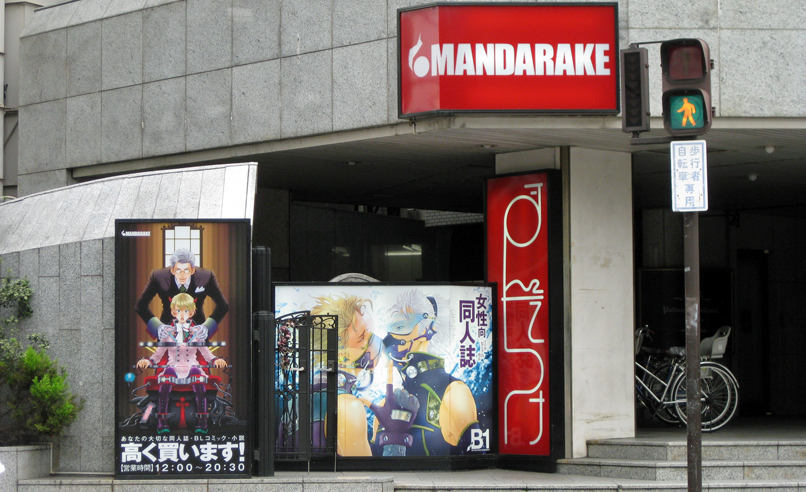
Otome Road begins at the Animate and ends at the three-story K-Books Dōjin-kan. This K-Books is probably the single best dōjinshi store in all of Tokyo. They have dōjinshi for every conceivable fandom, and they usually have the same dōjinshi for less money (¥210 as opposed to ¥420) than at the Mandarake you passed on the way. They also have tons of original dōjinshi and dōjinshi sets (all of the dōjinshi in a series, or a dōjinshi packaged with extras like fans or postcards). Keep in mind that all of the dōjinshi on the second floor are new and can usually be found for a fraction of the price on the third floor, where they sell used dōjinshi. What I like about this particular store is that they have a lot of general interest dōjinshi that have nothing to do with yaoi. The previously mentioned Mandarake has a much stronger focus on BL dōjinshi, and it’s a good place to find original dōjin artbooks as well.

There are two different branches of Café Swallowtail (a famous butler café) on Otome Road, one next to the Mandarake and one next to the K-Books. If you’d like to visit, make sure that you’re familiar with the process of attaining a reservation before you go. The two locations have two different reservation procedures, and you can only make a reservation for a thirty-minute time slot. Don’t be afraid of trying one out, even if your Japanese isn’t perfect, but it’s way more fun to go with a friend (especially since the cafés are geared towards parties of two).

On your way through Sunshine Plaza from the station to the highway overpass, you can turn right at any point to enter a maze of manga stores, maid cafés, and cat cafés. Also, if you’re really into Japanese youth culture and fashion, try entering Sunshine City (you’ll know it when you see it), which is the size of a small city – a small city filled with clothing and accessories for teenagers (and an aquarium). Finally, the cinemas lining Sunshine Plaza are the best places to go to see an animated movie, whether it’s the new Ghibli film or the latest feature-length spin-off of a popular franchise like K-ON. They’re also good places to pick up all the guidebooks and merchandise that accompany these movies. If you need to chill out and kill time before a show, you can always take advantage of one of the many many many kitschy love hotels (which are cheap and clean and more than likely have a nicer shower than your apartment or hotel) right off the main street.

Akihabara

Akihabara is where you go to get porn. The end.

Okay, seriously. Akihabara specializes in dansei-muke dōjinshi. There are tons of small dōjinshi stores located several floors up or several floors down from the narrow side streets that twist through the main electronics district. Many of these smaller stores cater to specific fetishes, and some of these fetishes might be extremely disturbing to some people. I will therefore leave the true exploration of this area to the truly adventurous. Thankfully, the Akihabara branches of K-Books and Mandarake are fairly mainstream (although still filled with porn).

Take the Akihabara Electric Town exit out of the JR station. Straight ahead you’ll be looking at several columns and a storefront, so head to your left to exit. Once outside the building, turn to your right. A few dozen feet down the left side of the street you’ll see the Radio Kaikan. There are several entrances into this building, but you want to take the escalator that goes directly from the storefront up to the second floor. (It’s right next to the display of electronic dictionaries. Incidentally, this is the single best place in Japan to get an electronic dictionary, as it has all the latest models at 40-60% off the list price.) Once off the escalator, go up the stairs to the third floor and then turn to your right to enter the K-Books dōjinshi store. Whatever fandom you’re interested in, from Evangelion to Azumanga Daioh, they have porn of it. They also have tons of fresh dōjinshi from the latest comic markets at reasonable prices, as well as other dōjin goods such as Vocaloid albums and body pillow covers.

[ETA: As of July 1, 2011, the Akihabara branch of K-Books has relocated to the “Akiba Cultures Zone” (AKIBAカルチャーズZONE). To get there, use the directions for Mandarake but turn to your left before the Sumitomo Fudōsan instead of after it. In other words, turn left at the Daikokuya electronics store (you should see the K-Books storefront reflected in the glass windows of the Sumitomo building). The first floor houses used manga, and the dōjinshi are on the second floor.]

The other big dōjinshi store in Akihabara is the Mandarake complex, which has separate floors for dansei-muke dōjinshi and josei-muke dōjinshi (as well as other floors for other things, like used manga and cosplay supplies). To get there, go straight past the Radio Kaikan until you reach a large street. This road is Chūō-dōri. Cross over to the other side of the street and turn to your right. Walk for about two blocks until you read the Sumitomo Fudōsan Building. Turn to your left after this building onto a small street, and you should see the Mandarake complex ahead on the right. The fourth floor has josei-muke dōjinshi, and the third floor had dansei-muke dōjinshi. The selection on both floors isn’t the best, but you can sometimes find stuff here that you can’t find anywhere else, such as the dōjinshi of a popular circle called CRIMSON, which publishes print versions of its dōjin visual novel games.

On the way to Mandarake, you will have seen the main branch of Tora no Ana on the other side of Shōwa-dōri. Tora no Ana publishes its own art books and dōjinshi (and a few mainstream manga like Fuku-Yomo), but its third floor is a fujoshi paradise of BL manga, manga magazines, and dōjinshi. Even if you’re not into porn, it’s worth visiting the Tora no Ana in Akihabara just to check out the culture.

Shibuya

The main attraction of Shibuya is the Mandarake, which specializes in used pornographic manga and figurines but has a sizeable josei-muke dōjinshi section with a unique selection. Since this Mandarake is somewhat removed from Otome Road, the dōjinshi in stock here aren’t the newest or the freshest that you can get your hands on, but this can work to your advantage if you’re looking for dōjinshi based on older titles like Sailor Moon, Revolutionary Girl Utena, Nodame Cantible, Hellsing, Wild Arms, Final Fantasy IV, or the next-to-latest incarnation of the Pokémon franchise. Also, if you’re looking for dōjinshi based on manga by CLAMP or the films of Studio Ghibli, this is the place to go. If you’re looking for original dōjinshi drawn by an artist like Ono Natsume or Yoshinaga Fumi, this is also the place to go. This particular store also has the friendliest and most helpful staff I’ve yet encountered.

To get there, take the Hachikō exit out of the JR station and orient yourself so that you’re facing the Tsutaya building with the Starbucks café. Head down the left side of the big road passing to the right of this building (the 109 Men building will be on the other side of the road). In about a block the Seibu department store will be on your left. Turn left to pass in between the two Seibu buildings (there will be bridges above you). Go straight on that street until it splits at a kōban (police box) and take the right fork. The Mandarake will be a block down on the left side of the street, directly across from a Choco Cro café. You’ll need to go down several flights of stairs to reach the actual store. (For the record, there is another entrance into the store, but this is the one that leads directly to its dōjinshi section.)

While we’re on the topic of Shibuya, I should also mention the Tsutaya I referred to in the directions. In my opinion, this particular branch of the chain is the single best place to buy new manga in Japan. They have multiple copies of all the volumes of all of the latest manga in stock, and they have really cute displays created by the staff to highlight interesting and notable titles. This is the place to go to find out what is popular in Japan right now, and you can take to elevator down to the basement to do the same trick with video games before progressively working your way up through music, movies, and literature.

If you find yourself spending a lot of money, go ahead and apply for a T-Point card, which also works at Book-Off (and Family Mart convenience stores and Excelsior coffee shops, for what it’s worth). Book-Off is a chain of used book stores known for its ridiculously low prices and the excellent condition of its used merchandise. In essence, after using your point card for the first two or three volumes of a manga at Tsutaya, you can get enough points to get a used copy of the next volume for free at Book-Off. And speaking of Book-Off, the one across the street from the Shibuya Tokyu Hands is a manga lover’s paradise. They also have tons of used light novels, art books, and video game strategy guides that you won’t even find in Akihabara.

Nakano

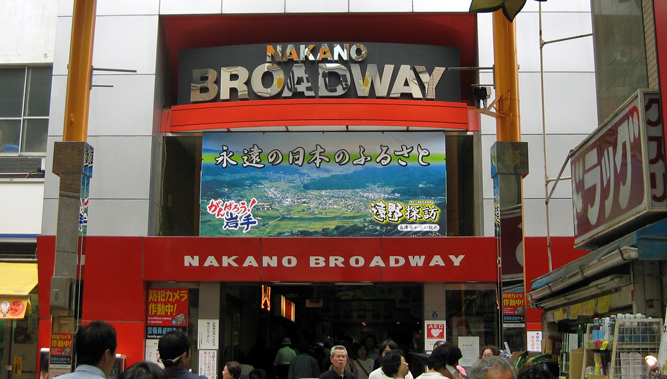
Nakano is a bustling, working-class shopping area a few stops out of the Yamanote loop on the JR Chuo line. The area is a bit out of the way of just about everything, but it’s home to Nakano Broadway, a rundown warren of manga stores and hobby shops. The top three stories of this indoor shopping complex are a hive of Mandarakes. If you have any sort of hobby related to anime or manga or video games, whether it’s cel collecting (fourth floor), cosplay (third floor), or researching Taishō-era children’s magazines (second floor), Nakano Broadway is where you go to spend all of your money. There are also tiny stores specializing in Ninja Turtles action figures from the nineties, old Japanese coins, and prayer beads and power crystals. There is even a Mandarake store called Hen-ya that, as its name implies, is a treasure hoard of the weird, baffling arcana of postwar Japanese pop culture.

From the JR Nakano station, take the north exit for Sun Plaza. Head around to your right past the turnstiles to exit the station, where you’ll see an open-air bus station in front of you. Beyond the bus station and to the right is the entrance to a shopping arcade called the Nakano Sun Mall, which is marked by yellow arches. Enter the shopping arcade and walk straight back all the way to the end to reach Nakano Broadway.

There’s nothing to see on the first floor, but you can take the escalator up to the third floor to reach the most awesome used manga store ever (run by Mandarake, of course). Whether you’re looking for editions of manga like Rose of Versailles from the eighties or the whole back catalog of a manga magazine like Monthly Cheese, they’ve more than likely got it stashed away somewhere. If you want to go straight to the dōjinshi stores, skip the escalator and take the stairs to the right of the escalator up to the second floor. Turn left from the stairs and then left again around the corner, and you should reach a dansei-muke store and a josei-muke store right across from each other a bit down the corridor.

Since Nakano is so out of the way, and since Mandarake keeps a lot of its excess stock up on the fourth floor, you can find old dōjinshi at these stores that have disappeared from just about everywhere else (such as those based on Harry Potter). The josei-muke store in particular specializes in anthologies, and you can strike real gold here if you don’t mind paying significantly more than the usual ¥210 – dōjinshi anthologies are huge and beautiful but can cost up to ¥5,000 (although ¥1,050 is more common). It takes a bit of work to get out to Nakano, and you’ll probably get seriously lost in Nakano Broadway, but it’s definitely worth the trip for a true treasure hunter.

***

All of the directions I have given take it for granted that you’re using one of the JR lines (such as the Yamanote-sen). Be aware that these directions may not apply if you’re using one of the Tokyo Metro lines (or another private line like the Keio-sen).

K-Books, Tora no Ana, and Animate all have point cards. These cards are free and allow you to accumulate points with each purchase. You can use these points to either take a discount off future purchases or to get limited edition goods that can only be bought with points. If you’re going to be spending a long time in Japan or are planning on spending a lot of money during a short visit, it might be worth your while to ask for one of these cards. (In the case of K-Books, you might want to just get one anyway, since they give you a choice of really cute, collectible cards.) You can just ask your cashier for a card at K-Books and Tora no Ana, but you’ll need to fill out an application form with your address in Japan at Animate.

All of the stores I have mentioned by name accept Visa and Mastercard. The only caveat about using a credit or debit card is that you may not be able to get points on your point card for that purchase. The policy on accumulating points for credit purchases differs from store to store (especially in Akihabara), but you shouldn’t have a problem anywhere in Ikebukuro.

Finally, if this guide has made you giddy with excitement, please consider investing in the book Cruising the Anime City. It’s a bit dated (just as this guide is probably going to be in a year or two), and it betrays a strong masculine bias, but it’s still awesome.

Girl, Illustrated

Title: Girl, Illustrated: Japanese Manga, Anime and Video Game Characters
Japanese Title: ガールズグラフ:コミック・ゲーム・ライトノベルのイラストレーターファイル (Girls graph: Comic, game, light novel no illustrator file)
Art Director: Sometani Yōhei (染谷 洋平)
Translators: Shima Miya (嶋 美弥) and Marian Kinoshita (木下 マリアン)
Publisher: Pie Books
Publication Year: 2009
Pages: 205

A few days ago I was killing time in the Borders next to Penn Station in New York City. I love this Borders. Not only do they allow people to sit on the heating vents next to the windows when it’s freezing outside, but they also have the largest and best-stocked manga section of any brick-and-mortar bookstore I’ve ever been inside. Every time I visit this Borders I find something that I had no idea had even been published. This time I found several copies of Girl, Illustrated. While I was flipping through one of them, I kept thinking about the recent New York Times article titled “In Tokyo, a Crackdown on Sexual Images of Minors.”

I am not a big fan of the article. For one, it doesn’t bother to introduce Ishihara Shintarō, his racism, his sexism, or his vocal ultra-nationalist political stance. So, when Ishihara is quoted as saying of the media in question that “These are for abnormal people, for perverts,” his statement seems only natural from a moral perspective. (Although one does chuckle a bit when he says, “There’s no other country in the world that lets such crude works exist.”) Indeed, the media that Ishihara hopes to censor is sensationalized as child pornography, and an impartial reader has no choice but to view it with disgust. It is only in the very last line of the article that someone is quoted as saying, “It’s a completely imaginary world, separate from real life.”

I wish the journalist who wrote the article, Hiroko Tabuchi, had played up this side of the debate more. I wish she had mentioned that, while Ishihara and his cohort are drafting legislation against the depiction of imaginary girls, they are also fighting an ongoing battle against feminists who want to change the law that doesn’t allow a married couple to maintain separate surnames (which hinders the career development of many female professionals). I wish these things because, in the past two weeks, enough people have quoted from or referenced the article that I am starting to fear how it may have influenced a non-specialist’s view of Japanese popular culture.

As all of this ran through my mind while I paged through Girl, Illustrated, I decided that the best way to look at Japanese illustrated images of girls is to actually look at Japanese illustrated images of girls. I would therefore like to review Girl, Illustrated, a bilingual art book published in Japan and available in America through online retailers like Amazon, Borders, Barnes and Noble, and Tower Books. Before I begin, I would like to state that this book does not contain child pornography. I myself do not support child pornography, and it is not my aim to defend or justify it in any way. Instead, I hope to challenge common notions regarding “anime-style” Japanese illustrations of young women.

The style of illustration in question is known as bishōjo-kei, or “bishōjo style,” with “bishōjo” meaning “beautiful young woman.” A bishōjo (as opposed to a regular shōjo, or “young woman”) is usually a female protagonist or central supporting character in a manga, anime, or light novel that belongs to a genre generally regarded as being targeted towards a male audience, like science fiction or adventure fantasy. Good examples might be Nausicaä (from Nausicaä of the Valley of the Wind), Nadia (from Nadia: The Secret of Blue Water), or Ayanami Rei (from Neon Genesis Evangelion). Bishōjo are rooted firmly in fantasy, whether that fantasy is a post-apocalyptic technological wasteland or a halcyon senior year of high school. They need not be connected to an actual narrative, however, and are often depicted in original artistic compositions.

Girl, Illustrated is a collection of such compositions. Each artist is allotted two pages and four to six full-color illustrations. Accompanying these images is a section for information about the artist, which includes fields for the artist’s birth date, gender, hometown, webpage, inspiration, and comments. More often than not, most of these fields have been left blank, but the information is written in both English and Japanese when it is available. Unfortunately, the translation isn’t always perfect. For example, something like 銃器・武器と女の子を描く (drawing girls with guns or other weapons) might become something like “drawing girls in their underwear with guns,” but these short artists’ comments are still fun to read.

This being said, the main draw of Girl, Illustrated is what the artists say with their illustrations. Through affective character design and rich, detailed backgrounds, each of these illustrations wordlessly suggests a story. The vast majority of these images have been created with digital ink in programs like Photoshop, Illustrator, and PaintTool SAI. Although most of the artists choose not to reveal their gender, judging from those that do, it seems that 2/5 are female. Among these female artists are young professional illustrators like Sakizou, Foo Midori, and fukahire. All of the artists, male or female, take beautiful young girls as their subject matter, and there doesn’t seem to be any discernable difference between the themes and style of the male illustrators and those of the female illustrators. For example, this is a piece by the female artist onineko:

And here is a piece by the male artist Ichikawa Takashi:

Both of these illustrated girls seem to be young, pure, and innocent. They are magical beings firmly enmeshed in their respective fantasy worlds, and there is a kind of “Alice in Wonderland” quality about them that probably seems familiar to a Western (and non-otaku Japanese) audience. Illustrations like these won’t raise any eyebrows.

Problems in the interpretation and judgment of these images arise when the girls are not quite so pure and innocent but instead betray hints of sexuality. For example, one picture by the male artist gorobots parodies the NHK (Japan Broadcasting Corporation) with the logo NPK (Japan Panty Corporation) and contains the text “When you sit down, I stand up,” double entendre absolutely intended:

Such sexualized images of young women are not just drawn by men, however. Exposed breasts, bums, and panties are also explored in the work of female artists like Higuchi Norie:

The portfolios of other female artists whose work appears in Girl, Illustrated are full of scantily-clad young women enjoying themselves and each other’s company. Regardless of the extent or intensity of the sexualization, however, the fantasy element of these pieces remains strong, and the girls are always more playful than pornographic.

As I mentioned earlier, I am not defending child pornography. Illustrated pornography in Japan is extraordinarily explicit, and it is quite clearly packaged as pornography and sold in separate venues, regardless of the imagined ages of its imaginary protagonists. As for sexualized but non-(overtly-)pornographic images of young girls, though, I might argue that they belong to a different discursive space altogether. Bishōjo simply are not real. They are not real because they are illustrated, obviously, but they are also not real because they are the embodied representatives of pure fantasy. Their world is not our world, and they are our gateways into that world. People who draw and appreciate them do so because of the beautiful otherworld they channel, not because they are fodder for onanistic inclinations. One might draw a parallel between the bishōjo style of illustration and the hyper-sexualized men and women on the covers of American fantasy novels; the tight leather pants and clinging silk dresses of these painted figures are not so much signifiers of pornography as they are emblems of a certain Tolkienian fantasy aesthetic.

The fundamental idea behind the proposed manga (and game and illustration) censorship law in Tokyo is that men are looking at women in a way that is psychologically unhealthy. There is obviously a pornographic gaze that is encouraged and exploited in many aspects of popular and commercial art, but I wonder if perhaps it wouldn’t be unreasonable to posit the existence of something like a “fantasy gaze,” or at least a type of gaze that is less concerned with the image itself than the story behind the image.

Moreover, the sizable percentage of women painting and consuming these bishōjo characters and illustrations complicates the idea of an all-powerful male gaze. One might argue, as have many feminist scholars, that these women have adopted an hermaphroditic gaze. In other words, female viewers have internalized the male gaze and therefore identify with male characters and viewers when they look at sexualized images of women. I myself would like to raise the possibility of a female gaze. This female gaze is responsible for the fanworks featuring male-on-male pairings from popular series like Naruto and Hetalia, of course, but I think it’s also a way for women to portray and look at themselves and other women. By creating and appreciating mildly sexualized images of girls, for example, women can embrace and celebrate a sexuality that lies beyond virgin/mother/whore stereotypes. For women, then, the appeal of bishōjo is not merely the asexual appeal of the fantasy world they represent but also the self-reflexive appeal of being young, beautiful, magical, and, yes, sexual. Furthermore, who is to say that male viewers don’t similarly employ this female gaze when looking at such images?

Girl, Illustrated isn’t just a collection of gorgeous artwork. It’s also a way of looking at and thinking about Japanese bishōjo illustrations. Included at the beginning of the volume is a (mostly) translated essay about how bishōjo characters are marketed and used to promote domestic regional tourism in Japan. Are the editors of the volume trying to suggest that perhaps bishōjo are Japan? It’s a stretch, but it’s also an interesting cultural perspective. In any case, this collection is both fascinating and beautifully produced. Even if you’re more interested in fine art than you are in anime, Girl, Illustrated is still an excellent resource for examining both portrayals of the body and the possibilities of new digital media.

Permitted and Prohibited Desires

Title: Permitted and Prohibited Desires:
Mothers, Comics, and Censorship in Japan

Author: Anne Allison
Publisher: University of California Press
Publication Year: 1996
Pages: 213

I am not a fan of theory. To be perfectly honest, I find the vast majority of it, from Barthes to Foucault to Kristeva to Butler, very difficult to read. The ideas are interesting, certainly, but the contexts often feel dated, and the language is occasionally impenetrable. I suppose this is an occupational hazard, though, as specific terminology is needed to express certain ideas, and the names of theorists are useful as metonymic signifiers of certain strains of thought. Also, although pure theory can sometimes come across as bogwash, its application to more textually grounded studies helps to both deepen and widen the scope of the topic, making something like pornographic manga, for example, relevant to the non-specialist.

In Permitted and Prohibited Desires, anthropologist Anne Allison applies gender and cinema theory to adult manga, arguing that its pornographic elements attest more to the weakness of men than they do to the exploitation of women. Allison reacts against the position of feminists like Andrea Dworkin, who argues that pornography is always misogynistic, and Catherine MacKinnon, who treats pornography as both a reflection and cause of gender inequality, in order to argue for a more nuanced view of how gender functions within pornography, which restricts male social and sexual roles perhaps even more than it restricts those of women.

In the erotic manga that Allison discusses, women are indeed penetrated, gazed upon, and reduced to a spectacle against their will, but men are often absent or unnecessary. Allison demonstrates that the male position of dominance is undermined by the fact that the man is often unable to obtain consent from the woman, as well as by the fact that his genitals are never directly shown but instead replaced with inanimate substitutes like baseball bats and soda bottles. Many scenarios do not feature men at all but leave a woman or pair of women to their own autonomous devices. When the two sexes are paired, however, the display of aggressive female desire often leaves the man impotent, thus driving him to lash out violently at his partner. In other words, the pornographic manga that Allison discusses betrays a strong stake in maintaining a fiction of male domination. It also goes out of its way to construct a clear opposition between male and female sexual identities. Although the man’s position as aggressor and voyeur is meant to empower him, the necessity of his resort to violence suggests that his gaze is not as powerful as it might seem.

Allison does not challenge the notion that the Japanese social order is inherently phallocentric, but she argues that its economic and organizational structures put an enormous burden on men. She sees the brutalized women of pornographic manga as representing real women – such as the potential sexual partners who make themselves unavailable to the reader, or the wives and mothers who are perceived as single-handedly managing a household in which men have become irrelevant. However, these fictional women also stand in for other things that chain males to patriarchal societal expectations, such as entrance exams and companies that require infinite hours of overtime. Allison states that the relatively open acceptance of erotic manga, which are published so as to be easily consumed during a commute, functions as a pressure release valve that allows men to indulge in superficially subversive fantasies before then returning to their primary roles as workers. Pornographic manga thus provide an escape for men, but the escape is only temporary and belies numerous fears of male impotence and powerlessness.

Fun stuff, right? Actually, oddly enough, it is. Allison writes in a very accessible style; and, when she refers to critical literature to make her argument, she draws out and pinpoints exactly what she is referring to. She will never merely cite the Freudian understanding of castration anxiety but rather delve into it in detail, explaining how it differs from a Lacanian understanding and how both understandings relate to the manga narrative in question. As a result, I feel like I learned a lot from Permitted and Prohibited Desires that had nothing to do with manga or Japan. Also, for readers who might not be familiar with the visual conventions of Japanese pornography, the book is filled with well-chosen illustrations that are sufficiently not safe for work. Sometimes a picture is worth a thousand words, after all.

But don’t let me fool you into thinking that discussions of erotic cartoons, adult manga, and censorship laws are all this book has to offer. Sandwiched between chapters on fictional fantasy women are two essays on Japanese motherhood that had previously been published elsewhere to great acclaim. According to the book’s introduction, these two chapters, “Japanese Mothers and Obentōs” and “Producing Mothers,” are based on Allison’s own experience as a mother of two young children while doing research in Japan. Although the purpose of these two chapters is to show how women are almost coerced into becoming good mothers by school regulations concerning everything from uniforms and homework to the prepared lunches children must bring to school with them, the author’s descriptions of her own hardships and surprises are fairly entertaining as stories in and of themselves. These chapters are aptly illustrated with images from Japanese magazines that showcase the obentō lunchboxes that constitute such a large symbolic portion of the relationship between mother and child in Japan. Allison ties these two chapters into the larger theme of the book with a highly relevant discussion of mother-son incest fantasies, which she uses to show how both parties are bound to state ideology even in pornography.

Although Allison’s application of psychoanalytic theory to erotic manga reveals many aspects of the psychology of the male reader, it neglects to take into account the position of female readers, either of pornography marketed towards men or of josei manga, which can be equally pornographic. Allison’s study of pornographic manga is highly useful in its analysis of how women are constructed in narratives written by men and for men, but I feel that work still needs to be done on how women are characterized in narratives written by and for women. Also, Permitted and Prohibited Desires discusses real women primarily in the context of “traditionally” accepted roles like housewife and caregiver. Allison succeeds in showing how these roles have been fetishized by Japanese media and educational superstructures, but she also risks the perpetuation of this fetishization by arguing that it is only through their mothers that men in Japan are able to enter into adulthood. The roles of women as sexual objects and as mothers are given primacy in Permitted and Prohibited Desires, but obviously these roles are far from the only roles occupied by both real and fictional women in Japan. Nevertheless, I feel that this book serves as an excellent foundation for the study of female characters in manga, and it can be easily supplemented by the numerous works that have followed in its wake – one of the most recent being the newest issue of the U.S.-Japan Women’s Journal, which collects a handful of essays on shōjo manga written by Japanese academics.

Before I wrap up, I must admit that I am writing this review partially in response to the recently published essay collection Manga: An Anthology of Global and Cultural Perspectives edited by Toni Johnson-Woods. The essays in this book cover a wide range of topics, but they are less analytical than descriptive, explaining manga to an audience that has presumably never seen or read one before. The book also succumbs to one of my personal pet peeves, the italicization of Japanese words that have become common in America, such as anime, manga, shōjo, and shōnen. This stylistic decision is disconcerting not only because the introduction attempts to argue that manga are a truly global phenomenon (using evidence like a picture of a section of bookshelves clearly labeled “Manga” in a Borders book store), but also because such words are used so frequently in all of the essays. I was hoping that this collection would be to the study of manga what Susan Napier’s Anime is to the study of Japanese animation, but it’s just basic information presented in a somewhat unprofessional manner. That’s a harsh judgment, I know, but my disappointment is commensurate to my expectations. In the end, I still find myself searching for the perfect book about manga, but Permitted and Prohibited Desires will do well enough for now.

The Walking Man

Title: The Walking Man
Japanese Title: 歩くひと (Aruku hito)
Artist: Taniguchi Jirō (谷口ジロー)
Publication Year: 2004 (England); 1992 (Japan)
Publisher: Fanfare / Ponent Mon
Pages: 155

Taniguchi Jirō is a popular manga artist that I’m always surprised more people don’t know about. His beautifully detailed, hyper-realistic artwork is simply amazing. The other day I stumbled across his one-volume manga The Walking Man in an independent bookstore, and the cover was so gorgeous that I went ahead and paid the import price for the book. It was worth it. As soon as I got home and finished reading it, I immediately read it again. That’s how wonderful and immersive the art is.

The Walking Man doesn’t tell a story, necessarily; it merely depicts a series of walks taken by its middle-aged protagonist. Each eight-page chapter has a broad theme, like taking the trash out at night or finding a shortcut through a narrow alley. The reader follows the protagonist on his walks, which are laid out in a beautiful use of paneling with a minimum of text and sound effects. The rich visual detail and minimalist storytelling make the reader almost feel as if he or she is actually walking along through the small-town Japanese cityscape inhabited by the protagonist. As a result, flipping through this manga is a thoroughly engaging experience.

For manga fans who might appreciate more conventional dramatic storytelling (and slightly less cartoonish character designs), Taniguchi’s later, two-volume A Distant Neighborhood (1999) is also a compelling read. Although the subject matter is quite different, readers who enjoy nostalgic slice-of-life manga featuring normal people moving through detailed visual depictions of Japanese cities might also consider checking out Kōno Fuyumi’s Town of Evening Calm, Country of Cherry Blossoms (2003), which follows several generations of Hiroshima survivors in a story that is touching but never overly political. Perhaps illustrations of everyday life such as those contained in the work of Taniguchi and Kōno don’t have the immediate, flashy appeal of more mainstream series, but there’s a lot to enjoy and appreciate in these manga, and I think every anyone who reads Japanese literature should at least give them a chance.