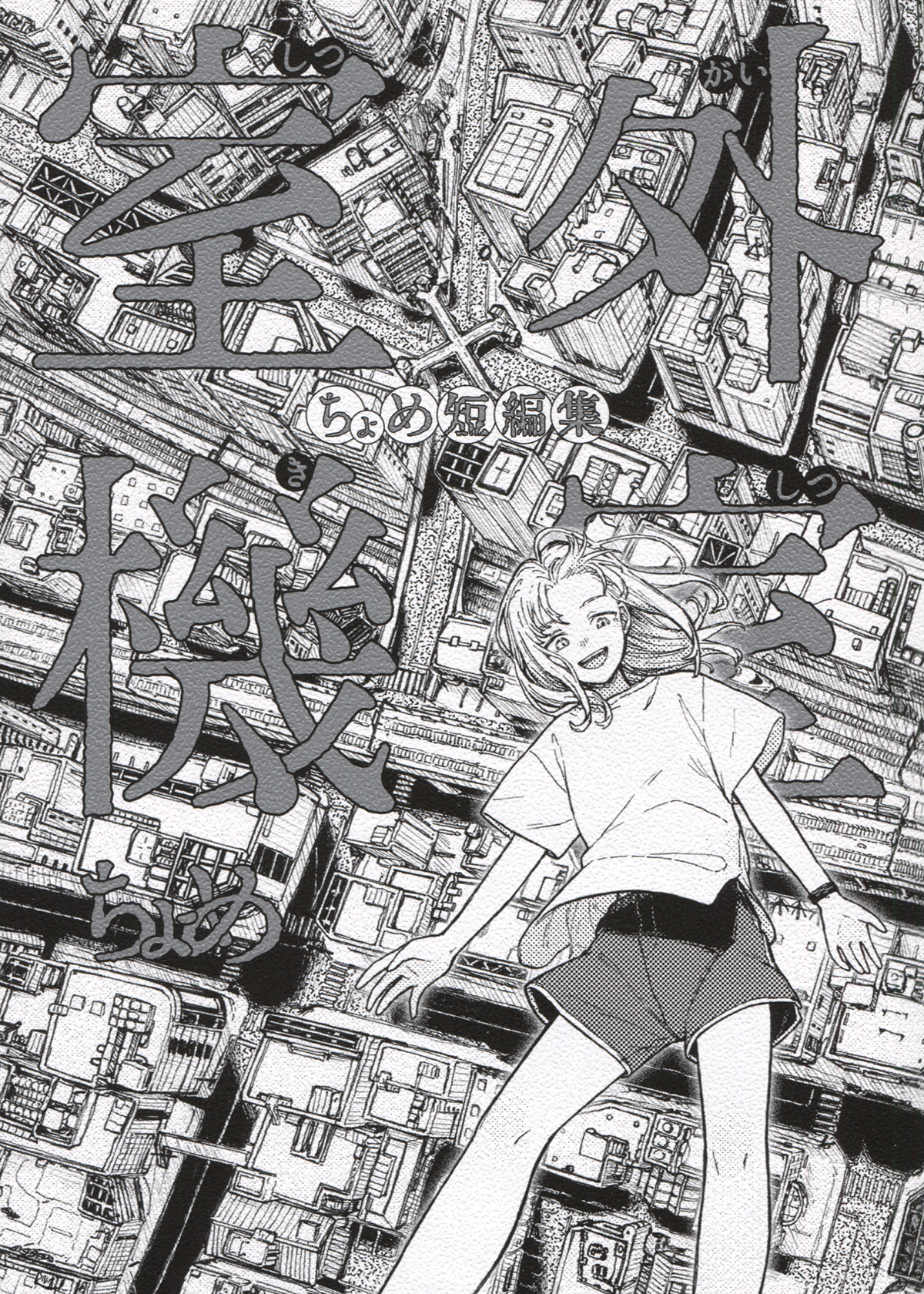
室外機室 collects four gorgeously illustrated magical realist stories drawn by an otherwise unpublished artist who goes by Chome. The stories transport the reader to a reality slightly removed from our own as each of the mundane protagonists catches a small glimpse of a hidden world.
I immediately fell in love with this collection from the opening pages of the first story, Tsugiho, in which a woman attends a large comic convention and finds a self-published minicomic that turns out to be brilliant despite its nondescript cover. The comic doesn’t seem to be documented anywhere online, so the woman starts writing a description. Her project quickly spirals out of control, however, as the pages of the small book seem to change each time she reads it. In the end, the woman’s essay transforms into an original illustrated short story, which she self-publishes and takes to the same comic convention where she found the mysterious comic that inspired her.
Speaking personally, I couldn’t describe the process of creative inspiration more accurately if I tried. What begins as a relatively straightforward act of casual appreciation can easily turn into something that has almost no relation to the original work at all, often to such an extent that the source is entirely forgotten by the end. In addition, it’s not always the case that creative inspiration comes from “the great works” of art and literature, as smaller and more specific stories can create a powerful sense of resonance and creative motivation even despite being unacknowledged by the broader culture. It’s nothing short of amazing that Tsugiho captures this aspect of creativity so perfectly in just twenty pages.
The two middle stories are thought experiments that are far more beautifully executed than they have any right to be. In 21g no bōken (which illustrates the manga’s front cover), a young woman dies and finds that her ghost is able to go anywhere and do anything. This story is primarily an excuse to illustrate the joy of absolute freedom of movement, but the ending is quite touching. Meanwhile, Konshin takes place almost entirely in a woman’s bedroom as she sits at her desk and listens to a strange radio broadcast from a parallel universe in which history has developed in an entirely different direction. The strength of this story lies in its writing, but the uncanniness of the broadcast is augmented by the visual coziness of the woman’s apartment.
The fourth and final story, Chika tosho tankenshō, is a seventy-page graphic novella that blew me away with its creativity and charm. A young woman doing research at the library drops her eraser, which bounces into the crack of a panel at the bottom of a bookshelf. The woman opens the panel to find a staircase. To the woman’s surprise, there’s an enormous library complex underground, but something about it is decidedly strange. The staff is wearing traditional Japanese clothing, and none of the books have titles. The young woman quickly arrives at the conclusion that this isn’t a place she’s supposed to be, but can she escape without being caught by the librarians? And what are all the mysterious books?
If I had the power to snap my fingers and make any manga appear in a licensed English translation, Shitsugai Kishitsu would be at the top of the list. This short story collection is a hidden treasure that easily stands its ground with the experimental but gorgeously polished work of emerging creators published by small presses like Silver Sprocket and Peow, and I could see any of these minicomics being released in the line-up of the ShortBox Comics Fair. Whoever the mysterious Chome may be, they’re creating brilliant and accessible comics that deserve an appreciative international audience.
Maru Ayase’s short magical realist novel The Forest Brims Over is about a young woman named Rui whose husband is a famous writer. Fed up with the words her husband puts in her mouth in his fiction, Rui swallows a handful of seeds that sprout from her body, gradually turning her into a forest.
Despite its fantastic premise, the story is firmly grounded in the psychological realism of the authors and editors who treat women as nothing more than literary symbols to be exploited for sales and awards. In the first four chapters, Rui’s transformation inspires significant shifts in the lives of the people in her husband’s literary circle. In the fifth and final chapter, we finally get to see Rui’s own perspective, and it’s brilliant.
I sympathize with Rui, whose every word is stolen from her by the literary professionals who conspire to confine her existence to a page of pulped paper. If Rui can’t speak in the language of the cultural elite, she’ll find another way of expressing herself, and the vast and mysterious array of life she produces is infinitely more vibrant than her husband’s formulaic literary fiction.
Rui’s husband may have the privilege of publishing award-winning books made of dead wood, but she is the roots and the leaves and the flowers and the wind. The Forest Brims Over is much more subtle and nuanced than perhaps I’m making it seem, but I personally found it joyful and liberating to be reminded that there’s much more room to grow outside the walls built by literary gatekeepers.
Shima Shinya’s four-volume sci-fi manga Glitch opens in a mundane setting in contemporary Japan: a high school student named Minato Lee (who uses they/them pronouns) has moved to a small rural town with their mother and younger sister Akira.
Minato notices that there’s something strange about their new home after a fragmented hole in reality emerges from the ceiling of her classroom. Two of Akira’s friends confirm Minato’s experience, telling them that only some people can see the distortions.
The group consults with the clerk of a neighborhood corner store, a mild-mannered man in flip-flops with a Biblically accurate angel for a face. He tells them that, since the town was constructed on top of open fields thirty years ago, various visitors have been emerging from a mysterious forest. He should know, given that he’s one of them, but the town’s glitches are a mystery to him as well.
Shima is a big fan of Star Wars and a co-author of The High Republic: The Edge of Balance manga series. Glitch captures the fun “weird little creatures in rundown environments” spirit of Star Wars, but the manga also engages with the deeper themes expressed in the movies, especially regarding how the small-scale actions of a diverse coalition are necessary to undermine the mundanity of evil.
Glitch handles its portrayal of diversity in a light-handed and clever way, and the “evil” confronted by the characters isn’t what readers might expect. While its story takes time to develop, the strength of Glitch’s art is immediately apparent, as Shima mixes the dynamic poses and expressions of Disney-style animation with the detailed backgrounds and dramatic panel compositions of indie manga.
Atsuhiro Yoshida’s 2018 linked short story collection おやすみ、東京 chronicles the adventures of a cast of slightly odd characters with subtle connections to one another. Each of the stories begins at precisely 1:00am. Far from being scary or dangerous, the nighttime urban space of Tokyo is gentle and welcoming.
Four women run a small restaurant that’s only open in the early hours of the morning. A taxi driver listens patiently to his passengers so that he can take them exactly where they need to go. Other characters have highly specialized professions, from someone who runs a highly curated antique store to someone who disposes of old telephones.
I’m in love with Yoshida’s writing style, which is playfully idiosyncratic but still clear and light and easy to read. Despite the gentleness of the stories, there’s never any sentimentality, just slightly damaged people doing their best to make it through their lives. おやすみ、東京 tends more toward realism than some of Yoshida’s other work, but small bits of strangeness still shine through the cracks of the mundane.
An English translation of this book, Goodnight Tokyo, is scheduled to be released on July 9, and I’m looking forward to Yoshida’s English-language debut!
Dragon Palace collects eight surreal stories by award-winning and internationally celebrated author Hiromi Kawakami. These stories are contemporary fantasies about shapeshifters, talking animals, and interspecies romance that borrow from traditional folklore even as they express the psychological complexity of modern magical realism. Originally published in 2002, Dragon Palace is now available from Stone Bridge Press with a translation by Ted Goosen, who also translated Kawakami’s People From My Neighborhood.
The first story in Dragon Palace, “Hokusai,” is about the octopus who seduces the fisherman’s wife in the infamous ukiyo-e print. At least, that’s who the bum who persuades the narrator to go out drinking claims to be. The narrator is depressed and hates his life, so he easily falls under the sway of the stranger who tells him fanciful stories of his exploits as an octopus-turned-human as they drink their way across a shabby port town. At several points during the evening, the narrator sees his drinking companion shift and change. By the end of the night, the narrator’s own form isn’t as solid as it once was.
Although “Hokusai” defies allegory, I read it as a story about how sad men become shitty men as they gain confidence through the stories they tell one another about women. Despite his unapologetic misogyny, there’s an appealing earthiness – or saltiness, I should say – to the octopus man that I found oddly compelling. Like the narrator, I wanted to hear more of his stories, and I was happy to go along for the ride.
“Hokusai” holds a special charm for me as a fan of H.P. Lovecraft’s 1931 novella The Shadow over Innsmouth, a classic American horror story about a decaying New England town whose residents have started marrying with fishpeople. Like Lovecraft, Kawakami paints a detailed portrait of a grimy port town that has seen better days. Unlike Lovecraft, she offsets the strangeness of interspecies relations by focusing on the more mundane aspects of what it would be like to have an ocean-dwelling boyfriend who doesn’t pay rent. In fact, even more than The Shadow over Innsmouth, “Hokusai” reminds me of Yoko Tawada’s famous short story “The Bridegroom Was a Dog,” which transposes the persistent “beast husband” trope of East Asian folklore to everyday suburban life.
“Dragon Palace,” the title story of the collection, swims even deeper into fantastic waters. The narrator is a housewife visited by the pint-sized spirit of her great-grandmother, who was supposedly a medium at the center of a sex cult before she abdicated to become a wandering vagrant. “Dragon Palace” is a prose poem on heredity and generational legacies, and about how the seeds of mystery are buried in the heart of even the most prosaic housewife.
“The Kitchen God” is a more grounded exploration of the theme of the strangeness hidden in everyday life. A housewife named Izumi is having an affair with an older man named Sanobe. Along with her recreational shoplifting, Izumi believes this affair distinguishes her from the other housewives in her neighborhood. What she seems to take for granted, however, is that her thriving collection of houseplants has turned the inside of her apartment into a small ecosystem. Among the leaves and vines lives a creature Izumi calls “the kitchen god.” This god may or may not be one of the weasels said to have infested the apartment complex, but it’s clearly no ordinary creature.
Images of strange interior spaces continue in “The Fox’s Den,” which is about a middle-aged housekeeper who begins a quasi-romantic relationship with one of her clients, an elderly booklover who once owned a used bookstore and has since become a book hoarder. To the jaded eyes of the housekeeper, this man’s attachment to old books isn’t as remarkable as his foxlike tendencies.
The housekeeper has been married twice before, once to someone she calls “completely human” and once to another man who had a tendency to behave like a fox. It’s never clear whether the animalistic traits of these characters are literal. Do they shapeshift like the octopus in “Hokusai,” or are these men animals only in the narrator’s imagination? This question is of no concern to Kawakami, who trusts the reader not to get caught up on minor details like “the nature of reality” as she explores the deep and essential weirdness of human beings.
The standout story in the collection is “Mole,” which was previously translated by Michael Emmerich in 2007 and published as “Mogera Wogura” in Kurodahan Press’s Speculative Japan anthology. In the slightly off-kilter world of the story, mole people live in human cities, where they go about their lives just like everyone else. “Mole” is narrated from the perspective of an adult male mole person, who lives with his wife in a hole. Although he’s a normal office worker, what’s unique about the narrator is that he collects humans who have lost the will to live:
The humans are bereft of energy—their faces are lifeless. Yet they are not dead. They live by eating away at their surroundings, at themselves, without ever moving. They remain with us in our hole without ever becoming moles themselves, waiting for the time when, still human, they can return to the world aboveground.
I’ve discussed this story in several of my literature classes, and it’s been my experience that students have a strong positive response. Although “Mole” could easily be read as horror, many students find it comforting to think that someone would pick them up and care for them during the days when they’re too tired to keep going. There’s a certain flavor of darkness to Kawakami’s writing that keeps her work out of the realm of being “wholesome,” but “Mole” comes the closest to a story that might be adapted into a short film by Studio Ghibli.
I have to admit that I’m not a fan of modern retellings of fairy tales. I tend to find them tedious and awkward, especially when they’re pushed into the service of a political agenda. Don’t get me wrong – I’m all for feminism and gay pride and destroying monarchies. Still, what’s always been interesting to me about “traditional” folklore is how incredibly strange it is. Sigmund Freud was wrong about a lot of things, but I think he was onto something when he talked about how it’s the very absurdity of folktales that allows them to resonate with people regardless of time or place.
The stories in Dragon Palace lean into the more surrealistic elements of folklore in a way I find emotionally satisfying. For example, what does a story about bar-hopping with a shape-shifting octopus mean in literary terms? I’m not sure, but I’ve definitely had a few boozy nights like that myself, and “Hokusai” captures the truth of that experience in a way that a more mimetically realistic story couldn’t. Likewise, what does it mean that the narrator of “Dragon Palace” picks up the off-putting spirit of her great-grandmother and hugs her like a baby? I couldn’t say, but I’ve definitely felt that exact sense of unreality while playing with one of my nieces and realizing that she looks just like my grandmother.
What I appreciate most about Kawakami’s stories is that they’re marvelously entertaining to read. Although it can sometimes be difficult to relate to the characters, each new page holds a fresh surprise for the reader. Goosen’s translation perfectly captures the tone of the original Japanese, in which Kawakami writes the most outlandish things in the most casual and colloquial prose. The style conveys the sense that someone is telling you these stories directly, perhaps as you sit in a cozy bar filled with people whose shapes shift just out of the corner of your eye. Dragon Palace is a fascinating collection of oddities in which some stories are humorous and accessible while others are more poetic and surreal. I’d recommend this striking collection to anyone intrigued by the prospect of catching a glimpse of the wonders that lie just under the surface of everyday life.
Japanese Title: カラフル (Karafuru) Author: Eto Mori (森絵都) Translator: Jocelyne Allen Publication Year: 1998 (Japan); 2021 (United States) Publisher: Counterpoint Pages: 224
A fourteen-year-old boy named Makoto Kobayashi has committed suicide, so a nameless and formless soul is granted a second chance at life by doing a “homestay” in his body. While inhabiting Makoto’s body, the soul must also occupy his life while guided by an angel named Prapura.
As if being in middle school weren’t difficult enough, the soul soon realizes that Makoto’s life is a mess. His family initially appears to be warm and loving, but it soon becomes apparent that nothing is as simple as it seems. To begin with, Makoto’s phone is completely free of contacts, which Prapura gleefully explains is because Makoto doesn’t have friends. The only girl who’s ever been nice to him visits love hotels with an older man, which Makoto knows because he saw her – at the same time he saw his mother leaving with her dance instructor.
Although the soul now occupying Makoto’s body is given a year to figure out its past crime, there’s very little sense of narrative urgency involved in solving this mystery. Instead, the forward momentum of the story comes from “Makoto” gradually realizing that life isn’t so black and white, and that every person has different colors. As he explains it…
The idea of the Kobayashi family I’d had in my head gradually began to change color. It wasn’t some simple change, like things that I thought were black were actually white. It was more like when I looked closely, things I thought were a single, uniform color were really made up of a bunch of different colors. That’s maybe the best way to describe it. (149)
Although Colorful is YA fiction, some of the “colors” of its characters may require an unusual degree of empathy for many American readers, but I would argue that it’s precisely this exercise of empathy that makes the experience of reading the novel so powerful and moving.
To give an example, Hiroka, the fourteen-year-old girl who is “dating” an adult man for money, is represented as being in control of her body and decisions. When Makoto attempts to rescue her from the doorway of a love hotel, she initially goes along with him, but it doesn’t take long for her to make it clear that she doesn’t appreciate his heroic gesture. She actually enjoys having sex with a considerate and experienced older partner, she says, and she appreciates the money he gives her. When Makoto asks if she can’t just wait until she’s older, Hiroka doesn’t hesitate to explain her reasoning, telling him that she wants to be able to buy nice things while she’s still the appropriate age to appreciate them. She wants to enjoy her body, and she wants to enjoy her life, and she doesn’t want to date Makoto, whom she considers to be a friend.
Later in the story, Hiroka admits to occasionally feeling depressed, confessing to Makoto that she’ll want to have sex on six days of the week but then want to join a convent on the seventh. By this point, Makoto has matured enough to accept Hiroka’s decisions. He assures her that it’s normal to feel confused sometimes, and that there’s nothing wrong with her. This conversation does not lead to romance, but rather to Makoto’s self-awareness that he has grown enough as a person to accept Hiroka on her own terms.
This is what is expected of the reader as well – a willingness to accept the characters not as stereotypes or idealizations, but as they actually exist. Colorful does not place any value judgments on Hiroka’s personality, desires, or decisions. She does not decide to stop having sex with her older partner, nor does she realize that the things she spends the money on are childish and shallow. She is not diagnosed with any sort of mental illness or personality disorder, and she does not decide to “get help.”
It’s extraordinarily refreshing to see teenage female sexuality discussed with honesty and sensitivity without being punished. Hiroka is not a slut or a victim, but rather a normal young woman who enjoys having sex with people who enjoy having sex with her. She’s not 100% emotionally mature, and she doesn’t entirely understand who she wants to be or what she’s doing with her life, but that’s okay. The point of Colorful is that human beings are complicated.
Makoto’s father is another example of a relatable character whose story requires empathy to appreciate. When Makoto tells him that, as an aspiring artist, he prefers to draw landscapes because he dislikes people, his father confesses that he dislikes people too. Although he’s a talented designer, he was bullied at the company where he works. He thought he was highly positioned and highly respected enough to be able to speak up about the CEO’s mismanagement of the company, which was causing real and serious harm. This backfired, and he was ostracized for two years by his former friends and colleagues even though they knew he was right. He explains to Makoto that, although he was promoted when the CEO was eventually forced to step down after a public scandal, he will never get back those two years of his life, nor will he be able to return to his former easy friendships with his colleagues.
This is a difficult lesson – that “doing the right thing” is not always going to be appreciated. Many times, in fact, speaking out against something that is clearly wrong will turn you into a social pariah. Even worse, this damage can linger for years, perhaps even for the rest of your life. Doing the right thing can ruin your career, and you might become so focused on damage control that you don’t notice that you’re sacrificing your relationships with the people who are close to you.
In so many stories, young people who do the right thing despite the hardships involved are rewarded for their uncompromising bravery. Meanwhile, the “absent father” figure has to make difficult and complicated decisions and ends up being positioned as the villain. As with Hiroka, being able to hear Makoto’s father’s side of the story is refreshing, not to mention validating to me as an adult reader.
The beauty of Colorful rises from the novel’s ability to take simple stereotypes and explode them into rich and detailed character portraits as Makoto comes to understand and empathize with people who aren’t perfect but are doing their best to live their lives with dignity. Along with Hiroka, Makoto is able to forge friendships with two other classmates; and, along with his father, he’s also able to better understand his mother and brother. The fantasy bits about souls and angels and resurrection are little more than props for an extremely character-driven story that doesn’t feel like a fantasy at all.
Colorful doesn’t go out of its way to be gritty or nasty or unpleasant. It’s honest and sincere, and it handles serious topics with gentle nuance and an occasional touch of humor. As the author describes her intentions in the Afterword,
I chose to write about a serious subject with a comical touch. I chose to depict it lightly. I wanted kids who liked reading and those who didn’t have fun with it to start. I wanted them to laugh and roll their eyes and relate to everything the characters did. I wanted them to enter the world of the book and be free of their everyday lives. And then, when they closed the book at the end, I wanted the weight on their hearts to be just a little lighter. (210)
I believe that Mori succeeded marvelously, and I could not write a better summary of her novel.
I should also mention that Colorful received a high-profile anime adaptation in 2010 that was later released in North America in 2013 by Sentai Filmworks. The movie makes a number of interesting choices regarding plot and characterization that help keep the story moving forward at a brisk pace. It also includes a charming interlude into Japanese train fandom as a means of showing Makoto’s growing friendship with one of his classmates. Although it might be difficult to find a copy of the officially licensed DVD version, it’s definitely worth the effort to seek out a way to watch the movie. Colorful is on par with slice-of-life Studio Ghibli movies like Whisper of the Heart and From Up on Poppy Hill, and its art, animation, and voice actor performances are all lovely.
Jocelyne Allen’s translation of the original novel is equally fun and lively, with an especially good ear for the dialog of the teenage characters. Over the years, many of my international students have told me that Colorful meant a lot to them as they were growing up, and that it sparked their interest in Japanese fiction. I’m delighted that Colorful is finally available in translation, and it’s my hope that this heartfelt coming-of-age story inspires readers with a sense of joy and appreciation for the rich and vibrant colors of the world.
I want to extend my gratitude to Counterpoint Press for sending me an advance review copy. Colorful will be released in paperback on July 20, 2021. You can learn more about the book on their website (here), and you can find a set of pre-order links on the book’s page at Penguin Random House (here).
People from My Neighborhood
Japanese Title: このあたりの人たち (Kono atari no hitotachi)
Author: Hiromi Kawakami (川上 弘美)
Translator: Ted Goosen
Publication Year: 2019 (Japan); 2020 (United Kingdom)
Publisher: Granta
Pages: 121
The unnamed first-person narrator of People From My Neighborhood lives in a town that was rural when they were a child but has since developed and gentrified as farmers sold their land. Young people now commute to Tokyo, but a number of interesting people – and creatures – remain in the area. Some of the stories in this collection of microfiction are about the supernatural, but many are about people who are just a little odd or different.
There’s the taxi driver, for example, who spends all night driving around the ghosts of three women who supposedly died in the old tenement housing he refuses to vacate. There’s the self-appointed principle of a dog training program who spends all day loafing around the local park and sharing gossip. A child named Hachirō rotates between families in three-month intervals determined by lottery, as his parents already have fourteen kids. An elderly man who lives in a dilapidated mansion on the outskirts of town is called “Grandpa Shadows” by the local children because he has two shadows, one of which is rowdier than the other.
Then there is the mysterious diplomat who comes to town and provokes panic by going fishing in a lake that doesn’t exist. A princess keeps a beautiful garden and may or may not be responsible for a handful of murders and mass poisonings. One day a temporary mountain of sand appears along with a temporary god, and one day gravity simply disappears for a few hours.
My favorite story is “The White Dove,” in which a high school student picks up a peculiar avian creature during a fieldtrip. She takes the creature home, and it undergoes several metamorphoses before transforming into a sweet-tempered middle-aged man. He has a great destiny to fulfill, but this is largely irrelevant to the girl, who has a healthy sex drive and can think of far better uses for the man-shaped creature who now lives in her house. Although I’m always a fan of monster romance, what I love about this story is the way it sidelines the spectacular in order to focus on the drama of the mundane.
Some characters appear in more than one story, such as the narrator’s friend Kanae, who has a strong personality and goes on to live a storied life. Kanae’s sister, whose dream is to become a psychic medium, also finds herself at the center of several strange occurrences, as do a number of the narrator’s friends and acquaintances. The progression of stories jumps backwards and forwards through time, but the reader is nevertheless able to develop a sense of the social landscape of the small town and its population.
Since each story is only about two to six pages long, it’s fun to dip into the collection a bit at a time to see what’s new in town. By the end of the book, you almost feel as though you live there yourself. If you’re in the mood for a vacation to a place where anything could happen, People From My Neighborhood is your ticket to a bizarre yet relaxing experience.
Parade is a short story that takes place during Hiromi Kawakami’s 2001 novel Strange Weather in Tokyo, which is about a woman in her late thirties who falls in love with her former high school teacher, whom she still refers to as “Sensei.” Parade stands on its own, and it’s not necessary to be familiar with Strange Weather in order to appreciate Parade, which is strange and delightful.
Parade opens with the narrator, Tsukiko Omachi, preparing noodles at Sensei’s house. He asks her to tell him “a story of long ago,” and she responds by relating something that happened during her childhood as they spend a lazy afternoon together.
When she was a kid, Tsukiko woke up one day to find two small people sitting beside her bed. They were about her size, and they had long noses, small wings, and bright red skin. Tsukiko decided that they were probably creatures from Japanese folklore called tengu. The two tengu followed Tsukiko to school, but no one seemed to notice them.
When Tsukiko arrives at school, however, she realizes that a few of the other children are accompanied by creatures of their own, such as a badger and a long-necked rokurokubi. The children followed by these creatures can see them, but they remain invisible to everyone else. None of the children find this odd, and Tsukiko’s mother – who once had a fox of her own – treats the issue in a matter-of-fact manner.
These creatures turn out to have less of an impact on Tsukiko’s life than a bullying incident in which Tsukiko’s classmate Yuko is ostracized by the other girls at their school. Yuko has a healthy response to this, ignoring her classmates while still being friendly with other kids her age outside of class. Tsukiko is uncomfortable with the situation, however, and her tengu begin to fall ill.
The situation resolves itself, but there’s no sentimental moral or life lesson to the story, just children behaving in the way that children tend to behave. Instead, the otherness of the tengu serves as a means by which Tsukiko begins to understand her own subjectivity as someone who has never thought of herself as “a tengu person” yet has somehow come to be associated with them. At the same time, she becomes more aware of the subjectivity of other people who are paired with mythological creatures of their own, as well as the subjectivity of people who can’t see them but have no trouble accepting that they exist. There’s no direct allegory implied, but the imagery of Parade is compelling enough to resonate on multiple levels.
Soft Skull Press’s paperback publication of Parade is a lovely physical object, with a velvet-touch cover and finely textured pages. It also features creative interior design work by Wah-Ming Chan and a gallery of abstract illustrations by Takako Yoshitomi (who has also published work in a number of josei magazines, although you won’t see any manga influences in Parade). The book measures about 4 by 6 inches, the perfect size for a short commute or a small gift. Although younger children may not understand the implications of the frame story (namely, Tsukiko and Sensei’s relationship), Parade is suitable for all ages, and I can imagine that it might inspire a few fledgling writers to tell “a story from long ago” of their own.
The God of Bears
Japanese Title: 神様 (Kamisama)
Author: Hiromi Kawakami (川上弘美)
Publisher: Chūōkōronsha (中央公論社)
Publication Year: 1998
Pages: 205
At the age of 36, Hiromi Kawakami submitted a story titled “The God of Bears” (Kamisama) to the Pascal Short Story Literary Newcomers Prize competition sponsored by Asahi Net, one of Japan’s largest internet service providers. “The God of Bears” was the winning entry, and it was first published online in 1994. “The God of Bears” was later published in print in 1998 in a collection of the same name, which won the prestigious Murasaki Shikibu Literary Prize of that year and the Bunkamura Deux Magots Literary Prize in the following year.
The God of Bears contains nine short stories set in contemporary Japan and connected by an unnamed narrator who encounters a variety of curious people and creatures during her daily life. In the title story, the narrator is invited out on a picnic by a bear who has just moved into their apartment complex. The narrator’s interactions with the bear over the course of a lazy afternoon illustrate both how familiar and how alien he seems as he attempts to adjust to life in human society. Other stories involve similarly supernatural yet mundane creatures, as well as normal people who find themselves in extraordinary situations.
In the second story, “Summer Break,” the narrator spends a few weeks working at a pear orchard, where she adopts a trio of small tree spirits. Like the other stories in The God of Bears, “Summer Break” operates according to the logic of magical realism, which is perhaps why the owner of the orchard tells the narrator not to worry about the small, talking creatures that run through the trees and devour fallen fruit. One of these creatures is introverted and oddly neurotic, and its anxiety over its short lifespan resonates with the worries of the narrator, who feels as if the world is slipping away from her. Both the pear spirit and the narrator grapple with depression, but the conclusion of “Summer Break” embraces healing and self-acceptance.
The stories collected in The God of Bears are suffused with symbolism and subtext, and their themes emphasize appreciation for the natural world and a nuanced understanding of difference. The narrator is an engaging presence whose mood hovers between gentle amusement and dry cynicism, and she leads the reader along a trail of strange experiences while sharing her unique perspective on the fantastic events that befall her.
The God of Bears has the potential to speak to a broad audience of both casual and serious readers. Readers of contemporary Japanese writers such as Haruki Murakami and Yoko Ogawa will be drawn in by the quiet elements of the fantastic and the distinctive but non-intrusive narrative voice. The folkloric nature of many of the stories, combined with the tongue-in-cheek attitude of the narrator, will also appeal to fans of anime and manga. Kawakami’s work is rich in visual imagery that lends itself to the development of a rich world for readers to explore, and the stories in this collection are filled with joy and wonder at the delightful weirdness of everyday life.
Aside from the title story, which can be found in the 2012 anthology March Was Made of Yarn, The God of Bears has not yet appeared in English translation.
The Lonesome Bodybuilder
Japanese Titles: 嵐のピクニック (Arashi no pikunikku) and 異類婚姻譚 (Irui kon’in tan)
Author: Yukiko Motoya (本谷 有希子)
Translator: Asa Yoneda
Publication Years: 2015 & 2016 (Japan); 2018 (United States)
Publisher: Soft Skull Press
Pages: 209
The Lonesome Bodybuilder collects eleven stories originally published in two books by the celebrated author Yukiko Motoya, whose writing has been winning prestigious awards in Japan for more than fifteen years. I’m a fan of Motoya’s work, and I was looking forward to the day when it would appear in translation. I couldn’t have asked for a better rendition into English than Asa Yoneda’s lively and engaging translation, and The Lonesome Bodybuilder is a wonderful introduction to the work of a fascinating writer.
The title story, “The Lonesome Bodybuilder,” is an eighteen-page journey. The protagonist feels as if her husband is ignoring her, so she takes up bodybuilding. She ends up becoming serious about it, but her husband fails to notice the dramatic changes of her body. After a traumatic incident in which she’s too afraid to use her physical strength to stop a dog from attacking another dog outside the home goods store where she works, she begins to embrace the idea that her training has no practical purpose other than to make her feel good about the way she looks. This sense of agency leads her to confront her husband, who finally makes an effort to be a better partner. At the end of the story, the narrator has started to build her self-confidence as well as her muscles, and she’s even beginning to consider adopting a dog of her own.
While the narrator of “The Lonesome Bodybuilder” learns to strengthen her connections with the people around her, “The Dogs” is a surreal celebration of self-imposed isolation. The narrator lives in a cabin in the woods that she’s borrowing from a friend while she does a vague sort of work that involves tweezers and a magnifying glass. She lives with dozens of bright white dogs that emerged from the forest and now share her space and sleep with her at night. When she goes to a nearby village for groceries, she learns that people have been going missing, and she fantasizes about what it would be like if everyone were to disappear. Her wish comes true as winter sets in and snow begins to fall, leaving her alone with dozens of mysterious dogs. The narrator treats all of this as if it were perfectly natural, and it’s clear that she couldn’t be happier.
The longest story in the collection, “An Exotic Marriage,” appears to be a straightforward account of a mundane marriage, but it gradually devolves into troubled confession regarding a genuinely bizarre situation. Several people close to the narrator have remarked that she has begun to physically resemble her husband, an observation that she finds disturbing. Although he’d already been married once, her husband seemed like an ordinary person until they moved in together, at which point he stopped making any attempt to hide his idiosyncrasies. He watches variety shows on television for hours on end before eventually transferring the target of his obsessive attention to a mobile game that the narrator tries and fails to understand. His unapologetic monomania leads him to quit his job; and, as he spends more time at home and becomes even more eccentric, his appearance begins to shift. The narrator is understandably concerned about what it might mean that she’s come to look like him, but she’s at a loss for how to keep her sense of self intact. At the end of the story, she realizes that her husband’s transformation is more dramatic than she suspected – and that he may not be human at all.
The stories in The Lonesome Bodybuilder toe an odd and uncanny line between slipstream horror and emotional comfort food. Although some of the situations the protagonists find themselves in are strange and uncomfortable, Motoya’s writing doesn’t convey any particular sense of dread. The lighter stories play games with popular culture, humorously exploring questions such as “What would it be like to be a generic minor character in a video game?” and “What if your anime girlfriend were real?” As a collection, The Lonesome Bodybuilder carries on a conversation about the tenuous relationships people forge with difference, and most of the narrative tension comes from the ways in which this difference manifests in various identities, ontologies, and communication styles that may not always be compatible or even fully comprehensible.
Each of the eleven stories in The Lonesome Bodybuilder is interesting and unexpected, and Asa Yoneda’s skillful translation of Motoya’s sparkling prose is a joy to read.


 Contemporary Japanese Literature