Kieli: The Dead Sleep in the Wilderness

Title: Kieli: The Dead Sleep in the Wilderness
Japanese Title: キーリ ― 死者たちは荒野に眠る
(Kiiri: Shishatachi wa kōya ni nemuru)
Author: Kabei Yukako (壁井 ゆかこ)
Illustrator: Taue Shunsuke (田上 俊介)
Translator: Alethea Nibley and Athena Nibley
Publication Year: 2009 (America); 2003 (Japan)
Publisher: Yen Press
Pages: 228

Kieli is one of those hauntingly pretty girls whose special blood and pure heart allow her to see things unnoticed by others. Harvey is one of those chiseled copper-haired boys who is seventeen and has been seventeen for a long time. When their paths cross seemingly at random, Harvey finds himself charmed by Kieli, and Kieli finds herself dazzled by Harvey… Stop me if you’ve heard this story before.

What’s special about this novel isn’t its love story, however, but rather its setting. In her “Afterword,” the author says, “Wasted planets, steampunk, old-fashioned radios, rusty machines, old oil. It would make me as happy as I could be if all of you who like dilapidated things and react to that kind of vocabulary like this book.” I hope the author is indeed as happy as she can be, since her book is perfect for anyone who enjoys the atmosphere conjured by such words. Kieli is set on a dying planet where society still functions to a certain degree as life crumbles to dust in stages. This decay pervades every corner of the novel:

The next morning, when Kieli opened her eyes she was lying on a sofa with broken springs in the waiting room, wrapped in her coat and a dusty old blanket.

The clinic had completely fallen to ruin. Yellow sand and dust had settled below the crisp, clear, cold morning air, and the once clean, white paint on the walls had faded to yellow and peeled off in places, showing the concrete wall underneath.

Kieli spent a while walking through the deserted house, looking for Harvey, the floor creaking with every step she made. When she went up to the second floor, the plants that decorated the balcony had withered to nothing, and only the cracked pots remained under the nebulous morning light.

Everything in Kieli’s world is slowly falling apart. Isolated cities are separated by vast stretches of desert, small villages that serve as way stations along the side of railway lines are slowly shrinking in population, and the wasteland outside habited areas is still littered with the detritus for a war over natural resources that petered out a hundred years ago. Kieli is strangely suited to life in this world, as she possess the unusual ability to see and interact with the ghosts of the dead, who are seemingly more numerous than actual living people. Through the mischief of her dead roommate, Kieli encounters Harvey, who used to be a soldier in the war. Harvey is a creation known an as Undying, a class of artificial beings powered by mechanical cores of pure energy. Aside from his bad attitude, Harvey seems mostly harmless until he unwittingly drags Kieli into a conspiracy concerning the Church that governs Kieli’s world. The two are accompanied by the ghost of an older man known as the Corporal, who resides in the shell of an old radio and provides both insight and comic relief. In an environment where everything is dead or dying, Kieli and Harvey shine brightly as they find adventure and new life in each other’s company.

Since Kieli is a light novel, it receives the full graphic treatment, with eight full-color anime-style illustrations at the front of the book and a number of black-and-white illustrations scattered throughout the book’s chapters. The tropes of the novel are not specific to Japanese popular media, and they should appeal to a wider audience for young adult fiction. Kieli is an orphan who lives in a boarding school, where she is misunderstood and unappreciated by her peers. Harvey is an angsty, brooding badass who has a soft side that he keeps hidden in order to survive in a harsh world. The spirit of the Corporal residing in Harvey’s radio is a grumpy old man who cheerfully dispenses humorous complaints. The Church is mysterious and sinister, and its agents are genuinely frightening.

A shortcoming of many light novels published in translation is that their language is more manga-like than literature-like, by which I mean that its primary purpose is to shoot the reader forward as quickly as possible through a series of increasingly improbable events. Kieli occasionally suffers from this style of narration, but it usually allows the reader time to linger over events and absorb the story’s atmosphere. The translation of Kabei’s prose is lucid and engaging, inviting the reader to enter Kieli’s world without fussing over translation notes and awkwardly translated dialog. Occasionally a character will bow to another character, but the novel otherwise has very little “cultural odor.” Because of the quality of the translation, I found myself reading not just for the story but also for the pleasure of reading such straightforward and well edited language. I also feel the same way about the translation of the Spice and Wolf light novels, and I can’t help but offer my most profound thanks to the editorial staff at Yen Press for doing such an excellent job with their releases.

Kieli ends with a bit of a cliffhanger, but its sequels have already been published by Yen Press, which seems to be keeping up a steady release schedule. I don’t know why I waited so long to start reading this series, because it’s really quite good. I can’t wait to read the next volume!

Speculative Japan 2

Title: Speculative Japan 2
Editor: Edward Lipsett
Publication Year: 2011
Publisher: Kurodahan Press
Pages: 269

Speculative Japanese 2 (subtitled “‘The Man Who Watched the Sea’ and Other Tales of Science Fiction and Fantasy”) is a collection of thirteen stories ranging in length from four to forty-eight pages. Half of the stories are from the late seventies and eighties, and the other half are from the past decade, with the most recent being published in 2007. These stories, which were selected for translation based on a Japanese SF magazine reader survey and the editor’s own taste, range from fantasy to magical realism to hardcore science fiction. In fact, the stories are so varied in genre that “speculative fiction” does indeed seem to the only label capable of describing them.

Speculative Japan 2 is an excellent anthology without even a single dull story. The premise or idea behind each story in the book is uniquely fantastic. In Enjoe Toh’s “Freud,” a family gathers at the house of the narrator’s recently deceased grandmother only to find twenty clones of Sigmund Freud hidden under the tatami mats and beneath the floorboards. In Issui Ogawa’s “Old Vohl’s Planet,” the inorganic life forms inhabiting a planet with an extremely volatile atmosphere are threatened with annihilation and must rely on the vast reserves of their hereditary memory to send a distress signal to the stars. Kajio Shinji’s “Emanon: A Reminiscence” tells of a man’s brief encounters with separate incarnations of a woman who is able to remember all of her former lives. Kobayashi Yasumi’s “The Man Who Watched the Sea” describes a world in which time flows differently at different altitudes from the perspective of two time-crossed lovers. Nakai Norio’s “Mountaintop Symphony” chronicles the tribulations and victories of an orchestra tasked with the performance of a piece of music that spans dozens of years and requires instruments that haven’t been invented yet.

The longest story in the collection, Tani Kōshū’s “Q-Cruiser Basilisk,” is told from the perspective of a petty officer on a spacecraft with a five-man crew. In the dead of space, the narrator’s ship encounters a much larger craft that seems to be a remnant of a war that ended two hundred years ago. The vessel is, as the narrator puts it, a “ghost ship,” and, despite his trepidation, the narrator finds himself recalling classic adventure tales by the likes of C.S. Forester and Robert Louis Stevenson. Despite the narrative static generated by detailed descriptions of naval battle maneuvers executed in space, the story is genuinely creepy as the narrator and his fellow crew members board the empty ship. As the narrator reads the captain’s log, the reader is drawn into an even stranger tale of uncertain fates and eerie distortions in space. Along with its echoes of the adventure tales alluded to by the narrator, “Q-Cruiser Basilisk” resonates with the plots and themes of postwar American space fiction, as well as with classic existential speculative fiction such as Nelson S. Bond’s “And Lo! The Bird.” The story is satisfyingly old school but fresh enough to feel like a plot from a contemporary animated short film.

My two favorite stories in the collection were more fantasy flavored. In Ōhara Mariko’s “The Whale that Sang on the Milky Way Network,” a young man on a backwater agricultural planet waits eagerly for a circus that visits a certain seaside town once every four years. When the circus finally comes again, the young man befriends one of its performers, a whale who can supposedly fly through space. He confesses his love for a local politician’s pop star daughter to his new friend, and he and the whale hatch a plan to leave the planet and become famous together, which succeeds spectacularly. Takagi Nobuko’s “Melk’s Golden Acres” at first seems like a normal work of realist fiction, as it opens with a Japanese traveler’s impressions of the Austrian countryside and the abbey above the town of Melk. The narrator recounts the history and treasures of the abbey, especially those of its library. After touring the library himself, the narrator is addressed by an old man who had been gazing at one of the room’s stained glass windows. The old man claims that his wife is in the window, and the narrator, intrigued, follows him to a nearby restaurant where he learns more about the old man’s life. The story then takes a slow turn towards the surreal before closing in an entirely unexpected fashion. Whereas I enjoyed “The Whale that Sang on the Milky Way Network” because of its whimsy and sense of adventure, I loved “Melk’s Golden Acres” for its grounded yet beautifully descriptive language and the way it toes the line between realism and fantasy, leaving a multitude of possibilities open to the reader.

Each of the stories in Speculative Japan 2 is worth reading, and each writer represented in the collection has a unique and engaging style of storytelling. The quality of the translation is uniformly excellent, and the goofiness and genre allusions and creative language of each respective writer comes through in sharp focus. The efforts of the editor have ensured that the overall readability of the translations maintains a high standard, so even the more interesting linguistic experiments of the original authors are conveyed in solid English that is fully aware of the idioms of Anglophone speculative fiction. As a result, a reader of Speculative Japan 2 can effortlessly jump from one world into another, and the experience is thoroughly enjoyable.

Speculative Japan 3 is slated for publication at the end of the year, and I’m already looking forward to it!

Review copy provided by Kurodahan Press.

Speculative Japan

Title: Speculative Japan: Outstanding Tales of Japanese Science Fiction and Fantasy
Editors: Gene van Troyer and Grania Davis
Publication Year: 2007
Publisher: Kurodahan Press
Pages: 290

As a short story collection, Speculative Japan is a strange book. 200 of its 290 pages are comprised of short stories, and the other 90 pages are mainly short non-fiction essays about the book itself. These essays involve topics such as how the stories appearing in Speculative Japan came to be selected, edited, and translated. 20 of these 90 pages are author and translator biographies, and another 20 pages are filled by a translated essay by Shibano Takumi, the editor of the Japanese sci-fi magazine Uchūjin. For a reader who starts the book at the front cover and progresses in a linear fashion, Speculative Japan gets off to a somewhat rocky start with pages and pages of metatextual material.

Gene Von Troyer’s introduction jumps from topic to topic before finally summarizing Yamano Kōichi’s “three phases of Japanese science fiction” and settling into speculation concerning what makes Japanese science fiction “Japanese”:

We can’t say definitively, but can only point to trends and tendencies. Viewed through one facet of the jewel, we can say, as Tatsumi [Takayuki] does, that “what with the imperative of American democratization and the effect of indigenous adaptability, the postwar Japanese had simultaneously to transform and naturalize themselves as a new tribe of cyborgs” as reflected in the images from manga and anime. Japanese SF leans (or has leaned) more on robots and cyborgs than on stars and planets.

This generalization is certainly interesting, but I wonder if it’s really true. For example, the advertisements in the back of the book for Mayumura Taku’s Administrator (a collection of four short novels about “Terran colonies far from Earth”) and Night Voices, Night Journeys (the first of a series of collections of “Tales in the Cthulu Mythos from Japan”) seem oriented more towards “stars and planets” stories, and I can’t help but think of the “spaceships and galaxies” imagery of popular 1970s series such as Takemiya Keiko’s To Terra and Matsumoto Leiji’s Space Battleship Yamato, but perhaps it might simply be better to read Troyer’s introduction as an initial attempt to sketch a map of a huge and understudied body of literature.

In any case, the stories contained in Speculative Japan have less to do with either cyborgs or space than they do with hypothetical concepts. Toyota Artisune’s “Another Prince of Wales” concerns the question, “What if, in the future, war were a popular sport played on an international stage?” Yamano Kōichi’s “Where do the Birds Fly Now?” is an expansion of the question, “What if birds could fly between dimensions and take people with them?” Very few of these stories have serious, in-depth plots; but, then again, very few of these stories are more than twenty pages long. A reader familiar with the type of tightly plotted sci-fi stories published in Fantasy & Science Fiction Magazine is in for a surprise with Speculative Japan, which – as its title suggests – is more about “speculative fiction” than “science fiction.”

Five of the stories in the collection are recycled from the out-of-print The Best Japanese Science Fiction Stories. Of these five, Tsutsui Yasutaka’s Orwellian fable “Standing Woman” and Yano Tetsu’s “The Legend of the Paper Spaceship,” a lyric tale of a woman deep in the Japanese mountains who may or may not be an alien, are excellent and definitely worthy of republication. Making an appearance from the out-of-print Monkey Brain Sushi anthology is Ōhara Mariko’s “Girl,” a sex-saturated story of love and body modification in a decaying city on the eve of an apocalypse.

Three stories that have appeared for the first time in book form in Speculative Japan that really jumped out at me were Kajio Shinji’s “Reiko’s Universe Box,” Kawakami Hiromi’s “Mogera Wogura,” and Yoshimasu Gōzō’s “Adrenalin.” In “Reiko’s Universe Box,” a young woman copes with her negligent husband and failing marriage by becoming absorbed in a box containing an entire galaxy in miniature form. Like many of the stories in this collection, “Reiko’s Universe Box” is driven by strong elements of allegory, but its concept is delivered with cleverness, darkness, vivid description, and humor. When compared to the other stories in the collection, Kawakami’s “Mogera Wogura,” a description of a day in the life of a mole-like creature who lives among humans in contemporary Japan, is in a class of its own in terms of its gentle magical realism, its playfulness, and its removal from the themes and narrative style of more traditional science fiction and fantasy. “Adrenalin” is not a story but rather an abstract poem filled with evocative imagery conveyed through variations of a handful of short and catchy refrains, such as “To you, children of spirits, I send an immediate telegram / To drink milk / To memorize the names of flowers / Some day, I will return / That day, I will start fire.” I’m usually not a fan of Japanese poetry in translation, but I found myself captured and moved by Marilyn Mei-Ling Chin’s translation of Yoshimasu Gōzō’s verse. Each of these three selections stands on its own not simply as an illustration of a speculative concept but as a piece of writing that is fun to read, thought-provoking, and capable of multiple interpretations.

Of the collection’s fifteen stories, four were written in the sixties, eight were written in the seventies, and another was written in 1981. These thirteen stories, written during the period between 1962 and 1981, are all by men. The two more recent stories (published in 1985 and 2002) were written by female authors, but one can still say that this collection is mostly representative of science fiction written by men in the sixties and seventies. In the author biography section at the end of the book, the editors attempt to canonize many of the male authors (“without a doubt a Grand Master of Japanese science fiction and fantasy,” “one of the three pillars of Japanese SF,” “often referred to as ‘The King of Japanese SF,'” and so on), but I wonder if perhaps there wasn’t a hint of personal politics at play in the selection of authors. This suspicion seems to be corroborated by the collection’s metatextual essays, which detail the personal relationships between the authors and their translators.

Speculative Japan sometimes reads like a sci-fi literary fanzine in which the editors and regular contributors are just as concerned about themselves and their relationships with each other as they are with the fiction itself, and the essays in Speculative Japan demonstrate a certain geeky fixation on metatextual marginalia. If you happen to be outside of the small circle of authors, translators, and editors who all know each other and worked together on this collection, you might find these essays confusing and off-putting. If you’re already used to the style of the front (and back) material included in SF-themed literary magazines and fanzines, though, you’ll more than likely be able to see past (or even appreciate) the many pages of essays included in Speculative Japan.

The actual stories in the collection are interesting and well worth reading, and a few of them are truly excellent. Still, I want more work that doesn’t belong to a set clique of authors, more contemporary work, and more work by women. To be honest, I found Speculative Japan somewhat disappointing as a compilation. That being said, I am intrigued enough by the stories themselves to consider giving Speculative Japan 2 a shot in the near future.

The Girl Who Leapt Through Time

Title: The Girl Who Leapt Through Time
Japanese Title: 時をかける少女 (Toki o kakeru shōjo)
Author: Tsutsui Yasutaka (筒井 康隆)
Translator: David Karashima
Publication Year: 2011 (Britain); 1967 (Japan)
Publisher: Alma Books
Pages: 170

Three things are generally true of Tsutsui Yasutaka’s writing: it’s easy to read, it’s creative and fun, and it’s usually more about the concept than the characters. The Girl Who Leapt Through Time is no exception. The story is short, it’s entertaining, and the idea of time travel is more fleshed out than the characters.

Junior high school student Kazuko hears a crash in her school’s science lab while helping her friends Goro and Kazuo clean up after class. When she enters the room to investigate, she smells lavender and passes out. The next morning, she and Goro are run down by a bus while rushing to school. Right before the bus strikes them, however, Kazuko opens her eyes and finds herself back in bed. She discovers that she has somehow jumped back in time to the morning of the previous day. Kazuko tells Kazuo and Goro about her strange experience, and they suggest that she talk to their science teacher, Mr. Fukushima, after school. Surprisingly enough, Mr. Fukushima listens sympathetically before explaining that Kazuko needs to jump back in time to the incident in the science lab in order to figure out what happened. She does so and meets Kazuo, who explains everything to her before erasing her memory and returning to where he originally came from.

And that is the story. Nothing else really happens. Kazuo’s debriefing is interesting, but there is no on-screen adventuring or experimentation on the part of Kazuko. There is no narrative tension, just a bit of simple mystery solving. None of the characters really stand out. Kazuko is frightened and dependent on the help of others, Goro is childish and petty, and Kazuo drifts along without contributing anything until the last three or four chapters. The two other named characters, Mr. Fukushima and Kazuko’s friend Mariko, barely have any lines at all. Director Hosoda Mamoru’s 2006 animated adaptation is much richer in terms of storytelling and character development. Still, The Girl Who Leapt Through Time is a quick and easy read that should appeal to a younger audience.

A bit more interesting than the main novella is the shorter work “The Stuff Nightmares Are Made Of,” which is also included in the book. In this story, junior high school student Masako tries to get to the bottom of her fear of heights, which is somehow connected to the discomfort she feels around Prajna masks. Masako’s close friend Bunichi passes along what his therapist uncle tells him about the psychology of fear, and Masako uses this information to help not only herself but also her five-year-old brother Yoshio, who suffers from night terrors. The relationship between Masako and Yoshio is charming and sweet, as is the budding romance between Masako and Bunichi.

If I had to guess, I would say that the two stories in The Girl Who Leapt Through Time are meant for kids who are a bit younger than their protagonists, despite the adult woman adorning the book’s cover. They’re both entertaining, simple stories for the age seven to twelve crowd. If you’re an adult reader in North America who can’t seem to find a copy of this British publication, though, you’re not missing much. The movie is definitely better.

The Best Japanese Science Fiction Stories

Title: The Best Japanese Science Fiction Stories
Editors: John L. Apostolou and Martin H. Greenburg
Publication Year: 1997
Publisher: Barricade Books
Pages: 176

In the introduction of The Best Japanese Science Fiction Stories, editor John Apostolou informs the reader that, prior to the publication of this collection, it was very difficult to find Japanese science fiction in English translation. Translations of a few Abe Kōbō novels (such as The Ark Sakura and Inter Ice Age 4) had been published by Knopf, but the majority of translations of science fiction stories (such Arai Motoko’s A Ship to the Stars and Takachiho Haruka’s The Adventures of Dirty Pair) were only available from the Kodansha English Library, which was (and still is) virtually impossible to find outside of Japan. The purpose of The Best Japanese Science Fiction Stories, then, was to collect translations of short stories by major Japanese sci-fi authors such as Hoshi Shinichi, Hanmura Ryō, and Komatsu Sakyō.

Most of the thirteen stories in this collection are less than ten pages long. Some (like Abe Kōbō’s “The Flood” and Komatsu Sakyō’s “The Savage Mouth”) read like modern parables of the nastier aspects of human nature, while some (like Hanmura Ryō’s “Tansu” and Kōno Tensei’s “Triceratops”) are more dark fantasy than science fiction. Others, however, are examples of speculative fiction at its best. One of my favorite stories in the collection is Tsutsui Yasutaka’s “Standing Woman,” which is a window into a dystopian future in which anyone caught grumbling about the wrong thing – whether it’s high prices at the supermarket or too much overtime at work – is punished by being “vegetized” and planted next to a sidewalk or park bench. The story that closes the collection, Yano Tetsu’s “The Legend of the Paper Spaceship,” comes as close as a twenty-page short story can get to being a masterpiece of science fiction. It features a mysterious woman, a psychic son, an isolated village in the country, and strange legends that all come together to suggest secrets and cosmic mythologies that are illuminated just enough to capture the reader’s imagination.

Although the translation is a bit wonky in places (particularly in Kita Morio’s “The Empty Field”), I really enjoyed reading all of the stories in The Best Japanese Science Fiction Stories, and the foreword and introduction provided interesting glimpses into the process of how these stories were translated. If I am allowed one complaint, however, it would be that there are no female writers represented by this collection. I would recommend that anyone looking for an overview of the many female sci-fi writers in Japan should check out Kotani Mari’s essay “Alien Spaces and Alien Bodies in Japanese Women’s Science Fiction” in the essay collection Robot Ghosts and Wired Dreams. (If you can read Japanese, Kotani’s monograph Technogynesis is also fun and informative.) In any case, The Best Japanese Science Fiction Stories served its purpose by making me want to read more Japanese science fiction short stories, and from here I’m planning on moving on to Speculative Japan and Speculative Japan 2.

The Stories of Ibis

Title: The Stories of Ibis
Japanese Title: アイの物語 (Ai no monogatari)
Author: Yamamoto Hiroshi (山本 弘)
Translator: Takami Nieda
Publication Year: 2010 (America); 2006 (Japan)
Publisher: Haikasoru
Pages: 423

After reading Melinda Beasi’s essay Twilight and the Plight of the Female Fan, I reached a strange epiphany. It’s okay if I don’t like Twilight! It’s okay if I don’t like Black Bird! It’s okay that I am never, ever going to enjoy reading manga like DearS and My-HiME! I am simply not the intended audience – and that’s okay. The point of Beasi’s essay is that fans should not judge other fans for being fans, even if they don’t personally enjoy the work that has inspired fannish behavior. Beasi has made this argument elsewhere, concerning shōjo manga and again concerning the Twilight fandom, and I agree with her. My own personal problem, however, is exactly the opposite. I do not get upset when people denigrate my interests; what upsets me is when I’m derided for not liking something that someone else feels I should.

One of my weak points in this regard is young adult fiction. I used to love it, but I’m almost ten years past sixteen and am beginning to find myself growing impatient with the tropes of both American and Japanese novels written for teenagers. Certainly, not every book written for a younger audience can be The Golden Compass or Harry Potter and the Chamber of Secrets, but I still hold everything else to the same standard. This applies to Japanese light novels as well. Books like Nishizaki Megumi’s adaptation of Hot Gimmick and Coda Gakuto’s Missing series make me grind my teeth in frustration. Thankfully, there are young adult novels in Japan that are every bit as good as anything found in the West, and The Stories of Ibis is one of them.

The Stories of Ibis is pure science fiction directed at a presumably teenage audience, and it can boast everything that is fun about young adult fiction. The prose is clear and concise while still being creative. The narrative is very forward-driven without neglecting character development. Stereotypes are clearly referenced but then played with and expanded upon. Finally, the overall mood of the book is refreshingly positive. As science fiction goes, The Stories of Ibis is overwhelmingly utopian, but there are still lots of quests and uncertainties to keep the reader engaged.

As the title suggests, The Stories of Ibis is a collection of six short stories and two longer stories connected both by theme and by a frame narrative. The theme is the reality of virtual reality and, by extension, the power of fiction. Ibis, a humanoid robot blessed with artificial intelligence, tells these stories to the narrator of the frame story, one of the last human beings on earth. In the narrator’s world, humans fear and distrust robots, and the narrator travels from outpost to outpost, spreading tales of humanity’s glory before the rise of artificial intelligence. The narrator is wounded in an encounter with Ibis, who had been searching for him, so she reads him fiction as he recovers. In between stories (in short segments marked as “Intermission”), Ibis and the narrator discuss the stories, and their relationship gradually changes and deepens.

The first six stories are short, with each barely thirty pages in length. Only one of them is hard science fiction, and only one is strongly anime-flavored. The other four are set in more or less the present day and the present reality. All six deal with artificial intelligence or the reality of a virtual, fantasy world in some way. They’re all enjoyable; but, in my mind, the standout is the first story, in which people who only know each other through a Star Trek themed role playing site try to save one of their online friends from committing suicide in real life. The seventh and eighth stories are considerably longer than the first six, spanning one hundred pages each. I read a short review in Neo magazine that claimed that the two final stories made the book feel unbalanced, but I have to disagree. The final two stories are like a main course after an appetizer, and they are both excellent. Yamamoto reels his readers in with the first six stories and then lands us with the final two.

“The Day Shion Came” is about a nursing robot that whose programming has been implanted with a kernel of artificial intelligence. The robot is given over to a young human nurse to train as the two go through their rounds at a senior care facility. Certain A.I. clichés apply to this story, but they are not the ones you would suspect, and they are challenged and reworked in surprising ways. If there is a literary genre of magical realism, then “The Day Shion Came” might be termed science fictional realism, as everything about it is simultaneously fantastic and mundane. The final story is the story of Ibis herself, who draws together all of the “Intermission” segments by explaining the history of the frame narrator’s world. A remarkable feature of this story is the language that the A.I. entities use to communicate with each other. It’s both interesting and intelligent, but never overused or explicated at length. I won’t attempt to describe it here, but let it suffice to say that I have no idea how the translator was able to handle it so successfully. I tip my hat in admiration of her efforts.

In the final evaluation, The Stories of Ibis is a wonderful book for both young adult readers and adult readers who enjoy good young adult fiction. It’s neither too sci-fi nor too “Japanese” to put off people who aren’t fans of either “genre,” but I think it will still appeal to fans who are familiar with the tropes presented. In other words, like any good young adult novel, The Stories of Ibis attains the perfect balance of intelligence, accessibility, and creativity – and you don’t even have to feel embarrassed for enjoying it.

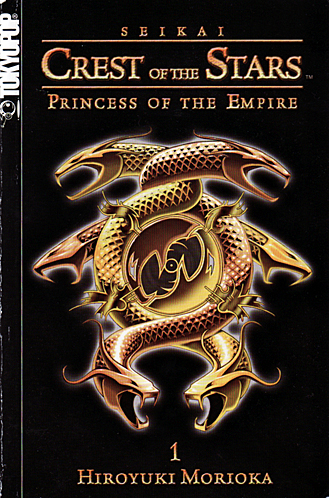
Crest of the Stars

Title: Crest of the Stars: Princess of the Empire
Japanese Title: 星界の紋章:帝国の王女 (Seikai no monshō: Teikoku no ōjo)
Author: Morioka Hiroyuki (森岡浩之)
Translator: Sue Shambaugh
Publication Year: 1996 (Japan); 2006 (America)
Publisher: Tokyopop
Pages: 212

I am a great lover of books, and I spend a great deal of my time reading. I genuinely enjoy almost everything I read, no matter what the genre, and rarely do I dismiss something as absolutely not worth reading. It is very easy for me to explain why I like a particular book, or what is valuable about a particular work, but I think that sometimes it’s important to also discuss what is mediocre, and what can be done better.

Morioka Hiroyuki’s Crest of the Stars series was recently held up to me as a paragon of Japanese science fiction. I wasn’t impressed with the translation of the first book in the series, Princess of the Empire, when it was released in the fall of 2006, but I decided to try it again. The series is massively popular in Japan, and it has quite a dedicated fan base in America as well. I have heard it described as a masterpiece of Tolkienesque proportions in several reviews; and, in my mind, there is no higher praise. Perhaps I had misjudged it four years ago.

Unfortunately, upon re-reading the book, that turned out not to be the case. Princess of the Empire starts off with a wonderful prologue, which briefly introduces the main character of the series in an interesting and beautifully described setting before launching into a short but fascinating account of the space journeys that led to the present moment. This history is then interrupted by action! intrigue! betrayal! and emotion! Unfortunately, this prologue is only sixteen pages long. What follows is 161 pages of utter garbage.

The teenage hero of the series, Jinto, arrives at a spaceport, where he is met by a beautiful blue-haired space elf named Lafiel. Lafiel takes Jinto to a space elf ship which will transport him to the space elf academy (Jinto, although genetically human, is politically an honorary space elf). The ship is attacked by a human group that seeks to oppose the space elf empire, and only Jinto and Lafiel escape. The ship is destroyed, and the unlikely pair (well, actually, very likely, considering that there are no other characters) is stranded on a small backwards planet. The end. Oh, and if you guessed that Lafiel is the princess of the space elf empire, you win a cookie.

You might be thinking, well, if Morioka spins 161 pages out of relatively nothing, then he must be a fairly talented writer with an eye for detail and a talent for dialog. Wrong. The Crest of the Stars series is known for its world building, and what Morioka has given us is 161 pages of almost unmitigated world building. The space elves are called Abh, they have a space empire, they have strange breeding practices, and they are genetically engineered to be beautiful, blue-haired, and psychic. That’s right, they are psychic space elves – which would perhaps be forgivable if there were more to them. Unfortunately, Morioka’s world building reads like a world history textbook written for fourth graders. Even when delivered in speech, the tone of this information is uniformly dry, essentialist, and uninteresting. Population statistics and general government details are provided, but nothing is said about culture, religion, art, lifestyles, political factions, diversity, philosophy, attitudes towards technology – or anything that the reader might actually care about. The clunky constructed language that annoyingly pervades the text is substituted for any real imagination. The almost complete lack of any visual imagery makes the book seem almost sterile, which I don’t think is a deliberate choice on the part of the author, whose writing is incessantly puerile:

Sure, Jinto had experience interacting with girls – he’d made a point on Delktou, in his own way. However, older women were still a complete mystery to him – especially gorgeous older women who were commanders of interstellar battleships. He couldn’t get his heart to stop racing.

In other words, instead of building a fictional world gradually while pulling his readers deeper into said world through plot thickening and character development, making them increasingly curious about the universe in which the characters live as they become increasingly attached to the characters themselves, Morioka completely forgoes plot and character development in order to construct his setting, which quite frankly feels like a cliché mix of Star Wars empire-and-princess driven space opera and Star Trek alien-culture-of-the-week episodic exploration adventure. The fact that the Abh are long-lived, pointy-eared, and dismissive of humans does not make Crest of the Stars Tolkienesque, unfortunately. In his postscript, Morioka states that he hopes “to make shameless sci-fi fans groan.” I’m pretty sure “groan” is the operative word here, since even Troy Denning’s novels set in the Star Wars universe are better written. Alas.

Princess of the Empire is everything I hate about the genre of young adult fiction, which tends to presume that its readers can’t handle complex plots, three-dimensional characters, figurative language, or middle school vocabulary. It could be argued that Japanese light novels are an entirely separate medium than young adult fiction; but still, there are infinitely better light novels out there. One of my personal favorites is Ono Fuyumi’s The Twelve Kingdoms series. A translation of the fourth installment, Skies of Dawn, was recently released a week or two ago, and I am happy to report that the series is only getting better with each successive book.

If it’s Japanese science fiction you’re looking for, then popular mainstream writers from Abe Kōbō to Ōe Kenzaburō to Miyabe Miyuki have successfully tried their hands at hard science fiction at one point or another. If you’re looking for the epic adventure and unparallel world building of Frank Herbert (or China Miéville), then check out Murakami Haruki’s Hard-Boiled Wonderland and the End of the World, which benefits from one of the most artistic and creative translations I have ever read. If you’re more in the mood for the intellectual short fiction of someone like Ray Bradbury (or Tim Pratt), then check out Tsutsui Yasutaka’s collection The Salmonella Beings from Planet Porno. If you’re in the market for lighter fare, I have been especially impressed by several of the translations I have read from an upcoming press called Haikasoru, which is an arm of Viz Media, an established publisher of manga intended for a slightly more mature audience than that targeted by Tokyopop.

In any case, to return to Princess of the Empire, it’s a morass of weak writing and tired stereotypes. Perhaps the Crest of the Stars series deepens in the second and third books, which are also available from Tokyopop, but I would rather spend my time reading all the cool new stuff that seems to be coming out almost every month. For those who want to know what all the fuss is about but don’t have the stomach to brave the light novels, there is always the Crest of the Stars manga trilogy (also published by Tokyopop). The manga are just as mediocre as the books – but at least the female characters provide the service of bending over to reveal themselves every few pages. Which, I suppose, is always a welcome distraction from heavy-handed world building and the overuse of a constructed language.