Shimeji Simulation

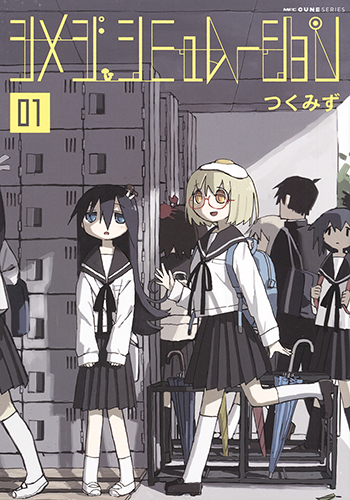
Shimeji Simulation (シメジ シミュレーション) is a gentle but deeply surreal slice-of-life manga about two teenage girls living through the end of the world – or perhaps not “the” world, necessarily; but rather, an artificial world that they happen to inhabit. The focus of the manga isn’t on the apocalypse, which passes mostly unremarked and unexplained. Instead, the core of the story is the friendship (and understated romance) between the two girls, Shijima and Majime. 

Shijima Tsukishima has spent the past two years of middle school quietly living inside a closet, and the manga opens when she decides to begin attending high school at the beginning of the school year. Why Shijima became a hikikomori is something of a mystery, but her primary personality trait is that she dislikes being bothered. She plans to spend her time in high school silently reading books at her desk.

This plan is interrupted by a classmate named Majime, who aggressively demands that Shijima become her friend. Since a pair of shimeji mushrooms sprouted from the side of Shijima’s head during her period of isolation, Majime immediately gives her the nickname “Shimeji,” an appellation that quickly becomes as pervasive and persistent as Majime herself.

Majime bluntly inserts herself into Shijima’s life and persuades her to join the school’s Hole Digging Club, which is managed by an art teacher named Mogawa. Majime assumes that the club is little more than an excuse to hang out after school, but Mogawa is oddly committed to the endeavor, especially when encouraged by the quiet presence of a second-year student named Sumida who only communicates through abstract drawings. Meanwhile, Shijima’s older sister has dropped out of college to devote herself to the ongoing construction of a bizarre machine with an inexplicable function.

For the most part, the girls engage in mundane slice-of-life adventures. They chat in the classroom, visit one another’s houses, and attempt a study session at a family restaurant. Mogawa teaches her art lessons. Majime catches a cold. A group of girls in their homeroom start a rock band. Shijima meets a super-senior named Yomigawa who’s decided to stay in high school just to hang out in the library and read philosophy books.

What makes this manga interesting are the strange glitches in the world surrounding the characters. The mushrooms sprouting from Shijima’s head are a good example, but there’s also the fact that Shijima and her sister occupy one of the only two tenanted apartments in a giant danchi housing building that’s falling apart yet still somehow livable. 

As the story progresses, more glitches begin to manifest. Everyone wakes up to a snowstorm in the middle of summer, for example. One day, the school building is flipped vertically and becomes a pocket dimension with a separate axis of gravity. Another day, water loses its mass and floats in the air. Suburban streets twist into optical illusions, and fish swim through the sky.

Although small glitches seem to be innate to the world, they’re exacerbated by Shijima’s sister, who’s been building and experimenting with various devices that alter the fabric of reality. Each of the first three volumes of the manga concludes with a longer narrative segment that shows the consequences of these experiments for Shijima and Majime, who are briefly thrown into the gaps between the cracks of reality.

The cumulative damage caused by Shijima’s sister is countered by a godlike entity who presents as a young girl and calls herself “the Gardener.” The Gardener’s role is to ensure that the reality experienced by the characters doesn’t mutate too wildly from one day to the next, but her power is curbed by the features of the universe’s code intended to keep its residents safe. She might be able to repair gaps in reality, but she has no means of forcing her will onto humans, even if it’s for their own good.  
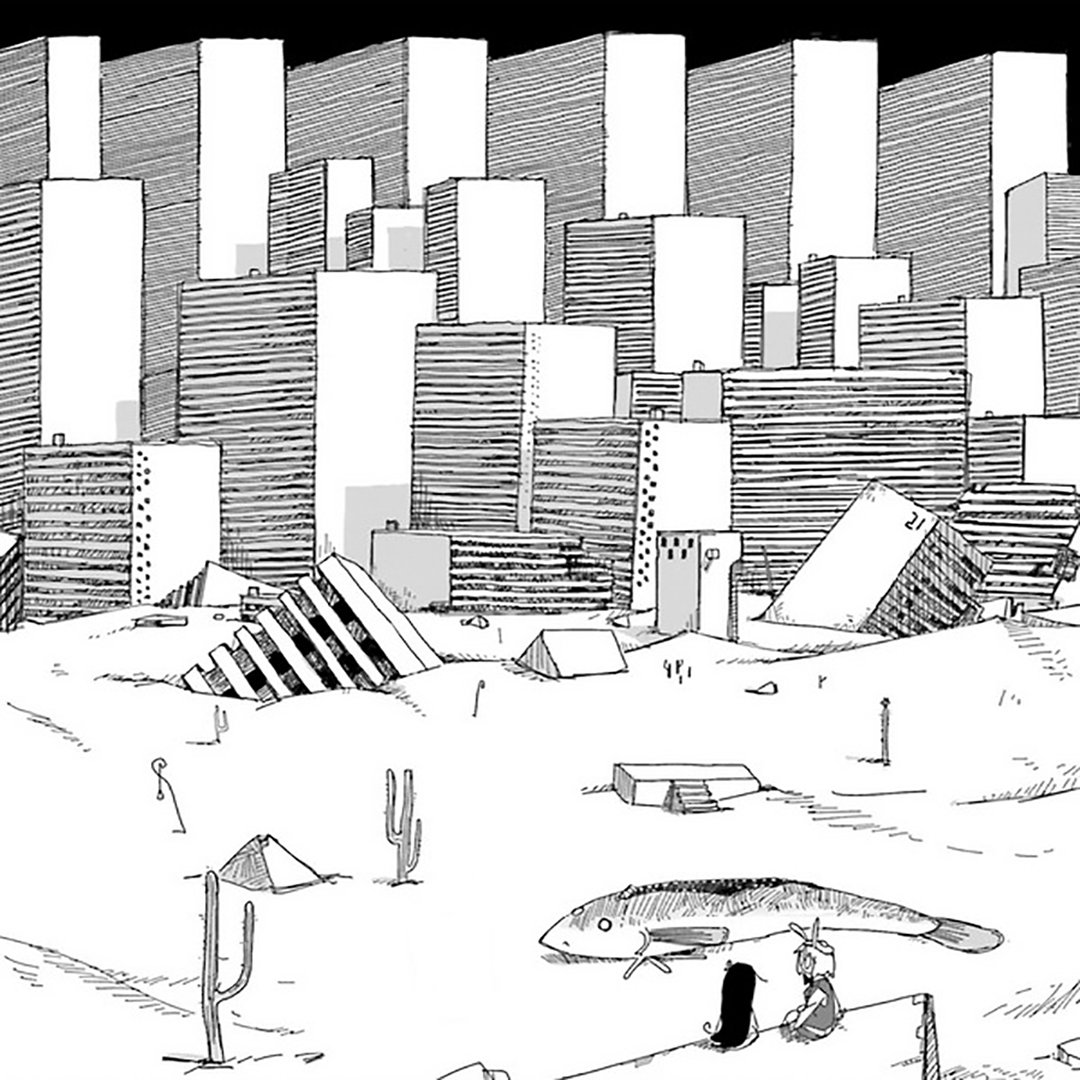
Like Tsukumizu’s previously serialized manga, Girls’ Last Tour, it’s difficult to say that Shimeji Simulation is “about” anything. There’s no plot to speak of, and the only real conflict is between the characters and the entropy eating away at the edges of their slowly decaying world. In addition, it’s never explained how this constructed universe and the characters who inhabit it came to exist. Instead, I think it’s probably fair to say that the manga’s primary concern is existential ontology. In other words, what does it mean to be human, and why do we exist?

I recently read an interesting essay (here) whose author argues that Shimeji Simulation is about the barriers between people, why we need them, and what happens when they disappear. If everyone were able to get exactly what they want, what happens when the desires of separate individuals come into conflict? If there were a world perfectly tailored for one person alone, could anyone else live there? And, if you retreat into complete solipsism, what’s the point of being alive?

Toward the end of the manga, Shijima finds herself in a situation very much like her self-imposed hikikomori isolation in the beginning, when she lived entirely in the darkness of her closet. In the simulated world she comes to occupy through her sister’s rewriting of the universe’s code, Shijima doesn’t bother anyone, and she never has to deal with any external input that she doesn’t choose for herself. Still, can we really say that such pristine loneliness is preferable to the messiness of human relationships?

I read Shimeji Simulation as a story about the various ways that people communicate and connect with one another. Shijima never becomes a “normal” or friendly person, but she still manages to find joy and meaning in her interactions with other people, even if most of these interactions are nothing special. This is why, in the fifth and final volume of the manga, Shijima breaks the boundaries of her personal universe to find Majime, wherever her friend might exist in the fractured constellation of simulations.
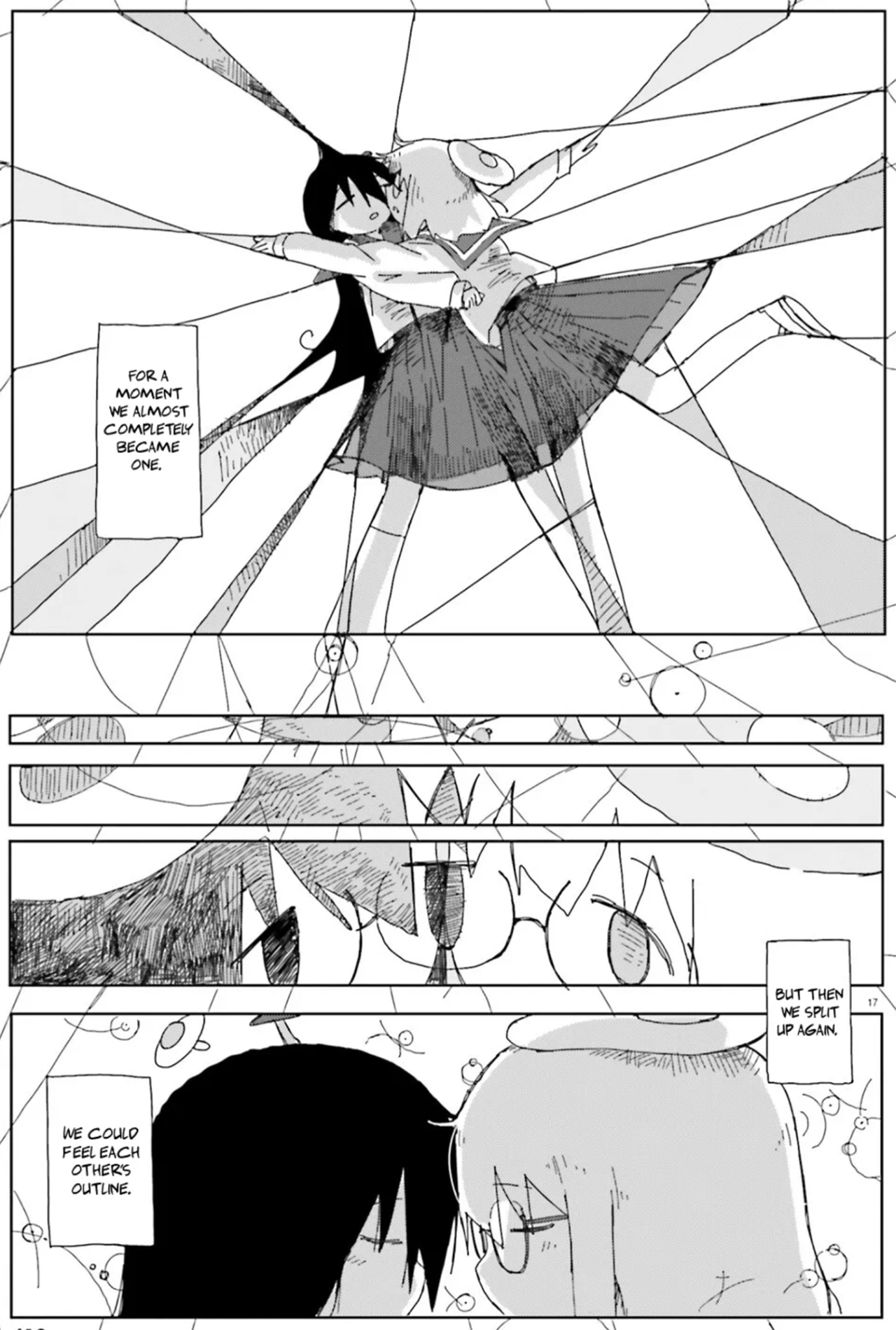
“The meaning of life is to understand love” may seem cliché; but, given how strange and surreal her story becomes, Shijima’s realization feels significant and well-earned. Life is a constant shifting and melding of interpersonal boundaries, and communication and companionship are worth the pain and trouble of being human.

Shimeji Simulation is a remarkable work of science fiction. The manga may seem to have an unassuming beginning, but its narrative structure gradually builds, loops back in on itself, and continually starts over from a weirder and more nuanced position. Likewise, Tsukumizu’s art may initially feel sketchy, but this style is perfectly suited to express the uncanny glitches and fluid malleability of the setting. Shimeji Simulation is gentle and quiet, but also immensely intelligent and creative, and it’s a manga to contemplate and enjoy slowly while allowing yourself to be transformed alongside the characters and their strange but fascinating world.

Shimeji Simulation hasn’t received an officially licensed English translation, but a fan translation is currently available to read on Dynasty Scans (here). If you’re interested in a small taste of the manga’s tone, I’d also like to recommend the short fan anime adaptation of the opening chapter on YouTube (here).

Lonely Castle in the Mirror

Japanese Title: かがみの孤城 (Kagami no kojō)
Author: Mizuki Tsujimura (辻村 深月)
Translator: Philip Gabriel
Publication Year: 2017 (Japan); 2021 (United Kingdom)
Press: Doubleday
Pages: 355

Thirteen-year-old Kokoro has stopped going to school after being bullied by her classmates and ignored by her homeroom teacher. Kokoro’s sympathetic mother has enrolled her in an alternative school, but Kokoro can’t bring herself to attend, as much as she might want to. Made physically ill by her anxiety, all Kokoro can do is stay at home while watching daytime television and waiting for time to pass. Just as she’s on the verge of spiraling into depression, the mirror in her bedroom begins glowing, and she is pulled through its shining surface into a mysterious castle.

Kokoro is one of seven middle-schoolers greeted by a girl wearing a fancy dress and a wolf mask who calls herself “the Wolf Queen.” The Wolf Queen tells the children that they have one year to locate a hidden key that will unlock a secret room. If one of them manages to make it inside the room, they will be rewarded by having a wish granted. The caveat is that, once the wish is granted, the castle will disappear. In the meantime, they can use the castle however they like during school hours.

It doesn’t take Kokoro and the other children long to figure out that none of them are going to school, at least not during the day. Instead of competing to see who can find the key and the room, then, they’re content to use the castle as a place to hang out while playing video games and chatting. They eventually grow close enough to make plans to get together as a group outside the castle; but, despite their firm promises to each other, no one appears at the designated meeting spot.

This intensifies the question that no one has wanted to bring up – what in the world is going on? And, perhaps more importantly, will they ever be able to see each again once their year in the castle has ended?  

Lonely Castle in the Mirror is a novel about friendship, specifically friendship between outcasts. In many ways, the group of children who gather in the castle is reminiscent of the Loser’s Club from the Stephen King novel IT (albeit with a much lighter tone). Each of the kids is living through the unpleasant fallout of a traumatic experience, but they gradually open up to each other and work through their issues together. Nothing about this character development is saccharine or sentimental, and misunderstandings and gaps in communication occasionally arise. There’s a fair amount of teenage awkwardness and egocentrism, but none of the characters is overtly unsympathetic.

Kokoro is struggling with having been targeted a group of mean girls, and the novel’s depiction of bullying felt especially real to me. The treatment Kokoro received at the hands of her classmates is genuinely disturbing, but even worse is the attitude of the teachers at her school, who apparently expect her to apologize to the people who went out of their way to antagonize her. Lonely Castle in the Mirror is YA fiction, to be sure – there is no strong language, substance abuse, or mention of sex or sexuality. Still, parts of the story are painfully honest, and the novel’s sensitive but realistic treatment of cruelty and anxiety doesn’t pull any punches.

Despite its fantastical elements, Lonely Castle in the Mirror is more of a mystery than a fantasy, although it admittedly takes its time warming up. Kokoro and her friends are in the process of recovering from trauma, and they’re understandably reluctant to discuss serious matters. Most of them avoid doing anything that would disturb the comfortable haven they’ve been miraculously granted. The novel ambles through what seem to be a few false starts, with one problem emerging only to be quietly resolved. Patient readers who accept the story on its own terms will be rewarded, however, as the plot gradually gains depth and momentum. It’s easy to fly through the pages of the lengthy final chapter, and the conclusion is extremely satisfying.  

As its cover copy proclaims, Lonely Castle in the Mirror is a bestselling novel in Japan, and there’s no reason why this story won’t resonate with readers outside of Japan. Philip Gabriel’s translation is impeccable, preserving a sense of timelessness while handling the teenage characters’ dialog with grace and good sense. It’s easy to compare Lonely Castle in the Mirror to Eto Mori’s recently translated YA novel Colorful, or perhaps even the early Harry Potter novels, but it has its own unique charm and magic. Teenagers in the same age range will find Kokoro and her friends to be sympathetic and relatable, while the story is compelling enough to wrap adult readers in its mysteries.

Nickelodeon

Nickelodeon Blue

Title: Nickelodeon
Japanese Title: ニッケルオデオン (Nikkeruodeon)
Artist: Dowman Sayman (道満 清明)
Publisher: Shōgakukan (小学館)
Publication Dates: 11/2010 – 10/2014
Volumes: 3 (赤・緑・青)

I sometimes feel as if I’ve spent the past ten years of my life trying to find another Azumanga Daioh: a set of girl-centric stories that are weird and funny and touching without being male gazey. I love Azumanga Daioh‘s cute artwork and bizarre situations and perfect ratio of dark to sweet humor. Having read my way across a large swath of its many, many imitators, I’ve come to the conclusion that Azumanga Daioh is one of a kind. But I’ve found something close, yet different – and just as enjoyable.

Dowman Sayman’s Nickelodeon series is, on the surface, nothing like Azumanga Daioh. Each of the manga’s stand-alone stories is exactly eight pages long; and, aside from a few inconsequential crossover references, they have nothing to do with each other. Whereas Azumanga Daioh was all about the daily lives of high school girls, the subject matter of the stories in Nickelodeon ranges from grotesque fantasy to sci-fi spoofs to sarcastic magical realism. Unlike Azumanga Daioh, which has few male characters of note, the cute girls of Nickelodeon are more than adequately balanced by cute boys. What Nickelodeon does have in common with Azumanga Daioh is the tone of its unique style offbeat humor, as well as the artist’s ability to imbue stock characters with unexpected depth and feeling.

At the core of each of the stories in the series is a relationship between people, with “people” being a relative term. These relationships can be friendly, or romantic, or antagonistic, or a mix of all three. Boys are paired with girls, boys are paired with other boys, girls are paired with girls, girls are paired with tigers, boys are paired with flesh-eating demons, high school students are paired with clueless angels, conjoined twins are paired with blind dates, and ghosts of all sexes are all over the place. There are robots, giants, mad scientists, wish-granting devils, zombie princesses, and seemingly normal people with all manner of strange hobbies. The artist is like Scheherazade, spinning a seemingly infinite number of stories out of contemporary pop culture tropes, but all of his stories are refreshingly original.

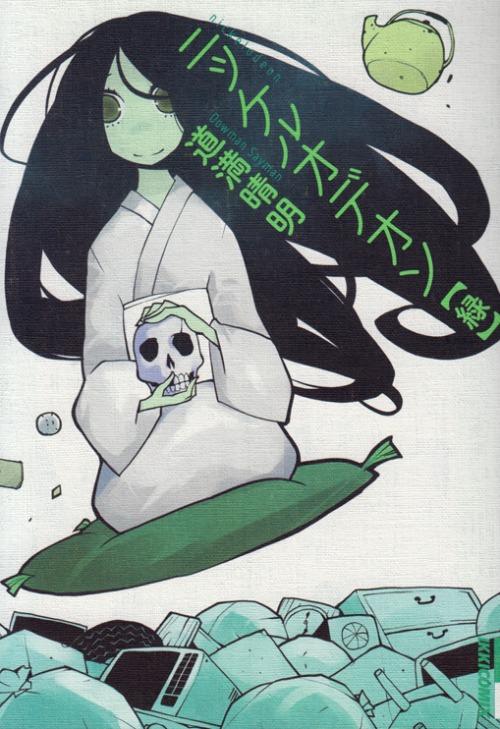
One of my favorites is the cover story of the “Green” volume (pictured below), “Hickey & Gackey” (Hikkī & Gakkī). The piece opens with a girl named Otowa delivering a set of handouts to her classmate Sengoku-san, who seems to have become a hikikomori some time ago. Sengoku-san lives alone in her house, which has become a gomi-yashiki (trash hoarder’s den). After speaking briefly with Sengoku-san, Otowa promises to come again next week, but Sengoku-san tells her that this is the last time they’ll meet, as the city is sending an enormous garbage disposal unit named “Duskin Hoffman” (Duskin is a Japanese company that makes Swiffer-like cleaning implements) to her house to dispose of her like the rubbish she is. Suddenly, the ground starts shaking, the blades start whirling, the trash starts flying, and Otowa reaches out to Sengoku-san, making a last desperate confession. It’s absurd and ridiculous but somehow manages to punch you right in the feels, and the ending is beautifully open to interpretation.

Nickelodeon was serialized in Shōgakukan’s recently defunct IKKI monthly alternative seinen magazine, and its readers were thus expected to be genre-saavy and open to weirdness. The manga also contains moments of overt sexuality – it’s nothing that could even remotely be considered pornographic, but some of the characters are shown engaging in adult thoughts and behaviors, and there is occasional cartoonish nudity. The humor is for the most part good-natured, and the author emphasizes and plays on the silliness and personality quirks of his characters, not the sizes and shapes of their bodies. However, because male and female humans are portrayed as having nipples (the horror!), I don’t foresee Nickelodeon being licensed in North America. If you can speak a little Japanese, though, it’s fairly easy to read. In fact, I assigned a chapter to my fourth-year Japanese class this past fall, and the students seemed to really enjoy it.

Nickelodeon is almost perfectly bespoke to my own personal tastes, so it may be that I’m biased, but I think the three-volume series represents many of the great pleasures of manga written for an adult audience. Downman Sayman is wonderfully talented, and I’m expecting great things from him in the future. Hopefully one day his work will find its way into English!

The artist has two other two-volume seinen series, The Voynich Hotel (Voinicchi Hoteru) and Paraiso (Para☆Iso), available on Amazon.co.jp, and you can also find him on Twitter. Although he hasn’t updated it in some time, he has an account on Tumblr, which is cute and hilarious (but not entirely safe for work).

Nickelodeon Green

Bye Bye Kitty

Title: Bye Bye Kitty: Between Heaven and Hell in Contemporary Japanese Art
Editor: David Elliott
Additional Essay By: Tetsuya Ozaki (小崎 哲哉)
Publisher: Japan Society Gallery and Yale University Press
Publication Year: 2011
Pages: 125

I’m glad someone finally said it: Japan is not all cute, all the time. Japan produces many cute things (I’ll admit it, pokémon are pretty cute), and Japanese cuteness is fairly visible in America, where there are vast subcultures of people who idolize it. Part of the reason why Japanese cuteness has spread to North America, Europe, and other countries in Asia is because cuteness appeals to people outside Japan, after all. (And it’s not like mainstream American media doesn’t produce its fair share of appeals-to-men-in-their-thirties cuteness on its own.) I think there is still an oddly pervasive idea, however, that everything that comes out of Japan is either Hokusai or Hello Kitty. I therefore want to hug David Elliott, whomever he may be, for putting together the Japan Society’s Bye Bye Kitty exhibition and catalog. The artwork is spectacular, and the essay by Elliott that opens the catalog strikes a powerful blow against the assumption that all contemporary Japanese art features huge anime eyes.

Elliott begins with a five-paragraph introduction to postwar Japan, from Douglas MacArthur to double-digit GNP growth to post-bubble malaise. He then moves on to Murakami Takashi’s cultural theory of kawaii, namely, that the Japanese nation is some sort of puer aeternus stuck in a neverland of cuteness and consumption. And then Elliott laughs and states the obvious:

Many artists, however, … have produced work that indicates a more complicated, adult view of life, melding traditional viewpoints with perceptions of present and future in radical and sometimes unsettling combinations. This hybridity … has created a fertile seedbed in which the struggle between extremes of heaven and hell, fantasy and nightmare, ideal and real take place. There is no room for Kitty’s blankness here.

In other words, Japanese artists deal with the same concerns as Western artists, and they do so as adults, intelligently processing cultural and political history and anxieties through creative and technically sophisticated artworks. Elliott identifies three major themes in the work of the artists represented in this exhibition: critical memory (how we deal with the legacy of the immediate past), threatened nature (how we deal with our fears concerning the immediate future), and the unquiet dream (how we deal with our selves). As a whole, the essay is beautifully worded, beautifully illustrated, and well worth the price of the entire book.

Elliott’s essay is followed by a short piece by Tetsuya Ozaki, the former editor of ART iT, a gorgeous bilingual magazine devoted to the contemporary Japanese art scene (if you happen to be in Japan, you can easily find back issues on Amazon.co.jp or at major bookstores like Kinokuniya). In this essay, Ozaki makes the connection between “a system that doesn’t make people happy” and the current “floating generation” of suicides, hikikomori, and otaku. He demonstrates how young Japanese artists are resisting “the kawaii phenomenon” as a means of escape and argues for a broader understanding of Japanese artists as adults both reacting to and transcending their cultural environment. Accompanying this essay are timelines demonstrating, for example, the discursive space of Shōwa Japan and landmarks in postwar Japanese art.

And then there is the art itself. The catalog showcases the work of sixteen artists, all in their twenties through forties, and all showing large and colorful pieces in this exhibition. In my opinion, the primary keyword for these pieces is detail. Yamaguchi Akira, for example, has two pen and watercolor paintings on the theme of Narita Airport in which the roofs (even those of the planes) are lifted to reveal a minutely detailed Edo-esque fantasy of Meiji bureaucrats rubbing shoulders with women in kimono excusing themselves after bumping into Caucasian tourists fumbling with their cell phones. Another of Yamaguchi’s paintings, The Nine Aspects, is a picture scroll reading from right to left and illustrating the nine stages of decay of a horse after its top-knotted master discards its corpse by the wayside. Except the horse is also a motocycle, and the architecture is half Edo and half Shōwa nostalgia. Time is also compressed in the huge pen-and-ink illustrations of Ikeda Manabu, which depict hulking architectural monstrosities so finely detailed that a magnifying glass is necessary to catch all the small touches, like the bomber planes flying in formation below the golden-ceilinged temple caught up in the branches of an enormous dying cherry tree. Finally, there is Aida Makoto (of Harakiri School Girls fame) whose acrylic painting Ash Color Mountains confronts the viewer with towering piles of dead salarymen, each individually detailed, which somehow makes the spectacle even more disturbing.

My one complaint about the Bye Bye Kitty catalog is that, with dimensions of about a foot squared, it really can’t do justice to all of the amazing detail of the exhibition’s artwork, the majority of which is at least as tall as I am. Therefore, if you can possibly get to New York to see the show itself before it closes on June 12, you should go! It’s one thing to see something like Ash Color Mountains while flipping through the pages of a catalog; it’s another thing entirely to walk into a room with no expectations and suddenly find that there it is all around you. The work of Ikeda Manabu especially must be seen to be believed, and the more installation-focused work of artists such as Shioyasu Tomoko and Chiharu Shiota should really be experienced in person. There is not a single boring artist in the exhibition, so it’s definitely worth traveling to visit. The best work of so many unique and high-profile Japanese artists doesn’t come together like this very often, so catch it while you can – or at least consider ordering a copy of the catalog.

Anime Explosion!

anime-explosion

Title: Anime Explosion! The What? Why? & Wow! of Japanese Animation
Author: Patrick Drazen
Publication Year: 2003
Publisher: Stone Bridge Press
Pages: 369

When I got Anime Explosion! in the mail from Amazon, I was so excited. I had seen it on a friend’s bookshelf, and, silly cover illustration aside, it seemed like a fairly serious reference source on anime. Instead of merely listing one anime series after another, its chapters are structured around broad themes (portrayals of nature, anti-war messages, etc.), with chapters devoted to single works or directors at the end of the book. The chapters are filled with well-selected and well-formatted illustrations accompanied by captions that do not merely repeat what is in the text, and there are numerous footnotes, which are also well-formatted and easy to read. The bibliography at the end of the book references such serious scholarly works as Professor William LaFleur’s Liquid Life: Abortion and Buddhism in Japan as well as numerous creator interviews from the pages of the long defunct but still fondly remembered anime magazine Animerica. The book hits all the big bases, like Japanese folklore in anime, nudity in anime, the Pokémon phenomenon, Studio Ghibli, and even one of my personal favorite series, Revolutionary Girl Utena. What’s not to like?

The fact that Anime Explosion! is one of the more boring books I’ve ever read is not to like, actually. And you’ll have to believe me when I say that, during my six years in higher education, I have read some pretty boring books. During my two years in higher higher education, I have also read some pretty terrible student papers, and so I think I can put my finger on what I dislike about Anime Explosion! – it’s the plot summary. Pages and pages of it. All written in singularly uncreative and unevocative prose. Judging from the level of the language, I would say that, despite the occasional frank discussions of sex and sexuality, the target audience for this book is currently enrolled in middle school. The book also assumes that the reader knows nothing about Japan, which I suppose is fair; but, to those of us who have studied the country, the cultural clichés referenced over and over again come off as a little stale. There also isn’t much interpretation involved, and the little that does exist is tepid and sophomoric.

I hesitate to say this, as Drazen acknowledges this problem in both his introduction and his conclusion, but Anime Explosion! is also a bit dated. The individual works covered in the book are, for the most part, classics, and no amount of time is going to change that. In that sense, Drazen has done an excellent job of creating a reference work that will transcend the whims of an extremely capricious field. On the other hand, for having been published in 2003, this book feels like a relic from the mid-nineties. The internet? What is this strange thing? The Japanese bubble economy collapsed? Oh my god! Also, to me, a presumably serious scholar, many of the seventies and eighties era texts Drazen references (like Kitteridge Cherry’s Womansword: What Japanese Words Say About Women) can no longer be taken seriously. Also, for those fans curious about such recent phenomena as moe and hikikomori, there is nothing to be found.

All that being said, this is a solid book and may prove interesting to younger or more hard-core anime fans. And, to be fair, Drazen’s chapter on “Gay and Pseudo-Gay Themes in Anime” (which Drazen aptly titles “A Very Pure Thing”) is bold, insightful, and well ahead of its time. For those of us interested in how anime stereotypes came to be, chapters like “Shojodo: The Way of the Teenage Girl” are also useful. For older readers looking for thrills and entertainment, however, I would recommend an anime magazine like Otaku USA, which tends to function at a much higher level than Drazen’s well-meaning but regrettably prosaic reference work.