The Columbia Anthology of Modern Japanese Literature, Abridged Edition

Title: The Columbia Anthology of Modern Japanese Literature, Abridged Edition
Editors: J. Thomas Rimer and Van C. Gessel
Poetry Editors: Amy Vladeck Heinrich, Leith Morton, and Hiroaki Sato
Publication Year: 2011
Publisher: Columbia University Press
Pages: 960

The Columbia Anthology of Modern Japanese is the most comprehensive anthology of Japanese literature since the mid-nineteenth century; but, with two enormous (and expensive) volumes, it’s a bit daunting for all but the most stalwart of readers. I was therefore excited to learn that an abridged softcover version of the text has been released. At almost a thousand pages, the anthology still isn’t for the casually interested. As it provides a much wider selection of writers and genres than every other anthology of modern and contemporary Japanese literature on the market, however, The Columbia Anthology is an invaluable resource not only for students of Japanese literature but also for anyone interested in Japan in any capacity.

The anthology is divided into six sections spanning from the beginning of the Meiji period in 1868 to the end of the twentieth century. The two sections devoted to the Meiji era include work by naturalists and playwrights such as Mori Ōgai, Shimazaki Tōson, Kunikada Doppo, and Nagai Kafū, as well as essays by Natsume Sōseki, including “The Civilization of Modern-Day Japan.” The anthology then proceeds into the interwar period, which includes the work of authors such as Akutagawa Ryūnosuke, Edogawa Rampo, Kawabata Yasunari, and Tanizaki Junichirō. The section titled “The War Years” is mercifully short but includes stories by Dazai Osamu, Ishikawa Tatsuzō, and Ōoka Shōhei.

The “Early Postwar Years: 1945-1970” section is the longest in the anthology and reads like a hit parade of famous postwar writers such as Abe Kōbō, Enchi Fumiko, and Mishima Yukio. Many well-known postwar joryū bungaku (“women’s literature”) writers, such as Hayashi Fumiko and Kōno Taeko, are represented as well. The last section collects contemporary literature from the seventies, eighties, and nineties by both internationally famous authors such as Murakami Haruki and Ogawa Yōko and writers who are prolific and well known in Japan, such as Hoshi Shinichi and Furui Yoshikichi.

What is wonderful about this anthology is that, unlike other anthologies of modern and contemporary Japanese literature, it includes lengthy selections of Japanese poetry, both in “traditional” forms (such tanka and haiku) and in more modern forms (such as free verse). Although I am not a connoisseur of poetry in translation and thus can’t vouch for the quality of The Columbia Anthology‘s selections, I am thankful that so many works of modern and contemporary Japanese poetry have been brought together in a single volume. The majority of the original publications in which these translations appeared have long since gone out of print, so The Columbia Anthology is perhaps the best way to familiarize oneself with a rich yet underappreciated body of literature. The anthology also includes dramatic scripts by playwrights and screenwriters such as Inoue Hasashi and Kara Jūrō, texts which are also difficult to find elsewhere.

My enthusiasm for The Columbia Anthology is genuine, but some of the editors’ comments in the Preface shed light on some of the more conservative politics of literary anthologization. For example, to justify the entry of their project into a field in which many anthologies already exist, Rimer and Gessel state:

One difference between this volume and some of the earlier collections is related to the evolving view of both Japanese and foreign scholars as to what constitutes “literature.” Many of the earlier collections sought, consciously or unconsciously, to privilege the long and elegant aesthetic traditions of Japan as they were transformed and manifested anew in modern works. […] But many other kinds of writing, ranging from detective stories to personal accounts – always valued by Japanese readers but neglected by translators in the early postwar decades – can now be sampled here.

Expanding the scope of what is considered literature through diversity in anthologization is always good, of course, but two paragraphs earlier, the editors also made this strange comment:

Whatever the level of young people’s interest in manga (comics) and video games may be, literature, as opposed to simple entertainment, often remains the best way to grapple with the problems, and ironies, of the present generation of Japan.

On reading this sentence, I somehow managed to raise an eyebrow and roll my eyes at the same time. The context of this statement was a defense of the strength of contemporary literature in the face of a weighty literary tradition, but I wonder why the editors needed to make the distinction between “literature” and “entertainment” at all. Some types of print culture (such as dramatic scripts) are literature, but others (such as the text portions of visual novels) are not? Edogawa Rampo’s grotesque short stories are literature, but Otsuichi’s horror fiction is not? Haiku are literature, but tweets are not? And – most importantly – manga is not literature? Seriously?

Despite the editors’ stated desire to expand the scope of what is considered literature, their literary politics are, as I stated earlier, quite conservative. Popular fiction by writers like Murakami Haruki and Yoshimoto Banana is included in the anthology, but the work of such writers has been so resolutely canonized by scholarly articles and inclusion in course syllabi that its anthologization comes as no surprise. It’s good to have “outsider” writers like Tawada Yōko and Shima Tsuyoshi included in the anthology, but all of the volume’s stories more or less fit neatly into the category of “literary fiction.” You will not find the cerebral science fiction of Kurahashi Yumiko, or the historical revisionings of Miyabe Miyuki, or the fantastical explorations of Asian-esque mythology of Uehashi Nahoko, or the socially conscious mystery stories of Kirino Natsuo in The Columbia Anthology. You also won’t find any prewar popular fiction, such as the short stories of Yoshiya Nobuko.

This leads me to another criticism I have concerning the anthology, which is that it is remarkably dude-centric. Until the last two sections of the text (“Early Postwar Literature” and “Toward a Contemporary Literature”), there are no female writers represented (save for Yosano Akiko, who has a few poems about flowers and vaginas); not even one of Higuchi Ichiyō’s short stories is included. In the anthology’s defense, many of the women writing before and during the Pacific War, such as Enchi Fumiko and Hirabayashi Taiko, are included in the “Early Postwar” section. Unfortunately, this means that their more overtly political work has been passed over for stories that focus more on “traditional” women’s issues like female sexuality and the family. Furthermore, even though I applaud the editors for including literary essays in their anthology, it frustrates me that not a single one these essays was written by a woman, despite the fact that many female authors – including those represented in this anthology – are extraordinarily well known for their essays. What the editors has done is the equivalent of collecting the most influential essays on literature in North America and leaving out something as important and groundbreaking as Margaret Atwood’s On Being A Woman Writer.

In the end, though, I stand by my assessment of the abridged edition of The Columbia Anthology of Modern Japanese Literature as an essential resource to students of Japan. The volume contains many excellent stories, poems, essays, and dramatic scripts that are difficult to find elsewhere, and the editors keep their introductions of writers and literary epochs brief and to the point. As long as this text is supplemented to bridge over its gaps and omissions, I can imagine it becoming the backbone of a respectable introductory course on modern and contemporary Japanese literature, as well as a source of out-of-print translations of the work of less widely taught authors.

Review copy provided by Columbia University Press.

An Otaku Tour of Kansai

If you’re an otaku, Tokyo is the best place to be. No other city on the face of the earth can hold a candle to Tokyo in terms of vibrant subcultures and amazing subcultural experiences that are completely open to anyone who stumbles upon them.

Kansai is awesome in its own right, however, and the region is well worth visiting, even if you’re not interested in rich cultural traditions, gorgeous architecture, and delicious food. There are plenty of things for an otaku to do in Kyoto, Osaka, and Takarazuka.

If you’re headed to Kansai, do yourself a favor and get an Icoca card from the JR automated ticket machines as soon as you exit the Shinkansen into the station. The Icoca is the Kansai equivalent of Kantō’s Suica card. Like the Suica, you pay need to pay 2000 yen for an Icoca. 500 of that yen is a deposit that will be returned to you if you turn in the card at a station office, and the rest can be used to go anywhere, anytime, on any vehicle. You can put more money on your Icoca at any station, and your remaining balance will be returned to you along with your deposit when you return the card. If you already have a Suica, you can use it for all JR rail lines in Kansai, but it doesn’t work anywhere else. Since the best way to get around Kyoto is by bus or taxi, and since the best way to get around Osaka is by subway, it’s definitely worth getting yourself an Icoca.

Kyoto

Besides being filled with temples and famous historic sites and traditional Japanese arts and so on, Kyoto is a tech hub and a college town populated by students, artists, and young professionals. The infinite alleyways snaking behind the main boulevards are lousy with ultra-modern restaurants, tiny theme bars, hostess clubs, host clubs, crazily decorated clothing boutiques, and art spaces the size of a hotel room. Alcohol of all types is cheap, plentiful, and delicious, and strange and fascinating things happen on the streets and along the Kamo River after dark, especially on the weekends. Kyoto is a great city to get lost in.

The top Kyoto attraction for otaku is the Kyoto International Manga Museum. This place is amazing. As an added bonus, it’s also bilingual and Anglophone-friendly. The permanent exhibit is a hyper-illustrated walkthrough of the history and development of manga, the tools and artistic techniques used to create manga, the publishing culture of manga, the genres of manga, and the internationalization of manga. The museum also hosts special exhibits showcasing the work of specific manga artists and illustrators, many of whom are local to Kyoto.

All along the walls of the museum are bookcases on which are shelved the most massive collection of manga I’ve ever seen (and I have seen some massive collections, such as the one housed in the Yoshihiro Yonezawa Memorial Library). Most of this manga is Japanese, but a sizable portion is foreign, including all sorts of North American and European translations and originals. The best part about this library is that you can take anything down from the shelves and read it for as long as you want. The museum also has a smaller library of academic materials dedicated to manga. Again, most of these materials are in Japanese, but there’s also a ton of stuff in English and other European languages. Was there some obscure manga exhibition in Germany? They have the catalog. Was there an issue of The Comics Journal from ten years ago that mentioned shōjo manga? They have that issue. The museum also publishes a few high quality pamphlets and periodicals that you’re free to take as you please (my favorite is a small magazine highlighting the areas of Kyoto featured in recent anime and manga).

To get to the museum, take the subway to the Karasuma-Oike Station, which is served by the Karasuma and the Tōzai lines. Take Exit 2 out of the station, turn to your right at the top of the staircase, and walk for a minute or two until you see the museum on your left. The museum is a converted primary school building, and you’ll know it when you see it. The pennants hanging from the telephone poles along the street in front of it help. Because the museum is awesome, they’ve posted an illustrated map explaining how to get there.

There are also a small handful of otaku specialty stores clustered along Teramachi between Sanjō and Shijō (these are all the names of streets/walkways). If you’d like to get to this area from the Manga Museum, go back to the intersection where you came out of the subway, cross the street, and turn left on Oike to go towards the Kamo River. Walk for about ten blocks (which actually isn’t that far) and enter the Teramachi covered shopping arcade on your right. To get to this area from anywhere else, start at the Sanjō-Keihan Station and cross over the Kamo River on the Sanjō bridge. Keep heading west on Sanjō for about two blocks until the street dead-ends into a covered pedestrian shopping arcade called “Sanjo Cupola.” Keep going straight through the Sanjo Cupola until you emerge into the open air (there will be a giant mechanical crab ahead on your right), and immediately turn left into the Teramachi covered shopping arcade.

After walking for awhile, you’ll see a Melon Books above a drugstore to your right. Melon Books sells hardcore pornographic manga and doujinshi for men, so enter at your own risk. Further ahead on your right you’ll see a bookstore called Manga・Can (漫画館), which is a great place to browse and discover new manga titles. A bit further ahead on your right is the Kyoto branch of Gamers, which has games (mainly of the erotic variety) on the fourth floor and manga and doujinshi on the fifth floor. Most of the merchandise stocked by Gamers is targeted at men, but the store isn’t as hardcore as Melon Books and caries many things of interest to female otaku as well.

Running parallel to Teramachi to the east (one street over to your left if you’re walking towards Shijō) is another shopping arcade called Shinkyogoku. Right before you emerge onto Shijō while walking along Shinkyogoku, there will be an Animate to your right on the second-floor level above a small open plaza. Like all Animate branches, the Kyoto store is distinctive. It has a large and well-stocked manga section that showcases work by local artists, work that has won regional manga prizes, and work appealing to yuri sensibilities.

If cross Shijō on Teramachi, you’ll find yourself on a small, uncovered street. Several dozen feet past Shijō, there will be a five-story Tora no Ana on your left and a five-story bookstore called Shinchō Shoten (信長書店) on your right. Both stores are custom-made for otaku.

Right next to Shinchō Shoten, in a tiny alley about twelve feet past the bookstore and leading off the right, is one of the best-kept secrets of Kyoto: a tiny vegetarian restaurant and sake bar called Mikōan (彌光庵). The food is cheap and delicious and varied enough that no two people will get the same meal even if they order the same thing. The décor and atmosphere are like something out of an urban fantasy novel. There are also several adorable, fluffy cats wandering around the restaurant at any given time, and they don’t mind being friendly if you engage them. Mikōan is all about how awesome Kyoto can be if you wander off the beaten path.

Osaka

Osaka never gets enough credit. Sure, it’s not as rich or as populous as Tokyo, but it’s still a huge city filled with interesting places to go. The urban landscape of Osaka resembles that of Tokyo, but it’s different in all sorts of neat ways. You really will hear people speak Osaka dialect here, which is lots of fun if you’re learning Japanese.

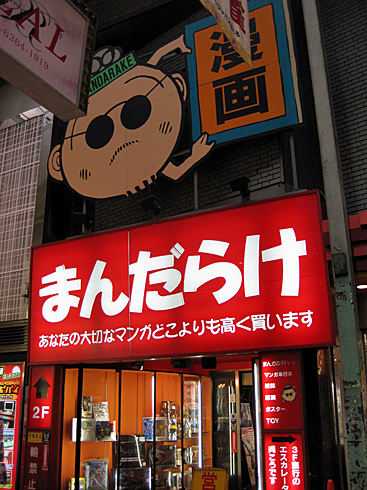
Nanba is the Osaka equivalent of Akihabara. This neighborhood runs alongside a broad avenue called Yotsuhashi-suji or, more appropriately, in the smaller streets and alleys branching off from either side of Yotsuhashi-suji. Nanba Station is an epic mess of stores and restaurants and hotels, and there are many ways to navigate your way outside, but the area you want to be in is on the northeast side of the station. Depending on what train line you’re coming from, it might be easiest to walk through the Takashimaya department store and exit the building from the main entrance. In any case, a small street called Nansan-dōri snakes along the west side of the station. Follow it until you see a Taito Station, and turn left past the arcade. If you keep walking west along the small road (which is still called Nansan-dōri even after if veers away from the station), you’ll begin to see otaku-related stores on your right. The area between Nanba Station, Nansan-dōri, and Yotsuhashi-suji is where all of the electronics stores, maid cafés, used video game stores, and specialty book stores are. You will find a Melon Books and a Yellow Submarine along these backstreets, but, if you want to go to the K-Books and Animate, follow Nansan-dōri until the big intersection and turn right on Yotsuhashi-suji. The K-Books and Animate will be down the street to your right, and the Mandarake will be across the street on your left.

If you’re looking for doujinshi, it’s definitely worth your while to visit the K-Books here, which stocks tons of work produced by Kansai artists. Doujinshi for large fandoms are more or less equally distributed across Kantō and Kansai, but work for small fandoms from small regional conventions doesn’t always make it to Tokyo. There are also a number of original doujinshi at the Nanba K-Books that don’t fall into pre-established genres and resemble nothing so much as they do North American indie comics.

For an otaku, I think the major attraction of Osaka is the Umeda Mandarake. According to fanlore, this is *the* Mandarake, the Mandarake to end all Mandarakes, and the One True Mandarake. The Umeda Mandarake is a sprawling three-story building stuffed to the gills with crap, garbage, and treasure. The building itself looks (and smells) like it should be condemned, and the soft, creaky floor literally sags under the weight of all the junk in the store. Otaku relics are lovingly displayed in glass showcases, while the dim overhead lighting flickers and throws shadows around the piles of unopened cardboard boxes stacked in the corners. The clerks cosplay, and there is a small stage for performances on the second floor that also serves as a dais for life-size renditions of pop culture icons. This place must really been seen to be believed.

Also, if you’re looking for original doujinshi drawn by artists like Yuki Kaori and CLAMP, this is the place to go. In addition, on the staircase landing between the second and third stories, there is a table with a few stacks of “Mandarake Note” notebooks in which visitors to the store can draw and scribble away to their hearts’ content with the art tools provided. If you take the time to flip through some of the old notebooks, you might be lucky enough to catch a glimpse of some really familiar names and art styles. If you’re an a creative mood, you can take over your own notebook page.

Fittingly for a quest of such magnitude, it’s a pain in the ass to get to the store. The easiest method is to take one of the south exists out of the JR Osaka Station (or the Hankyū Umeda Station across the street), get in a taxi, and pay the driver ¥660 to take you to the Osaka Tokyu Inn hotel. If you’re facing the Tokyu Inn, you’ll notice a Small Alley of Ultimate Sketchiness running alongside the right side of the hotel building. Turn left into the alleyway and keep walking until you emerge into a shopping arcade with the Mandarake right in front of you.

If you want to be adventurous, you can go on foot. Take the Mitōsuji South Exit from JR Osaka Station (which can be accessed from JR rail lines and the subway lines) and cross the street under the huge pedestrian bridge. Alternately, take the South Central Exit from JR Osaka Station and climb the stairs to get on top of the huge pedestrian bridge. Either way, you’re heading for the Umeda Hankyū Building. What you’re going to want to do, either by going around, going under, or going through, is to get to the other side of this building. At street level on the other side of the building you’ll see an intersection with a concrete island in the middle of it, and, on the far side of the intersection, a covered shopping arcade called “E Street.” This shopping arcade goes on for a few blocks and in the middle crosses over an open street and changes its name to Hankyū Tōtsū Shōtengai (阪急東通商店街). The Mandarake is on towards the end of the shopping arcade on the left. The shopping arcade itself is tacky and raucous, and any of the restaurants lining the passage can provide you with a ticket out of Sober City on the Cheap Alcohol Express, if you’re interested in that sort of cultural experience.

While you’re in the area, the Osaka Pokémon Center is on the thirteenth floor of the Daimaru department store above the South Central Exit of JR Osaka Station. The store has all sorts of special goods connected to Osaka and the Johto region that you can’t get anywhere else, as well as special Spot Pass promotions for fans who bring their Nintendo DS with them.

Takarazuka

Takarazuka is a mid-sized suburb located about a twenty minute train ride away from Osaka (and a forty-five minute ride from Kyoto, with one transfer in the middle). Not only is the area around the station interesting (it’s like an exaggerated fantasy version of the Europe described by Marcel Proust), but the city is also home to two major otaku-related attractions.

These two attractions are the Takarazuka Grand Theater building and the Osamu Tezuka Memorial Museum. Finding your way around is half the fun of an excursion to Takarazuka, so I won’t give directions. Let it suffice to say that you’re looking for the Hana no Michi (花のみち). This is an actual street divided by a raised walking path lined with flowers. It’s just as romantic as it sounds, and the Takarazuka Revue themed bronze statues along the path add to its charm.

The Takarazuka Grand Theater is the home base of the Takarazuka Revue, which is fabulousness incarnate. Even if you can’t catch a performance (if you do want to see a performance, you’ll want to book your seat well in advance), it’s fun to wander around the massive theater complex just to drink in the atmosphere. If you’re lucky, you’ll get to see a fan club; and, if you’re even luckier, you might get to spot a performer. The Quatre Rêves gift shop, which is easily accessible from the Hana no Michi, stocks all sorts of CDs and DVDs, as well as tons of glossy print material. Of special interest are “bromides,” which are laminated photos of Takarazuka actresses dressed in the costumes of their famous roles. If you’re not interested in spending money on pictures of glamorous ladies, you can get all sorts of material for free in the form of pamphlets, leaflets, and promotional fliers. There are also television screens set up around the theater complex where you can chill out and enjoy videotaped awesomeness at your leisure.

At the end of the Hana no Michi and down the street a bit is the Osamu Tezuka Memorial Museum, which is marked by a giant sculpture of Tezuka’s Phoenix just outside the main entrance. The museum hosts rotating exhibitions in a spacious and well-designed gallery space, but the permanent exhibition of Tezuka memorabilia is also interesting. Not only does the museum display the usual array of photographs and animation stills, but it also showcases the notebooks that Tezuka kept as a young adult. Even if you’re not a Tezuka fan, it’s difficult not to be awed by the range and scope of the artist’s imagination as represented in these notebooks. The museum has a handful of interactive installations, but my favorite is the Animation Studio (アニメ工房) on the basement floor, where anyone can sit at a computer station, draw pictures with the tablet and stylus provided, and then animate them. There’s also an open library with editions of Tezuka manga from around the world, as well as ample space to sit down, relax, and read. You’ll see visitors dressed in Tezuka cosplay (with floopy berets and seventies glasses), and the entire building is covered with images, murals, etchings, and sculptures. Visiting the museum is a unique experience and well worth the trip out to Takarazuka.

In conclusion, Kansai is a great area to visit, and not just for temples and historical sites. Kyoto and Osaka and Takarazuka can be just as edgy, quirky, and fun as Tokyo, and there’s no reason for a short-term or a long-term visitor with otaku inclinations not to make the trip down to Kansai.

Hatarake Kentauros

Title: はたらけ、ケンタウロス!(Hatarake, kentaurosu!)
Artist: est em (えすとえむ)
Year Published: 2011
Publisher: Libre Shuppan
Pages: 160

Hatarake Kentauros is a one-shot manga by the BL author est em that contains eight stories and a kaki-oroshi (a short afterward section created especially for the tankōbon publication). The subjects of these stories are centaurs trying to make a living in contemporary Japan. The first four stories are about a salaryman centaur named Kentarō, the challenges he faces at work and while commuting, and his relationship with his human co-worker. The fifth story is about a centaur who wants to apprentice at a soba shop but can’t fit into the kitchen and is assigned delivery work instead. The sixth story is about a centaur craftsman who makes shoes even though he can never wear them, and the seventh story is about a centaur model who becomes depressed because his lower half is always replaced with human legs in Photoshop. The eighth story is about a young centaur graduate who is nervous about moving to Tokyo and beginning work at his first job.

The world created by est em in Hatarake Kentauros is largely homosocial; and, although nothing is ever expressly stated, the reader is encouraged to think of the male protagonists of the stories as gay. The salaryman Kentarō misses a day of work due to a cold and is visited by his male coworker, who prepares noodles while making observations on Kentarō’s kitchen, which was built to accommodate a centaur. The apprentice soba chef ends up bonding with an attractive apprentice ramen chef, and the two decide to open a portable street stall together. The centaur shoemaker rescues the son of his employer from an arranged marriage, and the two grow old together while operating their own business in a different city. The bonds between these male characters are gentle and subtle but no less powerful for not including overtly romantic or sexual elements.

What I like about the stories in Hatarake Kentauros is that they avoid a facile allegorical application of social justice by disallowing a one-on-one correspondence between “centaur” and “gay.” Although they’re just as “human” as anyone else, the centaurs created by est em are most definitely “other.” They’re too large to fit into crowded elevators. There are special lanes for them on the streets because they can’t ride in cars. They need to eat large quantities of food, and they have separate toilets. Centaurs aren’t just different from humans in terms of the shapes and sizes of their bodies; they also live for hundreds of years and take almost fifty years to mature into adults. It is therefore difficult to map categories of real-world otherness, such as gender, race, ethnicity, and nationality, onto est em’s centaurs. The reader is thus able to understand the characters in Hatarake Kentauros not just as platonic symbols but also as individuals.

At its core, Hatarake Kentauros is about the stories of individuals. It’s not about social justice or about men in love with other men. est em’s Equus (released at the same time as Hatarake Kentauros), on the other hand, is much more raw. In my opinion, it’s also more artistic. Some of the book’s stories have almost no dialog, and the impressionistic yet forceful lines with which the centaurs of Equus are drawn emphasize their muscularity and masculinity. These centaurs are sexy – especially when they’re having sex with each other. The stories of Equus do not limit themselves to contemporary Japan but look back to other times and places in which centaurs lived freely in the wilderness apart from human habitation or were inherited from father to son like slaves. Equus makes a clear connection between otherness, sexiness, sexualization, and discrimination, and it’s not afraid to hit the reader where it hurts.

I could write much more about Equus and Hatarake Kentauros, but, to make a long story short, these two manga are brilliant, genius-level works. If you can read Japanese – and even if you can’t read Japanese – it’s absolutely worth the ridiculous shipping rates of Amazon.co.jp to import these two books from Japan.

ETA: Hatarake Kentauros will also be available via JManga starting on Thursday, April 19.

Villain

Title: Villain
Japanese Title: 悪人 (Akunin)
Author: Yoshida Shūichi (吉田 修一)
Translator: Philip Gabriel
Year Published: 2010 (Britain); 2007 (Japan)
Publisher: Pantheon Books
Pages: 296

Yoshida Shūichi’s Villain is not a classy novel. It’s got sex scenes, murder scenes, chase scenes, masturbation scenes, scenes of mothers abandoning their children, scenes of fathers crying over their dead daughters in the rain, scenes of catty girls, and scenes of men and women being obnoxious to each other. It’s got poison love, pathetic love, tragic love, and codependent love built on unfulfilled ideals. It’s the most unapologetically pulpy book I’ve read recently, and I very much enjoyed reading it.

Villain is the story of the murder of Ishibashi Yoshino, a graduate of a junior college who worked as an insurance saleswoman and lived in her company’s dorms in Fukuoka City. Yoshino had been involved in online dating and had occasionally taken on clients as an amateur prostitute. When her dead body is found dumped alongside a highway running between Fukuoka and Saga prefectures, an investigation opens in search of the person who strangled her and left her on the side of the mountain underneath a lonely highway pass.

The novel is less concerned with the police and their investigation than it is with the social and emotional ripples that spread from Yoshino’s death. Villain jumps between the various people who end up becoming involved, no matter how tangentially. There is Yoshino’s friend Sari, a virgin who tells lies about having dated a certain boy in high school. Yoshino’s friend Mako is chubby and good-natured and profoundly gullible. Yoshino had lied to her friends that she was dating a business major and named Masuo Keigo, a playboy who has dropped out of college in all but name. Yoshino’s dad is a deadbeat who runs a barbershop outside of JR Kurume Station that is slowly going out of business. Shimizu Yuichi is a construction worker from Nagasaki who drives a flashy car and was one of Yoshino’s johns. Yuichi has a grandmother named Fusae, who is hassled by thugs, and an uncle named Norio, who is also Yuichi’s tough-guy boss. Yuichi ends up running away with a woman named Mitsuyo, who has reached thirty without marrying and works a crappy job in a crappy department store in a crappy suburb. There are also a handful of other characters who only appear briefly, such as Keigo’s dippy friend Koki and Mitsuyo’s spinster sister Tamayo.

The thread connecting these characters is that they are all pathetic sadsacks who are weak, petty, stupid, gross, and despicable. The forward momentum of Villain isn’t created by plot or mystery but rather by the reader’s compulsion to see just how nasty the novel’s characters can become. Over the course of the book, the author delves deeper and deeper into the individual, familial, and social dysfunction that makes up the world in which Ishibashi Yoshino lived. Villain is like a long, glorious train wreck in which terrible personalities are compounded by idiotic lies that are in turn compounded by bad decisions. The sheer maliciousness of this novel must be read to be believed.

The Japanese setting of the story, and in particular the geography of the Kansai area, constitutes a significant portion of its meaning and appeal, and I’m sure that an astute observer can find all manner of trenchant social commentary embedded in the novel. In the end, though, Villain is an engaging psychological thriller. It doesn’t take itself too seriously, and it’s great guilty pleasure reading for people who find the more unpleasant side of human nature amusing rather than upsetting.

Reading Japanese Literature in Japanese

I started taking Japanese language classes as a college freshman in 2002, and I will begrudgingly admit that, almost ten years later, I’m still not entirely fluent in the language. True linguistic fluency is almost infinitely multifaceted and difficult to attain in any foreign language, especially when that foreign language is not regularly spoken in one’s everyday environment. The best way to attain a high proficiency in Japanese is to move to Japan and live there for an extended period of time. Nothing that I can suggest here can serve as a substitute for actually going abroad and living one’s life in Japanese, so the best advice I can possibly give is – go! Figure out how your school or employer can help fund your sojourn, apply for a passport, and go!

In the meantime, however, you don’t even need to leave your bedroom in order to start reading Japanese. Most Japanese language curricula focus on giving students the tools they need in order to read nonfiction texts such as newspapers, essays, and academic articles. Of course this type of instruction is useful, but a sentence like “the economy suffered a sudden downturn in the fourth quarter” requires a different set of linguistic skills than a sentence like “the stars shone brightly in the sky,” especially in Japanese. It’s therefore up to many language learners to figure out how to read Japanese fiction on their own.

What follows is a guide for students of the Japanese language who want to start reading literature – whatever their definition of “literature” may be – in Japanese. In this essay I will detail the necessary linguistic foundations before discussing useful tools and entry points for getting started. Beginning to read in Japanese may seem like a huge hurtle to clear for anyone who’s ever held an entire Japanese novel in her hands, and I’m not going to promise that it won’t be difficult, especially at first. It’s not impossible, however, and it can even be enjoyable.

Foundations

I think that, at an absolute minimum, one needs two full years of college-level Japanese before it makes sense to start reading Japanese language texts. There are two primary reasons for this. The first reason is that it takes about two years to become comfortable reading the Japanese scripts as they appear on a page. Basic reading skills, such as figuring out where words begin and end, figuring out who is speaking, and figuring out how to look up unknown words, will be unavailable to a student who doesn’t have two years’ worth of knowledge of kana usage, kanji, and grammar patterns. Without these skills, the characters printed on the page are just so much linguistic slurry. The second reason one needs two years of Japanese is that it takes about that long to develop a familiarity with the way the Japanese language works outside of an artificial environment (such as a classroom or a textbook). In Japanese, as in English, writers abbreviate words, leave out words, make up words, use words in strange ways, bend the rules of grammar, and do fun things with dialog and dialect. These are not the sorts of things one can look up in a dictionary, so one needs to know the rules well enough to identify which rule has been broken. Both reasons I have given are really the same reason – literature is high level writing, and one needs to accumulate experience with the language in order to understand it.

There are obvious benefits to enrolling in college level Japanese language classes, but I realize that not everyone has the necessary resources to do so. Thankfully, there are some excellent textbooks on the market that make self study easy. My absolute favorite is the Genki series, which comes with a matching set of workbooks. The main benefits of the Genki series are that it is ergonomically formatted, it teaches vocabulary and grammar in a well organized and easily digestible manner, and it contains reading passages and practice drills that help you use what you’re supposed to be learning in the most efficient way possible. I also think the Genki series tackles the challenge of learning to read written Japanese in a superlatively intelligent and user-friendly manner. The Genki series neither gives you too much information (like an expensive hardcover textbook such as Yokoso! does) or too little information (like a popular study guide such as Adventures in Japanese does), and it also integrates grammar and vocabulary seamlessly into speech patterns and the written language, unlike mass market texts such as those created by companies like Berlitz and Rosetta Stone. The two Genki books will teach you the rules of Japanese; and then, once you’ve mastered these rules, you can go on to the next book in the series, An Integrated Approach to Intermediate Japanese, which will teach you how to apply the rules to real conversations and reading material.

In whatever way you choose to study, it’s good to have those two years of Japanese language experience under your belt before you start trying to read real texts. Of course language learning ability differs from one person to the next; but, if you have less than two years of experience, attempting to read Japanese is more than likely going to be an exercise in frustration. I think the problem most people have, however, is not diving headfirst into real Japanese, but rather waiting too long to get their feet wet. I don’t think there’s any real need to wait until you’ve learned all the grammar points or all the kanji before you start reading – all you need is the right set of tools.

Useful Tools

As with many realms of study in the twenty-first century, the most useful tools available to you are digital, and the foremost of these digital tools is the internet. As wireless internet access is not available in all times and all places (especially in Japan), however, it’s always good to be in the possession of more concrete tools as well.

The single most useful tool available to someone moving past the initial stages of Japanese language study is a denshi jisho, or electronic dictionary. A denshi jisho will include a wide range of dictionaries, including the Genius series of English/Japanese and Japanese/English dictionaries. (Models with dictionaries for other languages, such as French and Chinese, are available as well.) Denshi jisho will also, without fail, include a Japanese dictionary, which is like a combination of a Japanese-language OED and an illustrated encyclopedia that may include sound (just in case you need to know the difference between the calls of two species of crickets, for example). Electronic Japanese dictionaries come equipped with a feature called gyaku-jibiki, which allows the user to search for a word by its last character instead of by its first, as well as many other search tools that accommodate the difficulties involved in figuring out how any given kanji is read.

If you don’t know a word in any of the entries you’re reading, most denshi jisho have a “jump” feature that allows you to highlight a word on the screen and then go to that word’s entry in any other dictionary available on your machine (including the Japanese/English one) before returning to the original entry. This is useful if, for example, you’re using one of the more specialized dictionaries available on your denshi jisho. Depending on the model you choose, these specialized dictionaries may include a Classical Japanese dictionary, an encyclopedia of Japanese history, an index of Japanese poetry, a dictionary for katakana words and onomatopoeia, a dictionary for four-character phrases, a botanical reference guide, and so on.

One of the most useful features of any denshi jisho is its kanji dictionary. Learning to use one of these things is a cultural and linguistic experience in and of itself. If your model has a stylus and a trackpad, all you need to do is to write the character – these pieces of equipment have better handwriting recognition software than iPhones and Wacom tablets. If your model doesn’t have a trackpad (and many of them don’t), there are still plenty of plenty of ways to look up kanji, the most useful of which is by a combination of radical and stroke count. Once you find the character in the dictionary, you will turn up a wealth of information, including how it pronounced, a list of words beginning with and including the character, a brief etymology and a Chinese pronunciation guide. Once you get used to your denshi jisho, searching for kanji becomes quick, easy, and painless. No paper source in existence can compete with a digital kanji dictionary.

Denshi jisho can be purchased at any electronics store (and many large bookstores) in Japan, but they’re harder to come by abroad. If you live near a major urban center, Japanese bookstores (such as Kinokuniya) will generally have a selection of denshi jisho on display. You can also order one through Amazon.co.jp, whose restrictions on shipping electronics overseas doesn’t apply to these devices. The two most common brands are Sharp and Canon. There is a greater difference between individual models than there is between the two brands as a whole, but lower price range Sharp models tend to be more technologically sophisticated (with trackpads, color screens, auditory pronunciation guides, and embedded video), while most Canon models have an English language menu setting and touchscreens (which is great for highlighting words and “jumping” between dictionary entries).

If you don’t want to invest in a denshi jisho, there are many excellent resources on the internet, one of which is a site called Denshi Jisho, which features a great kanji lookup system. My personal favorite online Japanese dictionary is Jim Breen’s WWWJDIC, which will return tons of entries and example sentences for any search, including searches for internet slang, English-derived portmanteaus and other neologisms, and onomatopoeia so obscure that they don’t appear in Japanese dictionaries. If you’re in the habit of reading Japanese online, a popup browser plug-in called Rikaichan can define any text you highlight in your web browser (although it doesn’t always work so well with Flash-embedded text).

I am given to understand that there are also many types of tools available on the iPhone and the iPad. I don’t have enough experience with either of these devices to make recommendations, but a quick search on Google will turn up dozens of lists and reviews.

Getting Started

Speaking from an almost complete lack of training in linguistics, I can confidently say that some types of language are more difficult to read than others. As it just so happens, however, the types of language that you’re interested in are going to be much easier for you to learn to read than the types of language you’re not interested in. What this means is that, once you’re ready to read, it’s not necessary use “training wheels.” If you’re interested in reading mystery novels, read mystery novels. If you’re interested in reading manga, read manga. If you’re interested in reading novels by Kawabata Yasunari, read novels by Kawabata Yasunari (they’re actually not that difficult).

I don’t mean to suggest that one can simply pick up a book and read it. What I am trying to suggest is that there’s no need to slowly work your way up through material of increasing levels of difficulty until you’re finally able to read what you actually want to read. You don’t need to slog through fourth grade level readers or collections of fairy tales written for children if you think stuff like that is stupid and boring. You don’t have to muddle your way through the confusing layouts and endless notes and vocabulary lists of “Japanese-English parallel text” books like Reading Real Japanese or Breaking into Japanese Literature if you don’t want to. You shouldn’t feel the need to start with something “easy” like the Japanese translations of the Harry Potter books (which aren’t actually that easy, as it turns out). These sorts of preparatory exercises really aren’t necessary.

That being said, some books are easier to read than others. Even among manga titles by the same artist that all use simple vocabulary and furigana, some are going to be easier to understand by virtue of good editing and solid storytelling. For example, Ōkubo Atsushi’s popular shōnen series Soul Eater is much easier to read in Japanese than his debut series B. Ichi. The same goes with literature. To offer an example from my own experience, the first writer I tried to read in Japanese was a nightmare until I figured out that what she wrote in the sixties is infinitely easier to read than what she wrote in the eighties. Before I was able to arrive at this conclusion, however, I gave up on her altogether in order to read another writer writing at the same time on roughly similar themes using much simpler vocabulary and sentence structures. The point I’d like to illustrate with these examples is that there’s no shame in giving up on something difficult in order to search out something easier. Reading in Japanese is not about punishing yourself or training yourself through hardship; it’s about experiencing the pleasure of becoming immersed in something you enjoy. You shouldn’t be hunched over a desk with a dictionary and a notebook; you should be chilling out in the bath or in a hammock in your backyard.

Unless you’re preternaturally brilliant, you’re going to go through an awkward stage in which you make embarrassing mistakes in interpretation and can’t read more than two or three pages at a time. The progress you’ll be able to make during this awkward stage shouldn’t be underestimated, however. You’ll learn things about the Japanese language that you never would have learned in a textbook, such as how to appreciate the nuances of word choice and the subtle differences in writing styles. Reading a page at a time will turn into reading two pages at a time, and two pages will turn into three pages, and three pages will eventually turn into just one more chapter, which will eventually turn into I am not sleeping until I finish this.

In other words, reading Japanese is hard…

…but it gets better!

Good luck!

The Fox’s Window

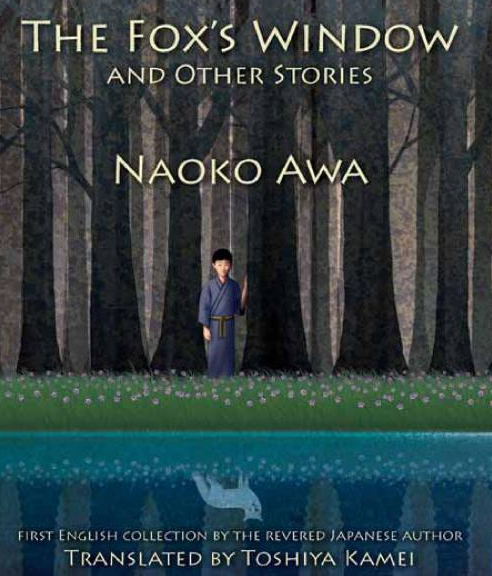
Title: The Fox’s Window: And Other Stories
Japanese Title: きつねの窓 (Kitsune no mado)
Author: Awa Naoko (安房 直子)
Translator: Toshiya Kamei
Publication Year: 2010
Publisher: University of New Orleans Press
Pages: 232

I found out about this book due to the happy accident of stumbling upon the website of the SCBWI (Society of Children’s Book Writers and Illustrators) Tokyo Translation Group. It’s a fantastic site that has taught me a great deal about Japanese children’s literature, and I’m grateful that it’s so well organized and contains so many interesting and well written essays.

Before I discovered the website, however, I had never heard of “the revered Japanese author” Awa Naoko. Thankfully, her translator’s short introduction does a fine job of sketching out her background for the reader:

Naoko Awa (1943-1993) was an award-winning writer of modern fairy tales. She was born in Tokyo, and while growing up, lived in different parts of Japan. As a child, Awa read fairy tales by the Brothers Grimm, Hans Christian Andersen, and Wilhelm Hauff, as well as The Arabian Nights, which later influenced her writings. She earned a bachelor’s degree in Japanese literature from Japan Women’s University, where she studied under Shizuka Yamamuro (1906-2000), who translated Nordic children’s literature into Japanese. While still in college, Awa made her literary debut in the magazine Mejiro jidō bungaku (Mejiro Children’s Literature).

The themes of Awa’s work collected in The Fox’s Window are nature, transformation, and bittersweet pain of fondly remembered past. Like Western fairy tales, Awa’s stories are filled with animals who possess anthropomorphic attributes, such as the ability to talk. Like Classical mythology, Awa’s stories operate on at the edges of a constantly shifting boundary between plant, animal, and human; flowers can easily turn into girls, and rabbits and can easily turn into boys. In the worlds Awa creates in her writing, charming and innocuous trickster spirits abound and good deeds are always rewarded. This childhood realm is seldom presented without nostalgia, and characters often remember the past as being more vibrant than the present.

The story collection opens with “The Sky-colored Chair.” In this story, a blind girl’s father wants to paint a rocking chair he’s built for her the color of the sky so that she will be able to see the sky by sitting in the chair. On a windy hilltop, the father meets a young boy who helps him create the color of the sky for his daughter. The chair is such a success that the father begins to seek out other colors, such as those of the sea and the sunset. The boy, in an effort to help the father achieve these colors, disappears and then reappears as a young man who asks that the girl’s father take him on as an apprentice chair maker. The blind girl is never really able to see any other colors, but her story still ends happily:

After a short while, the blind girl married the young man. She became a happy wife who knew the true color of the sky better than anyone else. Even after her hair turned white, she enjoyed watching the sky in her rocking chair.

In the collection’s title story, “The Fox’s Window,” an archetypal hunter enters an archetypal forest in order to hunt an archetypal fox. After chasing and losing the fox, the hunter emerges into a clearing, in the middle of which is a house he has never seen before. Out of the house emerges the fox, now in the form of a boy, who offers to paint the hunter’s hands blue in an act of magic that will allow the hunter to see into the past. The story has no plot, per se, but the visions that the hunter sees in the window that he forms with his fox-painted hands are lovely:

In my mother’s vegetable garden, a patch of shiso plants was getting soaked by the drizzle. I wondered if she would come out into the yard to pick the leaves. A soft light seeped from the house. From time to time I heard children’s laughter mixed with the music from the radio. The voices belonged to me and my sister, who was now dead. I gave a deep sigh and dropped my hands. The house I grew up in burned down, and that yard doesn’t exist anymore.

Although many of the stories in the collection are harmlessly beautiful, a few, such as “Forest of Voices,” contain touches of genuine fairy-tale horror:

The Forest of Voices returned to silence and waited for its next prey. It was a terrifying place. Countless animals had lost their way in the forest. Like someone scared of his own reflection in the mirror, every animal going astray among the trees was surprised by its own echo and ran in circles until it collapsed and died. Sometimes humans wandered into the forest – hunters pursuing their game and woodcutters following the wrong path in the fog. They all ended up nourishing the oaks.

Such stories always end well, though. The pure of heart always prevail and no one is ever really punished. The only characters who die or get hurt are animals, and even then it’s usually just an instance of the “dead mother” trope.

Unfortunately, this lack of darkness made the stories seem shallow to me. With no true shadows or bursts of light, the separate stories began to blur together into a sepia-toned slurry of adorable children, talking animals, and nature imagery. These stories are completely harmless and thus, in my opinion, mostly forgettable.

Perhaps The Fox’s Window would appeal to parents of young children for whom the stories of Beatrix Potter and Jill Barklem are deemed too scary. The stories might also appeal to the children themselves, as younger readers have an astonishing ability to make up details to fill in the gaps of minimalist narratives. Since the visual imagery of Awa Naoko’s writing is so strong, her stories might also appeal to artists and illustrators looking for inspiration. In fact, I felt that each of the individual pieces in The Fox’s Window was highly impressionistic, like a pencil sketch of a scene onto which a single layer of watercolors has been quickly applied. Although this type of writing doesn’t hold a great deal of appeal for someone like me, who finds beauty and meaning in words and narratives, I imagine that Awa’s short fairy tales could be much more interesting to someone better able to think in pictures and images.

I’d like to thank University of New Orleans Press for making The Fox’s Window available on the Kindle Store. I’ve been noticing a baffling dearth of children’s literature in digital format, and I think it’s wonderful that this collection is helping to remedy the situation.

1Q84

Title: 1Q84
Author: Murakami Haruki (村上 春樹)
Translators: Jay Rubin and Philip Gabriel
Publication Year: 2011 (America); 2009-2010 (Japan)
Publisher: Knopf
Pages: 944

This review contains mild spoilers. Some might argue that warning for spoilers is missing the point, but I think that gradually figuring out what’s going on in this novel is one of the main pleasures of reading it. With that in mind, allow me to summarize the conclusion of my review for anyone trying to decide whether or not to start reading: 1Q84 is an engrossing book, and you more than likely won’t be able to separate yourself from it once you begin. It might be a good idea to save it for when you anticipate having lots of time on your hands. However, if you’ve read Murakami’s work before and don’t particularly like it, this book won’t turn you into a fan. The novel contains several graphic depictions of rape and child abuse. If you imagine that such descriptions might function as triggers, consider yourself warned for both the novel and this review.

IQ84 is about Kawana Tengo, a would-be writer who pays the bills by working as a math teacher at a cram school, and Aomame Masami, a semi-professional assassin who pays the bills by working as a personal trainer at a private gym. Tengo’s story kicks off when his literary agent, an eccentric editor named Komatsu Yuji, drafts him into rewriting a fantasy novella called “Air Chrysalis” written by a seventeen-year-old named Fukada Eriko. Fuka-Eri, as she calls herself, is a beautiful yet incommunicative girl who claims to have actually experienced the things she’s written about. When Tengo meets Fuka-Eri’s guardian, a retired academic named Ebisuno, the man explains that the girl’s biological father had founded a politically radical farming commune called Sakigake that has since reshaped itself into a religious compound closed to the outside world. Unfortunately for Tengo, when Fuka-Eri’s novella is published and becomes a bestseller, Sakigake takes notice. Meanwhile, Aomame works with an older woman referred to as “the Dowager,” who runs a battered women’s shelter called The Willow House. When no other recourse can free the women who take refuge there, the Dowager calls on Aomame to assassinate the men who have made their lives hell. The Dowager ends up rescuing a girl who has been horribly abused by the leader of Sakigake, and she requests that Aomame perform a job so dangerous that it may well be her last – the assassination of this powerful religious figure.

Alternate chapters are told from Aomame and Tengo’s perspectives, and their stories gradually become interwoven even though they never meet or interact with each other. They knew each other briefly as children, however, and it turns out that their bond runs deeper than mere casual coincidence. As the novel progresses, other characters with connections to Aomane and Tengo are introduced, such as Tengo’s strict and conservative father, Aomame’s gentle but romantically unlucky childhood friend Yasuda Kyoko, the Dowager’s personal bodyguard Tamaru Kenichi, an under-the-law private investigator named Ushikawa Toshiharu, and a diabolically relentless NHK fee collector. All of these secondary characters are interesting enough to be the protagonists of their own novels, and their stories and conflicts and motivations are just as engaging as those of Tengo and Aomame.

The novel is divided into three books, which are each characterized by distinctive plot developments and themes.

In the first book, Tengo meets Fuka-Eri. As he edits her novella, he learns more about and is drawn into the strange world she represents. Meanwhile, Aomame accidentally travels from 1984 into an alternate reality (in which two moons hang in the sky) that she calls 1Q84. As she attempts to figure out what happened to her, the reader learns about her daily life and her relationship with the Dowager. This first book is overtly political in its attitude concerning such issues as protest movements, new religions, publicly sanctioned sexism, and the business of literary publishing.

In the second book, both Tengo and Aomame are plunged headlong into the strange business with the Sakigake group. Even as the two characters are thrust forward into an uncertain future, the reader learns more about their pasts and the experiences they had as children. The second book seems primarily concerned with the unknowability of large swaths of reality and the challenges facing moral judgment and action in the face of absurdity. In my mind, this was the most “Murakami-esque” section of the book in that it revisited many of the themes and narrative devices present in the writer’s earlier work.

The third book concerns the aftermath of Aomame’s involvement in the Sakigake affair. Aomame has gone into hiding, and Tengo leaves Tokyo to tend to his catatonic father. Despite their adverse circumstances, the two have begun searching for each other. A chillingly aggressive NHK fee collector threatens Tengo’s neighborhood, and the private investigator Ushikawa stakes out Tengo’s apartment as Fuka-Eri comes and goes. The themes of the third book are fate and love or, more appropriately, the denial of coincidence and the belief that even the most tenuous bonds between people can be extraordinarily powerful. Because of its sentimentality, and because of the way in which the multiple pieces of the complicated plot all begin to fit together, I almost felt as if I were reading a Stephen King novel at certain points towards the end of 1Q84.

“Reading a Stephen King” novel is not necessarily a bad thing, however. One of the aspects of King’s writing that I admire most is his ability to get into the heads of even the most loathsome characters, and one of the most surprising and interesting developments of the third book is that the reader is now offered chapters from Ushikawa’s perspective. While Tengo and Aomame are being irrationally idealistic and swooning over their memories of each other, Ushikawa adds humor, realism, and a sense of tragedy to the novel’s conclusion. As he describes himself:

Maybe I am just an ugly, middle-aged, outdated man, Ushikawa thought. Nope, no maybes about it. I am, without a doubt, one ugly, middle-aged, outdated man. But I do have a couple of talents nobody else has. And as long as I have these talents, no matter what weird world I find myself in, I’ll survive.

But will he really survive if the happiness of the protagonists depends on him not surviving? Ushikawa keeps the novel from becoming too cut-and-dry towards its inevitable conclusion, and I felt that his sections allowed the reader to see the world of 1Q84 from the perspective of a true outsider.

Although 1Q84 is set in a time when most people went about their lives without knowing that computers existed, the novel clearly reflects the concerns of the digital age. Like George Orwell’s 1984, 1Q84 handles issues of identity formation and information control in a world that is unstable and confusing under its placid surface. Cult leaders, lines of power, rapidly shifting worldviews, and the creation and co-existence of multiple histories all factor into the novel, which ultimately questions what sort of agency an individual can have in an environment silently controlled by invisible systems. The subjective viewpoints of Aomame, Tengo, and Ushikawa allow the reader to approach this problem from different angles, and Murakami himself never seems to align his novel with any one political or philosophical perspective. Like Orwell, Murakami also exploits the dark humor implicit in any dystopian situation. For example, the NHK fee collector, who might be seen as a direct allegorical representative of Japanese postwar social control, is just as comic as he is frightening. When he positions himself outside of a victim’s door and starts ranting, his diatribes are gleefully malicious:

“Miss Takai, let’s not play hide and seek anymore, okay? I’m not doing this because I like to. Even I have a busy schedule. Miss Takai, I know you watch TV. And everyone who watches TV, without exception, has to pay the NHK subscription fee. You may not like it, but that’s the law. Not paying the fee is the same as stealing, Miss Takai, you don’t want to be treated as a thief because of something as petty as this, do you? This is a fancy building you live in, and I don’t think you will have any trouble paying the fee. Right? Hearing me proclaim this to the world can’t be much fun for you.”

And so on, and so on and so on, for pages. This character frightens and upsets the characters whenever he appears; but, as a reader, I couldn’t wait for him to show up again. Since he appears so often and at such length, I get the feeling that Murakami enjoyed writing the character as much as I enjoyed reading him.

Like most Murakami novels, 1Q84 is fairly dude-centric. The Aomame chapters alleviate the dudeliness to a certain extent; but, as Aomame is almost continually thinking about how in love with Tengo she is, the sex she wants to have with random men, and the sex she has had with other women, it’s difficult to completely separate her from her role as a female sex object and the object of Tengo’s sexual energy. Aomame may be a hard-boiled ninja assassin, but the reader is constantly reminded that she has a vagina. Then again, we hear a great deal about Tengo’s penis and scrotum, so the repeated descriptions of Aomame’s breasts and public hair may simply be par for the course in 1Q84. This is not to say that Aomame isn’t a fascinating character, but the way the author treats her is markedly different than the way he treats the Dowager (who is old, and thus not a sexual being) and Tamaru (who is gay, and thus not a sexual being).

1Q84 contains descriptions of underage rape and incest, which the text pardons and eroticizes. When Aomame is alone with the Leader of Sakigake, who is clearly guilty of child abuse, it turns out that he is not such a bad guy after all. Furthermore, he explains that, due to the workings of mysterious otherworldly beings known as “the Little People,” his body is sometimes completely paralyzed, at which point the pre-pubescent girls who attend him have sex with him. He can’t move or speak during these times; he can only ejaculate. The sexual activity is spiritual, and it is initiated by the girls. When he penetrated his ten-year-old daughter, the same thing happened: she had sex with him, and the bodies of both parties were controlled by the Little People. The reader finds out several chapters later that he is not lying, as an event occurs in which Tengo finds himself physically paralyzed and, as part of some ritual, mounted by Fuka-Eri (who at seventeen has never had her period and never developed sexually or mentally).

I’m not upset by the deviant sexual lives of fictional characters, and this is one of the more interesting and original plot devices I’ve encountered in serious literary fiction (although I can’t claim to have never seen it before in fan fiction). Still, I found the erotic descriptions of the young girls in question to be off-putting. For example, Tengo thinks Fuka-Eri’s hairless vagina is so beautiful and her lovely ears look just like her vagina and, as he thinks about the flat-chested ten-year-old Aomame while having sex with the childlike Fuka-Eri, he comes so hard and feels so good. It’s kind of gross.

There is a fair amount of sex and sexuality in 1Q84, and these themes are narrated from a perspective that is subtly yet undeniably male. To draw a parallel with a series I happened to be reading at the same time as 1Q84, in A Song of Fire and Ice, the narrative tone changes when the author switches between the perspectives of different characters. In 1Q84, it absolutely does not. The limited third-person narrator of the novel is definitely a heterosexual man, and this does not change when he narrates the story from the perspective of a female character or describes the rape of a young girl. However, I don’t think this type of narration ruins the story, and it’s quite interesting when accepted for what it is.

Issues of sex and gender aside, there’s a lot going on in this novel. The descriptions of Tokyo are wonderful. The descriptions of the suburbs and countryside surrounding Tokyo are also wonderful. The secondary characters are sympathetic and vividly portrayed. I loved Komatsu, and Ushikawa, and Professor Ebisuno, and Aomame’s friends Tamaki and Ayumi. The Dowager and Tamaru are a novel unto themselves. The allusions and parallels to political revolutionaries and religious cults in postwar and contemporary Japan are striking. The novel’s challenge to conventional notions of reality are intriguing. The connections between Murakami’s 1Q84 and Orwell’s 1984 (and in particular the transformation of “Big Brother” into “the Little People”) are fascinating.

As I mentioned at the beginning of this review, if you’re not a fan of Murakami’s writing, 1Q84 won’t change your opinion. The Murakami tropes established by his earlier novels – disappearing women, unsolvable mysteries, perpetually loose plot threads, passive protagonists, close descriptions of genitalia, endless references to jazz records, men cooking alone in sad bachelor kitchens – all appear in force in this novel, which is more of the same, except further up and further in.

If you haven’t read 1Q84 yet, then you definitely have something to look forward to. It’s an incredible novel that will give you the sort of reading experience that the word “spellbound” was created for. This a book that will make you wish your two-hour jog on the treadmill, your fourteen-hour plane ride, or your week-long illness were actually longer. Since 1Q84 will consume your life until you’re done with it, it might be good to save it for an occasion when you can take some time off so that real life doesn’t get in the way of this book.

By the way, the cover image I used for this review was designed by Cory Schmitz.

March Was Made of Yarn

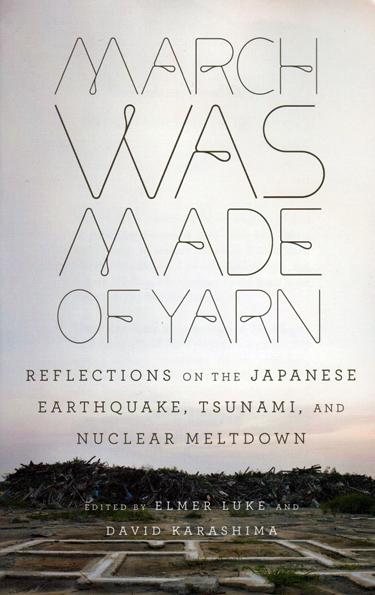
Title: March Was Made of Yarn: Reflections on
the Japanese Earthquake, Tsunami, and Nuclear Meltdown
Editors: Elmer Luke and David Karashima
Publication Year: 2012
Publisher: Vintage
Pages: 216

As the March 11 anniversary of the 2011 Tōhoku earthquake and tsunami draws closer, Japanese bookstores have begun to promote retrospective magazine-books. These publications are filled with huge glossy photographs of destruction, and the number of people killed is printed in bold characters across their covers. Although such disaster porn is disturbing, it helps to illustrate a definite aspect of the reality of what happened a year ago in Japan.

March Was Made of Yarn helps to illustrate another aspect of the reality of the earthquake, tsunami, and resulting nuclear crisis. If pictures and body counts inform the physical reality, then this collection of fiction and nonfiction offers insight into the emotional reality. Thankfully, March Was Made of Yarn is infinitely more gentle and subtle than sensationalist reporting and sentimental recollections of heroism and despair.

Even though all of the short pieces brought together by this collection address the events of last year in some fashion, many do so obliquely, and the themes of the pieces are universal. What is it like to live through a crisis? What is it like to know that other people are living through a crisis? What does it feel like to worry about the future? What does it feel like when science fiction becomes reality? What happens when you’re so sick with worry that you can’t fall asleep at night? What happens when words can no longer express truth or meaning?

March Was Made of Yarn features the work of internationally renowned Japanese writers such as Ogawa Yōko, Murakami Ryū, Kakuta Mitsuyo, Furukawa Hideo, and Tawada Yōko. These writers don’t cut corners in their craft simply because they happen to be responding to a topical issue; and, although none of them are writing “happy” stories or essays, their work is a pleasure to read. Kawakami Hiromi, who rewrote her debut story “Kami-sama” (translated as “God Bless You”) to address the incidents at the Fukushima reactor, reminds us that, even though we live in a world shadowed by the fear of radiation and environmental poisoning, we still need to eat, and we still want to go outside. The title story, Kawakami Mieko’s “March Yarn,” deals with the strange ways in which people process their memories and their understanding of their relationships with each other. Tanikawa Shuntarō’s poem “Words,” which opens the book, poses the question of how we can even write about things for which there are no words (yet still “Words put forth buds / From the earth beneath the rubble”). The translators who contributed to this volume are among the best in the field, and their skill illuminates the entirety of the collection.

March Was Made of Yarn isn’t just an excellent anthology of work related to the Tōhoku disasters; it’s an excellent Japanese literary anthology period. The range of authors represented by the book has the most even distribution of gender, generation, and genre I’ve ever encountered, and the English-language contributors, such as David Peace and John Burnham Schwartz, bring an added level of flavor and diversity. This collection is also accessible to casual readers, as few of the stories are any longer than twenty pages, and it has been beautifully published by Vintage. I don’t know how so many good things were able to come together to create this amazing book, but I am extraordinarily grateful that it exits.

March Was Made of Yarn should be available at all major bookstores in North America, Britain, Australia, and Japan, and it’s available on the Kindle Store as well.

If you don’t mind reading entirely in PDF digital format, please consider checking out Waseda University’s Japan Earthquake Charity Literature Project, which has some overlap with March Was Made of Yarn. It’s free to download and read the PDF versions of the stories and essays on the website, and the reader is encouraged to make a donation to disaster relief efforts afterwards.

Speculative Japan

Title: Speculative Japan: Outstanding Tales of Japanese Science Fiction and Fantasy
Editors: Gene van Troyer and Grania Davis
Publication Year: 2007
Publisher: Kurodahan Press
Pages: 290

As a short story collection, Speculative Japan is a strange book. 200 of its 290 pages are comprised of short stories, and the other 90 pages are mainly short non-fiction essays about the book itself. These essays involve topics such as how the stories appearing in Speculative Japan came to be selected, edited, and translated. 20 of these 90 pages are author and translator biographies, and another 20 pages are filled by a translated essay by Shibano Takumi, the editor of the Japanese sci-fi magazine Uchūjin. For a reader who starts the book at the front cover and progresses in a linear fashion, Speculative Japan gets off to a somewhat rocky start with pages and pages of metatextual material.

Gene Von Troyer’s introduction jumps from topic to topic before finally summarizing Yamano Kōichi’s “three phases of Japanese science fiction” and settling into speculation concerning what makes Japanese science fiction “Japanese”:

We can’t say definitively, but can only point to trends and tendencies. Viewed through one facet of the jewel, we can say, as Tatsumi [Takayuki] does, that “what with the imperative of American democratization and the effect of indigenous adaptability, the postwar Japanese had simultaneously to transform and naturalize themselves as a new tribe of cyborgs” as reflected in the images from manga and anime. Japanese SF leans (or has leaned) more on robots and cyborgs than on stars and planets.

This generalization is certainly interesting, but I wonder if it’s really true. For example, the advertisements in the back of the book for Mayumura Taku’s Administrator (a collection of four short novels about “Terran colonies far from Earth”) and Night Voices, Night Journeys (the first of a series of collections of “Tales in the Cthulu Mythos from Japan”) seem oriented more towards “stars and planets” stories, and I can’t help but think of the “spaceships and galaxies” imagery of popular 1970s series such as Takemiya Keiko’s To Terra and Matsumoto Leiji’s Space Battleship Yamato, but perhaps it might simply be better to read Troyer’s introduction as an initial attempt to sketch a map of a huge and understudied body of literature.

In any case, the stories contained in Speculative Japan have less to do with either cyborgs or space than they do with hypothetical concepts. Toyota Artisune’s “Another Prince of Wales” concerns the question, “What if, in the future, war were a popular sport played on an international stage?” Yamano Kōichi’s “Where do the Birds Fly Now?” is an expansion of the question, “What if birds could fly between dimensions and take people with them?” Very few of these stories have serious, in-depth plots; but, then again, very few of these stories are more than twenty pages long. A reader familiar with the type of tightly plotted sci-fi stories published in Fantasy & Science Fiction Magazine is in for a surprise with Speculative Japan, which – as its title suggests – is more about “speculative fiction” than “science fiction.”

Five of the stories in the collection are recycled from the out-of-print The Best Japanese Science Fiction Stories. Of these five, Tsutsui Yasutaka’s Orwellian fable “Standing Woman” and Yano Tetsu’s “The Legend of the Paper Spaceship,” a lyric tale of a woman deep in the Japanese mountains who may or may not be an alien, are excellent and definitely worthy of republication. Making an appearance from the out-of-print Monkey Brain Sushi anthology is Ōhara Mariko’s “Girl,” a sex-saturated story of love and body modification in a decaying city on the eve of an apocalypse.

Three stories that have appeared for the first time in book form in Speculative Japan that really jumped out at me were Kajio Shinji’s “Reiko’s Universe Box,” Kawakami Hiromi’s “Mogera Wogura,” and Yoshimasu Gōzō’s “Adrenalin.” In “Reiko’s Universe Box,” a young woman copes with her negligent husband and failing marriage by becoming absorbed in a box containing an entire galaxy in miniature form. Like many of the stories in this collection, “Reiko’s Universe Box” is driven by strong elements of allegory, but its concept is delivered with cleverness, darkness, vivid description, and humor. When compared to the other stories in the collection, Kawakami’s “Mogera Wogura,” a description of a day in the life of a mole-like creature who lives among humans in contemporary Japan, is in a class of its own in terms of its gentle magical realism, its playfulness, and its removal from the themes and narrative style of more traditional science fiction and fantasy. “Adrenalin” is not a story but rather an abstract poem filled with evocative imagery conveyed through variations of a handful of short and catchy refrains, such as “To you, children of spirits, I send an immediate telegram / To drink milk / To memorize the names of flowers / Some day, I will return / That day, I will start fire.” I’m usually not a fan of Japanese poetry in translation, but I found myself captured and moved by Marilyn Mei-Ling Chin’s translation of Yoshimasu Gōzō’s verse. Each of these three selections stands on its own not simply as an illustration of a speculative concept but as a piece of writing that is fun to read, thought-provoking, and capable of multiple interpretations.

Of the collection’s fifteen stories, four were written in the sixties, eight were written in the seventies, and another was written in 1981. These thirteen stories, written during the period between 1962 and 1981, are all by men. The two more recent stories (published in 1985 and 2002) were written by female authors, but one can still say that this collection is mostly representative of science fiction written by men in the sixties and seventies. In the author biography section at the end of the book, the editors attempt to canonize many of the male authors (“without a doubt a Grand Master of Japanese science fiction and fantasy,” “one of the three pillars of Japanese SF,” “often referred to as ‘The King of Japanese SF,'” and so on), but I wonder if perhaps there wasn’t a hint of personal politics at play in the selection of authors. This suspicion seems to be corroborated by the collection’s metatextual essays, which detail the personal relationships between the authors and their translators.

Speculative Japan sometimes reads like a sci-fi literary fanzine in which the editors and regular contributors are just as concerned about themselves and their relationships with each other as they are with the fiction itself, and the essays in Speculative Japan demonstrate a certain geeky fixation on metatextual marginalia. If you happen to be outside of the small circle of authors, translators, and editors who all know each other and worked together on this collection, you might find these essays confusing and off-putting. If you’re already used to the style of the front (and back) material included in SF-themed literary magazines and fanzines, though, you’ll more than likely be able to see past (or even appreciate) the many pages of essays included in Speculative Japan.

The actual stories in the collection are interesting and well worth reading, and a few of them are truly excellent. Still, I want more work that doesn’t belong to a set clique of authors, more contemporary work, and more work by women. To be honest, I found Speculative Japan somewhat disappointing as a compilation. That being said, I am intrigued enough by the stories themselves to consider giving Speculative Japan 2 a shot in the near future.

Loups-Garous

Title: Loups-Garous
Japanese Title: ルー=ガルー (Rū=Garū)
Author: Kyōgoku Natsuhiko (京極 夏彦)
Translator: Anne Ishii
Year Published: 2010 (America); 2001 (Japan)
Publisher: Haikasoru
Pages: 450

Spoiler: There are no actual werewolves in this book.

The real shape-shifter is Loups-Garous itself, which wears multiple skins. The novel is a murder mystery and a sci-fi suspense thriller. It is a police procedural, a cyberpunk dystopia, and a high school drama. It can also be read as a series of philosophical musings on technology, authority, and human nature.

Loups-Garous is set in the not-too-distant future (the 2030s are referred to as if they were the 1990s) of Japan, in which many of the laws and social conventions concerning food, housing, education, communication, and privacy are no longer what they once were. For example, although minors are assigned guardians who may or may not be their parents, they are apparently not required to cohabitate with these adults. Furthermore, children learn from computer modules instead of from teachers, and their only physical contact with other people is through periodically scheduled meetings with selected peer groups and guidance counselors. The younger generation has gradually come to interact with the world almost exclusively through computerized devices called “moniters,” which range in size from wristband models to screens the size of bedroom walls. Cities are divided into carefully controlled zones, all food is artificial, and the movements and consumption patterns of every individual are recorded through omnipresent video cameras maintained in both public and private spaces by the corporation that controls the country.

Despite the fact that this micro-management of individual lives is supposed to keep people safe, a series of connected murders has broken out in an otherwise peaceful residential district. A possibly related set of school absences draws three high school girls, Hazuki, Mio, and Ayumi, to meet together in person. Meanwhile, the girls’ guidance counselor, Shizue, is pulled into a police investigation of several students who may be either suspects or victims. As Hazuki and Shizue are pulled deeper into the circumstances surrounding the murders, the grimy foundations of their seemingly utopian society are revealed, as is a major government conspiracy.

The cyberpunk gothic noir setup of Loups-Garous attracted me to the novel and kept me reading, but I will admit that I ultimately did not enjoy the experience. None of the plot devices are particularly original, the themes are spread too thin, and the pacing is uneven. Long passages of exposition and dialog are broken by fights and chase scenes in a way that seems random and frenetic, and the last fifty pages of the novel read like the two minutes of downhill careen that follow a very long and very slow slog up the first hill of a roller coaster ride. Furthermore, the big surprises at the end, such as the identity of the killer, have almost no foreshadowing. To give an example, there’s a giant mecha at the end of the novel. It comes out of nowhere. The lack of suspenseful buildup leading to its appearance is so total that mentioning it doesn’t even feel like a spoiler.

I also found the main characters infuriating. I understand that these characters, who have grown up in a world in which there is very little interpersonal interaction, are supposed to be socially maladjusted, but that doesn’t make their antisocial awkwardness any easier to read. To bring up a topical analogy, Sherlock Holmes is interesting (and bearable) as a character because he is juxtaposed against foils such as John Watson and Inspector Lestrade. These foils don’t just help to demonstrate what is so unique and fascinating about Holmes; they also serve to drive the story forward by providing a means to address the more commonplace concerns that exist for a reader who lives in a world governed more by social and accidental systems of cause and effect than by pure logic. A story with two Sherlocks and no Watson wouldn’t be nearly as readable. Loups-Garous has five Sherlocks and no Watson, and it’s painful to watch these characters bicker with each other endlessly. Besides being socially maladjusted, each of them is idiosyncratic in her own way (“I’m a genius, so I don’t have a sense of aesthetics.”), and the weird gaps in their knowledge of the world mean that each of them will often say things that can come off as inane to the reader (“You think you can actually eat animals? That’s stupid.”).

Speaking of the characters’ knowledge of their world, the author’s construction of the novel’s setting felt uneven to me. Specifically, the story is supposed to be set in a time in which people who were adults in the twentieth century still hold active positions of power, yet the main characters act completely ignorant of the history, economic systems, and technologies that existed before their own lifetimes (even though the reader is left to assume that such information is freely and easily available, such as in the form of entertainment media). For example, when the self-proclaimed genius Mio explains the concept of a “telephone” to Hazuki, Hazuki is completely flabbergasted over the fact that such a thing could ever exist, and Mio herself admits that she doesn’t know what language the word “telephone” comes from. There is thus a deep contradiction in the novel’s construction of its setting (which is either super-futuristic or not really futuristic at all) that prevents the reader from really understanding the novel’s worldview or becoming absorbed in its atmosphere.

Finally, perhaps partially as a result of the awkwardness of the characters and setting, the long philosophical passages that fill the novel are written in a style that is somewhat confusing. For example, a chain of logic might be set up like this:

“It goes without saying that scissors are good for cutting paper. Similarly, the best accounting software can’t make music. Computers are nothing more than calculators. It’s a system built to do the math necessary to accomplish a task. If humans were able to do several calculations at once there’d be no need for computers. No matter how grand the calculation, nothing but cutlery can cut paper.”

Or a theme of the novel might be expressed in a meaningless repetition of chichés and platitudes:

“The adults don’t know anything.” Don’t they? It wasn’t just the adults. Kids wouldn’t know anything about other people either. No one wanted to know and no one wanted to be known. So no one knew anything about anyone else. They weren’t bothered by not knowing. They weren’t bothered by not being known. Moreover… They actually hated being known.

Unfortunately, Loups-Garous is filled with many such pseudo-philosophical soliloquies, which detract from what little plot, character development, and world building the novel is able to offer.

In the end, I feel that Loups-Garous is a waste of a good premise that could have been vastly improved with either more judicious editing of the original text or more creative license on the part of the translator. I hate to bash anything published by Haikasoru, a press that has almost consistently put out quality material, but Loups-Garous weighs in towards the lower end of the publisher’s catalog (along with Mardock Scramble, another title that, like Loups-Garous, has an animated adaptation).

If you’re interested in the dystopian sci-fi premise of the novel, you might be better off watching either Fractale (streaming on Hulu) or No.6 (streaming on Crunchyroll), two anime that share similar themes but are much more intelligent and stylish in their execution of these themes. Also, while I was reading Loups-Garous, I kept wishing that I was reading Margaret Atwood’s Oryx and Crake instead. The story and premise of Oryx and Crake are similar to those of Loups-Garous, but the readability and literary flair of Atwood’s novel are much higher. Even though I didn’t like this novel, Kyōgoku Natsuhiko is a very interesting writer, and I definitely recommend his Summer of the Ubume. With so much other excellent reading and viewing material, why would you want to waste time on Loups-Garous? The novel wears many skins, but it doesn’t wear any one of them particularly well.