Second Quest

Second Quest

Title: Second Quest
Artist: David Hellman
Author: Tevis Thompson
Publication Year: 2015
Publisher: Fangamer
Pages: 120

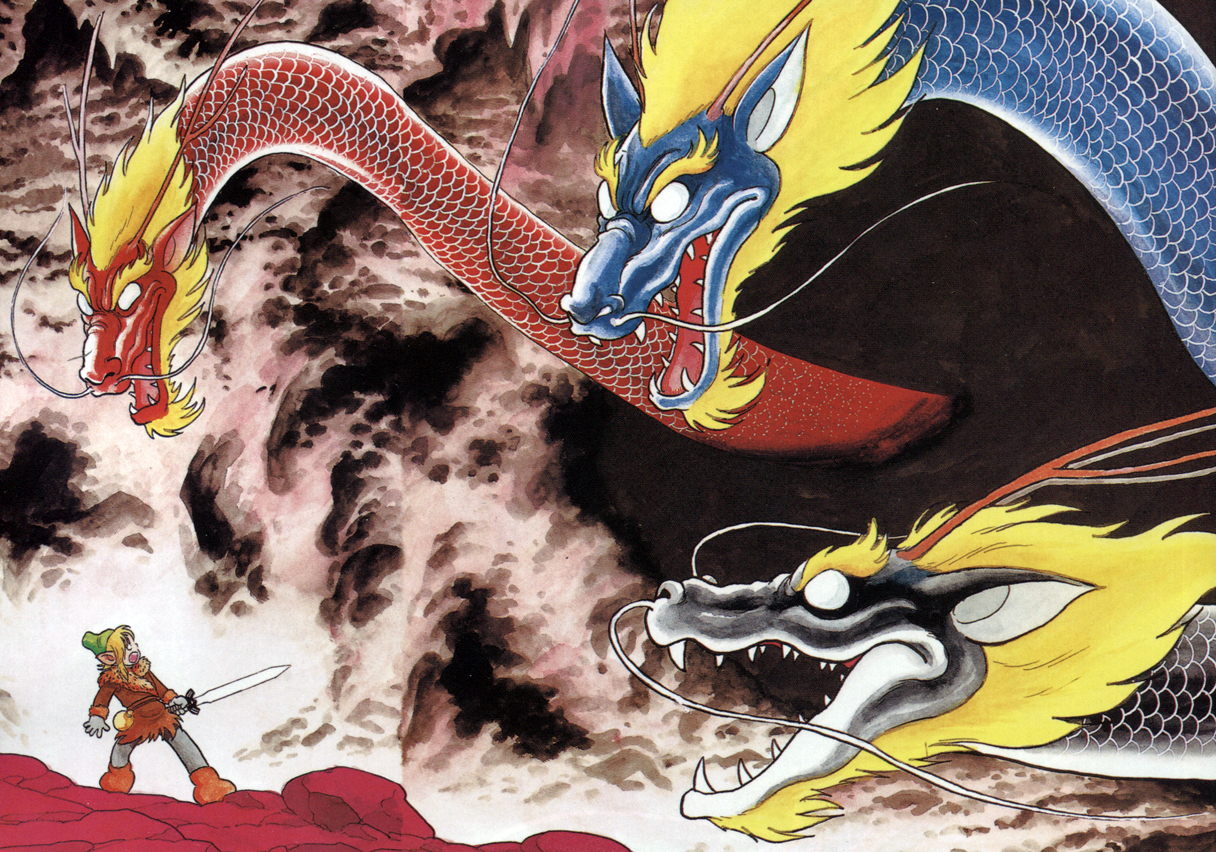
Second Quest is a beautifully drawn comic that reimagines the Zelda mythos and explores just how bizarre it is that the Hylians consider themselves to be “the chosen people” who need to be “protected” from other races. What was Ganon really trying to do? Did Zelda really need to be rescued? Why is Link valorized for running around with a sword and smashing everything he encounters? What sort of cultural legacy does this create, and who suffers when outsiders are removed from historical narratives?

Of course, The Legend of Zelda is a keystone franchise of the global game industry, and licensing it is not cheap or easy, so all of the serial numbers have been filed off in David Hellman and Tevis Thompson’s interpretation. What this means is that Second Quest is accessible to non-gamers and people largely unfamiliar with the series, and it’s of special interest to readers interested in how Japanese stories have influenced people around the world to begin their own conversations.

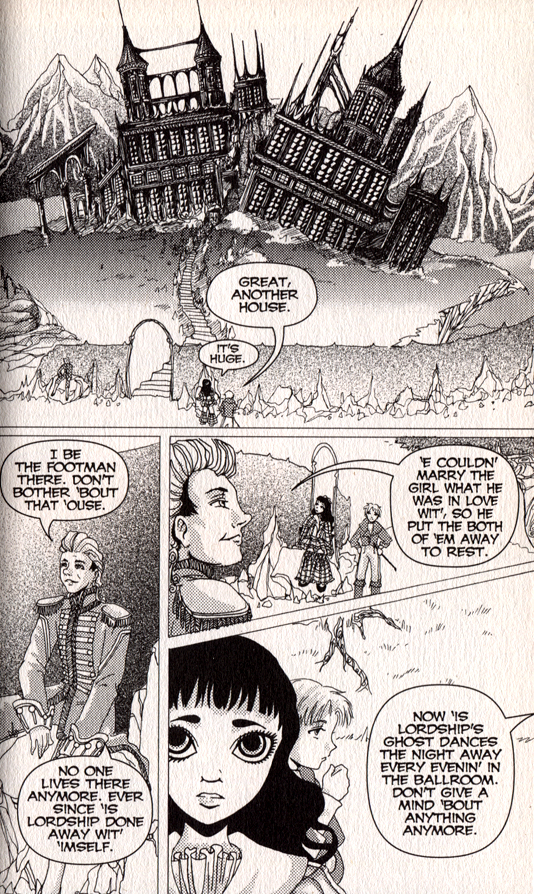
Second Quest Page 13

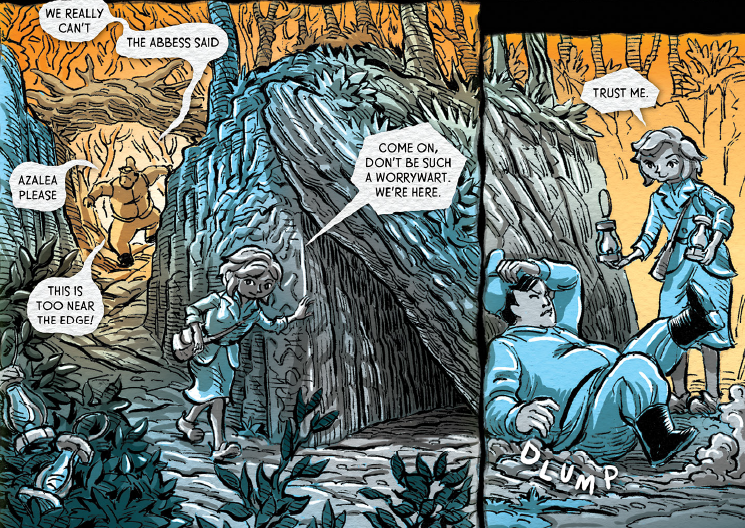
Second Quest is about a young woman named Azalea who lives on an island that floats high above the clouds. The island is sparsely populated and immense, and vast ruins are buried just underneath its surface. Azalea is fascinated by this uncharted territory, especially since she has the mystical ability to perceive the past history of the objects she touches. The story begins when Azalea is struck by an especially forceful vision of a young woman fleeing from a unseen pursuer when she picks up a broken key deep underground.

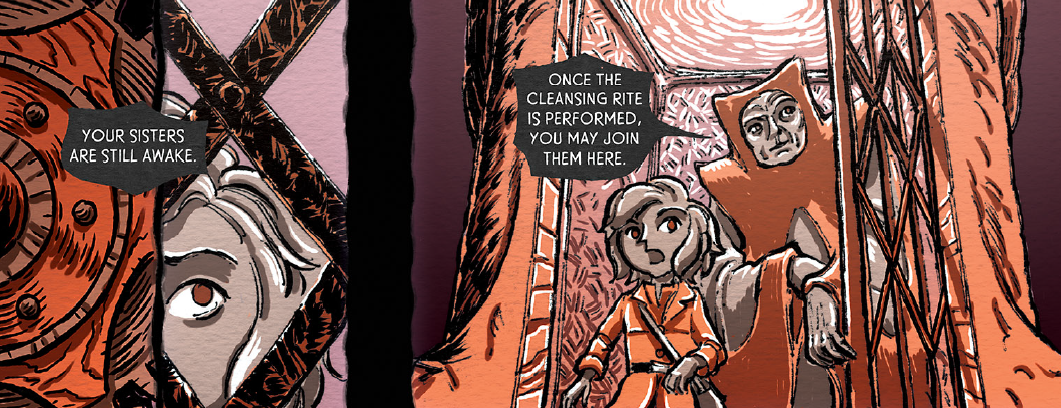
Unfortunately, Azalea’s interactions with underground artifacts trigger an earthquake, an event that is especially frightening to people living on a floating island. The tremors lead to mass panic, and it is decreed that a cleansing ritual must be performed. This ritual involves the re-enactment of a great battle against the evil “pig thief” who, envious of the sky island people’s prosperity, had captured the human vessel of their goddess. Azalea, whom the island’s religious leader has designated as the newest member of an order of secluded women who silently pray for the prosperity of the island and its inhabitants, must play the role of the sacrificial princess in this ritual before she retires from the world to become a symbolic reminder of the past and future glory of people other than herself.

Second Quest Page 56

David Hellman’s line work is both intricate and forceful, but what I especially appreciated was the artist’s color palette. The majority of Second Quest is warm and dark, with the twilit purples of the first half giving way to the angry reds of the second half. These colors emphasize the enclosed and suffocating nature of the floating island and its society, and the sky, when we see it, is a frightening orange or black. When the sky suddenly turns blue during the enactment of the purification ritual, presumably to emphasize the characterization of the island’s people as being “on the side of light,” the effect is disquieting. The appearance of teal and green at the very end of the book is breathtakingly dramatic, as the major theme of the story – a quest for freedom from the past – explodes onto the page through a series of textless spreads.

Second Quest was promoted and published through a Kickstarter campaign, the seed for which was planted by an essay written by Tevis Thompson about how the Zelda series has been declining in quality since the early games. While the first Zelda games forced the player to explore a boundless world, the more recent games are nothing more than an extended linear obstacle course. Tevis writes:

Players are constantly reminded that they’re shackled to a mechanistic land. There is no illusion of freedom because the gears that keep the player and Hyrule in lockstep are eminently legible. You read the landscape all too easily; you know what it’s asking of you. One of the greatest offenders occurred early on with A Link to the Past: most bomb-able walls became visible. What had been a potential site of mystery in the original Legend of Zelda (every rockface) became just another job for your trusty keyring. Insert here. Go on about your business.

Personally, I don’t think the Zelda series is broken. Even in Skyward Sword, which can indeed be frustratingly linear, there is more than ample room for exploration. My own favorite thing to do in Skyward Sword is bug catching, an activity that encourages the player to explore the world of the game both thoroughly and nonviolently while closely observing the game’s lush scenery and the behavioral patterns of the creatures that move unobtrusively within it. There are any number of different ways to play the Zelda games; and, if the huge body of Zelda fanfic is any indication, there are any number of different ways to read the games as well.

Last summer, however, there was a small backlash of fannish frustration over Aonuma Eiji’s denial that the Link character in the upcoming WiiU Zelda game might be female, a possibility that had been met with surprising enthusiasm. Furthermore, Aonuma stated that the gender of the Link character is inconsequential; instead, the important thing is that the player is able to identify with the character. The implication of this statement, of course, is that it’s easier for gamers to identify with a male player-protagonist than with a female player-protagonist. Let us never forget that the normative identity is “male,” after all. Men are subjects, so it makes sense for the player to control a male character, while women are objects, so it makes sense for them to act as McGuffins that enable the plot.

It’s important to the critique implicit in Second Quest that its protagonist is female. This is not simple fanboy pandering but rather a conscientious effort on the part of the creators to tell the “legend of Zelda” from the perspective of someone who is forced into a role that doesn’t suit her. When the reader first encounters Azalea, she is actively exploring the secret and hidden places of her world. We later learn, however, that women are not allowed entry into the knight academy that trains the elite police force that seems to govern the floating island. She’s not allowed to question authority or to develop her talents, even despite her obvious leadership qualities and intelligence. Azalea thus allows us to see the story of so many video games, a story frustratingly repeated time and again, from the perspective of someone excluded from shaping this story in any way. Azalea sees things that we usually aren’t shown, and what she sees is troubling and thought-provoking.

Second Quest is absolutely brilliant. If you’re a gamer, get this book. If you’re a comics person, get this book. If you’re into the darker side of religion and folklore, get this book. If you’re into feminism, gender politics, and the deconstruction of gendered tropes, then by all means, get this book. Second Quest is a beautifully published and a true pleasure to read and share with friends. I’ve been waiting for this book to come out for a long time, and I’m thrilled that it turned out to be so fantastic and inspiring.

For more information, be sure to check out:
http://www.secondquestcomic.com/

Second Quest Page 24

The Master Key

The Master Key

Title: The Master Key
Japanese Title: 大いなる幻影 (Ōinaru gen’ei)
Author: Togawa Masako (戸川 昌子)
Translator: Simon Grove
Publication Year: 1985 (United States); 1962 (Japan)
Publisher: Dodd, Mead & Company
Pages: 198

The Master Key, first published in 1962 and set in the late 1950s, is an interesting window into a period of postwar Japan that we don’t often see represented in Japanese fiction in translation. The story takes place entirely within the closed world of the K Apartments for Ladies, a large, multi-story building located in southeast Ikebukuro and registered as a charitable trust with “rents pegged at wartime levels.”

On its surface, the story is about a 1951 kidnapping of a young boy who is the son of a Japanese woman and an American military officer. Seven years later, when the K Apartments building is lifted and moved to a different location in a grand public works experiment, the body of a child is discovered buried underneath a shared bathing area in the basement. Right around the time the child disappeared, a man dressed as a woman was struck by a van in an intersection near the apartment building, and it’s revealed to the reader early in the novel that this man disguised himself as a woman to help one of the tenants dispose of the body that would later be found in the building’s basement. Who in the apartment buried the body, and what relation does this have to the kidnapping incident?

About twenty pages into The Master Key, however, it becomes clear that the mystery portion of the story is going to take a backseat to an extended exploration of the inner worlds contained within the K Apartments for Ladies and the psychological dysfunctions of its aging tenants.

Ishiyama Noriko, who has been diagnosed with “nervous pains,” has removed herself from the rest of the world and lives in a dark apartment stuffed with other people’s trash, which she occasionally boils and eats to sustain herself. Yatabe Suwa, a former concert violinist who now gives music lessons to children, is haunted by the loss of potential represented by the theft of a violin from her own teacher, even though it’s possible that she herself may have more to do with this incident than she likes to admit. Kimura Yoneko retired from her position as a schoolteacher years ago and spends her days writing letters to her former students, and she is not above checking into the affairs of the other tenants as well. Santo Haru is obsessed with a religious cult, and she is in the palm of its leader, who frequents her apartment to hold prayer meetings centered around the trances of its vestal priestess.

The plot is complicated and circuitous but is centered around the use and whereabouts of the master key of the title, which various tenants use to sneak into one another’s rooms in order to discover the secrets of others while concealing their own. At the end of the novel, it’s revealed that there is a mastermind orchestrating all of their movements, someone who has been spying on everyone for years and has manipulated the women around her for her own amusement. As someone who had essentially done the same thing to these characters through the process of reading this novel, I felt somewhat guilty, but not enough to lessen my enjoyment of how neatly all of the different plot threads are eventually tied together.

I will openly admit that I love stories about women being unpleasant and irrational and absolutely human. All of the female characters in this story are a little pathetic and a little demonic in that they have no power outside the K Apartments but all manner of strange little powers within their closed world. I’m sure this can be read as a metaphor for something, but it need not be, as the haunted and uncanny environment the characters shape through their bizarre actions is absolutely fascinating in and of itself.

For people with more background on Japanese history and urban space, the story’s setting in Ikebukuro is of special interest. In the immediate postwar period, Ikebukuro famously functioned as a heterotopia in which diverse groups of people came together and the norms of mainstream society didn’t necessarily apply. There is all manner of hidden “national polity” history in Ikebukuro, where the family-state of Japan has buried countless failed narratives under highways and skyscrapers. The Master Key thus serves as an excellent example of postwar Tokyo gothic (as similarly exemplified by Kyōgoku Natsuhiko’s The Summer of the Ubume). A reader doesn’t need historical knowledge to appreciate the story, but a bit of research into the setting has the potential to deepen the experience of reading this novel, which has sub-basements under sub-basements under sub-basements.

The Master Key is long out of print but still cheaply available through a number of online used book services. If you have access to your local or university library’s Interlibrary Loan program, it’s well worth requesting this book. It’s a quick read, and it packs a huge impact. To my fellow horror and mystery lovers especially, I highly recommend tracking down a copy of this short, satisfying, and creepy little novel.

Cool Japan Guide

Cool Japan Guide

Title: Cool Japan Guide: Fun in the Land of Manga, Lucky Cats and Ramen
Artist: Abby Denson
Publication Year: 2015
Publisher: Tuttle
Pages: 127

Abby Denson is a comics writer who has worked on a number of high-profile and kid-friendly titles, such as the comic adaptations of Powerpuff Girls and Sabrina the Teenage Witch. She’s also drawn two graphic novels of her own, Dolltopia and Tough Love: High School Confidential, both of which I love beyond all reason. She has a quirky style all her own, and her charm shines from everything she creates.

I should probably get this out of the way first – Denson is a wonderful writer, but her art can sometimes be a little uneven. In Cool Japan Guide, the continuity between panels is inconsistent, and her characters all tend to have the same の∇の facial expression. The coloring is absolutely flat, and the bright primary colors can occasionally clash against each other violently.

Even if Denson’s art style isn’t to your taste, is Cool Japan Guide still worth reading?

It definitely is!

As you progress through the book, the art will grow on you, I promise. Denson has a special talent for depicting places and objects, and the details of each panel are fun and creatively stylized.

All of Denson’s travel advice is spot-on. Seriously, this woman has excellent taste – if she recommends something, then it’s definitely worth doing. By all means, check out the train-themed socks for sale at Tokyo Station! Try the sweet potato soft serve ice cream in Kamakura! Enjoy a cocktail at the 8bit Café in Shinjuku! Make plans to attend the Kaigai Manga Festa! Soak in the warm water and kitschy atmosphere of Oedo Onsen Monogatari!

Cool Japan Guide also offers a fair bit of reference material, such as websites with travel resources and smartphone apps convenient for tasks like train scheduling and quickly finding phrases in Japanese. Each chapter is preceded by eight or nine useful words or expressions, and the hand-drawn map of Japan at the end of the book is a treasure, especially for people planning longer journeys.

Cool Japan Guide is definitely not for the type of thirty-something hipsters who are into the Wallpaper* city guides or the type of forty-something yuppies who are into Fodor’s, but I can imagine a younger person smiling with joy while reading through the book. Since Denson takes care to ensure that the content is family-friendly, the book would make a great gift for a child or teenager. The gentle silliness and positivity of the guide succeed in making it enjoyable for older readers as well.

For more pictures, stories, and news, Abby Denson has her own website, and Cool Japan Guide has its own Tumblr.

Review copy provided by Tuttle.

Cool Japan Guide Page 37

Yellow Rose

Yellow Rose

Title: Yellow Rose
Japanese Title: 黄薔薇 (Kibara)
Author: Yoshiya Nobuko (吉屋 信子)
Translator: Sarah Frederick
Publication Year: 2015 (America); 1923 (Japan)
Publisher: Expanded Editions

I’m absolutely thrilled to write that one of Yoshiya Nobuko’s stories has finally appeared in a readily available English translation. “Yellow Rose” is drawn from Yoshiya’s acclaimed collection Hana monogatari (Flower Stories), which first appeared in print in the 1920s and has been a major guiding influence in shōjo manga, literature, and aesthetics. Thankfully, Yoshiya’s fiction is not just important from the perspective of literary history but also a true delight to read.

The short story “Yellow Rose” is about Katsuragi Misao, a twenty-two-year-old college graduate who accepts a teaching post at an all-girls prefectural academy “a thousand miles distant from Tokyo” to avoid getting married. On the train departing from Tokyo she meets Urakami Reiko, who happens to be a student entering her final year at Katsuragi’s school. Reiko is running late; and, clutching a bouquet of yellow roses, she dashes across the platform to catch the train, just barely making it:

Perhaps because she had been running so fast her little chest beat wildly, sending the profusion of flowers in that single hand all a-tremble, and this quivering of the yellow rose bouquet moved in unison with the fluttering of the girl’s sleeves – it was a beautiful scene–

Reiko gets a grain of soot in one of her eyes, thus giving Miss Katsuragi a chance to be alone and in intimate contact with her as she administers aid:

The end of her ponytail stretched down below the pillow, and a wisp of stray hair lay on her white forehead; her cool eyes were both gently closed and just her lips moved with her breath like a flower – in the stillness of a moon perhaps her closed eyes were seeing a dream……ah, how lovely!

The two continue their association throughout the summer, and their romance blooms in a series of short vignettes, of which the following is representative:

Thus carries the sound of the bell down to the water at Kiyomigata shore. It must be from the Seikenji Temple bell tower in Okitsu –

The bell sound crosses the twilight waters……

Motionless on the beach shadows……two of them

Two shadows paused silently as if to let the sounds of the bell gently embrace them –

Twilight, the moon thinly visible at the yonder edge of the sky – as they neared the shore only the very faint tips of the breaking waves sported a faint whiteness, like frayed silk tassels.

Miss Katsuragi and Reiko make plans for the girl to attend Katsuragi’s alma mater in Tokyo before embarking on a journey to the United States together, but Reiko’s mother expects her to enter an arranged marriage immediately after her graduation in April. At the end of the story, as Katsuragi boards a ship to Boston alone, she abandons herself to her grief.

As with many of the stories contained within Yoshiya’s Hana monogatari, “Yellow Roses” ends in tears. The story’s focus is not on plot, however, but rather the beauty of the two young women and the depth of their feelings for one another. Entire paragraphs are spent on detailed descriptions of mournful eyes and chiseled cheekbones, and the poetry of Sappho is quoted at length. As in the above passages, Yoshiya’s writing is characterized by fragments and ellipses, which heighten the emotional impact of certain scenes while leaving the reader free to fill in the suggestive gaps in the text with her imagination.

“Yellow Roses” can be a quick and feather-light read, but the reader is rewarded for returning to the story a second time, as many of its passages can be appreciated as jewels in a beautiful setting – or roses in a stunning bouquet.

Although the story alone would be well worth the price of admission, this publication is graced by the addition of an extended translator’s introduction, a fascinating note on the cover illustration, an extensive selection of illuminating endnotes, and a meticulously curated list of selected English-language readings that functions as an invaluable resource to anyone interested in the history and inner workings of shōjo culture in Japan from the nineteenth century onward.

Translator Sarah Frederick’s introduction, which is roughly as long as the translated story itself, functions as something of an abbreviated textbook, touching on not merely the author and the story but also many aspects of the society and publishing culture that form its context. Frederick’s writing is not mired in the academic garble of postmodern theory but is immediately accessible to a casual reader as it paints a picture of a time and place in broad yet deliberate strokes. What I especially appreciate about this short essay is that it directly confronts the issue of female queer sexuality in Japan:

While it is not difficult to frame these desires via the flexible contemporary category of “queer,” it may be surprising to some readers that to invoke the word “lesbian” for Katsuragi and Urakami’s relationship, Flower Stories, or Yoshiya’s work and life more generally, has sometimes been controversial. I think this is a wonderful question to raise and discuss in a classroom or elsewhere using the story itself, and no translator’s introduction can “answer” it. […] While the term “lesbian” or loan word “rezubian” were not used in these stories or by Yoshiya herself in her lifetime, they are used literally here in reference to Sappho from Lesbos. More broadly, the claim that “lesbian” does not apply in the Japanese context or the prewar Japanese context (both arguments are sometimes made) leans far too much toward cultural essentialism and the false sense that Japan was cut off from the rest of the world, including its varied discourses on sexuality. The impression given by “Yellow Rose” and its milieu is rather the opposite: a highly cosmopolitan girls’ culture, aware of Sappho as a figure available to express the desire of one girl for another. It is engaged in active exploration of the rich but incomplete solutions posed by the possibilities of western philosophy, emotional poetry, and travel to America as sources for different ways of thinking about the realities and aesthetics of women’s lifestyles, desires, and conceptions of love.

The words in bold are my own emphasis, because I’ve been waiting for someone to state that very point as clearly and succinctly as Frederick for years now. Yes Virginia, there are queer women in Japan! The next time anyone asks me whether we can really call portrayals of homosexuality in Japan “gay,” as if the Japanese archipelago were home to a bizarre alien society completely removed from the cultural currents flowing across the rest of the world, I am going to quote this passage word for word.

The main appeal of “Yellow Rose” and its introduction really isn’t in any sort of political statement, however. Instead, the reader is invited to enter a sparkling, rose-colored world of radiant young women, their pure yet dangerous emotions, and the tragic pressures of a bygone era that prevent them from expressing their truest selves. As Frederick explains in her introduction, there is no better place to go looking for the roots of shōjo manga and literature. The translation itself expertly captures the language and cadences of the girls’ literature of writers such as Frances Hodsgon and Louisa May Alcott (whose work Yoshiya was almost certainly familiar with), so even the English feels pleasantly nostalgic. I therefore recommend “Yellow Rose” not only to serious academic types and hardcore shōjo fans but to even the casually curious. Within the short span of a train or subway ride, you can be transported into a glittering space removed – but never too removed – from the grittiness of the mundane. It’s quite an experience!

Yellow Rose is currently available exclusively as a digital text, and it can be purchased on Amazon’s Kindle store. It will also soon be available directly from the website of its publisher, Expanded Editions, a shiny new operation with two translations of vintage Japanese science fiction ready to download. Even if you’re not interested in Yellow Rose, be sure to check out Expanded Editions, which has done a fantastic job with its digital texts.

The manageable length and impeccable scholarship of Yellow Rose recommend it for classroom use. For educators hoping to incorporate the text into a printed or PDF course pack, Expanded Editions offers educational sales and will work directly with campus bookstores to make the material available to students. More information can be found on the relevant section of the publisher’s webpage.

Review copy provided by Expanded Editions.

Vampire Knight: Fleeting Dreams

Vampire Knight Fleeting Dreams

Title: Vampire Knight: Fleeting Dreams
Japanese Title: ヴァンパイア騎士 煌銀の夢 (Vanpaia naito: Fureiru no yume)
Author: Fujisaki Ayuna (藤咲 あゆな)
Original Story: Hino Matsuri (樋野 まつり)
Translator: Su Mon Han
Publication Year: 2014 (America); 2013 (Japan)
Publisher: Viz Media
Pages: 273

Yesterday I blew through this book in one sitting, and I was like, “Why am I reading this garbage?”

Today I’m sitting in front of my computer, and I’m like, “Why am I reviewing this garbage?”

Vampire Knight: Fleeting Dreams is like a McDonald’s Oreo McFlurry: it’s cheap, it has absolutely no substance, it’s terrible for you, and yet it’s bizarrely compelling.

If you’ve never heard of Hino Matsuri’s Vampire Knight, it’s a shōjo manga supernatural soap opera starring Kurosu Yūki (Yuki Cross in the translation), a high school girl who is the object of the obsessive romantic interest of both Kiryū Zero, a vampire hunter who was bitten and turned as an adolescent, and Kuran Kaname, an older (much older) Pureblood vampire who has known Yūki since she was a small child. While Zero and Kaname glower and brood, Yūki is the embodiment of pure-hearted sweetness. She’s clumsy, she’s stupid, she’s ineffectual, and everyone adores her. Many necks are bitten.

Sexuality is the big theme in the first half of the nineteen-volume manga series, while the intersection of politics and bioethics is the major concern of the latter half (in which everyone is still sexy, of course). Although things happen to Yūki, and although the reader learns more about her background, her character doesn’t really change over the course of the story; and, at the end of the manga, she is just as trusting and cheerful and willing to sacrifice herself for others as she was at the beginning. In essence, although she’s surrounded by adults, she herself never really grows up. It’s from this characterization that the third major theme of the series arises, namely, the preservation of innocence.

What’s really interesting to me about Vampire Knight is that the fantasy the reader is most expected to identify with is not related to being the object of sexual desire or being physically young and healthy forever; rather, the fantasy of Vampire Knight; is all about being protected. Unlike the Twilight novels, in which Bella begins as Sleeping Beauty and ends up as Jean Grey, Yūki does not become a symbol of love or immortality. Instead, the reader comes to associate her with being shielded. Yūki fails at everything she does, but she is always given a second chance, and then a third, and then a fourth. She experiences hardship, certainly, but nothing is ever her fault. Although Yūki’s complete lack of development can be frustrating to the reader, one might say that her true talent lies in not being tainted by the evils of the adult world.

Vampire Knight: Fleeting Dreams is a collection of six short stories written by Fujisaki Ayuna, one of the scriptwriters for the Vampire Knight anime series. Although the book does contain a dozen illustrations by Hino Matsuri, the smoldering eyes and parted lips of the manga are largely (but not entirely) absent, as are all but the briefest references to the political games and secret technologies that dominate the latter volumes of the series. What Fleeting Dreams focuses on is the fantasy of being protected and sheltered, whether it’s Yūki finally succeeding in her studies after being assigned a private tutor, Zero becoming a temporary bodyguard for a female vampire named Shien, or the human students of Yūki’s high school finding a sense of community through a school festival.
My favorite story in the collection is “A Maiden’s Melancholy” (Otome no yūutsu: Aru hi no Howaito Ririi), which is narrated by Zero’s horse, White Lily. Describing herself as “the maiden of the snowy white blossoms,” White Lily is devoted to Zero and will allow no other rider to approach her, a temperament that has resulted in her being labeled as “difficult.” One day, when Headmaster Cross (Yūki’s adoptive father) proposes that White Lily be “matched” with a stallion named Black Sword, she becomes enraged but is unable to communicate her displeasure to Zero, who doesn’t oppose the arrangement. It turns out that the only person who is able to understand White Lily’s feelings is Yūki, who reassures the horse that Zero and Headmaster Cross would never do anything to make her unhappy. What I like about this story is that it highlights Yūki’s narratively underutilized ability to protect those around her because of her empathy, not in spite of it.

Of course, I also enjoyed the fact that the narrator of “A Maiden’s Melancholy” is a horse who proclaims her love for Zero in twenty-point font. It’s a ridiculous situation, and the writer plays it for all it’s worth. To be honest, everything in Fleeting Dreams is way over the top, and its dark heart pumps purple prose. The text is double-spaced and sits in the center of enormous margins, so not even the layout editor is trying to trick you into thinking it’s serious. Although the stories are intended for an audience that has already completed the manga (or Ayuna’s previous three-part novelization of the manga), you really don’t have to have read even a single volume of the series to appreciate the appeal; Fleeting Dreams is like the best (and worst) fanfiction in that the source text almost doesn’t matter.

If you don’t go into this book expecting camp, or if you don’t enjoy campy romance fiction to begin with, I guarantee that you will dislike Fleeting Dreams. As I wrote at the beginning of this review, it’s garbage. Regardless, I’m overjoyed that Viz Media has published it in lovely physical and digital editions, because it’s always good to see more light novels for girls in English. Yen Press has the boys spoiled for choice, and we really need some pointy boy bits (look at those fingers on Hino’s cover illustration!) to balance out all the bouncing breasts currently on offer. Bring on the trashy young adult chick lit!

Nickelodeon

Nickelodeon Blue

Title: Nickelodeon
Japanese Title: ニッケルオデオン (Nikkeruodeon)
Artist: Dowman Sayman (道満 清明)
Publisher: Shōgakukan (小学館)
Publication Dates: 11/2010 – 10/2014
Volumes: 3 (赤・緑・青)

I sometimes feel as if I’ve spent the past ten years of my life trying to find another Azumanga Daioh: a set of girl-centric stories that are weird and funny and touching without being male gazey. I love Azumanga Daioh‘s cute artwork and bizarre situations and perfect ratio of dark to sweet humor. Having read my way across a large swath of its many, many imitators, I’ve come to the conclusion that Azumanga Daioh is one of a kind. But I’ve found something close, yet different – and just as enjoyable.

Dowman Sayman’s Nickelodeon series is, on the surface, nothing like Azumanga Daioh. Each of the manga’s stand-alone stories is exactly eight pages long; and, aside from a few inconsequential crossover references, they have nothing to do with each other. Whereas Azumanga Daioh was all about the daily lives of high school girls, the subject matter of the stories in Nickelodeon ranges from grotesque fantasy to sci-fi spoofs to sarcastic magical realism. Unlike Azumanga Daioh, which has few male characters of note, the cute girls of Nickelodeon are more than adequately balanced by cute boys. What Nickelodeon does have in common with Azumanga Daioh is the tone of its unique style offbeat humor, as well as the artist’s ability to imbue stock characters with unexpected depth and feeling.

At the core of each of the stories in the series is a relationship between people, with “people” being a relative term. These relationships can be friendly, or romantic, or antagonistic, or a mix of all three. Boys are paired with girls, boys are paired with other boys, girls are paired with girls, girls are paired with tigers, boys are paired with flesh-eating demons, high school students are paired with clueless angels, conjoined twins are paired with blind dates, and ghosts of all sexes are all over the place. There are robots, giants, mad scientists, wish-granting devils, zombie princesses, and seemingly normal people with all manner of strange hobbies. The artist is like Scheherazade, spinning a seemingly infinite number of stories out of contemporary pop culture tropes, but all of his stories are refreshingly original.

One of my favorites is the cover story of the “Green” volume (pictured below), “Hickey & Gackey” (Hikkī & Gakkī). The piece opens with a girl named Otowa delivering a set of handouts to her classmate Sengoku-san, who seems to have become a hikikomori some time ago. Sengoku-san lives alone in her house, which has become a gomi-yashiki (trash hoarder’s den). After speaking briefly with Sengoku-san, Otowa promises to come again next week, but Sengoku-san tells her that this is the last time they’ll meet, as the city is sending an enormous garbage disposal unit named “Duskin Hoffman” (Duskin is a Japanese company that makes Swiffer-like cleaning implements) to her house to dispose of her like the rubbish she is. Suddenly, the ground starts shaking, the blades start whirling, the trash starts flying, and Otowa reaches out to Sengoku-san, making a last desperate confession. It’s absurd and ridiculous but somehow manages to punch you right in the feels, and the ending is beautifully open to interpretation.

Nickelodeon was serialized in Shōgakukan’s recently defunct IKKI monthly alternative seinen magazine, and its readers were thus expected to be genre-saavy and open to weirdness. The manga also contains moments of overt sexuality – it’s nothing that could even remotely be considered pornographic, but some of the characters are shown engaging in adult thoughts and behaviors, and there is occasional cartoonish nudity. The humor is for the most part good-natured, and the author emphasizes and plays on the silliness and personality quirks of his characters, not the sizes and shapes of their bodies. However, because male and female humans are portrayed as having nipples (the horror!), I don’t foresee Nickelodeon being licensed in North America. If you can speak a little Japanese, though, it’s fairly easy to read. In fact, I assigned a chapter to my fourth-year Japanese class this past fall, and the students seemed to really enjoy it.

Nickelodeon is almost perfectly bespoke to my own personal tastes, so it may be that I’m biased, but I think the three-volume series represents many of the great pleasures of manga written for an adult audience. Downman Sayman is wonderfully talented, and I’m expecting great things from him in the future. Hopefully one day his work will find its way into English!

The artist has two other two-volume seinen series, The Voynich Hotel (Voinicchi Hoteru) and Paraiso (Para☆Iso), available on Amazon.co.jp, and you can also find him on Twitter. Although he hasn’t updated it in some time, he has an account on Tumblr, which is cute and hilarious (but not entirely safe for work).

Nickelodeon Green

Tales from a Mountain Cave

Tales from a Mountain Cave

Title: Tales from a Mountain Cave
Japanese Title: 新作遠野物語 (Shinsaku Tōno monogatari)
Author: Inoue Hisashi (井上 ひさし)
Translator: Angus Turvill
Year Published: 2013 (England); 1976 (Japan)
Publisher: Thames River Press
Pages: 134

In 1910, the famous ethnologist Yanagita Kunio published the Tōno monogatari, a collection of folk legends from the Tōno region of central Iwate Prefecture in northeast Japan. Although the authenticity of these records is debatable, the collection is extremely important and has influenced subsequent generations of folklorists, including the inimitable manga artist Mizuki Shigeru. In 1975, Robert A. Morse translated the work as The Legends of Tono.

Inoue Hisashi was born in Yamagata Prefecture, which is southwest of Iwate but still in the Tōhoku region. Although famous primarily as a playwright, Inoue is also known for his novels, many of which are humorous and contain elements of fantasy and science fiction. Tales from a Mountain Cave, or “The New Legends of Tono” in its Japanese title, is Inoue’s take on the Tōno monogatari, which he sets in the coastal town of Kamaishi, just east of Tōno.

If you’re not a professional historian or ethnologist, the Tōno monogatari can require quite a bit of study to fully appreciate. Robert Morse’s translation is remarkably well done, and the book is nicely published, but the work is still difficult to read for pleasure. Tales from a Mountain Cave, on the other hand, is a lot of fun.

The nine stories in Tales from a Mountain Cave are relayed to the narrator, a young man taking time off from college, by an old man named Inubuse Takichi, who lives in a small cave in the mountains behind the sanatorium where the narrator works. Initially drawn to Inubuse by the sound of his trumpet, the narrator forms a habit of spending his lunch break with the old man, who rewards him with a series of stories about his life.

In these stories, which span from the 1920s through the early postwar period, Inubuse describes his hardships, his various forms of employment, his romantic relationships, and the odd characters he’s encountered. Not all of these characters are human, and each of the tales focuses on a supernatural occurrence, many of which are the doing of the yōkai that inhabit the region. Inubuse’s recollections of these creatures are vivid and refreshingly original. To give an example from the second story, “House up the River,” this is how the narrator summarizes Inubuse’s description of river imps called kappa:

According to him, there were several thousand kappa in the Hashino River, but when in the water they were translucent, like jellyfish. In fact they couldn’t be seen with human eyes at all. Once they were out of the river they took the form of children or travelers. In the mountains they appeared as monkeys or phesants. They could change size as well as appearance – a thousand kappa could hide in the puddle of a horse’s hoof print.

Far from being remixed or modernized versions of legend fragments, each story has a clear and compelling narrative arc; and, although they’re all connected, all but the last of the stories (which ties everything together) can be read by itself. The major theme of the collection seems to be the inability of human beings and yōkai to coexist, which can be understood as representing a fundamentally antagonistic relationship between human society and the dangerous wilderness of the Tōhoku region. If you’re looking for the sort of religious messages common in medieval Japanese folktales, they’re practically nonexistent, but Tales from a Mountain Cave does offer plenty of sexuality and earthy humor.

I really enjoyed this collection. It’s colorful, charming, and highly entertaining. Even if you’re not familiar with Japanese history or folklore, you’ll still enjoy Inoue Hisashi’s outrageous stories and charming prose.

Review copy provided by Thames River Press.

Marshmallow Bungaku Girl

Marshmallow Bungaku Girl

Title: Marshmallow Bungaku Girl
Japanese Title: ましまろ文學ガール (Mashimaro bungaku gāru)
Alternate Title: Mädchen Marshmallow Literatur
Artist: Amano Taka (天乃 タカ)
Publisher: enterbrain (エンターブレイン)
Publication Dates: 6/27/2011 – 2/15/2013
Volumes: 2

In the late Meiji Period, as Japan undergoes the process of modernization, Hoshino Mone is a student at an all-girls private high school in Tokyo, where she lives with her male guardian, Sei. Although a young woman’s duty is to be beautiful and modest so as to become a suitable bride, Mone has a different dream – she wants to write literature! Literature (the bungaku of the manga’s title) is believed to corrupt women, so Mone cuts off her braids, dons schoolboy clothing, and joins an all-male literature club. Although she must face a bit of drama concerning her choices, the friends Mone makes help her hone her talents and offer her inspiration as they take her on adventures around town. The handsome young literary illustrator Nasuhito knows Mone’s secret but believes in her potential. Nasuhito’s respect for Mone as a fellow artist is not the only source of his warm feelings for her, however.

Although Bungaku Girl was published in the seinen magazine Fellows! – the former name of Kadokawa’s prestige-format monthly serial Harta (ハルタ) – it reads like a shōjo manga from the 1990s, when the influence of series such as Fushigi Yûgi and Cardcaptor Sakura injected elements of gender bending and bishōnen harems into even the most prosaic romance stories. All of the young men in the literature club are impossibly gorgeous, and everyone is decked out in immaculate period dress. There’s a hint of yuri provided by the radiant high school princess Sono, another literature fan who becomes enamored of Mone’s courage and independent spirit, but there are no elements of the male gaze to be found in the manga’s story or art. Instead, there are touches of Mori Kaoru in the close attention paid to historically accurate fabrics, interiors, street scenes, and city vistas.

Bungaku Girl is less about Mone’s cross-dressing and gender identity than it is about her commitment to doing whatever it takes to find a supportive community for what she loves. Many of the story’s most powerful moments occur when the characters are being creative – when Mone is writing, or when Nasuhito is drawing, for instance – and these moments are reinforced by being framed within the sense of belonging to a group of people all working together to share their ideas and produce something tangible. For us nerds who have studied modern Japanese literary history, there are pleasurable echoes of the student groups, coterie magazines, and research trips into pleasure districts associated with real-life literary figures.

This two-volume series is only available in Japanese, but it would be really cool if someone were to license it in North America. The story is simple and charming, the characters are adorable, and the art is clean and attractive. Bungaku Girl offers love, drama, and interesting imagery, not to mention encouragement to leave your comfort zone and live your dreams!

Bungaku Girl Volume 1 Page 23

I… want to join your literature club!

Three Directions

Three Directions

Title: Three Directions: teamLab, Tenmyouya Hisashi, Ikeda Manabu
Editor: Kirstin Pires
Publisher: Chazen Museum of Art and Japan Society Gallery
Publication Year: 2014
Pages: 83

Three Directions was published on the occasion of an exhibition of the work of Tenmyouya Hisashi and Ikeda Manabu at the Chazen Museum in Madison and the Garden of Unearthly Delights exhibition at the Japan Society Gallery in New York, which lasts until January 11, 2015.

The “three directions” of the book’s title refer to the artists’ interpretations of early modern and modern Japanese art, specifically the Nihonga “Japanese-style painting” of the Meiji period (1868-1912). In her short essay on the works of the artists featured in Three Directions, curator Laura J. Mueller provides insight into the influences they have received from medieval and Edo-period (1600-1868) Japanese paintings, prints, sculpture, and garden design. Mueller also explains how the themes of the older art, such as the theme of anxiety surrounding the relationship between humankind and the natural world, have been translated into the work of the contemporary artists. In the main body of the book, which is comprised of extended interviews, the artists discuss their own perceptions of their influences, which are far more temporally immediate.

.

teamLab, whose work must be seen to be believed (check out the video above), is represented in Three Directions by its founder Inoko Toshiyuki, who talks about the power of participatory media in the twenty-first century. Although he references manga such as Dragon Ball and One Piece and the masume ga (mosaics) of the eighteenth-century painter Itō Jakuchū, his most interesting description of the philosophy behind teamLab’s video installation Life Survives by the Power of Life (Seimei wa seimei no chikara de ikite iru) is that Chinese characters function like summon spells from the Final Fantasy series of role-playing video games. Inoko’s emphasis on a range of interlocking influences is deliberate, as teamLab’s work is designed to illustrate the blurring of the boundaries that supposedly separate contemporary media as they collectively exist both as entertainment and as cognitive enhancements.

Tenmyouya Hisashi expresses a markedly different attitude concerning his relationship to contemporary and premodern artistic media. According to Tenmyouya, his “Neo Nihonga” reflect “the subculture of the ‘street samurai,'” which “represents a counter to the traditional values of wabi sabi, zen, and otaku,” aesthetics that are “far from the reality of contemporary Japan.” Instead, he sees himself as tapping into the energy that originally drove the artistic movements of the Sengoku period (1467-1600), an era of intermittent civil war. Tenmyouya envisions his work as being representative of an aesthetic he terms BASARA – the Sanskrit word for “diamond,” which seems to mean “rebellious” in the context of his art and ideology. As one of his primary influences, he cites the yakuza films of Kitano Takashi, especially the violence, chaos, and dynamism they portray.

Ikeda Manabu is less concerned with aesthetics than he is with process. Stating simply that the most dominant theme in his work is “the conflict and coexistence between man and nature,” Ikeda speaks of being influenced by news reports and the ephemera he encounters in his daily life. The rest is a matter of design, focus, and patience, with the result being that many of his ink paintings function almost like diaries.
Ikeda is currently in residence at the Chazen Museum – you can read his residency blog here – where he is putting together a large and richly detailed masterwork. Three Directions includes an eight-page section on Ikeda’s tools, methods, and progress, which are fascinating even from the perspective of a non-artist.

These interviews with the artists, combined with Laura Mueller’s short contextual essay and the many high-quality images on display, make Three Directions an incredible resource for anyone interested in contemporary Japanese art, aesthetics, and culture. A commonality between the artists is the 3.11 “triple disaster,” which each references and responds to either obliquely or quite directly, so the interviews in particular will be of interest to students and scholars curious about how recent events have impacted mainstream art in Japan. I can also imagine the catalog becoming a useful classroom text, as it’s full of discussion points and allusions to both Eastern and Western art history.

Unfortunately, the book is almost impossible to acquire without either physically visiting the Chazen Museum or Japan Society Gallery or writing to one of their curators, as it’s not available through the online shops of either institution or through other online retailers. If you’re on the East Coast and can make it out to the Japan Society, I highly recommend checking out both the Three Directions catalog and the exhibition itself, which is running until January 11, 2015.

Review copy provided the Japan Society Gallery.

Ikeda Manabu, Meltdown

Ikeda Manabu’s Meltdown, image courtesy of Spoon & Tamago.

Emily

Emily

Title: Emily
Japanese Title: エミリー (Emirii)
Author: Takemoto Novala (嶽本 野ばら)
Translator: Misa Dikengil Lindberg
Publication Year: 2013 (America); 2002 (Japan)
Publisher: Shueisha English Edition

There are two short stories and one novella included in Takemoto Novala’s collection Emily, which was nominated for the Mishima Yukio Prize (for popular established writers) in 2003. “Readymade,” which is only a few pages long, is written in the form of a confession of a young female office worker to an older male colleague who takes her on a date to an exhibition of French Cubist art at the Ueno Royal Museum. “Corset” is told from the perspective of a male illustrator in Kyoto who plans to indulge in a short romantic relationship with an engaged woman before committing suicide in honor of a deceased friend. The novella Emily is about two high school misfits devoted to street fashion.

The two short stories are wonderfully atmospheric and can be read as treatises on Lolita aesthetics. Both stories follow the pattern of an older and self-assured man aggressively offering instruction to a naïve younger woman characterized as a tabula rasa, and they’re less about suspense and development than they are about establishing a colorful and stylized worldview.

To give an example from “Corset”:

“Wouldn’t it have been great if you and I had been born in the nineteenth century?”

“Yes. Sometimes I really think so. But I also think that if you and I had been born in the nineteenth century, maybe we’d still be complaining, saying, ‘Wouldn’t it have been great if we’d been born in the eighteenth century?’ Perhaps it’s not this era that we dislike, but the state of being in the present that doesn’t agree with us.”
“You mean no matter what era we were born in, we’d always long for the past and have nothing but despair for the present? Maybe you’re right. So there’s no way out except death.”

“Regardless of how the times change, as long as you are alive, you’ll be full of nothing but discord with the world around you.”

Such sentiments provide a fitting prelude to the novella Emily, in which the narrator truly is out of sync with the world in which she lives. This is not her personal failing, but rather a failing on the part of a society that refuses to accommodate diversity and always seeks a scapegoat. Emily‘s narrator, who enjoys visiting the Laforet shopping center in Harajuku and dressing in cute street fashions, has become a target for the other girls in her high school, who subject her to bizarrely cruel forms of bullying:

They sometimes made me stand in the middle of the court with my hands bound, as they spiked balls at me. I had to take the hits directly to my body as the seniors spiked and then ordered others to spike. There was no way I could run. If the balls had been coming from one direction, I could have escaped, but they came from all directions. Every ball hit me. It was a game to them. If a ball hit my body, they scored one point. If it hit my face, they scored five points. And if it knocked me over, they scored ten points.

The narrator isn’t subject to abuse just from her classmates and volleyball club teammates, but also from her mother, who is disappointed that she was unable to become a child television star, a path the narrator refused to follow after she suffered abuse of another kind. Instead of becoming bitter or resentful, however, the young woman finds joy in the self-expression she realizes through clothing that flies in the face of conformity and social expectations. In fact, it seems only natural to the reader that she would use street fashion to carve out a comfortable refuge for herself away from her school and family.

Through a shared interest in the Emily Temple Cute brand, the narrator becomes friends with a boy who also hangs out around Laforet. It turns out that he’s a student at her high school, and he’s also being bullied because he came out as gay to another male student. After one particularly frightening incidence of bullying that threatens the life of the narrator, her friend flies into a rage and attacks her tormentors before fleeing the school grounds. The narrator tracks him down in Shibuya, and they have a long heart-to-heart conversation that is both touching and extremely painful.

Although Emily addresses real social issues, like the two other stories in the collection, its themes are exaggerated, and the style in which it is written is clearly stylized. Readers searching for absolute mimetic realism probably won’t be impressed, but fans of young adult fiction – including young adults – will be moved and swept away by the entire collection.

Included at the end of Emily is a lengthy and illuminating interview with the author, Takemoto Novala.

Although the translation is only available as an e-book, its short length (probably fewer than 150 pages) would make it a perfect classroom text should it ever become available in a paperback edition.

So, you’re intrigued by Emily. You should be! The publisher, Shueisha English Edition, has put up a lovely website to help promote the book. But you’ve searched on Amazon, on Barnes and Noble, on Kobo, and on iBooks, and it’s nowhere to be found. What gives?

It turns out that Shueisha English Edition titles were only available through the Sony Reader digital storefront, which was shut down earlier this year (2014). When the Sony Reader store closed, an announcement was posted stating that all Sony Reader titles would be transferred to Kobo. An April 2 post on the Shueisha English Edition Facebook page reads as follows:

We’re very sorry but our move to Kobo won’t happen very soon. We’re still talking with our possible representative in the States.

On June 29, the following update appeared:

Ours is an editorial team only working for Shueisha English Edition, and has no connection to Shueisha’s other operations. We’ll restart our publication soon when we reach an agreement to our next retailer. Please don’t send any inquiries about Shueisha’s other publications and rights/licensing business. We simply cannot answer to any such questions and requests. Thank you for your patience and we’re working hard on our future titles. Please wait for some more for our official announcements and new titles.

Since then, nothing.

It seems as though the publisher has disappeared, which is a shame, since it was off to a fantastic start, regularly putting out lovely digital books with excellent bonus materials and carefully crafted promotional websites (such as those for Shimizu Yoshinori’s Labyrinth and Makime Manabu’s The Great Shu Ra Ra Boom). In an interview on the SCBWI Japan Translation Group’s webpage, the Shueisha English Edition editor in chief, Yoshio Kobayashi, outlines the care and attention put into the translation, editing, and presentation of each of the publisher’s titles. Although I don’t have access to any of these other titles, Emily is a cool little book, and I imagine that it would have been able to find a sizeable audience through the appropriate distribution channels.

Although I understand that the collapse of the Sony Reader Store must have been a major blow, I can’t even begin to imagine what’s going on with Shueisha English Edition, especially since the publisher is working with such fantastic and high-profile authors and translators. I can only hope that good news is forthcoming from them soon.

Review copy provided by Shueisha English Edition.