The Melancholy of Haruhi Suzumiya

The Melancholy of Haruhi Suzumiya, originally published in 2003, is a sci-fi romantic comedy about a quirky afterschool club. It’s also one of the most influential light novels from the heyday of otaku culture. Although I can’t say that all of its humor has aged well, it’s a quick and fun read, and there’s a good reason why it’s still in print.

Kyon is an average high school boy who’s assigned to the same homeroom as Haruhi Suzumiya, a beautiful girl who has a reputation for being weird. True to everyone’s expectations, she marches into the first day of class and introduces herself with the declaration that she’s not interested in speaking to anyone who isn’t an alien, an esper, or a time traveler. When Kyon tries to strike up a conversation with Haruhi, he gets roped into joining the SOS Brigade, an afterschool club that Haruhi has created to research supernatural phenomena.

The plot twist is that, with the exception of Kyon, every member of the SOS Brigade is indeed an alien, an esper, or a time traveler. They gradually reveal themselves to Kyon, insisting that they’re posing as high school students in order to observe Haruhi, who unknowingly has extraordinary powers capable of restructuring the universe. If Haruhi becomes bored with the current universe, it’s not beyond the realm of possibility that she might inadvertently destroy it. It’s therefore imperative that Haruhi remains entertained and blissfully unaware of her power.

As you might imagine, this scenario has a number of unsettling implications. Is everyone in the story merely a figment of Haruhi’s imagination? Does anyone in the universe she created have free will? If Haruhi created “this” universe, what happened to the universe where aliens, espers, and time travelers don’t exist?

The Melancholy of Haruhi Suzumiya goes right to the edge of these darker implications but ultimately backs off in favor of light comedy and mild teenage romance, a tonal balance that undoubtedly contributed to its popularity.

This light novel was adapted into an anime that aired in the Winter 2006/07 season. I admit that I’ve never watched it from start to finish, but the show was ubiquitous in Japanese pop culture fandom communities for years. The ending theme, “Hare Hare Yukai,” became a meme that spawned countless flash mobs of cosplayers recreating the iconic dance at anime conventions.

Due to its prominent place in mid-2000s otaku culture, I was considering including The Melancholy of Haruhi Suzumiya on the syllabus of a college class about Japanese science fiction and fantasy. I think it would be a good choice, but I’m still undecided. My hesitation is mainly due to the fact that one of the early chapters includes light elements of goofy sexual comedy that made sense in the cultural atmosphere at the time but might read a bit differently today.

To give an example, in order to blackmail the members of the computer club into giving her a PC, Haruhi takes someone’s hand and places it on the breast of one of the female SOS Brigade members before asking Kyon to take a photo. To me, this scene reads as the sort of stupid but harmless fantasy that might appeal to the book’s target readership of teenage boys, but I understand how it might be interpreted as sexual harassment (because, undeniably, it is).

Still, light novels are filled with this sort of thing, and I tend to think that The Melancholy of Haruhi Suzumiya is on the “unproblematic” end of the spectrum. To be fair, it’s not anything worse than what’s in most Haruki Murakami novels.

I don’t read many light novels these days, but I enjoyed The Melancholy of Haruhi Suzumiya. The pace is brisk, the writing is snappy, and the story offers a nice treatment of its speculative worldbuilding without getting too deeply into the weeds of hard science fiction. Looking back on this book from twenty years in the future, I found myself waning a bit nostalgic for an earlier (and, I think, more lighthearted) era of otaku culture. The Melancholy of Haruhi Suzumiya is an interesting cultural artifact, but it’s also a fun story that I’d recommend to anyone who hasn’t yet encountered its particular flavor of high school comedy.

Under the Eye of the Big Bird

Hiromi Kawakami’s Under the Eye of the Big Bird is a book about the quiet end of the world. Despite its postapocalyptic setting, the story is gentle. The author’s background as a biology teacher shines through her writing as she imagines the diverse forms that humans and their societies might take in the far distant future.

Under the Eye of the Big Bird is structured as a collection of fourteen stand-alone stories that gradually form a larger narrative, and the reader is encouraged to put together a history from bits and pieces of individual lives. We never see the full picture, however, and I imagine that assembling a concrete timeline would take careful detective work.

This isn’t a plot-driven story that can have “spoilers,” necessarily, but any description of the book’s premise is going to contain analysis and speculation. Under the Eye of the Big Bird is one of the most intriguing works of speculative fiction that I’ve read in years, and this is partially due to its fragmented structure. You may want to venture into the collection on your own before reading any reviews, this one included.

.

Still with me? Let’s go!

Over the millennia, the number of people on the planet has steadily decreased, and the last remaining humans live in isolated settlements of various sizes. In order to ensure harmony, the settlements are discretely managed by “watchers” who have been cloned and genetically engineered to fulfil their duty. Unlike regular humans, watchers grow up in small communities with “mothers” that are all physical manifestations of the same AI.

Everyone takes this arrangement for granted, but their “normal” is not the same as ours. Whether a story is told from a first-person or third-person point of view, the reader can only see the world from a limited perspective. It can be difficult to understand what’s going on at first, but the opportunity to surf successive waves of strangeness is a major part of this book’s charm.     

My favorite story is “Testimony,” which is delivered as a statement to a watcher by one of the new phenotypes of humans to emerge from centuries of genetic isolation. A small number of people are born with the ability to photosynthesize, and the joy they take from the sunlight and changing seasons affects their behavior in surprising ways. If enlightenment exists, these people have attained it; and honestly, it sounds really nice.             

Not all of the future human phenotypes are so peaceful or self-assured, however, and other stories have a bit more conflict. Still, with one notable exception, there’s no violence in this book. If there are wars and explosions, they happen entirely offscreen. Like the watchers and mothers, it’s the reader’s job simply to observe the biology, ecology, and culture of the future.

On the front cover of the American edition, Kawakami is billed as the author of People from My Neighborhood, a loosely connected series of magical realist flash fiction that’s an excellent comparison for Under the Eye of the Big Bird. To me, Under the Eye of the Big Bird also feels like a natural development of Kawakami’s debut short story, Kamisama, in which the narrator has a lovely afternoon picnic with a literal bear. The bear, being a bear, is clearly nonhuman, but no one seems to be bothered by this. The same casual acceptance of difference pervades Under the Eye of the Big Bird, which invites the reader to imagine the mundane everyday reality of the final days of the human race.

I’ll admit that I felt the chilling touch of existential dread at a few points during the book; but, as in any encounter with real difference, this initial sense of discomfort is important. The gentle strangeness of Under the Eye of the Big Bird encourages the reader to confront their biases, and it also lends weight to the narrative theme of human extinction. Instead of presenting the apocalypse as a standard dystopian superhero story, Kawakami allows the reader to take all the time and space they need to consider whether it would really be so horrible if the people we currently think of as “human” were to slowly disappear from the earth.

Under the Eye of the Big Bird is a book about the end of the world, but it’s also one of the kindest and most hopeful works of speculative fiction I’ve had the pleasure to read. Reading this book for the first time was a unique experience, but the impact of its stories linger even after their novelty fades.

Glitch

Shima Shinya’s four-volume sci-fi manga Glitch opens in a mundane setting in contemporary Japan: a high school student named Minato Lee (who uses they/them pronouns) has moved to a small rural town with their mother and younger sister Akira.

Minato notices that there’s something strange about their new home after a fragmented hole in reality emerges from the ceiling of her classroom. Two of Akira’s friends confirm Minato’s experience, telling them that only some people can see the distortions.

The group consults with the clerk of a neighborhood corner store, a mild-mannered man in flip-flops with a Biblically accurate angel for a face. He tells them that, since the town was constructed on top of open fields thirty years ago, various visitors have been emerging from a mysterious forest. He should know, given that he’s one of them, but the town’s glitches are a mystery to him as well.

Shima is a big fan of Star Wars and a co-author of The High Republic: The Edge of Balance manga series. Glitch captures the fun “weird little creatures in rundown environments” spirit of Star Wars, but the manga also engages with the deeper themes expressed in the movies, especially regarding how the small-scale actions of a diverse coalition are necessary to undermine the mundanity of evil.

Glitch handles its portrayal of diversity in a light-handed and clever way, and the “evil” confronted by the characters isn’t what readers might expect. While its story takes time to develop, the strength of Glitch’s art is immediately apparent, as Shima mixes the dynamic poses and expressions of Disney-style animation with the detailed backgrounds and dramatic panel compositions of indie manga.

The manga’s fourth and final volume was published in July 2023, and I’m overjoyed that Yen Press is releasing the series in English translation.

The End of the Line for the Shinra Corporation

One of the most iconic images of Final Fantasy VII is Cloud standing tall as he faces the dark tower of the Shinra corporate headquarters. Over the meandering course of its expansive story, Final Fantasy VII changes direction and shifts focus, but its story holds fast to the end goal of saving the world from a crisis created by Shinra. Even if there were no interstellar demons or mad scientists, the planet would never have survived were it not for a small group of activists who dared to challenge the most powerful corporation in the world.

Many players may have initially questioned the morals of Barret Wallace, the leader of the ragtag group of guerilla activists calling themselves Avalanche, but Barret’s anger and frustration prove to be justified when Shinra brings an entire section of the suspended concrete city of Midgar down on the slums, just as it had once ruined the towns of Corel and Nibelheim. The Shinra Electric Power Company authors its own demise with its destruction of the environment and the people whose lives depend on the land. It seems therefore natural, and perhaps even validating, when Shinra’s massive office tower becomes the target of an avenging meteor.

But why was the fantasy of saving the world from an evil corporation so powerful and pervasive in Japan, a wealthy country famous for its powerful economy?

This essay situates Final Fantasy VII within the political and cultural context of the 1990s, a decade of economic depression characterized by social malaise in Japan. I will begin by explaining the collusion between Japan’s public and private sectors before sketching an outline of how local groups protested and disrupted corporate destruction of the natural environment. I will then discuss how Avalanche reflects real-world grassroots environmental activism in Japan. I hope to demonstrate that, while Cloud and Aerith become heroes by saving the planet from a magical meteor, Barret and Tifa’s stand against the Shinra Corporation is just as brave and inspiring.

Japan’s postwar economic recovery was admired throughout the world, and the country boasted the second-largest global economy by the 1980s, when it was considered to be a serious threat to American economic hegemony. Japan’s swift economic recovery was facilitated by the coordination of the country’s “iron triangle” of elected officials, career bureaucrats, and large corporations known as keiretsu.

The expression keiretsu designates a “grouping of enterprises,” and it primarily refers to holding companies that oversee a diverse range of business interests. To give an example, the Mitsubishi keiretsu controls holdings ranging from Japan’s largest private bank to automobile manufacturing plants, as well as an electronics company that produces everything from industrial robots to home appliances. The economic activities of keiretsu like Mitsubishi were enabled by bureaucratic subsidies and adjustments to corporate law, which were in turn engineered by politicians, many of whom also served on the board of directors of various keiretsu. Through the coordination of activity between the public and private sectors, Japan’s economy was able to expand at a rate that amazed even the United States.

When Final Fantasy VII was released in 1997, however, Japan was deep into what has become known as “the Lost Decade,” a period of severe economic depression. Like the global financial crisis of 2008, Japan’s Lost Decade was partially the result of the implosion of a real-estate speculation bubble. Essentially, financial companies made investments without the necessary capital to back their speculation. When they defaulted on their loans and went bankrupt, the entire economy spiraled into a tailspin.

Salaried workers lost their jobs, and middle-class families lost their houses and apartments. People working for hourly wages at the bottom of the economic ladder, a demographic that included foreign nationals and the vast majority of the female workforce, fell into even greater financial precarity. Average middle-class company employees who had sacrificed their personal lives while working long hours could do nothing but watch as their savings evaporate and their investments become worthless.

The fall of the mighty keiretsu resulted in deep cultural tremors. Along with the widespread social unrest that unseated Japan’s long-reigning Liberal Democratic Party, there was an intellectual pushback against the economic philosophy now known as neoliberalism, which refers to a return to nineteenth-century “liberal” policies that hold that the market functions best when unregulated. Not only had the unregulated activities of the keiretsu ultimately resulted in economic collapse and social instability, but the incestuous relationship between the national government, local bureaucracies, and corporate interests was also responsible for unnecessary and absurd incidents of environmental destruction.

The radical activist group Avalanche is representative of growing public support for ecological movements in Japan during the 1990s as coverage of horrific cases of industrial pollution began to appear in the media. Japan ultimately took a leadership position in various protocols of the United Nations to reduce greenhouse gas emissions and slow global climate change, but these top-down initiatives would never have been possible without the ongoing grassroots activism of local groups like Avalanche.

The 1960s saw the rise of Japanese environmental activism. Environmentalism was tied to other prominent activist movements of the decade, such as protests against American military conflicts in East Asia and demands to end institutional discrimination against women and ethnic minorities. In 1970, the Japanese Diet passed a number of laws regulating industrial pollution, thus ending the discharge of dangerous chemicals such as mercury and arsenic into rivers and ocean harbors.

Because of the Iron Triangle collusion driving Japan’s rapid economic growth, the bureaucratic systems in charge of enforcing environmental regulations worked with elected officials, many of whom had close ties to keiretsu with holdings in construction and real estate. The former environmental threat of pollution from mines and factories was therefore replaced by the threat of land development as municipally owned forests, riverbanks, and other uninhabited areas were sold to private business interests and cleared in order to build apartment complexes and shopping centers.

Essentially, the government facilitated the sale of public land to corporations, which destroyed natural environments for short-term economic gain. In Japan, the “economic bubble” years of the 1980s are notorious for absurd development projects in remote areas that included malls, museums, and amusement parks that have since closed and been abandoned. Contracting companies with ties to politicians and bureaucrats also received government funding to build unused bridges and tunnels in the countryside while needlessly coating mountainsides and shorelines with concrete reinforcement.

Widespread popular protest movements had become rare by the early 1980s. Nevertheless, local citizen’s groups once again banded together to take action against environmental destruction during the early 1990s. Along with raising public awareness, these groups pooled their resources to file lawsuits against corporations and buy land under consideration for development. A few high-profile cases, such as acclaimed director Hayao Miyazaki’s ongoing efforts to conserve a forest in Saitama, have been celebrated by the international news media, but most of these activist groups were treated as nuisances, as their activities intentionally disrupted corporate development.

Barret Wallace is very much a representative of the “disruptive” guerilla activism that characterized Japan’s local environmental movements during the 1980s and 1990s. Barret saw his hometown of Corel exploited and abandoned, and he has firsthand experience of the emptiness of Shinra’s promises to create a better future. Barret initially supported Shinra’s plans to build a reactor on Mt. Corel, as the town’s mining economy had fallen into a gradual decline as a result of the spread of mako energy. At the slightest hint of trouble, however, Shinra burned Corel and converted it into a prison. Barret therefore understands from firsthand experience that it’s not possible to peacefully disagree with Shinra, as the corporation is essentially the government, legal system, and military.

Tifa, whose hometown of Nibelheim was destroyed by Shinra in order to protect its assets, also understands that Shinra cannot be resisted using conventional means. Unlike Barret, who is interested in combating a corrupt system, Tifa seems to be more concerned with nurturing personal relationships and protecting her community. Barret and Tifa’s goals are not in opposition, however. “Protecting the planet” is a lofty ambition, but environmental activism in Japan is grounded in the efforts of local communities attempting to deal with the effects of industrial pollution and overdevelopment in specific areas. Activist groups have often formed around small community meeting spaces like Tifa’s Seventh Heaven bar, especially as public spaces have become increasingly corporate owned.

In the Final Fantasy VII Remake, Avalanche is a large paramilitary organization with multiple branches; but, in the original release, Avalanche is exactly what Japanese environmental activist groups are like in real life – small, local, underfunded, and dependent on community support and grassroots communication networks. Midgar may have been partially based on New York City, but the spray-painted slogans and paper billets that appear both above and below the city’s plate reflect the real-life edginess of Japanese activism, where graffiti in public places is rare and extremely eye-catching. This style of grassroots outreach occurred online as well. It’s easy to imagine Jessie, the tech guru of Avalanche, making the sort of clunky but charmingly hand-assembled website associated with Japanese activist groups.

This DIY style of environmental activism isn’t about the countercultural aesthetic of “punk” or “street,” nor is it mystical or intellectual, like the scientists in Cosmo Canyon who sit around the fire and gaze at the stars while pondering the nature of the universe. Rather, the people involved in activist groups are often older, with jobs and families and strong ties to the community. Disenfranchised but politically active people like Barret and local business owners like Tifa understand from personal experience that you can’t fight Shinra with academic monographs or polite editorials. Direct action is necessary, even if it’s uncomfortable and disruptive.

When Cloud returns to himself after falling into the Lifestream, Barret and Tifa encourage him to continue their quest to protect the planet. Whether it’s standing up to the destructive excesses of a large corporation or preventing the fall of a magical meteor, the actions taken to ensure the survival of humanity are important and necessary, even if the cause may seem hopeless. As Barret says, “You gotta understand that there ain’t no gettin’ of this train we’re on, till we get to the end of the line.” Midgar, Corel, and Nibelheim may be fictional, but human suffering caused by environmental destruction is real. Final Fantasy VII therefore functions as a form of modern storytelling that enables the children of the 1990s to understand why conglomerates like the Shinra Corporation failed while serving as a model demonstrating just how heroic it is to protect the planet.

. . . . . . . . . .

Selected References

Journalist and translator Matt Alt possesses an encyclopedic knowledge of Japanese popular culture, and his book Pure Invention: How Japan Made the Modern World (2020, Crown) discusses the Lost Decade and its influence on various aspects of media from the 1990s.

Simon Avenell’s Transnational Japan in the Global Environmental Movement (2018, University of Hawai’i Press) features an overview of postwar environmental activism and discusses its reemergence in the 1990s as local groups protested environmental degradation due to corporate development.

Alexander Brown’s Anti-Nuclear Protest in Post-Fukushima Tokyo (2018, Routledge) provides a solid background on contemporary environmental activism in Japan and demonstrates how the ethos of local citizen’s movements has carried over to the present day.

Rachael Hutchinson’s Japanese Culture Through Videogames (2019, Routledge) serves as an excellent model for how to discuss the “Japaneseness” of JRPGs and includes an insightful and meticulously researched chapter on Final Fantasy VII.

Matt Leone’s 500 Years Later: An Oral History of Final Fantasy VII (2018, Read-Only Memory), which is based on a lengthy Polygon article of the same name, contains a fascinating account of Squaresoft before the studio became a giant, Shinra-esque corporate media conglomerate.

Anna Lowenhaupt Tsing’s The Mushroom at the End of the World: On the Possibility of Life in Capitalist Ruins (2015, Princeton University Press) details a few case studies of local citizen’s groups around Kyoto banding together to purchase forests threatened with development.

. . . . . . . . . .

This essay is my contribution to Return to the Planet, a fanzine celebrating the original 1997 release of Final Fantasy VII. The zine is free to download and filled with stunning artwork, moving fiction, and insightful meta essays. You can check out the zine on its website (here) and preview the contributors’ work on Twitter (here).
The Woman with the Flying Head

Author: Yumiko Kurahashi (倉橋由美子)
Translator: Atsuko Sakaki
Publisher: M. E. Sharpe
Publication Year: 1997
Pages: 159

Yumiko Kurahashi was a member of the generation of female writers whose work began appearing in the early 1960s. She continued writing into the 1990s, by which time she had produced a number of collections of short stories. Kurahashi is notable for her absurdist imagination, as well as the cleverness with which she blends multiple literary traditions from Noh drama to Greek tragedy.

The Woman with the Flying Head was published in 1997 by the academic press M. E. Sharpe (which has since been incorporated into Routledge) and collects eleven stories that were originally published between 1963 and 1989. Some of these stories are playful, and some are creepy, but all are fiercely intellectual reflections on both carnal and creative desires.

There’s a fair amount of taboo sexuality in these stories, including incest and bestiality, not to mention sexual entrapment and murder. It’s important for the reader to understand that these stories are explorations of concepts and ideas, not mimetic representations of three-dimensional characters. In the opening story, “The Extraterrestrial,” why do a brother and sister have sex with the alien that hatched out of the egg that mysteriously appeared in their bedroom one morning? It doesn’t matter; what matters is the experimental space generated by the scenario.

You can have a lot of fun with Kurahashi’s stories once you accept the author’s writing on its own terms. If you’re the sort of person who enjoys close reading and analysis, there’s a lot to read and analyze. It’s also entirely possible to enjoy the stories as sex comedies and interpersonal dramas constructed on a scaffolding of absurdist thought experiments. Kurahashi has won numerous literary awards for her work, and this collection is prefaced with a serious and thoughtful introduction by the translator, but “supernatural sci-fi erotic dark comedy” is probably the most accurate label to apply to the author’s distinctive genre of fiction.

The intellectualism attributed to Kurahashi partially stems from her references to a wide range of world mythologies. Although her narrators tend to be terrible and problematic men, the real stars of the show are the demonic women who torment them. Far from being symbols of female resistance or empowerment, the majority of Kurahashi’s female characters are demons in the traditional sense. They are to be feared and abhorred instead of admired, and they tend to reflect the anxieties of a patriarchal society even as they playfully mock fears regarding female sexuality.

The demon in the 1985 story “The Witch Mask” takes the form of a Noh mask that has been passed down as an heirloom in the narrator’s family. This style of mask, the horned hannya, is used to represent women who have turned into demons after succumbing to powerful emotions. The narrator’s mask is particularly frightening because its hunger literally consumes its victims with desire.

The male narrator of the story is fully aware of the danger of the mask, but the cursed object still captivates him. He places the mask on the face of each of his lovers and watches their bodies writhe as it consumes them. He refers to his obsession with the beautiful mask as “an irresistible desire” before finally applying it to the face of his fiancée, whom he loves dearly. He attempts to justify this murderous act by confessing that he “was haunted by an idea – the call of the demon… the desire to put the witch mask on a beautiful face.” 

“House of the Black Cat” is also about a hungry demon. This demon alternates in shape between a regular-sized housecat and a human-sized catwoman. The cat in its humanoid form is strangely alluring to the story’s human protagonist, Keiko, as she watches it go about its day in a video made by her husband’s friend Kamiya. The video becomes pornographic as the cat “devours” her human partner, who bears a strong resemblance to Kamiya himself. It seems that Kamiya disappeared shortly after lending Keiko’s husband the video. Although Keiko is never able to conclusively determine his fate, she suspects that the cat killed him so that she could feed him to her children, four black kittens. “House of the Black Cat” is about forbidden sexuality; but, as is the case with many of Kurahashi’s stories, it’s also about the creative drives that inspire artists to test the boundaries of consensus reality.     

The stories collected in The Woman with the Flying Head are strange, fantastic, and thought-provoking. Kurahashi’s writing is filled with vivid imagery and suggestive symbolism that blend together to create fantasies that are both horrible and darkly fascinating. A decent comparison might be Patricia Highsmith’s Little Tales of Misogyny, or perhaps even Jorge Luis Borges’s Labyrinths, but Kurahashi’s voice is absolutely unique. I always find myself returning to The Woman with the Flying Head every October for Halloween, but these creepy little stories are perfect for whenever you want to take a step back from the grind of mundane reality to channel some playfully demonic energy.  

Strange Tale of Panorama Island

Strange Tale of Panorama Island
Japanese Title: パノラマ島奇談 (Panorama-tō kitan)
Author: Edogawa Ranpo (江戸川 乱歩)
Translator: Elaine Kazu Gerbert
Publication Year: 1927 (Japan); 2013 (United States)
Publisher: University of Hawai’i Press
Pages: 113

Strange Tale of Panorama Island is a short novel about murder, misdirected passion, and artistic delusion that climaxes with an explosive conclusion.

The story’s antihero, Hirosuke Hitomi, is a writer who is neither living his dream nor making a living. His life is horribly bleak until he receives news that a college friend named Genzaburō Komoda has passed away from a rare illness. Although Hirosuke was never close to Genzaburō, he knows that he was the sole heir of a wealthy family. He also knows that he resembled the recently deceased young man to such a strong degree that he could have been his doppelganger.

Hirosuke sees his chance, and he takes it. He fakes his death by leaping from a ship, an act interpreted as a suicide by the newspapers that report the event. He then disinters Genzaburō’s body, destroys it, and crawls to the Komoda family estate, claiming to have experienced a miraculous recovery. As Genzaburō, he blames his disorientation and seeming loss of memory on the trauma, knowing that the family’s doctors will be too embarrassed by their “mistake” to interrogate him.

Hirosuke is not content to live an easy life of luxury in the company of Genzaburō’s beautiful widow Chiyoko, however. Instead, he uses the vast wealth of the Komoda family to buy an island and fill it with aesthetic marvels, creating a sensualist utopia outfitted with near-future technology. The wonderland he names Panorama Island is both a museum of the fantastic and an amusement park for adults.

The short translator’s introduction explains the cultural context of the novel, specifically the public interest in panoramas during the 1920s in Japan, but none of this information is necessary to appreciate the marvelous imagery Edogawa dreams up to dazzle the reader as Hirosuke leads Genzaburō’s widow across the island. If Chiyoko knows Hirosuke’s secret, which she almost certainly does, what will become of her? Like Chiyoko, the reader can only be amazed by the island while disturbed by the troubled genius that created it.

Edogawa is interested, like his namesake Edgar Allan Poe, in the precise mechanics of how Hirosuke’s series of crimes might be possible. The novel contains a touch of the pulpy adventure story, as well as an earnest foray into the realm of medical science. Thankfully, the narrative never becomes mired in superfluous details, with most of the science remaining staunchly fiction. Hirosuke’s degeneration as a human being receives much more attention, as does his erotic and grotesque fascination with the confused and powerless widow of his former friend.

Although it’s published by a university press, Strange Tale of Panorama Island is a pleasure to read. The introduction and endnote sections are short, discrete, and quite interesting. If you’ve read and enjoyed any of the books in the Penguin Horror Classics series, including the handsome reprints of the work of Edgar Allan Poe and H.P. Lovecraft, you’ll more than likely have a lot of fun with Strange Tale of Panorama Island. The novel was originally written for a broad but intelligent audience, and it’s aged extremely well, partially thanks to the excellent translation.

I also want to recommend the manga adaptation drawn by Suehiro Maruo and published in English translation by Last Gasp Press. Maruo, a gekiga artist who has adapted numerous other works of dark mystery fiction, delights in the lurid imagery of the story, which he depicts with his signature detailed linework and bold panel compositions. Readers should be cautioned that, although this is a “classic” that’s taught in university classes, it is most definitely not safe for work.

Overlord: The Undead King

Overlord, Volume 1: The Undead King
Japanese Title: オーバーロード 1 不死者の王 (Ōbārōdo 1: Fushisha no ō)
Author: Kugane Maruyama (丸山くがね)
Translator: Emily Balistrieri
Illustrator: so-bin (@soubin)
Publication Year: 2012 (Japan); 2016 (United States)
Publisher: Yen Press
Pages: 246

Overlord is about a normal man from near-future Japan who becomes trapped in an MMORPG. It’s a typical isekai story, but there’s a twist. Instead of valiant hero who must learn to fight monsters, the protagonist is the monster, and his goal is nothing less than to take over the world.

The premise of Overlord is fairly standard. An MMORPG called Yggdrasil that was developed to take advantage of an immersive “neuro-nano interface” is scheduled to go offline after a successful twelve-year run, but a max-level player and guild master who calls himself Momonga (after a supremely adorable species of flying squirrel) decides to stay logged in until the last second. Momonga is not forced out of the system but remains inside the virtual world, and he quickly realizes that he’s unable to leave. He has no friends or family outside of Yggdrasil, so this is not as distressing for him as it could be. Nevertheless, he decides to “take over the world” in an attempt to find other players who may have become similarly trapped inside the game.

I’m not sure I can recommend Overlord to someone looking for a more literary type of fantasy. To begin with, there’s a fair amount of geeky talk concerning game mechanics like quickcasting and debuffer immunities, especially early in the novel. Overlord assumes that its reader is already familiar with MMORPG culture and the conventions of the isekai genre. If none of this is new to you, however, the way the novel fast travels through issues that aren’t pertinent to the immediate plot (such as “where am I” and “how did I get here”) is a welcome change of pace.

This novel is an unabashed power fantasy. Not only is Momonga inhumanly strong on his own terms, he now possesses all of the magical treasures left behind by his guildmates. On top of that, all of the powerful level bosses in the dungeon formerly occupied by his guild are tripping over themselves to swear allegiance to him. Momonga can heal the sick, raise the dead, summon dragons, and make all of his subordinates (male and female) swoon at his very presence.

There’s a bit of boob grabbing and panty wetting, but it’s very silly and feels perfunctory, almost as if it’s something that the author felt he needed to check off a list. For the most part, Momonga is a decent person who’s not particularly interested in romancing the (dubiously?) sentient NPCs who were originally created by his friends. He’s a “demon king” in title and appearance only – although he doesn’t hesitate to kill an entire battalion of mercenary soldiers who attack a civilian village later in the novel.

The real power fantasy explored by Overlord has very little to do with swords and sorcery, however. Rather, the novel is essentially a story about what it means to be a good boss. All of the fantasy-themed gaming business aside, what Momonga needs to figure out is how to become an effective leader who is able to work efficiently while maintaining the respect of his subordinates. The decisions he makes concerning matters such as when to intimidate people and when to let things slide are interesting, and they form the core of the story, whose conflicts have fairly low stakes – at least in the opening volume.

The Overlord light novel franchise has sold millions of copies in Japan. It was also adapted into an anime series in 2015, with its third season airing in 2018. The illustrator, @soubin, has a massive following on social media, not in the least because of his stylish fan art for anime like Neon Genesis Evangelion and Attack on Titan. The first volume of Overlord was originally serialized online, and it reads a bit like fanfiction with the serial numbers filed off. If you enjoy this type of writing, Kugane Maruyama’s novel is a decadent treat.

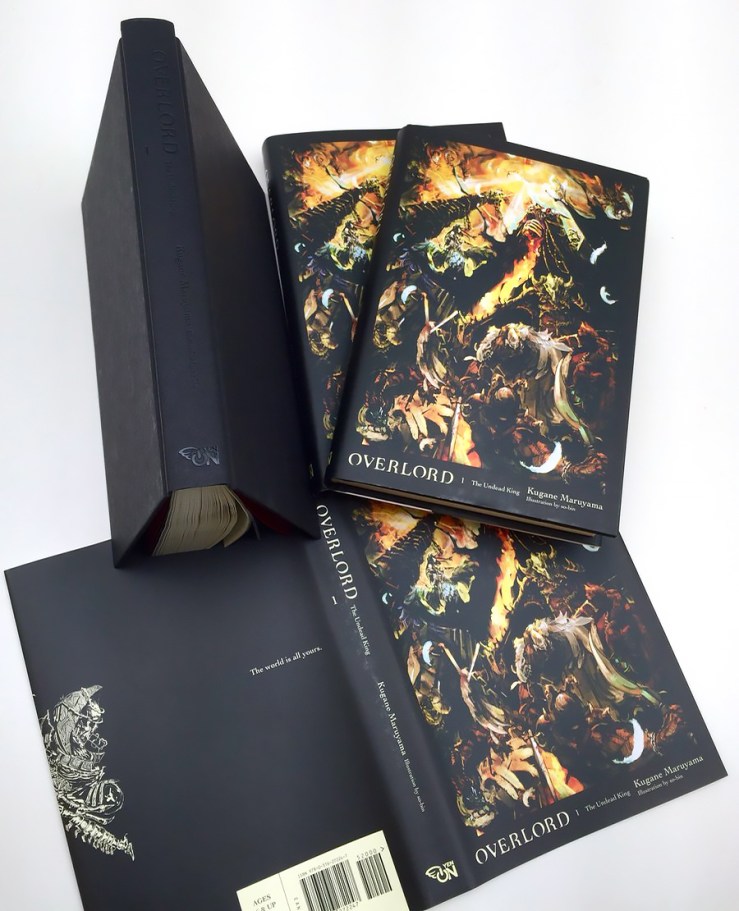
I should add that I’m extremely impressed by the quality of the hardcover edition of this book. Yen Press always does a fantastic job with its physical publications, but Overlord is something special. There’s a beautiful pull-out map at the beginning, character profiles at the end, and a full-color illustration on the cover page of every chapter. I have to admit that I’m not sure why Overlord has been singled out for this sort of “collector’s edition” treatment – aside from its massive popularity, of course – but I’m not complaining. Yen Press has currently published twelve volumes in the series, and each is as devilishly handsome as the last.

(Image from the Yen Press official Twitter account)

The Memory Police

The Memory Police
Japanese Title: 密やかな結晶 (Hisoyaka na kesshō)
Author: Yoko Ogawa (小川 洋子)
Translator: Stephen Snyder
Publication Year: 1994 (Japan); 2019 (United States)
Publisher: Pantheon Books
Pages: 274

The Memory Police is set on an island isolated from the rest of the world. The island is large enough to support a hospital, a university, and even a publishing company, but its community is small enough for people to be able to gather together for significant events. Like her parents before her, the narrator has lived on this island her entire life, and she takes its idiosyncrasies for granted.

The narrator’s island is cozy, with lovely bakeries and gardens. No one seems worried about money, and the narrator is able to live in a comfortable house despite the fact that the only work she does is to write novels that, by her own admission, no one reads. The narrator focuses her attention on the small details of everyday life, and it’s only gradually that the peacefulness and nostalgia of the narrative begin to unravel.

Every so often an object will “disappear.” Almost overnight, whatever has disappeared will vanish not just from the world, but from everyone’s memory as well. It’s not entirely clear how or why this works, but no one questions it. In some instances, such as perfume and photographs, the objects that disappear must be discarded, usually by means of being ritually thrown into a river or incinerated. In other cases, such as when the concept of “fruit” disappears, all the fruit on the island literally falls from the trees to the ground. Once something disappears, all perception of it disappears as well, and people aren’t able to recognize something that’s disappeared even if they’re looking at it. Even idiomatic expressions change, as with “to hit two creatures with one stone” after birds disappear. The world of the narrator is limited, but her attention to detail is precise, so even small disappearances take on an emotional weight for the reader.

Some people don’t lose their memories, however, and this is where the eponymous memory police come in. This is also where the novel becomes dystopian, with midnight arrests, people suddenly going missing, families fleeing, and all records of these incidents buried deep within an impenetrable bureaucracy. The narrator’s mother, who worked as a sculptor and kept a variety of disappeared objects hidden in a cabinet, was an early casualty of the memory police, leaving the narrator an orphan.

The narrator gradually realizes that her editor is also immune to disappearances, and she resolves to keep him safe by concealing him in a sealed room in the basement of her house while his pregnant wife flees to a rural area north of town, ostensibly for the sake for her health. As her editor continues to read and comment on the narrator’s manuscript in secret, an intimacy develops between them, which is reflected in the strange and surreal excerpts from her novel interspersed throughout the main story.

As the novel progresses, the rate of disappearances increases, an alarming trend that is exacerbated by environmental disaster. At the end of the story, the concept of “disappearances” is followed to its logical conclusion in an undeniably disturbing yet surprisingly soft and gentle manner.

The Memory Police is dystopian horror fiction reminiscent of The Handmaid’s Tale, but it’s also a meditation on the ghosts that quietly follow us without ever attracting our notice. There may be no memory police in the real world, but we still forget things all the time, and we forget them so thoroughly that we don’t even realize we’ve forgotten them. The narrator is just as susceptible to these small disappearances as everyone else, but what sets her apart is that she understands the value of remembering and the importance of preservation. By maintaining a diversity of small narratives, the larger narrative represented by the memory police – namely, that which is not productive must be aggressively forgotten – can be resisted. The novel works on multiple levels as historical and political allegory, but it’s also universal and deeply personal.

The Memory Police was originally published in 1994, but it feels contemporary, fresh, and relevant. There are no specific cultural markers in the text, and most character names are abbreviated as single letters, a device that confers an air of timelessness to the story. This novel is therefore accessible to a broad general audience with no knowledge of Japan, and the translation is gorgeous. The Memory Police is brilliant and extraordinary, and it refuses to be forgotten.

The Last Children of Tokyo

The Last Children of Tokyo
Japanese Title: 献灯使 (Kentōshi)
Author: Yōko Tawada (多和田葉子)
Translator: Margaret Mitsutani
Publication Year: 2014 (Japan); 2018 (United Kingdom)
Publisher: Portobello Books
Pages: 138

In the future – but not long in the future – Japan has secluded itself from the rest of the world. The environment is saturated with toxic substances, it’s dangerous to go near the sea, and most animals have disappeared from the wild. Humans still live on the Japanese archipelago, but their society has changed. Adults born in our own time live long lives and continue working well past their hundredth birthdays, while children born in the present of the novel have trouble retaining nutrients from food and are often too weak for sustained physical activity. Young and healthy people in their sixties and seventies do everything in their power to immigrate to Okinawa or the north of Japan, where agriculture still thrives, while Tokyo suffers from depopulation.

A novelist named Yoshiro still lives in Tokyo, where he cares for his great-grandson, Mumei. Mumei is fascinated by pictures of animals that have recently gone extinct, while Yoshiro devotes his time to looking back on the gradual shifts and changes in Japanese society. Each of Yoshiro’s memories is a sustained flight of magical realism that often has very little to do with the standard conventions of science fiction or dystopian fantasy. The Last Children of Tokyo is not about social critique through the medium of apocalypse, nor does it have much of a plot. Rather, it’s a reflection of everyday life in contemporary Japan in a mirror that’s mostly accurate but has a few interesting distortions.

Some of these distortions offer a speculative interpretation of how the texture of daily life has changed as a result of Japan’s recent demographic shifts.

The names of some of the older holidays were changed: “Respect for the Aged Day” became “Encouragement for the Aged Day,” while “Children’s Day” was now “Apologize to Children Day”; “Sports Day” was changed to “Body Day” to avoid upsetting children who were not growing up big and strong; so as not to hurt the feelings of young people who wanted to work but simply weren’t strong enough, “Labor Day” became “Being Alive Is Enough Day.” (43-44)

Other distortions magnify current practices out of proportion, making them seem like harbingers of social collapse.

He heard the phrase “Baby Carriage Movement” from Marika for the first time. This was a movement to encourage mothers to push their baby carriages around town every day as long as the sun was shining. Mothers who woke up unbearably miserable every morning, feeling helpless, hungry, about to pee all over themselves with no one to help them, whether because of a moist, clammy dream they’d had the night before, or because being cooped up all day with a squalling infant stimulates memories of the mother’s own infancy, went out to push their baby carriages until they came to a coffee shop with a “baby carriage mark” in the window, where they would find books and magazines to read and other mothers to talk to. (67)

Nevertheless, Tokyo is still a center of population, and Yoshiro can’t bring himself to leave the city as social services crumble, public transportation breaks down, and people resort to eating weeds. Even in decline, it seems, Tokyo is still home to many vibrant communities.

Though Tokyo was now impoverished, new shops still bubbled up from the depths to open up like flowers; just sitting on a park bench, you never got tired of watching the people go by. Walking around the city made the gears in your brain start turning. People had begun to realize that these simple pleasures were the most delicious part of the fruit we call everyday life, which is why even though their houses were small and food was scarce, they still wanted to live in Tokyo. (60-61)

In The Last Children of Tokyo, the city of Tokyo is less of a physical location than it is a collection of people who, as a society, have developed a fascinating set of quirks. The novel has very little plot to speak of and instead allows the reader to take in the sights as its narration slowly meanders between times and places. The last forty or so pages shift to Mumei’s perspective as he becomes involved in a secret plan to leave Japan, but there’s no sense of urgency regarding the matter; and, like the rest of the novel, the ending is meant to be enjoyed for its atmosphere. Tawada’s writing is given form by its abstractions, most of which can be interpreted by the reader in multiple ways and pursued in multiple directions. As a result, The Last Children of Tokyo is neither a particularly hopeful nor a particularly grim novel. It’s an odd book and an entertaining thought experiment, and Tawada playfully invites her readers to join her on a journey through a Tokyo that doesn’t exist – at least, not yet.

Syndrome

Title: Syndrome
Japanese Title: シンドローム (Shindorōmu)
Author: Satō Tetsuya (佐藤 哲也)
Illustrator: Nishimura Tsuchika (西村ツチカ)
Publication Year: 2015
Publisher: Fukuinkan Shoten
Pages: 315

This guest review is written by Max Rivera (@makkusutl on Twitter).

Thanks to a recommendation from a writer whose work I follow closely, I had the pleasure of reading this tiny monster of a book, whose story is comprised of elements widely regarded as “classic” or even “cliche” in Western science fiction films: a meteorite that crashes down onto a small town, a group of kids whose unquenchable curiosity leads them to a mysterious discovery, bicycle rides at night, and meta-references to prominent sci-fi cinematic works such as Close Encounters of the Third Kind, E.T., and Super 8.

Syndrome‘s synopsis is as simple as it gets: a meteorite crashes down on an unnamed city, causing a lot of turmoil. As days pass, the city becomes ensnared in a spiral of surrealism, mystery, and suspicion. The unnamed protagonist is an average yet gloomy high school student who hates the fact that this happened, as his fragile peace of mind is disturbed by the clash of what is normal and what is not. At first glance, it would seem Syndrome is a rehash of a number of works its readers have seen or read in the past, but there are two unmistakable elements that place this book a cut above the rest: its technically accomplished prose and its depiction of the perspective of its protagonist.

Syndrome‘s story is divided into seven chapters that represent seven days. On Day One, when the meteorite lands, things are relatively calm, but the reader can already perceive a faint sense of eeriness stirring, as can the protagonist. The gradual transition from normal to bizarre is highlighted by the detached sentence structure used by the author. Descriptions of landscapes, occasional thoughts, and conversations often lack any human trait; they are intriguing but feel almost numb. The prose bears almost no emotion whatsoever, which lends it an addictive and breakneck pace.

As the protagonist and his ostensible friends Hiroiwa and Kuraishi investigate the crash site and attempt to unveil what’s going on, the characters become more self-aware of their situation. Kuraishi is particularly knowledgeable and also happens to be a die-hard cinephile. He doesn’t directly break the fourth wall, but he acknowledges that the meteorite scenario is a classic trope of Western science fiction movies. For example, Kuraishi mentions The Blob (1958) and its 1988 remake, discussing how it became Steve McQueen’s feature film debut. Later on, Kuraishi compares what’s happening in the town to H.G. Wells’s 1953 film The War of the Worlds and Steven Spielberg’s 2005 adaptation. It’s amusing to the reader to watch Kuraishi ramble on about all this while the protagonist and Hiroiwa have no idea what he’s talking about, especially since he is stereotypically nerdy, which is perhaps a meta reference in itself. The author, a veteran at the renowned Hayakawa SF imprint, thus gives the reader a taste of his extensive cinematic knowledge.

All of these loose strands contextualize each other as days grow darker and reality begins to mirror fantasy. By then, the reader has already begun to tell that the protagonist’s state of mind is unique, to say the least. He becomes ever more suspicious of his surroundings, his so-called friends, and even his family. For him, anyone and anything outside what he considers “his mental zone,” namely, people who are outspoken and act based on their instincts, are “dangerous” people to be wary of. There’s a strong contrast between the protagonist’s standard narrative style and the narration that occurs when he gets lost in his obsessive thoughts, which are represented by longer sentences and textual stacks of repeated concepts. This type of prose achieves a dreamlike effect, and the two narrative styles intertwine in ways that portray a fascinating human dichotomy. As there is little recognizable emotion in the writing, which is close to a stream of consciousness, the impassive first-person perspective generates an illusion that the reader is being sucked into the black hole of the protagonist’s mind.

The ending of the novel is fitting, given how the story works: we don’t know what comes next, nor do we have a feeling that everything is over. In truth, Syndrome doesn’t have a beginning or an end, per se. Instead, it’s an epistolary account of a mentally-troubled teenager who watches everything around him fall apart.

Syndrome is a wormhole into the unknown. Once you start reading it, the book won’t let you go.

* * * * *

Max Rivera is a freelance writer from Mexico City. He is currently majoring in Translation & Interpretation and Literature. As a former resident of Japan and aficionado of Japanese fiction, the Japanese publishing world, and pop culture, he often publishes reviews and cutting-edge articles on these subjects through several outlets, such as his personal blog on Tumblr and the popular Japanese media blog Tanoshimi. He loves cold weather, books, and cats way too much.