Gothic & Lolita Bible

gothic-lolita-bible

Title: Gothic & Lolita Bible
Editors: Jenna Winterburg and Michelle Nguyen
Publisher: Tokyopop
Publication Schedule: Quarterly
Pages: 128

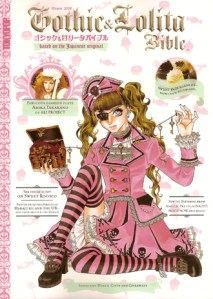
This month has seen the publication of the fifth issue of the English edition of the famed Japanese “mook” (magazine-book) Gothic & Lolita Bible (ゴシック&ロリータバイブル). Since the theme of the Spring 2009 issue is “A Dreamy Gothic & Lolita Wedding,” and since I find the obsession with weddings somewhat troubling (blame my inner feminist), I will base this review on the Winter 2009 (fourth) issue of the Bible. The focus of this issue seems to be “badassery and cupcakes,” which provides more comfortable thematic material for me to work with.

So, what is the Gothic & Lolita Bible all about, anyway? Well, obviously, it’s about Gothic and Lolita fashion, but there is also information about visual kei singers and bands, as well as copious amounts of information concerning the Gothic Lolita lifestyle so vividly portrayed in contemporary Japanese fiction like Novala Takemoto’s novel Kamikaze Girls (下妻物語, published in translation by Viz Media). The English version of the Bible provided both translated material from the original Japanese mooks and incorporates new material of interest to Western (especially American) readers.

Because the English edition of the Bible just came into existence (the first issue was released in early 2008), the content tends to change from issue to issue, as features and formats still seem to be in a developmental stage. Each issue, however, will contain numerous fantasy-inspired photo shoots of both Japanese models and Western readers, a Fruits magazine-esque montage of Harajuku street fashion photos, and, of course, a detailed section featuring the season’s offerings from major Japanese Gothic Lolita fashion brands like Baby, the Stars Shine Bright, Angelic Pretty, Innocent World, h.NAOTO, Black Peace Now, and Atelier Boz. Also, like the Japanese version, each issue contains patterns and instructions for do-it-yourself pieces (mainly accessories). Other articles may feature interviews with American Gothic Lolita designers, information on American and Japanese artists specializing in Gothic Lolita art, and reviews of fancy cupcakes that would presumably complement a Gothic Lolita tea party.

Personally, my favorite features are the “Letters from Our Readers” section, which includes, for example, poetry and reader-submitted art of surprisingly high quality, and the occasional fiction and essays that make it into the magazine, such as Arika Takarano’s manifesto titled “Oh Maiden, Advance with a Sword and a Rose,” which encourages young ladies to follow their hearts and their dreams regardless of the social pressures they might face. Along these lines, the reader letters published by the mook tend to deal with issues of participating in the Gothic Lolita culture even though you’re too old, too fat (by Japanese sizing standards), or live in the middle of nowhere. If nothing else, the Gothic & Lolita Bible gives its readers a sense of community, regardless of whether they own a stitch of the clothing or not.

Does this sound corny? You bet it’s corny. The whole mook is corny, actually. If you’ve already made up your mind that Gothic and Lolita culture is the most silly, superficial thing you’ve ever had the misfortune to encounter, the Gothic & Lolita Bible will not convince you otherwise. If you’re even the slightest bit curious about Gothic Lolita, however, I would recommend picking up a copy of this mook. It’s a gorgeous publication and well worth the $20 price tag.
Anime Explosion!

anime-explosion

Title: Anime Explosion! The What? Why? & Wow! of Japanese Animation
Author: Patrick Drazen
Publication Year: 2003
Publisher: Stone Bridge Press
Pages: 369

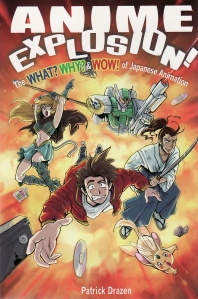
When I got Anime Explosion! in the mail from Amazon, I was so excited. I had seen it on a friend’s bookshelf, and, silly cover illustration aside, it seemed like a fairly serious reference source on anime. Instead of merely listing one anime series after another, its chapters are structured around broad themes (portrayals of nature, anti-war messages, etc.), with chapters devoted to single works or directors at the end of the book. The chapters are filled with well-selected and well-formatted illustrations accompanied by captions that do not merely repeat what is in the text, and there are numerous footnotes, which are also well-formatted and easy to read. The bibliography at the end of the book references such serious scholarly works as Professor William LaFleur’s Liquid Life: Abortion and Buddhism in Japan as well as numerous creator interviews from the pages of the long defunct but still fondly remembered anime magazine Animerica. The book hits all the big bases, like Japanese folklore in anime, nudity in anime, the Pokémon phenomenon, Studio Ghibli, and even one of my personal favorite series, Revolutionary Girl Utena. What’s not to like?

The fact that Anime Explosion! is one of the more boring books I’ve ever read is not to like, actually. And you’ll have to believe me when I say that, during my six years in higher education, I have read some pretty boring books. During my two years in higher higher education, I have also read some pretty terrible student papers, and so I think I can put my finger on what I dislike about Anime Explosion! – it’s the plot summary. Pages and pages of it. All written in singularly uncreative and unevocative prose. Judging from the level of the language, I would say that, despite the occasional frank discussions of sex and sexuality, the target audience for this book is currently enrolled in middle school. The book also assumes that the reader knows nothing about Japan, which I suppose is fair; but, to those of us who have studied the country, the cultural clichés referenced over and over again come off as a little stale. There also isn’t much interpretation involved, and the little that does exist is tepid and sophomoric.

I hesitate to say this, as Drazen acknowledges this problem in both his introduction and his conclusion, but Anime Explosion! is also a bit dated. The individual works covered in the book are, for the most part, classics, and no amount of time is going to change that. In that sense, Drazen has done an excellent job of creating a reference work that will transcend the whims of an extremely capricious field. On the other hand, for having been published in 2003, this book feels like a relic from the mid-nineties. The internet? What is this strange thing? The Japanese bubble economy collapsed? Oh my god! Also, to me, a presumably serious scholar, many of the seventies and eighties era texts Drazen references (like Kitteridge Cherry’s Womansword: What Japanese Words Say About Women) can no longer be taken seriously. Also, for those fans curious about such recent phenomena as moe and hikikomori, there is nothing to be found.

All that being said, this is a solid book and may prove interesting to younger or more hard-core anime fans. And, to be fair, Drazen’s chapter on “Gay and Pseudo-Gay Themes in Anime” (which Drazen aptly titles “A Very Pure Thing”) is bold, insightful, and well ahead of its time. For those of us interested in how anime stereotypes came to be, chapters like “Shojodo: The Way of the Teenage Girl” are also useful. For older readers looking for thrills and entertainment, however, I would recommend an anime magazine like Otaku USA, which tends to function at a much higher level than Drazen’s well-meaning but regrettably prosaic reference work.

Yokai Attack!

yokai-attack

Title: Yokai Attack! The Japanese Monster Survival Guide
Authors: Hiroko Yoda and Matt Alt
Illustrations: Morino Tatsuya (森野達弥) 
Publication Year: 2008 (America)
Publisher: Kodansha International
Pages: 191

I was absolutely certain that I was not going to like Yokai Attack. I had fully expected it to be a boring and poorly organized mishmash of folklore, citations, and half-baked interpretation along the lines of Borges’s The Book of Imaginary Beings. But the illustrations for this book were commissioned from Morino Tatsuya, a famous apprentice of Mizuki Shigeru (a manga-ka known especially for his manga Hakaba no Kitarō, which was adapted into multiple versions of the anime franchise Ge Ge Ge no Kitarō), so I decided to give it a shot, despite the silly cover.

To my immense surprise, I fell in love with Yokai Attack right from the book’s dedication to Lafcadio Hearn and his wife, which I found apt and also quite touching. It is clear from the first few paragraphs of the preface that the authors have done their research and are extremely knowledgeable on the subject matter. In fact, the “Yokai Resources” section at the end of the book, with its extensive bibliography, is almost worth the price of the entire book itself for people interested in yōkai. Alt and Yoda draw on wide range of materials, from Nō plays to Edo-period collections of woodblock prints to Yoda’s memories of the ghost stories she heard as a child, to bring together about thirty-five detailed, four-page profiles of Japanese ghosts and goblins.

The joy of this book is not its wealth of information, however, but rather the lucid and witty style in which the information is presented. Alt and Toda obviously enjoy what they do, and they make sure their readers are just as amused as they are. I don’t mean to say that Yokai Attack is condescending or facetious; rather, the writing is exuberant and filled with small, good-natured jokes that make it a pleasure to read. The format and organization of the book are reader-friendly as well, and the captions, panels, and side notes are enjoyable and not distracting.

Yokai Attack seems to be targeted towards an audience of all ages, with perhaps a movie rating of “PG.” Although instances of people (or other strange and inappropriate things) getting eaten are directly referenced with much glee, all mention of grotesque violence and sexual activity has been struck from the text. This is something of a shame, as I’m sure the writers ran across enough upsetting and salacious material to fill another couple of books, but I suppose it’s for the best, as it will allow this gem of a book to reach a wider audience.

The one qualm I have with Yokai has nothing to do with the authors but rather with the publisher. Kodansha International, true to its Japanese origins, is known for going out of its way to publish beautiful books. It seems that it has shortchanged Alt, Yoda, and especially Morino by being only half full-color. Although the first two pages of each yōkai entry are full-color, the second two are not, and the publisher seemed to give up around page 145, when the full-color pages end. Since this book is beautifully formatted and filled with interesting images, I can’t even begin to imagine why Kodansha would cut corners like this. I am so disappointed in them! Such a fine book deserves better.

Another thing that bothers me is that I have not seen this book in bookstores anywhere – not even Kinokuniya in New York. Kodansha should get on the PR train and market Yokai Attack as a manga, so that it will be shelved with manga and reach its target audience. I kind of want to go to Kodansha and throw something at them for being so willfully ignorant.

But three cheers for Hiroko Yoda and Matt Alt! Yokai Attack is a wonderful book, and I highly recommend it to anyone interested in Japan in any capacity whatsoever.

Japanese Schoolgirl Inferno

Title: Japanese Schoolgirl Inferno: Tokyo Teen Fashion Subculture Handbook
Authors: Patrick Macias and Izumi Evers
Illustrations: Kazumi Nonaka
Publication Year: 2007 (America)
Pages: 147

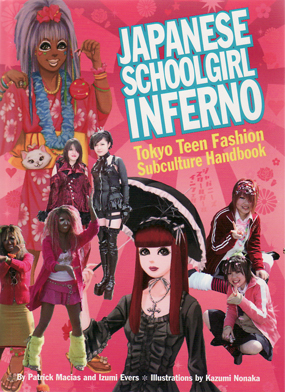
When a friend gave me this garishly pink little book as a present, I saw the name “Patrick Macias” on the cover and immediately prepared to be disappointed. Macias has authored and co-authored numerous books on Japanese popular culture. Two that might be familiar are Cruising the Anime City: An Insider’s Guide to Neo-Tokyo (2004) and TokyoScope: The Japanese Cult Film Companion (2001). These books are not only boring but were also outdated on the day they were published, primarily because Macias’s fascination with Japan’s popular culture during the seventies and early eighties fails to hold the attention of those of us who want to know what’s going on in Japan right now. In fact, I might even go so far as to say that Macias’s earlier books might have been better served if they were marketed as cultural histories instead of as guides to contemporary popular culture.

While it’s true that Japanese Schoolgirl Inferno is only up-to-date as of around 2005, and while it’s true that this book contains quite a bit of cultural history, I found it to be one of the most entertaining books I’ve read in a long time. Maybe it’s because of all of the bright and eye-popping photography. Maybe it’s because of Kazumi Nonaka’s fun and plentiful illustrations. Maybe it’s because of the concise prose and scandalous quotations. Or maybe it’s because of all the pink. In any case, once I picked up this cute and trim guidebook, I had a hard time putting it down.

One thing that I found especially charming about this book were all the suggestions the authors offer as to how to achieve these schoolgirl looks yourself. Far from being helpful, these sections actually serve to pinpoint how outrageous the fashions are. Another fun, recurring segment are the illustrated “A Day in the Life” inserts, which usually end with captions like “Mom says, ‘Take a shower! You two smell awful!’”

So, if you’ve always wanted to know what’s going on inside the heads of the Gothic-Lolita princesses, or if you’ve always been curious about how exactly the Mamba girls put on their makeup, this is the book for you. Even if you’ve never had the leisure to wonder about those things but have spent time in Tokyo, this is also probably the book for you. And if you really, really love pink, then I honestly can’t recommend this book enough. Go out and get it before it goes out of print. For the win. I’m serious.