Anime from Akira to Howl’s Moving Castle

Title: Anime from Akira to Howl’s Moving Castle: Experiencing Contemporary Japanese Animation
Author: Susan J. Napier
Publisher: Palgrave Macmillan
Publication Year: 2005
Pages: 355

Although I consider myself a literature person, it might be better to call what I do “media studies.” I write papers about books, but I also write more than a few papers about movies, and at least half of the Japanese movies I watch and write about these days are animated. This is something I wouldn’t have dreamed that I’d be doing when I first entered graduate school. For whatever reason, however, I read the 2005 updated edition of Susan Napier’s book on anime during my first winter break and was so inspired that I decided to start writing about popular media, too.

I had taken a lot from Napier’s two earlier books on literature (Escape from the Wasteland and The Fantastic in Modern Japanese Literature) as an undergraduate, so I’m not sure why it took me so long to sit down and starting reading Anime. If I had to guess, it probably had something to do with the bad reputation the book had (has?) among anime fans. I didn’t have a particularly strong impression from the chapters on magical girls from the original 2001 edition that I had read as a freshman in college (probably because I was eighteen years old), and several people had said that the book is poorly written, gets plot points wrong, and doesn’t respect anime as a medium.

My experience of reading the book was completely the opposite of the bad rumors I had heard. The first chapter of the book (appropriately titled “Why Anime?”) explains why Japanese animation is amazing and exciting and well worth academic attention, and I feel like it conveys a great deal of appreciation and respect for the medium. Also, I’ve seen my fair share of anime, and I’m a member of the generation that is old enough to have seen most of the works Napier discusses in Anime. Upon re-reading the book this past semester, nothing jumped out at me as overtly incorrect in terms of plot or character summary (but, then again, I have never finished and do not plan to ever finish watching Ranma 1/2, so I am willing to admit that I could be wrong). Finally, I think the writing is wonderful. Napier’s prose is clear, precise, and easily understandable by anyone who has neither a long history of watching anime nor a long history of studying Japan. Her writing is also enjoyable to read, as it is occasionally augmented by clever and poetic turns of phrase and various well-placed rhetorical devices that help her make her argument.

Anime is more or less written as a textbook for university-level students. It covers about two dozen films, television series, and OVA’s, usually focusing on two or three primary works over the course of each 20-25 page chapter. The book is broadly divided into three parts according to what Napier sees as the three essential modes of Japanese animation: the apocalyptic, the carnivalesque, and the elegiac. Woven throughout these modes are the three themes of technology, the body, and history. Chapters have titles like “Ghosts and Machines: The Technological Body,” “The Enchantment of Estrangement: The Shōjo in the World of Miyazaki Hayao,” and “Waiting for the End of the World: Apocalyptic Identity.” Although many of the works she discusses could belong in multiple chapters, I feel that Napier chooses her primary works for each chapter extraordinarily well and uses representative works to make strong arguments about various trends in contemporary Japanese animation.

Is there a danger of occasional overgeneralization? You bet. But so must there be in any entry-level textbook. A casual reader might run the risk of thinking, for example, that all Japanese animated pornography is fantastically grotesque after finishing the chapter “Controlling Bodies: The Body in Pornographic Anime” (which discusses such classics as Legend of the Overfiend and La Blue Girl), but Napier is always careful to qualify her argument and choice of texts not only within her main discussion but also in her footnotes, which document the sources from which Napier is drawing her conclusions, alternate texts for consideration, and interpretations that are at odds with her own.

Napier reads animation like a literature scholar would read a book, although her focus, understandably, seems to fall on visual imagery. Her readings of the texts follow two lines: psychoanalytic and socio-historic. Since Anime is targeted at undergraduates, neither line of interpretation is ever allowed to become too esoteric. A standard knowledge of Freudian psychology and basic sociology should suffice for the reader, who runs no danger of being confronted with Lacan’s objet petit a or the superstructures of Frederic Jameson. Nevertheless, Anime is far from mindless, and anime fans looking for extended plot summary followed by commentary, insights provided by interviews with directors, or viewing recommendations would probably best be served elsewhere.

I firmly believe that Anime works very well as an introductory textbook. It’s filled with interesting general ideas, and Napier’s clear language and precise structuring make these ideas easy to understand and debate. You don’t have to take my word for it, though, since there are plenty of other opinions floating around the internet. William Gardner (a scholar of science fiction) is happy that the book doesn’t seem like it’s written for otaku; Adam Arnold (a reviewer on Animefringe) is unhappy that the book doesn’t seem like it’s written for otaku. A reviewer for the Anime News Network claims that the book can be enjoyed as long as one is willing to accept the academic context; a reviewer for Hofstra Papers in Anthropology claims that the book can be enjoyed as long as one accepts that the academic context is not rigorous enough. Wherever you fall along this spectrum, Anime is a fun and inspiring book, and it contains a lovely ten-page bibliography that’s good to browse through for further reading on both the fun end and the serious end of writing on Japanese animation.

Little Boy

Title: Little Boy: The Arts of Japan’s Exploding Subcultures
Editor: Takashi Murakami
Publisher: Japan Society Gallery
Publication Year: 2005
Pages: 300

Little Boy is most definitely the contemporary Japanese art exhibition catalog to end all art exhibition catalogs. It quickly sold out when it was first released, and secondhand copies now sell for ridiculous amounts of money. The Japan Society of New York has finally released a softcover edition, which it sells in its headquarters in New York City. The new edition is just as gorgeous and well put together as the original hardcover version; so, if it’s at all possible for you to acquire one, go for it! Quickly! Do it now! Before you even start reading this review! Yes, it’s that good.

The first one hundred or so pages of this catalog feature full color plates of various artworks, photographs, and screen stills. Through these plates, pop artist extraordinaire Murakami Takashi attempts to demonstrate in images the thesis of his introductory essay “Earth in my Window.” Murakami’s main argument can be summarized in two points. First, the Pacific War, especially the two atomic bombs that ended it, left an indelible scar on the Japanese psyche. Second, the experience of having been defeated in war and thereafter occupied by America has turned multiple generations of Japanese people into perpetual children. The first point is illustrated by plates demonstrating recurring nuclear imagery in films and television serials such as Akira and Neon Genesis Evangelion and various tokusatsu (“special effects”) films released by Tōhō Studios, as well as in the artistic output of artists like Yanobe Kenji and Murakami himself. The second point is easily demonstrable by the overtly cartoonish and childlike work of artists such as Nara Yoshitomo, Ban Chinatsu, and Mr., as well as by the designs of popular and festishized kyara (“characters”) like Hello Kitty. Following these images and explanatory essay is a short manifesto penned by Murakami to support his superflat art movement, which is apparently based on the idea that contemporary Japan needs art that reflects its current cultural status of being awash in meaningless junk.

Next up is a transcription of a conversation between Okada Toshio and Morikawa Kaichirō (two self-proclaimed experts of “otakuology”) moderated by Murakami. Morikawa in particular states that otaku are characterized by an obsession with things that are dame (absolutely useless), whether it’s collecting antique model kits or falling in love with moe (young and innocent) characters. Okada seems to have a somewhat more optimistic view of otaku, who he thinks are simply resorting to childish things in order to escape a meaningless and unforgiving life. This conversation is superbly illustrated by images of the cultural paraphernalia the two men mention, and it also includes several dozen footnotes explaining their various obscure otaku references.

Following this conversation are two academic essays by Japanese scholars, Sawaragi Noi and Matsui Midori. Sawaragi discusses how the Pacific War has filtered through Japanese pop culture in movies like the Godzilla and Space Battleship Yamato series, and Matsui discusses the subculture of kawaii (“cute”) in postwar Japan, especially in terms of how it is connected to art depicting women and art by women artists like Takano Aya and Mizuno Junko. Following these two essays by Japanese authors are two essays by American authors, Alexandra Munroe and Tom Eccles. Munroe offers a history of otaku subculture from the perspective of a Western observer, and Eccles attempts to situate the superflat movement with the history of Western pop art. All of these essays (as well as everything else in the catalog) are presented in both English and Japanese, with a column of English text on the left and a column of Japanese text on the right. Finally, the “Further Readings” section at the end of the book is an invaluable six-page bibliography of related works in both English and Japanese.

In short, Little Boy is gorgeous, fun, and intelligent. The dual language presentation is unobtrusive for readers of one language but wonderful for readers of both. Murakami’s presentation of Japanese culture itself is both extremely interesting and highly controversial. This catalog is a work of art and an object of culture in and of itself. No matter what your field of interest is, I highly recommend picking up a copy before they’re all gone.

Shojo Manga! Girl Power!

Title: Shojo Manga! Girl Power!: Girls’ Comics from Japan
Editor: Masami Toku
Publication Year: 2005
Publisher: Flume Press
Pages: 80

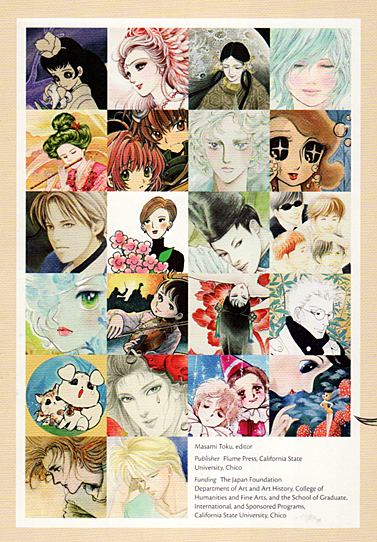
Judging from its front and back cover, you might expect this catalog to contain big, glossy reproductions of artwork gleaned from shōjo manga, like watercolor cover illustrations or the artistic two page spreads that are a defining characteristic of the genre. Aside from six color pages in the middle of the volume, however, there are relatively few images, and majority of the book is printed in black and white.

What this volume does contain are thirteen essays, each three pages long, on the phenomenon of shōjo manga, manga in general, and the impact of Japanese comics on America, followed by page-long profiles of twenty-three manga artists. The essays mainly repeat the same outdated information and stereotypes about manga (and gender) that you can find anywhere. Typical of these short essays is the misleading and essentially meaningless line, “The popularity of the genre [of boys’ love] is reflective of the fact that in Japan, male love, loyalty, and companionship are considered of the highest virtue (Toku).” A few of the essays are well worth reading, however. One of them is Yoko Nagakubo’s essay “Yaoi Novels and Shojo Manga,” which contains the most reasonable explanation concerning gender identification in boys’ love manga that I have ever come across. Another is Frederick Schodt’s “A Different View,” which seeks to correct some of the most widespread American misconceptions about the Japanese manga industry (and which seems surprisingly prescient in light of the current crisis facing the American manga industry).

The main selling point of the book are the artist profiles. These profiles list two or three major works of each creator and briefly cover his or her thematic preoccupations. Each profile is accompanied by one or two small, black-and-white (but still gorgeous) illustrations that demonstrate the artist’s style. Most of these artists are still relatively unknown in America, as only a small handful of them have been translated into English. (And, even if their works have been translated, as is the case with Ikeda Ryōko of Rose of Versailles fame, they are almost impossible to find.) They include Watanabe Masako, Maki Miyako, Mizuno Hideko, Satonaka Machiko, and on and on.

In other words, this exhibition catalog might not be the most beautiful or academically rigorous book ever published, but it serves as an extremely useful field guide to the history of shōjo manga through its creators. It’s also an excellent reading guide, highlighting a manageable number titles as well as the reasons why they are important and enjoyable. I’m definitely taking this book along with me the next time I visit Japan.

Most major university libraries own a copy of this 2005 exhibition catalog; but, since there have recently been several copies floating around the internet (on Amazon and eBay), I thought I’d snag one for myself before they disappear. If you’re interested, I would encourage you to do the same!

Magic as Metaphor in Anime

Title: Magic as Metaphor in Anime: A Critical Study
Author: Dani Cavallaro
Publication Year: 2010
Publisher: McFarland
Pages: 212

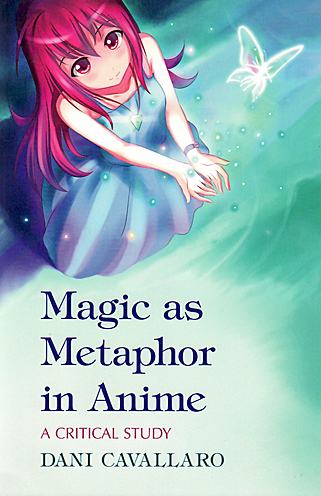
When Amazon recommended this book to me, I was really excited. What an interesting topic! I haven’t had good experiences with Dani Cavallaro’s work in the past, however. I felt that her books on the films of Oshii Mamoru (The Cinema of Oshii Mamoru: Fantasy, Technology and Politics, 2006) and Studio Gainax (The Art of Studio Gainax: Experimentation, Style and Innovation at the Leading Edge of Anime, 2009) were somewhat shallow and, to be frank, extraordinarily difficult to read. In these two books, Cavallaro has devoted five or six pages to films and television series to which other scholars have written thirty to forty page articles and chapters. Each of her essays reads like an outline – she skips from topic to topic with no development and little transition, using theoretical and philosophical terms without explaining what they mean in context and without giving examples. In this way, she can cover an exhaustive list of material, but it doesn’t seem like she has much to say. Since its table of contents would suggest that Magic as Metaphor focuses more on broader themes, though, I thought I would at least check it out from my university’s library and give it a shot.

Unfortunately, Magic as Metaphor is unreadable. I found so many things about this book frustrating that I don’t even know where to begin. I suppose I should start with the least damning of my criticisms: Cavallaro discusses an enormous number of titles. Her “Filmography” section at the back of the book lists forty-one primary titles (many of which are simply successive seasons of the same franchise). She’s got roughly seventy other ancillary titles listed, however, just in case the main forty weren’t enough. Even if we focus on the main titles, though, she still has less than 190 pages to talk about thirty or so anime franchises, which equals about six pages devoted to each of them. So yes, there is quite a bit of breadth, and I admire Cavallaro for being able to watch and keep track of so many titles (many of which came out quite recently); but again, it feels like she’s writing only marginally fleshed-out outlines, and the way she jumps from title to title and from concept to concept is disorienting. It’s also almost impossible to ascertain the main point of each chapter, and the way that various anime are included in the various chapters comes off as almost random.

In addition to her shallow discussions and poor structuring, I also feel like Cavallaro isn’t saying anything interesting. Certainly, she will quote key thinkers (like Tzvetan Todorov and Wikipedia) and then quickly move on without explaining what these quotes mean or how they relate to her argument, but most of her discussion is plot summary. Not explication through plot summary, but explanatory text that could be taken from an entertainment journalist’s review of a particular title. Her description of characters and themes often stems from the most simple and most obvious interpretation possible, as if it came off of the back of a DVD box. I am exaggerating, of course, but only a little bit. Certain sentences stand out as being insightful and useful and meaningful, but they are rare and isolated from one another.

The writing itself is terrible, ranging from overly flowery diction (“CLAMP’s passion for ocular impairment”) to purple prose (“whereas Lydia’s expression invariably exudes infinite kindness and compassion, Raven’s holds a malevolent light soaked with unspeakable sadness”) to condescension (“Earl and Fairy makes reference to so bountiful a range of magical entities as to occasionally come across as a concise guide to the spirit world for newbies”). Her paragraphs rarely have topic sentences, and there are no strong conclusions to be found anywhere. She quotes inane movie reviews as if they were scholarship and often uses these idiotic quotes (“Sousuke is ‘one of those adorable anime moppets with large round eyes’ amid ‘many a winsome tummy-poke and nose-wiggle’”) to close paragraphs. Things like this occur so frequently that I found myself growing increasingly frustrated as I read. In short, the writing in this book toes the line between journalism and scholarship but, unfortunately, contains none of the pleasures of either.

You may be asking yourself why I read the book if it was so bad. The answer is that I didn’t. I read one chapter (“Magic Bildungsromans”) and then threw the thing against the wall. It may be possible that I picked the worst chapter to read, and it may also be possible that the rest of the book is sheer brilliance, but I highly doubt it. Cavallaro has six other books about anime in print through McFarland, and all of them have been published in the last five years. These do not include the numerous other works she has published on cyberpunk through other publishers in the past five years. Simply put, Cavallaro is a writing machine, and her output indeed reads like it was written by a machine. I have found some of her work, especially Anime and Memory: Aesthetic, Cultural and Thematic Perspectives (2009) to be useful as a guide for viewing recommendations. Otherwise, it’s best to approach her books with caution, and with a library card instead of a credit card.

In all fairness, Cavallaro’s books are more than capable of carrying their weight as reference guides to Japanese animation (as opposed to “critical studies”), but I myself prefer the work of British anime scholar Helen McCarthy, whose books are less pretentious and infinitely more enjoyable to read. They also have more pictures, which is always a good thing where visual media is concerned.

From Impressionism to Anime

From Impressionism to Anime

Title: From Impressionism to Anime: Japan as Fantasy and Fan Cult in the Mind of the West
Author: Susan Napier
Publication Year: 2007
Publisher: Palgrave
Pages: 243

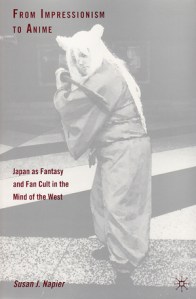
Let me start off by listing the obvious flaws of this book. First of all, the cover. It’s terrible. Whose idiot idea was it to take a crappy photo of crappy cosplay, run it through the “Impressionism” filter in Photoshop, and then put it on the cover of a book? According to the back cover, this monstrosity is the work of “Scribe Inc.” Shame on you, Scribe Inc., and shame on you, Palgrave, for letting them get away with it! Second of all, in a book primarily concerned with visual culture, there are surprisingly few illustrations. To be precise, there are ten, and only four of them are in color. This I am going to blame on the author, whose 2005 work Anime from Akira to Howl’s Moving Castle is also surprisingly under-illustrated (while other Palgrave scholarly publications have no shortage of well placed, high-quality greyscale images). Napier has no excuse for this, especially since the cosplay culture she details so lovingly is all about getting pictures of itself published. Third, Napier’s scope is very broad, but her treatment of her many topics is, perhaps unsurprisingly, shallow. I did not find this to be the case with Anime (despite many critical accusations to the contrary), but I’m disappointed with what I found to be the lack of sustained intellectual rigor in Impressionism.

Now that that’s out of the way, let me be something of a fangirl for a second and say that I love all of Napier’s work, Impressionism included. Napier always manages to choose the most fascinating things to write about, and she always does an excellent job of explaining why her chosen subject matter is interesting and important. Her analysis is apt, penetrating, and lucid, and her work does not suffer from any of the structural weakness found in a great deal of recent academic work – you always know what she’s trying to say, and her way of saying it is both logical and artistic. Although her theoretical background is rock solid (her bibliographies are a bit intimidating), she doesn’t blithely toss around big names and critical jargon. Also, you can tell that, even though she occasionally betrays a bit of light-hearted sarcasm, she has nothing but respect for the topics of her studies.

This attitude of respect is very important for a work like Impressionism, which deals with some strange and, depending on one’s perspective, almost contemptible subject matter. The book is divided into eight chapters (not including the Introduction and Conclusion). The first four chapters each take up a different aspect of the West’s fascination with Japan during the last two centuries. The first chapter covers turn-of-the-century Impressionists like Claude Monet and Vincent Van Gogh, who revolutionized the fine arts with a little inspiration from Japan, or at least the “Japan” of their imaginations. The second chapter goes into famous inter-war Japan enthusiasts such as Lafcadio Hearn, Arthur Waley, and Frank Lloyd Wright. The third chapter follows the antics of post-war American writers like Jack Kerouac, Gary Snyder, Michel Crichton, and William Gibson, and the fourth chapter is all about how Western men perceive and interact with Japanese women in works like Madame Butterfly and Memoirs of a Geisha. The last four chapters, which I consider to be the true raison d’être of this book, deal with American anime fandom and all its various manifestations, from anime conventions to cosplay to slash fan fiction. Through all of this, Napier attempts to uncover the source of the West’s long fascination with Japan, all the while making astute references to the global political and economic climates during which this fascination has become manifest.

The first four chapters, while interesting, are, as I said earlier, somewhat shallow. Each topic that Napier covers in these chapters has been written about extensively by other scholars, a fact which she openly acknowledges. Her originality here lies in the fact that she documents what she sees as a trend, although she is cautious about saying that the various moments in the history of what I am going to call “Japan fandom” are directly related. The main point of interest for readers is the work that Napier has done on post-1980 American anime fandom, which is the culmination of many years of interviews and surveys. Mainly speaking through the voices of the fans she has contacted, Napier attempts to explain the appeal of contemporary Japanese popular culture to Americans, often in contrast to American popular culture. Although she offers no strong conclusion, the variety of insights Napier offers are invaluable.

My one real criticism of this study is that, although Napier hints at exposing the power relations underlying fan culture, she never really follows through. In other words, she is mainly concerned with the relation of fans to the world outside fandom (what she calls “the Muggle world”) and doesn’t delve into the hierarchies of power within the in-group of fandom itself. For example, I would have found an analysis of the term “weeaboo” (an American who loves anime so much that he or she wants to become Japanese) to be a pertinent addition to her discussion. Instead, Napier makes American anime fandom seem like something of a utopia; although she mentions the darker side of fandom by quoting scholars who bring up the concept of “fan pathology,” she never directly acknowledges that such a thing might actually exist in her own object of study.

Otherwise, I found From Impressionism to Anime to be a very satisfying read. It’s an excellent cultural study and could double as a perfect introduction to modern and contemporary Japanese history for someone considering pursuing the subject as an undergraduate – or simply as an intelligent, interested individual. Don’t let the cover fool you. This is actually a book you want to read!

Kamikaze Girls

kamikaze-girls

Title: Kamikaze Girls
Japanese Title: 下妻物語
Author: Takemoto Novala (嶽本野ばら)
Translator: Akemi Wegmüller
Publication Year: 2008 (America); 2002 (Japan)
Publisher: Viz Media
Pages: 219

In his afterward to Kamikaze Girls, Takemoto Novala writes that “Lolita is a fusion of the spirit of punk rock with formal beauty that honors tradition. Lolitas value independence and beauty above all else. In Kamikaze Girls, the two girls are drawn to each other’s independent natures and eventually come to respect one another.” Such a lofty statement is belied by the colorful and overwhelmingly pink cover of the novel, as well as the fact that the “two girls” in question (the protagonists of the novel) are a stereotypically representative Sweet Lolita and a stereotypically representative Yanki, or juvenile motorcycle (or, as the case may be, scooter) gang member.

The novel is narrated by Momoko, who describes herself in this way: “A red felt mini-hat accented with rose-shaped burnout lace is perched on my hair, which is styled in a princess cut with long ringlets, and I have on frilly white over-the-knee socks. So aside from my shoes, which are Vivienne Westwood’s Rocking Horse Ballerinas and Lolita must-haves (they go with any Lolita outfit), I am clad head-to-toe in my darling Baby, the Stars Shine Bright.”

In other words, Momoko is a Lolita among Lolitas, and she peppers her story with all sorts of references to and explanations of Lolita culture. In fact, Momoko begins her engagingly chatty narrative with a pseudo-historical lecture on the Rococo era in France, which supposedly inspired Lolita fashion and its ideals. Despite the silliness of the premise, Momoko’s narrative style is one of the major attractions of the novel. An unreliable narrator par excellence, Momoko relates the often sordid and depressing details of her personal and family history in witty, toungue-in-cheek monologues that reflect teenage power fantasies (at least as I remember my own) to an amazing degree.

In any case, the aggressively anti-social Momoko manages to attract the attention of Ichigo, a similarly dysfunctional seventeen year old. Unlike Momoko, Ichigo was born to a fairly bourgeois family; but, upon encountering ijime (group bullying) in middle school, she fell into despair and was rescued by a female Yanki gang. Although Ichigo respects and admires the leader of this gang for both her toughness and her nurturing personality, she is drawn to Momoko despite the Lolita’s almost constant derision. When the Yanki leader announces her intention to “graduate” from the gang (she intends to get married), Ichigo wants to present her with a kamikaze coat embroidered by the legendary Yanki figure Emma, who can supposedly be found in the fashionable Daikanyama district of Tokyo. Emma doesn’t exist, unfortunately, but Momoko is quite skilled at embroidery herself, and the pair’s adventures in Tokyo have some unexpected outcomes for both of them.

Even though Nakashima Tetsuya’s 2004 film version of Kamikaze Girls was so ridiculous and oversaturated that it made my eyes bleed a little, I found that I honestly enjoyed Takemoto’s original novel. As I mentioned earlier, the informal, chatty, and at times almost essay-like narrative style is quite enjoyable, the dialog is quick and jazzy and well-translated, and the characterization is surprisingly deep and complex for a book with such a pink cover. I’m not quite sure what Takemoto’s novel says about gender performity, post-modern identity construction, or the historical moment in which it was written, but hey, it’s a really fun book with two awesome protagonists.

Gothic & Lolita Bible

gothic-lolita-bible

Title: Gothic & Lolita Bible
Editors: Jenna Winterburg and Michelle Nguyen
Publisher: Tokyopop
Publication Schedule: Quarterly
Pages: 128

This month has seen the publication of the fifth issue of the English edition of the famed Japanese “mook” (magazine-book) Gothic & Lolita Bible (ゴシック&ロリータバイブル). Since the theme of the Spring 2009 issue is “A Dreamy Gothic & Lolita Wedding,” and since I find the obsession with weddings somewhat troubling (blame my inner feminist), I will base this review on the Winter 2009 (fourth) issue of the Bible. The focus of this issue seems to be “badassery and cupcakes,” which provides more comfortable thematic material for me to work with.

So, what is the Gothic & Lolita Bible all about, anyway? Well, obviously, it’s about Gothic and Lolita fashion, but there is also information about visual kei singers and bands, as well as copious amounts of information concerning the Gothic Lolita lifestyle so vividly portrayed in contemporary Japanese fiction like Novala Takemoto’s novel Kamikaze Girls (下妻物語, published in translation by Viz Media). The English version of the Bible provided both translated material from the original Japanese mooks and incorporates new material of interest to Western (especially American) readers.

Because the English edition of the Bible just came into existence (the first issue was released in early 2008), the content tends to change from issue to issue, as features and formats still seem to be in a developmental stage. Each issue, however, will contain numerous fantasy-inspired photo shoots of both Japanese models and Western readers, a Fruits magazine-esque montage of Harajuku street fashion photos, and, of course, a detailed section featuring the season’s offerings from major Japanese Gothic Lolita fashion brands like Baby, the Stars Shine Bright, Angelic Pretty, Innocent World, h.NAOTO, Black Peace Now, and Atelier Boz. Also, like the Japanese version, each issue contains patterns and instructions for do-it-yourself pieces (mainly accessories). Other articles may feature interviews with American Gothic Lolita designers, information on American and Japanese artists specializing in Gothic Lolita art, and reviews of fancy cupcakes that would presumably complement a Gothic Lolita tea party.

Personally, my favorite features are the “Letters from Our Readers” section, which includes, for example, poetry and reader-submitted art of surprisingly high quality, and the occasional fiction and essays that make it into the magazine, such as Arika Takarano’s manifesto titled “Oh Maiden, Advance with a Sword and a Rose,” which encourages young ladies to follow their hearts and their dreams regardless of the social pressures they might face. Along these lines, the reader letters published by the mook tend to deal with issues of participating in the Gothic Lolita culture even though you’re too old, too fat (by Japanese sizing standards), or live in the middle of nowhere. If nothing else, the Gothic & Lolita Bible gives its readers a sense of community, regardless of whether they own a stitch of the clothing or not.

Does this sound corny? You bet it’s corny. The whole mook is corny, actually. If you’ve already made up your mind that Gothic and Lolita culture is the most silly, superficial thing you’ve ever had the misfortune to encounter, the Gothic & Lolita Bible will not convince you otherwise. If you’re even the slightest bit curious about Gothic Lolita, however, I would recommend picking up a copy of this mook. It’s a gorgeous publication and well worth the $20 price tag.

Anime Explosion!

anime-explosion

Title: Anime Explosion! The What? Why? & Wow! of Japanese Animation
Author: Patrick Drazen
Publication Year: 2003
Publisher: Stone Bridge Press
Pages: 369

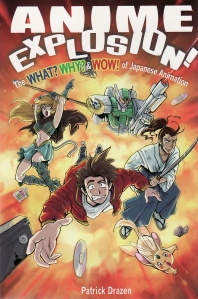
When I got Anime Explosion! in the mail from Amazon, I was so excited. I had seen it on a friend’s bookshelf, and, silly cover illustration aside, it seemed like a fairly serious reference source on anime. Instead of merely listing one anime series after another, its chapters are structured around broad themes (portrayals of nature, anti-war messages, etc.), with chapters devoted to single works or directors at the end of the book. The chapters are filled with well-selected and well-formatted illustrations accompanied by captions that do not merely repeat what is in the text, and there are numerous footnotes, which are also well-formatted and easy to read. The bibliography at the end of the book references such serious scholarly works as Professor William LaFleur’s Liquid Life: Abortion and Buddhism in Japan as well as numerous creator interviews from the pages of the long defunct but still fondly remembered anime magazine Animerica. The book hits all the big bases, like Japanese folklore in anime, nudity in anime, the Pokémon phenomenon, Studio Ghibli, and even one of my personal favorite series, Revolutionary Girl Utena. What’s not to like?

The fact that Anime Explosion! is one of the more boring books I’ve ever read is not to like, actually. And you’ll have to believe me when I say that, during my six years in higher education, I have read some pretty boring books. During my two years in higher higher education, I have also read some pretty terrible student papers, and so I think I can put my finger on what I dislike about Anime Explosion! – it’s the plot summary. Pages and pages of it. All written in singularly uncreative and unevocative prose. Judging from the level of the language, I would say that, despite the occasional frank discussions of sex and sexuality, the target audience for this book is currently enrolled in middle school. The book also assumes that the reader knows nothing about Japan, which I suppose is fair; but, to those of us who have studied the country, the cultural clichés referenced over and over again come off as a little stale. There also isn’t much interpretation involved, and the little that does exist is tepid and sophomoric.

I hesitate to say this, as Drazen acknowledges this problem in both his introduction and his conclusion, but Anime Explosion! is also a bit dated. The individual works covered in the book are, for the most part, classics, and no amount of time is going to change that. In that sense, Drazen has done an excellent job of creating a reference work that will transcend the whims of an extremely capricious field. On the other hand, for having been published in 2003, this book feels like a relic from the mid-nineties. The internet? What is this strange thing? The Japanese bubble economy collapsed? Oh my god! Also, to me, a presumably serious scholar, many of the seventies and eighties era texts Drazen references (like Kitteridge Cherry’s Womansword: What Japanese Words Say About Women) can no longer be taken seriously. Also, for those fans curious about such recent phenomena as moe and hikikomori, there is nothing to be found.

All that being said, this is a solid book and may prove interesting to younger or more hard-core anime fans. And, to be fair, Drazen’s chapter on “Gay and Pseudo-Gay Themes in Anime” (which Drazen aptly titles “A Very Pure Thing”) is bold, insightful, and well ahead of its time. For those of us interested in how anime stereotypes came to be, chapters like “Shojodo: The Way of the Teenage Girl” are also useful. For older readers looking for thrills and entertainment, however, I would recommend an anime magazine like Otaku USA, which tends to function at a much higher level than Drazen’s well-meaning but regrettably prosaic reference work.

Yokai Attack!

yokai-attack

Title: Yokai Attack! The Japanese Monster Survival Guide
Authors: Hiroko Yoda and Matt Alt
Illustrations: Morino Tatsuya (森野達弥) 
Publication Year: 2008 (America)
Publisher: Kodansha International
Pages: 191

I was absolutely certain that I was not going to like Yokai Attack. I had fully expected it to be a boring and poorly organized mishmash of folklore, citations, and half-baked interpretation along the lines of Borges’s The Book of Imaginary Beings. But the illustrations for this book were commissioned from Morino Tatsuya, a famous apprentice of Mizuki Shigeru (a manga-ka known especially for his manga Hakaba no Kitarō, which was adapted into multiple versions of the anime franchise Ge Ge Ge no Kitarō), so I decided to give it a shot, despite the silly cover.

To my immense surprise, I fell in love with Yokai Attack right from the book’s dedication to Lafcadio Hearn and his wife, which I found apt and also quite touching. It is clear from the first few paragraphs of the preface that the authors have done their research and are extremely knowledgeable on the subject matter. In fact, the “Yokai Resources” section at the end of the book, with its extensive bibliography, is almost worth the price of the entire book itself for people interested in yōkai. Alt and Yoda draw on wide range of materials, from Nō plays to Edo-period collections of woodblock prints to Yoda’s memories of the ghost stories she heard as a child, to bring together about thirty-five detailed, four-page profiles of Japanese ghosts and goblins.

The joy of this book is not its wealth of information, however, but rather the lucid and witty style in which the information is presented. Alt and Toda obviously enjoy what they do, and they make sure their readers are just as amused as they are. I don’t mean to say that Yokai Attack is condescending or facetious; rather, the writing is exuberant and filled with small, good-natured jokes that make it a pleasure to read. The format and organization of the book are reader-friendly as well, and the captions, panels, and side notes are enjoyable and not distracting.

Yokai Attack seems to be targeted towards an audience of all ages, with perhaps a movie rating of “PG.” Although instances of people (or other strange and inappropriate things) getting eaten are directly referenced with much glee, all mention of grotesque violence and sexual activity has been struck from the text. This is something of a shame, as I’m sure the writers ran across enough upsetting and salacious material to fill another couple of books, but I suppose it’s for the best, as it will allow this gem of a book to reach a wider audience.

The one qualm I have with Yokai has nothing to do with the authors but rather with the publisher. Kodansha International, true to its Japanese origins, is known for going out of its way to publish beautiful books. It seems that it has shortchanged Alt, Yoda, and especially Morino by being only half full-color. Although the first two pages of each yōkai entry are full-color, the second two are not, and the publisher seemed to give up around page 145, when the full-color pages end. Since this book is beautifully formatted and filled with interesting images, I can’t even begin to imagine why Kodansha would cut corners like this. I am so disappointed in them! Such a fine book deserves better.

Another thing that bothers me is that I have not seen this book in bookstores anywhere – not even Kinokuniya in New York. Kodansha should get on the PR train and market Yokai Attack as a manga, so that it will be shelved with manga and reach its target audience. I kind of want to go to Kodansha and throw something at them for being so willfully ignorant.

But three cheers for Hiroko Yoda and Matt Alt! Yokai Attack is a wonderful book, and I highly recommend it to anyone interested in Japan in any capacity whatsoever.

Japanese Schoolgirl Inferno

Title: Japanese Schoolgirl Inferno: Tokyo Teen Fashion Subculture Handbook
Authors: Patrick Macias and Izumi Evers
Illustrations: Kazumi Nonaka
Publication Year: 2007 (America)
Pages: 147

When a friend gave me this garishly pink little book as a present, I saw the name “Patrick Macias” on the cover and immediately prepared to be disappointed. Macias has authored and co-authored numerous books on Japanese popular culture. Two that might be familiar are Cruising the Anime City: An Insider’s Guide to Neo-Tokyo (2004) and TokyoScope: The Japanese Cult Film Companion (2001). These books are not only boring but were also outdated on the day they were published, primarily because Macias’s fascination with Japan’s popular culture during the seventies and early eighties fails to hold the attention of those of us who want to know what’s going on in Japan right now. In fact, I might even go so far as to say that Macias’s earlier books might have been better served if they were marketed as cultural histories instead of as guides to contemporary popular culture.

While it’s true that Japanese Schoolgirl Inferno is only up-to-date as of around 2005, and while it’s true that this book contains quite a bit of cultural history, I found it to be one of the most entertaining books I’ve read in a long time. Maybe it’s because of all of the bright and eye-popping photography. Maybe it’s because of Kazumi Nonaka’s fun and plentiful illustrations. Maybe it’s because of the concise prose and scandalous quotations. Or maybe it’s because of all the pink. In any case, once I picked up this cute and trim guidebook, I had a hard time putting it down.

One thing that I found especially charming about this book were all the suggestions the authors offer as to how to achieve these schoolgirl looks yourself. Far from being helpful, these sections actually serve to pinpoint how outrageous the fashions are. Another fun, recurring segment are the illustrated “A Day in the Life” inserts, which usually end with captions like “Mom says, ‘Take a shower! You two smell awful!’”

So, if you’ve always wanted to know what’s going on inside the heads of the Gothic-Lolita princesses, or if you’ve always been curious about how exactly the Mamba girls put on their makeup, this is the book for you. Even if you’ve never had the leisure to wonder about those things but have spent time in Tokyo, this is also probably the book for you. And if you really, really love pink, then I honestly can’t recommend this book enough. Go out and get it before it goes out of print. For the win. I’m serious.