After Dark

Title: After Dark
Japanese Title: アフターダーク
Author: Murakami Haruki (村上春樹)
Translator: Jay Rubin
Publication Year: 2007 (America); 2004 (Japan)
Pages: 244

I honestly can’t decide whether I like After Dark. With a few major exceptions (like “Barn Burning”), I don’t like Murakami’s short stories. According to several interviews, Murakami considers himself a novelist and primarily uses short stories as practice. Although his short stories are more polished than he gives himself credit for, I can understand why Murakami would say that. Compared to the huge imagination and forceful imagery of his novels, Murakami’s short stories tend to feel somewhat shallow.

To me, After Dark felt more like a short story than a novel. Perhaps the problem is the length of the book. Weighing in at approximately 250 double-spaced pages, Murakami’s latest novel should perhaps be more properly considered a novella. Another consideration might be the novel’s timeframe. The main action of After Dark takes place in the span of seven hours. To be precise, it starts 11:59pm and ends at 6:52am, as the chapter headings (each labeled by hours and minutes) inform us. Within this short period, the reader learns a great deal about the book’s protagonists, including a brief outline of the more sordid highlights of their pasts. Unfortunately, I was so entranced by these characters that I found myself wanting to know more about them. I wanted to see them in action, I wanted to hear their voices, and I wanted to see them standing around cooking spaghetti. I wanted to learn their life histories slowly, and not in bullet points.

My main concern with the book, however, was the treatment of what I like to call the “Murakami myth.” A recurring theme throughout almost every Murakami novel is the woman who disappears into the neverland of her unconscious. After Dark’s disappearing woman takes the form of Eri Asai, the older sister of one of the two protagonists. Eri, who has fallen into a deep sleep from which she will not wake, is the subject of the novel’s even-numbered chapters, which detail the uncanny events which befall her during the night. Although Murakami never resolves the mysteries surrounding his disappearing women, I felt that After Dark’s Eri subplot was more undeveloped than usual. In fact, it left me quite frustrated, and it felt almost randomly thrown into the main action of the story. Although the Murakami myth generally adds a wonderful level of depth to his novels, I felt that, in this case, it was a misguided attempt to flesh out a novella that perhaps should have more properly been a short story.

That being said, the main action of After Dark is more than interesting enough to justify the existence of the book. In short, two lost souls manage to connect in the late night / early morning hours of Shinjuku. Several passages, such as the description of a Japanese Denny’s and the interactions between the employees of a love hotel, stand out like gems. The vast majority of this book doesn’t sparkle, though; it glows softly like street lamps, or eerily like the static on a TV screen. In other words, this isn’t one of Murakami’s masterworks, but it does have a quiet charm that should appeal even to those of you who aren’t necessarily Murakami fans.

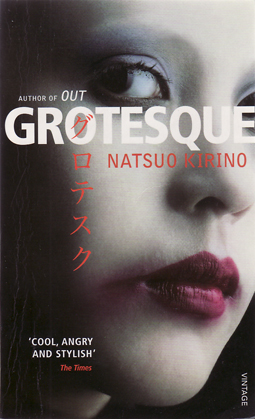
Grotesque

Title: Grotesque
Japanese Title: グロテスク
Author: Kirino Natsuo (桐野夏生)
Translator: Rebecca Copeland
Publication Year: 2008 (America); 2003 (Japan)
Pages:467

First of all, I would like to say that Grotesque is a very, very dark novel. It’s also filled with descriptions of all sorts of physical and emotional abuse, as well as numerous scenes of disgusting, extremely upsetting sex. In short, this novel is not for the faint of heart.

The novel essentially consists of the nameless narrator’s account of the murder of her younger sister, Yuriko, and her pseudo-friend from high school, Kazue, each of whom were marred by deep psychological imperfections. These emotional deficiencies were exacerbated by the harsh and competitive nature of the exclusive private high school that the two attended. In the end, both Yuriko and Kazue became prostitutes and were both ultimately murdered by the same unsavory client.

Putting the sensationalism of the novel aside, perhaps the most chilling aspect of Grotesque is the voice of the narrator. The reader quickly becomes inured to the sex and violence, but the cold and bitter tone of the narrator, as well as her pronounced disgust with her fellow human beings, continue to add a tinge of horror to the novel until the very last page. The narrator occasionally interrupts herself to present “evidence” concerning the two murder cases: the diary of her sister, the testimony of the murder suspect, and a letter from her old classmate. These stories within the story allow the reader to experience the voices of the novel’s other main characters, each of whom is just as disturbing as the main narrator.

In America, Kirino is mainly known for her first translated work, a massive chunk of a murder novel called Out (アウト, translated by Stephen Snyder). Like Out, Grotesque is long and depressing, and it would be a stretch to call any of the characters sympathetic. Unlike Out, however, Grotesque has a much smoother style, courtesy of translator Rebecca Copeland, and is therefore much easier to read. Also, compared to Out, the characters of Grotesque are much more artistically presented. Namely, in this novel, Kirino chooses to explore her characters’ depravity instead of merely wallowing in it. Moreover, I found the portion of the book that concerns the narrators’ experiences at their high school to be extremely entertaining. As I said earlier, Grotesque is not for the squeamish, but those readers who can deal with the darkness will be pleased to find an occasional glimmer of good writing and entrancing character study.

I should note that the version of Grotesque I reviewed is the British version, which I purchased in Japan. The American version of the book has been edited to remove all references to male child prostitution. Don’t let this deter you from reading the novel, though – the passages that were cut aren’t particularly riveting or important.

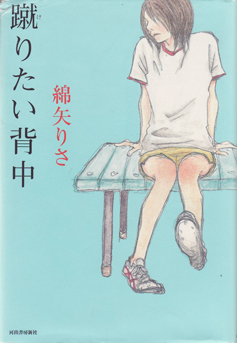
Keritai Senaka

Keritai Senaka by Wataya Risa

Title: 蹴りたい背中
English Title: “The Back I’d Like To Kick”
Author: 綿矢りさ (Wataya Risa)
Publication Year: 2003 (Japan)
Pages: 140

Wataya Risa made waves in 2001 when she became the youngest writer to win the Bungei Prize (文藝賞), a prestigious award managed by the literary magazine Bungei. She won the award for her debut novel Install (インストール), written while she was a senior in high school. After graduating from high school, Wataya entered Waseda University and began work on her second novel, Keritai Senaka. This novel would win her the Akutagawa Prize (芥川賞), the single most prestigious literary award in Japan. At the age of nineteen, Wataya became the youngest author ever to receive this award.

So, what’s all the fuss about? In a market dominated by pop fad writers like Yoshimoto Banana and Yamada Amy, it’s easy to be skeptical. You’ll have to take my word for it, though, when I say that Wataya is the real deal. Her prose reflects the background and personality of her high school aged narrator while still managing to maintain a definite literary tone. Her descriptions of people and places are vivid and artistic, and her introspective examination of memory and interpersonal dynamics are sure to resonate with anyone who’s old and yet young enough to be able to look back on high school with both bitterness and nostalgia.

The novel’s plot centers around the lone wolf narrator Hachi, her changing relationship with her best friend Kinuyo, and her developing relationship with a strange boy named Ninagawa. Hachi and Kinuyo have just graduated from middle school, and Hachi is disappointed that Kinuyo has become popular with a new group of friends in high school. Left to her own devices, Hachi is drawn to Ninagawa, a fellow outcast who steadfastly refuses to have anything to do with other people. When Hachi mentions that she’s met the fashion model with whom Ninagawa is obsessed, he latches on to her, and she finds herself introduced to his strange otaku fantasy world, which ultimately provides a means for her to re-affirm her relationship with Kinuyo.

Although it’s debatable whose back Hachi wants to kick, the back that she does kick (twice) belongs to Ninagawa. Don’t let yourself think for one second, however, that this book is about a high school romance between the two. The somewhat twisted relationship between the them is exquisitely complicated and yet imminently understandable, even if you can’t quite put your finger on why. One of the main appeals of this novel, in fact, is the challenge of decoding Hachi’s feelings towards Ninagawa. Perhaps the other main appeal is trying to understand one’s own feelings, as the reader, concerning Hachi (and, by extension, oneself at her age).

Unfortunately, this novel has yet to be translated. For those of you studying Japanese, however, you will be pleased to find that Wataya’s prose is very accessible. The book can easily be finished in three or four sittings. If you’ve been looking for a book to serve as a gateway into Japanese literature, please allow me to recommend Keritai Senaka.

The Commoner

The Commoner by John Burnham Schwartz

Title: The Commoner
Author: John Burnham Schwartz
Publication Year: 2008 (America)
Pages: 351

Let me be honest with you. I generally hate books intended for a popular audience written by gaijin (foreigners, or non-Japanese). Bruce Feiler’s Learning to Bow (2004), Peter Carey’s Wrong About Japan (2006), and Michael Zielenziger’s Shutting Out the Sun (2007) spring immediately to mind. My complaints concerning books of this kind are myriad, but they basically boil down to a few specific points. Namely, the authors have never formally studied Japan, they’ve never spent any significant length of time in Japan, and they don’t speak Japanese. As a result, their theories are based on misinformation and mistaken assumptions, if not on pure ethnocentrism. “Wrong about Japan,” indeed.

I am excited to tell you that this book is different. Not only is it meticulously well researched, detailed, and accurate to a point at which I would not have doubted a Japanese name on the cover, but it is also perhaps the most outstanding work of English language fiction that I have read this year. Schwartz’s novel brought me, a literary cynic, to tears on more than one occasion, and its emotional impact stayed with me long after I had closed the book for the final time.

The Commoner is a fictionalized account of the life of Michiko, the current Empress of Japan, and the entrance of the current Crown Princess, Masako, into the royal family. Schwartz has renamed Michiko “Haruko” and Masako “Keiko,” but the parallels between his fictional princesses and the lives of the two real-life princesses cannot be mistaken. Even though the various triumphs and tragedies of these two women has been well publicized by the media, the Japanese imperial institution has put up an iron wall of silence behind the moats of the Imperial Palace in Tokyo, preventing the thoughts and stories of its residents from ever reaching the public. Schwartz’s novel is an attempt to understand the lives and emotions of the Empress and the Crown Princess lying dormant underneath their carefully-managed public facade.

I’m not going to spoil the plot, but I have to let you know that the ending of this book is amazing. If the beautiful prose and delicate characterizations, evident from the first page and only building in intensity, weren’t enough to hook you, the novel’s climax definitely makes The Commoner well worth the read.

69

69 by Murakami Ryū

Title: 69
Japanese Title: 69 (シクスティナイン)
Author: Ryu Murakami (村上龍; Murakami Ryū)
Translator: Ralph F. McCarthy
Publication Year: 1993 (America); 1987 (Japan)
Pages: 191

Who wrote Holden Caulfield? The truth is, many aspiring young writers have given it a shot, and the infamous literary bad boy Murakami Ryū is not exempt from their numbers. Murakami’s early novels, such as Almost Transparent Blue (限りなく透明に近いブルー) and Coin Locker Babies (コインロッカー・ベイビーズ) are filled with dissatisfied young men violently striving to bring meaning into their lives, so what makes 69 special?

For one thing, it might have actually happened. The plot concerns nothing more than the vitally important matter of the protagonist’s budding attraction for the lovely “Lady Jane,” a member of his high school’s prestigious English Drama Club. For a high school student living in the boondocks of Japan, the means at his disposal at first seem to be limited. The year is 1969, however, and anything can happen. Considering Murakami’s well-publicized admission of the autobiographical nature of this work, some of it more than likely did happen. The nature of this work as being well-grounded in reality not only gives it an interesting historical flavor but also exacerbates the outrageousness of the lengths to which the protagonist will go to get laid. Simply put, this book is hilarious.

Translator Ralph McCarthy renders the narrator’s young yet jaded voice into perfect English idiom, and the translated slang doesn’t feel dated in the least. My favorite aspect of the translation is the way that McCarthy chose to emphasize some of the novel’s key phrases in huge bold print. For example:

It’s also a fact, however, that in 1969 there was a convenient tendency to describe people who studied for college entrance exams as capitalist lackeys.

“Look, you fucking asshole, we’re here on a sacred mission, and you want to peek in the girls’ changing room? If that’s where your head’s at, man, the whole thing’s a failure before we’ve even started.”

Although 69 seems somewhat juvenile and inane compared to Murakami’s later work, such as In the Miso Soup (インザ・ミソスープ), I feel that it’s almost required reading for anyone interested the background behind the insane and disturbing world of Murakami Ryū.