Manga-Inspired Comics at Toronto Comic Arts Festival 2015

Last month I posted an essay titled The Cultural Cross-Pollination of Shōjo Manga in which I argued that the work of young comics creators in North America has increasingly come to demonstrate narrative and visual allusions to shōjo manga.

Such influences are readily on display in the Artist Alleys at anime conventions, which I illustrated in an earlier post on fan comics at the Los Angeles Anime Expo. Transformative works based on anime and manga are obviously drawn to reflect the artistic conventions employed in these media, as are the majority of the original comics distributed at anime conventions.

What about comics conventions that aren’t directly connected to anime and manga?

This past May, I had the opportunity to travel to Canada to attend the Toronto Comic Arts Festival (TCAF), one of the largest and most prominent gatherings of small comics presses and independent comics creators in North America (others include the MoCCA Arts Festival in New York and the Small Press Expo just outside of Washington DC). On the day I attended, the venue was absolutely packed with fans and creators, and there were tons of references and homages to manga to be seen.

The most high-profile celebrations of manga culture at the TCAF came in the form of two special guests from Japan, the contemporary alternative manga posterchild Taiyo Matsumoto and the god of bara (male/male) manga Gengoroh Tagame, both of whom were enthusiastically welcomed. Established and well respected comics publishers such as Fantagraphics and Drawn & Quarterly also actively promoted their releases of translated manga.

In addition, the TCAF was bursting with self-published comics of all shapes and sizes, and I’d like to share my scans of the covers of some of the manga-influenced work I had the great fortune to get my hands on while I was there.

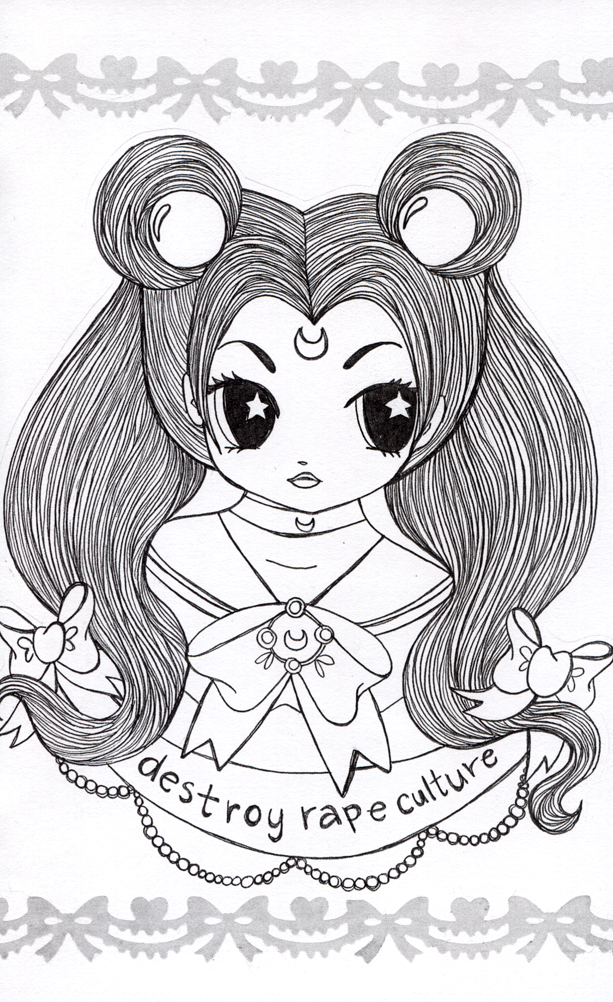
Destroy Rape Culture

Destroy Rape Culture, by Starchild Stela
In which the Sailor Senshi encourage you to smash the patriarchy.

Magical Beatdown

Magical Beatdown, by Jenn Woodall
In which a magical girl beats the everloving crap out of street harassment.
(This comic is brilliant and should win the next Nobel Prize for Literature. Sorry Murakami.)

How to Make a Magic Wand

How to Make a Magic Wand, written by Chris Eng and illustrated by Jenn Woodall
A field guide to utterly decimating the sexist assholes in your life like a badass mahō shōjo.

Lacrimancer

Lacrimancer, by Jade F. Lee
I’m digging that Revolutionary Girl Utena realness.

Louisa Roy Queen of Hearts

Queen of Hearts, by Louisa Roy
Such gorgeous art, such lovely writing, such interesting research, so Rose of Versailles.

This Tastes Funny

This Tastes Funny, an anthology by the Suddenly Sentai collective
Stories about food with shōnen manga stylings.

No Scope

No Scope, by Sara Goetter
And let us not forget that video games are part of the manga media mix too.
(Sara Goetter’s RPG-inspired original comics are amazeballs, by the way.)

The Enemies of Twenty Something Mega Man

The Enemies of Twenty-Something Mega Man, published by The Devastator (NSFW)
They also have a book about otaku, but it’s too close to home and it hurts.

This is the standard disclaimer that the work posted above is not universally representative and is subject to my own taste and resources. If I have misrepresented an artist, or if you are an artist who wants any links or images removed, please let me know.

Fan Comics at Anime Expo 2015

Nicolle Lamerichs, in a 2013 essay titled The Cultural Dynamic of Doujinshi and Cosplay: Local Anime Fandom in Japan, USA and Europe, writes:

I argue that anime fandom is not easily understood as a global phenomenon but rather is composed of different, heterogeneous values and communities. The local iterations of cosplay and doujinshi, which may seem homogeneous activities, are read as manifestations that are firmly anchored in particular traditions. (156)

Essentially, the fan practices and productions on display in anime conventions are different in different countries. Lamerichs readily points out that this has less to do with any sort of “national character” and more to do with the fact that “these fan cultures are individual events with their own ecologies” (158). Nevertheless, Lamerichs argues that, in comparison with Japan, Germany, and the Netherlands, American anime conventions exhibit “a very different tendency towards prints and hand-made drawings rather than full-fledged comics” (161).

Lamerichs is absolutely not wrong, but I would like to respond by positing that online communities primarily used for fannish artistic production and consumption, such as Tumblr, DeviantART, and Pixiv (along with many mirrors, offshoots, webcomic serialization platforms, and independently run artistic collectives), have put not just individuals but fannish cultural norms into closer contact with one another during the past several years. Among other things, this trend has led to an explosion of anime-inspired comics and fan comics at anime conventions in the United States.

I picked up a suitcase full of these comics at the Los Angeles Anime Expo this past 4th of July weekend, and I’d like to share some of them here in order to document this change. Independent artists had tables in the main Exhibition Hall and in the smaller Artist Alley section, but both areas are huge, and I’m not entirely certain I was able to cover the entire floor. Also, as much as I would have liked to buy everything I saw, my financial resources were limited. What I am posting here should therefore not be considered a representative sample. Furthermore, while I am focusing on fan comics based on well-known existing media properties, the reader should keep in mind that there was a great deal of original work available as well.

Without further ado, here are the scans I made of self-printed fan comics from Anime Expo 2015. Click on any of the thumbnails to see a larger image.

Ending to Naruto

The 100% True and #Confirmed Ending to Naruto by Kelly (on Tumblr)
based on the shōnen franchise Naruto

And Steven

…And☆Steven! by Mike Luckas (on Tumblr)
based on the Cartoon Network animated series Steven Universe

Tomoyo's Secret Diary

Tomoyo’s Secret Diary, edited by Yuj Lee (on Tumblr)
based on the shōjo manga and anime Cardcaptor Sakura

Pokémon Cross Breeds

Pokémon Cross Breeds, by Nathan Nguyen (on Tumblr)
based on the Pokémon series of video games

Artisan Ordinance

Artisan Ordinance, edited by MERODii (on DeviantART)
based on the video game Animal Crossing: New Leaf

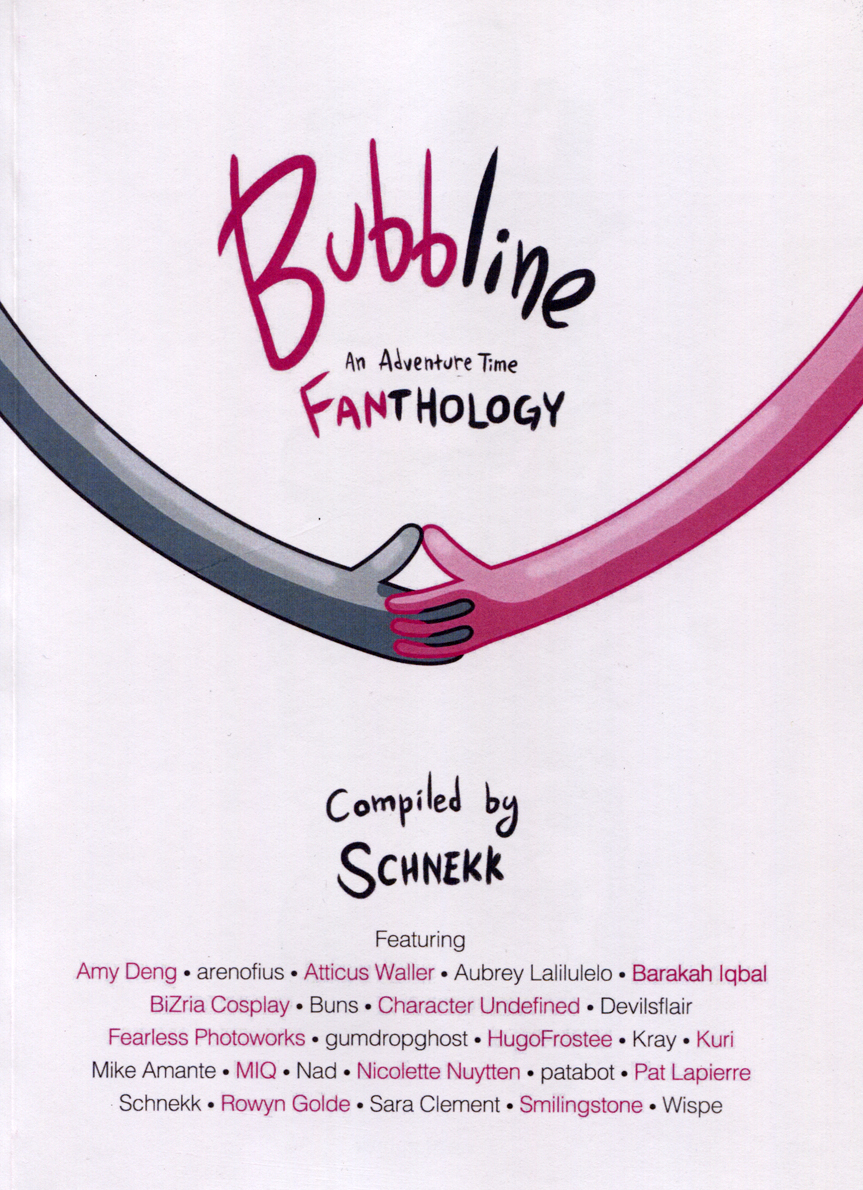
Bubbline

Bubbline, edited by Schnekk (on Tumblr)
based on the Cartoon Network animated series Adventure Time

Shimotsuma Zine

Shimotsuma Zine, edited by FANGRRLZ (on Tumblr)
based on the novel and film Kamikaze Girls

I Will Always Be Here

I Will Always Be Here, by Karen and Britney (on Tumblr)
based on the animated Disney film Big Hero 6

In addition, there were several cool fan comics and comic anthologies based on the Marvel cinematic universe drawn or edited by Krusca (on Tumblr), and I also came across a cool book based on the manga of CLAMP put together by Lärienne (on DeviantART), GYRHS (on DeviantART), and Samantha Gorel (on DeviantART).

All of these books are *amazing.*

If I have misidentified an artist or editor, or if you are an artist or editor and would like me to remove or update any links or images, please let me know! I have nothing but admiration and respect for people who self-publish their art and comics, and I don’t want to misrepresent or appropriate anyone’s work. Stay awesome!

Ground Zero, Nagasaki

Ground Zero Nagasaki

Title: Ground Zero, Nagasaki
Japanese Title: 爆心 (Bakushin)
Author: Seirai Yūichi (青来 有一)
Translator: Paul Warham
Publication Year: 2014 (America); 2006 (Japan)
Publisher: Columbia University Press
Pages: 182

Although Seirai is a relative newcomer to the Japanese literary scene, having won the Akutagawa Prize for his story collection Seisui (Holy Water) in 2001, he was born in 1958 and was 47 years old when Ground Zero, Nagasaki was first published in November 2006. Although its stories are all set in contemporary Japan, Ground Zero, Nagasaki is deeply engaged with themes of personal and historical legacy.

Each of the six stories in this collection is about the physical and emotional damage suffered by Christians living in Nagasaki in the wake of the atomic bombing. The memory of the atomic bomb is extremely subtle in most of the stories, but it’s never completely absent. Even more powerful than any real or imagined trauma generated by the bomb, however, are the moral dictates of Christianity, which demands that its adherents bear witness to suffering.

The second story, “Stone,” is narrated from the perspective of the brother of a Diet member who is being forced to resign from office because he hired his girlfriend as his secretary. While his brother is giving a talk to local business association at a hotel in Nagasaki, the narrator, a 45-year-old man who calls himself “Adam,” waits in the lobby, where he is approached by a female journalist named Shirotani. Adam is on the autism spectrum, and his conversation with Shirotani is almost frustratingly elliptic.

It gradually becomes clear that Adam’s mother is dying. She has sent Adam to intercept his brother in order to ask that the politician care for him, as he can’t live by himself. Shirotani, who has a brother like Adam, is sympathetic, but the author does not allow this story to become sentimental. Instead, the reader is hit with the full force of Adam’s sexual attraction as he fantasizes about the journalist: “If she wouldn’t marry me, at least I could carry her smell around with me. I would bury my face in her panties and inhale her woman’s scent to my heart’s content” (33). Adam’s mother has punished him for such thoughts in the past, asking him how he could dare to entertain such un-Christian notions “‘after our ancestors went to the stake with pure thoughts and prayers on their lips'” (32).

Adam’s brother Kutani is caught in a the grips of a similar moral vise. He entered politics for the most noble of reasons: to ensure that a doctrine of peace was represented at the highest levels of the Japanese government. The woman with whom he has cheated on his wife had come to him looking for a job after her husband’s family cast her out with her newborn son, who was born severely handicapped. Kutani explains to Adam that he initially wanted to help her as he wants to help all of his constituents, but that he couldn’t help falling in love with her. He says: “‘As long as I had her in my arms, nothing else mattered. Even if war had broken out and nuclear bombs were exploding all over the world, I probably wouldn’t have cared'” (41). His adherence to Christian doctrine, which has guided him along his path as a politician, allows no leeway for his identity as an individual. His affair with his secretary is merely an indication of a deeper emotional dissonance that has also estranged him from his mother and brother, who need him to be a person instead of a politician.

As Kutani struggles with his conscience in the penthouse suite of the hotel where he will offer his resignation, his brother is overwhelmed by feelings he doesn’t understand. After Adam leaves the hotel, he is afraid that his body will turn to stone in response to the emotional overload as it has in earlier catatonic episodes triggered by stressful situations. The story ends with Adam begging God to not leave him alone without a family and without ever having experienced intimacy, his longing for comfort inseparable from his sexual desire.

Another story that I found especially trenchant is “Shells,” which is also told from the perspective of a highly unreliable narrator. Six months ago, the narrator’s daughter Sayaka suddenly came down with a fever and ended up dying of a brain hemorrhage. Since then, he has become convinced that the ocean has been rising during the night, covering entire sections of the city and leaving behind cowrie shells and other assorted sea creatures in his highrise apartment. His delusions became so powerful and persistent that his wife has left him and his brother has placed him under outpatient psychiatric care.

While walking in his neighborhood one day, the narrator encounters an old man named Nagai who tells him that his late sister used to be friends of a sort with Sayaka. His sister had become senile, and the narrator’s daughter was the only one who would listen to her rambling stories. The narrator, overcome with gratitude, invites Nagai back to his apartment, where the old man tells him that his sister spent her entire life trying to forget the day of the atomic bomb, when she was forced to leave her siblings behind in a burning house as she fled with her mother. Nagai’s sister had once spoken to him about the sea of flames engulfing the city, saying, “‘I wish the sea would wash over it all,'” suggesting that she wished her memories would be washed away as well (146).

The narrator, who has his own fantasies of the sea, feels a connection with this woman, but he is terrified of losing his memories, specifically his memories of his daughter and the love he felt for her, which he describes as “the best and brightest, the truest feeling I have ever had” (117). He realizes that the shells that the ocean leaves behind for him every evening after the flood recedes are akin to physical manifestations of his memories, but this insight does not weaken his conviction that the city of Nagasaki sleeps under the waves every night. He tries to convince Nagai that his visions are real but fails. The story ends with his understanding that the saltwater coming in from the bay is not a purifying force like the Biblical deluge but rather indicative of a spiritual wasteland in which God allows the innocent to suffer and perish.

Obviously Ground Zero, Nagasaki is not light reading, and I found that I had to let a week or two pass between the stories, each of which stayed with me long after I had closed the book. Reading Seirai feels a lot like reading Ōe Kenzaburō, yet his style is pellucid where Ōe’s is confoundedly literary. Seirai’s narrators are not philosopher poets citing The Great European Male Thinkers in casual conversation, but this does not make them any less complex and compelling; their proximity to the mundane and mimetic “realness” serves to emphasize how the lasting reverberations of Nagasaki’s violent history have touched the lives of even the most unassuming of its citizens.

I would be remiss if I did not conclude this review by stating that Ground Zero, Nagasaki has the best book design I have seen in a long time. A faded image of the black circle on the cover, an inverse of the red rising sun of the Japanese flag, is on every page of the book, a reminder that the proverbial gross insult to human dignity in the room can never be ignored. Each chapter begins with a progressive series of diagrams illustrating how to fold an origami crane, indicating that somewhere inside this terrible mess is hope. These illustrations suggest that the reader, by sharing the experiences of these stories with the author, is in effect performing a symbolic act of prayer resembling the dedication of a chain of paper cranes to the atomic bomb victims. Kudos to designer Julia Kushnirsky!

Is Ground Zero, Nagasaki worth the $35 asking price for the hardcover? Yes, I think so.

Will the stories in this book be of interest to anyone outside of the academic field of Japanese literary studies? Absolutely. It’s not easy to read this book, but that’s a major part of what allows it to dig so deeply into the reader.

Review copy provided by Columbia University Press.

The Art Lover’s Guide to Japanese Museums

The Art Lover's Guide to Japanese Museums

Title: The Art Lover’s Guide to Japanese Museums
Author: Sophie Richard
Publication Year: 2014
Publisher: The Japan Society
Pages: 176

According to the good people at The Japan Society, art historian Sophie Richard’s The Art Lover’s Guide to Japanese Museums has been very popular, quickly selling out of its first print run. Between its convenience as a guide and its beauty as a physical object, it’s easy to understand why.

The Art Lover’s Guide to Japanese Museums is so titled because it’s aimed at serious art appreciators who are willing to go off the beaten path in order to visit smaller museums that offer a more personalized and intimate experience. Richard skips the large national institutions and instead highlights private or regional galleries that would be worthy of a day trip or that necessitate a willingness to venture off the beaten path in urban and suburban areas. Based on my personal experience with several of these museums, the trip will definitely be worth it.

The main body of the guide is divided into five sections: Tokyo, Around Tokyo, Kyoto Area, West, and East (with “West” designating the area from Osaka to Hiroshima and “East” designating the area from Nagoya to Aomori). 29 of the 52 museums profiled are in or around Tokyo. In some cases, a location “around Tokyo” might require a long train ride and an overnight stay, but most are well within the city limits or accessible by commuter rail.

Most of the entries are two pages long. Each opens with the museum’s address in English and Japanese and general information (hours, holidays, access, website). This is followed with three paragraphs of description. The content of varies but can include information about the museum’s history, the highlights of its collection, and the availability of English text or audio guides. The short “In the neighborhood” section at the end of every entry tempts the reader out into the open to take in the layout of the town, the local cuisine, nearby temples, and even other museums. Each entry also includes two or three full-color photographs of the museum space and representative works from its holdings. The occasional four-page entries are usually longer because of their inclusion of more pictures, all of which are gorgeous.

Even if you’re not planning on visiting Japan, browsing through The Art Lover’s Guide to Japanese Museums is still enjoyable, as Richard’s articulate prose guides the reader through the experience of visiting the galleries. For example, writing on the Chichu Art Museum designed by Andō Tadao, Richard offers this intriguing description:

The museum’s complex space includes passageways and stairs set at sharp angles and a courtyard with evergreen plants that contrast starkly with the grey concrete. The interior of the building is lit with natural light alone. At the heart of the museum, five monumental paintings by Claude Monet from the late Waterlilies series appear to float mysteriously in a serene space gently illuminated by the sun’s rays, which are diffused through channels in the ceiling. Security guards wearing futuristic white uniforms ask visitors to remove their shoes before entering the room, which adds to the compelling atmosphere.

As in the excerpt above, Richard does walkthroughs like Sherlock Holmes, albeit with less of an emphasis on dry facts and with more of an emphasis on atmosphere. If you’d prefer to travel from the comfort of your own sofa, Guide to Japanese Museums is a perfect companion.

Also included in the guide are a short “Introduction” in which the author explains her motivations for embarking on this project, an overview of “Museums in Japan,” a six-page essay on “Looking at Japanese art,” and a brief list of “Tips and advice.” These sections are useful regardless of whether you’re making plans to visit Japan or whether you’re already there. For instance, this is the first time I’ve heard of the Grutt Pass, a ¥2,000 booklet that provides one-time admission to several of the museums profiled in this guide.

I should add that Guide to Japanese Museums came with me across the North American continent twice during the past two months, and it’s still in pristine condition. The book is lightweight and flexible, and it can easily be slipped inside a backpack or a suitcase. If I couldn’t destroy it, it’s more than likely safe with you as well, so don’t feel as if you need to leave it on a shelf while you go and have adventures, whether those adventures are in Japan or at your local café.

Review copy provided by The Japan Society of the UK.

The Cultural Cross-Pollination of Shōjo Manga

Natasha Allegri Madoka PuppyCat

On January 18 of 2015, Ed Chavez, the Marketing Director at manga publisher Vertical, replied to a Twitter user’s question on ask.fm regarding whether manga is becoming a niche entertainment industry outside of Japan. Chavez’s response was a definite “maybe.” After stating that shōnen manga is selling just as well – if not better – than it always has, Chavez added the caveat that, “Unlike the 00’s, where a shojo boom introduced a whole new demographic to manga, there hasn’t been a culture shifting movement recently.” Johanna Draper Carlson, one of the most well-respected and prolific manga critics writing in English, responded to Chavez’s assessment on her blog Comics Worth Reading. She agreed with him, adding, “I find myself working harder to find series I want to follow. Many new releases seem to fall into pre-existing categories that have already demonstrated success: vampire romance, harem fantasy, adventure quests, and so on. It’s harder to find the kind of female-oriented story that [has always appealed] to me.” Meanwhile, the manga that stood at the top of the New York Times’s “Best Sellers” list for manga that week was the seventh volume of a series called Finder, a boys’ love story targeted at an over-18 female audience.

What we’re seeing here, from Chavez’s reference to a former boom in shōjo manga sales to evidence that even a title from a niche category for women can sell just as well as the latest volume of the shōnen juggernaut One Piece, is that girls and women in North America do care about manga, and that they are active participants in manga fandom cultures. What I’d like to do today is to provide a bit of background on how female readers were courted by manga publishers – specifically Tokyopop – and then to demonstrate how manga has influenced the women who grew up with it to reshape North American comics and animation with a shōjo flair.

I’d like to argue that, despite periods of relatively low sales in the United States, shōjo manga (and the animated adaptations of these manga) have had a strong cultural impact on recent generations of fans. During the past fifteen years, fan discussions and fannish artistic production have nourished diverse interests in Japanese cultural products, which are in turn beginning to exert a stronger influence on mainstream geek media. Using M. Alice LeGrow‘s graphic novel series Bizenghast and Natasha Allegri‘s animated webseries Bee and PuppyCat as case studies, I want to demonstrate how it is not only the visual styles and narrative tropes of shōjo manga that have increasingly begun to influence North American media, but the creative consumption patterns of shōjo fandom communities as well.
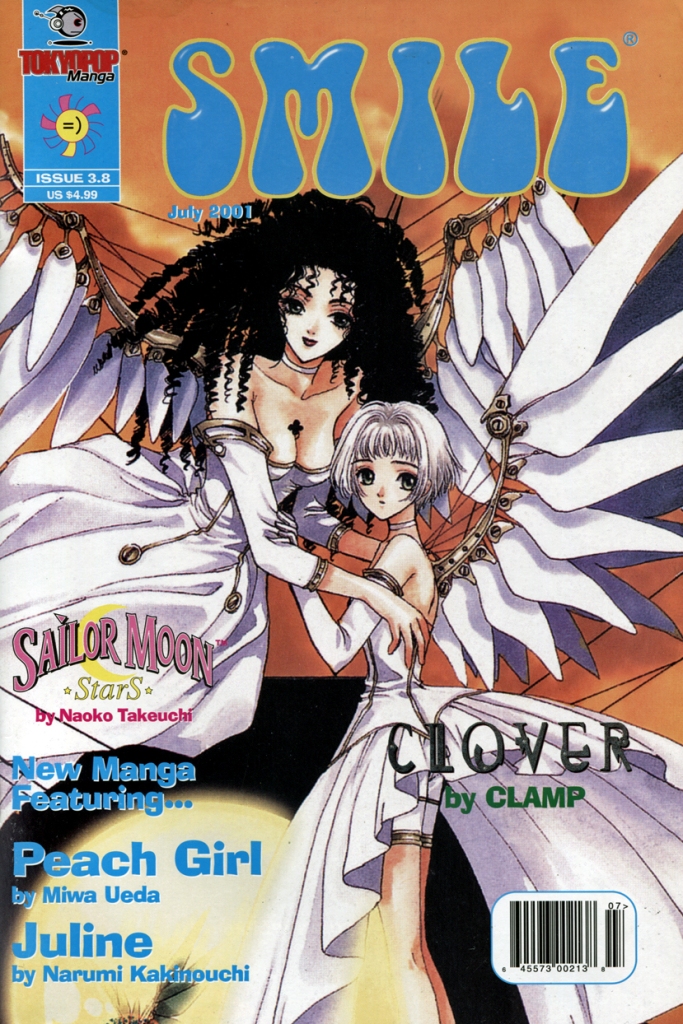
Tokyopop Smile Magazine July 2001

Before I talk about American interpretations of shōjo cultures, however, I’d like to skim through a bit of publishing history. In the mid-1990s, there was a Barnes-and-Noble-style big suburban box store called Media Play, which had an entire section devoted to manga and Japanese culture magazines. One of the most prominent of these magazines was fledgling publisher Tokyopop’s manga anthology MixxZine, which began serialization in 1997 and ran the manga version of Sailor Moon as well as the similarly themed fantasy shōjo series Magic Knight Rayearth and Card Captor Sakura. In 1999, the magazine changed its name to “Tokyopop” and began to target an older male audience by dropping its shōjo manga and focusing on shōnen and seinen titles. Tokyopop the magazine folded in 2000 but was survived by a publication called Smile, which was a bulky, 160-page monthly magazine that serialized only shōjo manga. In 2001, Media Play’s parent company was bought out by Best Buy. When Media Play stores were closed, Tokyopop lost a major venue for its magazines, and Smile folded in 2002.

Now that a large fanbase had been created, however, Tokyopop was able to launch a program it called “Global Manga,” which was kicked off by the 2002 “Rising Stars of Manga” talent competition. The winning entries were published in a volume of the same size and length of the publisher’s Japanese manga titles. There were eventually eight volumes of The Rising Stars of Manga, with the last appearing in the summer of 2008. During this time, certain winners were encouraged to submit proposals to Tokyopop, which published their work as OEL, or “original English language,” manga. By my count, about half of Tokyopop’s OEL manga were shōjo series. Examples include Peach Fuzz, Shutter Box, Fool’s Gold, and Sorcerers & Secretaries. Tokyopop promoted these titles with free “sampler” publications distributed by mail and at anime conventions, which were exploding in number and attendance in the United States and Canada during the 2000s. Although users of anime-related message boards and fannish social media sites debated the company’s use of the term “manga” to describe these graphic novels, Tokyopop was able to attract well-known American entertainment franchises to the medium, such as Star Trek, Battlestar Galactica, World of Warcraft, and for the girls, Jim Henson’s Labyrinth, featuring David Bowie’s Goblin King in all his spandex-clad glory.
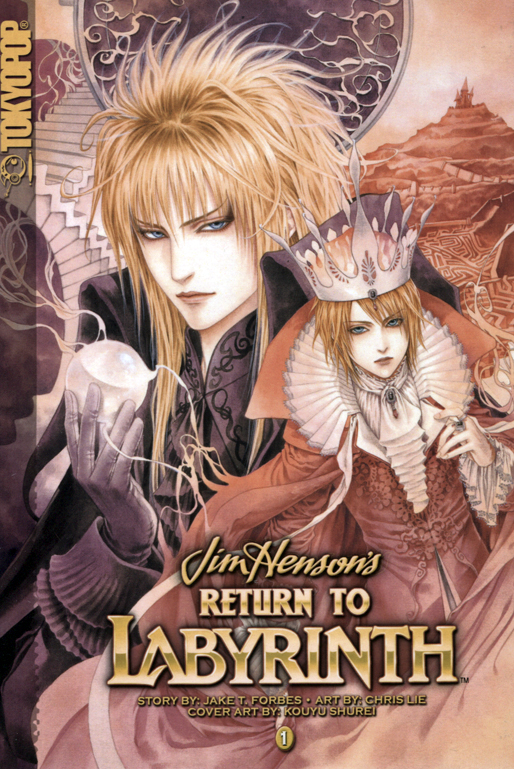
Return to Labyrinth OEL Manga

One of the Tokyopop’s most popular OEL manga titles was M. Alice LeGrow’s eight-volume series Bizenghast, which, like Sailor Moon and Cardcaptor Sakura, is a shōjo story with shōnen elements. LeGrow’s story takes the adorable mascot creatures, monsters-of-the-week, cute costumes, adoring and beautiful young men, and powerful female villains of Japanese manga for girls and transplants them to the small Massachusetts community of Bizenghast, which becomes an Edgar Allan Poe-ified Gothic wonderland after dark. The art style combines the huge eyes and wide panels of fan-favorite shōjo manga like Fruits Basket and Fushigi Yûgi with steampunk Art Deco motifs and Edward Gorey-style line etchings. The artistic and narrative conventions of manga and the stylizations of Western fantasy are so delicately blended and intermixed that it’s impossible to tell whether Bizenghast is a manga with American influences or a graphic novel with Japanese influences.
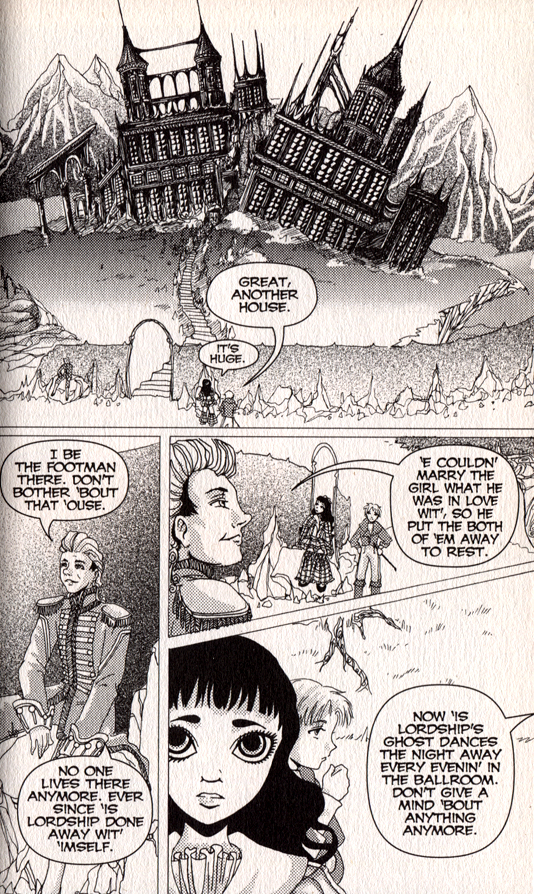
Bizenghast Volume 1 Page 075

What I want to highlight is the way that the Tokyopop publications of each volume in the Bizenghast series included a section at the end for fan art and cosplay photos, thus encouraging and legitimizing reader participation in the way that shōjo magazines have done since the early twentieth century in Japan.
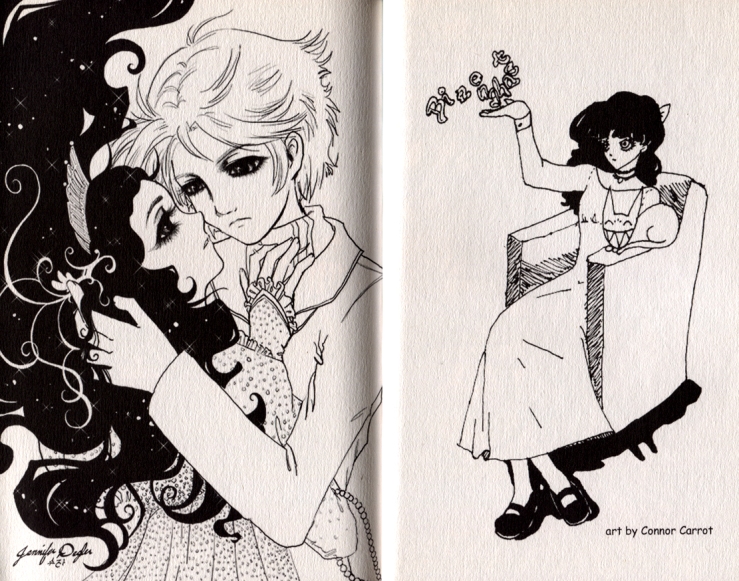
Bizenghast Fan Art Spread

Instead of eschewing or actively opposing fandom involvement, and specifically female fandom involvement, Tokyopop pursued it, allowing LeGrow to maintain her presence on the fannish artistic networking site deviantART, where she was able to interact with her fans. Due to the non-localized nature of the internet, LeGrow was able to build a fanbase that stretched around the globe, with Bizenghast being published in translation in Germany, Finland, Russia, and Hungary, as well as in several countries of the British Commonwealth, including Australia and New Zealand. In addition to assigning Bizenghast its own dedicated website, Tokyopop released a light novel adaptation, an art book, and even a coloring book based on the world of the manga. Although Tokyopop shut down its publishing operations in May 2011, it continued to offer certain titles through a print-on-demand service managed by the online anime retailer The Right Stuf. The initial line-up of these titles included the massively popular manga Hetalia Axis Powers and the eighth and concluding volume of Bizenghast. What I’d like to emphasize here is that, in its publication and promotion of Bizenghast as an OEL shōjo manga product, Tokyopop actively promoted the sort of interactive fan consumption utilized by Japanese shōjo manga publishers – and this encouragement paid off, quite literally.

Multiple market watchers have located the peak of United States manga sales in the mid-to-late 2000s. Even though Tokyopop ceased its manga magazines earlier in the decade, Viz Media stepped in with an English-language version of Shonen Jump, which was paired with a monthly sister magazine, Shojo Beat. Shojo Beat, which ran from June 2005 until July 2009, also styled itself as a lifestyle magazine, running articles about clothing, makeup, and real-life romantic concerns. Although Shojo Beat did not include OEL manga, manga publisher Yen Press’s publication Yen Plus did. From its launch in July 2008, the editors of Yen Plus solicited reader contributions, which resulted in both one-shot and continuing OEL manga appearing within the pages of the magazine.

In addition, Yen Press’s parent company Hachette began releasing manga adaptations of some of its biggest young adult properties, including Gossip Girl, Gail Carriger’s The Parasol Protectorate series, and, of course, Twilight. For our purposes, it’s interesting to note that these manga adaptations all had a strong shōjo feel, as did other franchise manga revisionings created by longstanding American comics publishers such as Marvel and Vertigo. What these publishers seemed to be jumping on was the idea that manga could reach an audience of young women (and young-at-heart women) who may have felt excluded from traditionally male-centered genres like action comics and science fiction. These female readers increasingly came equipped with access to online and in-person fandom networks, which could help ensure the longevity and profitability of any given franchise, as was famously the case with Star Trek and Harry Potter.
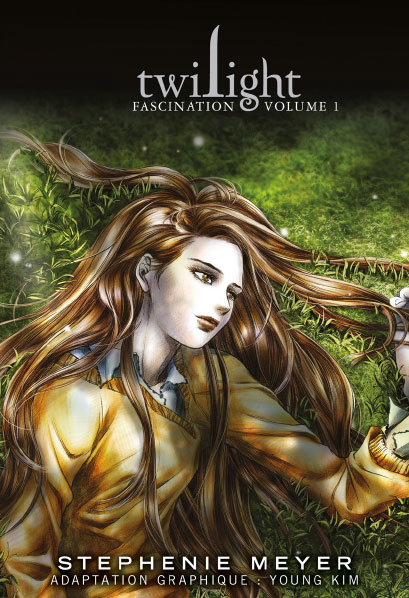
Twilight Manga

What we’re seeing, then, is the creation and growth of an audience for shōjo manga that began in the 1990s and has extended throughout the past two decades. So – has this changed anything? I’d like to argue that it has, and that we’re starting to see a definite shōjo influence on mainstream entertainment media in North America.

One of the most interesting incarnations of this trend is Cartoon Network’s animated television series Adventure Time, whose producers have actively scouted young talent from places like comic conventions and fannish art sharing websites such as Tumblr. A number of these artists are women from the generation that grew up reading and watching shōjo series such as Sailor Moon and Revolutionary Girl Utena, and easily identifiable references to these titles occasionally pop up in the show. Rebecca Sugar, a storyboard artist for Adventure Time, ended up being given a green light by Cartoon Network to create a magical boy show, Steven Universe, that features all manner of references to anime, manga, and video game culture. Natasha Allegri, another storyboard writer and character designer for Adventure Time, launched a Kickstarter project backed by Adventure Time‘s Studio Frederator for a magical girl animated series called Bee and PuppyCat, which received an overwhelming amount of support from both Adventure Time fans and the enormous shōjo manga fanbase on Tumblr.
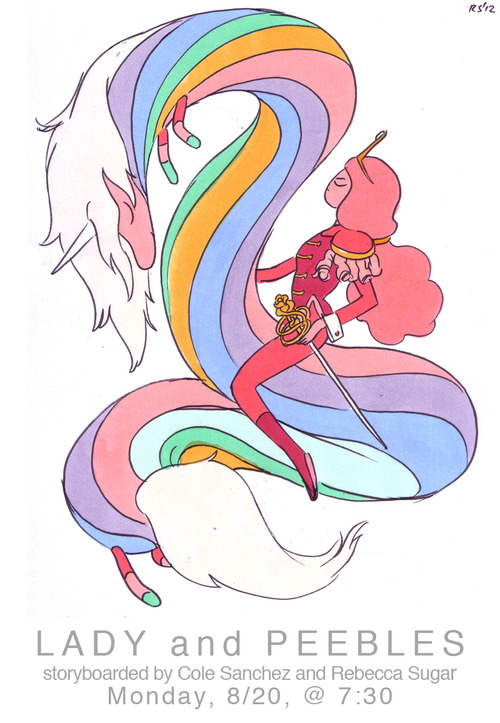
Lady and Peebles

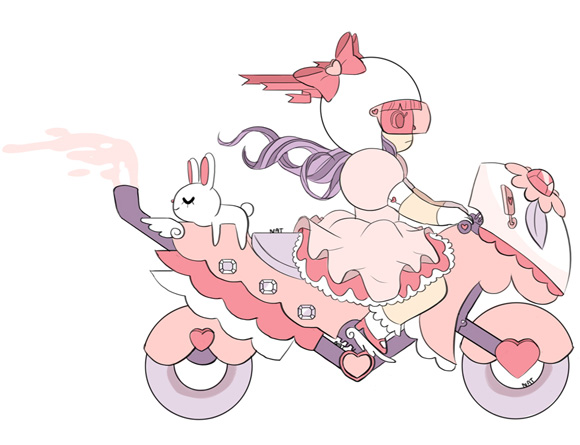
What’s really cool about these three properties is that they all have separate monthly comic book incarnations published by Boom! Studios. There’s a lot to be said about these comic books, but what I want to emphasize here is that each monthly issue features shorts and variant covers by young and upcoming artists. The comic book version of Bee and PuppyCat is especially notable in that most of its contributing artists are female, and many of them include obvious stylistic and topical references to elements of Japanese popular culture such as Studio Ghibli character stylizations, magical girl henshin transformation sequences, and role-playing video games. Although Natasha Allegri has stated in multiple interviews (here’s one) that she’s a fan of manga such as Sailor Moon and Takahashi Rumiko’s supernatural romance InuYasha, and even though the influence of these titles is quite clear in her work, Bee and PuppyCat has not been promoted as a type of OEL anime but rather as just another cool new addition to the Studio Frederator lineup. In other words, the strong shōjo elements of the show and its comic book are presented as completely natural and naturalized to a North American audience.

I’m going to wrap things up by summarizing my main points. First, I think we can say that the iconography of shōjo manga and anime are entering American popular culture full force. Second, I believe that seeing better representation of diverse female characters in shōjo manga has encouraged more young women outside of Japan to seek careers in comics and animation. Third, although it’s difficult to make strong statements in the current market, I think it’s safe to say that the “reader participation” model employed by Japanese shōjo publishers has been fairly financially successful in the United States. Fourth and finally, I’m going to conclude that we will therefore see an even stronger embrace of shōjo-related narrative influences, art styles, and fandom cultures as the members of the Adventure Time and Bee and PuppyCat generation, who are currently in college, start coming out with their own work. It’s an exciting time to be a fan of shōjo manga, and I’m happy that young women and men are still as excited about shōjo-flavored comics and animation as I was when I first discovered Sailor Moon almost twenty years ago.
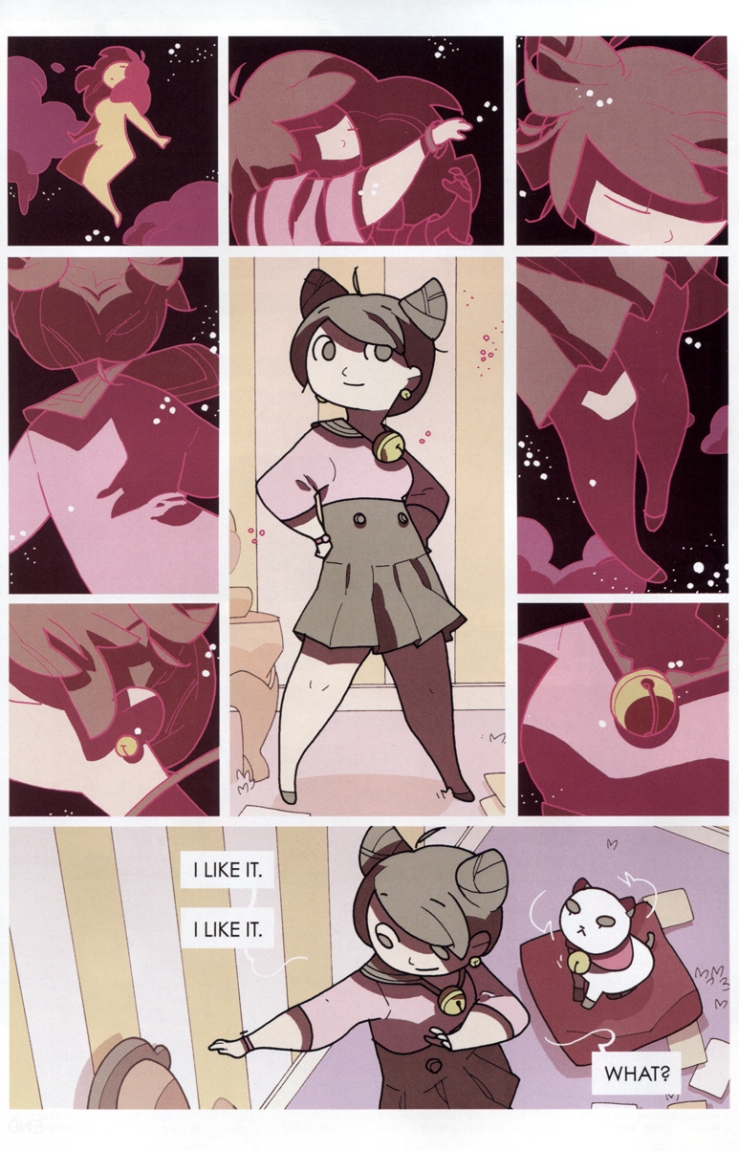
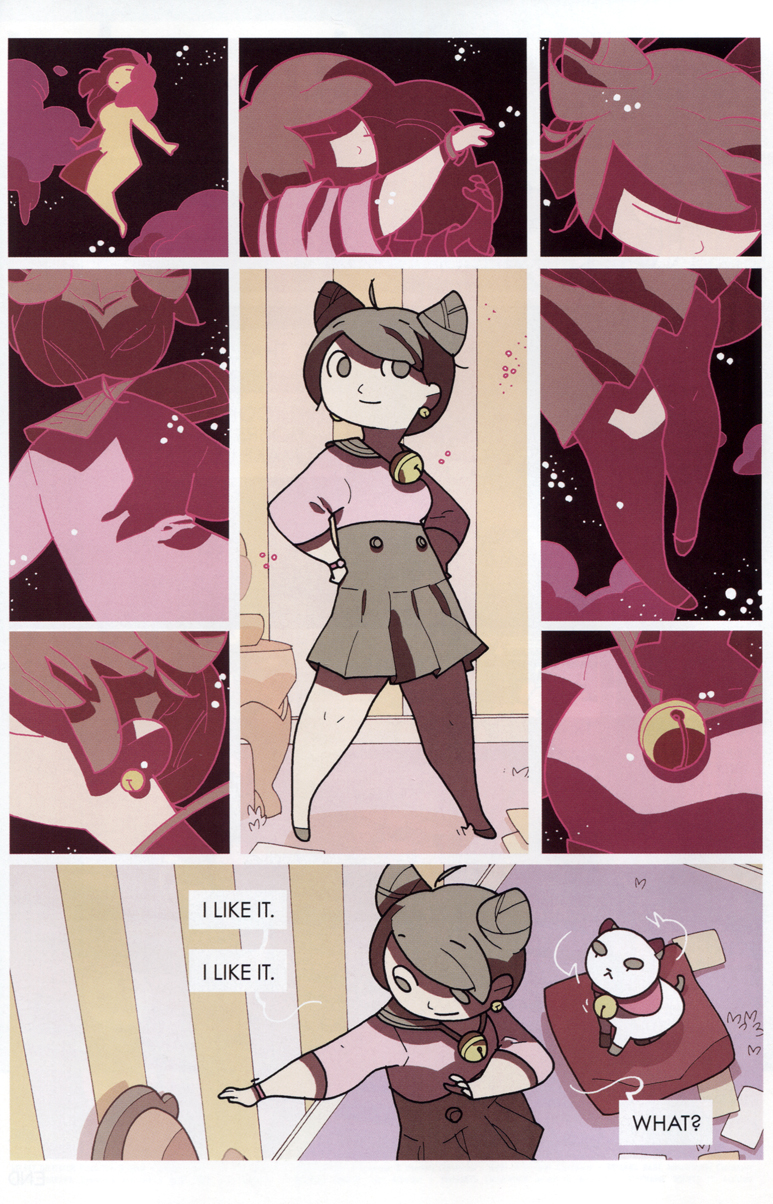
Bee and PuppyCat Comic Issue 06 Meredith McClaren

The above image is a scan of a page from Meredith McClaren‘s short comic in the sixth issue of the Bee and PuppyCat comic book series.

The Legend of Zelda: A Link to the Past

The Legend of Zelda A Link to the Past

Title: The Legend of Zelda: A Link to the Past
Japanese Title: ゼルダの伝説 (Zeruda no densetsu)
Artist: Ishinomori Shōtaro (石ノ森 章太郎)
Translator: Dan Owsen
Publication Year: 2015 (America, new edition); 1993 (America and Japan, original edition)
Publisher: Viz Media
Pages: 196

Full disclosure: I read this manga countless times as a kid, and the game it’s based on is one of the greatest loves of my life. This review is biased, because of course it is.

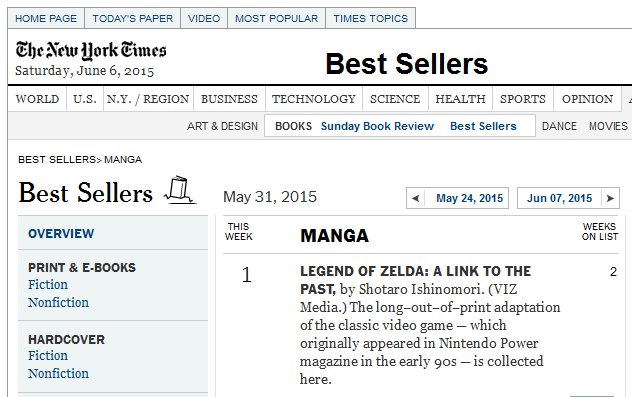
My own adoration aside, Viz Media’s new publication of manga giant Ishinomori Shintarō‘s adaptation of the 1991 Super Nintendo game The Legend of Zelda: A Link to the Past has been selling extremely well since it was released a month ago.

A Link to the Past on the NYT Bestseller List

This success makes perfect sense. Not only is The Legend of Zelda a major video game franchise with its own culture cachet, but Viz has also managed to put out a handsome publication, and manga’s story is easy to follow and immediately accessible to readers not familiar with the games.
The teenage orphan Link lives peacefully in a quiet village in “the pristine land of Hyrule” when, one stormy night, his uncle is summoned to the castle. Link is awoken by a voice claiming to be the princess Zelda, who telepathically tells him that she is being held prisoner in her own dungeons. Link, fearing shenanigans, rushes to the castle in the rain only to see his uncle put to death by a powerful wizard named Agahnim (whose dark skin and Orientalist stylings are how you know he’s a bad guy, yikes). Link manages to infiltrate the castle and rescue Zelda, only to have her immediately kidnapped once more by the wizard, who intends to use her to break the seal on an even greater evil. Before she’s spirited off to wherever princesses are stashed away in such situations, Zelda manages to tell Link that it’s his destiny to save Hyrule and that he must locate the legendary Master Sword, which is the only blade capable of defeating the powerful force controlling Agahnim. Off he goes, and adventure ensues.

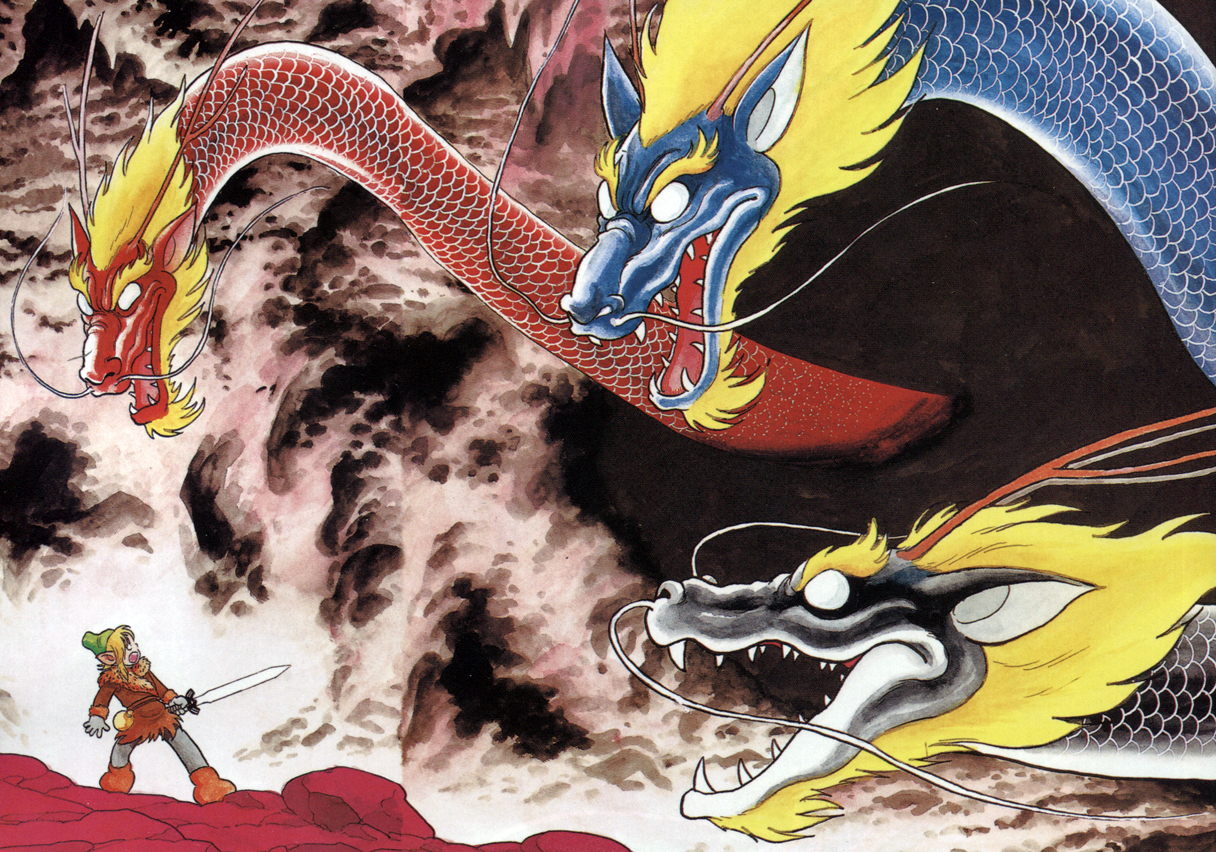
Video game adaptations into other media tend to be hit or miss, but Ishinomori, genius that he is, pulls off his manga rendering of A Link to the Past flawlessly. Although Link is never really alone in the game (as he is always accompanied by you, the player), his quest is a lonely one, as he bears the sole responsibility for delivering the land from a terrible fate. Ishinomori especially excels at portraying Link’s smallness in a vast world filled with hostile creatures. The action sequences – and there are a lot of them – are nicely choreographed, with a smooth flow facilitated by expert paneling. This flow is so dependable that, when it’s interrupted, the reader is instantly made aware that Link has encountered a true threat, as he does in his final battle with Ganon, the story’s ultimate villain.

A Link to the Past Link vs Ganon

The manga is also populated by friendly characters who aid Link along his journey. The most striking of these fellow wayfarers is a bird-like “mystery knight” named Roam (a classic Ishinomori archetype in both personality and visual characterization). The inhabitants of Ganon’s dark world, a mirror reflection of Hyrule that changes the shape of people based on the truest form of their hearts, are also given small roles that help raise the stakes of Link’s battle. For example, immediately after Link is exiled to the dark world by Agahnim, he encounters a talking tree who explains to him that there are many other people who, for whatever reason, followed Ganon into the dark world only to become trapped there, doomed to wander as beasts or serve an evil master until a hero can purify the land. Such accounts add layers of depth to the story that aren’t to be found in the original game, in which the player progresses from objective to objective simply to experience the next challenge.

Despite the assistance of friends he encounters, Link is still one boy caught up in a legend much larger than his own life, a theme Ishinomori emphasizes with splash panels depicting Link as a faceless dot at one corner of a daunting landscape. In the game on which the manga is based, the enemy the player must engage most frequently is the environment itself, and the artist’s translation of this element into menacing backgrounds and elaborate framing devices is beautiful to behold. Ishinomori’s interpretation of Ganon’s castle, the revelation of which is a climactic moment, is especially awe-inspiring.

I would be remiss if I didn’t mention that there are also some fun Easter eggs for Zelda fans scattered throughout the manga. I don’t want to spoil all of them; but, to give an example, Link flies to the Desert Ruins in a winged hang glider. As the villager who provides him with this contraption recounts, “They say these miracle wings belonged to a powerful bird that carried the knights of Hyrule into battle!” In retrospect, this statement seems to refer to the events alluded to in Skyward Sword. And yet, considering that this was written more than ten years ago, one can’t help but wonder how much of the lore explored in more recent games was already in place as the earliest titles were being developed. Or, conversely, was this manga perhaps a guiding influence for subsequent world building?

This manga was originally serialized in the American gaming magazine Nintendo Power from January to December 1992. The following year, it was published as a full-color collected volume by Nintendo of America and in a black-and-white tankōbon by Shōgakukan in Japan. As such, it’s an interesting slice of both manga and video game history. Manga was still relatively unknown in the United States in 1992, and Viz Media only started publishing its groundbreaking Animerica magazine the following year. Meanwhile, Gail Tilden (the marketing manager at Nintendo of America) and the editors of Nintendo Power, the first publication of its kind, were responding to the sudden appearance of a rabid gaming public in the wake of U.S. release of Super Mario Bros. 3 in 1991. (More information about the early years of the magazine can be found in Jon Irwin‘s excellent Super Mario Bros. 2.) It’s extremely interesting that Nintendo was already attempting a manga/game media mix marketing strategy through the burgeoning medium of English-language video game journalism. It’s also interesting that Viz seems to be using a similar strategy – using the popularity of a gaming franchise to promote manga – with this new release.

Even if you don’t usually care for video games or manga, Ishinomori Shōtaro is a force of nature and a credit to the human race. Since it’s difficult to find his work in English translation, Viz’s new edition of A Link to the Past is a fantastic opportunity to see a master artist and storyteller at the top of his game.

A Link to the Past Link's Battle Against Trinexx

Second Quest

Second Quest

Title: Second Quest
Artist: David Hellman
Author: Tevis Thompson
Publication Year: 2015
Publisher: Fangamer
Pages: 120

Second Quest is a beautifully drawn comic that reimagines the Zelda mythos and explores just how bizarre it is that the Hylians consider themselves to be “the chosen people” who need to be “protected” from other races. What was Ganon really trying to do? Did Zelda really need to be rescued? Why is Link valorized for running around with a sword and smashing everything he encounters? What sort of cultural legacy does this create, and who suffers when outsiders are removed from historical narratives?

Of course, The Legend of Zelda is a keystone franchise of the global game industry, and licensing it is not cheap or easy, so all of the serial numbers have been filed off in David Hellman and Tevis Thompson’s interpretation. What this means is that Second Quest is accessible to non-gamers and people largely unfamiliar with the series, and it’s of special interest to readers interested in how Japanese stories have influenced people around the world to begin their own conversations.

Second Quest Page 13

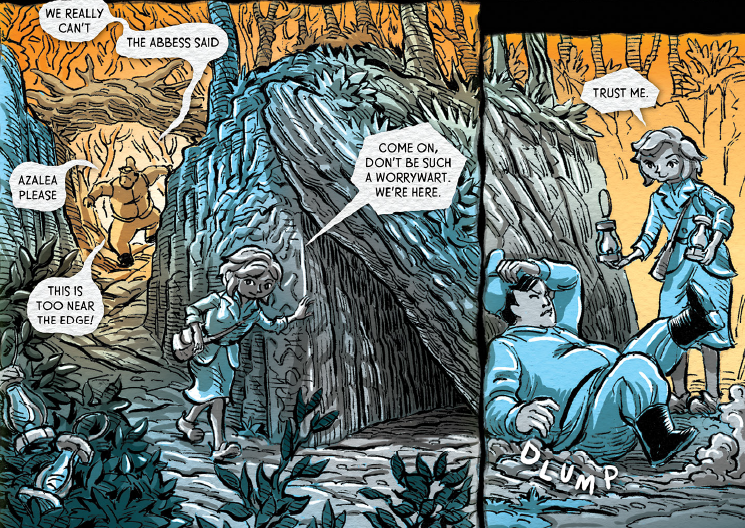
Second Quest is about a young woman named Azalea who lives on an island that floats high above the clouds. The island is sparsely populated and immense, and vast ruins are buried just underneath its surface. Azalea is fascinated by this uncharted territory, especially since she has the mystical ability to perceive the past history of the objects she touches. The story begins when Azalea is struck by an especially forceful vision of a young woman fleeing from a unseen pursuer when she picks up a broken key deep underground.

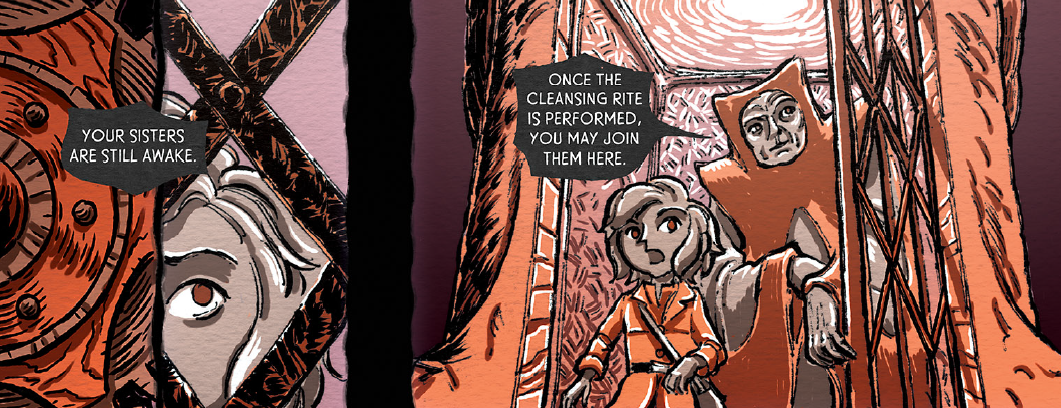
Unfortunately, Azalea’s interactions with underground artifacts trigger an earthquake, an event that is especially frightening to people living on a floating island. The tremors lead to mass panic, and it is decreed that a cleansing ritual must be performed. This ritual involves the re-enactment of a great battle against the evil “pig thief” who, envious of the sky island people’s prosperity, had captured the human vessel of their goddess. Azalea, whom the island’s religious leader has designated as the newest member of an order of secluded women who silently pray for the prosperity of the island and its inhabitants, must play the role of the sacrificial princess in this ritual before she retires from the world to become a symbolic reminder of the past and future glory of people other than herself.

Second Quest Page 56

David Hellman’s line work is both intricate and forceful, but what I especially appreciated was the artist’s color palette. The majority of Second Quest is warm and dark, with the twilit purples of the first half giving way to the angry reds of the second half. These colors emphasize the enclosed and suffocating nature of the floating island and its society, and the sky, when we see it, is a frightening orange or black. When the sky suddenly turns blue during the enactment of the purification ritual, presumably to emphasize the characterization of the island’s people as being “on the side of light,” the effect is disquieting. The appearance of teal and green at the very end of the book is breathtakingly dramatic, as the major theme of the story – a quest for freedom from the past – explodes onto the page through a series of textless spreads.

Second Quest was promoted and published through a Kickstarter campaign, the seed for which was planted by an essay written by Tevis Thompson about how the Zelda series has been declining in quality since the early games. While the first Zelda games forced the player to explore a boundless world, the more recent games are nothing more than an extended linear obstacle course. Tevis writes:

Players are constantly reminded that they’re shackled to a mechanistic land. There is no illusion of freedom because the gears that keep the player and Hyrule in lockstep are eminently legible. You read the landscape all too easily; you know what it’s asking of you. One of the greatest offenders occurred early on with A Link to the Past: most bomb-able walls became visible. What had been a potential site of mystery in the original Legend of Zelda (every rockface) became just another job for your trusty keyring. Insert here. Go on about your business.

Personally, I don’t think the Zelda series is broken. Even in Skyward Sword, which can indeed be frustratingly linear, there is more than ample room for exploration. My own favorite thing to do in Skyward Sword is bug catching, an activity that encourages the player to explore the world of the game both thoroughly and nonviolently while closely observing the game’s lush scenery and the behavioral patterns of the creatures that move unobtrusively within it. There are any number of different ways to play the Zelda games; and, if the huge body of Zelda fanfic is any indication, there are any number of different ways to read the games as well.

Last summer, however, there was a small backlash of fannish frustration over Aonuma Eiji’s denial that the Link character in the upcoming WiiU Zelda game might be female, a possibility that had been met with surprising enthusiasm. Furthermore, Aonuma stated that the gender of the Link character is inconsequential; instead, the important thing is that the player is able to identify with the character. The implication of this statement, of course, is that it’s easier for gamers to identify with a male player-protagonist than with a female player-protagonist. Let us never forget that the normative identity is “male,” after all. Men are subjects, so it makes sense for the player to control a male character, while women are objects, so it makes sense for them to act as McGuffins that enable the plot.

It’s important to the critique implicit in Second Quest that its protagonist is female. This is not simple fanboy pandering but rather a conscientious effort on the part of the creators to tell the “legend of Zelda” from the perspective of someone who is forced into a role that doesn’t suit her. When the reader first encounters Azalea, she is actively exploring the secret and hidden places of her world. We later learn, however, that women are not allowed entry into the knight academy that trains the elite police force that seems to govern the floating island. She’s not allowed to question authority or to develop her talents, even despite her obvious leadership qualities and intelligence. Azalea thus allows us to see the story of so many video games, a story frustratingly repeated time and again, from the perspective of someone excluded from shaping this story in any way. Azalea sees things that we usually aren’t shown, and what she sees is troubling and thought-provoking.

Second Quest is absolutely brilliant. If you’re a gamer, get this book. If you’re a comics person, get this book. If you’re into the darker side of religion and folklore, get this book. If you’re into feminism, gender politics, and the deconstruction of gendered tropes, then by all means, get this book. Second Quest is a beautifully published and a true pleasure to read and share with friends. I’ve been waiting for this book to come out for a long time, and I’m thrilled that it turned out to be so fantastic and inspiring.

For more information, be sure to check out:
http://www.secondquestcomic.com/

Second Quest Page 24

The Master Key

The Master Key

Title: The Master Key
Japanese Title: 大いなる幻影 (Ōinaru gen’ei)
Author: Togawa Masako (戸川 昌子)
Translator: Simon Grove
Publication Year: 1985 (United States); 1962 (Japan)
Publisher: Dodd, Mead & Company
Pages: 198

The Master Key, first published in 1962 and set in the late 1950s, is an interesting window into a period of postwar Japan that we don’t often see represented in Japanese fiction in translation. The story takes place entirely within the closed world of the K Apartments for Ladies, a large, multi-story building located in southeast Ikebukuro and registered as a charitable trust with “rents pegged at wartime levels.”

On its surface, the story is about a 1951 kidnapping of a young boy who is the son of a Japanese woman and an American military officer. Seven years later, when the K Apartments building is lifted and moved to a different location in a grand public works experiment, the body of a child is discovered buried underneath a shared bathing area in the basement. Right around the time the child disappeared, a man dressed as a woman was struck by a van in an intersection near the apartment building, and it’s revealed to the reader early in the novel that this man disguised himself as a woman to help one of the tenants dispose of the body that would later be found in the building’s basement. Who in the apartment buried the body, and what relation does this have to the kidnapping incident?

About twenty pages into The Master Key, however, it becomes clear that the mystery portion of the story is going to take a backseat to an extended exploration of the inner worlds contained within the K Apartments for Ladies and the psychological dysfunctions of its aging tenants.

Ishiyama Noriko, who has been diagnosed with “nervous pains,” has removed herself from the rest of the world and lives in a dark apartment stuffed with other people’s trash, which she occasionally boils and eats to sustain herself. Yatabe Suwa, a former concert violinist who now gives music lessons to children, is haunted by the loss of potential represented by the theft of a violin from her own teacher, even though it’s possible that she herself may have more to do with this incident than she likes to admit. Kimura Yoneko retired from her position as a schoolteacher years ago and spends her days writing letters to her former students, and she is not above checking into the affairs of the other tenants as well. Santo Haru is obsessed with a religious cult, and she is in the palm of its leader, who frequents her apartment to hold prayer meetings centered around the trances of its vestal priestess.

The plot is complicated and circuitous but is centered around the use and whereabouts of the master key of the title, which various tenants use to sneak into one another’s rooms in order to discover the secrets of others while concealing their own. At the end of the novel, it’s revealed that there is a mastermind orchestrating all of their movements, someone who has been spying on everyone for years and has manipulated the women around her for her own amusement. As someone who had essentially done the same thing to these characters through the process of reading this novel, I felt somewhat guilty, but not enough to lessen my enjoyment of how neatly all of the different plot threads are eventually tied together.

I will openly admit that I love stories about women being unpleasant and irrational and absolutely human. All of the female characters in this story are a little pathetic and a little demonic in that they have no power outside the K Apartments but all manner of strange little powers within their closed world. I’m sure this can be read as a metaphor for something, but it need not be, as the haunted and uncanny environment the characters shape through their bizarre actions is absolutely fascinating in and of itself.

For people with more background on Japanese history and urban space, the story’s setting in Ikebukuro is of special interest. In the immediate postwar period, Ikebukuro famously functioned as a heterotopia in which diverse groups of people came together and the norms of mainstream society didn’t necessarily apply. There is all manner of hidden “national polity” history in Ikebukuro, where the family-state of Japan has buried countless failed narratives under highways and skyscrapers. The Master Key thus serves as an excellent example of postwar Tokyo gothic (as similarly exemplified by Kyōgoku Natsuhiko’s The Summer of the Ubume). A reader doesn’t need historical knowledge to appreciate the story, but a bit of research into the setting has the potential to deepen the experience of reading this novel, which has sub-basements under sub-basements under sub-basements.

The Master Key is long out of print but still cheaply available through a number of online used book services. If you have access to your local or university library’s Interlibrary Loan program, it’s well worth requesting this book. It’s a quick read, and it packs a huge impact. To my fellow horror and mystery lovers especially, I highly recommend tracking down a copy of this short, satisfying, and creepy little novel.

Cool Japan Guide

Cool Japan Guide

Title: Cool Japan Guide: Fun in the Land of Manga, Lucky Cats and Ramen
Artist: Abby Denson
Publication Year: 2015
Publisher: Tuttle
Pages: 127

Abby Denson is a comics writer who has worked on a number of high-profile and kid-friendly titles, such as the comic adaptations of Powerpuff Girls and Sabrina the Teenage Witch. She’s also drawn two graphic novels of her own, Dolltopia and Tough Love: High School Confidential, both of which I love beyond all reason. She has a quirky style all her own, and her charm shines from everything she creates.

I should probably get this out of the way first – Denson is a wonderful writer, but her art can sometimes be a little uneven. In Cool Japan Guide, the continuity between panels is inconsistent, and her characters all tend to have the same の∇の facial expression. The coloring is absolutely flat, and the bright primary colors can occasionally clash against each other violently.

Even if Denson’s art style isn’t to your taste, is Cool Japan Guide still worth reading?

It definitely is!

As you progress through the book, the art will grow on you, I promise. Denson has a special talent for depicting places and objects, and the details of each panel are fun and creatively stylized.

All of Denson’s travel advice is spot-on. Seriously, this woman has excellent taste – if she recommends something, then it’s definitely worth doing. By all means, check out the train-themed socks for sale at Tokyo Station! Try the sweet potato soft serve ice cream in Kamakura! Enjoy a cocktail at the 8bit Café in Shinjuku! Make plans to attend the Kaigai Manga Festa! Soak in the warm water and kitschy atmosphere of Oedo Onsen Monogatari!

Cool Japan Guide also offers a fair bit of reference material, such as websites with travel resources and smartphone apps convenient for tasks like train scheduling and quickly finding phrases in Japanese. Each chapter is preceded by eight or nine useful words or expressions, and the hand-drawn map of Japan at the end of the book is a treasure, especially for people planning longer journeys.

Cool Japan Guide is definitely not for the type of thirty-something hipsters who are into the Wallpaper* city guides or the type of forty-something yuppies who are into Fodor’s, but I can imagine a younger person smiling with joy while reading through the book. Since Denson takes care to ensure that the content is family-friendly, the book would make a great gift for a child or teenager. The gentle silliness and positivity of the guide succeed in making it enjoyable for older readers as well.

For more pictures, stories, and news, Abby Denson has her own website, and Cool Japan Guide has its own Tumblr.

Review copy provided by Tuttle.

Cool Japan Guide Page 37

Yellow Rose

Yellow Rose

Title: Yellow Rose
Japanese Title: 黄薔薇 (Kibara)
Author: Yoshiya Nobuko (吉屋 信子)
Translator: Sarah Frederick
Publication Year: 2015 (America); 1923 (Japan)
Publisher: Expanded Editions

I’m absolutely thrilled to write that one of Yoshiya Nobuko’s stories has finally appeared in a readily available English translation. “Yellow Rose” is drawn from Yoshiya’s acclaimed collection Hana monogatari (Flower Stories), which first appeared in print in the 1920s and has been a major guiding influence in shōjo manga, literature, and aesthetics. Thankfully, Yoshiya’s fiction is not just important from the perspective of literary history but also a true delight to read.

The short story “Yellow Rose” is about Katsuragi Misao, a twenty-two-year-old college graduate who accepts a teaching post at an all-girls prefectural academy “a thousand miles distant from Tokyo” to avoid getting married. On the train departing from Tokyo she meets Urakami Reiko, who happens to be a student entering her final year at Katsuragi’s school. Reiko is running late; and, clutching a bouquet of yellow roses, she dashes across the platform to catch the train, just barely making it:

Perhaps because she had been running so fast her little chest beat wildly, sending the profusion of flowers in that single hand all a-tremble, and this quivering of the yellow rose bouquet moved in unison with the fluttering of the girl’s sleeves – it was a beautiful scene–

Reiko gets a grain of soot in one of her eyes, thus giving Miss Katsuragi a chance to be alone and in intimate contact with her as she administers aid:

The end of her ponytail stretched down below the pillow, and a wisp of stray hair lay on her white forehead; her cool eyes were both gently closed and just her lips moved with her breath like a flower – in the stillness of a moon perhaps her closed eyes were seeing a dream……ah, how lovely!

The two continue their association throughout the summer, and their romance blooms in a series of short vignettes, of which the following is representative:

Thus carries the sound of the bell down to the water at Kiyomigata shore. It must be from the Seikenji Temple bell tower in Okitsu –

The bell sound crosses the twilight waters……

Motionless on the beach shadows……two of them

Two shadows paused silently as if to let the sounds of the bell gently embrace them –

Twilight, the moon thinly visible at the yonder edge of the sky – as they neared the shore only the very faint tips of the breaking waves sported a faint whiteness, like frayed silk tassels.

Miss Katsuragi and Reiko make plans for the girl to attend Katsuragi’s alma mater in Tokyo before embarking on a journey to the United States together, but Reiko’s mother expects her to enter an arranged marriage immediately after her graduation in April. At the end of the story, as Katsuragi boards a ship to Boston alone, she abandons herself to her grief.

As with many of the stories contained within Yoshiya’s Hana monogatari, “Yellow Roses” ends in tears. The story’s focus is not on plot, however, but rather the beauty of the two young women and the depth of their feelings for one another. Entire paragraphs are spent on detailed descriptions of mournful eyes and chiseled cheekbones, and the poetry of Sappho is quoted at length. As in the above passages, Yoshiya’s writing is characterized by fragments and ellipses, which heighten the emotional impact of certain scenes while leaving the reader free to fill in the suggestive gaps in the text with her imagination.

“Yellow Roses” can be a quick and feather-light read, but the reader is rewarded for returning to the story a second time, as many of its passages can be appreciated as jewels in a beautiful setting – or roses in a stunning bouquet.

Although the story alone would be well worth the price of admission, this publication is graced by the addition of an extended translator’s introduction, a fascinating note on the cover illustration, an extensive selection of illuminating endnotes, and a meticulously curated list of selected English-language readings that functions as an invaluable resource to anyone interested in the history and inner workings of shōjo culture in Japan from the nineteenth century onward.

Translator Sarah Frederick’s introduction, which is roughly as long as the translated story itself, functions as something of an abbreviated textbook, touching on not merely the author and the story but also many aspects of the society and publishing culture that form its context. Frederick’s writing is not mired in the academic garble of postmodern theory but is immediately accessible to a casual reader as it paints a picture of a time and place in broad yet deliberate strokes. What I especially appreciate about this short essay is that it directly confronts the issue of female queer sexuality in Japan:

While it is not difficult to frame these desires via the flexible contemporary category of “queer,” it may be surprising to some readers that to invoke the word “lesbian” for Katsuragi and Urakami’s relationship, Flower Stories, or Yoshiya’s work and life more generally, has sometimes been controversial. I think this is a wonderful question to raise and discuss in a classroom or elsewhere using the story itself, and no translator’s introduction can “answer” it. […] While the term “lesbian” or loan word “rezubian” were not used in these stories or by Yoshiya herself in her lifetime, they are used literally here in reference to Sappho from Lesbos. More broadly, the claim that “lesbian” does not apply in the Japanese context or the prewar Japanese context (both arguments are sometimes made) leans far too much toward cultural essentialism and the false sense that Japan was cut off from the rest of the world, including its varied discourses on sexuality. The impression given by “Yellow Rose” and its milieu is rather the opposite: a highly cosmopolitan girls’ culture, aware of Sappho as a figure available to express the desire of one girl for another. It is engaged in active exploration of the rich but incomplete solutions posed by the possibilities of western philosophy, emotional poetry, and travel to America as sources for different ways of thinking about the realities and aesthetics of women’s lifestyles, desires, and conceptions of love.

The words in bold are my own emphasis, because I’ve been waiting for someone to state that very point as clearly and succinctly as Frederick for years now. Yes Virginia, there are queer women in Japan! The next time anyone asks me whether we can really call portrayals of homosexuality in Japan “gay,” as if the Japanese archipelago were home to a bizarre alien society completely removed from the cultural currents flowing across the rest of the world, I am going to quote this passage word for word.

The main appeal of “Yellow Rose” and its introduction really isn’t in any sort of political statement, however. Instead, the reader is invited to enter a sparkling, rose-colored world of radiant young women, their pure yet dangerous emotions, and the tragic pressures of a bygone era that prevent them from expressing their truest selves. As Frederick explains in her introduction, there is no better place to go looking for the roots of shōjo manga and literature. The translation itself expertly captures the language and cadences of the girls’ literature of writers such as Frances Hodsgon and Louisa May Alcott (whose work Yoshiya was almost certainly familiar with), so even the English feels pleasantly nostalgic. I therefore recommend “Yellow Rose” not only to serious academic types and hardcore shōjo fans but to even the casually curious. Within the short span of a train or subway ride, you can be transported into a glittering space removed – but never too removed – from the grittiness of the mundane. It’s quite an experience!

Yellow Rose is currently available exclusively as a digital text, and it can be purchased on Amazon’s Kindle store. It will also soon be available directly from the website of its publisher, Expanded Editions, a shiny new operation with two translations of vintage Japanese science fiction ready to download. Even if you’re not interested in Yellow Rose, be sure to check out Expanded Editions, which has done a fantastic job with its digital texts.

The manageable length and impeccable scholarship of Yellow Rose recommend it for classroom use. For educators hoping to incorporate the text into a printed or PDF course pack, Expanded Editions offers educational sales and will work directly with campus bookstores to make the material available to students. More information can be found on the relevant section of the publisher’s webpage.

Review copy provided by Expanded Editions.