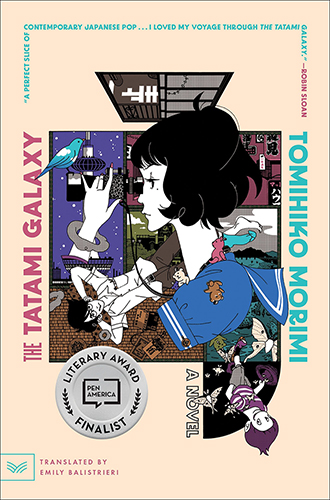
The Tatami Galaxy is a magical realist comedy set in Kyoto in the early 2000s. The author, Tomihiko Morimi, is famous for his over-the-top characters and offbeat urban fantasy, and The Tatami Galaxy takes the reader on a wild ride through a set of parallel universes.
The unnamed narrator is a third-year student at a university in Kyoto. He came to campus, he says, with dreams of pursuing a rose-colored student life full of friends, scholarship, and wholesome extracurricular activities.
This is not how things turned out, unfortunately. After joining a student club that he didn’t quite click with, the narrator develops a friendship with a fellow student named Ozu, a slimy but charming manipulator who drags him into all manner of unsavory plots.
What would happen, the narrator wonders, if he had joined another club? Could he have escaped Ozu’s influence and enjoyed his ideal rose-colored campus life?
The Tatami Galaxy collects four versions of the narrator’s story. At the beginning of each version, the narrator joins a different student club. Though the details are different, the characters remain the same.
The narrator never manages to break his “black thread of fate” with Ozu; but, then again, that’s not really what he wants. After all, what good is a rose-colored campus life without friends?
The Tatami Galaxy is very silly and sweet, and it also feels like a window into what college was like before the pandemic. Remember the world before neoliberal enshittification really started to take hold? Remember when eating out was cheap, drinking was fun, and your life wouldn’t be completely ruined by a few bad grades and stupid mistakes?
As a university professor myself, it’s painful to see how exhausted my students are, and it’s wild to think about how different everything was even ten years ago. The Tatami Galaxy is a perfectly preserved time capsule, and it’s as good of an opportunity as any to remember that college isn’t supposed to be about optimizing your metrics. If you aren’t drunkenly setting off fireworks at a rival student club across a river on a warm spring night, the author argues, you’re wasting your chance at a rose-colored campus life.
I really love Emily Balistrieri’s short “Note from the Translator” at the end of the book, in which she discusses how much fun it was to translate Tomihiko Morimi’s distinctive style of writing and sense of humor. This joy definitely comes through on the page, and Balistrieri’s translation feels remarkably fresh and energetic.
If you’re interested, the (subtitled) anime version of The Tatami Galaxy is free to watch on YouTube (here). It’s something of a cult classic, and with good reason. The art and animation are unique and creative, and the voice acting is genius. Still, I have to admit that the visual eyestrain is intense. The anime boasts the same high energy and twisted sense of humor as the original novel, but mercifully (for those of us past our student days) the book version is much easier to enjoy at a chill and relaxed pace.
 Contemporary Japanese Literature
I’ve heard so much about this novel but had no idea it was set in a college environment! thank you for the review, I’ve now added this to my reading list 🙂
[…] Japanese Literature: The Tatami Galaxy – “The Tatami Galaxy is a magical realist comedy set in Kyoto in the early 2000s. The author, […]
One of my all time favourite. I love it’s explorations on romance too, that this yearning for better can be found both for a better life and for romantic relationships and that abandoning them grants you what you’ve really wished for all along. I like the sequel too, though gotta admit for that one I’ve only seen the adaptation of.