Thermae Romae

Thermae Romae

Title: Thermae Romae
Japanese Title: テルマエ・ロマエ(Terumae Romae)
Artist: Yamazaki Mari (ヤマザキ マリ)
Translation: Stephen Paul
Publication Year: 2012 (America); 2009-2010 (Japan)
Publisher: Yen Press
Pages: 372

This manga is fantastic.

There’s a drawing of a naked man on the cover (you can see his penis under the removable acetate), and there’s a chapter about Roman and Japanese phallus worship. There’s also a chapter about the Bar Kokhba revolt that’s sympathetic to the Romans. The manga tacitly acknowledges Roman homosexuality (Emperor Hadrian is an important character) and Roman slavery (Emperor Hadrian thinks it’s funny that his pet crocodiles have bitten his slaves). All of this is in the background, however; and, if you can get around it, you will love this manga. It’s like reading a super-awesome issue of National Geographic, except with time travel.

Thermae Romae is about Lucius Modestus, a Roman architect living in the first half of the second century who specializes in designing baths and balnea, or bath houses. At the beginning of the story, he sees his own time as possessing an inferior bathing culture and wants to return Rome to the glory days of bathing, but his designs are considered old-fashioned and unmarketable. While taking a breather in a public bath house after being fired from his job at an architectural firm, Lucius slips and is sucked through a water vent into a sentō, or public bath, in twenty-first century Japan. Lucius thinks the Japanese are just slaves from one of the lands that Rome has conquered (he calls them “flat-faces”), and the Japanese think Lucius is just another clueless foreigner (they call him “gaijin-san”), and thankfully no gaping time-travel-related holes open in time and space. Lucius is taught the joys of contemporary Japanese baths; and, after being sucked through another hot water vent, he returns to Rome to share his own adaptations of certain aspects of this culture, which prove popular with his fellow romans.

Although the story gradually develops over the course of the manga, it remains largely episodic. In each chapter, Lucius encounters a problem, is transported to contemporary Japan, learns about Japanese bathing culture, returns to Rome, and implements his own versions of what he saw in Japan to the amazement and delight of everyone involved.

Through these episodes, the reader gets to visit various parts of the city of Rome, as well as locations such as Emperor Hadrian’s mansion in Tibur, Trastevere (a small city on the banks of the Tiber River), and the Roman province of Judea. Also on offer are the hot springs of the Tōhoku region, including monkey hot springs and therapeutic hot springs for convalescents. In his accidental journeys to Japan, Lucius also finds himself in the bathroom of a private residence, a corporate showroom for bathtubs, and even an aquarium that uses the water from a natural hot spring to create a habitat for crocodiles and banana trees.

If exploring contemporary Japan and ancient Rome is half the fun of this manga, the other half is watching Lucius in action. Lucius, earnest to a fault, is a classic straight man who is very serious about everything and responds to every situation he finds himself in with utmost sincerity. Although his upright personality isn’t directly exploited for laughs, it occasionally leads to humorous situations, such as when Lucius takes off his clothes in inappropriate places (for science!) in modern Japan. Mostly, however, Lucius’s personality allows him to act naturally in situations that would otherwise be extremely awkward or uncomfortable. He’s a sympathetic character, and his intelligence and curiosity allow the reader to see and experience more than would be possible if Lucius were a more cynical or self-conscious person.

At first glance there seems to be an undercurrent of “everything in Japan is the best thing ever” running throughout the manga, but I don’t think the artist ever takes the story seriously enough for her celebration of Japanese bath culture to come off as jingoistic. Through Lucius, who is by turns clueless and comically sincere, Yamazaki pokes fun at both ancient Rome and contemporary Japan. The Romans thought they were the most civilized people in the world, but their culture is capable of improvement through outside influences; and, while Japan has a fantastic bathing culture, it’s not flawless either. If Emperor Hadrian trying to recreate the scenery of the Egypt in his private estate is a bit silly, so too is a Japanese zoo that grows bananas. Whether it’s foreign live-in caregivers for elderly people in Japan or Lucius’s frustrated wife leaving him for another man after he runs off to spend three years in Judea, the manga always treats its subject with gentle good humor.

Yamazaki’s art isn’t hyper-detailed, but it is pleasantly realistic. Although she uses screen tone, most of the texture in her drawing, such as the roughness of cloth or the movement of water or the blush on freshly bathed skin, is conveyed by pen strokes. She slightly abbreviates both line and texture in about half of her panels to give the page a clean and open feel and to draw attention to the more visually dense panels. There are always several pages in each chapter that display nothing more than talking heads, but Yamazaki is capable of conveying such a wide and deep range of emotion with facial expressions and body language that these pages never become oppressive or boring.

Perhaps the most pleasant surprise for me in Thermae Romae were the two-page essays at the end of each chapter. These essays, which are always accompanied by a handful of captioned images, offer the reader a few more details about the cultural and historical elements of the preceding chapter. Yamazaki supplements factual information with her experiences travelling through Europe and Japan and anecdotes about famous figures of the ancient world, and her essays are entertaining without ever becoming too personal or pedantic.

Yen Press has done a beautiful job with Thermae Romae. Although the book is a bit too large to comfortably read in the bath, the extra size is worth the better print quality. It’s also worth mentioning that Stephen Paul’s translation is superb. When I read the manga in Japanese earlier this year, I wondered how certain aspects of the text (such as the Tōhoku dialect spoken by a handful of secondary characters) could be handled in translation, and I think the translator and editorial staff did a wonderful job; the language in Thermae Romae is beautifully smooth with no awkward translatorese or corny attempts to reproduce dialect.

Thermae Romae is fantastic. I’m so happy this manga finally made it to America.

Kieli: The Dead Sleep in the Wilderness

Title: Kieli: The Dead Sleep in the Wilderness
Japanese Title: キーリ ― 死者たちは荒野に眠る
(Kiiri: Shishatachi wa kōya ni nemuru)
Author: Kabei Yukako (壁井 ゆかこ)
Illustrator: Taue Shunsuke (田上 俊介)
Translator: Alethea Nibley and Athena Nibley
Publication Year: 2009 (America); 2003 (Japan)
Publisher: Yen Press
Pages: 228

Kieli is one of those hauntingly pretty girls whose special blood and pure heart allow her to see things unnoticed by others. Harvey is one of those chiseled copper-haired boys who is seventeen and has been seventeen for a long time. When their paths cross seemingly at random, Harvey finds himself charmed by Kieli, and Kieli finds herself dazzled by Harvey… Stop me if you’ve heard this story before.

What’s special about this novel isn’t its love story, however, but rather its setting. In her “Afterword,” the author says, “Wasted planets, steampunk, old-fashioned radios, rusty machines, old oil. It would make me as happy as I could be if all of you who like dilapidated things and react to that kind of vocabulary like this book.” I hope the author is indeed as happy as she can be, since her book is perfect for anyone who enjoys the atmosphere conjured by such words. Kieli is set on a dying planet where society still functions to a certain degree as life crumbles to dust in stages. This decay pervades every corner of the novel:

The next morning, when Kieli opened her eyes she was lying on a sofa with broken springs in the waiting room, wrapped in her coat and a dusty old blanket.

The clinic had completely fallen to ruin. Yellow sand and dust had settled below the crisp, clear, cold morning air, and the once clean, white paint on the walls had faded to yellow and peeled off in places, showing the concrete wall underneath.

Kieli spent a while walking through the deserted house, looking for Harvey, the floor creaking with every step she made. When she went up to the second floor, the plants that decorated the balcony had withered to nothing, and only the cracked pots remained under the nebulous morning light.

Everything in Kieli’s world is slowly falling apart. Isolated cities are separated by vast stretches of desert, small villages that serve as way stations along the side of railway lines are slowly shrinking in population, and the wasteland outside habited areas is still littered with the detritus for a war over natural resources that petered out a hundred years ago. Kieli is strangely suited to life in this world, as she possess the unusual ability to see and interact with the ghosts of the dead, who are seemingly more numerous than actual living people. Through the mischief of her dead roommate, Kieli encounters Harvey, who used to be a soldier in the war. Harvey is a creation known an as Undying, a class of artificial beings powered by mechanical cores of pure energy. Aside from his bad attitude, Harvey seems mostly harmless until he unwittingly drags Kieli into a conspiracy concerning the Church that governs Kieli’s world. The two are accompanied by the ghost of an older man known as the Corporal, who resides in the shell of an old radio and provides both insight and comic relief. In an environment where everything is dead or dying, Kieli and Harvey shine brightly as they find adventure and new life in each other’s company.

Since Kieli is a light novel, it receives the full graphic treatment, with eight full-color anime-style illustrations at the front of the book and a number of black-and-white illustrations scattered throughout the book’s chapters. The tropes of the novel are not specific to Japanese popular media, and they should appeal to a wider audience for young adult fiction. Kieli is an orphan who lives in a boarding school, where she is misunderstood and unappreciated by her peers. Harvey is an angsty, brooding badass who has a soft side that he keeps hidden in order to survive in a harsh world. The spirit of the Corporal residing in Harvey’s radio is a grumpy old man who cheerfully dispenses humorous complaints. The Church is mysterious and sinister, and its agents are genuinely frightening.

A shortcoming of many light novels published in translation is that their language is more manga-like than literature-like, by which I mean that its primary purpose is to shoot the reader forward as quickly as possible through a series of increasingly improbable events. Kieli occasionally suffers from this style of narration, but it usually allows the reader time to linger over events and absorb the story’s atmosphere. The translation of Kabei’s prose is lucid and engaging, inviting the reader to enter Kieli’s world without fussing over translation notes and awkwardly translated dialog. Occasionally a character will bow to another character, but the novel otherwise has very little “cultural odor.” Because of the quality of the translation, I found myself reading not just for the story but also for the pleasure of reading such straightforward and well edited language. I also feel the same way about the translation of the Spice and Wolf light novels, and I can’t help but offer my most profound thanks to the editorial staff at Yen Press for doing such an excellent job with their releases.

Kieli ends with a bit of a cliffhanger, but its sequels have already been published by Yen Press, which seems to be keeping up a steady release schedule. I don’t know why I waited so long to start reading this series, because it’s really quite good. I can’t wait to read the next volume!

Book Girl and the Suicidal Mime

Title: Book Girl and the Suicidal Mime
Japanese Title: “文学少女”と死にたがりの道化 (“Bungaku Shōjo” to shinitagari no piero)
Author: Nomura Mizuki (野村 美月)
Illustrator: Takeoka Miho (竹岡 美穂)
Translator: Karen McGillicuddy
Publication Year: 2010 (America); 2006 (Japan)
Publisher: Yen Press
Pages: 183

Oh, Yen Press. Oh, how I love you; oh, how I hate you.

I love the money and effort you put into publishing your books. I love that you took a chance on titles like Black Butler and succeeded remarkably. I love that you turned garbage like Maximum Ride and Cirque du Freak into readable and artistically beautiful graphic novels. I love that you found room in your capitalistic heart for series like Bunny Drop and One Fine Day. I love how you don’t put Japanese manga-ka on a pedestal but instead give equal attention to Korean and American artists. I hate that you stopped publishing the paper-and-ink version of your monthly magazine. I hate that I can only access the digital version from your website even after I pay for it. I hate that you sent cease-and-desist orders to scanlation sites but then decided to launch your digital titles exclusively on the most expensive e-reader on the market.

I am similarly conflicted about the light novels Yen Press has released. I enjoyed Spice & Wolf, even if it was a bit bland (the most interesting bits were the watered-down speculations on preindustrial economies, if that gives you any idea how clumsy the characterization was). Kieli had an intriguing premise and was set in a fun dystopic fantasy world but was riddled with stereotypes and awkward dialog. Worst of all, the nails-on-a-chalkboard banality of The Melancholy of Haruhi Suzumiya made me despite not only Tanigawa Nagaru but the entire genre of light novels. So, when Nomura Mizuki’s Book Girl and the Suicidal Mime was released last July, I decided to give it a pass. I felt justified in my decision after reading the opening epigraph:

Mine has been a life of shame. I’m like the one black sheep born into a pure white flock. Unable to enjoy the things my peers enjoyed, unable to grieve the things they grieved, unable to eat the things they ate – being born an ignoble black sheep, I didn’t understand the things my friends found pleasant, such as love, kindness, and

Actually, let’s just leave it at that. There’s no need to copy the full paragraph. Glistening tears leaving black ebony trails of eyeliner down a tragic alabaster face – you get the picture. Maybe I would be more patient with such things if I were seventeen; but I’m ten years past seventeen and not quite as intrigued by alienated narcissism as perhaps I once was, regardless if said narcissism is a deliberate homage to Dazai Osamu. And so it was that Book Girl fell off my radar.

What made me leave my desk and walk straight to Borders to pick up a copy was Erica Friedman’s glowing review of the second book in the series, Book Girl and the Famished Spirit, over on Okazu. If the series is that good, why shouldn’t I read it immediately? And so I did. Suicidal Mime was short and engaging enough for me to read from cover to cover the very evening I bought it, and I did indeed enjoy the experience.

The “book girl” of the title is Amano Tohko, who seems to be an ordinary high school student save for the fact that, instead of food, she consumes the written word. She is the president of her prestigious high school’s book club, the only other member being Inoue Konoha, whom Tohko has drafted to write short, impromptu snacks for her. Tohko’s secret is that she quite literally eats paper with stories written on it, and Konoha’s secret is that he once wrote a bestselling novel under the name of his former girlfriend, who had committed suicide by jumping off the roof of her middle school in front of him. Konoha is taciturn but good-natured, and Tohko is brash but unflaggingly cheerful. The dynamic between these two characters is typical (one might almost say stereotypical) of the genre of Japanese high school comedy, but it’s entertaining nonetheless.

The book is plot-driven instead of character-driven, though, and the plot is set in motion with the introduction of Takeda Chia, who asks Konoha to write a series of love letters for her. The recipient of these letters is Kataoka Shuji, an upperclassman on the archery team. As Konoha soon discovers, however, Shuji doesn’t exist. Or, at least, not anymore – he supposedly committed suicide ten years ago, but a letter found inside an old copy of Dazai Osamu’s No Longer Human hints that there might have been more to his death than suicide. The story is thus propelled by three intertwined mysteries. Who was Kataoka Shuji? How did he die? What stake does Chia have in the matter? Playing the role of Sherlock, Tohko knows more than she lets on but sends Konoha on several fetch quests to discover concrete clues.

These clues seem unconnected at first; and, unfortunately, they tend to remain unconnected towards the end of the book, when everything wraps up so quickly that I was left wondering what had just happened. It turns out that Dazai Osamu is not the only sociopath in the story; literally everyone is a black sheep who has lived a life of shame. This sudden plot development boggled my mind, and I ended up not really caring about any of the inexplicably psychologically damaged characters. Perhaps this makes me a sociopath, but, in my defense, the characterization is rather weak. For example, Tohko is introduced to the reader in this way:

Tohko was perched on a metal folding chair, her knees pulled up to her chest. It wasn’t a very modest way for her to sit. Her pleated skirt was almost wide open – but not quite. If she moved her legs even slightly she would be flashing me.

This is how Chia is introduced:

A girl was splayed out on the floor, her skirt flipped up in her fall, exposing her bear-print underwear for all to see. It occurred to me that my little sister had the exact same pair of underwear, but she was only just starting elementary school.

In other words, the characterization depends fairly heavily on anime tropes, which are emphasized and reinforced by the illustrations:

To make a short story even shorter, then, Book Girl and the Suicidal Meme is a plot-driven novel with a ridiculous and poorly paced plot populated by characters that are little more than amalgamations of tropes culled from the otaku database. Despite this (or perhaps because of this), the book is a fun read. It’s short, and it moves quickly. It doesn’t take itself too seriously, and I imagine how it would be perfect for a younger audience. If nothing else, Tohko’s synaesthetic responses to literature are kind of cute:

“Mmmm, so good. Fitzgerald has a really snazzy flavor. I feel as if flamboyance, glory, and passion are dancing a waltz in my mouth, like I’m eating glittering caviar with champagne at a party. When I bite into it, its delicate skin pops, and a fragment of liquid spills into my mouth.”

As you can probably tell from the above passage, the touch of the translator is feather-light, so reading Book Girl feels really no different than reading “normal” (ie, contemporary American) young adult fiction, save for the eight full-color pages of illustration at the beginning. At $8.99, the book is priced like normal young adult fiction as well, so it’s well worth picking up and breezing through for anyone interested in light novels, young adult fiction, or anime and manga in general. I’m definitely going to order the second volume of the series before my next plane ride. The Famished Spirit is about sixty pages longer than The Suicidal Mime, so hopefully there will be more room for plot and character development.

Another mystery-flavored light novel I read recently was the first volume of Sakuraba Kazuki’s Gosick series, which is published by Tokyopop and still (as of this writing) available at a discount through Right Stuf. Like Book Girl (and many of Doyle’s original stories), Gosick employs a Todorovian element of fantasy in that the reader never quite knows if the cause of the story’s improbable events is supernatural in origin. The innocence of the beautiful young female Holmes-equivalent can be grating at times (as is that of Tohko), and there were times I suspected that her “astronomical genius” was only given to her by the author to make her a more desirable prize for the male reader-stand-in protagonist; but, if you can get around that, the first volume of Gosick is an enjoyable mystery novel. The Gosick anime series is currently streaming on Crunchyroll, and it’s worth briefly checking out if only for its gorgeous Mucha-inspired art nouveau opening sequence.

Yotsubato!

Title: よつばと!(Yotsuba to)
Artist: あずまきよひこ (Azuma Kiyohiko)
Publication Year: 2003 (Volume 1) – 2009 (Volume 9)
Publisher: 電撃コミックス (Dengeki Comics)
Pages: 225 (per volume)

Let me get this out of the way first: Yotsubato! has no story. It is not “about” anything. There is no point. It does not go anywhere. The manga could be classified as falling within the genre of comedy, but it doesn’t really try to be funny. The reader never really learns anything about the characters, and the relationships between the characters show almost no development. Nothing important or exciting happens.

Let me also get this out of the way: Yotsubato! is one of my favorite manga in the whole wide world.

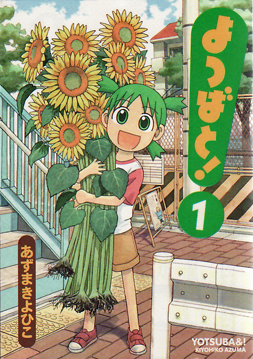
I have been fond of Azuma Kiyohiko’s four-panel manga Azumanga Daioh ever since the translation was released in America in 2002. I also enjoyed the anime based on said manga. When defunct American manga publisher ADV Manga started releasing translations of Yotsubato!, Azuma’s new project following the completion of Azumanga Daioh, I picked up the first volume immediately. Unfortunately, I found myself disappointed. It wasn’t a fun manga to read. I didn’t get it. The dialog was translated in a way that was supposed to be wacky and zany, but I didn’t think the manga itself was that funny. The art was a little weird, too. A year later, in 2007, I went to Japan to find Yotsubato! featured prominently at almost every major bookstore in Tokyo and Yokohama – most memorably at the Tsutaya in Shibuya, which had an entire wall devoted to Yotsuba paraphernalia. The cover of the Japanese publication of the manga was approximately five hundred times more appealing than the cover of the translation, so I picked up a copy. While reading it on the train home, I fell in love.

Yotsubato! follows the daily life of a five-year-old girl named Yotsuba. Having been orphaned on an island somewhere outside of Japan (the circumstances are never made clear to the reader), Yotsuba has been taken in by a man named Koiwai, who seems to be in his late twenties or early thirties and makes his living as a translator. At the beginning of the first volume of the manga, Yotsuba and her adopted father move into a new house in the suburbs of a city assisted by Koiwai’s friend Jumbo, a florist with a preference for Hawaiian shirts whose name reflects his comically enormous stature. After moving in, Yotsuba and Koiwai (and Jumbo, who visits from time to time) become friends with the family living next door, which consists of a mother, a daughter in college, a daughter in high school, and a daughter a year or two older than Yotsuba (the father of the family never makes an appearance). Although other friends of Koiwai and the next-door neighbors are occasionally introduced, Yotsubato! mainly revolves around this core set of characters and their interactions. The manga moves slowly from day to day. Over the course of nine volumes, its leisurely pace has taken it from the middle of summer to the very beginning of fall.

What I love about this manga is this very slowness. I wouldn’t describe this work as “contemplative,” however; Yotsuba herself is very curious and energetic, and her adopted father is something of a character as well. There is nothing boring about the manga, but its focus on the mundane allows the reader to take a step back from his or her own presumably hectic life and enjoy an endless summer full of daytrip adventures and small discoveries. This is not to say that Yotsubato! somehow resembles something like My Neighbor Totoro. The manga is written from an adult perspective, and the reader is constantly encouraged to identify with the people who surround Yotsuba rather than with the girl herself. The occasional jokes that the manga makes are sophisticated, and the adult speech and relationships are not sanitized or downplayed.

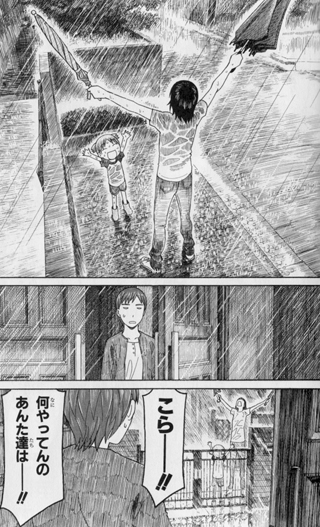
The attention to detail expressed in every aspect of the manga finds its most visible outlet in its gorgeous artwork. As I noticed when I first read the manga in America, it takes Azuma several chapters to settle on his character designs, which are drawn in his unique style. The rest of the visual realm, however, is drawn in an almost photorealistic way, from the tiniest detail of the interior architecture of Yotsuba’s house to the products lining the shelves of a neighborhood convenience store. Aside from the shade of Yotsuba’s unique hair, there is almost no screen tone used in the manga; everything is conveyed in understated ink work, which miraculously never clutters the page or busies the panels. The slightly cartoonish characters provide a pleasing contrast to this sort of detailed background. I feel like the background art in this manga captures the essence of a Japanese suburb far away from Tokyo; so, even while I was reading this manga in Yokohama, it made me feel nostalgic for living in Japan.

I suppose you could say that I enjoy this manga because of its pace, its narrative tone, and its art. I’m not really sure, though, what makes Yotsubato! different from any other “slice of life” manga, but it is different. I have said before that I think manga can be considered literature, but Yotsubato! is not literature. It is a masterwork of an entirely different medium of artistic expression. Really, I think Yotsubato! stands alongside the works of Urasawa Naoki and Asano Inio as an exemplar of what manga is capable of.

Although I am a great believer in translation, I feel that Yotsubato! is much more enjoyable in the original Japanese. Thankfully, even beginning students of Japanese should not find the dialog in the manga to be prohibitively difficult. For those readers who have no Japanese language background, however, a new English translation of the manga is currently being published under the title of “Yotsuba&!” by Yen Press.

I think the following two pages demonstrate the style of the manga. In the middle of a late summer typhoon, Yotsuba runs into the storm to warn her next door neighbors to be careful. In her haste, she forgets her umbrella, so her adopted father runs after her to give it to her. Upon catching up with her, he finds her already drenched, so….