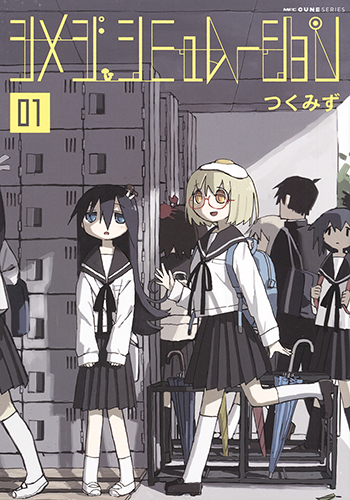
Shimeji Simulation

Shimeji Simulation (シメジ シミュレーション) is a gentle but deeply surreal slice-of-life manga about two teenage girls living through the end of the world – or perhaps not “the” world, necessarily; but rather, an artificial world that they happen to inhabit. The focus of the manga isn’t on the apocalypse, which passes mostly unremarked and unexplained. Instead, the core of the story is the friendship (and understated romance) between the two girls, Shijima and Majime. 

Shijima Tsukishima has spent the past two years of middle school quietly living inside a closet, and the manga opens when she decides to begin attending high school at the beginning of the school year. Why Shijima became a hikikomori is something of a mystery, but her primary personality trait is that she dislikes being bothered. She plans to spend her time in high school silently reading books at her desk.

This plan is interrupted by a classmate named Majime, who aggressively demands that Shijima become her friend. Since a pair of shimeji mushrooms sprouted from the side of Shijima’s head during her period of isolation, Majime immediately gives her the nickname “Shimeji,” an appellation that quickly becomes as pervasive and persistent as Majime herself.

Majime bluntly inserts herself into Shijima’s life and persuades her to join the school’s Hole Digging Club, which is managed by an art teacher named Mogawa. Majime assumes that the club is little more than an excuse to hang out after school, but Mogawa is oddly committed to the endeavor, especially when encouraged by the quiet presence of a second-year student named Sumida who only communicates through abstract drawings. Meanwhile, Shijima’s older sister has dropped out of college to devote herself to the ongoing construction of a bizarre machine with an inexplicable function.

For the most part, the girls engage in mundane slice-of-life adventures. They chat in the classroom, visit one another’s houses, and attempt a study session at a family restaurant. Mogawa teaches her art lessons. Majime catches a cold. A group of girls in their homeroom start a rock band. Shijima meets a super-senior named Yomigawa who’s decided to stay in high school just to hang out in the library and read philosophy books.

What makes this manga interesting are the strange glitches in the world surrounding the characters. The mushrooms sprouting from Shijima’s head are a good example, but there’s also the fact that Shijima and her sister occupy one of the only two tenanted apartments in a giant danchi housing building that’s falling apart yet still somehow livable. 

As the story progresses, more glitches begin to manifest. Everyone wakes up to a snowstorm in the middle of summer, for example. One day, the school building is flipped vertically and becomes a pocket dimension with a separate axis of gravity. Another day, water loses its mass and floats in the air. Suburban streets twist into optical illusions, and fish swim through the sky.

Although small glitches seem to be innate to the world, they’re exacerbated by Shijima’s sister, who’s been building and experimenting with various devices that alter the fabric of reality. Each of the first three volumes of the manga concludes with a longer narrative segment that shows the consequences of these experiments for Shijima and Majime, who are briefly thrown into the gaps between the cracks of reality.

The cumulative damage caused by Shijima’s sister is countered by a godlike entity who presents as a young girl and calls herself “the Gardener.” The Gardener’s role is to ensure that the reality experienced by the characters doesn’t mutate too wildly from one day to the next, but her power is curbed by the features of the universe’s code intended to keep its residents safe. She might be able to repair gaps in reality, but she has no means of forcing her will onto humans, even if it’s for their own good.  
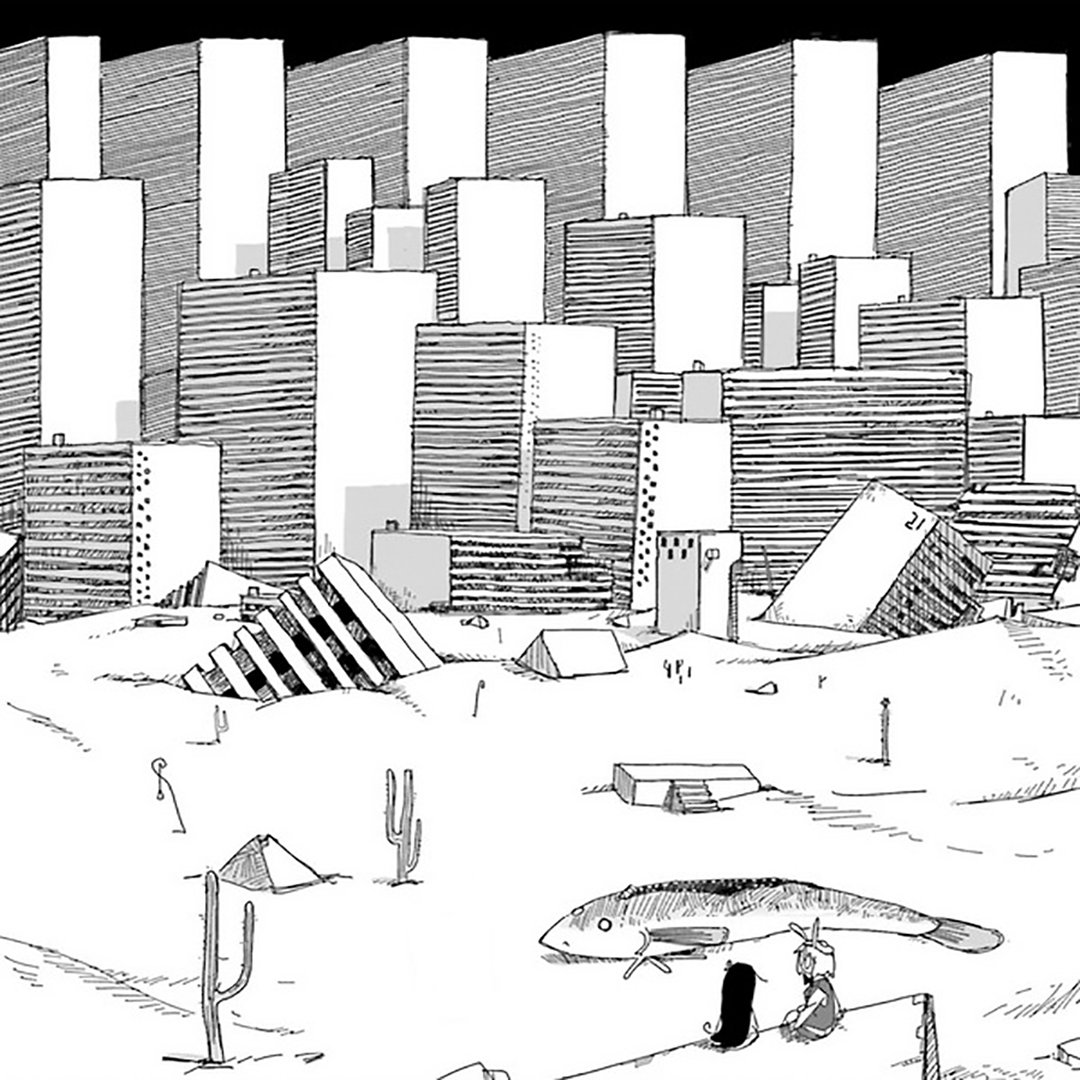
Like Tsukumizu’s previously serialized manga, Girls’ Last Tour, it’s difficult to say that Shimeji Simulation is “about” anything. There’s no plot to speak of, and the only real conflict is between the characters and the entropy eating away at the edges of their slowly decaying world. In addition, it’s never explained how this constructed universe and the characters who inhabit it came to exist. Instead, I think it’s probably fair to say that the manga’s primary concern is existential ontology. In other words, what does it mean to be human, and why do we exist?

I recently read an interesting essay (here) whose author argues that Shimeji Simulation is about the barriers between people, why we need them, and what happens when they disappear. If everyone were able to get exactly what they want, what happens when the desires of separate individuals come into conflict? If there were a world perfectly tailored for one person alone, could anyone else live there? And, if you retreat into complete solipsism, what’s the point of being alive?

Toward the end of the manga, Shijima finds herself in a situation very much like her self-imposed hikikomori isolation in the beginning, when she lived entirely in the darkness of her closet. In the simulated world she comes to occupy through her sister’s rewriting of the universe’s code, Shijima doesn’t bother anyone, and she never has to deal with any external input that she doesn’t choose for herself. Still, can we really say that such pristine loneliness is preferable to the messiness of human relationships?

I read Shimeji Simulation as a story about the various ways that people communicate and connect with one another. Shijima never becomes a “normal” or friendly person, but she still manages to find joy and meaning in her interactions with other people, even if most of these interactions are nothing special. This is why, in the fifth and final volume of the manga, Shijima breaks the boundaries of her personal universe to find Majime, wherever her friend might exist in the fractured constellation of simulations.
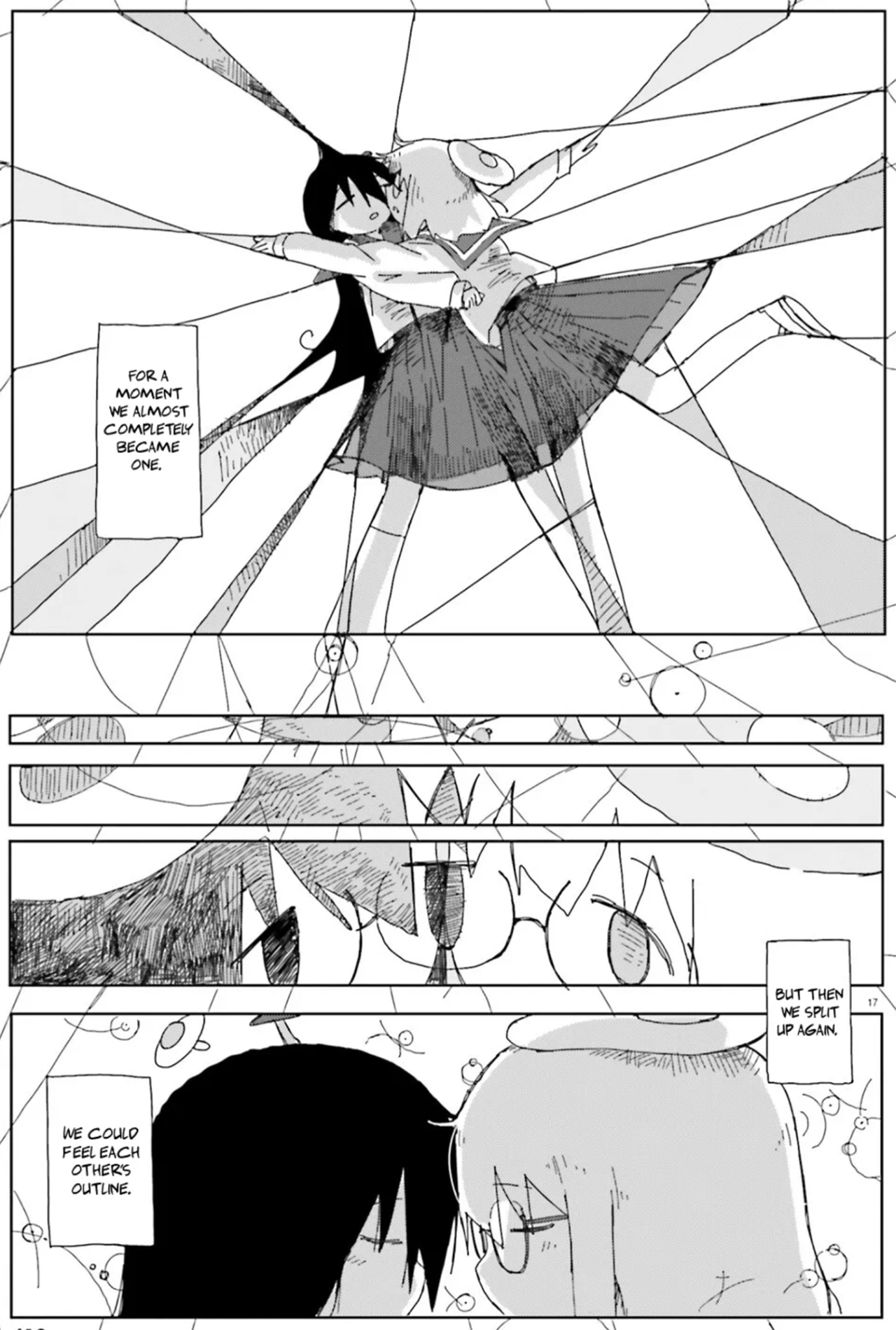
“The meaning of life is to understand love” may seem cliché; but, given how strange and surreal her story becomes, Shijima’s realization feels significant and well-earned. Life is a constant shifting and melding of interpersonal boundaries, and communication and companionship are worth the pain and trouble of being human.

Shimeji Simulation is a remarkable work of science fiction. The manga may seem to have an unassuming beginning, but its narrative structure gradually builds, loops back in on itself, and continually starts over from a weirder and more nuanced position. Likewise, Tsukumizu’s art may initially feel sketchy, but this style is perfectly suited to express the uncanny glitches and fluid malleability of the setting. Shimeji Simulation is gentle and quiet, but also immensely intelligent and creative, and it’s a manga to contemplate and enjoy slowly while allowing yourself to be transformed alongside the characters and their strange but fascinating world.

Shimeji Simulation hasn’t received an officially licensed English translation, but a fan translation is currently available to read on Dynasty Scans (here). If you’re interested in a small taste of the manga’s tone, I’d also like to recommend the short fan anime adaptation of the opening chapter on YouTube (here).

Record of a Night Too Brief

Title: Record of a Night Too Brief
Japanese Title: 蛇を踏む (Hebi o fumu)
Author: Kawakami Hiromi (川上 弘美)
Translator: Lucy North
Publication Year: 2017 (United Kingdom); 1996 (Japan)
Press: Pushkin Press
Pages: 158

Record of a Night Too Brief collects three short stories that the book’s cover copy describes as “haunting” and “lyrical” in their depiction of young women experiencing “loss, loneliness and extraordinary romance.” This is a lovely sentiment, but it in no way describes the actual stories in question, which are less “haunting” than they are grotesque and less “lyrical” than they are unapologetically strange. Instead of trying to treat them as romance, I believe it’s much more fulfilling to approach their absurdity in the spirit of intellectual play.

The title story, “Record of a Night Too Brief,” is a sequence of nineteen of the unnamed narrator’s dreams. Each of these dreams is two or three pages long, and they are linked only in that every other scenario features a young woman whom the narrator is either pursuing or in the process of merging with. If there is a unifying theme or plot, it is lost on me, but the power of these dreams comes from their vivid imagery. To give an example (from page 11):

Several dozen ticket collectors stood in a row, and once we passed through, showing our tickets, the tall object came into view.

It was a singer, who stood as tall as a three-storey building. From where I was, I had a clear view of the beauty spot under her jaw, and the rise and fall of her breasts.

“The beauty spot is artificial,” the girl informed me, gazing up at the singer, enraptured.

The singer was producing notes at different pitches, as if she were warming up. When she sang high notes, flocks of birds took flight from the branches of the ginko trees. When she sang low notes, the earth heaved, and small furry creatures emerged from underground and crawled about.

…and so on. It’s all very random, but one can’t help but become swept up in the ebb and flow of the constantly shifting parade of surreal images.

The next story, “Missing,” is set in an apartment complex that functions according to its own arbitrary and bizarre set of customs and rituals. One of the rules of this community is that each household can only have five members. If a sixth member is added for any reason, then someone has to disappear. This recently happened to the narrator’s family after her older brother was engaged to be married. Because his fiancée would have become the sixth person, he disappeared, and the narrator’s other older brother stepped in to fill his position. His fiancée, Hiroko, has no idea that this has happened, as the rules are different in her own apartment complex, where certain members of certain families literally shrink. Meanwhile, the narrator continues to hear the voice of the older brother as he (or his spirit) skulks around the apartment. No explanation is given for any of this, as everyone takes these occurrences for granted.

The final story, which provides the title of the original Japanese publication, is “A Snake Stepped On.” This story is about a young woman who one day finds herself living with a snake. This snake takes the form of an older woman who insists that she is the narrator’s mother. As she accustoms herself to life with a snake, the narrator begins to realize that many of the people around her are also living with snakes, including the local Buddhist priest whom she thought of turning to for an exorcism. Following the conventions of magical realism, the tone of this story is mundane, with the possibility of being devoured by a snake – or becoming a snake oneself – treated as merely another everyday occurrence.

Record of a Night Too Brief is a short collection of curiosities that are fascinating in their novelty. The fantastical qualities of each story allow for various interpretations, and they will no doubt intrigue different readers for different reasons. As contemporary fairy tales, the stories in this collection spark and inspire the imagination.

The Briefcase

Title: The Briefcase
Japanese Title: センセイの鞄 (Sensei no kaban)
Author: Kawami Hiromi (川上 弘美)
Translator: Allison Markin Powell
Year Published: 2012 (America); 2001 (Japan)
Publisher: Counterpoint
Pages: 176

Kawakami Hiromi’s novel Manazuru, translated by Michael Emmerich and published in 2010 by Counterpoint, is a strange, dreamlike story told from the perspective of an otherworldly and unreliable narrator. Manazuru is about pain and bitterness, and broken hearts and broken families.

Kawakami’s newest novel in translation, The Briefcase, is a far cry from the atmospheric surrealism of Manazuru. Its narrator, Ōmachi Tsukiko, is a single woman in her late thirties who is firmly grounded in reality. The Briefcase is about her daily life and centers around her encounters with her former Classics teacher, Matsumoto Harutsuna, whom she still refers to as “Sensei.” Two decades after graduating from high school, Tsukiko meets Sensei by chance at a neighborhood bar, and the two strike up an easy friendship. Each of the ten-page chapters in The Briefcase details an episode in this friendship, such as a trip to an outdoor market or a mushroom hunting excursion with the owner of the bar Tsukiko and Sensei frequent. Seasons change, but not much else does. Nothing particularly dramatic or unexpected happens throughout the large majority of The Briefcase, and the novel’s close attention to detail provides much of its charm.

Although it doesn’t become apparent until a little more than halfway through the novel, Tsukiko gradually develops romantic feelings for Sensei. I would love to say something along the lines of “despite the significant age difference, the relationship between Tsukiko and Sensei blossoms beautifully;” but, in reality, it’s quite awkward. Not only is the situation itself awkward, but both Tsukiko and Sensei are awkward people. They’re not charmingly awkward, or amusingly awkward, or so awkward that want to hug them – they’re just awkward. Still, the gentle progression of their relationship is entertaining in its earnestness, and Kawakami describes it from Tsukiko’s perspective with commensurate delicacy:

At some point, sitting beside Sensei, I began to notice the heat that radiated from his body. Through his starched shirt, there came a sense of Sensei. A feeling of nostalgia. This sense of Sensei retained the shape of him. It was dignified, yet tender, like Sensei. Even now, I could never quite get a holf on this sense – I would try to capture it, but the sense escaped me. Just when I thought it was gone, though, it would cozy back up to me.

The quiet normalcy of The Briefcase is satisfying in and of itself, yet there are some disturbing undercurrents running through the novel. Why is Tsukiko alone? Why is Sensei alone? What happened to him? Why does he always carry around his briefcase? These uncertainties serve to make the story more intriguing, however, and don’t escalate into a full-blown crisis until the very end of the novel, when Tsukiko undergoes a startlingly surreal experience. During two of the final chapters of the novel, Tsukiko’s feelings for Sensei, as well as her fear of his rejection, are explored in a strange sequence titled “The Tidal Flat – Dream,” which may or may not have actually happen. This chapter is a unexpected break from the regular mundane atmosphere of The Briefcase, but it pulls the novel together thematically in a creative and unexpected way.

Allison Markin Powell, who also translated Dazai Osamu’s Schoolgirl, deftly conveys the lightness and humor occasional strangeness of Kawakami’s prose. Although Powell’s English is flawless (with the possible exception of a few out-of-place Britishisms), her style of translation leaves the reader with no doubt as to the Japanese setting of the novel. Passages like…

“Yes, today is a tomobiki day. But tomorrow is a red-letter day, a konoe-tora!”

…and…

Daikon, tsumire, and beef tendons, please, Sensei ordered. Not to be outdone, I followed with Chikuwabu, konnyaku noodles, and I’ll also have some daikon. The young man next to us asked for kombu and hanpen.

…are not uncommon. It’s an interesting style of translation that emphasizes the novel’s focus on peaceful daily life in a richly detailed environment, and it’s fun to read. The culturally specific words scattered throughout the text can be largely ignored if you’re not feeling up for a hyperlinked adventure on Google, though, so they shouldn’t be distracting for the reader.

The Briefcase is a gentle and quiet novel that’s enjoyable both for its story and for its atmosphere, and it’s much more accessible than Manazuru (which is not to say that Manazuru is bad, just very weird). It’s literature that doesn’t take itself too seriously, and I very much enjoyed reading it.