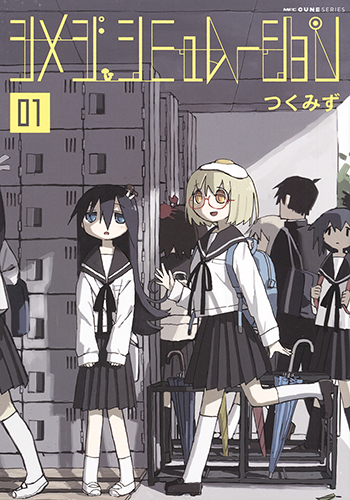
Shimeji Simulation

Shimeji Simulation (シメジ シミュレーション) is a gentle but deeply surreal slice-of-life manga about two teenage girls living through the end of the world – or perhaps not “the” world, necessarily; but rather, an artificial world that they happen to inhabit. The focus of the manga isn’t on the apocalypse, which passes mostly unremarked and unexplained. Instead, the core of the story is the friendship (and understated romance) between the two girls, Shijima and Majime. 

Shijima Tsukishima has spent the past two years of middle school quietly living inside a closet, and the manga opens when she decides to begin attending high school at the beginning of the school year. Why Shijima became a hikikomori is something of a mystery, but her primary personality trait is that she dislikes being bothered. She plans to spend her time in high school silently reading books at her desk.

This plan is interrupted by a classmate named Majime, who aggressively demands that Shijima become her friend. Since a pair of shimeji mushrooms sprouted from the side of Shijima’s head during her period of isolation, Majime immediately gives her the nickname “Shimeji,” an appellation that quickly becomes as pervasive and persistent as Majime herself.

Majime bluntly inserts herself into Shijima’s life and persuades her to join the school’s Hole Digging Club, which is managed by an art teacher named Mogawa. Majime assumes that the club is little more than an excuse to hang out after school, but Mogawa is oddly committed to the endeavor, especially when encouraged by the quiet presence of a second-year student named Sumida who only communicates through abstract drawings. Meanwhile, Shijima’s older sister has dropped out of college to devote herself to the ongoing construction of a bizarre machine with an inexplicable function.

For the most part, the girls engage in mundane slice-of-life adventures. They chat in the classroom, visit one another’s houses, and attempt a study session at a family restaurant. Mogawa teaches her art lessons. Majime catches a cold. A group of girls in their homeroom start a rock band. Shijima meets a super-senior named Yomigawa who’s decided to stay in high school just to hang out in the library and read philosophy books.

What makes this manga interesting are the strange glitches in the world surrounding the characters. The mushrooms sprouting from Shijima’s head are a good example, but there’s also the fact that Shijima and her sister occupy one of the only two tenanted apartments in a giant danchi housing building that’s falling apart yet still somehow livable. 

As the story progresses, more glitches begin to manifest. Everyone wakes up to a snowstorm in the middle of summer, for example. One day, the school building is flipped vertically and becomes a pocket dimension with a separate axis of gravity. Another day, water loses its mass and floats in the air. Suburban streets twist into optical illusions, and fish swim through the sky.

Although small glitches seem to be innate to the world, they’re exacerbated by Shijima’s sister, who’s been building and experimenting with various devices that alter the fabric of reality. Each of the first three volumes of the manga concludes with a longer narrative segment that shows the consequences of these experiments for Shijima and Majime, who are briefly thrown into the gaps between the cracks of reality.

The cumulative damage caused by Shijima’s sister is countered by a godlike entity who presents as a young girl and calls herself “the Gardener.” The Gardener’s role is to ensure that the reality experienced by the characters doesn’t mutate too wildly from one day to the next, but her power is curbed by the features of the universe’s code intended to keep its residents safe. She might be able to repair gaps in reality, but she has no means of forcing her will onto humans, even if it’s for their own good.  
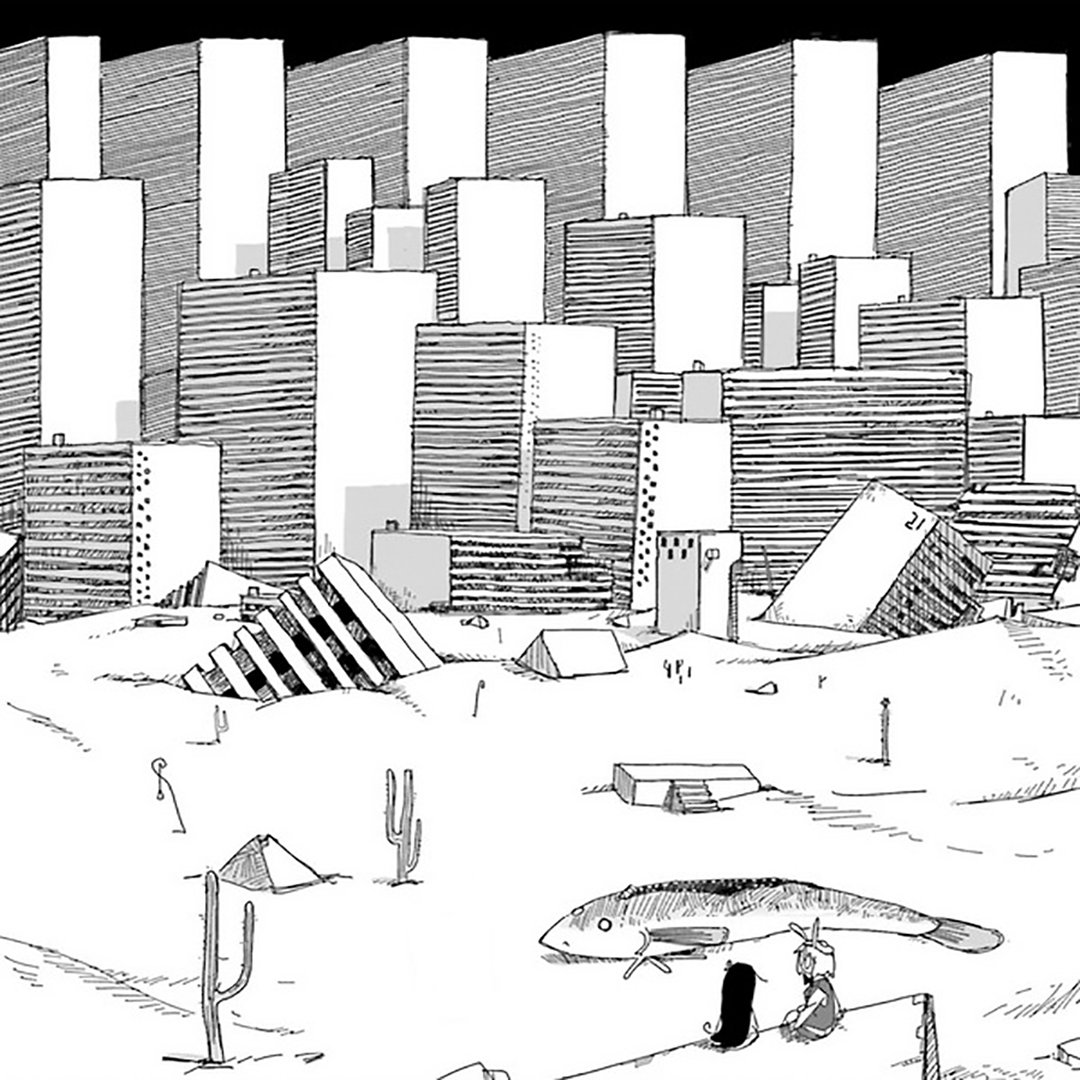
Like Tsukumizu’s previously serialized manga, Girls’ Last Tour, it’s difficult to say that Shimeji Simulation is “about” anything. There’s no plot to speak of, and the only real conflict is between the characters and the entropy eating away at the edges of their slowly decaying world. In addition, it’s never explained how this constructed universe and the characters who inhabit it came to exist. Instead, I think it’s probably fair to say that the manga’s primary concern is existential ontology. In other words, what does it mean to be human, and why do we exist?

I recently read an interesting essay (here) whose author argues that Shimeji Simulation is about the barriers between people, why we need them, and what happens when they disappear. If everyone were able to get exactly what they want, what happens when the desires of separate individuals come into conflict? If there were a world perfectly tailored for one person alone, could anyone else live there? And, if you retreat into complete solipsism, what’s the point of being alive?

Toward the end of the manga, Shijima finds herself in a situation very much like her self-imposed hikikomori isolation in the beginning, when she lived entirely in the darkness of her closet. In the simulated world she comes to occupy through her sister’s rewriting of the universe’s code, Shijima doesn’t bother anyone, and she never has to deal with any external input that she doesn’t choose for herself. Still, can we really say that such pristine loneliness is preferable to the messiness of human relationships?

I read Shimeji Simulation as a story about the various ways that people communicate and connect with one another. Shijima never becomes a “normal” or friendly person, but she still manages to find joy and meaning in her interactions with other people, even if most of these interactions are nothing special. This is why, in the fifth and final volume of the manga, Shijima breaks the boundaries of her personal universe to find Majime, wherever her friend might exist in the fractured constellation of simulations.
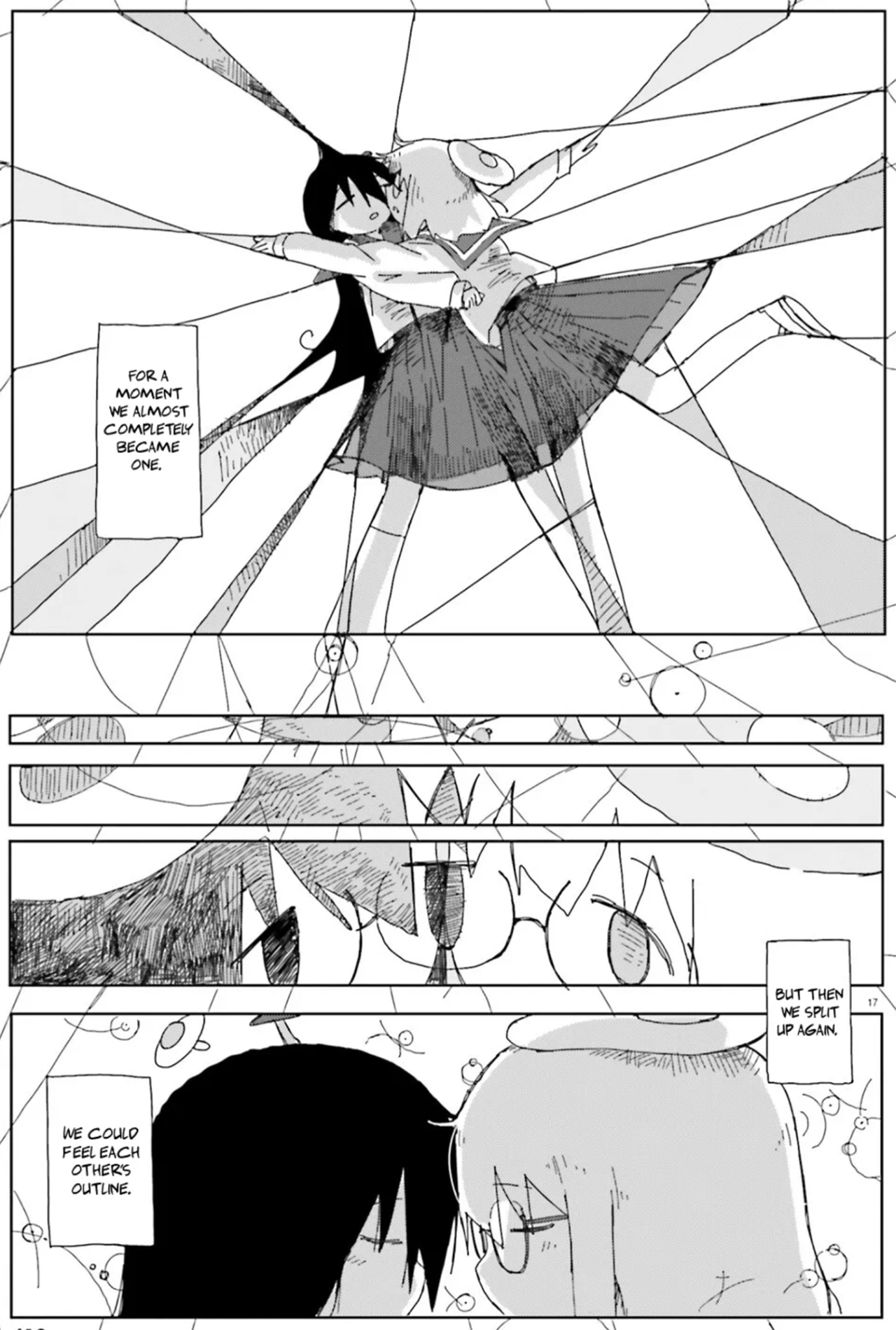
“The meaning of life is to understand love” may seem cliché; but, given how strange and surreal her story becomes, Shijima’s realization feels significant and well-earned. Life is a constant shifting and melding of interpersonal boundaries, and communication and companionship are worth the pain and trouble of being human.

Shimeji Simulation is a remarkable work of science fiction. The manga may seem to have an unassuming beginning, but its narrative structure gradually builds, loops back in on itself, and continually starts over from a weirder and more nuanced position. Likewise, Tsukumizu’s art may initially feel sketchy, but this style is perfectly suited to express the uncanny glitches and fluid malleability of the setting. Shimeji Simulation is gentle and quiet, but also immensely intelligent and creative, and it’s a manga to contemplate and enjoy slowly while allowing yourself to be transformed alongside the characters and their strange but fascinating world.

Shimeji Simulation hasn’t received an officially licensed English translation, but a fan translation is currently available to read on Dynasty Scans (here). If you’re interested in a small taste of the manga’s tone, I’d also like to recommend the short fan anime adaptation of the opening chapter on YouTube (here).
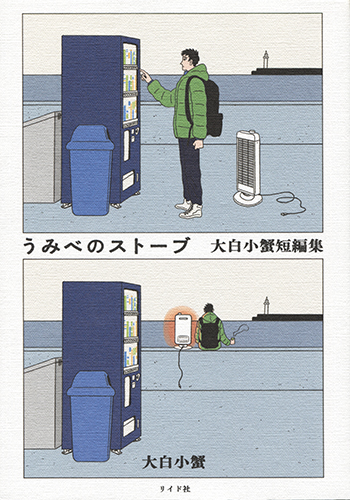
うみべのストーブ

Umibe no Stove (うみべのストーブ), originally published in 2022, is a collection of seven short manga stories by Kogani Ōshiro. In a surprising but well-deserved turn of fate, the collection was listed as the #1 women’s title in the 2024 edition of the Kono Manga ga Sugoi! (“This Manga Is Awesome”) series of mass-market reference books. Ōshiro’s magical realist stories are difficult to categorize, but what they share is a gentle and bittersweet appreciation for the small challenges and victories of growing older and moving on. 

The title story is about a man named Sumio whose girlfriend breaks up with him on her birthday. Left alone in the apartment they once shared, Sumio huddles next to the space heater and cries. The space heater takes pity on him and reveals that it can talk. It suggests that they go to the beach together, a trip Sumio never made with his girlfriend. Sumio agrees and spends the night sitting on a concrete embankment overlooking the ocean as he talks with the space heater and finally accepts the fact that his girlfriend isn’t coming back. Even though it’s unplugged, the space heater keeps him warm by sharing its memories of happier times.

The second story, 雪子の夏 (Yukiko no natsu), is about a trucker who encounters a Yuki Onna while stuck in traffic on a snowy night. The childlike yōkai doesn’t particularly want to kill the trucker; and, after they talk for a bit, she reveals that it’s her dream to see summer fireworks. The trucker invites the Yuki Onna to share her apartment until summer, at which point she can use her refrigerated cargo space to take her guest to see a summer festival. While watching the fireworks explode in the night sky, the Yuki Onna is so overjoyed that snow begins to fall.

My favorite of the stories, 海の底から (Umi no soko kara), is about a young woman named Fukatani who always dreamed of being a professional novelist. Her two friends from college both managed to become published authors after they graduated, but Fukatani lost her motivation to write after starting an office job. During a late-night drinking session, Fukatani’s friends ask her if she’d really be happy never writing another story, but she doesn’t know what to say. She used to love writing, but she just hasn’t felt any inspiration recently.

Later, Fukatani’s boyfriend comforts her, saying that there’s no rush for her to begin writing again. After college, he explains, she found herself standing at the base of a pyramid on the bottom of the sea. She’s been working to climb each step – finding a job, paying off student loans, and so on – but when she gets to the top and rises above the surface of her ocean of worries, she’ll be able to feel the wind of creativity again. This sounds like a silly analogy, but the way Ōshiro illustrates the process of coming up for air is remarkably cool and refreshing.

Something I love about Umibe no Stove is the non-commercial quality of Ōshiro’s visual style. Admittedly, the art of some of the stories feels a bit amateurish, but I find this charming. Even when Ōshiro’s drawings are unpolished, her sense of sequential art is unflaggingly excellent. Her use of panels in Umi no soko kara, for instance, creates a lovely sense of space during the protagonist’s conversation with her boyfriend. Even if Ōshiro’s drawings aren’t always technically precise, her manga still has incredible emotional impact.

I want to recommend this book to manga fans interested in a more indie style of Japanese comics, perhaps along the lines of the graphic novels published by Western presses like Fantagraphics and Drawn & Quarterly. Umibe no Stove may seem unassuming on the surface, but this manga is something special.

As an aside: if you’re looking for something similar that’s been translated into English, I’d like to recommend Natsujikei Miyazaki’s short story collection And the Strange and Funky Happenings of One Day. It’s weird, it’s fun, and the indie manga publisher Glacier Bay Books has done an amazing job with the translation and editing.

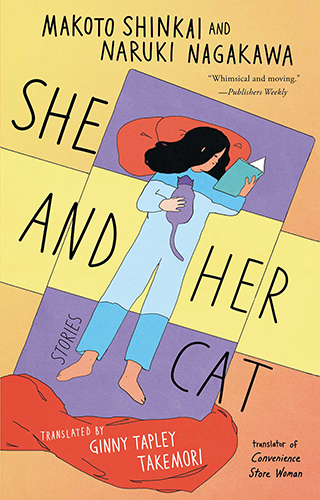
She and Her Cat

She and Her Cat collects four interlinked short stories about women and their cats. Though these stories are bittersweet, their gentleness is a source of comfort and encouragement.

The stories in She and Her Cat were written by Naruki Nakagawa, who’s mainly known as a screenwriter for science fiction anime from the mid 2000s, and the concept is based on the 1999 short indie film (which you can watch on YouTube here) created by the international superstar anime director Makoto Shinkai. I think it’s fair to say that the original short film is a representative example of the iyashikei “comfort” genre of anime, which Patrick Lum describes as “designed to be as comfy and mellow as can be.” This book, which Nakagawa wrote in his late forties, similarly uses young female characters to create a sense of living in a world where a brighter future is always possible.

The first story is a direct adaptation of Shinkai’s original short animation. A young office worker named Miyu brings home a kitten who’s been left outside in the rain in a disintegrating cardboard box. Miyu is growing apart from both her boyfriend and her best friend, and she feels as though she’s no longer able to understand the nuances of other people’s feelings. Thankfully, her new cat Shiro loves her unconditionally, and he’ll always be there for her.

The second story is about an art student who can’t find the motivation to apply to a university-level Fine Arts program, and the third is about an aspiring manga artist who was unable to make her debut and became a hikikomori after the death of her writer, who also happened to be her childhood friend. Both women find the courage to pull themselves out of their depression and take the first few steps forward – with the help of their cats, of course.

In the last story, a childless middle-aged woman finds herself alone after caring for her husband’s parents only to be left by her husband himself. As she gets older, so too does the boss of the neighborhood stray cats, and she ends up adopting him. Around the same time, her nephew has a quiet breakdown at his first job out of college, and the woman ends up sheltering him too. In return, he eagerly learns the non-corporate life skills she shares, and he naturally begins to help her manage the household. While it’s always rewarding to nurture a mutually loving and beneficial relationship with a cat, this story reminds the reader that kindness can exist between humans as well.

The narrative viewpoint of these stories alternates between the cats and their human companions. When the cats aren’t expressing their undying love for the human ladies in their lives, they’re off on their own adventures in the neighborhood, doing as cats do. Even more than the human characters, the cats have strong personalities and know what they’re about.

Comforting Japanese books about cats are currently enjoying a small cultural moment, and She and Her Cat is among the best of them. As you might expect from a book written by a professional screenwriter, each “scene” is fairly short, which makes for a quick and engaging read. Nagakawa maintains the distinctive narrative voice associated with Makoto Shinkai’s films, and Ginny Tapley Takemori conveys this straightforward gentleness perfectly in translation. In the English edition, each story is prefaced by a gorgeous full-page illustration by Rohan Eason, which only adds to the book’s charm. Exactly like the creatures it celebrates, She and Her Cat is light, nimble, and filled with character. 

Under the Eye of the Big Bird

Hiromi Kawakami’s Under the Eye of the Big Bird is a book about the quiet end of the world. Despite its postapocalyptic setting, the story is gentle. The author’s background as a biology teacher shines through her writing as she imagines the diverse forms that humans and their societies might take in the far distant future.

Under the Eye of the Big Bird is structured as a collection of fourteen stand-alone stories that gradually form a larger narrative, and the reader is encouraged to put together a history from bits and pieces of individual lives. We never see the full picture, however, and I imagine that assembling a concrete timeline would take careful detective work.

This isn’t a plot-driven story that can have “spoilers,” necessarily, but any description of the book’s premise is going to contain analysis and speculation. Under the Eye of the Big Bird is one of the most intriguing works of speculative fiction that I’ve read in years, and this is partially due to its fragmented structure. You may want to venture into the collection on your own before reading any reviews, this one included.

.

Still with me? Let’s go!

Over the millennia, the number of people on the planet has steadily decreased, and the last remaining humans live in isolated settlements of various sizes. In order to ensure harmony, the settlements are discretely managed by “watchers” who have been cloned and genetically engineered to fulfil their duty. Unlike regular humans, watchers grow up in small communities with “mothers” that are all physical manifestations of the same AI.

Everyone takes this arrangement for granted, but their “normal” is not the same as ours. Whether a story is told from a first-person or third-person point of view, the reader can only see the world from a limited perspective. It can be difficult to understand what’s going on at first, but the opportunity to surf successive waves of strangeness is a major part of this book’s charm.     

My favorite story is “Testimony,” which is delivered as a statement to a watcher by one of the new phenotypes of humans to emerge from centuries of genetic isolation. A small number of people are born with the ability to photosynthesize, and the joy they take from the sunlight and changing seasons affects their behavior in surprising ways. If enlightenment exists, these people have attained it; and honestly, it sounds really nice.             

Not all of the future human phenotypes are so peaceful or self-assured, however, and other stories have a bit more conflict. Still, with one notable exception, there’s no violence in this book. If there are wars and explosions, they happen entirely offscreen. Like the watchers and mothers, it’s the reader’s job simply to observe the biology, ecology, and culture of the future.

On the front cover of the American edition, Kawakami is billed as the author of People from My Neighborhood, a loosely connected series of magical realist flash fiction that’s an excellent comparison for Under the Eye of the Big Bird. To me, Under the Eye of the Big Bird also feels like a natural development of Kawakami’s debut short story, Kamisama, in which the narrator has a lovely afternoon picnic with a literal bear. The bear, being a bear, is clearly nonhuman, but no one seems to be bothered by this. The same casual acceptance of difference pervades Under the Eye of the Big Bird, which invites the reader to imagine the mundane everyday reality of the final days of the human race.

I’ll admit that I felt the chilling touch of existential dread at a few points during the book; but, as in any encounter with real difference, this initial sense of discomfort is important. The gentle strangeness of Under the Eye of the Big Bird encourages the reader to confront their biases, and it also lends weight to the narrative theme of human extinction. Instead of presenting the apocalypse as a standard dystopian superhero story, Kawakami allows the reader to take all the time and space they need to consider whether it would really be so horrible if the people we currently think of as “human” were to slowly disappear from the earth.

Under the Eye of the Big Bird is a book about the end of the world, but it’s also one of the kindest and most hopeful works of speculative fiction I’ve had the pleasure to read. Reading this book for the first time was a unique experience, but the impact of its stories linger even after their novelty fades.

Okareta basho de abaretai

Emuko Asai began posting essays online in 2021. She never considered herself to be a writer, she says, but the enthusiastic support she received from thousands of readers inspired her to keep sharing her stories. Asai’s 2024 collection 置かれた場所であばれたい (Okareta basho de abaretai) is a clear demonstration of the appeal of her essays, which inject a healthy dose of good humor into the trials and tribulations of everyday life.

Okareta basho de abaretai follows a loose timeline from Asai’s girlhood to her current career as a professional in the field of early childhood education. Although I get the sense that the staunchly pseudonymous Asai grew up in an upper middle-class family, the path she followed to adulthood was anything but standard. To me, Asai reads as having mild learning impairments, and she frequently makes jokes about her terrible grades and how much she hated studying. Since she was never going to meet expectations, Asai always figured that she might as well enjoy herself and have a good time.

One of my favorite essays is Miko no arubaito (Part-time job as a shrine maiden) which is about the weekend Asai worked at a large Shinto shrine during the rush over the New Year holiday. Just like her normal part-time job at a bakery, her duties involved standing behind a counter and helping people pay for their purchases. Amusingly, Asai had a bit of trouble with code-switching between secular and religious settings, which resulted in several comedic exchanges with confused patrons.

( As an aside, Miko no arubaito would be an excellent reading assignment for a Japanese language class, especially since its humor is dependent on a knowledge of the taigū hyōgen set expressions used by service workers. )

Asai’s most popular essay on social media is Yasashii uragiri (A gentle betrayal), which is about a written test given by her high school Home Economics teacher. This story will probably be familiar to American Millennials, many of whom were exposed to a variation of this test at some point in secondary education. Over the course of the essay, we follow Asai’s progress through the exam, which presents a lengthy series of detailed instructions. The last item on the list is, of course, “Don’t write anything. This is a test of whether you read the directions before starting work.”

Although Asai presents this story as little more than an amusing anecdote, I get the feeling that this experience was probably crucial in her decision to become a teacher. Many of Asai’s experiences with education seem confrontational at best (and downright depressing at worst), so it would make sense that she had a positive response to a teaching strategy that fostered independent thought and prioritized practical application.

In later essays, Asai describes her own goals as a teacher while challenging herself to accommodate different learning styles. Perhaps the best example is Sensei-tte, dare no koto (Who are you calling Teacher?), in which Asai attempts to help a 4yo child overcome his refusal to sit down and draw with crayons. It turns out that what the boy really disliked was having his pictures compared to the drawings of his best friend, who displays a small measure of artistic talent. Asai readily admits that she herself can’t draw, but what she can do (using an age-appropriate version of the Two Cakes! meme) is to help this little kid realize that his work is just as valuable as his friend’s.

Lest you think Asai has grown soft, however, she follows this essay with one titled Unchi somurie (Poo Sommelier), which is about how she possesses the rare but useful ability to tell which of her young charges has shit themselves at school. 

Emuko Asai’s essays read a bit like David Sedaris, albeit without the cutting edge of Sedaris’s characteristic meanness. Her work isn’t wholesome, necessarily, nor is there an absence of irony. Rather, Asai expresses a type of radical good humor that occasionally borders on passive-aggressive sweetness but always mellows out into a chill attitude of c’est la vie – or YOLO, as the case may be. If nothing else, it’s always amusing to follow the unexpected progression of the author’s thoughts as she relates episodes of her life that probably would have been traumatic for someone without her incredible store of gentle good humor. 

You can follow Emuko Asai on Twitter (here), and you can read her essays online on Note (here). The most recent posts are only accessible to subscribers, but her older essays are free to read. My recommendation would be her story about her Home Economics test, Yasashii uragiri, which you can find under its original title (here).

Tokyo These Days

Taiyō Matsumoto’s newest series, Tokyo These Days, follows a senior manga editor named Shiozawa who suddenly quits his job at a publishing company. After an initial period of wanting nothing more to do with manga, Shiozawa visits various artists he’s worked with over the past thirty years, hoping to commission “the perfect manga.”

Like Matsumoto’s Eisner-winning graphic novel Cats of the Louvre, Tokyo These Days is a sensitive yet realistic story about artists and the industry professionals who support their work. Although Matsumoto is honest about the pain caused by frustrated ambitions in a market that doesn’t value the wellbeing of artists, small moments of kindness and hope prevent the tone of the story from becoming too bleak.

Given that Tokyo These Days is a book about books, it’s worth mentioning that Viz’s hardcover edition is a beautiful publication with a glossy canvas cover and high-quality paper that allows Matsumoto’s artwork to shine. If you’re familiar with the kinetic urban fantasy Tekkonkinkreet, you’ll know just how much love Matsumoto puts into the details of his environments, and it’s a pleasure to take your time studying each page to appreciate the ink textures and image framing.

I’m looking forward to seeing how the story of Tokyo These Days develops, but the first volume stands on its own as an episodic commentary on the difficult but still worthwhile business of being an artist and storyteller during the slow decline of the traditional publishing industry.

A Perfect Day to Be Alone

Nanae Aoyama’s novella A Perfect Day to Be Alone chronicles a year in the life of a young woman named Chizu who moves in with an elderly relative named Ginko after her mother accepts a teaching position in China.

Aoyama deftly captures the reality of a relationship between a flighty 20-year-old girl and a mature 71-year-old woman. There are no heart-to-heart talks or life lessons, just a lot of sitting around and chatting about nothing in particular.

Chizu breaks up with one boyfriend and starts a casual relationship with another, but this relationship goes nowhere. The same could be said of Chizu’s job at a kiosk at a suburban train station. Aside from a vague desire to save money, Chizu has no goals or ambitions.

Rather, the story is completely interstitial, a chapter between chapters of Chizu’s life. A Perfect Day to Be Alone brought me back into my own 20-year-old headspace with an immediacy that would be difficult to achieve through a story with more of a plot.

Nothing happens in A Perfect Day to Be Alone, but I enjoyed getting to know Chizu and Ginko, whose characters are sketched out and then defined with subtle touches. I appreciate the opportunity to spend time in their company, which is supremely chill and relaxing.

Mild Vertigo

Mieko Kanai’s Mild Vertigo is a slice-of-life novella whose short length belies its Proustian ambitions. The narrator, a housewife living in an apartment in the Tokyo suburbs with her husband and two young sons, engages in extended meditations on her home, family, friends, neighborhood, and place in the world.

I don’t use the word “Proustian” lightly, as Kanai’s prose requires patience and concentration to read and appreciate. The endless sentences gallop and sprawl across pages, sweeping the reader along in a flow of thought and sensation that transcends time and place as the narrator’s focus wanders. This is no breezy stream-of-consciousness nonsense, however, as each sentence is exquisitely crafted and brilliantly translated by Polly Barton.

As with Proust, there’s a certain comfort and emotional satisfaction in the act of paying such close attention to the mundane details of daily life, but Kanai’s narrator has a strong sense of irony. Gendered double standards aren’t a primary concern of this novel by any means, but an underlying frustration still shapes the narrator’s relationships and observations on what it means to be a housewife.

Mild Vertigo (originally published in 2002) doesn’t set out to upset or challenge the reader in the same way as much of Kanai’s earlier writing, but it nevertheless operates with an absolute lack of sentimentality that I find extremely refreshing, especially on the more literary end of the “slice of life” genre. Due to the dense nature of Kanai’s prose, it took me a surprisingly long time to read this short book, but I wouldn’t have it any other way.