The Iguana Garden

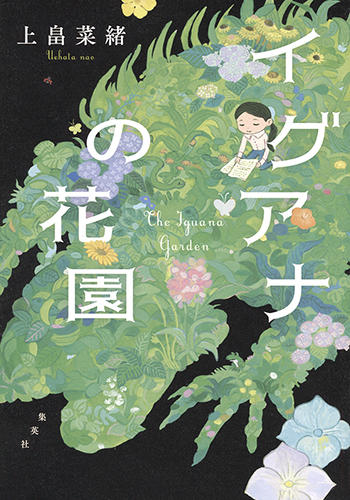
The Iguana Garden (イグアナの花園) is the second novel by Nao Uehata, whose 2020 magical realist story しゃもぬまの島 (Shamonuma Island) won the Subaru New Writer Award with high praise from Miyuki Miyabe. In The Iguana Garden, as in Uehata’s debut novel, a young woman who is able to speak with animals navigates a difficult relationship with her family. Instead of a mythical creature like the shamonuma, however, the protagonist of The Iguana Garden talks with her pet iguana as she hesitates on the border of adulthood.

Misono Yatsuguchi has a strange ability – she can hear the voices of small animals, especially reptiles. Though she feels at home in the garden of her family’s sprawling estate, she has trouble talking with other people. Misono’s father, a botanist who teaches at the local university, encourages her interest in the natural world and introduces her to his fellow professors, who befriend her and share their research.

When Misono’s father dies of a sudden heart attack, she’s left alone with her mother, an heiress who has inherited her family’s ikebana traditions along with their wealth. Misono’s mother is just as bad at connecting with people as Misono herself, so she unofficially adopts one of her ikebana students, a girl in high school named Tsubame, to act as her assistant. Tsubame moves into the estate and becomes something like an older sister to Misono.

Misono tries to make friends with the other girls in her elementary school class, but they find her lack of emotional expression creepy and begin bullying her in an attempt to provoke a response. When their pranks reach a point that Misono finally finds unacceptable, she resolves never to make friends again.

After these opening chapters, the story begins in earnest. Misono is a graduate student studying animal behavioral science at the university where her father once taught. She’s moved out of her mother’s estate and lives in a small atelier that her father once used to house his botanical samples and garden. Misono has remodeled the space as an open terrarium for her fully grown pet iguana, Sono, with whom she shares easygoing subverbal conversations.

The calm of Misono’s quiet life is shattered when her mother abruptly announces that she has terminal cancer. In the year she has left to live, she wants Misono to get married.

For someone like Misono, who reads as asexual and on the autism spectrum, dating is nothing less than a disaster waiting to happen. In distress, Misono allows herself to be taken to a post-seminar drinking session, where she gets blackout drunk and ends up inviting a friendly but financially strapped student named Kinoshita – who goes by Kiki – to live with her in the atelier. Kiki doesn’t mind the cramped space, or the free-roaming iguana, or even Misono’s personality quirks. In exchange for room and board, Kiki says, she’ll help Misono navigate the challenges of dating.

What follows is a semi-comedic gauntlet of mishaps that, more than anything, validate Misono’s asexuality and justify her prioritization of non-romantic relationships, especially with other women like Tsubame and Kiki. During this process, Misono ends up reconnecting with a childhood acquaintance who tells her that his secondhand experience with Misono’s bullying inspired him to become a teacher specializing in the education of neurodivergent children.  

Throughout the story, Sono the iguana offers commentary and wise advice. While I was reading, I wondered whether Sono was actually speaking, or whether Misono had created the persona of Sono as a trauma response to her father’s death.

At the end of the novel, Misono’s mother reveals that she can also hear the voices of animals, and that her demand for Misono to get married came from a private conversation with Sono, who wanted to create a catalyst for her human to learn how to connect with other people. Whether Misono’s mother is telling the truth is open to interpretation, but the result is the same – Misono manages to find her community, understand her parents, and figure out what she wants to do with her life without having to worry about romance or marriage.

It’s all very wholesome, honestly. I’m usually not a fan of sentimental stories, but the end of The Iguana Garden genuinely warmed my heart. “All the women become friends and no one gets married and no one has to worry about money and everyone lives happily ever after” is a good ending, all things considered.

I feel like there might be a bit too much trauma (and supremely awkward dates) in The Iguana Garden for this book to be considered “cozy fiction,” but I also feel like this novel is probably the closest to cozy cat fiction that you can get for all the girls who like dinosaurs instead of cats. The author never explicitly identifies Misono as asexual or on the autism spectrum, thereby avoiding the tricky issues of labels and identity politics, but all the classic markers are there for readers who understand them. Personally speaking, I was happy simply to watch a young woman like Misono find friendship and acceptance, but I imagine that readers who see aspects of themselves in Misono will appreciate the advocacy and allyship that the author offers with this story.

Putting all of that aside, The Iguana Garden combines the fantasy of being comfortably wealthy and living in a beautiful plant-filled atelier with the tension of wondering what will happen with Misono’s mother, who initially seems cold and unapproachable but gradually becomes more sympathetic as Tsubame helps Misono learn more about her late father. Sono the iguana, who comes off as a cranky but kind-hearted old lady, is a lot of fun, and Kiki radiates pure charisma as her good sense and good humor keep the story moving forward. Through it all, Nao Uehata delights in descriptions of the verdant nature and healthy plants that surround the characters.

The Iguana Garden is a beautiful book, and I’d love to see it translated (ideally along with Uehata’s debut novel Shamonuma Island). I feel like this story reflects something that a lot of pro-diversity advocates have been saying for a long time, namely, that “difference” doesn’t necessarily have to be subversive. Given all the bestselling cozy cat fiction in the world, it’s wonderful to see the nonconformist iguana girl find a similarly comfortable place for herself. She deserves a happy ending too!
Sakura

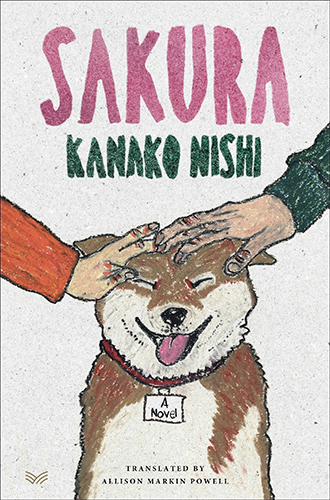
Kanako Nishi’s 2005 debut novel Sakura is a difficult book to write about.

The first part of the novel is a sweet slice-of-life story about three kids growing up in a middle-class household during the late twentieth century. The final 1/3 is a tragic drama that details how the family falls apart.

Unfortunately, I feel that the two parts of this book don’t really talk to each other or complement one another thematically. In addition, the tragedy has dark undertones of gothic horror that feel disturbingly accidental.

The author says she wrote this story to express what it might feel like to live in a large and boisterous family that has its share of ups and downs. The novel does indeed convey that sense of love and belonging, especially in relation to the eponymous family dog, Sakura.

I appreciate that Sakura contains sympathetic depictions of two queer and transgender characters, both of whom are close friends of the family, but…

…I really don’t like how the author equates LGBTQ+ pride with the final monologue of the narrator’s younger sister, who delivers something resembling a pride speech regarding her incestuous sexual desire for her oldest brother, whom she manipulated into suicide during a low point in his life so that he would never have the opportunity to love another woman.

In addition, Sakura features strong disability negativity, as well as unfair gendered double standards relating to grief. In particular, the narrator repeatedly body-shames his mother, calling her “fat” and “piggish” for drinking wine with dinner (in order to cope with the sister loudly masturbating on her dead brother’s bed) and finishing her meals instead of daintily leaving a portion uneaten. I understand that 2005 was a different time, but these parts of the text are still extremely uncomfortable to read.

Nothing inexcusably terrible happens to Sakura, who is a very good dog. That being said, some people may take issue with a certain treatment of pets that was considered standard in Japan (and elsewhere) several decades ago, and readers who are sensitive to depictions of dogs suffering while left outside during extreme temperatures and dangerous weather events may want to give this book a pass.

Sakura starts beautifully, but the ending left me with a very gross feeling. I’d love to see more work by Kanako Nishi in translation, but I kind of wish I’d never read this particular novel, which was once quite popular in Japan but hasn’t aged well.

ブラフマンの埋葬

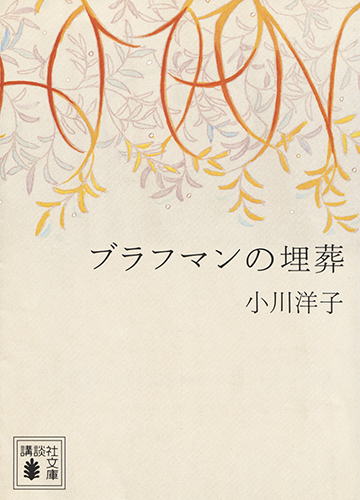
Yōko Ogawa’s 2004 novel Burafuman no maisō (Brahman’s Funeral) is a story about the lonely caretaker of an isolated artist’s retreat who adopts a forest creature of indeterminate species. Though this short novel features many of the tropes common in bestselling stories of animal companions, it was awarded the Izumi Kyōka Prize for literary fiction that explores the darker side of the human condition.

On the first day of summer, the unnamed caretaker finds a forest creature outside the back kitchen door. The creature is injured, and he doesn’t object when the caretaker picks him up and takes him inside. In fact, the creature almost seems to be asking for help, and his puppylike tameness inspires the caretaker to adopt him as an indoor pet.

The mansion where the narrator lives and works used to belong to the wealthy owner of a publishing company, but it has since been converted into an artist’s retreat. After a conversation with the stonemason who maintains a permanent studio on the grounds, the narrator decides to name the creature Brahman after the Sanskrit word the mason has carved onto a gravestone.

While Brahman recovers, the caretaker keeps the creature in his room. The caretaker’s personal space is stark and empty, but Brahman finds ways to keep himself occupied by opening drawers and gnawing on the coat hangers in the closet. At night, Brahman sleeps on the bed while curled up against the caretaker.

Once Brahman figures out how to operate the door handle, the caretaker begins taking him outside. The scenes in which he describes the meadows and forests surrounding the retreat through Brahman’s eyes are gorgeously written. Brahman delights in the sun and the wind and the grass, and he especially loves the garden pond, swimming and diving to his heart’s content as the caretaker watches.

Though the caretaker seems amiable enough, he seems to have no friends save for the stonemason. Aside from the artists visiting the retreat, the only person the caretaker speaks with is the young woman who works at the small general store outside the train station. Though the caretaker clearly has a crush on her, she’s dating an older man who lives in the city, and all she wants is to move away from the isolated village. The caretaker clearly doesn’t have a chance with her, and his yearning for connection is poignant yet gently pathetic. 

The purpose of contemporary popular pet fiction is to comfort the reader, often by anthropomorphizing the animals in service to the human protagonists. Burafuman no maisō is certainly beautiful and joyous in many places, but Ogawa has little interest in cozy vibes. To me, at least, this is an intensely gothic novel. 

Brahman dies at the end, but hints of death suffuse the entire story. Aside from the artists’ retreat managed by the caretaker, the most notable feature of the town is its sprawling cemetery, which has a strange but poetic history.

Because the mountainside town has a plentiful supply of both stone and stone carvers, people who lived upriver once commissioned its artisans to create coffins for their dead. Stone coffins were difficult to transport, however, and so the remains would be placed in wooden coffins that were sent downstream to be buried in the hillside cemetery. The isolated village thus became the final resting place for the dead who were all but abandoned by the rest of the world, a description that mirrors the position of the caretaker himself.

Ogawa has something of a fetish for sensitive but lonely men, and I have to admit that the caretaker breaks my heart a little. Along with having no name, he also seems to have no family, nor any past at all. What he has instead is an old family portrait photo that he buys from a Sunday antique market in the town square. The traveling merchant gives him an old wooden frame to go with it, so the caretaker hangs the photo in his room, where he sits on the bed and imagines the lives of the long-dead family. The only living joy in the caretaker’s life comes from his interactions with Brahman.

The genre of “cozy pet fiction” is almost always about people. As such, it often treats animals as human, even going so far as to give them human narrative voices so that the reader can better understand the human characters they observe. Burafuman no maisō does the opposite by using its nameless human narrator as a vehicle to document the short life of Brahman.

Though a human reader can never perceive the world in the way that an animal does, Ogawa asks us to sympathize with Brahman through the narrator’s documentation of his umwelt: what he sees and tastes and smells, and how he reacts to the world. To the caretaker, the behavior of other humans makes little sense, but he joyfully devotes himself to chronicling Brahman’s appearance and behavior through a series of annotated lists of observations with titles such as “Brahman’s Tail,” “Brahman’s Meals,” and “Brahman’s Footsteps.”

And finally, through no fault of his own, the caretaker is forced to close his account with a list titled “Brahman’s Funeral.” Through Brahman’s death and subsequent burial in a tiny stone coffin, Ogawa succeeds in making the reader care deeply about a semi-wild animal that was never anthropomorphized in any way. I appreciate the thematic artistry, but it’s nevertheless a difficult ending.

Hikaru Okuizumi (author of The Stones Cry Out) writes in his postscript to the Kodansha paperback edition that Ogawa more than likely started this short novel during a literary festival in the small French town of Fuveau, where she apparently bowed out on a large group dinner to stay alone in her room and write. This makes perfect sense to me, as Okuizumi’s anecdote accurately reflects the tone of the story. Despite Brahman’s death and the caretaker’s loneliness, Burafuman no maisō dwells in the quiet and contemplative corners of the gothic genre, and this short novel feels like a small but meditative retreat.

Udon: Unknown Dog of Nobody

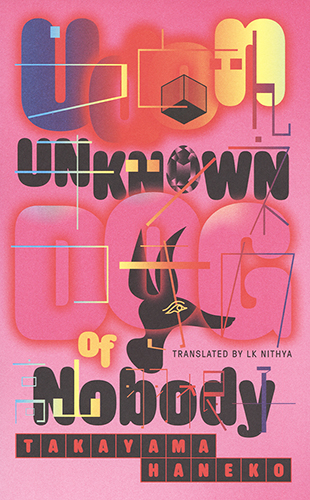
Haneko Takayama’s short story Udon: Unknown Dog of Nobody, published by Strangers Press as a stand-alone chapbook in their Kanata series, follows three sisters connected by their love for their family dog, Udon.

On their way home from school, Kazue and Misa find a newborn puppy abandoned in a styrofoam box. Horrified by the sorry state of the creature, they decide to rescue it. The way they see the matter, leaving the animal to die isn’t an option.

Seven days later, the puppy is still alive. Kazue and Misa’s younger sister Yoko goes to the pet store to get dog food, but she doesn’t know how many cans to buy. What if she gets too many, and the dog dies? After she buys just one can, she meets a classmate who assures her that, “When you care for things, they don’t die as easily as you might think.”

The next chapters provide snapshots of the sisters growing into adulthood as they continue to nurture small relationships with people and animals. In the final chapter, Kazue and Yoko take the train to snowy Toyama City to attend their grandmother’s funeral, where they’re immediately surrounded by the warmth of their extended family. Fifteen years after being rescued, Udon is a gross little gremlin, but he’s still alive and happy. 

At the end of the story, Kazue reflects on “the many living things they’d raised, not to eat, not because they were useful. Creatures that weren’t human, weren’t in need of preservation.” She comes to the conclusion that there’s no need for animals to have “value” to be cared for, an observation that would seem trite if not for the dramatic opening of the novella, in which the author presents the newborn Udon as little more than a slimy mass of hideously squally meat.

Haneko Takayama’s fiction has been nominated for a number of prestigious awards, and she won the Akutagawa Award for her 2020 novel The Horses of Shuri, a speculative meditation on the connections between human culture and ecological history that reminded me of Hideo Furukawa’s Belka, Why Don’t You Bark. I’m happy to see Takayama’s fiction in translation, and LK Nithya has done a marvelous job, deftly balancing the casual dialogue of the sisters with the literary touches of the narrative prose. I was also impressed by how smoothly the translator was able to handle the brief touch of science fiction at the end of the story, which was nowhere near as surprising as perhaps it should have been.

Udon: Unknown Dog of Nobody is a slim but striking chapbook that presents an intriguing and artfully translated story about what it means to share our space with animals. If nothing else, after all the cozy books about cats, it’s nice to have a story about a dog for once!

The Travelling Cat Chronicles

Title: The Travelling Cat Chronicles
Japanese Title: 旅猫リポート (Tabineko ripōto)
Author: Hiro Arikawa (有川 浩)
Translator: Philip Gabriel
Publication Year: 2015 (Japan); 2017 (United Kingdom)
Publisher: Penguin
Pages: 247

A man named Satoru Miyawaki is on a journey across Japan, visiting old friends as he looks for someone to adopt his pet cat, Nana. After Satoru’s parents died in a car accident, he went to live with his aunt Noriko, who moved for work every few years. Although he never stayed in one place for long, Satoru was able to make a number of close friends; and, as he drives north, he visits a friend from elementary school, a friend from middle school, and a pair of friends from high school. His final destination is Hokkaido, where his aunt has settled down.

Satoru adopted a stray cat after it was hit by a car, and he gives it the name Nana because a bend in its tail makes it look like the number 7 (nana in Japanese). As a former stray, Nana has his pride, but he decides to stay with Satoru because Satoru asks him respectfully if he wants to be his cat. The reader knows this because about half of the narration in The Travelling Cat Chronicles is from Nana’s perspective. As Satoru reconnects with old friends, Nana makes astute observations about their lives, their habits, and the nature of their relationships with Satoru. He also interacts with the pets of Satoru’s friends, who share insights of their own.

Satoru’s friend from elementary school, Kosuke, has taken over his father’s photography shop, but business isn’t doing well, and he’s separated from his wife. Satoru manages to convince Kosuke to follow his dreams, transition into pet photography, and reconcile with his wife by talking to her about adopting a cat of their own. The next person Satoru visits is Yoshimine, a friend from middle school who has left the city to become a farmer. Yoshimine has just adopted a kitten; and, in any case, he correctly suspects that Satoru doesn’t actually want to leave Nana behind. Afterwards, Satoru visits his high school friends Sugi and Chikako, who run a pet-friendly inn near Mount Fuji. Sugi and Chikako already have pets of their own, including a dog named Toramaru, who immediately takes a disliking to Nana. Needless to say, Nana is not adopted by anyone, which suits him just fine.

The Travelling Cat Chronicles is not so much a travelogue as it is a sustained reflection on Satoru’s childhood, which was shaped by his relationships with his friends, whom he bonded with over various incidents involving pets. All of Satoru’s memories are wholesome, and his friends are unfailingly kind. Nana is loyal and protective of Satoru, and he is a patient and considerate travel partner. When the pair finally arrives in Hokkaido, they encounter nothing but gorgeous green fields and delicious fresh foods. The reason Satoru feels that he can no longer care for Nana is sad (albeit predicable); but his aunt Noriko, who has always disliked cats, is a sweet and open-hearted person who learns to love and appreciate Nana.

The tone of The Travelling Cat Chronicles is warm and gentle, and both the humor and the tragedy of the novel are relatively light. It’s an easy novel to read, and its focus is on healing and the pleasures of living simply and in the moment. Some readers may find the story contrived and overly sentimental, and some pet owners may be disappointed by the lack of depth in the writer’s portrayal of the experience of living with a cat. Nevertheless, The Travelling Cat Chronicles is a lovely story of friendship and the affection that people share with their companion animals. The watercolor chapter header images by Shuai Liu are a delightful addition to the English translation of Hiro Arikawa’s bestselling novel, a cinematic adaptation of which will arrive in Japanese theaters in October 2018 (link).