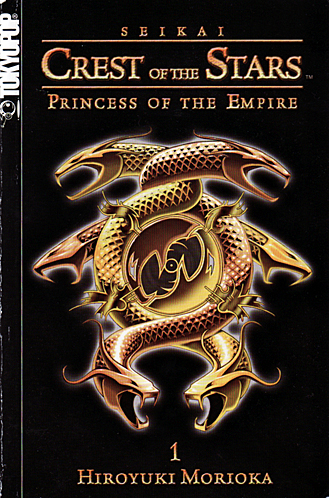
Crest of the Stars

Title: Crest of the Stars: Princess of the Empire
Japanese Title: 星界の紋章:帝国の王女 (Seikai no monshō: Teikoku no ōjo)
Author: Morioka Hiroyuki (森岡浩之)
Translator: Sue Shambaugh
Publication Year: 1996 (Japan); 2006 (America)
Publisher: Tokyopop
Pages: 212

I am a great lover of books, and I spend a great deal of my time reading. I genuinely enjoy almost everything I read, no matter what the genre, and rarely do I dismiss something as absolutely not worth reading. It is very easy for me to explain why I like a particular book, or what is valuable about a particular work, but I think that sometimes it’s important to also discuss what is mediocre, and what can be done better.

Morioka Hiroyuki’s Crest of the Stars series was recently held up to me as a paragon of Japanese science fiction. I wasn’t impressed with the translation of the first book in the series, Princess of the Empire, when it was released in the fall of 2006, but I decided to try it again. The series is massively popular in Japan, and it has quite a dedicated fan base in America as well. I have heard it described as a masterpiece of Tolkienesque proportions in several reviews; and, in my mind, there is no higher praise. Perhaps I had misjudged it four years ago.

Unfortunately, upon re-reading the book, that turned out not to be the case. Princess of the Empire starts off with a wonderful prologue, which briefly introduces the main character of the series in an interesting and beautifully described setting before launching into a short but fascinating account of the space journeys that led to the present moment. This history is then interrupted by action! intrigue! betrayal! and emotion! Unfortunately, this prologue is only sixteen pages long. What follows is 161 pages of utter garbage.

The teenage hero of the series, Jinto, arrives at a spaceport, where he is met by a beautiful blue-haired space elf named Lafiel. Lafiel takes Jinto to a space elf ship which will transport him to the space elf academy (Jinto, although genetically human, is politically an honorary space elf). The ship is attacked by a human group that seeks to oppose the space elf empire, and only Jinto and Lafiel escape. The ship is destroyed, and the unlikely pair (well, actually, very likely, considering that there are no other characters) is stranded on a small backwards planet. The end. Oh, and if you guessed that Lafiel is the princess of the space elf empire, you win a cookie.

You might be thinking, well, if Morioka spins 161 pages out of relatively nothing, then he must be a fairly talented writer with an eye for detail and a talent for dialog. Wrong. The Crest of the Stars series is known for its world building, and what Morioka has given us is 161 pages of almost unmitigated world building. The space elves are called Abh, they have a space empire, they have strange breeding practices, and they are genetically engineered to be beautiful, blue-haired, and psychic. That’s right, they are psychic space elves – which would perhaps be forgivable if there were more to them. Unfortunately, Morioka’s world building reads like a world history textbook written for fourth graders. Even when delivered in speech, the tone of this information is uniformly dry, essentialist, and uninteresting. Population statistics and general government details are provided, but nothing is said about culture, religion, art, lifestyles, political factions, diversity, philosophy, attitudes towards technology – or anything that the reader might actually care about. The clunky constructed language that annoyingly pervades the text is substituted for any real imagination. The almost complete lack of any visual imagery makes the book seem almost sterile, which I don’t think is a deliberate choice on the part of the author, whose writing is incessantly puerile:

Sure, Jinto had experience interacting with girls – he’d made a point on Delktou, in his own way. However, older women were still a complete mystery to him – especially gorgeous older women who were commanders of interstellar battleships. He couldn’t get his heart to stop racing.

In other words, instead of building a fictional world gradually while pulling his readers deeper into said world through plot thickening and character development, making them increasingly curious about the universe in which the characters live as they become increasingly attached to the characters themselves, Morioka completely forgoes plot and character development in order to construct his setting, which quite frankly feels like a cliché mix of Star Wars empire-and-princess driven space opera and Star Trek alien-culture-of-the-week episodic exploration adventure. The fact that the Abh are long-lived, pointy-eared, and dismissive of humans does not make Crest of the Stars Tolkienesque, unfortunately. In his postscript, Morioka states that he hopes “to make shameless sci-fi fans groan.” I’m pretty sure “groan” is the operative word here, since even Troy Denning’s novels set in the Star Wars universe are better written. Alas.

Princess of the Empire is everything I hate about the genre of young adult fiction, which tends to presume that its readers can’t handle complex plots, three-dimensional characters, figurative language, or middle school vocabulary. It could be argued that Japanese light novels are an entirely separate medium than young adult fiction; but still, there are infinitely better light novels out there. One of my personal favorites is Ono Fuyumi’s The Twelve Kingdoms series. A translation of the fourth installment, Skies of Dawn, was recently released a week or two ago, and I am happy to report that the series is only getting better with each successive book.

If it’s Japanese science fiction you’re looking for, then popular mainstream writers from Abe Kōbō to Ōe Kenzaburō to Miyabe Miyuki have successfully tried their hands at hard science fiction at one point or another. If you’re looking for the epic adventure and unparallel world building of Frank Herbert (or China Miéville), then check out Murakami Haruki’s Hard-Boiled Wonderland and the End of the World, which benefits from one of the most artistic and creative translations I have ever read. If you’re more in the mood for the intellectual short fiction of someone like Ray Bradbury (or Tim Pratt), then check out Tsutsui Yasutaka’s collection The Salmonella Beings from Planet Porno. If you’re in the market for lighter fare, I have been especially impressed by several of the translations I have read from an upcoming press called Haikasoru, which is an arm of Viz Media, an established publisher of manga intended for a slightly more mature audience than that targeted by Tokyopop.

In any case, to return to Princess of the Empire, it’s a morass of weak writing and tired stereotypes. Perhaps the Crest of the Stars series deepens in the second and third books, which are also available from Tokyopop, but I would rather spend my time reading all the cool new stuff that seems to be coming out almost every month. For those who want to know what all the fuss is about but don’t have the stomach to brave the light novels, there is always the Crest of the Stars manga trilogy (also published by Tokyopop). The manga are just as mediocre as the books – but at least the female characters provide the service of bending over to reveal themselves every few pages. Which, I suppose, is always a welcome distraction from heavy-handed world building and the overuse of a constructed language.

What I Talk About When I Talk About Running

What I Talk About When I Talk About Running

Title: What I Talk About When I Talk About Running
Japanese Title: 走ることについて語るときに僕の語ること
Author: Murakami Haruki (村上春樹)
Translator: Philip Gabriel
Publication Year: 2008 (America); 2007 (Japan)
Publisher: Vintage International
Pages: 180

Yay! Another Murakami book has come out in paperback! Yay! It’s translated by Philip Gabriel (the author of Spirit Matters: The Translucent in Modern Japanese Literature and veteran Murakami translator)!

Some critics say that people would read Stephen King’s grocery list if he published it. Although I’m not sure I would go that far, I certainly enjoyed King’s essay On Writing. Although I was disappointed that the newest Murakami translation isn’t one of his earlier novels (Hear the Wind Sing, for example, or Pinball, 1973) or his latest novel (1Q84) but a memoir-length essay on running, I decided to go ahead and read it. Because some writers, yes, I will read anything they publish. Even a log of miles run per month.

Over the course of my career as a student of Japanese, I have come to realize that the essay is still a thriving form of literature in Japan. It sometimes seems like every popular writer from Yoshimoto Banana to Murakami Ryū has at some point published at least one collection of essays. Instead of taking the form of concentrated inquiries into a single subject in the style of John McPhee, however, most of these essays are personal in nature and written in a light-hearted tone. What I Talk About When I Talk About Running is much the same. The memoir is conversational rather than educational and a pleasure to read.

In short, Murakami is preparing to run in the 2005 New York City Marathon. He has found that, as he gets older, it becomes harder to train and to run marathons in the amount of time that he would like to. Therefore, partly as refection, and partly as inspiration, he writtes a series of essays as he prepares to run in New York. These essays take him from Hawaii to Japan to Cambridge, Massachusetts, from summer into fall, and years into the past. He writes about running in Tokyo, running in Greece, running in triathlons, running in ultra-marathons, running next to Olympic runners, running next to John Updike, running next to Harvard freshmen, and running next to rivers. He talks about his decision to start running and his decision to become a writer. Everything is equally interesting.

The tone of the book is honest and self-effacing. Although it’s quiet, Murakami has a definite sense of humor that balances out his more contemplative passages. Aside from the fact that I don’t think he mentions drinking whiskey or cooking spaghetti even once, Murakami could very well be one of his infinitely personable narrators. Even though I have almost zero interest in running (or writing novels) myself, I was fascinated by these essays. I’m glad they were translated and published in America.

Kafka on the Shore

kafka-on-the-shore

Title: Kafka on the Shore
Japanese Title: 海辺のカフカ
Author: Murakami Haruki (村上春樹)
Translator: Philip Gabriel
Publication Year: 2005 (America); 2002 (Japan)
Publisher: Vintage International
Pages: 467

Kafka on the Shore is another Murakami novel about disappearing women. That, and penises – or, to be faithful to Gabriel’s translation, cocks. The “Kafka” of the title, “the world’s toughest fifteen year old,” gets a handjob from his (maybe) sister, has sex with his (maybe) mother, and fondles himself (maybe) half a dozen times in between. There are a lot of pages in this book, but there are a lot of cocks, too. Be forewarned.

If you can get past all that, Kafka on the Shore is an utterly charming book. In 2005, when Gabriel’s bestselling translation of the book was released in America, Kafka on the Shore was given a place on the New York Times’s “Ten Best Books of the Year” list and received the World Fantasy Award. I can’t help but wonder how much of this attention was simply a manifestation of the guilt and embarrassment of the American publishing industry, which failed to recognize Murakami’s genius as displayed in such monumental novels as The Wind-Up Bird Chronicle (ねじまき鳥クロニクル, 1995); but, in any case, a lot of people found this book to be utterly charming.

The plot of the novel is long and convoluted, and I see no need to go into it. I would much rather talk about what exactly I found charming about the novel. What I enjoyed the most were the parallel plot lines. Every odd-numbered chapter focuses on the fifteen-year-old runaway Kafka, and every even-number chapter focuses on the sexagenarian Nakata, a likable man who has been rendered mentally deficient by a strange incident in his childhood. Although the two plot lines never meet in anything but the most indirect and metaphysical way, Murakami handles the structure just as skillfully as he did in his earlier novel Hard-Boiled Wonderland and the End of the World (世界の終りとハードボイルド・ワンダーランド, 1985), and I found the experience of following the two stories to be very enjoyable.

The overall atmosphere of the novel was also quite enjoyable. Over the course of his career, Murakami has become more skillful at depicting the small details of everyday life in contemporary Japan, and the attention to setting in Kafka on the Shore should dispel any lingering doubts as to Murakami’s status as a “literary” writer. Particularly enjoyable were the early Nakata chapters, in which the fuzzy-headed old man wanders around Tokyo’s Nakano Ward looking for a lost cat. Nakata apparently has the ability to talk to cats, so he is employed in his neighborhood as a finder of missing pets. Following the details of his life through his muddled but quaint way of looking at the world is, as I have said before, utterly charming. Kafka’s experiences at a small, private library in Takamatsu are rendered in loving detail and will probably send bibliophiles directly to the internet, where they will compare prices on plane tickets to Shikoku. As a side note, the Komura Library described in the novel actually exists and is apparently every bit as pleasant and charming as Murakami makes it out to be.

I hope that I have been able to convince you that this novel is “utterly charming.” Indeed, despite some bizarre cameo appearances by Colonel Sanders and Johnnie Walker, Kafka on the Shore is not as dark as many of Murakami’s other novels and actually manages to break out of the Murakami cycle of privileging the world inside one’s own head above living in the real world. Miss Saeki, the disappearing woman of Kafka on the Shore, is elegantly mysterious and achingly eloquent concerning love, life, childhood, and memory. Her final fate is one of the many mysteries the reader must solve on his or her own, as, like the other supernatural elements in the novel, Murakami never quite satisfactorily explains it. Thankfully, this is another one of the charming points of Kafka on the Shore.

Dance Dance Dance

dance-dance-dance

Title: Dance Dance Dance
Japanese Title: ダンス・ダンス・ダンス
Author: Murakami Haruki (村上春樹)
Translator: Alfred Birnbaum
Publication Year: 1994 (America); 1988 (Japan)
Publisher: Vintage International
Pages: 393

One of my favorite passages in Dance Dance Dance is the ending of one of the last chapters in the novel:

When I was little, I had this science book. There was a section on “What would happen to the world if there was no friction?” Answer: “Everything on earth would fly into space from the centrifugal force of revolution.” That was my mood.

Indeed, that is the mood of this entire novel, which is perhaps the strangest, most nihilistic, and most off-center Murakami novel I’ve read.

Dance Dance Dance is the sequel to Murakami’s popular 1982 novel A Wild Sheep Chase (羊をめぐる冒険). It concerns the unnamed narrator’s quest to return to the Dolphin Hotel and rescue his former girlfriend Kiki, who had disappeared at the end of A Wild Sheep Chase. Upon returning to Sapporo, the narrator finds that the old, run-down, mystery-haunted Dolphin Hotel of his memory has disappeared, and the Sheep Professor is nowhere to be found. A large, modern, high-class resort hotel, also called “The Dolphin Hotel,” has gone up in the same neighborhood, but the managers and staff claim to know nothing of the former hotel. One receptionist, however, responds the inquiries of narrator by telling him about a cold, pitch-black phantom floor at which the hotel’s elevator sometimes stops. In order to recover Kiki, and, in doing so, save the part of himself that had been damaged by the events in A Wild Sheep Chase, Murakami’s protagonist attempts to pursue these mysteries, albeit in a somewhat half-hearted way.

Of course, this being Murakami, there are many side stories that need to be explored along the way. The narrator catches a glimpse of Kiki acting in a bit part in a high-school romance movie alongside an actor named Gotanda, who had been an acquaintance of the narrator in high school. This connection leads our protagonist to a series of misadventures with his former classmate, who has been accused of killing a call girl rented out by a mysterious organization. Also, during his first stay at the new Dolphin Hotel, the narrator encounters and befriends a thirteen-year-old girl named Yuki, who has for all intents and purposes been abandoned by her famous artist mother and her famous novelist father, who have their own ties to shady organizations. Yuki is charmingly cynical, one of her best lines being, “I don’t give a damn what people say. They can be reptile food for all I care,” and she leads the narrator all over Tokyo, Yokohama, Enoshima, and Hawaii.

Do these plot points ever come together? Are the mysteries presented by the novel ever solved? If you’re familiar with Murakami’s fiction, you can probably guess the answer.

Even though this novel is dark and rambling and bears very little thematic resemblance to A Wild Sheep Chase, it should be an interesting and enjoyable read for Murakami fans. Although Dance Dance Dance is only a loose sequel to A Wild Sheep Chase, there are many things that don’t make sense without knowledge of the events of the previous novel. That being said, I also don’t think Dance Dance Dance should be read immediately after A Wild Sheep Chase, as it isn’t so much a sequel as an appropriation of characters and places for the purpose of creating an entirely different story. Alfred Birnbaum is, as always, a fantastic translator, and his rendition of Murakami’s prose makes this novel a fun, if somewhat gloomy, read.

After Dark

Title: After Dark
Japanese Title: アフターダーク
Author: Murakami Haruki (村上春樹)
Translator: Jay Rubin
Publication Year: 2007 (America); 2004 (Japan)
Pages: 244

I honestly can’t decide whether I like After Dark. With a few major exceptions (like “Barn Burning”), I don’t like Murakami’s short stories. According to several interviews, Murakami considers himself a novelist and primarily uses short stories as practice. Although his short stories are more polished than he gives himself credit for, I can understand why Murakami would say that. Compared to the huge imagination and forceful imagery of his novels, Murakami’s short stories tend to feel somewhat shallow.

To me, After Dark felt more like a short story than a novel. Perhaps the problem is the length of the book. Weighing in at approximately 250 double-spaced pages, Murakami’s latest novel should perhaps be more properly considered a novella. Another consideration might be the novel’s timeframe. The main action of After Dark takes place in the span of seven hours. To be precise, it starts 11:59pm and ends at 6:52am, as the chapter headings (each labeled by hours and minutes) inform us. Within this short period, the reader learns a great deal about the book’s protagonists, including a brief outline of the more sordid highlights of their pasts. Unfortunately, I was so entranced by these characters that I found myself wanting to know more about them. I wanted to see them in action, I wanted to hear their voices, and I wanted to see them standing around cooking spaghetti. I wanted to learn their life histories slowly, and not in bullet points.

My main concern with the book, however, was the treatment of what I like to call the “Murakami myth.” A recurring theme throughout almost every Murakami novel is the woman who disappears into the neverland of her unconscious. After Dark’s disappearing woman takes the form of Eri Asai, the older sister of one of the two protagonists. Eri, who has fallen into a deep sleep from which she will not wake, is the subject of the novel’s even-numbered chapters, which detail the uncanny events which befall her during the night. Although Murakami never resolves the mysteries surrounding his disappearing women, I felt that After Dark’s Eri subplot was more undeveloped than usual. In fact, it left me quite frustrated, and it felt almost randomly thrown into the main action of the story. Although the Murakami myth generally adds a wonderful level of depth to his novels, I felt that, in this case, it was a misguided attempt to flesh out a novella that perhaps should have more properly been a short story.

That being said, the main action of After Dark is more than interesting enough to justify the existence of the book. In short, two lost souls manage to connect in the late night / early morning hours of Shinjuku. Several passages, such as the description of a Japanese Denny’s and the interactions between the employees of a love hotel, stand out like gems. The vast majority of this book doesn’t sparkle, though; it glows softly like street lamps, or eerily like the static on a TV screen. In other words, this isn’t one of Murakami’s masterworks, but it does have a quiet charm that should appeal even to those of you who aren’t necessarily Murakami fans.

Ōe and Beyond: Fiction in Contemporary Japan

Fiction in Contemporary Japan

Title: Ōe and Beyond: Fiction in Contemporary Japan
Editors: Stephen Snyder and Philip Gabriel
Essays: 12, with an Introduction by the editors
Publication Year: 1999 (America)
Pages: 317

This book, while undeniably academic, is perhaps the most important resource for students of contemporary Japanese literature. Included in this book are twelve essays by prominent scholars on the biggest names in post-war Japanese literature. There are essays on political writers like Ōe Kenzaburō and Nakagami Kenji, feminist writers like Ohba Minako and Takahashi Takako, and contemporary popular writers like Murakami Haruki and Banana Yoshimoto. Each of these essays aims to look at the writer as a whole, considering his or her major works and themes, while at the same time attempting to evaluate his or her place in the larger body of modern and postmodern Japanese literature. Every essay is a sound piece of scholarly work, and none of the analyses rely on theory unfamiliar to a college graduate.

Because these essays are so general and yet so rigorous in their approach, I would like to recommend the collection to general readers, as well as specialists, who have cultivated an interest in a particular writer. You won’t be disappointed by what you find. The short introductory essay is also a wonderful introduction to the state of Japanese literature at the turn on the 21st century.

Here is a list of the writers treated by the essays, as well as the authors of the essays themselves. An astute observer (such as myself, haha) will notice that many of the essayists are their subjects’ primary translators, a fact which attests to their close relationship with the authors and their works.

1. Ōe Kenzaburō (Susan Napier)
2. Endō Shūsaku (Van C. Gessel)
3. Hayashi Kyōko (Davinder L. Bhowmick)
4. Ohba Minako (Adrienne Hurley)
5. Takahashi Takako (Mark Williams)
6. Nakagami Kenji (Eve Zimmerman)
7. Kurahashi Yumiko (Atsuko Sakaki)
8. Murakami Haruki (Jay Rubin)
9. Murakami Ryū (Stephen Synder)
10. Shimada Masahiko (Philip Gabriel)
11. Kanai Mieko (Sharalyn Orbaugh)
12. Yoshimoto Banana (Ann Sheif)