First Love

Rio Shimamoto’s 2018 novel First Love is a psychological mystery about a beautiful college student who has been arrested for the murder of her adoptive father. Although it tackles serious themes, this story is compulsively readable. All of the characters bring emotional baggage to the table, and Shimamoto teases out the reader’s sympathy as each of their histories is revealed.

Yuki Makabe is a clinical psychologist who specializes in parenting and childcare. She’s ambitious, and she’s on the verge of making a career transition to media appearances and popular audience articles. When Yuki’s brother-in-law, Kasho, is assigned to the high-profile case of Kanna Hijiriyama, a college student accused of killing her father, he asks Yuki to help him interview the young woman in order to ascertain her motive. Yuki’s prospective editor at a major publisher, a friendly young man named Tsuji, asks her to write about the case, so she agrees.

Yuki is happily married to an internationally famous photographer who supports her career by shouldering the majority of the responsibilities involved in the care of their son. Despite her loving relationship with her husband, Yuki has a troubled past with Kasho that neither of them is willing to discuss. While she and Tsuji work together on Kanna’s case, Yuki must navigate her strained relationship with Kasho, who is very charming but a bit of an asshole.

Kanna presents Yuki with another set of challenges. To begin with, Kanna can’t explain why she wanted to hurt her father, or even whether she intended to hurt him in the first place. But, if she never meant to attack him, what was she doing with a knife? To make matters more complicated, one of Kanna’s college boyfriends gives an interview to a tabloid magazine and says that Kanna went crazy after they broke up. Even Kanna’s own mother claims the young woman is crazy.

Yuki is convinced that Kanna is far from “crazy,” but the truth of the matter is elusive. Kanna is traumatized by the death of her father, and Yuki quickly realizes that the young woman’s trauma is much more extensive.

Based on the title of the novel and the relationship between Kanna and the person she may or may not have killed, a reader might suspect that there is underage incest involved. I hope I can be forgiven for spoiling the story by saying that, thankfully, this is not the case. Regardless, Kanna didn’t have a happy home life as a child. 

I’m afraid that some readers may find Kanna frustrating, but her portrayal feels extremely realistic to me. I definitely knew people like this in high school and college. Generally speaking, these girls (and occasionally boys) were intelligent and competent, but they had a habit of saying whatever they needed to say to diffuse an awkward situation. 

This behavior wasn’t “lying” or “being dishonest” so much as it was a manifestation of fawning, an alternative to the “fight or flight” response that’s common in young people who live in hostile home situations. Instead of fighting their parents or running away from home, “well-behaved” children and teenagers will contort their speech, emotions, and understanding of reality to ease tension. Issues often arise when this behavior carries over to romantic and professional relationships that would benefit from honesty.

Although this element of the story isn’t presented as a mystery to be solved, Yuki is confronted with the issue of whether Kanna truly consented to sex with two of the key romantic partners in her life. I can completely understand how the men involved might have understood Kanna’s words and behavior as expressing consent, but I also understand how Kanna could later admit that sex isn’t what she wanted, and that she was just going along with what was expected. As the author demonstrates, Kanna’s inability to understand her own boundaries is directly related to the emotional abuse she endured as a child.

Shimamoto doesn’t lean into an overtly feminist message, but there are multiple points in the story when Yuki comes into contact with the sort of ambient misogyny that might compel a vulnerable young person like Kanna to second-guess her own emotions and sense of self-worth. At the beginning of the novel, for example, Yuki reflects on a conversation between a male television producer and his younger female colleague that she overheard as she entered the studio.

As I was getting my makeup done, I examined my own features: not bad, but not particularly beautiful either. A face with no distinctive features. The only thing that stood out was my collarbone, protruding above my shirt.

I’d met that male producer several times previously, but he’d never once made eye contact with me. There were men like that everywhere in the television industry – men who wouldn’t engage in conversation with women they’d give less than an eight out of ten on looks. Men who thought nobody would notice this behavior. Or maybe they just thought it didn’t matter. These were men who had never suffered a single setback in their lives.

This is the sort of observation that, while eminently relatable to many people, would have Yuki called crazy if she spoke it out loud. It’s not “misogyny” or “sexism” if the male producer isn’t doing anything wrong, right? It’s not like he actually said anything offensive to Yuki, or to his younger colleague. This man’s behavior is rancid, but no one will ever call him out on it. Yuki has a supportive family and professional colleagues who aren’t human garbage, so she can cope. But what about Kanna, who hasn’t yet found a support network to replace her abusive family?

What Shimamoto criticizes in First Love are the gendered aspects of a social system that allows toxic men to flourish. First Love doesn’t offer easy solutions, but Shimamoto demonstrates that we can all be allies in pushing back.

Yuki’s husband is a prince from start to finish, and her editor Tsugi is able to see what happened to Kanna with clear eyes while re-evaluating his own perspective and never apologizing for the bad behavior of other men. Kanna’s defense lawyer Kasho has issues of his own due to childhood abuse at the hands of his mother, but he’s an adult who is capable of realizing his limitations – which is why he arranges for a series of meetings between Yuki and Kanna in the first place.

Without spoiling too much of the plot, First Love connects the stories of a number of characters who begin to question their past behavior in light of Kanna’s upcoming trial, and Shimamoto helps the reader to sympathize with these characters even when they behave badly. The point is not that men are evil or that women are innocent victims. Rather, it’s important to extend empathy instead of overlooking questionable behavior.

Putting the social relevance of the novel’s themes aside, First Love is a fun book to read. I got sucked into the story immediately. Like Yuki, I was instantly intrigued by the mystery presented by the death of Kanna’s father. Kasho’s defense argument during Kanna’s trial felt like a major revelation unfolding before my eyes, and I admire how carefully Shimamoto laid each brick in the wall. Louise Heal Kawai’s translation is featherlight and flawless and sets the tone perfectly.

I’d recommend First Love not just to fans of mystery and suspense, but to any reader interested in a compelling character drama that offers a number of different perspectives on family, mental health, and the darker aspects of everyday interactions that often go overlooked.

The Cat Who Saved Books

Japanese Title: 本を守ろうとする猫の話 (Hon o mamorō to suru neko no hanashi)
Author: Sosuke Natsukawa (夏川 草介)
Translator: Louise Heal Kawai
Publication Year: 2017 (Japan); 2021 (United States)
Press: HarperCollins
Pages: 198

A high school junior named Rintaro Natsuki has inherited a bookstore from his recently deceased grandfather. During the week following the funeral, Rintaro is visited by a talking cat who spirits him away to a series of four magical book-themed “labyrinths.”

The Cat Who Saved Books is a celebration of reading in which a teenage booklover matches wits with the embodiments of academic pigheadedness and corporate greed. The warm coziness of Rintaro’s small bookstore is a welcome haven from the opulent sprawl of the Amazonian book labyrinths. At the center of each labyrinth is an adult in a position of power who misuses his authority to mistreat books. Accompanied his crush, Sayo Yuzuki, Rintaro is tasked with reminding these jaded adults of the true joy of reading. The boss of the second labyrinth, for instance, is a professor obsessed with dissecting books in order to create tidy summaries that will facilitate speed reading, but he realizes the error of his ways when Rintaro and Sayo present him with the passionate argument that reading is about the journey, not the destination.

The Cat Who Saved Books is unabashedly sentimental, and Rintaro and Sayo’s earnest sincerity can feel embarrassingly naive at times. That being said, the story’s satire is surprisingly sharp. The Cat Who Saved Books reminds me of Haruki Murakami’s 1Q84 in the strength of its indictment of the contemporary Japanese publishing industry. I was especially impressed by the third labyrinth, which acts as a bitter critique of giant corporations that put out a steady stream of publications simply for the purpose of pursuing profit. Natsukawa’s comments on easily digestible self-help guides written in the form of bullet points (“Five Ways to Change Your Life!”) are amusing, as is the fantastic image of endless reams of paper tossed from the windows of an impossibly tall skyscraper.

Each labyrinth’s theme is underscored by a set of books. The books referenced are (with the sole exception of Osamu Dazai’s short story “Run, Melos!”) classics of European literature. Examples include Antoine de Saint-Exupéry’s Vol de Nuit, Friedrich Nietzsche’s Also sprach Zarathustra, and John Steinbeck’s The Grapes of Wrath. These books line the shelves of the store managed by Rintaro’s grandfather, who stepped away from an important position in academia in order to free literature from the clutches of scholars and help make them more accessible to ordinary people. Although it’s odd not to see any Japanese fiction mentioned, these weighty European classics conjure an image of the sort of old-fashioned bookstores that used to be common in big cities but are quickly disappearing.  

That being said, the homogeneity of the “serious literature” Natsukawa valorizes in The Cat Who Saved Books is a bit disappointing. I remember what small bookstores used to be like, and I remember hating them. What if you want to read stories that aren’t written by not-so-proverbial Dead White Men? What if you want to read stories written by women? What if you want to read stories that speak more intimately to your own experiences? What if you want to read stories that challenge reality instead of simply reflecting it? It’s ironic that The Cat Who Saved Books would have no place at Rintaro’s bookstore, and it’s a shame the story isn’t self-reflexive enough to acknowledge this. It’s easy to sneer at study guides and self-help books, but that’s what funds the publication of literary fiction.

Likewise, it’s easy for me to be frustrated with the naive idealism of The Cat Who Saved Books, but I can imagine that this title will be prominently displayed in the windows of the indie bookstores that are still fighting the good fight. Perhaps it might even help booksellers guide interested readers to more stories outside the sphere of “literary classics.”  

Thankfully, HarperCollins has put an enormous amount of love and care into the publication of the hardcover edition of The Cat Who Saved Books. This book is a beautiful physical object. I’m a big fan of the gorgeous cover drawn by Yuko Shimizu, who was given space to write an interesting note that offers insight into her creative process. There’s also a wonderful afterword by Louise Heal Kawai, who explains a number of translation choices, including her decision not to assign gendered pronouns to the talking cat.   

As a middle-grade novel, The Cat Who Saved Books is perfect for younger readers just beginning their journey with books. The fantastic elements of the story will appeal to fans of anime and video games, and older readers who enjoy light novels and visual novels will appreciate the colorful, over-the-top characters and comfortably formulaic story structure. The Cat Who Saved Books is an entertaining story filled with warmth, kindness, and bright-eyed hope for the future of books as a means of encouraging empathy and inspiring imagination, and it speaks both to the kids delighted by its adventure and to the adults amused by its satire.

.   .   . . .

I’d like to extend my gratitude to HarperCollins for providing an advance review copy of The Cat Who Saved Books. The North American hardcover edition will be released on December 7, 2021. You can learn more about the book on its website (here) and order a copy from your local small bookstore, which you can find through IndieBound.

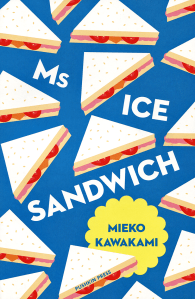
Ms Ice Sandwich

Title: Ms Ice Sandwich
Japanese Title: ミス・アイスサンドイッチ (Misu Aisu Sandoicchi)
Author: Mieko Kawakami (川上 未映子)
Translator: Louise Heal Kawai
Publication Year: 2013 (Japan); 2017 (United Kingdom)
Publisher: Pushkin Press
Pages: 92

Ms Ice Sandwich is a novella that gradually opens a door into the interior world of its protagonist, a boy living with his mother and grandmother in a commuter suburb. This boy is fascinated by a woman who sells sandwiches at the grocery store outside the train station, whom he calls “Ms Ice Sandwich” because of the ice-blue eyeshadow she always wears. Her makeup emphasizes her eyes, which she has had surgically altered to appear larger. The narrator, who is a strange little kid, becomes preoccupied with trying to capture Ms Ice Sandwich in art, obsessively drawing her facial features line by line and eyelash by eyelash.

The boy also gravitates toward Tutti, a girl in his class who was given this nickname (by the narrator himself, no less) after she once farted in class. Like the boy, Tutti is a bit strange, and she’s obsessed with gunfights. The boy learns that she lives alone with her father, who has filled their apartment with shelves of DVDs and makes time to sit down and watch a movie with her every week. Tutti’s love of gunfights stems from her interest in cinematic choreography, and the boy appreciates her ability to mimic calmness in the face of danger in the same way that he’s awed by the no-nonsense attitude of Ms Ice Sandwich in the face of customer rudeness.

Meanwhile, the boy’s mother is a weird one herself. Although the boy isn’t entirely sure what she does, she seems to be a self-employed spiritualist and fortune teller, and she’s recently had part of their house remodeled to resemble a caricature of a Western palace complete with a red carpet, foreign furniture, heavy curtains, and statues of angels. While the boy’s grandmother is bedridden in the back of the house, his mother spends an inordinate amount of time online, typing on her phone even when she’s out shopping. Like Tutti and Ms Ice Sandwich, however, the boy’s mother isn’t actually a bad person, and she loves her son in her own way.

The boy is perhaps ten or eleven years old, and Kawakami’s first-person narration skillfully captures his close attention to small and seemingly insignificant details, which are contrasted against a larger cluelessness concerning how the world works. The narrator doesn’t really know what’s going on with his mom, or his grandmother, or Tutti’s dad, or even Ms Ice Sandwich, but he nevertheless observes them with care and compassion. He is content to observe the movements of the people in his life until Tutti startles him out of his passivity, saying,

“When you say see you tomorrow to someone, it’s because you’re going to keep seeing them. It’s like at school you see everybody because they go to school every day. But when you graduate and you don’t go to school anymore, it stops and you don’t see everybody any more. If you want to see somebody, you have to make plans to meet, or even make plans to make plans, and next thing you end up not seeing them any more. That’s what’s going to happen. If you don’t see somebody, you end up never seeing them. And then there’s going to be nothing left of them at all.” (75)

Ms Ice Sandwich has no real plot or denouement, but Tutti’s words spark a small but significant shift in the narrator’s worldview that allows him to more fully appreciate the fact that his mother, his grandmother, and Ms Ice Sandwich all have lives that exist independently of his presence. Judging from the cover copy it might seem as if this is a novella about a boy’s sexual awakening, but the story actually hinges on a far more subtle emotional revelation. Thankfully, the narrator’s perspective is so singular and well-crafted that Ms Ice Sandwich‘s message about the ephemerality of human connection is never in any danger of becoming trite and sentimental.

According to the colophon, “This piece was published in the literary journal Shincho first in 2013, and in 2014 it was included in the novel Akogare, which is a combination of two stories: ‘Miss Ice Sandwich’ and ‘Strawberry Jam Minus Strawberry.'” At roughly ninety pages, Ms Ice Sandwich is short enough to read in one sitting, but it’s still substantial enough to feel like a self-contained world. I thoroughly enjoyed this story, and I’m impressed by the fantastic work that Pushkin Press has put into its ongoing series of translations of quirky Japanese novellas.