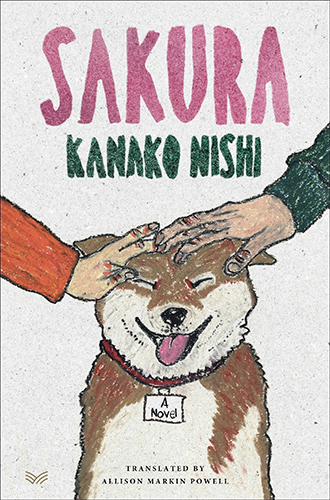
Kanako Nishi’s 2005 debut novel Sakura is a difficult book to write about.
The first part of the novel is a sweet slice-of-life story about three kids growing up in a middle-class household during the late twentieth century. The final 1/3 is a tragic drama that details how the family falls apart.
Unfortunately, I feel that the two parts of this book don’t really talk to each other or complement one another thematically. In addition, the tragedy has dark undertones of gothic horror that feel disturbingly accidental.
The author says she wrote this story to express what it might feel like to live in a large and boisterous family that has its share of ups and downs. The novel does indeed convey that sense of love and belonging, especially in relation to the eponymous family dog, Sakura.
I appreciate that Sakura contains sympathetic depictions of two queer and transgender characters, both of whom are close friends of the family, but…
…I really don’t like how the author equates LGBTQ+ pride with the final monologue of the narrator’s younger sister, who delivers something resembling a pride speech regarding her incestuous sexual desire for her oldest brother, whom she manipulated into suicide during a low point in his life so that he would never have the opportunity to love another woman.
In addition, Sakura features strong disability negativity, as well as unfair gendered double standards relating to grief. In particular, the narrator repeatedly body-shames his mother, calling her “fat” and “piggish” for drinking wine with dinner (in order to cope with the sister loudly masturbating on her dead brother’s bed) and finishing her meals instead of daintily leaving a portion uneaten. I understand that 2005 was a different time, but these parts of the text are still extremely uncomfortable to read.
Nothing inexcusably terrible happens to Sakura, who is a very good dog. That being said, some people may take issue with a certain treatment of pets that was considered standard in Japan (and elsewhere) several decades ago, and readers who are sensitive to depictions of dogs suffering while left outside during extreme temperatures and dangerous weather events may want to give this book a pass.
Sakura starts beautifully, but the ending left me with a very gross feeling. I’d love to see more work by Kanako Nishi in translation, but I kind of wish I’d never read this particular novel, which was once quite popular in Japan but hasn’t aged well.
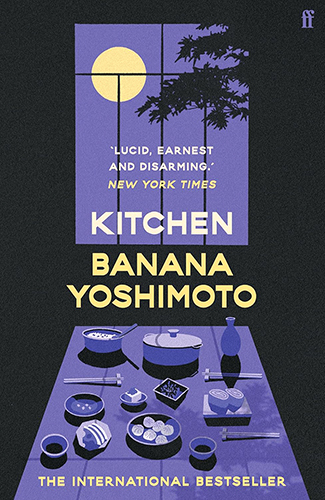
Banana Yoshimoto’s landmark 1988 novella Kitchen once inspired a great deal of heated discussion as a miserable chain of respected literary critics dismissed it as shallow and frivolous. Haters gonna hate, but I loved Kitchen when I first discovered it in high school, and I still think it’s a beautiful book that’s well worth reading.
After her parents died in a car accident, Mikage Sakurai was raised by her grandmother, who suddenly passes away when Mikage is in college. Now Mikage feels that she has well and truly become an orphan, and she doesn’t know what to do.
Yuichi Tanabe, a young man who was friendly with Mikage’s grandmother, invites her to stay with him and his mother at their apartment while she gets her life sorted out. Though Mikage has never met either of these people, Yuichi’s kindness is exactly what she needs, and she’s so stressed out and dispirited that she takes him up on his offer.
The apartment turns out to be gorgeous – it’s bright and sunny and spacious, and also outfitted with a thoroughly modern kitchen and a giant sofa that Mikage immediately falls in love with. Yuichi’s mother Eriko is just as friendly and charming as she is beautiful, and Mikage instantly feels at home. Though she knows she’ll have to leave eventually, she makes the best of her time in a warm and comfortable space in the care of two lovely people.
Eriko is clearly the star of this story, especially as she relates her own experience of loss to Mikage. Yuichi’s mother was the only woman she would ever love, she says, and she didn’t know what to do when her wife died after a long illness. She felt like the only reasonable course of action was to take on the role of “mother” by changing her name, getting surgery, and becoming a woman herself. She still misses Yuichi’s birthmother, but life goes on, and she couldn’t be happier. As Mikage describes Eriko at the end of the story:
Her hair rustled, brushing her shoulders. There are many days when all the awful things that happen make you sick at heart, when the path before you is so steep that you can’t bear to look. Not even love can rescue a person from that. Still, enveloped in the twilight coming from the west, there she was, watering the plants with her slender, graceful hands, in the midst of a light so sweet it seemed to form a rainbow in the transparent water she poured.
Kitchen is full of similar passages in which Mikage takes in the beauty of her surroundings while reflecting on her feelings. These moments are refreshingly light, and it’s as if the writing is washing over you in a gentle shower. Yoshimoto says that her goal is to create precisely this sense of peace, writing in her Afterword to Kitchen that “I know no greater happiness than that it may have cheered you, even a little.”
Kitchen includes a continuation of the story, “Full Moon,” which begins with Eriko’s murder. Mikage has gotten back on her feet, moved out of the Tanabes’ apartment, and become an assistant to a celebrity chef. Now that tragedy has visited Yuichi, it’s her turn to comfort him.
Mikage is comforted and supported by Chika, a transwoman who has taken over the cabaret club that Eriko managed. Chika helps Mikage to understand that, despite being disowned by her family, Eriko lived a full life, and she encourages Mikage to find her own happiness with Yuichi. Chika’s advice feels like the central thesis of Yoshimoto’s writing: the world can be dark and confusing, so you have to actively create your own sanctuary alongside the people you love.
All of this feels very much like shōjo manga created for teenagers, from the quiet and nonsexual love story between Mikage and Yuichi to the way that everyone seems to sparkle. The normalization of queer identity also has its roots in shōjo manga, as does the mundanity of the supernatural events depicted in “Moonlight Shadow,” the short companion story included at the end of the book. Yoshimoto’s language is filled with onomatopoeia and other cute expressions that feel directly lifted from manga, so much so that Megan Backus’s natural-feeling English translation is a genuine miracle.
If you’re not in the target demographic for Kitchen, it would make sense that Yoshimoto’s manga-inspired style of writing might not resonate with you. And that’s okay! Lord knows that there are enough works of literary fiction written by and for older adult men.
When I discovered Kitchen as a teenager, though, this book was definitely for me. In fact, it felt like the first book I’d encountered that took me seriously as a person. Having run the gauntlet of Ernest Hemmingways and William Faulkners and John Steinbecks in my high school English classes, I felt extremely alienated by fiction as a medium. I can’t even begin to describe what an amazing stroke of good fortune it was to find that Banana Yoshimoto had reached out with her writing and spoken to me specifically.
It’s not an exaggeration to say that the pop culture of the 1990s and early 2000s was a toxic slurry of homophobia and misogyny. In that sort of cultural environment, the independent young women and kind men and gentle queer sexuality of Kitchen were nothing short of revolutionary. I’m sure it was easy for older male literary critics to say that Yoshimoto’s writing was empty pablum, but it was something else entirely for me to encounter my first fictional depiction of gay adults who were treated as real human beings instead of stupid jokes or beleaguered minorities.
It felt like a revelation to see people being openly gay and also completely normal, and it would be disingenuous to say that this realization wasn’t political. Banana Yoshimoto showed me the rainbow, and sure, it was magical. How could it not be? But also, when I put this book down, I felt like I’d gained a sense of identity and purpose. When Chika tells Mikage that you have to fight for a world that accepts you, I took that advice to heart.
I was far from alone in being moved by this story. Kitchen was an instant bestseller in Japan, and it went on to gain fame overseas during the 1990s. In the 2000s and 2010s, Banana Yoshimoto enjoyed a degree of international recognition on the same level as Haruki Murakami. And she deserved it. She still does, honestly. I may have aged away from Kitchen, but that doesn’t mean I don’t respect it immensely.
Admittedly, Mikage sometimes seems as though she lives in a different world, and it can occasionally be a bit painful to look back on the prosperity and optimism of the 1980s. Still, Kitchen feels as fresh as the day it was written, and maybe you’re exactly the person who needs to read it now.
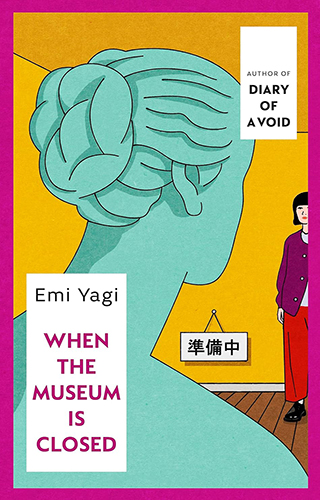
Emi Yagi’s 2023 novel When the Museum Is Closed is a refreshing work of magical realism about a shy young woman who falls in love with a statue of Venus. The twist is that the statue loves her back, and – even more miraculous! – their love story has a happy ending.
Rika is a recent college graduate who works in the freezer department of a warehouse for processed food. She sees this as the perfect job for three reasons. First, she never has to talk to anyone. Second, she can take pre-prepared food home from her job, so she rarely has to cook. And third, an invisible yellow raincoat suddenly appeared over her clothing in elementary school, and she’s found it almost impossible to remove in public. The heavy vinyl fabric keeps her body temperature high, but that’s not a problem in an industrial freezer.
The only variation in Rika’s days comes from her part-time job. Once a week, Rika takes the bus to a local museum to have an hour of conversation with a statue of Venus. Venus only speaks Latin, but Rika enjoys a freedom with the dead language that she’s never found in Japanese. Though Rika is shy at first, she and Venus become friends, and they eventually fall in love.
Unfortunately, there’s a bit of a situation with a man named Hashibami, the museum curator in charge of the statue. He wants Venus all to himself, and he never wants her to change – he doesn’t want her to learn modern languages, and he certainly doesn’t want her to learn about the world outside the museum.
Venus therefore makes a deal with Hashibami. If he can get Rika to fall in love with him, she’ll allow him to fire Rika from the conversation job. Regardless, Rika isn’t interested in men, nor does she allow Venus to push her away. What Rika wants is something else entirely, and her relationship with Venus has given her the courage to chase their mutual joy.
The fantastic elements of When the Museum Is Closed are presented as entirely mundane, and it’s easy to take them at face value. At the same time, the love story between Rika and Venus resonates at an allegorical level with the experience of having a queer crush on someone who’s friendly and flirtatious yet seemingly unattainable. It’s the crush you have on an older coworker, or the crush you have on an internet friend, or the crush you have on the gayest girl you’ve ever met who is, inexplicably, married to a man. It doesn’t really matter that Venus is a statue, as anyone who’s experienced queer longing can relate to Rika’s situation. At the same time, Emi Yagi’s Venus is animated by her own distinct personality and undeniably lovely.
I’m sure that When the Museum Is Closed could also be read as an allegory for how women tend to be treated in male-dominated artistic and curatorial spaces, but the story is far more concerned with Rika’s subjective experience of her own individual life. I especially enjoyed the subplot involving Rika’s friendship with her landlord, a quirky but kind elderly woman who needs home care assistance, and I appreciated the understanding Rika develops with the neglected young boy who lives next door. Though Rika’s invisible yellow raincoat is unique to her, she’s far from the only person carrying unseen baggage, and it’s not necessarily the case that this is a problem that needs to be fixed.
When the Museum Is Closed is a short but expertly paced novel that moves quickly yet still allows the reader enough time to appreciate each scene. Its premise is intriguing and well-executed, and Yuki Tejima’s delightful translation captures the author’s tone perfectly, both in Rika’s deadpan observations and Venus’s mature flirtations. Readers who enjoyed Emi Yagi’s novel Diary of a Void will be pleasantly surprised by When the Museum Is Closed, which features the same sharpness and clarity of writing augmented by lovely moments of sweetness.
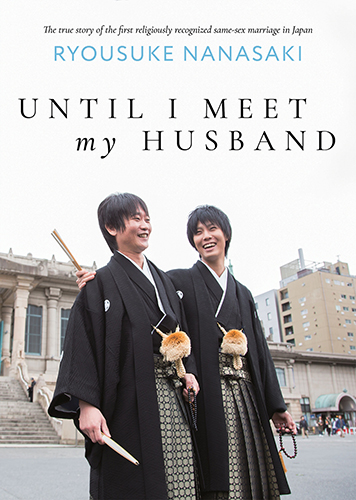
Until I Meet My Husband is a collection of short autobiographical essays by Ryousuke Nanasaki, an activist who established LGBT Community Edogawa in 2015 and a wedding planning company called Juerias LGBT Wedding in 2016, both of which contributed to Tokyo’s Edogawa ward officially recognizing same-sex partnership by issuing marriage certificates.
Nanasaki lays out his motivations for becoming an activist toward the end of the book, but the majority of his essays are humorous stories about life and love. As Nanasaki explains in the final chapter, “In Place of an Afterword,” he wants readers to understand the “raw, uncut truth” of queer identity, which is that gay people experience happiness and make mistakes like everyone else.
As a result of Nanasaki’s honesty, the essays in Until I Meet My Husband are immensely entertaining and compulsively readable. Many of the stories will be familiar to queer Millennials, from receiving a stern lecture from a well-meaning teacher in elementary school to dating other closeted queer kids in high school to falling a little too hard for your first serious partner as an adult. Nanasaki leans hard into friendship drama, relationship drama, and family drama, but he’s so funny and good-natured that you can’t help but support him through his misadventures.
Molly Lee’s translation is pitch perfect, conveying the confidence and enthusiasm of Nanasaki’s voice in natural English that’s a pleasure to read. Along with the original essay collection, Seven Seas has also released the manga adaptation, which features dreamy artwork by BL manga author Yoshi Tsukizuki.
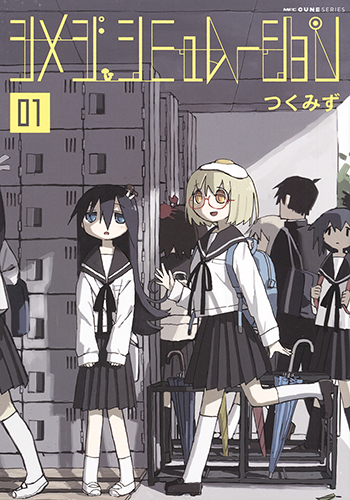
Shimeji Simulation (シメジ シミュレーション) is a gentle but deeply surreal slice-of-life manga about two teenage girls living through the end of the world – or perhaps not “the” world, necessarily; but rather, an artificial world that they happen to inhabit. The focus of the manga isn’t on the apocalypse, which passes mostly unremarked and unexplained. Instead, the core of the story is the friendship (and understated romance) between the two girls, Shijima and Majime.
Shijima Tsukishima has spent the past two years of middle school quietly living inside a closet, and the manga opens when she decides to begin attending high school at the beginning of the school year. Why Shijima became a hikikomori is something of a mystery, but her primary personality trait is that she dislikes being bothered. She plans to spend her time in high school silently reading books at her desk.
This plan is interrupted by a classmate named Majime, who aggressively demands that Shijima become her friend. Since a pair of shimeji mushrooms sprouted from the side of Shijima’s head during her period of isolation, Majime immediately gives her the nickname “Shimeji,” an appellation that quickly becomes as pervasive and persistent as Majime herself.
Majime bluntly inserts herself into Shijima’s life and persuades her to join the school’s Hole Digging Club, which is managed by an art teacher named Mogawa. Majime assumes that the club is little more than an excuse to hang out after school, but Mogawa is oddly committed to the endeavor, especially when encouraged by the quiet presence of a second-year student named Sumida who only communicates through abstract drawings. Meanwhile, Shijima’s older sister has dropped out of college to devote herself to the ongoing construction of a bizarre machine with an inexplicable function.
For the most part, the girls engage in mundane slice-of-life adventures. They chat in the classroom, visit one another’s houses, and attempt a study session at a family restaurant. Mogawa teaches her art lessons. Majime catches a cold. A group of girls in their homeroom start a rock band. Shijima meets a super-senior named Yomigawa who’s decided to stay in high school just to hang out in the library and read philosophy books.
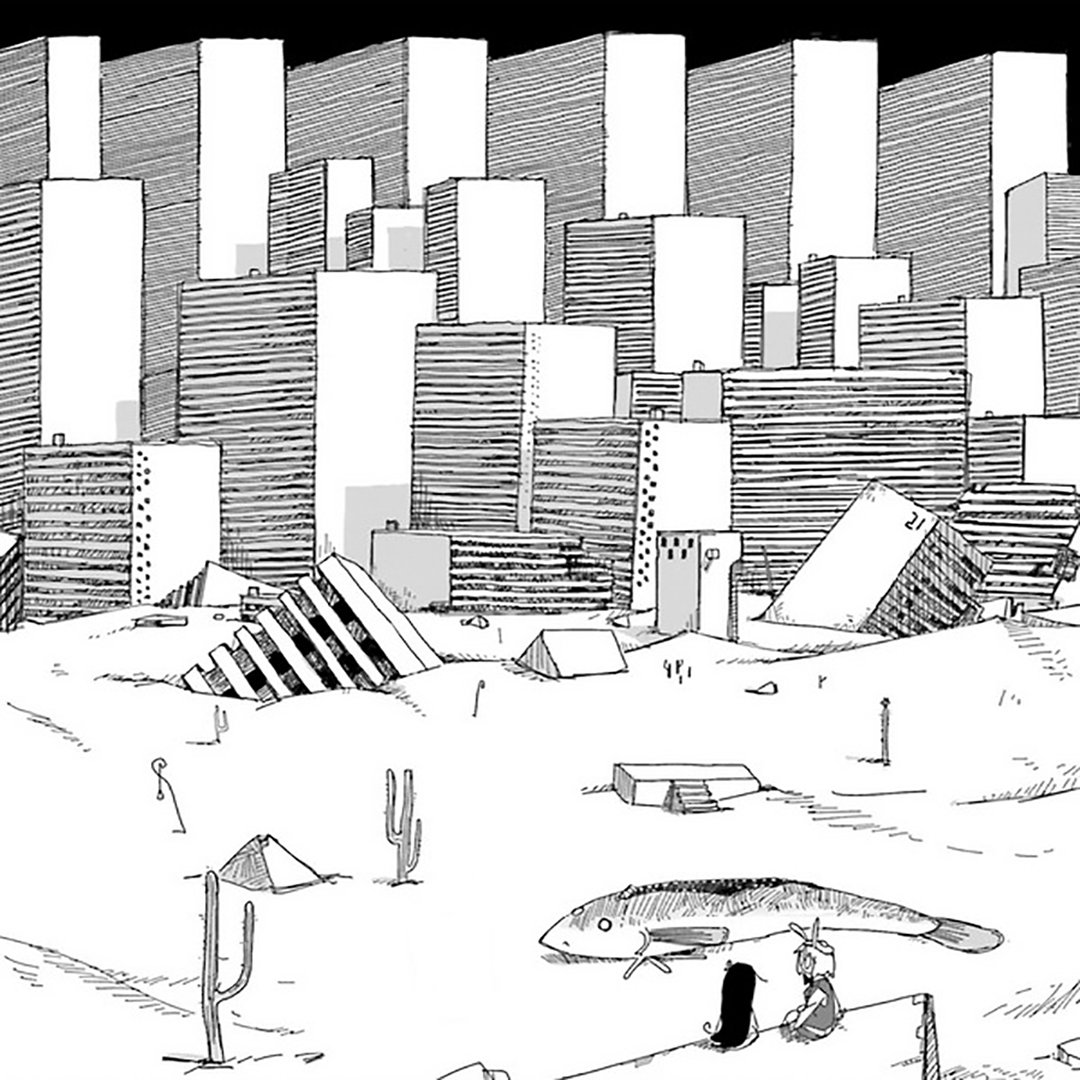
What makes this manga interesting are the strange glitches in the world surrounding the characters. The mushrooms sprouting from Shijima’s head are a good example, but there’s also the fact that Shijima and her sister occupy one of the only two tenanted apartments in a giant danchi housing building that’s falling apart yet still somehow livable.
As the story progresses, more glitches begin to manifest. Everyone wakes up to a snowstorm in the middle of summer, for example. One day, the school building is flipped vertically and becomes a pocket dimension with a separate axis of gravity. Another day, water loses its mass and floats in the air. Suburban streets twist into optical illusions, and fish swim through the sky.
Although small glitches seem to be innate to the world, they’re exacerbated by Shijima’s sister, who’s been building and experimenting with various devices that alter the fabric of reality. Each of the first three volumes of the manga concludes with a longer narrative segment that shows the consequences of these experiments for Shijima and Majime, who are briefly thrown into the gaps between the cracks of reality.
The cumulative damage caused by Shijima’s sister is countered by a godlike entity who presents as a young girl and calls herself “the Gardener.” The Gardener’s role is to ensure that the reality experienced by the characters doesn’t mutate too wildly from one day to the next, but her power is curbed by the features of the universe’s code intended to keep its residents safe. She might be able to repair gaps in reality, but she has no means of forcing her will onto humans, even if it’s for their own good.
Like Tsukumizu’s previously serialized manga, Girls’ Last Tour, it’s difficult to say that Shimeji Simulation is “about” anything. There’s no plot to speak of, and the only real conflict is between the characters and the entropy eating away at the edges of their slowly decaying world. In addition, it’s never explained how this constructed universe and the characters who inhabit it came to exist. Instead, I think it’s probably fair to say that the manga’s primary concern is existential ontology. In other words, what does it mean to be human, and why do we exist?
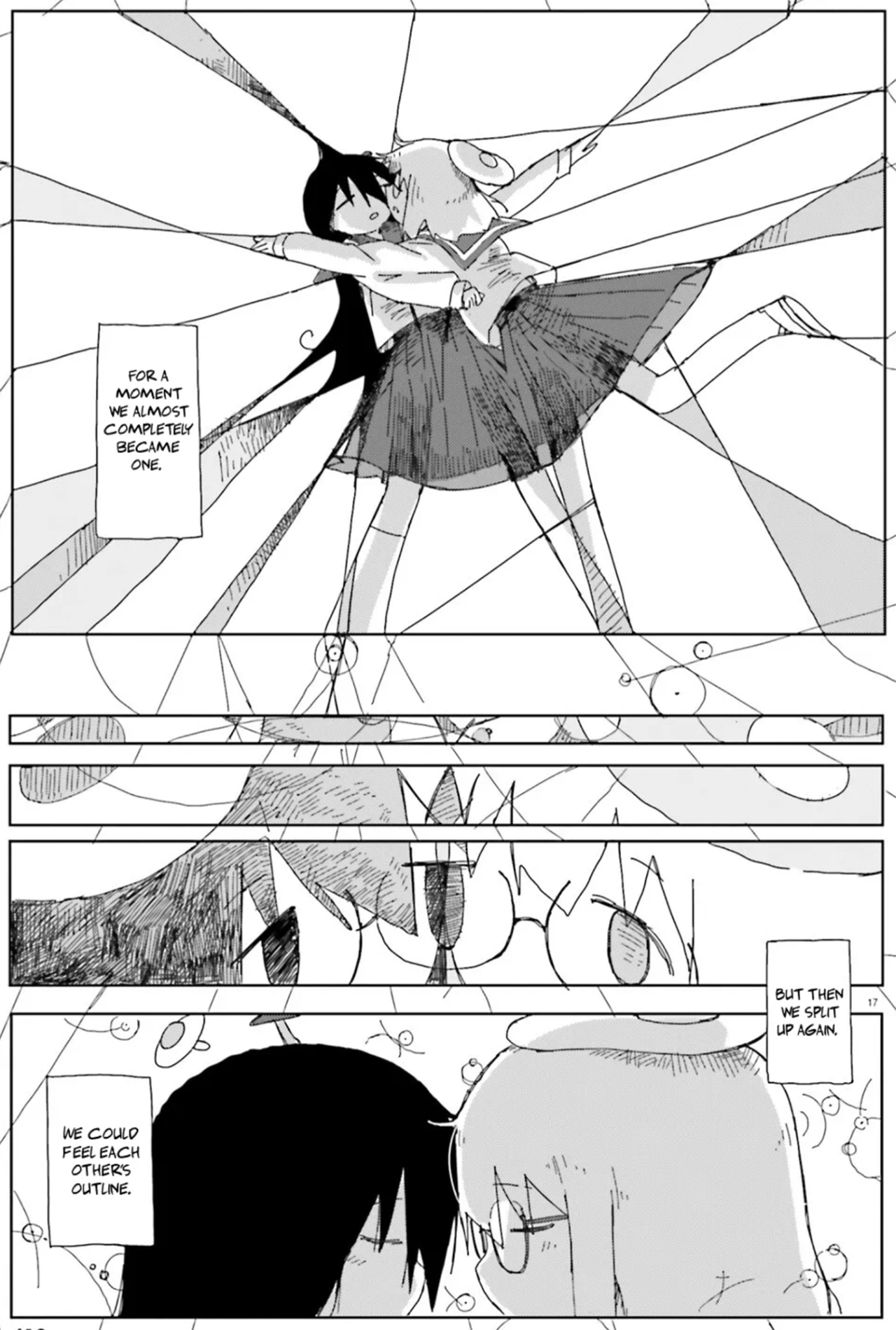
I recently read an interesting essay (here) whose author argues that Shimeji Simulation is about the barriers between people, why we need them, and what happens when they disappear. If everyone were able to get exactly what they want, what happens when the desires of separate individuals come into conflict? If there were a world perfectly tailored for one person alone, could anyone else live there? And, if you retreat into complete solipsism, what’s the point of being alive?
Toward the end of the manga, Shijima finds herself in a situation very much like her self-imposed hikikomori isolation in the beginning, when she lived entirely in the darkness of her closet. In the simulated world she comes to occupy through her sister’s rewriting of the universe’s code, Shijima doesn’t bother anyone, and she never has to deal with any external input that she doesn’t choose for herself. Still, can we really say that such pristine loneliness is preferable to the messiness of human relationships?
I read Shimeji Simulation as a story about the various ways that people communicate and connect with one another. Shijima never becomes a “normal” or friendly person, but she still manages to find joy and meaning in her interactions with other people, even if most of these interactions are nothing special. This is why, in the fifth and final volume of the manga, Shijima breaks the boundaries of her personal universe to find Majime, wherever her friend might exist in the fractured constellation of simulations.
“The meaning of life is to understand love” may seem cliché; but, given how strange and surreal her story becomes, Shijima’s realization feels significant and well-earned. Life is a constant shifting and melding of interpersonal boundaries, and communication and companionship are worth the pain and trouble of being human.
Shimeji Simulation is a remarkable work of science fiction. The manga may seem to have an unassuming beginning, but its narrative structure gradually builds, loops back in on itself, and continually starts over from a weirder and more nuanced position. Likewise, Tsukumizu’s art may initially feel sketchy, but this style is perfectly suited to express the uncanny glitches and fluid malleability of the setting. Shimeji Simulation is gentle and quiet, but also immensely intelligent and creative, and it’s a manga to contemplate and enjoy slowly while allowing yourself to be transformed alongside the characters and their strange but fascinating world.
Shimeji Simulation hasn’t received an officially licensed English translation, but a fan translation is currently available to read on Dynasty Scans (here). If you’re interested in a small taste of the manga’s tone, I’d also like to recommend the short fan anime adaptation of the opening chapter on YouTube (here).
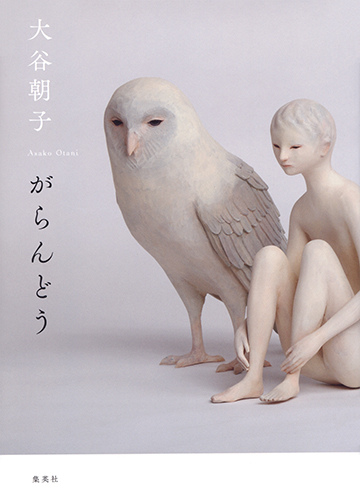
Asako Ōtani’s novella Garandō (がらんどう), which won the 46th Subaru Literary Prize in 2023, follows two 40yo women as they settle into a cozy life as adult flatmates.
Hirai recently moved in with her friend Suganuma, who suggested that they live together so they can afford a nicer apartment. The two women met as adults through their shared fandom of the boy band KI Dash, and they managed to remain friends during the pandemic despite drifting away from their other friends and family members.
Hirai works in an office, while Suganuma is a self-employed artist who uses a 3D printer to create custom memorial figurines of her clients’ deceased pets. The two women share chores and meals, sometimes cooking for each other and sometimes going out to eat. Although they’re not romantically involved, they often fall asleep together in the living room while watching KI Dash performances on DVDs that they play on an old PlayStation 2.
When Suganuma’s star idol suddenly marries an adult video actress, Hirai takes her flatmate to the beach for a breakup vacation. Afterward, Suganuma begins dating a married man she met at the hotel bar. Hirai is jealous but understands that this is simply the way of the world.
In resignation, Hirai signs up for a dating app, but this goes poorly. Her lack of success is partially because she’s aggressively targeted by someone involved in a multi-level marketing scam, but it’s mostly because Hirai is about as asexual and aromantic as someone can be. She has a vague aspiration of having a child one day, but is that really what she wants?
For Hirai’s birthday, Suganuma ends her relationship with the sleazy married man and uses her 3D printer to manufacture a baby as a gift for her flatmate. The story closes in much the same place it began, with the two women happy and secure in one another’s company. The title of the novella, Garandō, means “empty,” and it most directly refers to the hollow centers of Suganuma’s 3D-printed figurines. This title might at first be taken to refer to the relationship between Hirai and Suganuma as well, but their friendship is anything but hollow.
Because really, what’s to stop two adult women from spending their lives happily together as flatmates? Why do two people need to be married or related in order for it to be “normal” for them to live together? Is your life really “empty” if you don’t get married and have children?
More than anything, Garandō reminds me of Banana Yoshimoto’s bestselling 1988 novel Kitchen, which presents alternate models of modern families while comforting the reader that, even if you’re not “normal,” life is still well worth living. Granted, Hirai and Suganuma are older than the characters in Kitchen, and they’re not living in the lap of Japan’s bubble-era luxury. In addition, Ōtani’s writing style is relatively sardonic and dry, especially when compared to the bubblegum pop of Kitchen. Still, Garandō is a positive story about two weirdos who manage to find happiness. Even if their lives don’t follow the standard model, they’re doing okay.
At a slim 112 pages, Garandō is a quick read. Ōtani has a wonderful sense of pacing, juxtaposing scenes of comfort inside the home with scenes of (highly relatable) social awkwardness in the outside world. I really enjoyed this book, which pulls off something I appreciate – the normalization of “difference” without resorting to sentimentality or melodrama.
What Ōtani demonstrates in this meticulously crafted novella is that people like Hirai and Suganuma are less uncommon than you might think, and that’s cool. And honestly, given that a house and a nuclear family have become distant dreams for many of us, why not join them?
Takehiro Fukunaga’s 1954 novel Flowers of Grass is considered to be a classic of postwar Japanese fiction, and it’s the sort of book that I imagine many people envision when they think of “literature.” The main narrator is Shiomi, an intelligent but sad young man who’s deeply concerned with spiritual and philosophical matters. As the novel opens, Shiomi has opted to undergo a risky operation at a tuberculosis care facility. Knowing that he won’t survive, he leaves a handwritten account of his life before the war, when he loved and lost both a male classmate and that classmate’s sister.
If one reads Flowers of Grass “straight,” Shiomi is a passionate but pure-hearted young man who has a tendency to fall in love with the idealistic versions of people he creates in his head instead of the actual people themselves. If you’re me, however, it feels much more natural to read Shiomi as a closeted gay man who has an intense sexual crush on a fellow member of his high school archery club but feels obligated to transfer his affection to the boy’s sister once he enters college. Despite being a devout Christian, the sister loves the apostatic Shiomi and twice attempts to initiate a sexual relationship, but Shiomi finds himself unable to reciprocate her physical attraction.
Perhaps this is just my own personal bias, but I also picked up an element of homosexual attraction between Shiomi and the narrator of the novel’s frame story, a fellow patient at the tuberculosis sanitarium. In my reading of Flowers of Grass, the burgeoning romantic relationship between Shiomi and the frame narrator goes a long way toward answering the novel’s opening question: Why does Shiomi decide to undergo a dangerous operation that’s almost certain to be fatal? Essentially, Shiomi has decided to commit suicide, and the point of the testament he leaves behind is to explain why. The answer is complicated, but I get the feeling that Shiomi’s inability to come to terms with his queer sexuality is not inconsequential.
Putting the matter of sexuality aside, the bulk of Flowers of Grass is set during the late 1930s and early 1940s, and the story is of historical interest for its clear and unapologetic stance against the aggression of the Japanese imperial state. Shiomi is eventually drafted, and I think the author intends him to serve as a representative symbol of a typical Japanese soldier in that he really, really wasn’t cut out for the army. No sane military organization would want someone like Shiomi to be a soldier, but the Japanese Imperial Army was not sane.
The two love stories at the core of Flowers of Grass are intriguing, as is the mystery posed in its opening section. Unfortunately, the beginning of the novel is somewhat dull and meandering, and it takes an inordinately long time for the story to find its feet. In particular, your mileage may vary regarding how many dozens of pages of teenagers discussing philosophy you’re willing to wade through. Flowers of Grass requires patience, but it rewards thought and reflection.
As an aside, this novel was translated by Royall Tyler, who is famous for his translation of The Tale of Genji. I was curious about what Royall Tyler is up to these days, and I was amazed and delighted to find that he’s retired from academia to manage a llama farm. I highly recommend checking out his website (here), which is the most charming and wholesome thing I’ve encountered on the internet in a long time.