Dragon Palace

Dragon Palace collects eight surreal stories by award-winning and internationally celebrated author Hiromi Kawakami. These stories are contemporary fantasies about shapeshifters, talking animals, and interspecies romance that borrow from traditional folklore even as they express the psychological complexity of modern magical realism. Originally published in 2002, Dragon Palace is now available from Stone Bridge Press with a translation by Ted Goosen, who also translated Kawakami’s People From My Neighborhood.

The first story in Dragon Palace, “Hokusai,” is about the octopus who seduces the fisherman’s wife in the infamous ukiyo-e print. At least, that’s who the bum who persuades the narrator to go out drinking claims to be. The narrator is depressed and hates his life, so he easily falls under the sway of the stranger who tells him fanciful stories of his exploits as an octopus-turned-human as they drink their way across a shabby port town. At several points during the evening, the narrator sees his drinking companion shift and change. By the end of the night, the narrator’s own form isn’t as solid as it once was.

Although “Hokusai” defies allegory, I read it as a story about how sad men become shitty men as they gain confidence through the stories they tell one another about women. Despite his unapologetic misogyny, there’s an appealing earthiness – or saltiness, I should say – to the octopus man that I found oddly compelling. Like the narrator, I wanted to hear more of his stories, and I was happy to go along for the ride.

“Hokusai” holds a special charm for me as a fan of H.P. Lovecraft’s 1931 novella The Shadow over Innsmouth, a classic American horror story about a decaying New England town whose residents have started marrying with fishpeople. Like Lovecraft, Kawakami paints a detailed portrait of a grimy port town that has seen better days. Unlike Lovecraft, she offsets the strangeness of interspecies relations by focusing on the more mundane aspects of what it would be like to have an ocean-dwelling boyfriend who doesn’t pay rent. In fact, even more than The Shadow over Innsmouth, “Hokusai” reminds me of Yoko Tawada’s famous short story “The Bridegroom Was a Dog,” which transposes the persistent “beast husband” trope of East Asian folklore to everyday suburban life.

“Dragon Palace,” the title story of the collection, swims even deeper into fantastic waters. The narrator is a housewife visited by the pint-sized spirit of her great-grandmother, who was supposedly a medium at the center of a sex cult before she abdicated to become a wandering vagrant. “Dragon Palace” is a prose poem on heredity and generational legacies, and about how the seeds of mystery are buried in the heart of even the most prosaic housewife.

“The Kitchen God” is a more grounded exploration of the theme of the strangeness hidden in everyday life. A housewife named Izumi is having an affair with an older man named Sanobe. Along with her recreational shoplifting, Izumi believes this affair distinguishes her from the other housewives in her neighborhood. What she seems to take for granted, however, is that her thriving collection of houseplants has turned the inside of her apartment into a small ecosystem. Among the leaves and vines lives a creature Izumi calls “the kitchen god.” This god may or may not be one of the weasels said to have infested the apartment complex, but it’s clearly no ordinary creature.

Images of strange interior spaces continue in “The Fox’s Den,” which is about a middle-aged housekeeper who begins a quasi-romantic relationship with one of her clients, an elderly booklover who once owned a used bookstore and has since become a book hoarder. To the jaded eyes of the housekeeper, this man’s attachment to old books isn’t as remarkable as his foxlike tendencies.  

The housekeeper has been married twice before, once to someone she calls “completely human” and once to another man who had a tendency to behave like a fox. It’s never clear whether the animalistic traits of these characters are literal. Do they shapeshift like the octopus in “Hokusai,” or are these men animals only in the narrator’s imagination? This question is of no concern to Kawakami, who trusts the reader not to get caught up on minor details like “the nature of reality” as she explores the deep and essential weirdness of human beings.

The standout story in the collection is “Mole,” which was previously translated by Michael Emmerich in 2007 and published as “Mogera Wogura” in Kurodahan Press’s Speculative Japan anthology. In the slightly off-kilter world of the story, mole people live in human cities, where they go about their lives just like everyone else. “Mole” is narrated from the perspective of an adult male mole person, who lives with his wife in a hole. Although he’s a normal office worker, what’s unique about the narrator is that he collects humans who have lost the will to live:

The humans are bereft of energy—their faces are lifeless. Yet they are not dead. They live by eating away at their surroundings, at themselves, without ever moving. They remain with us in our hole without ever becoming moles themselves, waiting for the time when, still human, they can return to the world aboveground.

I’ve discussed this story in several of my literature classes, and it’s been my experience that students have a strong positive response. Although “Mole” could easily be read as horror, many students find it comforting to think that someone would pick them up and care for them during the days when they’re too tired to keep going. There’s a certain flavor of darkness to Kawakami’s writing that keeps her work out of the realm of being “wholesome,” but “Mole” comes the closest to a story that might be adapted into a short film by Studio Ghibli.  

I have to admit that I’m not a fan of modern retellings of fairy tales. I tend to find them tedious and awkward, especially when they’re pushed into the service of a political agenda. Don’t get me wrong – I’m all for feminism and gay pride and destroying monarchies. Still, what’s always been interesting to me about “traditional” folklore is how incredibly strange it is. Sigmund Freud was wrong about a lot of things, but I think he was onto something when he talked about how it’s the very absurdity of folktales that allows them to resonate with people regardless of time or place.

The stories in Dragon Palace lean into the more surrealistic elements of folklore in a way I find emotionally satisfying. For example, what does a story about bar-hopping with a shape-shifting octopus mean in literary terms? I’m not sure, but I’ve definitely had a few boozy nights like that myself, and “Hokusai” captures the truth of that experience in a way that a more mimetically realistic story couldn’t. Likewise, what does it mean that the narrator of “Dragon Palace” picks up the off-putting spirit of her great-grandmother and hugs her like a baby? I couldn’t say, but I’ve definitely felt that exact sense of unreality while playing with one of my nieces and realizing that she looks just like my grandmother.

What I appreciate most about Kawakami’s stories is that they’re marvelously entertaining to read. Although it can sometimes be difficult to relate to the characters, each new page holds a fresh surprise for the reader. Goosen’s translation perfectly captures the tone of the original Japanese, in which Kawakami writes the most outlandish things in the most casual and colloquial prose. The style conveys the sense that someone is telling you these stories directly, perhaps as you sit in a cozy bar filled with people whose shapes shift just out of the corner of your eye. Dragon Palace is a fascinating collection of oddities in which some stories are humorous and accessible while others are more poetic and surreal. I’d recommend this striking collection to anyone intrigued by the prospect of catching a glimpse of the wonders that lie just under the surface of everyday life.
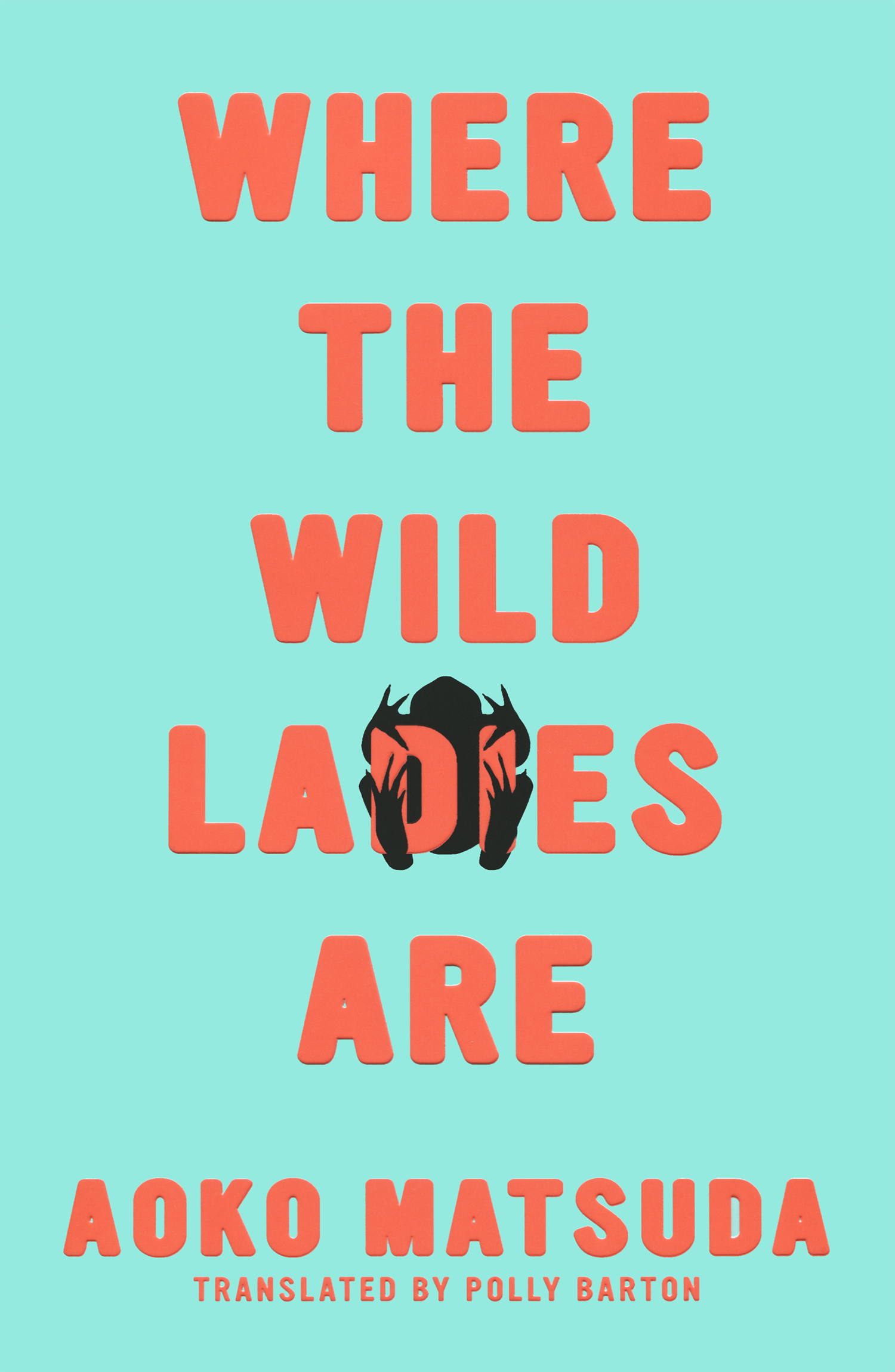
Where the Wild Ladies Are

Author: Aoko Matsuda (松田 青子)
Japanese Title: おばちゃんたちのいるところ (Obachan-tachi no iru tokoro)
Translator: Polly Barton
Publication Year: 2016 (Japan); 2020 (United States)
Publisher: Soft Skull Press
Pages: 271

Where the Wild Ladies Are collects seventeen short stories about the everyday lives of ghosts, demons, and yōkai in contemporary Japan. Although all of these stories are a bit strange, their tone is light and comedic, and all the hauntings are consensual.

My favorite story in the collection is “Quite a Catch,” which is about a young woman named Shigemi who has found herself in a romantic relationship with the ghost of a skeleton she inadvertently pulled out of the Tama River in Tokyo while fishing with a friend. The ghost, Hina-chan, appears outside of Shigemi’s apartment to thank her for dredging her bones from the riverbed. Shigemi is alarmed at first, but before long she and Hina-chan are chatting while watching television, not to mention bathing and sleeping together. Hina-chan’s nightly visits are a best-case scenario for the narrator, who has always wanted companionship without having to live with a spouse or roommate.

As the story notes in the back of the book explain, “Quite a Catch” is based on the comedic folktale Kotsutsuri (Skeleton Fishing) about a man who, after having heard a friend’s story about being thanked by the beautiful ghost of a drowned skeleton, goes to the river in an attempt to snare himself a supernatural girlfriend of his own but ends up fishing up the skeleton of the villain of a famous kabuki play.

Other stories in the collection feature other well-known figures from Japanese drama, lore, and legends narrated from unusual perspectives. “On High,” for example, is about a ghostly princess who haunts the beautiful hilltop Himeji Castle while it’s in the process of undergoing extensive renovations in the name of “historic preservation.” Meanwhile, “Enoki” is narrated by a sacred tree that is both frustrated and amused by the humans who insist on praying to it for various blessings, while “A Fox’s Life” is about a woman who’s been told she resembles a fox so often that she finally decides to go up into the mountains and become one.

“Smartening Up” is the first story in the collection, and it’s an excellent introduction to the author’s playful voice as she expresses the central theme of learning to embrace your weirdness and imperfections. The narrator begins the story obsessed with the darkness of her hair, spending a considerable amount of time and money on hair removal treatments while wishing she were born blond. On returning home after a rigorous session at an aesthetic salon one evening, she finds her aunt waiting for her in her apartment. This is something of a surprise, as her aunt had committed suicide in the wake of a failed love affair. Even more shocking, this aunt tells the narrator that she knows all about how she’s come to hate her appearance after being dumped. There’s nothing wrong with her hair, her aunt insists, especially since the fault lies with the piece of trash who cheated on her. The aunt assures her that her black hair is gorgeous, and that there’s no need for her to feel gross and ugly.

This story is loosely based on the Dōjōji legend, specifically the kabuki play Musume Dōjōji (The Maid of Dōjō Temple). The original story, in which a lustful woman is spurned by a celibate monk and turns into a giant snake to pursue him, is almost laughably misogynistic. The kabuki version, on the other hand, celebrates the woman’s serpentine transformation as an act of beauty and magic, with the dancer twirling in a robe that shines silver with the gorgeous gleam of scales.

The narrator’s aunt reminds her of the time they saw this play together and then admits that she’s still figuring out what her own secret power is. As the narrator considers the matter, she realizes that her own power is indeed in her hair. She begins eating hair-fortifying foods like liver and seaweed, helping her hair to become as monstrous and powerful as the snakes commanded by Medusa. She hides her demonic hair during the day but allows it to come out at night, brushing it to a high sheen and thinking about what sort of special skills she will learn in the future as she grows more comfortable wielding her magical power.

This may sound sentimental and a bit self-helpy, but the tone is actually very tongue-in-cheek and down to earth. The narrative voice, which is expertly captured through Polly Barton’s translation, is highly engaging. Many of the stories in Where the Wild Ladies Are were inspired by rakugo comedic storytelling, which is meant to be a bit salty and ridiculous. A set of brief notes concerning sources and inspirations is provided at the end of the book, but it’s absolutely not necessary to be familiar with the original legends to appreciate and enjoy the stories in the collection.

Although many of the stories in Where the Wild Ladies Are revolve around the theme of supernatural female empowerment, there’s no man-hating here – far from it. There are plenty of interesting male characters, including a time-traveling and dimension-hopping wizard who was inadvertently roped into the job and decided, like any good salaryman, just to stick with it. Although the reader doesn’t figure this out until late in the collection, all of the stories are loosely linked, with the various male and female characters managing to get along with each other in relative harmony.

Between the creative contemporary re-imaginings of folklore, the strong female friendships, the queer monster romance, and the general disdain for boring office jobs and awful bosses, the target audience of Where the Wild Ladies Are is specifically me, and I feel very seen and catered to. Still, Where the Wild Ladies Are should resonate with a broad readership. I suspect that a lot of anime fans and yōkai enthusiasts will be highly entertained by the collection, and the stories will appeal to anyone of any gender who enjoys clever comedy about how wild it is to live in the modern world.

Tales from a Mountain Cave

Tales from a Mountain Cave

Title: Tales from a Mountain Cave
Japanese Title: 新作遠野物語 (Shinsaku Tōno monogatari)
Author: Inoue Hisashi (井上 ひさし)
Translator: Angus Turvill
Year Published: 2013 (England); 1976 (Japan)
Publisher: Thames River Press
Pages: 134

In 1910, the famous ethnologist Yanagita Kunio published the Tōno monogatari, a collection of folk legends from the Tōno region of central Iwate Prefecture in northeast Japan. Although the authenticity of these records is debatable, the collection is extremely important and has influenced subsequent generations of folklorists, including the inimitable manga artist Mizuki Shigeru. In 1975, Robert A. Morse translated the work as The Legends of Tono.

Inoue Hisashi was born in Yamagata Prefecture, which is southwest of Iwate but still in the Tōhoku region. Although famous primarily as a playwright, Inoue is also known for his novels, many of which are humorous and contain elements of fantasy and science fiction. Tales from a Mountain Cave, or “The New Legends of Tono” in its Japanese title, is Inoue’s take on the Tōno monogatari, which he sets in the coastal town of Kamaishi, just east of Tōno.

If you’re not a professional historian or ethnologist, the Tōno monogatari can require quite a bit of study to fully appreciate. Robert Morse’s translation is remarkably well done, and the book is nicely published, but the work is still difficult to read for pleasure. Tales from a Mountain Cave, on the other hand, is a lot of fun.

The nine stories in Tales from a Mountain Cave are relayed to the narrator, a young man taking time off from college, by an old man named Inubuse Takichi, who lives in a small cave in the mountains behind the sanatorium where the narrator works. Initially drawn to Inubuse by the sound of his trumpet, the narrator forms a habit of spending his lunch break with the old man, who rewards him with a series of stories about his life.

In these stories, which span from the 1920s through the early postwar period, Inubuse describes his hardships, his various forms of employment, his romantic relationships, and the odd characters he’s encountered. Not all of these characters are human, and each of the tales focuses on a supernatural occurrence, many of which are the doing of the yōkai that inhabit the region. Inubuse’s recollections of these creatures are vivid and refreshingly original. To give an example from the second story, “House up the River,” this is how the narrator summarizes Inubuse’s description of river imps called kappa:

According to him, there were several thousand kappa in the Hashino River, but when in the water they were translucent, like jellyfish. In fact they couldn’t be seen with human eyes at all. Once they were out of the river they took the form of children or travelers. In the mountains they appeared as monkeys or phesants. They could change size as well as appearance – a thousand kappa could hide in the puddle of a horse’s hoof print.

Far from being remixed or modernized versions of legend fragments, each story has a clear and compelling narrative arc; and, although they’re all connected, all but the last of the stories (which ties everything together) can be read by itself. The major theme of the collection seems to be the inability of human beings and yōkai to coexist, which can be understood as representing a fundamentally antagonistic relationship between human society and the dangerous wilderness of the Tōhoku region. If you’re looking for the sort of religious messages common in medieval Japanese folktales, they’re practically nonexistent, but Tales from a Mountain Cave does offer plenty of sexuality and earthy humor.

I really enjoyed this collection. It’s colorful, charming, and highly entertaining. Even if you’re not familiar with Japanese history or folklore, you’ll still enjoy Inoue Hisashi’s outrageous stories and charming prose.

Review copy provided by Thames River Press.

The Night Parade of One Hundred Demons

The Night Parade

Title: The Night Parade of One Hundred Demons
Author: Matthew Meyer
Publication Year: 2012
Publisher: Amazon CreateSpace
Pages: 224

The Night Parade of One Hundred Demons, which began its life as a Kickstarter project, collects roughly four dozen entries on various yōkai, which are accompanied by lavish full-color illustrations. Both the pictures and the text are by Matthew Meyer, an artist heavily influenced by Japanese prints. Meyer has lived in a rural town in Fukui prefecture since 2007, and, as he explains on his Kickstarter page, he has been collecting and translating local folklore for years. There are a number of other books on yōkai available for digital download (such as Matt Alt and Hiroko Yoda’s fantastic Yokai Attack!), but what The Night Parade does especially well is to add regional color and variety to Japanese legends of supernatural creatures that may already be familiar to many Japanophiles.

Compiled in such a way as to resemble an illustrated bestiary, The Night Parade is divided into several sections, which include “In the Wilds,” “Out on the Town,” and “In the House.” The book includes entries on yōkai that appear frequently in popular media, such as the kappa, the kirin, the kitsune, the tanuki, and the yuki onna, as well as many lesser-known creatures, such as the bake kujira (an enormous ghostly whale), the jorōgumo (a man-eating spider), and the nuppepō (a flabby, stinky lump of flesh that lives in temple graveyards), and the nopperabō (who looks and acts like an ordinary person but has no face). Each entry contains information on the diet and appearance of these yōkai, their behavior, their interactions with human beings, and the various forms they may take, as well variations on and translations of their names.

Many of the entries are also peppered with interesting information about the historical and cultural contexts of these creatures. For example, the entry on the takanyūnō, or “tall priest,” contains a special section on why suffixes relating to Buddhism and Buddhist priests are so common in the names of yōkai. (Apparently, it’s not so much a connection to religion as it is a certain wariness regarding traveling priests, or at least strangers dressed as traveling priests.) The entry on the kerakera onna, a gigantic “cackling woman” who haunts the alleyways of red light districts and hounds men into their graves with her incessant laughter, alludes to the tendency in Japanese folklore to grant great power to long-lived things, whether they be cats (which become neko mata) or eating utensils (which become tsukumogami), and surmises that prostitutes who managed to live into middle age may well have become yōkai, an interesting conjecture that leaves the mind to wonder about what such a bit of folklore might correspond to in a less numinous context.

Meyer has published his work through Amazon’s CreateSpace program, which offers both print and digital versions of the collection. I can’t offer an opinion of the physical copy of The Night Parade, but the digital edition is beautifully formatted, and its images are of extremely high quality. Although the book is relatively kid-friendly, it includes frank (although far from explicit) references to prostitution and human sexuality. Most of the images are stylized as colorful and cute or understated and eerie, but a few (such as the illustration of the ubume, a spirit of a woman who has died during childbirth) may be too intense for younger readers. My honorary nieces and nephews have been delighted by pictures like the illustration of the onryō, a vengeful ghost who is depicted as a pale shrieking woman bleeding from her eyes, but discretion might be advised for more sensitive children.

Meyer has recently launched a successful Kickstarter project for a second collection, titled The Hour of Meeting Evil Spirits, so expect another excellent illustrated bestiary from him soon!

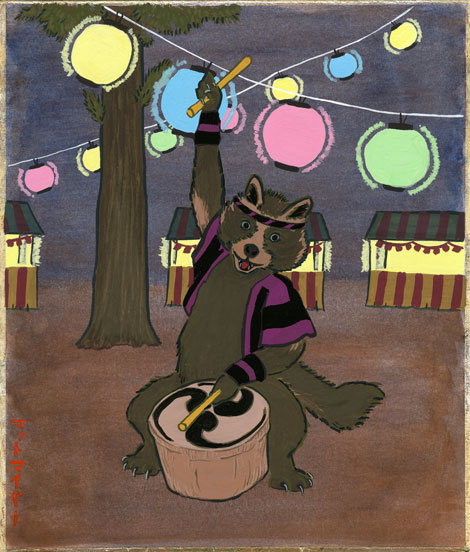
Matthew Meyer - Tanuki