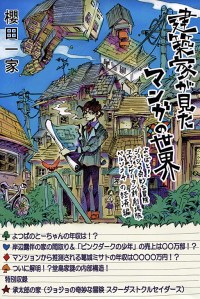
Title: Manga through the Eyes of an Architect: The Economics of Yotsuba&!, Jojo’s Bizarre Adventure, Evangelion, and Persona 4
Japanese Title: 建築家が見たマンガの世界:よつばと!、ジョジョの奇妙な冒険、ヱヴァンゲリヲン新劇場版、ペルソナ4の経済編 (Kenchikuka ga mita manga no sekai: Yotsubato, Jojo no kimyō na bōken, Evangerion shingekijōban, Perusona 4 no keizaihen)
Author: Sakurada Ikka (櫻田 一家)
Publisher: Gloria Earth Technology
Publication Year: 2015
Pages: 199
In his preface, architect Sakurada Ikka explains that the idea for this book came about through a conversation with a group of friends at a bar. A young editor, referring to the adage that “a good novel will make its protagonist’s economic circumstances clear,” wondered if the same could be said for manga. Sakurada, knowing full well that someone’s home reflects their socioeconomic status, posited that any story with solid worldbuilding would give the reader a clear picture of the living space of its characters. Once he set about investigating this issue, however, he realized that there were a great many gaps lurking in the shadows of even the most solidly constructed manga (and anime, and video games). Manga through the Eyes of an Architect thus functions as a set of close readings that attempt to fill in these gaps.
Sakurada opens his book with a precise examination of Yotsuba&! in an attempt to hammer out the details of its setting. For instance, when does it begin? (Probably July 18.) Where in Japan is Ajisai City, the fictional town where Yotsuba and her adoptive father Koiwai Yōsuke live? (Probably in Chiba Prefecture in the general vicinity of Narita airport.) What direction does Yotsuba’s house face? (Probably south.)
Sakurada uses evidence not only from passages in the manga but also from his own real-world research and observation. For example, in trying to figure out where Koiwai’s parents live, Sakurada argues that, since Koiwai borrowed a light cargo truck (a 2001 Mazda 660KU series, to be exact) from his friend Jumbo to move from his parents’ house to Ajisai City at the beginning of the first volume of the manga, he probably wasn’t traveling for more than a few hours. The “New Pione” label on a package Koiwai’s mom sends him (in Chapter 27 of Volume 5) would seem to indicate Okayama Prefecture, but that’s too far away, so it’s probably coming from nearby Yamanashi Prefecture, a somewhat lesser-known source of the brand’s grapes.
When I wrote “a precise examination” earlier, that’s the level of precision I mean. Sakurada does walkthroughs of his reasoning like Sherlock Holmes, and it’s fascinating to read through his evidence and conjectures.
The next section of the book investigates the floorplan of Kishibe Rohan’s house from Part 4 (the “Diamond Is Unbreakable” arc) of Jojo’s Bizarre Adventure. Despite Araki Hirohiko’s comment that his manga isn’t popular in America because Americans have no sense of style, all of the homes of the major characters exhibit classically American architecture. Sakurada teases out the layout of Rohan’s house room by room while discussing the history of the architecture and the furniture. As an American, I enjoyed seeing things I take for granted, such as Queen Anne houses and Mansard roofs, being treated as fascinating – and expensive! – foreign oddities. Sakurada tries to puzzle out how successful Rohan is as a manga artist by referring to the information presented in the manga Bakuman (about two manga industry hopefuls). For example, how many manga would Rohan need to sell in order to afford his Porsche 928 GTS? How do Rohan’s sales compare to the sales of Jojo’s Bizarre Adventure? Was this sort of wealth achievable for a manga artist in the late 1990s?
Sakurada continues with an analysis of the Rebuild of Evangelion movies (released in 2007, 2009, and 2012). In order to figure out how much Ikari Shinji’s guardian Katsuragi Misato is paying for her apartment, he argues that we must first understand how the catastrophic “Second Impact” event affected the earth. Since the viewer is told this disaster melted the polar ice caps, Sakurada employs math and maps to demonstrate what parts of Japan would have been submerged. He also speculates on how various Japanese industries would suffer from the resulting climate change, as well as how this would affect local economies and regional infrastructures within Japan.
Sakurada’s main concern in this section, however, is Misato’s annual salary. Her apartment accommodates herself, her pet penguin, two teenagers who get their own bedrooms (Shinji and Asuka), plus tons of extra space for her garbage, including a nice kitchen and living room. Given the state of Japan’s postapocalyptic economy, Misato must be doing well for herself in order to afford such a large place. (I guess NERV has to pay people the big bucks to put up with Shinji’s asshole father.) In addition, Sakurada gives a detailed analysis of each character’s room, providing an interesting set of insights. For instance, Shinji’s haplessness is emphasized by the fact that the room he’s given in Misato’s huge apartment is tiny and has no windows. Sakurada concludes with an estimate of Shinji’s dad’s salary, arguing that the women in Shinji’s life should really consider being nicer to him.
The final section of the book, which is by far its shortest, is about “The Mysteries of the Dōjima House.” The Dōjima house is the residence of the protagonist of the 2008 PlayStation 2 game Persona 4. Although a wealth of material related to the game and its 2011-2012 animated adaptation (not to mention several spin-off titles) has been released, Sakurada has been able to find numerous inconsistencies in the official floorplans of the quaint Shōwa-era structure that serves as the player’s (or viewer’s) home base. Where is the staircase, exactly? What’s filling all the space that’s unaccounted for on the second floor? Where’s the bathroom?
Although it helps to be familiar with the source texts under discussion, this is not necessary in order for the reader to enjoy his speculation and analysis. No prior knowledge of architecture is required, and Sakurada’s clear explanations and frequent illustrations render his arguments accessible to even a casual reader.
Granted, both the information presented and Sakurada’s readings are highly specific. In fandom terms, what Sakurada is performing would be referred to as “textual meta,” meaning that his analysis is so minute and self-referential that it might not make sense to people outside the fandom. As I wrote above, I don’t think this is true – I know very little about Jojo’s Bizarre Adventure but still enjoyed reading Sakurada’s essays on its architecture and economics.
Still, it brings up an interesting point concerning how manga and other pop culture texts should be discussed in an academic context. Is it absolutely necessary to reference larger social, historical, and intellectual currents, or are we allowed to dig our heels into the text itself in order to make it more meaningful? In my opinion, Manga through the Eyes of an Architect is close reading done right, and I can only hope that more formal English-language discussions of manga in this mode of inquiry appear as the related fields of Comics Studies and Anime and Manga Studies continue establish themselves.

 Contemporary Japanese Literature