Astral Season, Beastly Season

Tahi Saihate’s Astral Season, Beastly Season (translated by Kalau Almony) is a novella about toxic high school friendships and girl group fandom gone horribly wrong.

In the first half of the book, a junior in high school named Yamashiro writes a letter to an unpopular “underground idol” named Mami Aino. Mami, who is still in high school herself, was arrested on the charge of murdering her ex-boyfriend. Another boy in Yamashiro’s class, Morishita, takes the news poorly and decides to commit a series of copycat murders so that he can confess to the crime Mami committed and take the fall in her place.

Unlike Yamashiro, Morishita is attractive, popular, and a model student. Why he’s a fan of a fledgling girl group with such a small following is unclear, and it seems like an incredible coincidence that both Yamashiro and Morishita would be attracted to the same super-indie performer. Although Yamashiro doesn’t seem to be aware of this, I strongly suspect that Morishita is much more attracted to Yamashiro than he is to Mami.

Regardless of motive, Morishita’s intention to commit murders is sincere, and he wastes no time getting started on his grim task.

The second half of the book takes place several years later, when Morishita’s childhood friend Aoyama meets up with Watase, a high school classmate of one of Morishita’s victims. Watase accuses Aoyama of portraying the murderer as “an all-around good guy” in an interview he gave to a tabloid magazine, and she wants him to apologize. Before the two of them get a chance to have a proper conversation, Aoyama is contacted by the brother of another of Morishita’s victims. This young man also wants closure, but what was going on in Morishita’s head will forever remain a mystery.

I have to admit that Astral Season, Beastly Season left me cold. More than anything, this is a book about the friendship dynamics of a small group of high school students. The novella doesn’t dwell on the psychology of the criminals, nor does it offer much description of what underground idol culture is or what it’s like to participate in this sort of fandom.

Instead, the reader is inundated with inane details about who is friends with whom, and who does and doesn’t walk home together, and who ignores other people on the train, and who went to a café together, and who is and isn’t talking to whom, and who said something mean after class, who doesn’t want to be in a group together on a school trip.

Amidst the swirl of teen friendship drama, the actual murders seem like little more than an afterthought. Were it not for the second half of the book, one might even argue that Yamashiro and Morishita are just pretending to plan and commit crimes. In fact, I tend to think that the story might actually be more interesting if this were the case. None of the characters has anything particularly insightful to say after the time skip, and the reader never learns anything about what Mami or Morishita might have been thinking or feeling. It’s all a bit disappointing.

There are two points of comparison that might bring the novella’s story into sharper contrast. The first is Yukio Mishima’s classic novel The Temple of the Golden Pavilion, a psychological drama about the (heavily fictionalized) young man who set fire to the eponymous landmark in 1950. It’s a gorgeous piece of writing, and Mishima is fascinated by the mind of a teenage loner who commits a serious crime, especially with respect to how this crime results from an intense homoerotic friendship. Another interesting companion novel is Rin Usami’s Idol, Burning (which I reviewed here), which I feel offers a much more sensitive and astute portrayal of the role that pop music fandom can play in the life of an emotionally precarious teenager.

I get the feeling that Astral Season, Beastly Season might have benefitted from a translator’s afterword explaining who the writer is and what the context for her work might have been. It might be a worthwhile project to discuss this novella in a college class or an academic paper, especially given Tahi Saihate’s status as an internet-famous visual artist who uses text to create eye-catching public art installations, but I’m not sure it stands on its own as a work of fiction. 

If nothing else, the novella is painfully honest about how high school friendship drama can feel life-shattering and world-changing to the people involved. Still, whether this sort of story is worth spending time with really depends on the interests and taste of the reader. It wasn’t for me, but perhaps a younger reader might feel a stronger sense of immediacy and connection to a beautiful high school boy who commits terrible crimes.

First Love

Rio Shimamoto’s 2018 novel First Love is a psychological mystery about a beautiful college student who has been arrested for the murder of her adoptive father. Although it tackles serious themes, this story is compulsively readable. All of the characters bring emotional baggage to the table, and Shimamoto teases out the reader’s sympathy as each of their histories is revealed.

Yuki Makabe is a clinical psychologist who specializes in parenting and childcare. She’s ambitious, and she’s on the verge of making a career transition to media appearances and popular audience articles. When Yuki’s brother-in-law, Kasho, is assigned to the high-profile case of Kanna Hijiriyama, a college student accused of killing her father, he asks Yuki to help him interview the young woman in order to ascertain her motive. Yuki’s prospective editor at a major publisher, a friendly young man named Tsuji, asks her to write about the case, so she agrees.

Yuki is happily married to an internationally famous photographer who supports her career by shouldering the majority of the responsibilities involved in the care of their son. Despite her loving relationship with her husband, Yuki has a troubled past with Kasho that neither of them is willing to discuss. While she and Tsuji work together on Kanna’s case, Yuki must navigate her strained relationship with Kasho, who is very charming but a bit of an asshole.

Kanna presents Yuki with another set of challenges. To begin with, Kanna can’t explain why she wanted to hurt her father, or even whether she intended to hurt him in the first place. But, if she never meant to attack him, what was she doing with a knife? To make matters more complicated, one of Kanna’s college boyfriends gives an interview to a tabloid magazine and says that Kanna went crazy after they broke up. Even Kanna’s own mother claims the young woman is crazy.

Yuki is convinced that Kanna is far from “crazy,” but the truth of the matter is elusive. Kanna is traumatized by the death of her father, and Yuki quickly realizes that the young woman’s trauma is much more extensive.

Based on the title of the novel and the relationship between Kanna and the person she may or may not have killed, a reader might suspect that there is underage incest involved. I hope I can be forgiven for spoiling the story by saying that, thankfully, this is not the case. Regardless, Kanna didn’t have a happy home life as a child. 

I’m afraid that some readers may find Kanna frustrating, but her portrayal feels extremely realistic to me. I definitely knew people like this in high school and college. Generally speaking, these girls (and occasionally boys) were intelligent and competent, but they had a habit of saying whatever they needed to say to diffuse an awkward situation. 

This behavior wasn’t “lying” or “being dishonest” so much as it was a manifestation of fawning, an alternative to the “fight or flight” response that’s common in young people who live in hostile home situations. Instead of fighting their parents or running away from home, “well-behaved” children and teenagers will contort their speech, emotions, and understanding of reality to ease tension. Issues often arise when this behavior carries over to romantic and professional relationships that would benefit from honesty.

Although this element of the story isn’t presented as a mystery to be solved, Yuki is confronted with the issue of whether Kanna truly consented to sex with two of the key romantic partners in her life. I can completely understand how the men involved might have understood Kanna’s words and behavior as expressing consent, but I also understand how Kanna could later admit that sex isn’t what she wanted, and that she was just going along with what was expected. As the author demonstrates, Kanna’s inability to understand her own boundaries is directly related to the emotional abuse she endured as a child.

Shimamoto doesn’t lean into an overtly feminist message, but there are multiple points in the story when Yuki comes into contact with the sort of ambient misogyny that might compel a vulnerable young person like Kanna to second-guess her own emotions and sense of self-worth. At the beginning of the novel, for example, Yuki reflects on a conversation between a male television producer and his younger female colleague that she overheard as she entered the studio.

As I was getting my makeup done, I examined my own features: not bad, but not particularly beautiful either. A face with no distinctive features. The only thing that stood out was my collarbone, protruding above my shirt.

I’d met that male producer several times previously, but he’d never once made eye contact with me. There were men like that everywhere in the television industry – men who wouldn’t engage in conversation with women they’d give less than an eight out of ten on looks. Men who thought nobody would notice this behavior. Or maybe they just thought it didn’t matter. These were men who had never suffered a single setback in their lives.

This is the sort of observation that, while eminently relatable to many people, would have Yuki called crazy if she spoke it out loud. It’s not “misogyny” or “sexism” if the male producer isn’t doing anything wrong, right? It’s not like he actually said anything offensive to Yuki, or to his younger colleague. This man’s behavior is rancid, but no one will ever call him out on it. Yuki has a supportive family and professional colleagues who aren’t human garbage, so she can cope. But what about Kanna, who hasn’t yet found a support network to replace her abusive family?

What Shimamoto criticizes in First Love are the gendered aspects of a social system that allows toxic men to flourish. First Love doesn’t offer easy solutions, but Shimamoto demonstrates that we can all be allies in pushing back.

Yuki’s husband is a prince from start to finish, and her editor Tsugi is able to see what happened to Kanna with clear eyes while re-evaluating his own perspective and never apologizing for the bad behavior of other men. Kanna’s defense lawyer Kasho has issues of his own due to childhood abuse at the hands of his mother, but he’s an adult who is capable of realizing his limitations – which is why he arranges for a series of meetings between Yuki and Kanna in the first place.

Without spoiling too much of the plot, First Love connects the stories of a number of characters who begin to question their past behavior in light of Kanna’s upcoming trial, and Shimamoto helps the reader to sympathize with these characters even when they behave badly. The point is not that men are evil or that women are innocent victims. Rather, it’s important to extend empathy instead of overlooking questionable behavior.

Putting the social relevance of the novel’s themes aside, First Love is a fun book to read. I got sucked into the story immediately. Like Yuki, I was instantly intrigued by the mystery presented by the death of Kanna’s father. Kasho’s defense argument during Kanna’s trial felt like a major revelation unfolding before my eyes, and I admire how carefully Shimamoto laid each brick in the wall. Louise Heal Kawai’s translation is featherlight and flawless and sets the tone perfectly.

I’d recommend First Love not just to fans of mystery and suspense, but to any reader interested in a compelling character drama that offers a number of different perspectives on family, mental health, and the darker aspects of everyday interactions that often go overlooked.

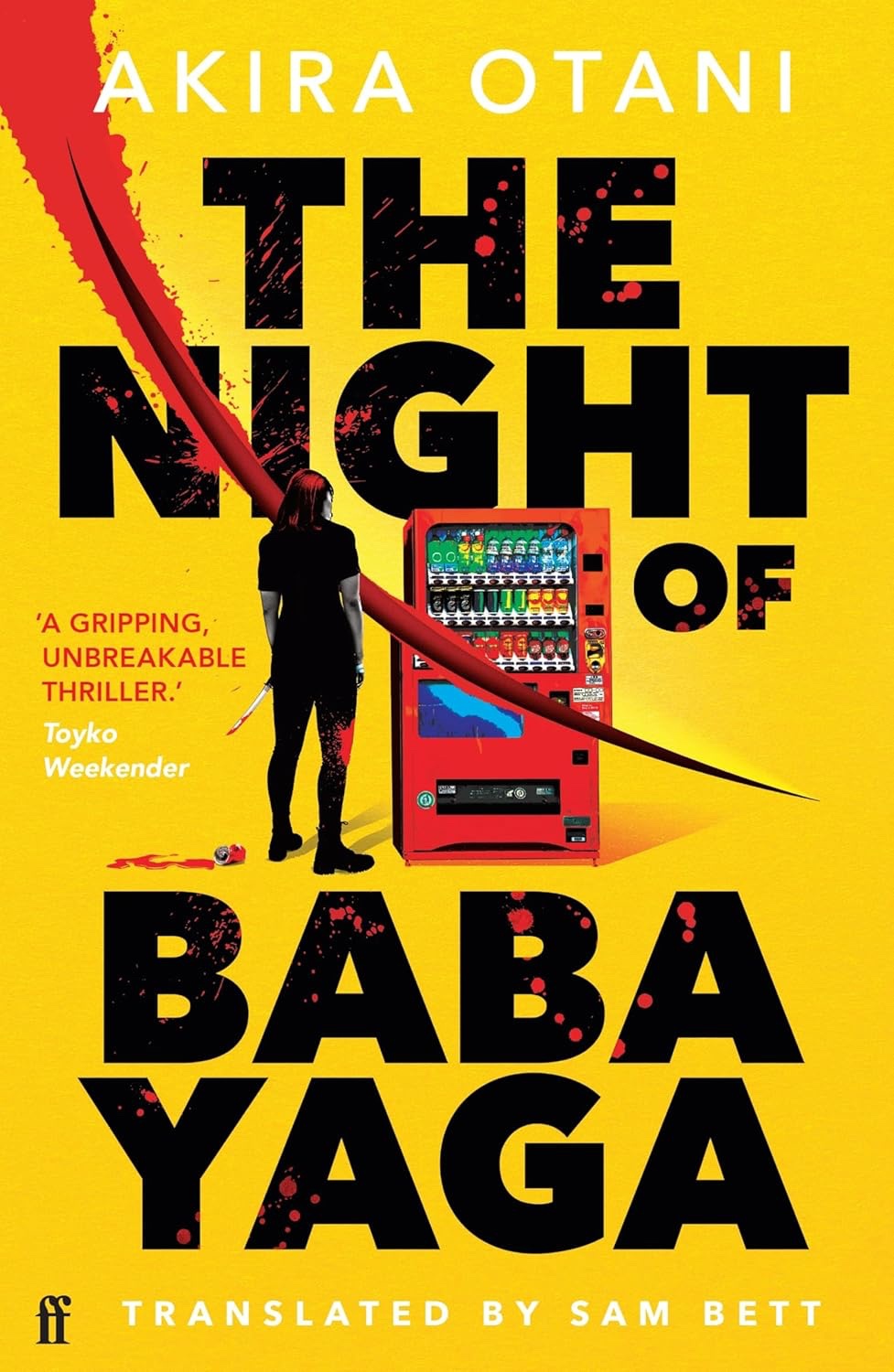
The Night of Baba Yaga

The Night of Baba Yaga is two hundred pages of violence, torture, and rape. All of the novel’s descriptions of violence, torture, and rape are graphically explicit; and again, there are two hundred pages of them. I enjoyed this book, but it’s not for everyone.   

The bulk of The Night of Baba Yaga is set in Tokyo in 1979. A 22yo street brawler named Yoriko Shindo is pressed into the service of a notorious yakuza crime syndicate whose boss has ordered her to become the chauffeur for his precious only daughter, a prim-and-proper college student named Shoko. The yakuza boss assumes that, because Shindo is female, she won’t attempt to romance Shoko, but of course the two women fall in love and help each other escape the family.

I’d like to say that The Night of Baba Yaga is a love story, but it’s more of a series of fight scenes occasionally broken by scenes of torture and rape. The novel begins and ends with Shindo getting the shit beaten out of her, and most of the gaps in the fighting are created by the aforementioned torture and rape. I’m not saying this is a bad thing. The Night of Baba Yaga is what it is, which is a lesbian BDSM hurt/comfort fantasy in which male characters enact hurt so that female characters can provide comfort. Aside from the brief comfort scenes, there’s not much romantic chemistry or character development.

The Night of Baba Yaga is empowering for the woman who wrote it, no doubt, and I get the sense that there will be queer readers (such as myself) who will be amused to see this sort of openly horny fantasy in print. The Night of Baba Yaga isn’t empowering for any of the characters, however. Short interstitial chapters jump ahead in time, but I hope it’s not a spoiler to say that nobody gets a happy ending. Not in this sort of story. The tragedy is so over-the-top it’s Shakespearean.

Personally, I thought the ultraviolence was a lot of fun. The action is so gory and exaggerated that it’s difficult to take seriously, and The Night of Baba Yaga feels silly and campy in the same way that Takashi Miike movies like Ichi the Killer do. If you (like me) are a fan of the horror movie mindset that inspires you to cheer with delight when somebody’s hand gets chopped off, The Night of Baba Yaga delivers.

The translator, Sam Bett, has done an amazing job. Fight scenes are notoriously difficult to write, yet the translation is snappy and remarkably fast-paced. The character voices aren’t “natural” by any means, but they’re pitch-perfect for the genre. When it comes to descriptions of rape and violence, Bett doesn’t pull any punches. It’s an incredible translation, and I am in awe.  

I’ve seen social media reviews hailing The Night of Baba Yaga as “an inspirational queer romance,” and it 100% most definitely is not that. Nobody does any learning or growing in this story, which has exactly zero social commentary. Rather, The Night of Baba Yaga is an adrenaline-laced lesbian power fantasy about being the most badass fighter you can be until you die. If you’re not the target audience, The Night of Baba Yaga probably isn’t for you. Like Wolverine, it’s the best at what it does, and what it does isn’t very nice. This short and compulsively readable novel gets in, gets messy, and gets what it came for.

Tokyo Express

Seichō Matsumoto’s Tokyo Express is a slim mystery novel from 1958 whose crime is largely dependent on train schedules. Although two apparent victims of suicide appear to have traveled together to a lonely seaside town, were they in fact being pursued…?

The officer assigned to the case, a young detective named Mihara, suspects the involvement of the president of an industrial manufacturer with close ties to the government. Mihara assumes that his prime suspect, an affable middle-aged gentleman named Yasuda, was attempting to cover up an illegal collusion.

As Mihara pursues various train schedules across the Japanese archipelago, he learns that Yasuda’s elaborate system of alibis checks out. But, if Yasuda didn’t murder the two victims, who could have been helping him?

For me, there were far too many timetables in Tokyo Express, and I found myself skimming to avoid getting bogged down in the numbers. No one in the story has much of a personality, and Mihara is mostly a cipher for the reader. Despite the plot’s emphasis on travel, the locations that Mihara visits don’t really have a sense of place or setting.

I’m given to understand that there are many mystery fans who appreciate this style of writing, namely, just the facts with little by way of atmospheric description. If you’re looking for a puzzle box in book form, Tokyo Express has a lot of fun moving parts to play with. If you read mysteries more for the story, however, it might be better to take a pass on this particular ride.

Japanese Suspense Novels by Female Authors

The Memory Police by Yoko Ogawa
Normal people quietly go about their lives on a sleepy island where memories collectively vanish a bit at a time. But what happens to the people who can’t forget?

Masks by Fumiko Enchi
Two cultured and handsome men compete for the affections of a beautiful young widow while her devious mother-in-law manipulates their relationships from the shadows.

The Woman in the Purple Skirt by Natsuko Imamura
The Woman in the Yellow Cardigan is intrigued by the Woman in the Purple Skirt – so intrigued that she follows her every move and investigates every detail of her private life.

All She Was Worth by Miyuki Miyabe
Pursued by debt collectors, loan sharks, and yakuza henchmen, a woman vanishes, leaving behind a trail of false identities and broken lives.

The Eighth Day by Mitsuyo Kakuta
A desperate woman, spurned by her married lover, kidnaps his child and goes on the run. Now an adult, the kidnapped child has no memory of this and must piece together what happened from interviews and newspaper clippings.

Penance by Kanae Minato
A young girl is assaulted and killed in a small rural town, and the murderer is never caught. Years later, a series of letters from the girl’s mother forces her former friends to reflect on what they knew and what they could never tell anyone.

The Graveyard Apartment by Mariko Koike
A family moves into an inexpensive apartment next to a graveyard, but their hopes for a new life are shattered as strange and inexplicable things begin to happen in their building.

There’s No Such Thing As An Easy Job by Kikuko Tsumura
A woman suffering from burnout leaves her white-collar position and goes to a temp agency, requesting that she be placed in an “easy” job. There’s no such thing as an easy job, however, and it stands to reason that companies who are desperate for temp workers have shady ulterior motives.

Convenience Store Woman by Sayaka Murata
An unmarried woman finds joy and meaning in the comfortable routine of working at a convenience store. When pressured by her family and friends to quit her job and find a partner, how far will she go to prove that she’s “normal”?

Real World by Natsuo Kirino
A teenage boy from an affluent Tokyo suburb kills his mother in a fit of explosive rage. The friends of the girl next door decide to help him escape and gradually succumb to the darkness at the core of their seemingly perfect lives at a prestigious private high school.

. . . . . . . . . . . . . . .

The illustration above is by James of ShelfWornDrawn, whose work can be found on Instagram (here) and on Tumblr (here). You can commission a portrait of your own library via his Etsy page (here).


The Aosawa Murders

The Aosawa Murders
Japanese Title: EUGENIA (ユージニア)
Author: Riku Onda (恩田 陸)
Translator: Alison Watts
Publication Year: 2005 (Japan); 2020 (United Kingdom)
Publisher: Bitter Lemon Press
Pages: 315

In 1973, in a small seaside town on the west coast of Japan, the prominent Aosawa family and their guests were poisoned with cyanide during a birthday party, an incident resulting in the death of seventeen people. Makiko Saiga, who was a child at the time, later interviewed people connected to the family for her senior thesis, which ended up becoming a true-crime bestseller titled The Forgotten Festival. Makiko never published another book and refused to give interviews, and the sole survivor of the Aosawa family, a young woman named Hisako, married and moved to the United States. When the man who delivered the poisoned alcohol to the party committed suicide, the police closed the case.

Thirty years after the incident, however, it becomes apparent that there may be more to the story. There are fourteen chapters in The Aosawa Murders, each narrated from the perspective of someone once connected to the Aosawa family or the publication of The Forgotten Festival. Makiko Saiga is polite yet evasive. Her research assistant knows that there are small departures from reality in her account but doesn’t know what to make of them. The detective who investigated the case is convinced that Hisako Aosawa is responsible for the murders but can’t quite prove it. Someone who knew the supposed culprit believes the young man was manipulated by a mysterious woman. A handful of other people, such as Makiko’s brother and the daughter of the Aosawa family’s housekeeper, offer additional intriguing anecdotes.

The Aosawa Murders is a slow burn. For the first two-thirds of the novel, the reader has no choice but to take each separate account as it comes while trying to pick out the connecting threads, which initially seem to be few and far between. The Aosawa Murders respects the intelligence of its reader by presenting information impartially and without cliffhangers, false leads, or red herrings. The circumstances surrounding the mystery are compelling enough to warrant sustained attention, but the carefully measured narrative pace allows the reader to take time with each account without being driven to rush forward.

When things begin to come together in the last hundred pages, the true brilliance of the story becomes apparent. The final two chapters focus on Hisako Aosawa (now Hisako Schmidt) and Makiko Saiga, and I couldn’t help but fall in love with both of them. After hearing so much about them from secondhand accounts, the down-to-earth reality of their actual personalities is refreshing. Regardless of what each of them may or may not have done, the author reminds us that both of these women are far more than archetypes in someone else’s story.

Although an astute reader will have formed several theories about what happened, the novel never presents a simple and neatly packaged explanation. The ending is fragmented and recounted in a jarring manner that serves as one of the strongest clues concerning the identity of the narrator who has presumably assembled the accounts that appear in the story. I can imagine that some people may find this sort of open-ended conclusion anticlimactic, but it was extremely satisfying to me.

I have to admit that I enjoy formulaic murder mysteries in which everything is neatly arranged and fits together perfectly at the end. The Aosawa Murders is not that type of story, however – not by a long shot. Instead, the novel is a sprawling puzzle that rewards the reader’s active attention and engagement. This is not a book that can be read in an afternoon. Thankfully, the strength of the writing and the quality of the translation encourage sustained reflection and speculation. I had an enormous amount of fun with The Aosawa Murders, and I would happily recommend it to anyone looking for an uncommon mystery written by a mature and confident storyteller.

To anyone concerned about such things, there is no overt violence, sexism, or misogyny in The Aosawa Murders. In addition, aside from a minor subplot involving a Buddhist priest, the story doesn’t contain any particularly “Japanese” elements, and it’s not necessary to be familiar with Japanese society or police procedure in order to fully appreciate the characters and plot. In fact, I think The Aosawa Murders would make an excellent addition to a reading list of contemporary international mystery fiction.

A review copy of this book was kindly provided by Bitter Lemon Press. The quality of the publication is excellent, and I’m thrilled and delighted that Riku Onda’s work has made such a stunning debut in English translation.

Penance

Title: Penance
Japanese Title: 贖罪 (Shokuzai)
Author: Kanae Minato (湊 かなえ)
Translator: Philip Gabriel
Publication Year: 2012 (Japan); 2017 (United States)
Publisher: Mulholland Books
Pages: 229

Fifteen years ago, in an unnamed rural town, a girl named Emily was raped and murdered. Although four of her friends saw the face of the man who tricked her into going off alone with him, he was never caught. Emily’s mother, driven half-crazy with grief, accused the four girls of being responsible for her daughter’s death, and they have all carried this burden with them into their adult lives. The statute of limitations on the murder is about to run out, yet its lingering effects have not yet faded. Is it possible that one of the surviving girls, now young women, holds a clue to solving the murder? If the murderer’s identity is revealed, will these women find peace, or is the cycle of violence impossible to halt?

The first four of Penance‘s five chapters are narrated from the perspectives of Emily’s friends, each of whom is haunted by the trauma of the incident.

The first narrator, Sae, is the girl who discovered Emily’s body, and the horror of what she saw has never been far from her mind. Of the four girls who survived, she’s been the most afraid that the killer will return, so she’s been determined to remain in the immature body of a child while keeping to herself and never dating. Not long after she’s hired by a firm in Tokyo, however, she’s presented with an offer of marriage she can’t refuse from a young man from her hometown. Although this man is too young to be the murderer, he possesses a significant and startling clue, and Sae comes to realize that he has a very good – and very creepy – reason for staying silent.

The second narrator, Maki, has become an elementary school teacher, and she’s recently found herself on national news after preventing a mentally ill young man from attacking her students. Far from being hailed as a hero, she is blamed for the young man’s death, and she does not deny that she took action to harm him. Addressing an assembly of parents, Maki explains what happened to her when she was a child, why she was able to act so quickly and decisively when threatened with violence, and why she bitterly regrets her behavior on the day that Emily died.

The third narrator, Akiko, is a precious human (I love her!) who sees herself as a “bear.” She has never moved out of her parents’ house, partially because of the trauma of Emily’s murder and partially because of outwardly imposed issues regarding her body image. “Boys have it easy,” she explains. “Even if they look like a bear they’re popular […] and being big isn’t a drawback the way it is for girls” (87). Akiko isn’t a shut-in, but she never went to high school and has since distanced herself from society. She now spends her days sleeping, helping her mother around the house, and working out. When her brother Koji gets married, she finds herself gradually being drawn out of her shell and becoming friends with her new sister-in-law’s child from a previous marriage, Wakaba. Wakaba’s mother Haruka has a dark past, however, and even the innocent and sweet-tempered Akiko senses that something isn’t quite right with the new family. She ends up becoming involved in their drama by accident, and disastrous consequences ensue.

The fourth narrator, Yuka, has lived her life in the shadow of her older sister, who was diagnosed with asthma at a young age. The older sister was doted on by their mother, while Yuka became the scapegoat for her mother’s frustrations. After Yuka indirectly witnessed Emily’s death, her mother began to alienate her even more, and Yuka has grown up feeling that she should have been the girl who died. Nevertheless, she has managed to achieve a modest amount of success in her life, but her resentment toward her sister has inspired her to enact a complicated plan of revenge. This brings her to the attention of the murderer, as well as Emily’s mother, who knows far more about why her daughter was killed than she has ever revealed to anyone.

The fifth narrator should perhaps remain a mystery for readers to discover for themselves. It seems as if this person will be able tie everything together… but then she doesn’t, not at all.

Penance had me enthralled from beginning to end. Although the story contains many mysteries, the identity of the murderer begins to feel irrelevant and inconsequential as the deeper tragedies of the narrators’ lives slowly unfold. The novel is are firmly grounded in contemporary Japanese society, but the characters’ anxieties are universally relatable. Penance has a lot to say about what it feels like to be an outsider, and what it feels like to live in fear of physical and social violence, and what it feels like to have difficulty communicating with the people who are close to you.

Penance is not a novel about vulnerability, however; it’s a story of resilience. It’s also a story about a group of women who learn where their breaking points lie and then purposefully put themselves into situations that trigger them to take action. By the end of the book, the narrators share more than one murder, and the loose conspiracy that arises between them is a beautiful development fashioned from intricate plot details. The strength of Kanae Minato’s writing is in her compassionate portrayal of her psychologically damaged yet intensely sympathetic characters, but that doesn’t get in her way of creating a compelling and suspenseful mystery in this brilliant literary thriller.

Under the Midnight Sun

under-the-midnight-sun

Title: Under the Midnight Sun
Japanese Title: 白夜行 (Byakuyakō)
Author: Higashino Keigo (東野 圭吾)
Translators: Alexander O. Smith and Joseph Reeder
Publisher: Minotaur Books (a division of St. Martin’s Press)
Publication Year: 2016 (America); 1999 (Japan)
Pages: 560

This guest review is written by Tyran Grillo (@TyranGrillo on Twitter).

Although Naoko was the first novel by Keigo Higashino to appear in English, it wasn’t until The Devotion of Suspect X that an energetic following of the author grew among Anglophone readers. Subsequent novels by Japan’s salaryman-turned-mystery writer, however, left fans hungry for something different, as the clothes of his popular Detective Galileo were beginning to wear thin. Enter the gruffer Sasagaki, whose investigation of a 1973 murder in Osaka starts him on a 20-year chase after the truth. The circumstances surrounding said murder play on the classic locked room scenario, as the body of a man is discovered by children playing in an abandoned building.

Our body of interest was once the property of Yosuke Kirihara. The owner of a pawn shop, the unfortunate Yosuke has left behind a son, Ryo, and a wife, Yaeko. Sasagaki immediately suspects the latter, due to a seeming lack of emotion toward her spouse’s death. Ryo, for his part, is broken by the loss, and offers little in the way of helpful information. Even as Sasagaki fears for the boy’s future, he cannot help but marvel at Yaeko’s performance. As he watches her late husband’s funeral procession from a respectable distance, he thinks to himself, “The strange attraction of a woman in mourning…. If she’s trying to play the part of the beautiful young widow, she’s doing a knockout job.” Such statements may be common hardboiled fare but here set the tone for an unnecessarily chauvinistic slog of a novel. Sasagaki’s suspicions turn to Fumiyo Nishimoto, the last person to have seen Yosuke alive, and her daughter Yukiho is described in such perverse terms that it’s all this reader could do not to gag on their persistence.

Yukiho and Ryo, in the wake of a tragedy that has affected them both, become our main protagonists. We follow their diverging paths out of the nostalgic ignorance of the 1970s into adulthood. Along the way, Higashino introduces us to a chain of new characters, some of whom feel unnecessary as false witnesses. Each subsequent chapter throws new names into the mix to throw us off the scent. Ryo goes on to become a bootleg video game manufacturer, while Yukiho goes on to become a male fantasy of femininity.

Therein lies a fundamental problem of the narrative. Like all of the women in Higashino’s testosterone zone, she is little more than the sum of her apparently siren-esque charms, which Yukiho hones in service of being what she is called from the start: a “perfect lady.” On the surface, one might read this as a noble critique of the ways in which women are expected to live up to idealized images of beauty, but assertions of this point reach a level of absurdity that make the story nearly impossible to finish. For while Yukiho’s beauty is doubtless the very epitome of feminine perfection, she is also described as having “thorns in her eyes,” and, as our omniscient narrator so dutifully explains, a “true lady would never have eyes like that.” In other words, a “true lady” cannot be prone to dark thoughts or ever have an off day; she must maintain a perfect and consistent exterior, if only to please the men around her.

Higashino’s descriptions of the mature Yukiho are striking in their blatant vacillation between praise and condemnation, not to mention their occasional slip into racial stereotypes. To give an example: “Yukiho looked down at the table. She had long eyelashes. Some of the people in the club said she looked like one of those French porcelain dolls. The comparison was admittedly apt, with the exception of her Asian eyes.” When a younger detective by the name of Imaeda picks up where Sasagaki left off years ago, his first look at Yukiho reminds him of the “women he’d seen in old foreign films” and makes him wonder “where she got her seemingly natural elegance and grace. What had polished her to gleam so brightly?” More than overstating Yukiho’s beauty, such language elevates it to farce, so that the woman herself no longer functions as a human character.

When Yukiho finally marries, her husband Makoto cheats on her by falling for a temp who works at his company. Not only does this downplay Yukiho’s tireless attempts to live up to perfection, it undermines her intelligence in choosing a suitable life partner, a point further stressed when we learn that Makoto, who admits to having an inferiority complex around his savvy wife, has beaten her in a drunken rage that he conveniently forgets. In addition to being entirely out of her husband’s character, this disclosure comes across as a desperate attempt to elicit pity for a woman of whom by this point we have no idea what to think.

Anytime a female character is described, the reader can be sure to learn a lot about her body, and Yukiho is no exception. Rather than add to knowledge of her character, as his visualizations of men do, Higashino indulges in details that have no bearing on her psychological profile. In an awkward scene of lovemaking between Yukiho and her husband, for instance, we get this: “Her breasts were soft and bigger than you might think to look at them.” Does this detail matter? Only to a voyeuristic narrator who takes pleasure in it.

Yukiho is animalized, as when she is compared to a cat for her “feline eyes.” When she later becomes a suspect, she is variously likened to a “black rose,” an “evil flower,” and ultimately an “artificial flower,” as if the combination of intelligence and femininity were a surefire recipe for malice. Although one might argue that Higashino is simply playing with the femme fatale trope like so many before him, it is far too convenient that Yukiho’s beauty, which for most of the novel has been seen as a divine gift inherent to her every fiber, suddenly ceases to be real once it’s revealed as a mask hiding an actual human being. Such classical sexism precludes any progressive tendencies that might be attributed to Under the Midnight Sun.

The issue of its depictions of female characters aside, problems abound in the novel’s structure and pacing. Aside from being too long for its own good – there is, for example, a full page of unnecessary dialogue between Yukiho’s college classmate and a future boyfriend about how wet one gets by either walking or running in the rain – it pads out a foreseeable conclusion with unrealistic conceits. The result is a novel whose flaws are, like Yukiho’s much-discussed features, bigger than you might think to look at them.

In addition, Detective Sasagaki is a rather uninteresting lighthouse decorating a coastline of possible perpetrators. We understand that he is skillful at his job, but his obsessive interest in this case feels somewhat out of place, given what we know about him. Then again, mistakes have been made on both sides of the equals sign that would have brought his suspicions to a verdict much sooner, and perhaps subconscious awareness of this drives him to overcompensate for the embarrassment of what ends up being a simple explanation. As in any mystery of this length, it’s the actions of investigators who unwittingly build a complex wall around the truth that allow murderers to get away with what they do for so long. As the story progresses, the plot becomes so unbelievable that it feels like a letdown when one reaches the tail end of its denouement.

Ironically, the novel’s meandering tendency is also its greatest strength, and the clearest justification of its author’s fame. Higashino makes it easy to keep track of an ever-growing cast of characters – almost to a fault, because many revelations, at least to this reader, were clear from many pages away. Above all, the book provides a fascinating cross-section of late twentieth-century Japan, tracing trends in manga, television shows, video games, and other popular arenas of technological production through a key transitional period in the nation’s history. Higashino juggles multiple arcs and implications with ease, and the reverse engineering required to put them all together will satisfy even some avid mystery fans, to be sure.

As a published translator of Japanese fiction myself, I feel compelled to note that none of my criticisms are the fault of Alexander O. Smith and Joseph Reeder, who have done an admirable job rendering Higashino’s often-terse and idiomatic prose into fluent English. The novel reads smoothly, handles cultural differences with tact, and evokes the original’s grittiness with clarity. If anything, it was the quality of their work that kept me engaged.

In the end, Under the Midnight Sun is a lackluster story with little payoff. As for the back cover copy’s comparisons of this book to Les Misérables and Crime and Punishment, I can only say these constitute a deception as criminal as the novel they are describing.

Under the Midnight Sun will be released on November 8, 2016. Review copy provided by St. Martin’s Press.

* * * * *

Tyran Grillo is a Ph.D. candidate at Cornell University, where his research focuses on the (mis)representation of animals in contemporary Japanese literature. He has translated nine books from Japanese into English, five of which have been published. The most recent of these is the science fiction masterpiece Mr. Turtle by Kitano Yūsaku. Tyran is also an avid blogger, having to date written over one million words of criticism on music, books, and film at ecmreviews.com.
Last Winter, We Parted

Last Winter We Parted

Title: Last Winter, We Parted
Japanese Title: 去年の冬、きみと別れ (Kyonen no fuyu, kimi to wakare)
Author: Nakamura Fuminori (中村 文則)
Translator: Allison Markin Powell
Publication Year: 2014 (America); 2013 (Japan)
Publisher: Soho Press
Pages: 216

A 35-year-old photographer named Kiharazaka Yūdai is charged with the murder of two young women who acted as his models. Although his work was highly regarded, he had lived mainly off the inheritance from his maternal grandfather, who had distanced himself from his daughter to such an extent that Yūdai and his sister Akari ended up growing up in an orphanage after being abandoned by their parents. He is currently being held in prison in solitary confinement, where he’s waiting to appeal his death sentence.

The narrator, an unnamed writer who is working with his editor to put out a book about Kiharazaka, visits him in prison and then begins exchanging letters. He also meets with Akari and a salaryman named Katani, who had been Kiharazaka’s only friend. Both of them believe he’s innocent, and both want to know why the narrator cares so much about him.

It turns out that both Kiharazaka and the narrator were involved with a group that had formed around a man named Suzuki, a creator of full-size silicon sex dolls. When the narrator approaches Suzuki about Kiharazaka, the craftsman talks at length about his clients and the uncanniness of his art. He also discusses the similarities between his work and Kiharazaka’s photography, bringing up Akutagawa Ryūnosuke’s short story Hell Screen as a means of explaining the relationship between beauty and suffering. Suzuki doesn’t doubt that Kiharazaka murdered his photographic subjects by setting them and his studios on fire, but he suspects that there was something that drove the man’s madness other than the desire to lift himself out of an artistic slump.

There is in fact more going on, but it’s the reader who has to play detective. Interspersed between the short passages charting the narrator’s descent into an unhealthy relationship with the Kiharazaka siblings are various documents presented as numbered “archives.” Some are letters from Kiharazaka to his sister and to the narrator, while others are diary entries and Twitter feeds, and some are more difficult to classify. The relationships between the characters are not what they initially seem, with names being nothing more than empty signifiers of fractured identities, and the reader is forced to fit all of the clues together herself if she wants to understand what really happened between this small group of irreparably damaged people.

Last Winter, We Parted is misogynistic in that female characters seem to only be there to be photographed and/or fucked before being burned alive, but that comes with the territory. Let’s be real here, this is a crime novel written by a man who won the Ōe Prize, what were you expecting.

Standard literary sexism aside, Last Winter, We Parted is a small book of eerie beauty. Despite its gory subject matter, the prose is as light as falling ash. Allison Markin Powell’s translation is, as always, wonderful. This is the first book by Nakamura Fuminori I’ve read, but I’m definitely hooked on his writing.