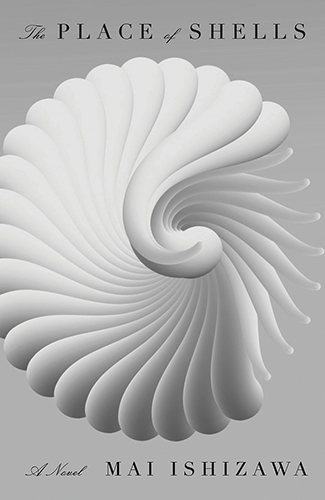
The Place of Shells

Mai Ishizawa’s short novel The Place of Shells, which was awarded an Akutagawa Prize in 2021, follows a Japanese woman pursuing her PhD research in European art history at a university in the German town of Göttingen. For a year and a half, she’s shared an apartment with a fellow grad student named Agatha, as well as Agatha’s dog Hector.

Around the late-summer Obon festival, when the spirits of the dead visit the world of the living, the narrator talks to her old classmate Sawata, who studied art history with her as an undergrad at a university in Sendai and currently works as a museum curator. Over Skype, Sawata tells her that their friend Nomiya will be visiting Göttingen for a brief period. This is odd, the narrator admits, as Nomiya disappeared during the March 2011 tsunami and has been presumed dead for nine years.

Nomiya’s sudden appearance isn’t the only strange thing happening in Göttingen. One of the town’s landmarks is its Planetenweg, where memorials representing the sun and planets are placed according to scale. Now that Pluto is no longer a planet, however, its memorial has been sighted in odd places, seemingly at random. In addition, Agatha’s dog Hector has been digging up mysterious bits of rubbish in the forest, and each discarded item is connected to the secret memories of the people in the narrator’s circle of friends. To make matters even more bizarre, the narrator painlessly begins to grow a set of human teeth on her back.

The Place of Shells doesn’t really have a plot, and none of these surreal occurrences are mysteries to be solved. Instead, the narrator reflects on the nature of memory as she comes to terms with the March 2011 tsunami and what she lost in the disaster, as best illustrated by this passage toward the end:

What I had been afraid of was the distortions of memory caused by emotions and the passing of time. That was where forgetting began. What my feet had felt as they went tramping around that seaside town, the scenes my eyes had taken in, the smell of the sea that rushed into my nose – these memories didn’t remain with me as raw sensations, but morphed into a distant narrative. That oblivion concealed more than just the dead who hadn’t returned to land.

As the narrator comes to terms with the constructed nature of her memories of trauma, she encounters a number of ghosts that manifest in cozy apartments and relaxed strolls through the beautiful German town. For most of us, the ghosts of the past have little to do with darkness or shadows; rather, they walk casually beside us during the day. While giving the reader a beautiful environment to explore through careful and attentive prose, Ishizawa encourages reflection on grief as refracted through the passage of time.

I’d also like to mention an aspect of this novel that was immensely appealing to me personally. For various reasons, my frame of intellectual reference is skewed away from Europe, and I’ve always wanted someone who doesn’t assume a thorough knowledge of Christianity to teach me about Western art history. The Japanese narrator (and, I suppose, the academic author speaking through her) presents an accessible discussion of her research on German artistic portrayals of Christian saints that I found fascinating. The Place of Shells is a meditation on art as much as it is on memory, and I feel as though I gained a more grounded and relatable perspective on the sort of medieval European art that I always passed by without understanding in museums.

In doing a bit of research of my own, I realized that each of the women in the narrator’s circle of friends has a connection to her saintly namesake that Ishizawa communicates through imagery both mundane and fantastic. Over the course of the story, the narrator makes something of a pilgrimage through overlapping systems of symbols in a way that mirrors her own academic study of religious art. If a reader were to draw a map of these symbols, I imagine that the constellations would be quite dense, but I found it satisfying simply to follow that narrator’s meanderings without imposing a definitive sense of meaning.

Mai Ishizawa reminds me of Yoko Ogawa in her ability to create a subtle sense of atmosphere through mundane descriptions of calm and lovely places that gradually become eerie through an accumulation of otherworldly imagery. I’m also reminded of the quiet and gentle surreality of Haruki Murakami’s 1982 novel A Wild Sheep Chase, especially in terms of the narrator’s time in the woods and proximity to historical palimpsests overlaid onto daily life.

The Place of Shells is a slow novel to be savored. A spiraling shell is an apt analogy for the style of narration, which only gradually approaches its central theme through ever-smaller circles. Ishizawa’s writing, which Polly Barton has translated with pitch-perfect clarity, is gorgeous and well worth taking a page at a time as the reader, like the narrator, softly explores a world made beautiful and strange through art and memory. 
Three Directions

Three Directions

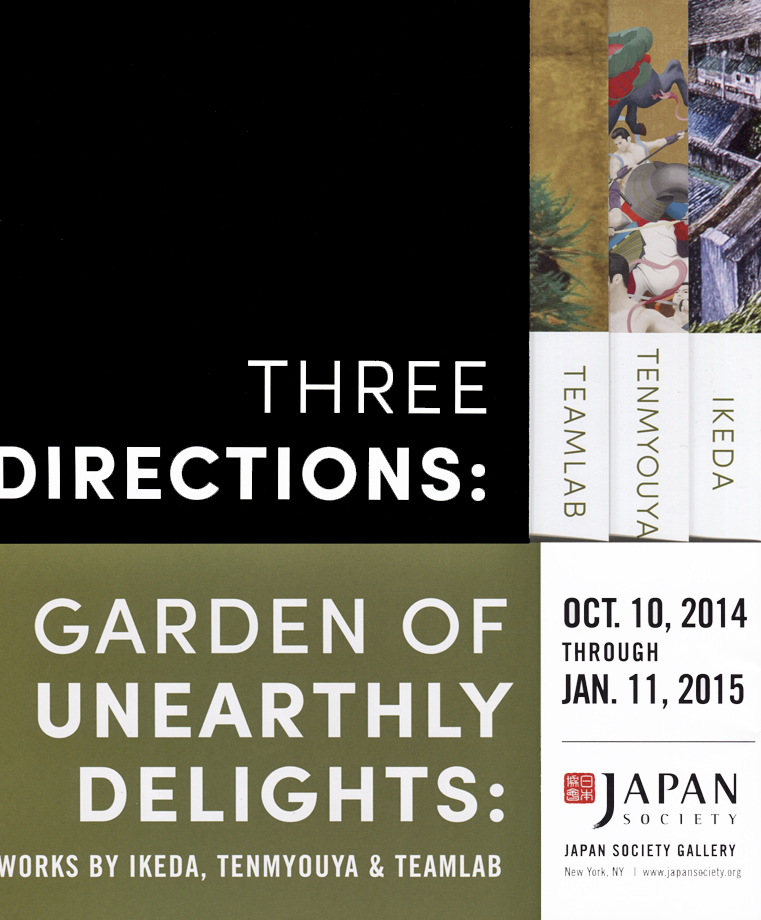
Title: Three Directions: teamLab, Tenmyouya Hisashi, Ikeda Manabu
Editor: Kirstin Pires
Publisher: Chazen Museum of Art and Japan Society Gallery
Publication Year: 2014
Pages: 83

Three Directions was published on the occasion of an exhibition of the work of Tenmyouya Hisashi and Ikeda Manabu at the Chazen Museum in Madison and the Garden of Unearthly Delights exhibition at the Japan Society Gallery in New York, which lasts until January 11, 2015.

The “three directions” of the book’s title refer to the artists’ interpretations of early modern and modern Japanese art, specifically the Nihonga “Japanese-style painting” of the Meiji period (1868-1912). In her short essay on the works of the artists featured in Three Directions, curator Laura J. Mueller provides insight into the influences they have received from medieval and Edo-period (1600-1868) Japanese paintings, prints, sculpture, and garden design. Mueller also explains how the themes of the older art, such as the theme of anxiety surrounding the relationship between humankind and the natural world, have been translated into the work of the contemporary artists. In the main body of the book, which is comprised of extended interviews, the artists discuss their own perceptions of their influences, which are far more temporally immediate.

.

teamLab, whose work must be seen to be believed (check out the video above), is represented in Three Directions by its founder Inoko Toshiyuki, who talks about the power of participatory media in the twenty-first century. Although he references manga such as Dragon Ball and One Piece and the masume ga (mosaics) of the eighteenth-century painter Itō Jakuchū, his most interesting description of the philosophy behind teamLab’s video installation Life Survives by the Power of Life (Seimei wa seimei no chikara de ikite iru) is that Chinese characters function like summon spells from the Final Fantasy series of role-playing video games. Inoko’s emphasis on a range of interlocking influences is deliberate, as teamLab’s work is designed to illustrate the blurring of the boundaries that supposedly separate contemporary media as they collectively exist both as entertainment and as cognitive enhancements.

Tenmyouya Hisashi expresses a markedly different attitude concerning his relationship to contemporary and premodern artistic media. According to Tenmyouya, his “Neo Nihonga” reflect “the subculture of the ‘street samurai,'” which “represents a counter to the traditional values of wabi sabi, zen, and otaku,” aesthetics that are “far from the reality of contemporary Japan.” Instead, he sees himself as tapping into the energy that originally drove the artistic movements of the Sengoku period (1467-1600), an era of intermittent civil war. Tenmyouya envisions his work as being representative of an aesthetic he terms BASARA – the Sanskrit word for “diamond,” which seems to mean “rebellious” in the context of his art and ideology. As one of his primary influences, he cites the yakuza films of Kitano Takashi, especially the violence, chaos, and dynamism they portray.

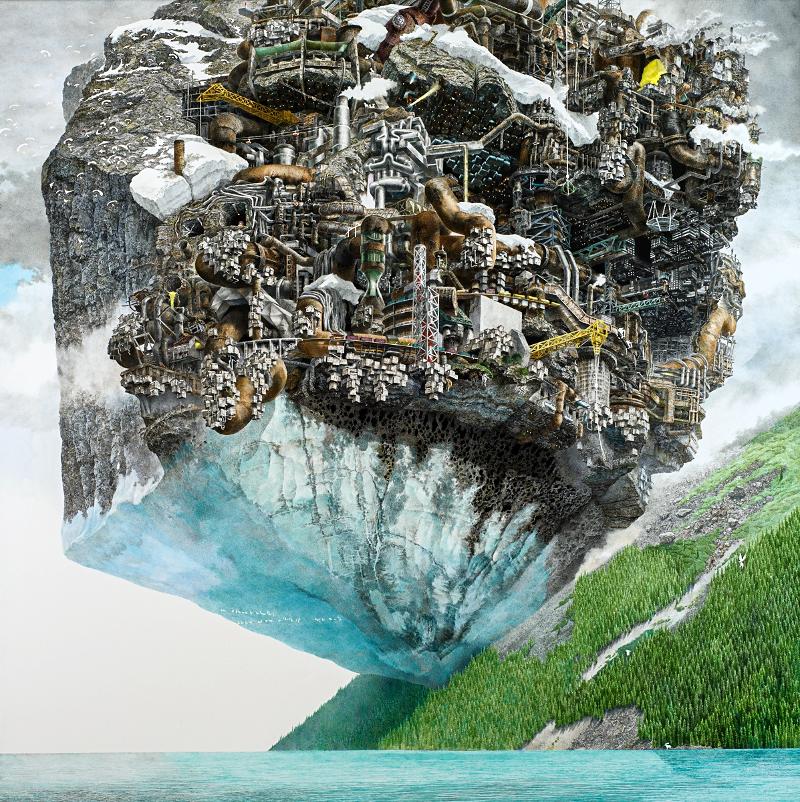
Ikeda Manabu is less concerned with aesthetics than he is with process. Stating simply that the most dominant theme in his work is “the conflict and coexistence between man and nature,” Ikeda speaks of being influenced by news reports and the ephemera he encounters in his daily life. The rest is a matter of design, focus, and patience, with the result being that many of his ink paintings function almost like diaries.

Ikeda is currently in residence at the Chazen Museum – you can read his residency blog here – where he is putting together a large and richly detailed masterwork. Three Directions includes an eight-page section on Ikeda’s tools, methods, and progress, which are fascinating even from the perspective of a non-artist.

These interviews with the artists, combined with Laura Mueller’s short contextual essay and the many high-quality images on display, make Three Directions an incredible resource for anyone interested in contemporary Japanese art, aesthetics, and culture. A commonality between the artists is the 3.11 “triple disaster,” which each references and responds to either obliquely or quite directly, so the interviews in particular will be of interest to students and scholars curious about how recent events have impacted mainstream art in Japan. I can also imagine the catalog becoming a useful classroom text, as it’s full of discussion points and allusions to both Eastern and Western art history.

Unfortunately, the book is almost impossible to acquire without either physically visiting the Chazen Museum or Japan Society Gallery or writing to one of their curators, as it’s not available through the online shops of either institution or through other online retailers. If you’re on the East Coast and can make it out to the Japan Society, I highly recommend checking out both the Three Directions catalog and the exhibition itself, which is running until January 11, 2015.

Review copy provided the Japan Society Gallery.

Ikeda Manabu, Meltdown

Ikeda Manabu’s Meltdown, image courtesy of Spoon & Tamago.