Yotsubato!

Title: よつばと!(Yotsuba to)
Artist: あずまきよひこ (Azuma Kiyohiko)
Publication Year: 2003 (Volume 1) – 2009 (Volume 9)
Publisher: 電撃コミックス (Dengeki Comics)
Pages: 225 (per volume)

Let me get this out of the way first: Yotsubato! has no story. It is not “about” anything. There is no point. It does not go anywhere. The manga could be classified as falling within the genre of comedy, but it doesn’t really try to be funny. The reader never really learns anything about the characters, and the relationships between the characters show almost no development. Nothing important or exciting happens.

Let me also get this out of the way: Yotsubato! is one of my favorite manga in the whole wide world.

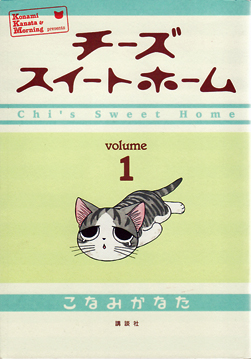
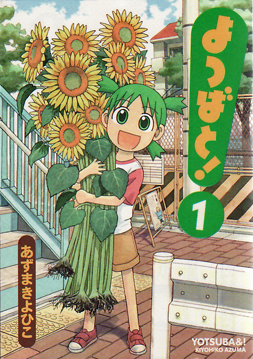
I have been fond of Azuma Kiyohiko’s four-panel manga Azumanga Daioh ever since the translation was released in America in 2002. I also enjoyed the anime based on said manga. When defunct American manga publisher ADV Manga started releasing translations of Yotsubato!, Azuma’s new project following the completion of Azumanga Daioh, I picked up the first volume immediately. Unfortunately, I found myself disappointed. It wasn’t a fun manga to read. I didn’t get it. The dialog was translated in a way that was supposed to be wacky and zany, but I didn’t think the manga itself was that funny. The art was a little weird, too. A year later, in 2007, I went to Japan to find Yotsubato! featured prominently at almost every major bookstore in Tokyo and Yokohama – most memorably at the Tsutaya in Shibuya, which had an entire wall devoted to Yotsuba paraphernalia. The cover of the Japanese publication of the manga was approximately five hundred times more appealing than the cover of the translation, so I picked up a copy. While reading it on the train home, I fell in love.

Yotsubato! follows the daily life of a five-year-old girl named Yotsuba. Having been orphaned on an island somewhere outside of Japan (the circumstances are never made clear to the reader), Yotsuba has been taken in by a man named Koiwai, who seems to be in his late twenties or early thirties and makes his living as a translator. At the beginning of the first volume of the manga, Yotsuba and her adopted father move into a new house in the suburbs of a city assisted by Koiwai’s friend Jumbo, a florist with a preference for Hawaiian shirts whose name reflects his comically enormous stature. After moving in, Yotsuba and Koiwai (and Jumbo, who visits from time to time) become friends with the family living next door, which consists of a mother, a daughter in college, a daughter in high school, and a daughter a year or two older than Yotsuba (the father of the family never makes an appearance). Although other friends of Koiwai and the next-door neighbors are occasionally introduced, Yotsubato! mainly revolves around this core set of characters and their interactions. The manga moves slowly from day to day. Over the course of nine volumes, its leisurely pace has taken it from the middle of summer to the very beginning of fall.

What I love about this manga is this very slowness. I wouldn’t describe this work as “contemplative,” however; Yotsuba herself is very curious and energetic, and her adopted father is something of a character as well. There is nothing boring about the manga, but its focus on the mundane allows the reader to take a step back from his or her own presumably hectic life and enjoy an endless summer full of daytrip adventures and small discoveries. This is not to say that Yotsubato! somehow resembles something like My Neighbor Totoro. The manga is written from an adult perspective, and the reader is constantly encouraged to identify with the people who surround Yotsuba rather than with the girl herself. The occasional jokes that the manga makes are sophisticated, and the adult speech and relationships are not sanitized or downplayed.

The attention to detail expressed in every aspect of the manga finds its most visible outlet in its gorgeous artwork. As I noticed when I first read the manga in America, it takes Azuma several chapters to settle on his character designs, which are drawn in his unique style. The rest of the visual realm, however, is drawn in an almost photorealistic way, from the tiniest detail of the interior architecture of Yotsuba’s house to the products lining the shelves of a neighborhood convenience store. Aside from the shade of Yotsuba’s unique hair, there is almost no screen tone used in the manga; everything is conveyed in understated ink work, which miraculously never clutters the page or busies the panels. The slightly cartoonish characters provide a pleasing contrast to this sort of detailed background. I feel like the background art in this manga captures the essence of a Japanese suburb far away from Tokyo; so, even while I was reading this manga in Yokohama, it made me feel nostalgic for living in Japan.

I suppose you could say that I enjoy this manga because of its pace, its narrative tone, and its art. I’m not really sure, though, what makes Yotsubato! different from any other “slice of life” manga, but it is different. I have said before that I think manga can be considered literature, but Yotsubato! is not literature. It is a masterwork of an entirely different medium of artistic expression. Really, I think Yotsubato! stands alongside the works of Urasawa Naoki and Asano Inio as an exemplar of what manga is capable of.

Although I am a great believer in translation, I feel that Yotsubato! is much more enjoyable in the original Japanese. Thankfully, even beginning students of Japanese should not find the dialog in the manga to be prohibitively difficult. For those readers who have no Japanese language background, however, a new English translation of the manga is currently being published under the title of “Yotsuba&!” by Yen Press.

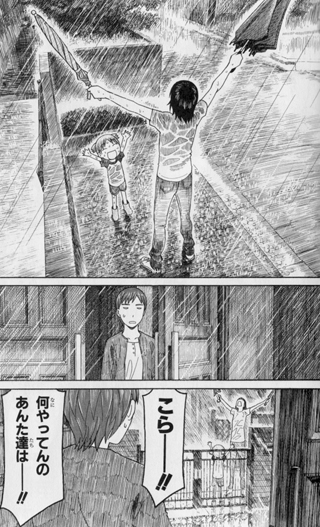
I think the following two pages demonstrate the style of the manga. In the middle of a late summer typhoon, Yotsuba runs into the storm to warn her next door neighbors to be careful. In her haste, she forgets her umbrella, so her adopted father runs after her to give it to her. Upon catching up with her, he finds her already drenched, so….

Drop Dead Cute

Title: Drop Dead Cute
Author: Ivan Vartanian
Publication Year: 2005
Publisher: Chronicle Books
Pages: 160

When I first picked up this book several years ago, I was quite disappointed. With a title like “Drop Dead Cute” and references to Murakami Takashi and Nara Yoshitomo in the blurb on the inside cover, I had expected the book to contain more of what I saw as “anime art” (or perhaps “manga art”). In fact, however, the deliciously pink cover image by Takano Aya is as close as this book gets to anime art. The rest of the book isn’t even cute. It’s disturbing, yes, and violent, yes, and all sorts of interesting and creative, but not cute.

Which leads me to wonder, upon closer examination, what exactly the title means by “cute.” To me, “cute” is something that elicits an emotional response along the lines of “Oh my gosh I want to love on it.” The pieces exhibited in Drop Dead Cute aren’t exactly that sort of cute (and, to that effect, I would wager that the emphasis in the title is actually on “drop dead”). The book is filled with animals, however, and plant life. Much of this flora and fauna is anthropomorphic. There are also plenty of young women (and almost no men) and a profusion of soft pastel colors.

Kudo Makiko opens the book with her oil paintings of young girls, perhaps sleeping, perhaps dreaming, who have found themselves in strange landscapes guided only by cats and dogs. Murata Yuko renders animals and landscapes in simple compositions consisting of wide, sweeping brushstrokes. Hosoya Yuiko is represented by pencil drawings of sullen young women that look like the work of a beginning art student, with finger smudges and blank backgrounds. Ban Chinatsu, famous for her collaboration with Murakami Takashi in the New York Japan Society’s “Little Boy” exhibition of 2005, paints huge acrylic canvases filled with baby elephants in pursuit of underpants. Murase Kyoko works in all sorts of media, from traditional oils to white out pen on yellow legal paper, but her naked drowning girls are equally unsettling no matter what her canvas. Tabaimo’s work is, as always, something straight out of a horror movie.

My two favorite artists in this collection are Aoshima Chiho and Takano Aya. Although Aoshima claims that she doesn’t read manga or watch anime, her works closely resemble the anime style, filled as they are with fantastic, wide-eyed girls sporting wild hair of various colors and very little clothing. In her work, these girls are bound, eaten, digested, rotting, free floating, and reborn in amazingly detailed, brightly colored graveyards and Edens. Since the majority of her work is digital, her photo manipulations, which juxtapose her cartoon-like demon girls against ordinary Japanese backdrops, blend seamlessly into the rest of her oeuvre. Takano, whose artwork was used for the cover of this book, does in fact draw manga, or at least sequential art resembling manga, and she is represented in this collection by a short, colorful, manga-esque piece titled “Subterraned,” which I think is by itself worth the price of the entire book. Her artist’s statement, which delves into themes of sci-fi and eroticism, is also quite interesting.

Each of the ten artists is given a three page introduction, with doodles at the top of the pages and text based on interviews at the bottom. Following each introduction are eleven pages showcasing the works of the artist, with one, or occasionally more, pieces per page. The titles of the pieces are given in English, but each artist has also handwritten the original title of the piece next to the English entry. The book begins with a twelve page, well-illustrated introductory essay by Ivan Vartanian and ends with short biographies of all the artists. Everything is full color, and the publication quality is just about as high as it can go.

The artists featured in this book are:

Kudo Makiko
Aoshima Chiho
Murata Yuko
Aoki Ryoko
Hosoya Yuiko
Takano Aya
Ban Chinatsu
Murase Kyoko
Kusama Yayoi
Tabaimo

The Budding Tree

Title: The Budding Tree: Six Stories of Love in Edo
Japanese Title: 恋忘れ草 (Koiwasuregusa)
Author: Kitahara Aiko (北原亞以子)
Translator: Ian MacDonald
Publication Year: 1993 (Japan); 2008 (America)
Publisher: Dalkey Archive Press
Pages: 170

This past fall, I took a seminar on ukiyo-e, or Japanese woodblock prints depicting the “floating world” of the Edo period (1600-1868) urban pleasure districts. As we studied the courtesan prints of artists like Kitagawa Utamaro, we kept running up against the same issue: prostitution. Namely, what were the lives of the women painted by Utamaro really like? Were these women as glamorous as they seem in ukiyo-e, or were they sex slaves who lived miserable lives and died at an early age of starvation and disease? Or did they perhaps fall somewhere in between the two extremes, victims of their fates but still holding on to a measure of personal agency and control over their lives? As our class debated this issue, I couldn’t help but think about The Budding Tree.

Kitahara’s short story collection The Budding Tree is not about courtesans, but it is about Edo-period women who have close connections to the floating world. Each of the six stories in this collection has a different female protagonist: a Confucian tutor, a calligrapher who pens text that will be printed as gesaku popular novels, a singer of jōruri popular stage ballads, a hairpin designer who manages her own store, a rising print artist who works with Utagawa Kuniyoshi’s publisher, and the manager of an exclusive restaurant. Although the women don’t know each other directly, their stories are connected in small ways, and a unity of theme ties these stories together into a cohesive whole. Each of these women is struggling to make it in a man’s world, and each therefore leads a somewhat complicated love life.

I’m not an expert on the Edo period, so I’m not sure how realistic Kitahara’s depiction of her setting (Edo at the turn of the nineteenth century) actually is. From what I know of the lives of Hokusai’s daughters (especially Katsushika Ōi), however, her depiction of urban working women at the time isn’t too far off. As historical fiction, the stories in The Budding Tree are interesting and satisfying, especially since the swashbuckling samurai that one usually encounters in Japanese historical fiction are kept offstage. It is my (perhaps futile) hope that Ian MacDonald’s excellent translation will find a wide audience, so that other Japanese female-centric historical fiction, such as the Edo-period female detective stories of Miyabe Miyuki, will find their way into American bookstores.

I therefore recommend The Budding Tree to anyone with an interest in the Edo period, historical fiction, women’s literature, or just plain good romantic stories. The one caveat I might offer concerns the translation’s complete absence of footnotes. There are more than a few non-translated and non-glossed terms (such as jōruri, i.e., the songs of the puppet theater) that appear with frequency throughout the text, as well the names of actual historical figures and geographical landmarks with which a casual reader might not be familiar. Hopefully, however, the stories themselves will whet the reader’s appetite to learn more about the world of early nineteenth century Edo.

A Quiet Life

Title: A Quiet Life
Japanese Title: 静かな生活 (Shizuka na seikatsu)
Author: Ōe Kenzaburō (大江健三郎)
Translator: Kunioki Yanagishita and William Wetherall
Publication Year: 1990 (Japan); 1996 (America)
Publisher: Grove Press
Pages: 240

About a month ago, a friend for whom I have a great deal of respect said that she doesn’t like Ōe Kenzaburō’s A Quiet Life. She argued, essentially, that the novel has no forward momentum and that she couldn’t bring herself to care about the characters, especially the narrator, whom she considered silly and a bit too passive. These are all genuinely valid criticisms; but, since I happen to rather like the novel (and since I haven’t read anything else that has caught my attention recently), I thought I might defend it a bit. Of course, a book that labels itself with the title “A Quiet Life” isn’t for everyone, but I feel like there’s so much interesting stuff going on in the novel that the lives of the characters are anything but quiet.

First of all, let me say that this novel does not fit neatly into Ōe’s other work. There is very little here that is overtly political (like Hiroshima Notes), very little having to do with Pacific War era ideological confusion in the forests of Shizuoka (like in the stories of Teach Us to Outgrow Our Madness), and exactly zero sleeping around with your former lover while your wife is in the hospital after having just delivered a baby that you are plotting to kill (à la A Personal Matter). Ōe’s oeuvre tends to be a bit intense, so I really appreciated reading something a bit more…quiet.

Also, there’s a really cool film adaptation directed by Itami Jūzō, the guy who directed Tampopo (1985) and A Taxing Woman (1987). It turns out that Itami was Ōe’s brother-in-law, oddly enough. But I digress.

A Quiet Life is about the author’s family. Ōe refers to everyone by nicknames, but the essential family structure is the same. A genius writer living in the suburbs of Tokyo tries to commit suicide, so his exasperated wife, who catches him in the act, persuades him to accept a year-long writer-in-residence position at a university in California. The couple leaves behind their three children, and the narrator, Ma-chan, is one of these children. She is twenty years old, writing her college graduation thesis on the interwar French writer Louis-Ferdinand Céline, and responsible for the care of her quick-witted younger brother O-chan and her mentally-handicapped older brother Eeyore. While O-chan comes and goes like the wind, Eeyore requires a bit more attention, especially as Ma-chan comes to suspect that he feels abandoned by their parents. A Quiet Life follows Ma-chan and Eeyore through the summer after their parents leave, with Eeyore attending music composition lessons, Ma-chan working on her thesis, the pair attending a funeral in their father’s home village in Shizuoka, and other various aspects of the family’s daily life. This daily life is spiced with such incidents as Eeyore’s capture of a neighborhood pervert, the composition teacher’s ventures into socialist activism, and Eeyore’s swimming lessons, conducted by a handsome young instructor for whom Ma-chan quickly develops a crush.

Throughout the novel run Ma-chan’s thoughts and commentary on a variety of works of film and fiction, including Andrei Tarcovsky’s Stalker, the religious poetry of William Blake, and Michael Ende’s novel The Neverending Story, not to mention a forty-page rumination on Céline. I enjoyed these discussions, which were more often than not carried out in the form of lively conversations between Ma-chan and Eeyore’s music composition teacher, but I imagine how this sort of intratextual literary criticism might derail the forward momentum of the story for people who simply don’t care for that sort of thing in their fiction.

In my opinion, however, the main point of the novel isn’t its plot or its intellectual discussions, but rather the development of the relationship between Ma-chan and Eeyore. The two are obviously close; but, when Ma-chan assumes the role of Eeyore’s primary caregiver and babysitter, she finds herself repeatedly frustrated with her brother. She suspects that Eeyore himself might be the neighborhood pervert, for example, and occasionally resents him for claiming the bulk of her parents’ attention and preventing her from getting closer to boys like the swimming instructor (who actually turns out to be a creep). Eeyore, despite his idiosyncrasies, has his heart in the right place and in fact turns out to be perhaps the most interesting character to come out of Ōe’s work. Ōe’s portrayal of him, both through his words and actions and through his sister’s perception of him, is both complex and sympathetic. Ma-chan may be passive (or she may simply be a normal if somewhat oversensitive twenty-year-old college student), but Eeyore is anything but, and he emerges as the real star of the novel.

At a meta-textual level, I found not only Ōe’s portrayal of Eeyore but also his decision to use the voice of a semi-adult woman (modeled after his own daughter) for his narrator to be quite interesting. Is it realistic? Is it convincing? Why in the world would he choose to employ such a narrator? Regardless, Ma-chan is much more than the typical shōjo heroine, and A Quiet Life is much more than the typical home drama. The translation is smooth, and the narrative flows fairly quickly, jumping effortlessly from one tableau to the next. Although A Personal Matter will probably continue to hold the place of honor in the work of this Nobel Prize winning author, I feel like A Quiet Life is a close second.

The Makioka Sisters

Title: The Makioka Sisters
Japanese Title: 細雪 (Sasameyuki)
Author: Tanizaki Jun’ichirō (谷崎潤一郎)
Translator: Edward G. Seidensticker
Publication Year: 1948 (Japan); 1957 (America)
Publisher: Vintage International
Pages: 530

In his introduction to Shimazaki Tōson’s The Broken Commandment (破壊), translator Kenneth Strong lists Tanizaki’s The Makioka Sisters as one of the five most famous works of Japanese literature in the West (along with Kawabata’s Snow Country, Sōseki’s Kokoro, Abe’s Woman of the Dunes, and Mishima’s Temple of the Golden Pavilion). Strong wrote this essay in 1972, and, since then, I would say that Naomi has replaced The Makioka Sisters as the Tanizaki text that is most frequently taught. The formation of national identity in the pre-war period is a hot topic in Japan-focused scholarship these days, especially when the evils of modernity are represented by a sexy young woman. Regardless, The Makioka Sisters is still an excellent novel.

As the English title suggests, the novel is about four sisters who live in a suburb of Osaka. Tsuruko and Sachiko, the two older sisters, are married, but the two younger sisters, Yukiko and Taeko, are not, and therein lies the main conflict of the novel. Eldest sister Tsuruko moves to Tokyo after her husband gets transferred, so the task of marrying off third sister Yukiko falls to second sister Sachiko and her (Tanizaki stand-in) husband Teinosuke, who remain in Osaka. The problem is that they can’t find a suitable husband for the shy traditional beauty, who has entered her thirties under the shadow of rebellious youngest sister Taeko, who cares nothing for the family’s reputation.

After Tsuruko and her family move to Tokyo, they all but disappear from the story, which is fine, since the author has more than enough material to work with concerning the three sisters who stay behind. Each of the three is an interesting and fully developed personality in her own right, and they have plenty of floods, illnesses, and secret love affairs to keep them busy. Taeko especially falls into the role of Tanizaki’s trademark femme fatale, with her modern clothing, flirtatious attitude, lies, ridiculous expenditures, and so on. Although the reader can’t help but share her sisters’ attitude of frustration towards her, Taeko adds spice to the novel and generally drives the plot forward.

Not that the novel has much of a plot. Nothing grand happens, no one important dies, no major secrets are revealed, and all conflicts are eventually resolved to everyone’s satisfaction. Instead of focusing on dramatic action, Tanizaki has instead created a world within his novel and invited the reader to visit it for five hundred pages. Although I wasn’t able to read the book for long stretches at a time, I was happy with its length and would have even been happy if it were longer. Even though the story takes place during the opening years of the Pacific War, the characters occupy a comfortable environment rich with detail, culture, and tradition. In other words, this is a novel not to be enjoyed for its forward impetus but rather for its description of a family outing to Kyoto to see the cherry blossoms. Any fan of traditional Japanese culture, and especially the tension between tradition and the modern lifestyle, should enjoy this novel – there’s a reason why an earlier generation of Japan scholars considered The Makioka Sisters to be one the defining works of modern Japanese literature.

What I Talk About When I Talk About Running

What I Talk About When I Talk About Running

Title: What I Talk About When I Talk About Running
Japanese Title: 走ることについて語るときに僕の語ること
Author: Murakami Haruki (村上春樹)
Translator: Philip Gabriel
Publication Year: 2008 (America); 2007 (Japan)
Publisher: Vintage International
Pages: 180

Yay! Another Murakami book has come out in paperback! Yay! It’s translated by Philip Gabriel (the author of Spirit Matters: The Translucent in Modern Japanese Literature and veteran Murakami translator)!

Some critics say that people would read Stephen King’s grocery list if he published it. Although I’m not sure I would go that far, I certainly enjoyed King’s essay On Writing. Although I was disappointed that the newest Murakami translation isn’t one of his earlier novels (Hear the Wind Sing, for example, or Pinball, 1973) or his latest novel (1Q84) but a memoir-length essay on running, I decided to go ahead and read it. Because some writers, yes, I will read anything they publish. Even a log of miles run per month.

Over the course of my career as a student of Japanese, I have come to realize that the essay is still a thriving form of literature in Japan. It sometimes seems like every popular writer from Yoshimoto Banana to Murakami Ryū has at some point published at least one collection of essays. Instead of taking the form of concentrated inquiries into a single subject in the style of John McPhee, however, most of these essays are personal in nature and written in a light-hearted tone. What I Talk About When I Talk About Running is much the same. The memoir is conversational rather than educational and a pleasure to read.

In short, Murakami is preparing to run in the 2005 New York City Marathon. He has found that, as he gets older, it becomes harder to train and to run marathons in the amount of time that he would like to. Therefore, partly as refection, and partly as inspiration, he writtes a series of essays as he prepares to run in New York. These essays take him from Hawaii to Japan to Cambridge, Massachusetts, from summer into fall, and years into the past. He writes about running in Tokyo, running in Greece, running in triathlons, running in ultra-marathons, running next to Olympic runners, running next to John Updike, running next to Harvard freshmen, and running next to rivers. He talks about his decision to start running and his decision to become a writer. Everything is equally interesting.

The tone of the book is honest and self-effacing. Although it’s quiet, Murakami has a definite sense of humor that balances out his more contemplative passages. Aside from the fact that I don’t think he mentions drinking whiskey or cooking spaghetti even once, Murakami could very well be one of his infinitely personable narrators. Even though I have almost zero interest in running (or writing novels) myself, I was fascinated by these essays. I’m glad they were translated and published in America.

Kokoro

Kokoro

Title: Kokoro
Japanese Title: こゝろ
Author: Natsume Sōseki (夏目漱石)
Translator: Edwin McClellan
Publication Year: 1957 (America); 1914 (Japan)
Publisher: Regency Publishing
Pages: 248

When I first started studying Japanese literature in college, Natsume Sōseki’s Kokoro was one of the first modern novels I read. I remember being disappointed and a bit confused by it, however. Sōseki is one of the major figures in the Japanese literary canon, if not in fact the major figure. His early novel Botchan (坊っちゃん, 1905, recently translated by Joel Cohn) has been required reading for generations of Japanese schoolchildren, and his portrait used to grace the one thousand yen bill. A quick search on Google will turn up numerous syllabi for courses in Japanese literature that all begin with Kokoro. In short, this novel is kind of a big deal.

So why then, when I first read it, was I so disappointed? In short, I couldn’t help thinking, “Is this it?” Kokoro contains few lyrical passages, few descriptions of landscape, season, architecture, interior, or dress. Perhaps as a result, there is also no overt or sustained system of imagery. No light, no sound, no water, no heat. Of course I am exaggerating a bit (there are two memorable passages that occur in a tree nursery and by the seashore, respectively), but this novel boasts none of the opulent attention to detail that, in my mind at least, characterizes a great deal of Japanese literature.

There is also very little plot. The novel is divided into three sections. The first, “Sensei and I,” details the meeting and deepening friendship between an unnamed narrator (“Watakushi”) and an older man who he calls “Sensei.” In the second section, “My Parents and I,” the narrator has graduated from college in Tokyo and returns to his home in the countryside to be with his dying father. The third section, “Sensei and His Testament,” consists of a letter that Sensei has sent the protagonist explaining his past, his melancholy, and his decision to commit suicide after the death of the Meiji emperor. Kokoro ends with the conclusion of Sensei’s letter, and the reader is given no indication as to whether the narrator of the first two sections is able to make it to Tokyo in time to save Sensei or whether his father dies during his absence.

Although every single character in the novel is otherwise fully fleshed out as a believable human being, none of them seem to reflect archetypes familiar to a Western reader. In fact, Kokoro offers very little in terms of allusions and therefore might tend to come off as a bit shallow and one dimensional. Sure, there are some topical references to the death of the Meiji Emperor and the death of General Nogi, who committed suicide to “follow his master” out of an anachronistic sense of honor, but I wonder how deeply the reader is supposed to consider these references. The theme of the passing of an age is intriguing, but far from fully developed in the novel.

So why this novel one of the great classics of Japanese literature? Although I was frustrated the first time I read it, I think I am finally beginning to understand its appeal. Much of the literary writing in the Meiji period (1868-1912), such as Tayama Katai’s “The Quilt” (布団, 1907) and Shimazaki Tōson’s Broken Commandment (破壊, 1906), was concerned with the literary philosophy of Naturalism, which in Japan took the form of an attempt to realistically depict the psychology of a modern individual. The narrative style of such works was often stilted and noticeably stylized (despite their claims of realism). To me, Kokoro is an amazing work in that the narrative style actually feels quite “natural” in a Western way; at no point is the reader made aware of the fact that he or she is reading a novel. In other words, Sōseki was able to take the Japanese language and the concept of Japanese literature and do with them something that no one had done before.

What will appeal to the reader, then, are passages that a first time reader (such as myself in college) might not notice simply because they are so natural. When the narrator returns to his parents’ home, for example, he remarks that coming home from school is nice for the first week or two, but then the novelty wears off both for the student, who misses his friends, and for the parents, who begin to nag him. I couldn’t help smiling a bit when I read this. Moreover, the tragic past revealed by Sensei is his letter is believable but also, perhaps because it is so low-key, quite heart-wrenching. I feel that takes a master writer to avoid melodrama when working with such material, and Sōseki handles his subject matter beautifully.

All in all, Kokoro is worth reading not merely because it is a monument of Japanese literature but because of the sheer quality of the writing (and McClellan’s excellent translation). In any case, I found it very satisfying, and I’m glad I re-read it.

xxxHOLiC: ANOTHERHOLiC

xxxHOLiC

Title: xxxHOLiC: ANOTHERHOLiC: Landolt-Ring Aerosol
Japanese Title: xxxHOLiC アナザーホリック ランドルト環エアロゾル
Author: NISIOISIN (西尾維新)
Translator: Andrew Cunningham
Publication Year: 2008 (America); 2006 (Japan)
Publisher: Del Rey Books
Pages: 203

Given my fondness for the supernatural genre, it is no surprise that I love CLAMP’s manga xxxHOLiC. It took me awhile to pick up the first volume, however, because the concept seemed so cliché and gimmicky: an excitable high school boy who can see spirits works at the shop of a witch who promises to eventually cure him in a story featuring numerous plot crossovers from the simultaneously running epic manga (I believe there are currently twenty-seven volumes of it) Tsubasa: Reservoir Chronicles. I was tempted, however, by the Japanese tankobon, which Kodansha has published in beautiful editions, and ended up becoming addicted to the series. Not only is the artwork gorgeous in the style of early twentieth century Japanese lithographs (or Edward Gorey drawings), but the manga is dark and engaging in a deliciously creepy way. Besides, I am in love with Yūko, the hedonistic yet wise ‘Dimensional Witch’ who employs Watanuki, the hapless protagonist.

I had known about NISIOISIN’s novelization of xxxHOLiC for some time, but, unimpressed by his work in the two translated volumes of the short fiction anthology Faust, I never bothered to pick it up (ditto with his novelization of Death Note). Upon accidentally running across the book in a local bookstore, however, I was seduced by the beautiful gold-foil embossed cover and the chapter heading illustrations provided by CLAMP. Perhaps I should give it a chance, just like I did the original manga. Perhaps there is more to NISIOISIN than meets the eye.

Nope. Wrong. In short, this is a waste of a hardcover book. All of the subtle black humor and eeriness of the original manga turns to dust in the hands of the novelist. To back up a bit, it is perhaps a stretch to call ANOTHERHOLiC a novelization. The book is made up of three episodic short stories featuring the characters from xxxHOLiC. The first story, “Outerholic,” is a prose adaptation of an episode in the first volume of the manga and thus retains a modicum of the charm of the original. The second two stories are, as far as I can tell, NISIOISIN’s original creations. And they suffer for it.

Why do I hate NISIOISIN so much? Because I think he hates me, his reader. In all sincerity, what he has written is so full of bitterness that it left me feeling defensive. I’m not the sort of person who feels the need to evaluate whether NISIOISIN was true to the original characters, but I definitely got the feeling that he does not like them. Watanuki comes off as juvenile and whiny, Yūko is petty and self-important, and the writer even extends harsh editorial judgment towards his own original characters. If the writer’s unrelenting antagonistic attitude were not enough to turn me off to this book, I’m sure the sloppy writing would have pushed me over the edge. NISIOISIN’s prose is rife with sentence fragments and ellipses, which might have some sort of dramatic effect if they didn’t appear multiple times on every page. On a broader scale, NISIOISIN relies not on foreshadowing, atmosphere, or suggestion to create a sense of mystery but rather on withholding information from the reader in a taunting way that almost resembles bullying. The last story forgoes any plot at all in favor of a long and tediously sophomoric pseudo-philosophical conversation. Moreover, things like the frequent otaku references to anime like Azumanga Daioh, combined with Yūko’s debate with Watanuki over the meaning of moe, left my head spinning.

According to the author biography in the back of the book, NISIOISIN was born in 1981, which would make him 27 or 28 this year. Although his accomplishments are nothing to sneeze at, ANOTHERHOLiC made me feel like he really needs to get a life and grow up. When I first started reading this book, I was considering buying the translation of the first volume of the author’s Zaregoto: The Kubikiri Cycle, but now I’m not sure I want to read anything written by him ever again. In any case, despite Del Rey’s lovely publishing job, ANOTHERHOLiC is not worth the money, even for fans of CLAMP’s original manga.

I should mention, however, that I don’t think the failure of this book is the fault of the translator, Andrew Cunningham. Cunningham does a wonderful job of rendering NISIOISIN’s numerous idiotic puns into English, and in fact the most enjoyable part of the whole thing were the translator’s footnotes. I can only hope that Cunningham will apply his considerable talent to other authors in the future.

Solanin

Solanin

Title: solanin
Japanese Title: ソラニン
Author: Asano Inio (浅野いにお)
Translator: JN Productions
Publication Year: 2008 (America); 2005 (Japan)
Publisher: Viz Media
Pages: 428

Is manga literature? In some cases, like Urasawa Naoki’s Monster or 20th Century Boys, one could make a very strong positive argument. Some manga, however, like Bleach or Yuzawa Ai’s Nana series, are nothing more than once promising but now over-bloated cash cows. On the other hand, many of my favorite manga, like Azuma Kiyohiko’s Yotsuba&!, are not literature simply because they are masterpieces of a completely different art form.

But Asano Inio’s 420 page work Solanin is literature, no doubt about it. Like many Japanese narratives, it is driven not so much by plot as by character development and a fascination with the beauty of everyday life, which sounds like a Hallmark greeting card but is actually quite gritty and satisfying. Unlike a great deal of manga, Solanin deals with the problems of Japanese young people who are not sailor-suited schoolgirls and have already passed through their fun and fancy-free college years. In other words, the protagonists of Solanin have already grown up, or at least are trying to. I suppose that, in this way, Solanin is like a more focused and mature version of Umino Chika’s popular shōjo manga Honey and Clover, which chronicles the struggles and heartbreaks of a group of friends who have just graduated from art school.

As I said, there isn’t much to discuss in terms of plot (although there are some fairly gut-wrenching twists in the story), but the basic premise of the manga is that the protagonist, Mieko, who has just graduated from college and moved in with her boyfriend, has gotten sick of her boring office job and creepy boss and decided to quit working for a few months. During this time, she focuses on her friends and boyfriend, who had formed a rock band together in college. Mieko wants her guitarist boyfriend Naruo, who also feels suffocated at work, to get the band back together and be more serious about his music and his dreams, which drives the story forward but causes tension between the two. What ends up happening is way beyond what the characters – or the readers – suspect. The ending of the manga isn’t happy, necessarily, but it is fulfilling.

Although the focus of the narrative is on Mieko, occasionally chapters will be told from the point of view of another character, like Mieko and Naruo’s friends Rip (the drummer) and Kato (the bassist). These chapters rarely have anything to do with the main story but are still interesting, especially in how they highlight different aspects of the group dynamic within the circle of friends. The alternate narrative chapters also provide the majority of the manga’s comic relief, which is actually quite funny in a quiet sort of way.

Although the characters and narrative style alone make Solanin worth reading, what really made me pick up this book and buy it was the artwork. The character designs, though simple, are very appealing. I also feel that, within the limits of Asano’s personal style, they are realistic in the way they depict different body types and facial expressions. The background art is wonderfully realistic, which is extraordinary when you realize how much of it there is. Unlike most manga, which only provide a panel of background art every page or two, Solanin is filled with beautiful drawings of the scenery and landscape of the Tokyo suburbs. Even if you think Solanin’s story is just basic Banana Yoshimoto style angsty emo crap (although, in my mind, it never gets that bad), the artwork makes the whole thing worthwhile. Really, it’s gorgeous.

So, although the cover isn’t that appealing, and although the $17.99 price tag is pretty hefty, I can’t recommend this book enough. I’m really happy I gave it a chance, despite my misgivings.

Just to give a feel for the art style, I’ll post some images from the manga. I apologize for the poor scanning quality…

Solanin Page 1

Solanin Page 2

From Impressionism to Anime

From Impressionism to Anime

Title: From Impressionism to Anime: Japan as Fantasy and Fan Cult in the Mind of the West
Author: Susan Napier
Publication Year: 2007
Publisher: Palgrave
Pages: 243

Let me start off by listing the obvious flaws of this book. First of all, the cover. It’s terrible. Whose idiot idea was it to take a crappy photo of crappy cosplay, run it through the “Impressionism” filter in Photoshop, and then put it on the cover of a book? According to the back cover, this monstrosity is the work of “Scribe Inc.” Shame on you, Scribe Inc., and shame on you, Palgrave, for letting them get away with it! Second of all, in a book primarily concerned with visual culture, there are surprisingly few illustrations. To be precise, there are ten, and only four of them are in color. This I am going to blame on the author, whose 2005 work Anime from Akira to Howl’s Moving Castle is also surprisingly under-illustrated (while other Palgrave scholarly publications have no shortage of well placed, high-quality greyscale images). Napier has no excuse for this, especially since the cosplay culture she details so lovingly is all about getting pictures of itself published. Third, Napier’s scope is very broad, but her treatment of her many topics is, perhaps unsurprisingly, shallow. I did not find this to be the case with Anime (despite many critical accusations to the contrary), but I’m disappointed with what I found to be the lack of sustained intellectual rigor in Impressionism.

Now that that’s out of the way, let me be something of a fangirl for a second and say that I love all of Napier’s work, Impressionism included. Napier always manages to choose the most fascinating things to write about, and she always does an excellent job of explaining why her chosen subject matter is interesting and important. Her analysis is apt, penetrating, and lucid, and her work does not suffer from any of the structural weakness found in a great deal of recent academic work – you always know what she’s trying to say, and her way of saying it is both logical and artistic. Although her theoretical background is rock solid (her bibliographies are a bit intimidating), she doesn’t blithely toss around big names and critical jargon. Also, you can tell that, even though she occasionally betrays a bit of light-hearted sarcasm, she has nothing but respect for the topics of her studies.

This attitude of respect is very important for a work like Impressionism, which deals with some strange and, depending on one’s perspective, almost contemptible subject matter. The book is divided into eight chapters (not including the Introduction and Conclusion). The first four chapters each take up a different aspect of the West’s fascination with Japan during the last two centuries. The first chapter covers turn-of-the-century Impressionists like Claude Monet and Vincent Van Gogh, who revolutionized the fine arts with a little inspiration from Japan, or at least the “Japan” of their imaginations. The second chapter goes into famous inter-war Japan enthusiasts such as Lafcadio Hearn, Arthur Waley, and Frank Lloyd Wright. The third chapter follows the antics of post-war American writers like Jack Kerouac, Gary Snyder, Michel Crichton, and William Gibson, and the fourth chapter is all about how Western men perceive and interact with Japanese women in works like Madame Butterfly and Memoirs of a Geisha. The last four chapters, which I consider to be the true raison d’être of this book, deal with American anime fandom and all its various manifestations, from anime conventions to cosplay to slash fan fiction. Through all of this, Napier attempts to uncover the source of the West’s long fascination with Japan, all the while making astute references to the global political and economic climates during which this fascination has become manifest.

The first four chapters, while interesting, are, as I said earlier, somewhat shallow. Each topic that Napier covers in these chapters has been written about extensively by other scholars, a fact which she openly acknowledges. Her originality here lies in the fact that she documents what she sees as a trend, although she is cautious about saying that the various moments in the history of what I am going to call “Japan fandom” are directly related. The main point of interest for readers is the work that Napier has done on post-1980 American anime fandom, which is the culmination of many years of interviews and surveys. Mainly speaking through the voices of the fans she has contacted, Napier attempts to explain the appeal of contemporary Japanese popular culture to Americans, often in contrast to American popular culture. Although she offers no strong conclusion, the variety of insights Napier offers are invaluable.

My one real criticism of this study is that, although Napier hints at exposing the power relations underlying fan culture, she never really follows through. In other words, she is mainly concerned with the relation of fans to the world outside fandom (what she calls “the Muggle world”) and doesn’t delve into the hierarchies of power within the in-group of fandom itself. For example, I would have found an analysis of the term “weeaboo” (an American who loves anime so much that he or she wants to become Japanese) to be a pertinent addition to her discussion. Instead, Napier makes American anime fandom seem like something of a utopia; although she mentions the darker side of fandom by quoting scholars who bring up the concept of “fan pathology,” she never directly acknowledges that such a thing might actually exist in her own object of study.

Otherwise, I found From Impressionism to Anime to be a very satisfying read. It’s an excellent cultural study and could double as a perfect introduction to modern and contemporary Japanese history for someone considering pursuing the subject as an undergraduate – or simply as an intelligent, interested individual. Don’t let the cover fool you. This is actually a book you want to read!