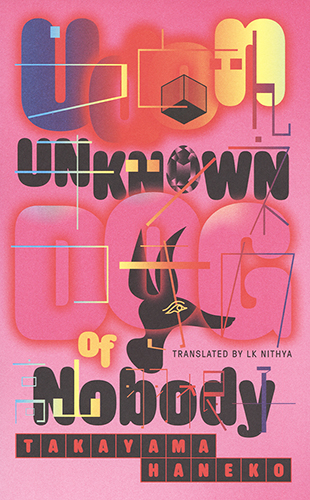
Haneko Takayama’s short story Udon: Unknown Dog of Nobody, published by Strangers Press as a stand-alone chapbook in their Kanata series, follows three sisters connected by their love for their family dog, Udon.
On their way home from school, Kazue and Misa find a newborn puppy abandoned in a styrofoam box. Horrified by the sorry state of the creature, they decide to rescue it. The way they see the matter, leaving the animal to die isn’t an option.
Seven days later, the puppy is still alive. Kazue and Misa’s younger sister Yoko goes to the pet store to get dog food, but she doesn’t know how many cans to buy. What if she gets too many, and the dog dies? After she buys just one can, she meets a classmate who assures her that, “When you care for things, they don’t die as easily as you might think.”
The next chapters provide snapshots of the sisters growing into adulthood as they continue to nurture small relationships with people and animals. In the final chapter, Kazue and Yoko take the train to snowy Toyama City to attend their grandmother’s funeral, where they’re immediately surrounded by the warmth of their extended family. Fifteen years after being rescued, Udon is a gross little gremlin, but he’s still alive and happy.
At the end of the story, Kazue reflects on “the many living things they’d raised, not to eat, not because they were useful. Creatures that weren’t human, weren’t in need of preservation.” She comes to the conclusion that there’s no need for animals to have “value” to be cared for, an observation that would seem trite if not for the dramatic opening of the novella, in which the author presents the newborn Udon as little more than a slimy mass of hideously squally meat.
Haneko Takayama’s fiction has been nominated for a number of prestigious awards, and she won the Akutagawa Award for her 2020 novel The Horses of Shuri, a speculative meditation on the connections between human culture and ecological history that reminded me of Hideo Furukawa’s Belka, Why Don’t You Bark. I’m happy to see Takayama’s fiction in translation, and LK Nithya has done a marvelous job, deftly balancing the casual dialogue of the sisters with the literary touches of the narrative prose. I was also impressed by how smoothly the translator was able to handle the brief touch of science fiction at the end of the story, which was nowhere near as surprising as perhaps it should have been.
Udon: Unknown Dog of Nobody is a slim but striking chapbook that presents an intriguing and artfully translated story about what it means to share our space with animals. If nothing else, after all the cozy books about cats, it’s nice to have a story about a dog for once!
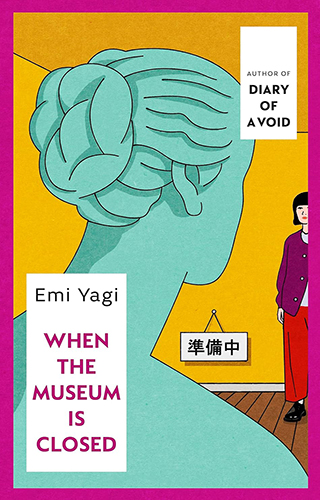
Emi Yagi’s 2023 novel When the Museum Is Closed is a refreshing work of magical realism about a shy young woman who falls in love with a statue of Venus. The twist is that the statue loves her back, and – even more miraculous! – their love story has a happy ending.
Rika is a recent college graduate who works in the freezer department of a warehouse for processed food. She sees this as the perfect job for three reasons. First, she never has to talk to anyone. Second, she can take pre-prepared food home from her job, so she rarely has to cook. And third, an invisible yellow raincoat suddenly appeared over her clothing in elementary school, and she’s found it almost impossible to remove in public. The heavy vinyl fabric keeps her body temperature high, but that’s not a problem in an industrial freezer.
The only variation in Rika’s days comes from her part-time job. Once a week, Rika takes the bus to a local museum to have an hour of conversation with a statue of Venus. Venus only speaks Latin, but Rika enjoys a freedom with the dead language that she’s never found in Japanese. Though Rika is shy at first, she and Venus become friends, and they eventually fall in love.
Unfortunately, there’s a bit of a situation with a man named Hashibami, the museum curator in charge of the statue. He wants Venus all to himself, and he never wants her to change – he doesn’t want her to learn modern languages, and he certainly doesn’t want her to learn about the world outside the museum.
Venus therefore makes a deal with Hashibami. If he can get Rika to fall in love with him, she’ll allow him to fire Rika from the conversation job. Regardless, Rika isn’t interested in men, nor does she allow Venus to push her away. What Rika wants is something else entirely, and her relationship with Venus has given her the courage to chase their mutual joy.
The fantastic elements of When the Museum Is Closed are presented as entirely mundane, and it’s easy to take them at face value. At the same time, the love story between Rika and Venus resonates at an allegorical level with the experience of having a queer crush on someone who’s friendly and flirtatious yet seemingly unattainable. It’s the crush you have on an older coworker, or the crush you have on an internet friend, or the crush you have on the gayest girl you’ve ever met who is, inexplicably, married to a man. It doesn’t really matter that Venus is a statue, as anyone who’s experienced queer longing can relate to Rika’s situation. At the same time, Emi Yagi’s Venus is animated by her own distinct personality and undeniably lovely.
I’m sure that When the Museum Is Closed could also be read as an allegory for how women tend to be treated in male-dominated artistic and curatorial spaces, but the story is far more concerned with Rika’s subjective experience of her own individual life. I especially enjoyed the subplot involving Rika’s friendship with her landlord, a quirky but kind elderly woman who needs home care assistance, and I appreciated the understanding Rika develops with the neglected young boy who lives next door. Though Rika’s invisible yellow raincoat is unique to her, she’s far from the only person carrying unseen baggage, and it’s not necessarily the case that this is a problem that needs to be fixed.
When the Museum Is Closed is a short but expertly paced novel that moves quickly yet still allows the reader enough time to appreciate each scene. Its premise is intriguing and well-executed, and Yuki Tejima’s delightful translation captures the author’s tone perfectly, both in Rika’s deadpan observations and Venus’s mature flirtations. Readers who enjoyed Emi Yagi’s novel Diary of a Void will be pleasantly surprised by When the Museum Is Closed, which features the same sharpness and clarity of writing augmented by lovely moments of sweetness.
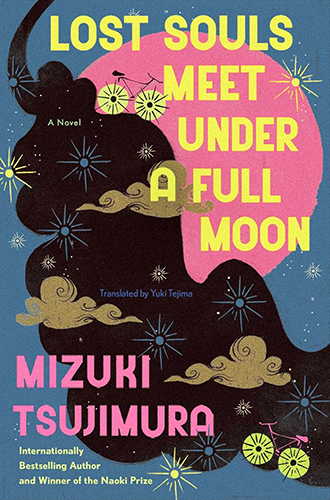
Lost Souls Meet Under a Full Moon brings together five interconnected short stories about people seeking to contact the dead. Though this book falls firmly into the category of “relaxing” fiction, it’s more plot-driven than most, and it distinguishes itself through its worldbuilding, especially its willingness to test the parameters of its magic system.
The central character of the novel is a handsome and stylishly dressed teenage “go-between” named Ayumi who can facilitate meetings between the living and the dead. The catch is that a person can only have one of these meetings in their lifetime, and each dead person is only allowed to return once.
This is why the choice of the focal character of the first chapter, “The Rule of the Idol,” is so unusual. Manami asks the go-between to connect her with, of all people, a performer named Saori who made her living as a tv personality appearing on various talk shows and quiz games. When Manami was at the lowest point in her life, alone in Tokyo and bullied by her coworkers, she had a random encounter with Saori, who encouraged her to get back on her feet. Manami wants to use Saori’s death as an opportunity to thank her personally, which she never would have been able to do while Saori was still alive.
The third chapter, “The Rule of the Best Friend,” is far less wholesome. A first-year high school student named Arashi wants to be cast into leading roles in the plays performed by her school’s drama club, and she’s not shy about making her intentions known. Her biggest supporter is her best friend Misono, who joins the drama club in solidarity. Misono’s introverted grace has an alluring appeal that Arashi overlooks in her brash ambition, and she ends up losing a starring role to her best friend.
Arashi takes this poorly and stops talking to Misono. She assumes this will be a punishment, but she quickly realizes that her friendship was holding Misono back from achieving her own dreams. When Misono dies in a cycling accident, Arashi desperately wants to apologize, but she hasn’t yet developed the maturity to say what really needs to be said. I have to admit that I was surprised by the final meeting between the two friends, which is steeped in a complexity otherwise absent in these stories, and “The Rule of the Best Friend” ended up being my favorite part of the book.
In the final chapter, “The Rule of the Go-Between,” we see the characters from the previous stories from Ayumi’s perspective as he goes on his own journey during the process of inheriting the role of go-between from his elderly grandmother. Ayumi’s parents died under mysterious circumstances when he was a child, and his grandmother has carried a sense of guilt for years. Unlike his unfortunate classmate Arashi, however, Ayumi is able to break the barrier of silence and offer comfort and closure to his grandmother while they’re both still alive.
Despite a few brief moments of darkness, Lost Souls Meet Under a Full Moon presents little emotional challenge to the reader. There are very few subversive or self-reflective elements in these stories, and the characters occasionally behave like two-dimensional constructs who act solely in service to the plot. This isn’t a bad thing, of course. Lost Souls moves quickly and follows its internal logic so impeccably that the reader’s suspension of disbelief is never broken. As a result, each of the chapters is great fun to read.
Mizuki Tsujimura has taken the five-chapter cozy fiction formula and polished it to a high sheen. As far as the genre goes, Lost Souls Meet Under a Full Moon is as good as it gets, largely thanks to the author’s willingness to explore the more nuanced implications of the stories’ premise. Yuki Tejima’s translation is lovely and uses a light touch to bring the energy of Tsujimura’s prose to English-language readers. I’d recommend Lost Souls Meet Under a Full Moon to anyone looking for a good comfort read, not to mention a welcome reminder of the importance of saying what needs to be said while you’re still alive.
Retrograde collects five short stories and one novella written by a young Osamu Dazai and gorgeously translated by Leo Elizabeth Takada.
The novella, Das Gemeine, follows a 25yo student studying French literature who aspires to become a writer himself. While hovering around an amazake stand in Ueno Park and hoping to catch the attention of the young woman who works there, the narrator meets another student, a violinist who barely attends class at all. The violinist’s friend, himself a painter, warns the narrator not to believe any of the violinist’s tall tales about his supposed talent.
The three young men decide to start a literary journal together (along with their pathetically unattractive acquaintance Osamu Dazai), but petty personality conflicts crash the project before it can get off the ground. Feeling hopelessly at a loss in letters and in love, the narrator meets a sad fate that may not have been entirely an accident.
One of the many myths surrounding Osamu Dazai (the author, not the character) is that he considered himself to be a failure rejected by the mainstream literary establishment. For better or worse, I can relate. I know from personal experience that, as an outsider, you often find yourself placing your work in the hands of upstart editors organizing projects that may, in all likelihood, never see the light of day. More often than not, things fall apart precisely because the creative team had big dreams but no practical skills to realize their ambitions.
I myself am something of a coward who immediately walks away from that sort of unpleasantness, but my familiarity with creative collaboration mishaps makes me respect the truth of the story Dazai tells in Das Gemeine, which is remarkably well-observed. The characters in this novella are deeply frustrating and more than a little cringe, but they’re 100% real – this is exactly what it’s like to work with creatives in their twenties who build castles in the air but haven’t yet developed the artistic discipline to commit their visions to paper. Bless their hearts.
The five shorter stories in the collection read like something that the narrator of Das Gemeine might actually have written. A 25yo man dies tragically and is mourned by his beautiful wife. A college student sits for the final exam of a French literature class he never attended. A high school student obnoxiously flirts with café waitresses but swiftly loses a fight with a grown man who’s not interested in his sophomoric bullshit. A teenage boy experiences a sexual awakening when the circus comes to town. Each of these stories is only a few pages long, and their unguarded sincerity contributes to their charm.
The closing story, “Blossom-Leaves and the Spirit Whistle,” is about two sisters in love with an idealized version of a man who only exists on paper until the strength of their shared storytelling summons his ghost to appear under their window… perhaps. I appreciate this story’s clever touch of Todorovian fantasy, and I’m always here for unapologetic gothic pathos. This aesthetically luxurious story is classic Dazai, in that it’s exactly the sort of work that’s contributed to his popularity among generations of students. I myself am not immune, of course, and this is by far my favorite piece in the collection.
In their “Translator’s Afterword,” Takada describes Dazai’s writing style as “a casual conversation with someone familiar,” and they explain that they want their translation to feel as if they’re “doing this just for you,” the reader. Takada gets the tone exactly right, rendering Dazai’s straightforward prose into an invitation to sympathize with the writer and his characters even despite their naked sincerity. I’ve never responded to overly “literary” renditions of Dazai’s prose, but I found myself flying through this translation. It’s fantastic.
I also want to highlight the care and attention that One Peace Books has put into the layout and typeset of this book, giving the words on the page exactly the room they need to breathe. Retrograde is a lovely object to hold in your hands, so much so that it might even spark the same youthful enthusiasm for literature that Dazai so aptly captures in his early fiction.
Much love to Leo Elizabeth Takada and One Peace Books for breathing fresh life into these classic stories from the 1930s. Retrograde is an admirable achievement, and I hope it brings the work of a fascinating author to new readers.
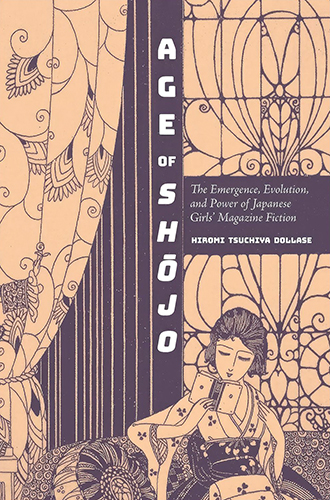
Numerous articles and book chapters have explored the origins of shōjo culture, and Hiromi Tsuchiya Dollase’s Age of Shōjo: The Emergence, Evolution, and Power of Japanese Girl’s Magazine Fiction contributes new insights while weaving these threads together into a tapestry depicting the history of how imagined communities of young women were shaped by the editors and contributors of popular mass-market magazines in Japan.
Age of Shōjo opens with a discussion of Louisa May Alcott’s novel Little Women, which was translated by Kitada Shūho in 1906 as Shōfujin. Through a close reading that compares the translation to the original, Dollase demonstrates how the novel “introduced a Japanese female audience to Western lifestyle and the image of a Western home” while still conforming to native Meiji-era constructions of femininity.
Chapters Two and Three introduce two key figures who helped shepherd amateur women’s fiction into professional venues. The first is Numata Rippō, who edited the seminal magazine Shōjo sekai (Girls’ World), and the second is Yoshiya Nobuko, who is famous for her contributions to this magazine, which were later published as the collection Hana monogatari (Flower Tales).
Chapters Four and Five trace the development of the portrayal of gender and sexuality in Yoshiya’s work in comparison with her contemporaries Morita Tama and Kawabata Yasunari, who also contributed short fiction to popular magazines such as Shōjo no tomo (Girls’ Friend) during the 1930s and early 1940s.
Chapter Six jumps forward to the immediate postwar era, when girls’ magazines such as Himawari (Sunflower) were filled with romanticized images of the United States, and Chapter Seven chronicles how magazine fiction for teenagers took a more mature turn during the 1980s. The stories published in the 1980s were still commissioned, selected, and edited to appeal to a readership of young women, but this fiction now addressed themes relating to women in the workforce, including frustrations concerning the choice between marriage and a career.
As related by the anecdotes in the book’s Introduction and Afterword, girls’ fiction continues to be widely read and culturally influential in Japan. Dollase handles this material with respect and care by acknowledging its problematic aspects but preferring to contextualize instead of critique. This is especially the case with the heavily censored fiction of the 1940s, as well as the work of writers whose stories were progressive when they were first published but may seem socially conservative now.
In her informative study of these texts, Dollase demonstrates how, “through magazine stories and illustrations, readers came to acknowledge themselves as shōjo, a new cultural identity,” and how the fiction of these authors contains “messages of resistance against disagreeable cultural conditions cloaked in fantasy, sentimentalism, and humor.” Along with Dollase’s deft and accessible analysis, Age of Shōjo’s annotated reproductions of magazine covers and interior illustrations are a gift to readers interested in the literature and visual culture of girlhood in twentieth-century Japan.
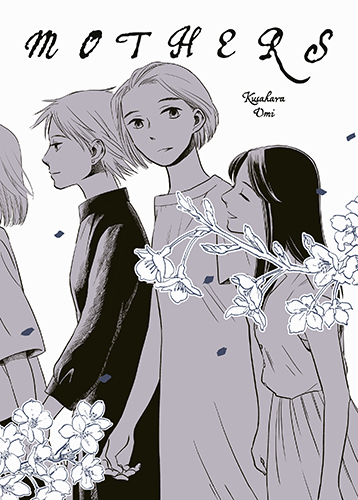
Mothers, released by Glacier Bay Books in April 2023 after a successful Kickstarter campaign, collects twelve one-shot manga stories about small but significant moments of kindness enacted in uncommon ways.
Umi Kusahara’s work is accented by touches of the fantastic but grounded in a reality that doesn’t pull its punches. These stories are particularly concerned with grieving and the emotional impact of loss, which is represented delicately but without sentimentality.
In the piece that lends its title to the collection, “Mothers,” two women visit the hospital beds of two teenagers who have only barely survived a horrible car crash. Each woman has a complicated relationship with the patient she visits, but they find sympathy and support in the connection they create with each other. As in the other stories in the collection, the catharsis lies in the moment of clarity when the characters can be finally honest with themselves about what they want and what will make their lives worth living.
Umi Kusahara originally self-published these short manga as dōjinshi, and it’s wonderful to see an American publisher uplifting noncommercial indie work that doesn’t fit into established genres. All of the titles in the Glacier Bay Books catalog are worth checking out, but I’m especially fond of Mothers, which I continually find myself returning to. Kusahara’s shōjo-inspired artwork is a lovely source of inspiration, and it’s a joy to bask in the sweetness of her worldview.
Glacier Bay Books is currently running a crowdfunding campaign for Fall 2025. The campaign will run until September 11, and this is a great way to check out and preorder their upcoming indie manga titles.
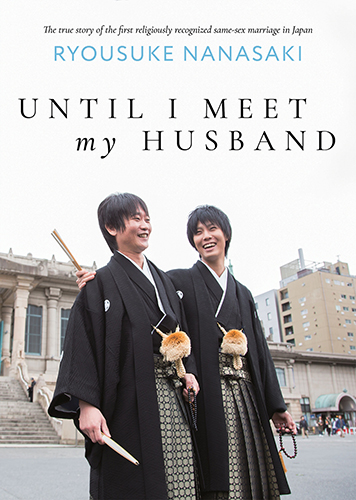
Until I Meet My Husband is a collection of short autobiographical essays by Ryousuke Nanasaki, an activist who established LGBT Community Edogawa in 2015 and a wedding planning company called Juerias LGBT Wedding in 2016, both of which contributed to Tokyo’s Edogawa ward officially recognizing same-sex partnership by issuing marriage certificates.
Nanasaki lays out his motivations for becoming an activist toward the end of the book, but the majority of his essays are humorous stories about life and love. As Nanasaki explains in the final chapter, “In Place of an Afterword,” he wants readers to understand the “raw, uncut truth” of queer identity, which is that gay people experience happiness and make mistakes like everyone else.
As a result of Nanasaki’s honesty, the essays in Until I Meet My Husband are immensely entertaining and compulsively readable. Many of the stories will be familiar to queer Millennials, from receiving a stern lecture from a well-meaning teacher in elementary school to dating other closeted queer kids in high school to falling a little too hard for your first serious partner as an adult. Nanasaki leans hard into friendship drama, relationship drama, and family drama, but he’s so funny and good-natured that you can’t help but support him through his misadventures.
Molly Lee’s translation is pitch perfect, conveying the confidence and enthusiasm of Nanasaki’s voice in natural English that’s a pleasure to read. Along with the original essay collection, Seven Seas has also released the manga adaptation, which features dreamy artwork by BL manga author Yoshi Tsukizuki.
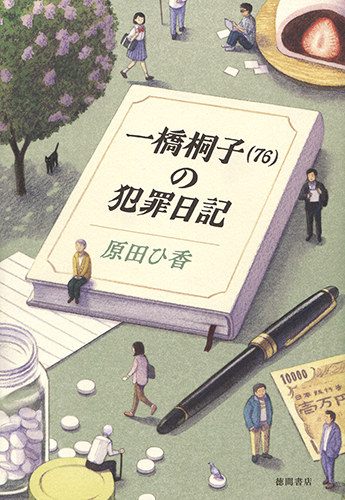
Hika Harada’s 2020 novel Hitotsubashi Kiriko (76) no hanzai nikki, which I’ll refer to as “Kiriko’s Crime Diary,” is the story of the eponymous Kiriko Hitotsubashi, who has found herself alone and in trouble at age 76. After her closest friend dies and her life savings are stolen, Kiriko decides that her best option is to spend her remaining years in prison. The only problem is that, before she goes to prison, Kiriko first needs to commit a crime.
Kiriko has been single all her life, but she jumps at the chance to share a house with her best friend Tomo, whose husband has died of a heart attack. Unfortunately, after two years of friendly companionship, Tomo dies of cancer, and Kiriko’s signature seal, bank passbook, and account holdings are stolen by a young man who asks to enter her house to pay respects to Tomo’s memorial. To add insult to injury, Tomo’s two sons treat Kiriko like garbage as they remove the furniture and cookware she shared with Tomo from her house.
Kiriko is left destitute, and she’s forced to use the last bit of money she has left to rent a subsidized apartment in a privately owned building for the elderly. She can barely afford groceries, and her new neighbors are difficult and unpleasant. Despite her age, Kiriko is as healthy as a horse, and she doesn’t seem to be in any danger of dying soon. She decides that being in prison would be preferable to becoming homeless, so she resolves to live a life of crime.
For the most part, Kiriko’s Crime Diary is a comedy that follows a sweet-natured and sensible woman as she does her best to get arrested. Kiriko has standards, and she doesn’t want to commit any sort of crime that might cause actual harm. She tries shoplifting from a chain grocery store, counterfeiting money with a convenience store photocopier, and scouting targets for a dubiously legal moneylender – all to no avail.
Over the course of her attempts to solicit advice regarding how to commit a crime, Kiriko ends up befriending all sorts of people, from the owner of the office building where she works as a janitor to a high school girl who volunteers to be kidnapped to punish her negligent parents. Between one thing and another, Kiriko ends up attracting the attention of a semi-retired yakuza boss, who uses intermediaries to contact Kiriko before finally meeting her in person.
One of the major subplots of the novel involves a man around Kiriko’s age who becomes entrapped in an elaborate “marriage scam” by a younger woman who drains his finances and then disappears. The man is crushed by disappointment, and the members of the poetry club Kiriko once attended with her friend Tomo have to band together to figure out how to help him. Along with Kiriko’s own troubles, this episode highlights the lack of a social safety net for many elderly people in Japan.
The theme of elder precarity becomes especially critical with the approach of Kiriko’s 77th birthday, which marks the start of her formal age of retirement. The janitorial company that employs Kiriko forces her to quit, depriving her of her only means of supporting herself. If Kiriko has no job and no one to serve as a guarantor for her rental contract, what is she supposed to do, exactly? Is her only recourse to start working with the yakuza?
Thankfully, Kiriko’s Crime Diary has a happy ending. All of Kiriko’s friends show up during a climactic scene to offer support and advocacy, and Tomo’s daughters-in-law apologize for the way she was treated by her late friend’s sons. All the loose ends are neatly tied, and Kiriko might even get to have a lovely winter romance with the handsome yakuza boss. I usually shy away from this sort of sentimentality, but why shouldn’t Kiriko have the best of all possible endings?
When I was working on one of my dissertation chapters about Natsuo Kirino’s gritty crime novel Grotesque, one of my readers asked me why Kirino’s characters all have to be so miserable. That was a fair question, and my answer was something along the lines that Kirino’s novels express the reality of the despair faced by many older adult women who find themselves completely devalued by society.
While I still believe that the tonal bleakness of Kirino’s style of critique is necessary and important, I also think that the happy ending of Kiriko’s Crime Diary is a welcome counterpoint. What Harada archives through this gentle comedy is to model one possible solution to elder precarity. Namely, if the neoliberal Japanese state is so utterly useless in providing social welfare, people must aggressively resist twentieth-century social conventions to form communities for mutual aid.
This support benefits not just elderly people, but also multigenerational networks. As much as Kiriko gains from her friendships with the owner of the building she cleans and the teenage girl she “kidnaps,” these characters also benefit from having Kiriko in their lives. It would be a shame, Harada suggests, not to have at least one friend like Kiriko.
Relearning how to make friends while relying on the kindness of strangers isn’t going to be a feasible solution for everyone, of course, but it’s a damn sight better than going to prison. And, if someone like Kiriko is considering prison, what are we even doing as a society? Even with a marvelously happy ending, Kiriko’s Crime Diary offers a social and political critique that’s difficult for even the most conservative reader not to agree with.
Hika Harada has enjoyed a productive career, and she’s won numerous awards for her fiction and screenplays. It’s no surprise that Kiriko’s Crime Diary was a bestseller that has found a place on all sorts of recommendation lists. This story will definitely appeal to readers outside of Japan, and it’s perfect for the same readership that enjoyed Killers of a Certain Age (which is fantastic, by the way).
Harada’s novel Dinner at the Night Library is going to be released in English translation in September 2025, and I’m looking forward to reading it. Kiriko’s Crime Diary is a genuinely fun and charming story, and I’d love to see it appear in translation too.
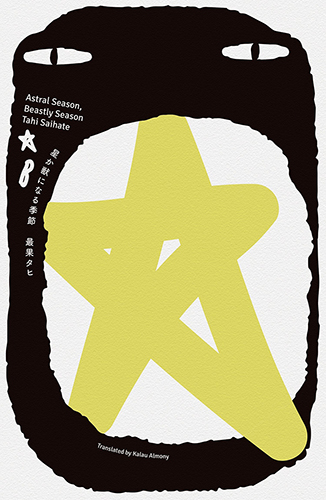
Tahi Saihate’s Astral Season, Beastly Season (translated by Kalau Almony) is a novella about toxic high school friendships and girl group fandom gone horribly wrong.
In the first half of the book, a junior in high school named Yamashiro writes a letter to an unpopular “underground idol” named Mami Aino. Mami, who is still in high school herself, was arrested on the charge of murdering her ex-boyfriend. Another boy in Yamashiro’s class, Morishita, takes the news poorly and decides to commit a series of copycat murders so that he can confess to the crime Mami committed and take the fall in her place.
Unlike Yamashiro, Morishita is attractive, popular, and a model student. Why he’s a fan of a fledgling girl group with such a small following is unclear, and it seems like an incredible coincidence that both Yamashiro and Morishita would be attracted to the same super-indie performer. Although Yamashiro doesn’t seem to be aware of this, I strongly suspect that Morishita is much more attracted to Yamashiro than he is to Mami.
Regardless of motive, Morishita’s intention to commit murders is sincere, and he wastes no time getting started on his grim task.
The second half of the book takes place several years later, when Morishita’s childhood friend Aoyama meets up with Watase, a high school classmate of one of Morishita’s victims. Watase accuses Aoyama of portraying the murderer as “an all-around good guy” in an interview he gave to a tabloid magazine, and she wants him to apologize. Before the two of them get a chance to have a proper conversation, Aoyama is contacted by the brother of another of Morishita’s victims. This young man also wants closure, but what was going on in Morishita’s head will forever remain a mystery.
I have to admit that Astral Season, Beastly Season left me cold. More than anything, this is a book about the friendship dynamics of a small group of high school students. The novella doesn’t dwell on the psychology of the criminals, nor does it offer much description of what underground idol culture is or what it’s like to participate in this sort of fandom.
Instead, the reader is inundated with inane details about who is friends with whom, and who does and doesn’t walk home together, and who ignores other people on the train, and who went to a café together, and who is and isn’t talking to whom, and who said something mean after class, who doesn’t want to be in a group together on a school trip.
Amidst the swirl of teen friendship drama, the actual murders seem like little more than an afterthought. Were it not for the second half of the book, one might even argue that Yamashiro and Morishita are just pretending to plan and commit crimes. In fact, I tend to think that the story might actually be more interesting if this were the case. None of the characters has anything particularly insightful to say after the time skip, and the reader never learns anything about what Mami or Morishita might have been thinking or feeling. It’s all a bit disappointing.
There are two points of comparison that might bring the novella’s story into sharper contrast. The first is Yukio Mishima’s classic novel The Temple of the Golden Pavilion, a psychological drama about the (heavily fictionalized) young man who set fire to the eponymous landmark in 1950. It’s a gorgeous piece of writing, and Mishima is fascinated by the mind of a teenage loner who commits a serious crime, especially with respect to how this crime results from an intense homoerotic friendship. Another interesting companion novel is Rin Usami’s Idol, Burning (which I reviewed here), which I feel offers a much more sensitive and astute portrayal of the role that pop music fandom can play in the life of an emotionally precarious teenager.
I get the feeling that Astral Season, Beastly Season might have benefitted from a translator’s afterword explaining who the writer is and what the context for her work might have been. It might be a worthwhile project to discuss this novella in a college class or an academic paper, especially given Tahi Saihate’s status as an internet-famous visual artist who uses text to create eye-catching public art installations, but I’m not sure it stands on its own as a work of fiction.
If nothing else, the novella is painfully honest about how high school friendship drama can feel life-shattering and world-changing to the people involved. Still, whether this sort of story is worth spending time with really depends on the interests and taste of the reader. It wasn’t for me, but perhaps a younger reader might feel a stronger sense of immediacy and connection to a beautiful high school boy who commits terrible crimes.
Yōko Ogawa’s 1994 book Kusuriyubi no Hyōhon (薬指の標本) brings together two novellas that feel spiritually akin to The Memory Police, which was originally published in the same year. Like The Memory Police, the two novellas in Kusuruyubi no Hyōhon are set in a seemingly normal world haunted by a sense that something important has vanished. These stories are about ordinary people who come into contact with pockets of magic whose mundanity belies their deep strangeness.
The narrator of the first story, Kusuriyubi no Hyōhon, has moved to the suburbs after losing a portion of her ring finger in an industrial accident. While walking through the neighborhood, she encounters a handwritten “help wanted” sign taped to the front door of a “specimen museum” (標本室) operating in a building that once served as a dormitory during the postwar period. With no connections and no other job prospects, the young woman interviews for and accepts a position as a receptionist.
It’s not entirely clear what exactly the museum’s “specimens” are, and their method of manufacture is a mystery. Regardless, anyone is welcome to bring an object representing a traumatic experience to the museum, where it will be registered, cataloged, and preserved. Through each object’s transformation into a specimen, the pain of its associated memories disappears.
The narrator becomes the focus of the intense gaze and possessive interest of the artist who creates these specimens. Though she loves him, he forbids her to enter his underground workshop. Given the apparent disappearance of the people who requested that specimens be made from parts of their own bodies, the narrator can’t help but wonder what would happen if she entered the artist’s forbidden underground chamber and asked him to work his magic on what remains of her severed ring finger.
The narrator of the second story, Rokkakkei no Kobeya (六角形の小部屋), is a nurse at a large hospital where she recently ended a serious relationship with one of the doctors. She becomes fascinated by two middle-aged women she encounters in the locker room of a local sports club; and, with little else to occupy herself during the long winter evenings, she trails them to a semi-abandoned danchi housing complex.
One of these women, Midori, operates an odd service in the former apartment manager’s office. The “Katari Kobeya” (語り小部屋) is a small, self-contained room with six soundproof walls. Anyone who enters this room can speak to their heart’s content, thereby relieving themselves of the psychological burden of their secrets.
The narrator has no secrets to speak of, but she becomes friendly with Midori and her handsome son. In order for the magic of the Katari Kobeya to remain effective, however, it can’t remain in one place for long. If the narrator comes too close to this strange liminal space, she runs the risk of another heartbreak.
In her monograph The Pleasures of Metamorphosis, Lucy Fraser describes Ogawa’s stories as having a fairytale-like quality, and this is certainly true of the two novellas in this book. In Rokkakkei no Kobeya, the narrator follows two women through the trees of a snowy park at night and thereby finds herself in a warm and comforting sanctuary that can be found only by those in need. Meanwhile, Kusuriyubi no Hyōhon has echoes of Bluebeard, with an older man forbidding an inexperienced young woman from entering a special room in his gothic mansion.
In addition to the subtle inclusion of fairytale tropes, the ethereal quality of Ogawa’s writing is partially due to what Elena Giannoulis, in her article “The Encoding of Emotions in Ogawa Yōko’s Works,” calls the writer’s “mood tableaux.” Giannoulis argues that Ogawa generally doesn’t reveal much below the surface of her characters’ placid demeanors, nor do her characters go out of their way to offer psychologically perceptive commentary on the world around them. Instead, Ogawa creates a “mood” by describing what the narrator perceives with their senses. By thus crafting a vivid picture of a setting unimpeded by value judgments, Ogawa invites the reader to associate their own feelings with the cinematic tableaux they see in their mind’s eye.
Giannoulis’s argument makes perfect sense to me, especially in relation to Kusuriyubi no Hyōhon. I find the texture of Ogawa’s writing to be similar to the visual style of Hirokazu Kore’eda, who allows the camera to linger on the small details of his characters’ environment while the characters themselves remain silent. These settings tend to be mundane in the extreme, and Kore’eda luxuriates in the interiors of older structures that have become dirty and dilapidated. As in Kore’eda’s films, the combination of nostalgia and neglect lends a subtle touch of pathos to the quiet drama of Ogawa’s stories.
Kusuriyubi no Hyōhon is a meditation not on what has vanished, necessarily, but rather on what remains behind. In these two novellas, Ogawa speaks to the dignity of people, places, and objects that are in danger of being forgotten. No one would notice if anything in Ogawa’s stories disappeared – but she has noticed, and now the reader has noticed, too. Still, though there’s a certain tonal warmth and narrative coziness to Kusuriyubi no Hyōhon, Ogawa never allows the reader to relax. As in any fairytale, there’s always a sense of danger, as well as the intriguing strangeness of half-remembered liminal spaces.



 Contemporary Japanese Literature