Translucent Tree

Title: Translucent Tree
Japanese Title: 投光の樹 (Tōkō no ki)
Author: Takagi Nobuko (高樹 のぶ子)
Translator: Deborah Iwabuchi
Publication Year: 2008 (America); 1999 (Japan)
Publisher: Vertical
Pages: 188

My past experiences with romance novels have been few and far between. My grandmother used to keep a few around her house back in the early nineties, and they were mostly period pieces with titles like “Master and Maid” and “Forbidden Tryst” (my favorite was “The Pirate Slave;” the cover art was epic). I’ve never actually read a romance novel all the way through, but I’ve always been curious about them (especially after finishing Loving with a Vengeance a few days ago). I’ve heard that Takagi Nobuko is a famous and prolific romance novelist in Japan, so I figured that a translation of her award-winning novel Translucent Tree would be as good of a place as any to begin a foray into the magical world of bodice rippers. If nothing else, I was drawn by the cover, which displays a super-phallic pinecone superimposed over a triangular spray of pine needles, which are suggestively cleft down the middle under the dust jacket. Classy, right?

Translucent Tree is a story of star-crossed lovers. Following the conventions of a tale as old as time (or at least as old as 1949, when Harlequin established its basic formula for romance), the man is wealthy and a bit of a jerk, and the woman is struggling financially and a bit immature. The man, Go, lives in Tokyo, and the woman, Chigiri, lives in a town close to the Japan Sea called Tsurugi (which actually exists). Go, who makes his living as a documentary filmmaker, had once worked on a piece featuring Chigiri’s father, a metalworker knowledgeable about traditional sword-smithing techniques. During the filming, Go met Chigiri. Chigiri was a child at the time, but the two left strong impressions on each other.

Years later, Chigiri has divorced her husband and moved back to Tsurugi with her daughter to take care of her bedridden father. Go returns to Tsurugi on a whim in order to revisit a famous cedar tree and ends up running into Chigiri. The sparks fly, and the two enter into a strained long-distance relationship in which neither can be completely honest with the other. Go offers money to Chigiri in an attempt to help her father, to whom he still feels a debt of gratitude, and Chigiri tries to compensate Go by sleeping with him. Since they love each other but can’t bring themselves to admit it, their brief encounters are fraught with sexual and emotional tension.

Takagi’s portrayal of Go and Chigiri’s relationship is heartbreakingly honest at times. Their inane phone conversations are painfully awkward, and their inability to communicate is endearing, as is the emotional blackmail to which they subject themselves. Neither Go nor Chigiri is portrayed as being particularly attractive, and both of them have legitimate personality flaws. Go can be an asshole, and Chigiri can be annoyingly dense. Despite this, they’re attracted to each other in what strikes me as a very human and realistic way.

What I didn’t appreciate, however, were Takagi’s attempts to add an element of timelessness to the narrative by characterizing Go as some sort of Eternal Man and Chigiri as an Eternal Woman. Translucent Tree is filled with overgeneralizing sexist statements, like:

What she hadn’t counted on was the inability of men to understand the depth of a woman’s resolution. Women are determined and tenacious when men are of precious little use merely because women lack adaptability; it’s impossible for them to take a step or speak a work unless they have thought things over thoroughly and adopted a plan of action.

Really? No one taught me that when I was going to woman school. I had no idea I was supposed to lack adaptability. There are similar statements on subjects such as how men and women lie differently (apparently, women reveal information selectively while men just make things up) and why men travel but women don’t (women are roots and men are branches, you see). The utterly non-ironic way in which these pronouncements are made grated on my nerves every time I encountered one.

Another aspect of Takagi’s writing that hit slightly off the mark was her pillow talk. Being a romance novel, Translucent Tree has its fair share of eight-page sex scenes. Fun sexytimes are always a welcome addition to any narrative; but, unfortunately, each of Translucent Tree’s bedroom shots is more awkward and stilted than the last. It’s possible that this awkwardness is largely the fault of the translator, who apparently never got the memo on how not to write sex, but I am still going to have to point my finger at Takagi herself for her descriptions that read like something out of bad fanfiction:

They were both thinking about the same thing, but from different positions. Chigiri was at the top of the mountain peering down at the deep valley between her legs and, beyond that, at her slippered feet, which felt oddly detached from the rest of her body. Go was standing at the foot of the mountain gazing deep inside the valley, waiting for the right moment to start the trek in.

I use this particular passage as an example because it’s a paragraph of self-contained awkwardness instead of two pages of gradually building awkwardness, but I think it’s also useful to illustrate not only what is merely amusing about Translucent Tree but also what is genuinely interesting. The numerous nature and geography metaphors throughout the text posit Go and Chigiri not just as the Eternal Man and the Eternal Woman but also as New Japan and Old Japan. Romantic conceits relating to nostalgia for an imagined Japanese tradition have been embodied in female characters before, but I think Takagi handles this device remarkably well. Chigiri’s hometown of Tsurugi is an appealing mix of old-style sushi shops and historic trees in the middle of rice fields. Chigiri herself is less of an idealization of well-bred Japanese femininity and more of a portrait of an earthier type of woman who has weathered the blows of misfortune yet still maintains the passionate core of her being. Go’s Tokyo is not a steampunk wonderland of trains and tall buildings but rather a shabby place where the human relationships are shallow, the food is all takeout, and the old pinup calendar on the wall is slowly turning yellow.

Go’s attempts to capture and preserve Old Japan through the lens of a camera are ultimately meaningless, while Chigiri’s charm is wasted as she slowly goes to seed out in the boondocks. It’s only through their relationship with each other that the two really come alive, and their first tryst is perhaps the most memorable scene in the book, if only because of its setting in a beautiful, “traditionally” Japanese estate in the countryside. In this scene, cultural imagery and sexual imagery are reflected back on one another repeatedly. Through its interaction with New Japan, then, Old Japan is both refreshed and refreshing. In the impact of its use of geography as metaphor, Translucent Tree is just as brilliant as As I Lay Dying or Deliverance. I can see why the book has won awards, even though the “romance” aspects of the novel are somewhat lacking. Although its gender politics tended to rub me the wrong way, I enjoyed Translucent Tree, and I would recommend it to anyone who enjoys Japan fantasies of the sort written by Kawabata Yasunari or Muriel Barbery.

Speaking of geography, I’m sure that by now everyone has heard about how Japan survived its most recent encounter with subterranean catfish tremors and walls of liquid death marching toward the coast. Not to lessen or belittle the tragedy, but I think the country handled the situation remarkably well, and I hope that the governments of other countries (*cough* such as my own *cough*) were paying attention. That being said, there are still many people who are evacuated and homeless. If you’re interested in making a donation but skeptical of the Red Cross, Global Giving is the site that everyone seems to be vetting, for what it’s worth.

Girl, Illustrated

Title: Girl, Illustrated: Japanese Manga, Anime and Video Game Characters
Japanese Title: ガールズグラフ:コミック・ゲーム・ライトノベルのイラストレーターファイル (Girls graph: Comic, game, light novel no illustrator file)
Art Director: Sometani Yōhei (染谷 洋平)
Translators: Shima Miya (嶋 美弥) and Marian Kinoshita (木下 マリアン)
Publisher: Pie Books
Publication Year: 2009
Pages: 205

A few days ago I was killing time in the Borders next to Penn Station in New York City. I love this Borders. Not only do they allow people to sit on the heating vents next to the windows when it’s freezing outside, but they also have the largest and best-stocked manga section of any brick-and-mortar bookstore I’ve ever been inside. Every time I visit this Borders I find something that I had no idea had even been published. This time I found several copies of Girl, Illustrated. While I was flipping through one of them, I kept thinking about the recent New York Times article titled “In Tokyo, a Crackdown on Sexual Images of Minors.”

I am not a big fan of the article. For one, it doesn’t bother to introduce Ishihara Shintarō, his racism, his sexism, or his vocal ultra-nationalist political stance. So, when Ishihara is quoted as saying of the media in question that “These are for abnormal people, for perverts,” his statement seems only natural from a moral perspective. (Although one does chuckle a bit when he says, “There’s no other country in the world that lets such crude works exist.”) Indeed, the media that Ishihara hopes to censor is sensationalized as child pornography, and an impartial reader has no choice but to view it with disgust. It is only in the very last line of the article that someone is quoted as saying, “It’s a completely imaginary world, separate from real life.”

I wish the journalist who wrote the article, Hiroko Tabuchi, had played up this side of the debate more. I wish she had mentioned that, while Ishihara and his cohort are drafting legislation against the depiction of imaginary girls, they are also fighting an ongoing battle against feminists who want to change the law that doesn’t allow a married couple to maintain separate surnames (which hinders the career development of many female professionals). I wish these things because, in the past two weeks, enough people have quoted from or referenced the article that I am starting to fear how it may have influenced a non-specialist’s view of Japanese popular culture.

As all of this ran through my mind while I paged through Girl, Illustrated, I decided that the best way to look at Japanese illustrated images of girls is to actually look at Japanese illustrated images of girls. I would therefore like to review Girl, Illustrated, a bilingual art book published in Japan and available in America through online retailers like Amazon, Borders, Barnes and Noble, and Tower Books. Before I begin, I would like to state that this book does not contain child pornography. I myself do not support child pornography, and it is not my aim to defend or justify it in any way. Instead, I hope to challenge common notions regarding “anime-style” Japanese illustrations of young women.

The style of illustration in question is known as bishōjo-kei, or “bishōjo style,” with “bishōjo” meaning “beautiful young woman.” A bishōjo (as opposed to a regular shōjo, or “young woman”) is usually a female protagonist or central supporting character in a manga, anime, or light novel that belongs to a genre generally regarded as being targeted towards a male audience, like science fiction or adventure fantasy. Good examples might be Nausicaä (from Nausicaä of the Valley of the Wind), Nadia (from Nadia: The Secret of Blue Water), or Ayanami Rei (from Neon Genesis Evangelion). Bishōjo are rooted firmly in fantasy, whether that fantasy is a post-apocalyptic technological wasteland or a halcyon senior year of high school. They need not be connected to an actual narrative, however, and are often depicted in original artistic compositions.

Girl, Illustrated is a collection of such compositions. Each artist is allotted two pages and four to six full-color illustrations. Accompanying these images is a section for information about the artist, which includes fields for the artist’s birth date, gender, hometown, webpage, inspiration, and comments. More often than not, most of these fields have been left blank, but the information is written in both English and Japanese when it is available. Unfortunately, the translation isn’t always perfect. For example, something like 銃器・武器と女の子を描く (drawing girls with guns or other weapons) might become something like “drawing girls in their underwear with guns,” but these short artists’ comments are still fun to read.

This being said, the main draw of Girl, Illustrated is what the artists say with their illustrations. Through affective character design and rich, detailed backgrounds, each of these illustrations wordlessly suggests a story. The vast majority of these images have been created with digital ink in programs like Photoshop, Illustrator, and PaintTool SAI. Although most of the artists choose not to reveal their gender, judging from those that do, it seems that 2/5 are female. Among these female artists are young professional illustrators like Sakizou, Foo Midori, and fukahire. All of the artists, male or female, take beautiful young girls as their subject matter, and there doesn’t seem to be any discernable difference between the themes and style of the male illustrators and those of the female illustrators. For example, this is a piece by the female artist onineko:

And here is a piece by the male artist Ichikawa Takashi:

Both of these illustrated girls seem to be young, pure, and innocent. They are magical beings firmly enmeshed in their respective fantasy worlds, and there is a kind of “Alice in Wonderland” quality about them that probably seems familiar to a Western (and non-otaku Japanese) audience. Illustrations like these won’t raise any eyebrows.

Problems in the interpretation and judgment of these images arise when the girls are not quite so pure and innocent but instead betray hints of sexuality. For example, one picture by the male artist gorobots parodies the NHK (Japan Broadcasting Corporation) with the logo NPK (Japan Panty Corporation) and contains the text “When you sit down, I stand up,” double entendre absolutely intended:

Such sexualized images of young women are not just drawn by men, however. Exposed breasts, bums, and panties are also explored in the work of female artists like Higuchi Norie:

The portfolios of other female artists whose work appears in Girl, Illustrated are full of scantily-clad young women enjoying themselves and each other’s company. Regardless of the extent or intensity of the sexualization, however, the fantasy element of these pieces remains strong, and the girls are always more playful than pornographic.

As I mentioned earlier, I am not defending child pornography. Illustrated pornography in Japan is extraordinarily explicit, and it is quite clearly packaged as pornography and sold in separate venues, regardless of the imagined ages of its imaginary protagonists. As for sexualized but non-(overtly-)pornographic images of young girls, though, I might argue that they belong to a different discursive space altogether. Bishōjo simply are not real. They are not real because they are illustrated, obviously, but they are also not real because they are the embodied representatives of pure fantasy. Their world is not our world, and they are our gateways into that world. People who draw and appreciate them do so because of the beautiful otherworld they channel, not because they are fodder for onanistic inclinations. One might draw a parallel between the bishōjo style of illustration and the hyper-sexualized men and women on the covers of American fantasy novels; the tight leather pants and clinging silk dresses of these painted figures are not so much signifiers of pornography as they are emblems of a certain Tolkienian fantasy aesthetic.

The fundamental idea behind the proposed manga (and game and illustration) censorship law in Tokyo is that men are looking at women in a way that is psychologically unhealthy. There is obviously a pornographic gaze that is encouraged and exploited in many aspects of popular and commercial art, but I wonder if perhaps it wouldn’t be unreasonable to posit the existence of something like a “fantasy gaze,” or at least a type of gaze that is less concerned with the image itself than the story behind the image.

Moreover, the sizable percentage of women painting and consuming these bishōjo characters and illustrations complicates the idea of an all-powerful male gaze. One might argue, as have many feminist scholars, that these women have adopted an hermaphroditic gaze. In other words, female viewers have internalized the male gaze and therefore identify with male characters and viewers when they look at sexualized images of women. I myself would like to raise the possibility of a female gaze. This female gaze is responsible for the fanworks featuring male-on-male pairings from popular series like Naruto and Hetalia, of course, but I think it’s also a way for women to portray and look at themselves and other women. By creating and appreciating mildly sexualized images of girls, for example, women can embrace and celebrate a sexuality that lies beyond virgin/mother/whore stereotypes. For women, then, the appeal of bishōjo is not merely the asexual appeal of the fantasy world they represent but also the self-reflexive appeal of being young, beautiful, magical, and, yes, sexual. Furthermore, who is to say that male viewers don’t similarly employ this female gaze when looking at such images?

Girl, Illustrated isn’t just a collection of gorgeous artwork. It’s also a way of looking at and thinking about Japanese bishōjo illustrations. Included at the beginning of the volume is a (mostly) translated essay about how bishōjo characters are marketed and used to promote domestic regional tourism in Japan. Are the editors of the volume trying to suggest that perhaps bishōjo are Japan? It’s a stretch, but it’s also an interesting cultural perspective. In any case, this collection is both fascinating and beautifully produced. Even if you’re more interested in fine art than you are in anime, Girl, Illustrated is still an excellent resource for examining both portrayals of the body and the possibilities of new digital media.

Book Girl and the Suicidal Mime

Title: Book Girl and the Suicidal Mime
Japanese Title: “文学少女”と死にたがりの道化 (“Bungaku Shōjo” to shinitagari no piero)
Author: Nomura Mizuki (野村 美月)
Illustrator: Takeoka Miho (竹岡 美穂)
Translator: Karen McGillicuddy
Publication Year: 2010 (America); 2006 (Japan)
Publisher: Yen Press
Pages: 183

Oh, Yen Press. Oh, how I love you; oh, how I hate you.

I love the money and effort you put into publishing your books. I love that you took a chance on titles like Black Butler and succeeded remarkably. I love that you turned garbage like Maximum Ride and Cirque du Freak into readable and artistically beautiful graphic novels. I love that you found room in your capitalistic heart for series like Bunny Drop and One Fine Day. I love how you don’t put Japanese manga-ka on a pedestal but instead give equal attention to Korean and American artists. I hate that you stopped publishing the paper-and-ink version of your monthly magazine. I hate that I can only access the digital version from your website even after I pay for it. I hate that you sent cease-and-desist orders to scanlation sites but then decided to launch your digital titles exclusively on the most expensive e-reader on the market.

I am similarly conflicted about the light novels Yen Press has released. I enjoyed Spice & Wolf, even if it was a bit bland (the most interesting bits were the watered-down speculations on preindustrial economies, if that gives you any idea how clumsy the characterization was). Kieli had an intriguing premise and was set in a fun dystopic fantasy world but was riddled with stereotypes and awkward dialog. Worst of all, the nails-on-a-chalkboard banality of The Melancholy of Haruhi Suzumiya made me despite not only Tanigawa Nagaru but the entire genre of light novels. So, when Nomura Mizuki’s Book Girl and the Suicidal Mime was released last July, I decided to give it a pass. I felt justified in my decision after reading the opening epigraph:

Mine has been a life of shame. I’m like the one black sheep born into a pure white flock. Unable to enjoy the things my peers enjoyed, unable to grieve the things they grieved, unable to eat the things they ate – being born an ignoble black sheep, I didn’t understand the things my friends found pleasant, such as love, kindness, and

Actually, let’s just leave it at that. There’s no need to copy the full paragraph. Glistening tears leaving black ebony trails of eyeliner down a tragic alabaster face – you get the picture. Maybe I would be more patient with such things if I were seventeen; but I’m ten years past seventeen and not quite as intrigued by alienated narcissism as perhaps I once was, regardless if said narcissism is a deliberate homage to Dazai Osamu. And so it was that Book Girl fell off my radar.

What made me leave my desk and walk straight to Borders to pick up a copy was Erica Friedman’s glowing review of the second book in the series, Book Girl and the Famished Spirit, over on Okazu. If the series is that good, why shouldn’t I read it immediately? And so I did. Suicidal Mime was short and engaging enough for me to read from cover to cover the very evening I bought it, and I did indeed enjoy the experience.

The “book girl” of the title is Amano Tohko, who seems to be an ordinary high school student save for the fact that, instead of food, she consumes the written word. She is the president of her prestigious high school’s book club, the only other member being Inoue Konoha, whom Tohko has drafted to write short, impromptu snacks for her. Tohko’s secret is that she quite literally eats paper with stories written on it, and Konoha’s secret is that he once wrote a bestselling novel under the name of his former girlfriend, who had committed suicide by jumping off the roof of her middle school in front of him. Konoha is taciturn but good-natured, and Tohko is brash but unflaggingly cheerful. The dynamic between these two characters is typical (one might almost say stereotypical) of the genre of Japanese high school comedy, but it’s entertaining nonetheless.

The book is plot-driven instead of character-driven, though, and the plot is set in motion with the introduction of Takeda Chia, who asks Konoha to write a series of love letters for her. The recipient of these letters is Kataoka Shuji, an upperclassman on the archery team. As Konoha soon discovers, however, Shuji doesn’t exist. Or, at least, not anymore – he supposedly committed suicide ten years ago, but a letter found inside an old copy of Dazai Osamu’s No Longer Human hints that there might have been more to his death than suicide. The story is thus propelled by three intertwined mysteries. Who was Kataoka Shuji? How did he die? What stake does Chia have in the matter? Playing the role of Sherlock, Tohko knows more than she lets on but sends Konoha on several fetch quests to discover concrete clues.

These clues seem unconnected at first; and, unfortunately, they tend to remain unconnected towards the end of the book, when everything wraps up so quickly that I was left wondering what had just happened. It turns out that Dazai Osamu is not the only sociopath in the story; literally everyone is a black sheep who has lived a life of shame. This sudden plot development boggled my mind, and I ended up not really caring about any of the inexplicably psychologically damaged characters. Perhaps this makes me a sociopath, but, in my defense, the characterization is rather weak. For example, Tohko is introduced to the reader in this way:

Tohko was perched on a metal folding chair, her knees pulled up to her chest. It wasn’t a very modest way for her to sit. Her pleated skirt was almost wide open – but not quite. If she moved her legs even slightly she would be flashing me.

This is how Chia is introduced:

A girl was splayed out on the floor, her skirt flipped up in her fall, exposing her bear-print underwear for all to see. It occurred to me that my little sister had the exact same pair of underwear, but she was only just starting elementary school.

In other words, the characterization depends fairly heavily on anime tropes, which are emphasized and reinforced by the illustrations:

To make a short story even shorter, then, Book Girl and the Suicidal Meme is a plot-driven novel with a ridiculous and poorly paced plot populated by characters that are little more than amalgamations of tropes culled from the otaku database. Despite this (or perhaps because of this), the book is a fun read. It’s short, and it moves quickly. It doesn’t take itself too seriously, and I imagine how it would be perfect for a younger audience. If nothing else, Tohko’s synaesthetic responses to literature are kind of cute:

“Mmmm, so good. Fitzgerald has a really snazzy flavor. I feel as if flamboyance, glory, and passion are dancing a waltz in my mouth, like I’m eating glittering caviar with champagne at a party. When I bite into it, its delicate skin pops, and a fragment of liquid spills into my mouth.”

As you can probably tell from the above passage, the touch of the translator is feather-light, so reading Book Girl feels really no different than reading “normal” (ie, contemporary American) young adult fiction, save for the eight full-color pages of illustration at the beginning. At $8.99, the book is priced like normal young adult fiction as well, so it’s well worth picking up and breezing through for anyone interested in light novels, young adult fiction, or anime and manga in general. I’m definitely going to order the second volume of the series before my next plane ride. The Famished Spirit is about sixty pages longer than The Suicidal Mime, so hopefully there will be more room for plot and character development.

Another mystery-flavored light novel I read recently was the first volume of Sakuraba Kazuki’s Gosick series, which is published by Tokyopop and still (as of this writing) available at a discount through Right Stuf. Like Book Girl (and many of Doyle’s original stories), Gosick employs a Todorovian element of fantasy in that the reader never quite knows if the cause of the story’s improbable events is supernatural in origin. The innocence of the beautiful young female Holmes-equivalent can be grating at times (as is that of Tohko), and there were times I suspected that her “astronomical genius” was only given to her by the author to make her a more desirable prize for the male reader-stand-in protagonist; but, if you can get around that, the first volume of Gosick is an enjoyable mystery novel. The Gosick anime series is currently streaming on Crunchyroll, and it’s worth briefly checking out if only for its gorgeous Mucha-inspired art nouveau opening sequence.

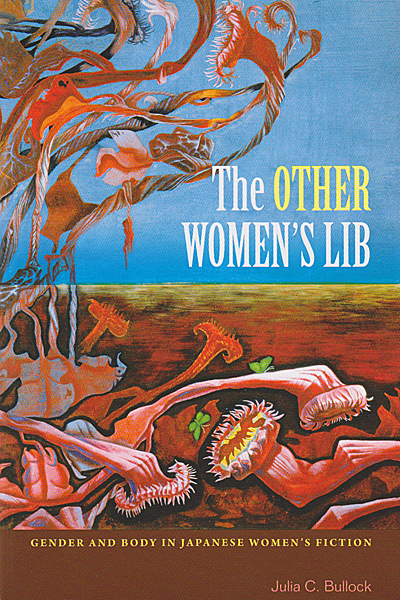
The Other Women’s Lib

Title: The Other Women’s Lib: Gender and Body in Japanese Women’s Fiction
Author: Julia C. Bullock
Publication Year: 2010
Publisher: University of Hawai’i Press
Pages: 200

Sometimes I will hear someone describe an academic text with disdain, calling it “accessible” as if that were a terrible, embarrassing thing. This bothers me. Psychoanalytical, literary, political, and cultural theory are wonderful tools, but the texts from which this theory is drawn are often very difficult to read. Furthermore, academia has reached a point in its cycle of production at which it is simply not enough to have read the original sources of theory; one must also read all of the lenses through which they have been interpreted over the past thirty to forty years. As a result, even one strain of theoretical thought is often difficult to master. And yet, some scholars expect their readers to know everything about the specific theory that informs their work. They thus go about using specialist terms without explanation, throwing theorists’ names around metonymically, and not bothering to orient their reader to their underlying system of assumptions. I believe this is unreasonable, if only because some of us have not been alive for the requisite number of years it takes to read and study all the books (if such a thing is even possible).

I don’t mean to suggest that all academics write like this. In fact, I believe most professors are far more interested in communicating ideas than they are in hoarding them within the confines of the ivory tower. Julia Bullock’s literary study The Other Women’s Lib is a perfect example, I think, of how an “accessible” academic text can convey both the pleasures of the authors whose works are examined and the pleasures of the methods used to examine them.

In The Other Women’s Lib, Professor Bullock handles three postwar writers: Kōno Taeko, Takahashi Takako, and Kurahashi Yumiko. Each of these three writers is fairly canonized in the tradition of Japanese literary studies, with numerous dissertations and anthologized essays celebrating their work. Bullock’s book-length study is important because it has the courage to focus on these three female writers alone without feeling the need to include chapters on some of the more prominent male figures of the Japanese literary world, thus carrying on the torch sparked by classics like Victoria Vernon’s Daughters of the Moon and the fantastic essay collection The Woman’s Hand.

Instead of dividing the book into three sections focusing on each of the three authors, Bullock has categorized her chapters thematically. Each of these five chapters deals with an important issue relevant to the work of all of the authors. For example, how were they received by the literary establishment? How did they incorporate the concept of the male gaze into their writing? Do their stories reflect an ingrained misogyny, or do they instead reproduce misogyny in order to challenge it? How do these authors narrate the female body? How do they characterize the relationships between women? Throughout these chapters, Bullock draws on the work of theorists such as Michel Foucault (the internalized gaze), Susan Gubar (feminist misogyny), and Luce Irigaray (the creation of discursive sexual difference). Bullock does not merely throw about concepts like panopticism, however; she explains her terms and their contexts and fleshes them out with well-chosen quotes before explaining exactly how they apply to the stories and novels she analyzes.

The first chapter of the book, “Party Crashers and Poison Pens,” places these themes and writers into their geographical and historical context, namely, Japan in the sixties and seventies. These decades were an era of high economic growth and the cradle of gender ideologies that many people have now come to regard as “traditional;” i.e., the man goes out into the world and fights the good fight as a corporate warrior, while the woman stays at home and takes care of the children. The chapter introduces these ideologies and their political implications, explains their social and economic context, and then touches on the male-dominated literary scene before then demonstrating how certain proto-feminist women writers crashed the party with dark, violent, and absurdist fiction. Bullock describes the literature that emerged during this period as “the other women’s lib,” a nuanced and intensely critical evaluation of contemporary gender roles and economic ideologies. Even if a reader has no interest in the particular writers in question, this chapter alone is worth reading for its excellent summary of an exciting literary movement and the dynamic and explosive time period that served as its background.

That being said, Kōno, Takahashi, and Kurahashi are all fantastic writers who have been well served by their English translations, which appear in collections like Toddler-Hunting, Lonely Woman, and The Woman with the Flying Head. Their North American equivalents would be authors like Joyce Carol Oates, Alice Munro, and Margaret Atwood. In other words, they are authors who are worth reading and worth reading about. It is my hope that The Other Women’s Lib will encourage the popularity of these three Japanese authors in English-speaking teaching and translation communities. If nothing else, it is extraordinarily satisfying for me to put Professor Bullock’s book on my shelf next to all of the literary studies of Kyōka, Sōseki, Tanizaki, Kawabata, Mishima, and Murakami.

To anyone interested in the topic of gender in Japanese literature, I might also recommend the title Girl Reading Girl in Japan, which was edited by Tomoko Aoyama and Barbara Hartley and published in late 2010 by Routledge. Unlike Bad Girls of Japan, Girl Reading Girl in Japan is intended for a more specialist audience, but this doesn’t mean it isn’t worth checking out, especially for someone interested in the burgeoning field of shōjo studies. The book is a collection of conference papers, with each paper being about ten to twelve pages of essay and another one or two pages of footnotes. The ten conference papers are accompanied by an editors’ introduction, a genealogical essay introducing three major Japanese players in the field of shōjo studies (Honda Masuko, Yagawa Sumiko, and Kawasaki Kenko), and then two translated essays. Taken together, these collected writings demonstrate what has happened in Western scholarship relating to shōjo in the past ten years and provide an excellent introduction to the body of Japanese scholarship. Girl Reading Girl in Japan brings the topics discussed in The Other Women’s Lib into the present day through essays on subjects ranging from Murakami Haruki to Kanehara Hitomi to the portrayal of rape in Harry Potter dōjinshi. The essays are intelligent, the topics are fun, and the book is very easy to browse through. I only wish Routledge would release it in paperback…

Bad Girls of Japan

Title: Bad Girls of Japan
Editors: Laura Miller and Jan Bardsley
Publication Year: 2005
Publisher: Palgrave Macmillan
Pages: 222

Every once in awhile I will demand, in my ignorance, why no one has published an article about some facet of Japanese culture that really deserves an article. It usually turns out that, in fact, someone has published an article; and, occasionally, it turns out that all of the articles I have ever wanted to read have been published in one book. My most recent of such discoveries is Bad Girls of Japan, which was published in hardcover in 2005 and paperback in 2007. Why hadn’t I read it before this past weekend? That’s a good question. Perhaps I had thought to myself, what do I care about Abe Sada or Yoshiya Nobuko? Perhaps I had thought to myself, how academically rigorous can a short collection of twelve-to-fifteen page essays actually be? Did I mention that I can be extremely ignorant sometimes?

Bad Girls of Japan is a compilation of eleven short articles (plus a separate introduction, conclusion, and bibliography) about, as the title suggests, Japanese bad girls, with “bad” meaning “defying mainstream notions of proper female conduct” and “girl” being a term of female empowerment, apparently. Rebecca Copeland begins the collection with an essay about the demonic women of Japanese folklore, such as the yamamba, or carnivorous mountain witch, and the jilted lover turned giant snake monster from the Dōjō-ji myth that has come down to us by way of a famous Nō play. Other essay topics include geisha, Meiji schoolgirls, kogal, and shopping mavens like Nakamura Usagi – as well as the aforementioned Abe Sada (whose erotic escapades were sensationalized by films like In the Realm of the Senses) and Yoshiya Nobuko (whose Hana monogatari – flower tales – more or less established the shōjo narrative style).

In short, Bad Girls of Japan is all about women who have become the vortexes generating major cultural currents in modern and contemporary Japan. As such, it reads like an alternate cultural history informed by various academic focuses and disciplines. Since the essays are short, each writer has been forced to say the most important things about her topic in the most efficient way possible, but none of these essays sacrifices theoretical nuance (or footnotes). Furthermore, in a book designed to upset common ideas concerning Japanese culture, it is appropriate that none of the essays makes any sort of culturally essentializing overgeneralizations, either.

Because of its essay length and broad range of topics, Bad Girls of Japan does feel a bit like an introductory textbook, but it’s a very intelligent textbook, and the excellent editing ensures that it’s easy to read, as well. As a result, I think this essay collection is one of the rare academic books that will appeal to non-academics, and it would be an excellent choice of reading material for someone who doesn’t know very much about Japan but wants to learn more. I especially recommend this book to pop culture fans interested in moving beyond archetypes and stereotypes. It’s a quick, fun read, and it paints a lively and vivid picture of the past one hundred years of Japanese cultural history. To respond to my own initial doubts concerning this book, then, one should care about women like Abe Sada and Yoshiya Nobuko not merely because they were interesting people who told interesting stories, but also because of what their stories reveal about Japan and its relation to the rest of the world as it made its way through the twentieth century.

By the way, that hypothetical essay I always wanted to read about sex in josei manga is in here too, and I think Gretchen Jones does a great job of addressing the possibility of female pleasure and agency lurking within all the graphic rape. I just wish her chapter were longer, which I suppose is something I could say about everything in the book…

Zaregoto, Book 1: The Kubikiri Cycle

Title: Zaregoto, Book 1: The Kubikiri Cycle
Japanese Title: クビキリサイクル 青色サヴァンと戯言遣い
(Kubikiri cycle: Aoiro savant to zaregoto-zukai)
Author: NISIOISIN (西尾 維新)
Translator: Greg Moore
Publication Year: 2008 (America); 2002 (Japan)
Publisher: Del Rey
Pages: 332

I am not a big fan of NISIOISIN (who I am going to refer to as “Nisio” for my own convenience). I didn’t get a terribly good impression of him from what I had read of his work before, which was limited to Death Note: Another Note, a collection of three short stories based on the manga xxxHOLiC (you can find my review of that one here), and the short story “Magical Girl Risuka” in the second English edition of the literary magazine Faust. Judging from these stories, Nisio is obsessed with the concept of genius. Of course, genius and its practical applications are fascinating, which is why characters like Sherlock Holmes and Tony Stark are so appealing. Nisio’s problem, however, is that he amps the asshole factor of Holmes and Stark all the way up to eleven and turns it directly towards the reader. When I read his work, I feel like he’s attacking me personally for being so stupid and incompetent, unlike his collection of beautiful geniuses. I think there’s perhaps an element of tsundere at play here, and perhaps it’s my fault for not being Nisio’s target audience, but there’s an even more annoying problem with his recurring descriptions of genius. I am going to call this problem the Hannibal Lecter paradox. Sure, it’s easy to say that a character has an IQ of 250, but it’s a bit tricky to write such a character if the author himself falls within a more normal range of intelligence, and most authors – including Nisio – fail.

I myself may not be the sharpest tool in the shed; but, if someone is going to tell me (or at least my reader-vehicle protagonist) that I’m stupid, I would at least prefer for that person to be interesting and intelligent, not a poorly-written, bloated mass of anime clichés. Zaregoto, Book 1: The Kubikiri Cycle is filled with many such bloated masses; but somehow, it works. In the same way that one angry bird is annoying, yet hundreds of angry birds are epic, Zaregoto is so ridiculously cliché that somehow it ends up being awe-inspiring. Are you ready to play cliché bingo? Let’s go!

Mild-mannered and unassuming teenage male protagonist who has secret depths of inner strength, Ii-chan, is friends with a beautiful teenage girl who is such a genius that she has trouble taking care of herself. She is a super-elite international computer hacker who builds her own super-amazing hardware and software and prefers the virtual world to the real world, you see. Anyway, this beautiful girl genius, Kunagisa Tomo, is invited to a small island inhabited by an outcast daughter of a very rich family. This outcast rich girl, Akagami Iria, is herself young, beautiful, and a genius. Since she either can’t or chooses not to leave her island, she invites all sorts of other geniuses to come to her. It just so happens that all of the other geniuses who visit her are also young, female, and beautiful. All of these gorgeous geniuses are cared for by Akagami’s (young and beautiful) trio of maids, who are sisters and hyper-talented at martial arts, among many other things. Everything is going well on Wet Crow’s Feather Island as the geniuses compare the sizes of their respective penis envy by taking turns telling Ii-chan what a stupid idiot he is, but suddenly! Someone is murdered! And we don’t know who did it! And then the prime suspect herself is murdered! In a locked room!

It gets worse from there, but I imagine my point has already been made. My mind boggles at how Nisio was able to hit so many of the high-profile mystery and anime stereotypes all at once. I kept reading just to see what would come out the bag next, and I was never disappointed. What is even more interesting about the book, however, are its logic puzzles. I’m not sure whether our narrator Ii-chan is deliberately unreliable or just an idiot; but, in either case, Sherlock Holmes he is not. He almost never notices anything for himself, and other characters are constantly pointing things out to him. What Ii-chan is good at doing, however, is taking all of this information, putting it together, and analyzing it. Along the way, he explains classic logic flaws and paradigms to the reader, which is fun in a Michael Crichton “this is how science works” sort of way.

None of this helps him solve the mystery, however, because the mystery itself is beyond ridiculous. Let it suffice to say that several people on the island are in the habit of amusing themselves by switching identities. And by “several people,” I mean “almost everyone.” (I kept expecting Ii-chan to pull off his pants and surprise everyone by being a beautiful girl genius himself, but alas, it didn’t happen.) There is no way that the reader can figure any of this out, so one must simply follow the twists and turns of the story developments and its various revelations along with the narrator. The dénouement of the mystery is so convoluted that it ceases to make any sense whatsoever about halfway through, but the identity of the killer at the core of the tangles of plot thread is actually quite interesting, especially as a conclusion to Nisio’s fetishistic focus on genius.

I will be honest. I bought Zaregoto because it was on sale for three dollars at an anime convention, and I read it because my plane back home from said convention was delayed for a few hours. Under those circumstances, which allowed me to read the book all the way through in one sitting while fueled by sleep deprivation and gallons of cheap coffee, I enjoyed it immensely. The translation is smooth and polished, and the illustrations by take are a very nice touch. This novel is the first in a nine-volume series, and it thus leaves certain plotlines open, like Ii-chan’s past and his budding romantic relationship with Kunagisa. The second volume of the series was released in English translation earlier this summer, but I’m not sure if I enjoyed the first volume enough to seek it out. But if I find it on sale for three dollars at another anime convention, I will definitely grab it.

Summer, Fireworks, and My Corpse

Title: Summer, Fireworks, and My Corpse
Japanese Title: 夏と花火と私の死体 (Natsu to hanabi to watshi no shitai)
Author: Otsuichi (乙一)
Translator: Nathan Collins
Publication Year: 2010 (America); 1996, 2001 (Japan)
Publisher: Haikasoru
Pages: 350

I don’t know why I haven’t reviewed anything by Otsuichi yet. Tokyopop has released two collections of his short stories (Calling You in 2007 and GOTH in 2008), and Haikasoru released the collection ZOO, which is a major bestseller in Japan and ended up getting its own film adaptation, around this time last year. It might be that I haven’t reviewed his work before now because, even though his stories are fun and creative, they tend to be hit or miss. Also, they fall squarely into the genre of horror, which has gradually eroded away into “Dark Fantasy” or “Thriller” in the American market (the back cover of my paperback copy of Stephen King’s most recent novel, which involves murder, rape, cannibalism, and mass asphyxiation, tells me that it is “Fiction”). However, the majority of Otsuichi’s stories are pure shock horror of the type that might be found in magazines like Black Static or Macabre Cadaver, which might explain the “hit or miss” factor and also makes them difficult to review. If you like horror, you’ll like Otsuichi. If you don’t like horror, why would you want to read him?

The three stories in Summer, Fireworks, and My Corpse are still horror, but I feel like two of them are fleshed-out enough (what a lovely analogy for horror fiction) to appeal to a wider audience. The title story, which is seventy pages long, tells the story of a murder from the perspective of the dead person, who is surprisingly nonchalant about the whole thing. Being dead, however, she’s able to follow the thoughts and movements of her best friend, who inadvertently killed her, and her friend’s older brother, a budding sociopath who helps his sister hide the body. The pair isn’t exactly professional in their cover-up operation, so there are a lot of delightfully suspenseful moments in which they are almost, almost found out. The surprise ending is morbid but equally playful. The setting of the story, the forest surrounding a Shintō shrine, is used to full advantage. I think those small forests are the closest thing to a Shakespearean green world in contemporary Japanese fiction; every time one pops up in a story, you know that something weird and exciting is going to happen. (Another good example might be found in the manga Tenken, which is absolutely brilliant and should be read by everyone.) Not just the suspense and the setting but everything about the story is well executed, and it’s hard to believe that Otsuichi made his literary debut with it while still in high school.

The following story, “Yuko” (優子), is the usual Otsuichi fare. It’s short, grisly, and doesn’t make a whole lot of sense. If you’re the sort of manga fan or Lolita fashionista who’s into the mock horror and period trappings of titles like Yuki Kaori’s Godchild, though, you’ll dig the gothic atmosphere and the creepy, creepy doll parts.

And then there’s the two hundred page novella Black Fairy Tale (暗黒童話), which was published five years after the other two stories in a separate volume. For me, this story is the best part of the collection. The narrative switches between a traditionally styled fairy tale and a more modern one, which is itself told from several points of view. The main point of view is that of a high school student named Nami, who loses her memory along with her left eye in a freak accident. She receives an eye transplant and gradually realizes that she can see the memories of the eye’s former owner if exposed to certain triggers. The blurb on the book’s cover makes it seem like this element of the story is its primary source of horror, in an I see dead people sort of way; but, as Nami has lost her own memories, she can only live her life though borrowed memories, and she becomes emotionally attached to the scenes of someone else’s life that she sees through the transplanted eye, which belonged to a college student named Kazuya. Since Nami has effectively become a different person than she was before her accident, her school friends and family distance themselves from her, so she drops out of school and uses the savings left behind by her former self to travel to Kazuya’s hometown, a backwater village called Kaede. As with the shrine forest of Summer, Otsuichi makes good use of his setting in this small mountain town, perfectly capturing both the charm and the pathos of rural Japan.

Black Fairy Tale is more than a travel novel, however. Of course Nami wants to visit the places and meet the people she has seen through the eye’s memories, but she also knows that its former owner was murdered for seeing something he shouldn’t have. The reader knows this too, as the narrative shifts between Nami’s story and that of a man who has the ability to keep living things alive, no matter what he does to them. He uses this ability to experiment on the human bodies he keeps in his basement, which are somehow able to maintain their lives and their consciousness despite the terrible things that have been done to them. Nami knows that, if she finds the house whose basement she has glimpsed through her transplanted eye, she will be able to rescue the people there and also avenge Kazuya. There is obviously a great deal of suspense in Black Fairy Tale, but it’s handled in a more sophisticated and effective way than it is in Summer. The character development is much stronger, as well. The separate narrative threads are woven skillfully throughout the story, and the story’s various themes and systems of visual imagery mirror each other artfully. Black Fairy Tale is undoubtedly a horror story, but it’s also put together in a fairly literary way, and it appealed to me and stayed with me in a way that Otsuichi’s previously translated work has not.

In other words, the collection Summer, Fireworks, and My Corpse should be fun for both fans of horror and fans of fiction in general, and I don’t feel bad about recommending it to anyone. My only regret is that I didn’t write about it in time for Halloween…

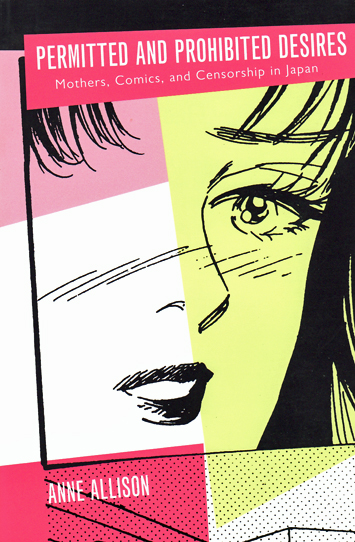
Permitted and Prohibited Desires

Title: Permitted and Prohibited Desires:
Mothers, Comics, and Censorship in Japan

Author: Anne Allison
Publisher: University of California Press
Publication Year: 1996
Pages: 213

I am not a fan of theory. To be perfectly honest, I find the vast majority of it, from Barthes to Foucault to Kristeva to Butler, very difficult to read. The ideas are interesting, certainly, but the contexts often feel dated, and the language is occasionally impenetrable. I suppose this is an occupational hazard, though, as specific terminology is needed to express certain ideas, and the names of theorists are useful as metonymic signifiers of certain strains of thought. Also, although pure theory can sometimes come across as bogwash, its application to more textually grounded studies helps to both deepen and widen the scope of the topic, making something like pornographic manga, for example, relevant to the non-specialist.

In Permitted and Prohibited Desires, anthropologist Anne Allison applies gender and cinema theory to adult manga, arguing that its pornographic elements attest more to the weakness of men than they do to the exploitation of women. Allison reacts against the position of feminists like Andrea Dworkin, who argues that pornography is always misogynistic, and Catherine MacKinnon, who treats pornography as both a reflection and cause of gender inequality, in order to argue for a more nuanced view of how gender functions within pornography, which restricts male social and sexual roles perhaps even more than it restricts those of women.

In the erotic manga that Allison discusses, women are indeed penetrated, gazed upon, and reduced to a spectacle against their will, but men are often absent or unnecessary. Allison demonstrates that the male position of dominance is undermined by the fact that the man is often unable to obtain consent from the woman, as well as by the fact that his genitals are never directly shown but instead replaced with inanimate substitutes like baseball bats and soda bottles. Many scenarios do not feature men at all but leave a woman or pair of women to their own autonomous devices. When the two sexes are paired, however, the display of aggressive female desire often leaves the man impotent, thus driving him to lash out violently at his partner. In other words, the pornographic manga that Allison discusses betrays a strong stake in maintaining a fiction of male domination. It also goes out of its way to construct a clear opposition between male and female sexual identities. Although the man’s position as aggressor and voyeur is meant to empower him, the necessity of his resort to violence suggests that his gaze is not as powerful as it might seem.

Allison does not challenge the notion that the Japanese social order is inherently phallocentric, but she argues that its economic and organizational structures put an enormous burden on men. She sees the brutalized women of pornographic manga as representing real women – such as the potential sexual partners who make themselves unavailable to the reader, or the wives and mothers who are perceived as single-handedly managing a household in which men have become irrelevant. However, these fictional women also stand in for other things that chain males to patriarchal societal expectations, such as entrance exams and companies that require infinite hours of overtime. Allison states that the relatively open acceptance of erotic manga, which are published so as to be easily consumed during a commute, functions as a pressure release valve that allows men to indulge in superficially subversive fantasies before then returning to their primary roles as workers. Pornographic manga thus provide an escape for men, but the escape is only temporary and belies numerous fears of male impotence and powerlessness.

Fun stuff, right? Actually, oddly enough, it is. Allison writes in a very accessible style; and, when she refers to critical literature to make her argument, she draws out and pinpoints exactly what she is referring to. She will never merely cite the Freudian understanding of castration anxiety but rather delve into it in detail, explaining how it differs from a Lacanian understanding and how both understandings relate to the manga narrative in question. As a result, I feel like I learned a lot from Permitted and Prohibited Desires that had nothing to do with manga or Japan. Also, for readers who might not be familiar with the visual conventions of Japanese pornography, the book is filled with well-chosen illustrations that are sufficiently not safe for work. Sometimes a picture is worth a thousand words, after all.

But don’t let me fool you into thinking that discussions of erotic cartoons, adult manga, and censorship laws are all this book has to offer. Sandwiched between chapters on fictional fantasy women are two essays on Japanese motherhood that had previously been published elsewhere to great acclaim. According to the book’s introduction, these two chapters, “Japanese Mothers and Obentōs” and “Producing Mothers,” are based on Allison’s own experience as a mother of two young children while doing research in Japan. Although the purpose of these two chapters is to show how women are almost coerced into becoming good mothers by school regulations concerning everything from uniforms and homework to the prepared lunches children must bring to school with them, the author’s descriptions of her own hardships and surprises are fairly entertaining as stories in and of themselves. These chapters are aptly illustrated with images from Japanese magazines that showcase the obentō lunchboxes that constitute such a large symbolic portion of the relationship between mother and child in Japan. Allison ties these two chapters into the larger theme of the book with a highly relevant discussion of mother-son incest fantasies, which she uses to show how both parties are bound to state ideology even in pornography.

Although Allison’s application of psychoanalytic theory to erotic manga reveals many aspects of the psychology of the male reader, it neglects to take into account the position of female readers, either of pornography marketed towards men or of josei manga, which can be equally pornographic. Allison’s study of pornographic manga is highly useful in its analysis of how women are constructed in narratives written by men and for men, but I feel that work still needs to be done on how women are characterized in narratives written by and for women. Also, Permitted and Prohibited Desires discusses real women primarily in the context of “traditionally” accepted roles like housewife and caregiver. Allison succeeds in showing how these roles have been fetishized by Japanese media and educational superstructures, but she also risks the perpetuation of this fetishization by arguing that it is only through their mothers that men in Japan are able to enter into adulthood. The roles of women as sexual objects and as mothers are given primacy in Permitted and Prohibited Desires, but obviously these roles are far from the only roles occupied by both real and fictional women in Japan. Nevertheless, I feel that this book serves as an excellent foundation for the study of female characters in manga, and it can be easily supplemented by the numerous works that have followed in its wake – one of the most recent being the newest issue of the U.S.-Japan Women’s Journal, which collects a handful of essays on shōjo manga written by Japanese academics.

Before I wrap up, I must admit that I am writing this review partially in response to the recently published essay collection Manga: An Anthology of Global and Cultural Perspectives edited by Toni Johnson-Woods. The essays in this book cover a wide range of topics, but they are less analytical than descriptive, explaining manga to an audience that has presumably never seen or read one before. The book also succumbs to one of my personal pet peeves, the italicization of Japanese words that have become common in America, such as anime, manga, shōjo, and shōnen. This stylistic decision is disconcerting not only because the introduction attempts to argue that manga are a truly global phenomenon (using evidence like a picture of a section of bookshelves clearly labeled “Manga” in a Borders book store), but also because such words are used so frequently in all of the essays. I was hoping that this collection would be to the study of manga what Susan Napier’s Anime is to the study of Japanese animation, but it’s just basic information presented in a somewhat unprofessional manner. That’s a harsh judgment, I know, but my disappointment is commensurate to my expectations. In the end, I still find myself searching for the perfect book about manga, but Permitted and Prohibited Desires will do well enough for now.

The Stories of Ibis

Title: The Stories of Ibis
Japanese Title: アイの物語 (Ai no monogatari)
Author: Yamamoto Hiroshi (山本 弘)
Translator: Takami Nieda
Publication Year: 2010 (America); 2006 (Japan)
Publisher: Haikasoru
Pages: 423

After reading Melinda Beasi’s essay Twilight and the Plight of the Female Fan, I reached a strange epiphany. It’s okay if I don’t like Twilight! It’s okay if I don’t like Black Bird! It’s okay that I am never, ever going to enjoy reading manga like DearS and My-HiME! I am simply not the intended audience – and that’s okay. The point of Beasi’s essay is that fans should not judge other fans for being fans, even if they don’t personally enjoy the work that has inspired fannish behavior. Beasi has made this argument elsewhere, concerning shōjo manga and again concerning the Twilight fandom, and I agree with her. My own personal problem, however, is exactly the opposite. I do not get upset when people denigrate my interests; what upsets me is when I’m derided for not liking something that someone else feels I should.

One of my weak points in this regard is young adult fiction. I used to love it, but I’m almost ten years past sixteen and am beginning to find myself growing impatient with the tropes of both American and Japanese novels written for teenagers. Certainly, not every book written for a younger audience can be The Golden Compass or Harry Potter and the Chamber of Secrets, but I still hold everything else to the same standard. This applies to Japanese light novels as well. Books like Nishizaki Megumi’s adaptation of Hot Gimmick and Coda Gakuto’s Missing series make me grind my teeth in frustration. Thankfully, there are young adult novels in Japan that are every bit as good as anything found in the West, and The Stories of Ibis is one of them.

The Stories of Ibis is pure science fiction directed at a presumably teenage audience, and it can boast everything that is fun about young adult fiction. The prose is clear and concise while still being creative. The narrative is very forward-driven without neglecting character development. Stereotypes are clearly referenced but then played with and expanded upon. Finally, the overall mood of the book is refreshingly positive. As science fiction goes, The Stories of Ibis is overwhelmingly utopian, but there are still lots of quests and uncertainties to keep the reader engaged.

As the title suggests, The Stories of Ibis is a collection of six short stories and two longer stories connected both by theme and by a frame narrative. The theme is the reality of virtual reality and, by extension, the power of fiction. Ibis, a humanoid robot blessed with artificial intelligence, tells these stories to the narrator of the frame story, one of the last human beings on earth. In the narrator’s world, humans fear and distrust robots, and the narrator travels from outpost to outpost, spreading tales of humanity’s glory before the rise of artificial intelligence. The narrator is wounded in an encounter with Ibis, who had been searching for him, so she reads him fiction as he recovers. In between stories (in short segments marked as “Intermission”), Ibis and the narrator discuss the stories, and their relationship gradually changes and deepens.

The first six stories are short, with each barely thirty pages in length. Only one of them is hard science fiction, and only one is strongly anime-flavored. The other four are set in more or less the present day and the present reality. All six deal with artificial intelligence or the reality of a virtual, fantasy world in some way. They’re all enjoyable; but, in my mind, the standout is the first story, in which people who only know each other through a Star Trek themed role playing site try to save one of their online friends from committing suicide in real life. The seventh and eighth stories are considerably longer than the first six, spanning one hundred pages each. I read a short review in Neo magazine that claimed that the two final stories made the book feel unbalanced, but I have to disagree. The final two stories are like a main course after an appetizer, and they are both excellent. Yamamoto reels his readers in with the first six stories and then lands us with the final two.

“The Day Shion Came” is about a nursing robot that whose programming has been implanted with a kernel of artificial intelligence. The robot is given over to a young human nurse to train as the two go through their rounds at a senior care facility. Certain A.I. clichés apply to this story, but they are not the ones you would suspect, and they are challenged and reworked in surprising ways. If there is a literary genre of magical realism, then “The Day Shion Came” might be termed science fictional realism, as everything about it is simultaneously fantastic and mundane. The final story is the story of Ibis herself, who draws together all of the “Intermission” segments by explaining the history of the frame narrator’s world. A remarkable feature of this story is the language that the A.I. entities use to communicate with each other. It’s both interesting and intelligent, but never overused or explicated at length. I won’t attempt to describe it here, but let it suffice to say that I have no idea how the translator was able to handle it so successfully. I tip my hat in admiration of her efforts.

In the final evaluation, The Stories of Ibis is a wonderful book for both young adult readers and adult readers who enjoy good young adult fiction. It’s neither too sci-fi nor too “Japanese” to put off people who aren’t fans of either “genre,” but I think it will still appeal to fans who are familiar with the tropes presented. In other words, like any good young adult novel, The Stories of Ibis attains the perfect balance of intelligence, accessibility, and creativity – and you don’t even have to feel embarrassed for enjoying it.

Manazuru

Title: Manazuru
Japanese Title: 真鶴 (まなづる)
Author: Kawakami Hiromi (川上弘美)
Translator: Michael Emmerich
Publication Year: 2010 (America); 2006 (Japan)
Publisher: Counterpoint
Pages: 218

To return to the issue of sexism in literature (hopefully for the last time before laying it temporarily to rest), I think that, even as a book written by a man should not be automatically dismissed as sexist, so should a book written by a woman not be lauded simply because it was written by a woman. Take Manazuru, for instance. I love Kawakami Hiromi. For example, I think her 1998 collection of short stories, Kami-sama, was an imminently enjoyable exercise in magical realism, successful not only in its popular appeal but also in its critical reception. Her 1996 debut novel, Hebi o fumu, easily deserved all of the attention (like the Akutagawa Prize) that it won. Manazuru, on the other hand, is just plain boring.

The premise of the novel seems promising. Its protagonist is a writer named Kei, who lives in Tokyo with her mother and teenaged daughter. Her husband vanished twelve years ago, and now Kei finds herself inexplicably drawn to the seaside town of Manazuru. She is lead not only by her intuition but also by the ghost of a woman who occasionally appears and has conversations with her, albeit in a mostly antagonistic and cryptic way. Even though Kei is having an affair with a married man, she is still haunted by the memory of her husband, and she believes the key to his disappearance lies somewhere in Manazuru. Meanwhile, her daughter starts spending more and more time outside of the house, finally running away to meet someone whose identity she will not reveal. From this description, it would seem that several mysteries are afoot, each as compelling as the next.

Unfortunately, Manazuru is not the least bit interested in resolving any of these mysteries. What happened to Kei’s husband? We never find out. Who is the ghost that follows Kei around? We never find out. Who did the daughter run away with? We never find out. Answers are suggested in Kei’s garbled stream of consciousness narration, but then they are just as quickly dismissed. Did Kei kill her husband? Is the ghost that follows her around her husband’s dead lover? Did Kei’s daughter meet the ghost of her father? Maybe… But probably not.

In Manazuru’s defense, its plot is not its raison d’être. Its focus instead lies in the depiction of the mind of its protagonist in all of its complexity and confusion. Kei does not seem to know what she wants but is still searching for something, all the while immaculately and poetically detailing her experiences of drifting through life. Her thoughts give weight and meaning to the mundane, and she turns activities like riding the train into an art. Most of the novel is concerned with the details of her everyday life, like putting away her family’s winter clothes with her mother:

Handling so many different fabrics, heavy clothes, light clothes, makes my palms feel silky. I rise quietly, take the folded material from here to there. Bend down, lay it in a box. Fabric brushing against fabric, making the merest sound. Two women, one getting on in years, one starting to get on in years, pacing among the fabrics. With the tips of my fingers, I tear off the paper tag the cleaners stapled to the label last year. Replace the paper that lines the drawer, fold the old paper, throw it out. Straighten the new paper in the drawer, pile in the different materials, layer upon layer.

The same attention to style and detail is carried over into more dramatic moments, such as when Kei wanders around Manazuru, lead by a ghost in the middle of a storm. Such a narrative style drains such scenes of any sense of urgency, however, especially since Kei never seems to accomplish anything. The back of the book describes the novel as “a meditation on memory – a profound, precisely delineated exploration of the relationships between lovers and family members.” Indeed, if you’re into contemplative prose about the love and family lives of women, I suppose it doesn’t get much better than Manazuru.

Even if the front of the book didn’t declare it a “Recipient of the 2010 Japan-U.S. Friendship Commission Prize for the Translation of Japanese Literature,” I think I still might have gotten the feeling that this book was published because of its close proximity to the stereotype of Japanese women’s writing: meandering novellas about the feelings of women who pay more attention than is absolutely necessary to flowers, plants, and the changing seasons. Kawakami has written work that is playful, creative, and fiercely intelligent. I wonder, then, why such a very very serious and very very emotional and very very “literary” (in a very, very outdated sense of the word) book of hers is the first to appear in English translation. Michael Emmerich is a brilliant translator, as always; but, after his 2009 translation of Matsuura Rieko’s wonderfully subversive The Apprenticeship of Big Toe P, I feel that his talent has been somewhat wasted with a boring and rather vacuous book like Manazuru.

To return to the issue of fiction and gender, I was thinking about creating a new category for my reviews: “Women Writers.” However, reading Manazuru has convinced me that a writer should not be judged according to his or her gender; and, furthermore, that the reification of the gender of an author is not something I particularly wish to engage in and perpetuate. For the time being, then, I am going to hold off on the creation of this category and allow female writers to stand on equal ground with their male counterparts without being branded as “Women Writers” and having to bear all the cultural baggage that comes with the label.