Yūrei: The Japanese Ghost

Yūrei The Japanese Ghost

Title: Yūrei: The Japanese Ghost
Author: Zack Davisson
Publication Year: 2015
Publisher: Chin Music Press
Pages: 206

Zack Davisson is a major rising star in the world of manga translation, having worked on high-profile and award-winning titles such as Mizuki Shigeru’s Showa: A History of Japan and Oishii Mamoru and Kon Satoshi’s Seraphim: 266613336 Wings. He is also a consultant for the ongoing comic series Wayward, for which he writes the closing essays. Fans of yōkai and other Japanese cryptids will know him from his blog, Hyakumonogatari Kaidankai, and he also maintains an active Twitter account, which is a great source of news on the American comics scene. Yūrei: The Japanese Ghost is Davisson’s first book, and it’s published by no less than Chin Music Press, which regularly releases Japan-related literary objets d’art such as Kūhaku & Other Accounts from Japan and Otaku Spaces. There’s obviously been a great deal of talent invested in this book, and it shows.

Yūrei are the ghostly cousins of yōkai, and their spectral tendrils stretch deep into Japanese history. Although he occasionally touches on contemporary popular culture, Davisson is mainly concerned with the society and print media of premodern and early modern Japan. Each of the twelve chapters in Yūrei covers one in-depth topic, the discussion of which is usually centered around a specific artistic work.

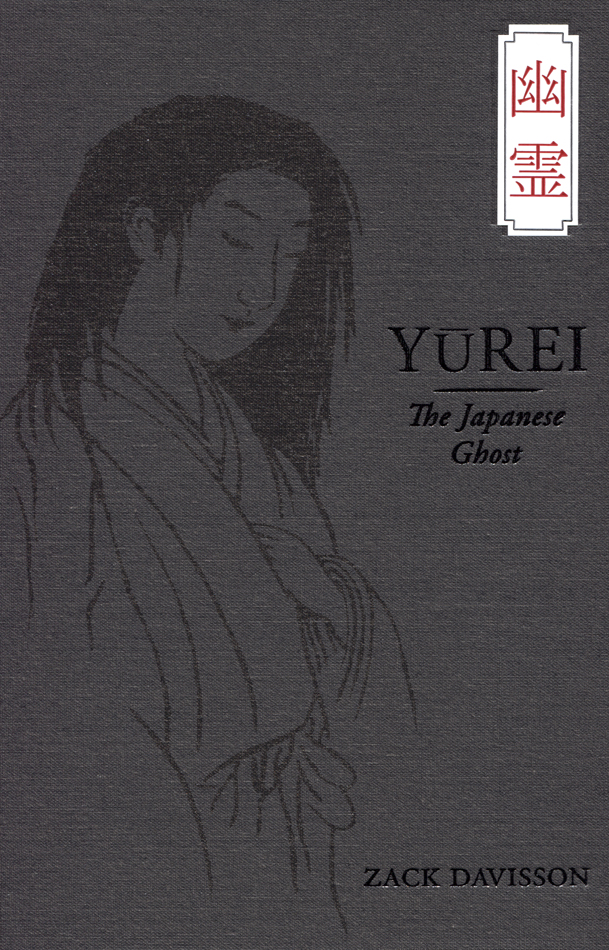
The first chapter takes as its subject “The Ghost of Oyuki,” the Edo-period painting by Maruyama Ōkyo that appears on Yūrei‘s cover. Davisson investigates the origin of this iconic image, melding history with legend. The second chapter covers kaidanshū, or “collections of weird tales,” while the third delves into the world of kabuki. The fourth and fifth chapters offer maps of the geography of the land of the dead, both imagined and, in the case of certain sacred mountains, real. Chapter 6 conveniently details how not to end up as a ghost, and Chapters 7 and 8 recount the lives and afterlives of people who really could have used this advice. Chapter 9, “The Ghost of Okiku,” is an Edo-period case study in how hauntings occur, and Chapter 10 brings the concept of haunting, or tatari, into the present by way of horror movies and urban legends. The eleventh chapter provides an explanation of the traditions surrounding Obon, the festival of the dead. Finally, the twelfth chapter is an informative analysis of Ueda Akinari’s Tales of Moonlight and Rain, which was published in 1776 but still stands (or hovers creepily) as one of the finest works of dark fantasy in any language.

Although every chapter is a lot of fun, my favorite section of the book is its Introduction, in which Davisson relates a personal anecdote about how he and his wife lived in a haunted apartment in Osaka for seven months. Part of the appeal of reading ghost stories is imagining that you yourself might one day come into contact with the supernatural, so I can’t imagine a better way to begin a book like this. Davisson transitions into a brief overview of what the term “yūrei” signifies, how it differs from the Western concept of “ghost,” and its pervasiveness in contemporary film and literature. If I were a curious horror fan, or perhaps a teacher looking for a concise and engaging essay to assign as reading for a class on Japanese folklore, Yūrei‘s Introduction would suit my needs perfectly.

Unfortunately, the writing in Yūrei is not always uniformly smooth. In certain sections of the book, there are brief moments of jarring dissonance, as when one paragraph states that the constant warfare of the Sengoku period (1467-1603) generated countless ghost stories because of people needed a way to process their fear, while the next paragraph argues that ghost stories proliferated in the Edo period (1603-1868) in a way that they couldn’t before because people were finally free from fear. These paradoxes are relatively minor; and, in Davisson’s defense, such seeming contradictions need not be regarded as such, as multiple interpretations are equally valid. This is a book about ghosts, after all.

Yūrei is an extremely handsome publication. It opens with eight full-color images depicting yūrei as imagined by artists in the Edo period. There are fifteen additional images interspersed throughout the book, each of which is accompanied by a short explanation. There is also a glossary at the end, which helpfully provides the kanji for each term, as well as a useful five-page list of English-language works referenced.

The book’s most interesting index is its collection of 33 yūrei kaidan (“strange tales”), which are organized by theme, such as “Tales of Ghostly Vengeance” and “Tales of Ghostly Love.” As it’s difficult to find stories from medieval and Edo-period kaidan compilations outside of out-of-print academic publications, these translations are an extremely welcome addition to the project.

Review copy provided by Chin Music Press. (Full disclosure: I was so excited about this release that I begged for a review copy, and they sent me one just to get me to go away. It was totally worth it.) You can preview the book on Davisson’s blog.

The Book of Tokyo

The Book of Tokyo

Title: The Book of Tokyo: A City in Short Fiction
Editors: Michael Emmerich, Jim Hinks, and Masashi Matsuie
Publication Year: 2015
Publisher: Comma Press
Pages: 180

In his introduction to this collection of ten short stories, editor Michael Emmerich writes:

In a sense, you might say that the stories of this anthology unfold within a landscape more imagined than real – that they create a Tokyo of their own by drawing on a rather abstract sense of the moods of certain sections of the city, or on a vision of Tokyo and the smaller areas it comprises that is more conceptual than physical. (x)

This is a perfect description of The Book of Tokyo, which offers the reader less of a detailed illustration of an urban landscape than it does a vivid sense of the energy and potential generated by a city inhabited by 13.5 million people, every one of whom has a story.

In Furukawa Hideo’s “Model T Frankenstein,” a monster that may or may not be a shapeshifting goat escapes one of the Izu Islands on a ferry and makes his way to Tokyo to assume a new identity as a ‘Japanese.’ He has to kill a few people along the way, but he eventually makes a home for himself in Shinjuku. In “Picnic,” Ekuni Kaori sketches a relationship between a disaffected couple whose hobby is to have designer picnics in a park by their house, an activity that makes them marginally less alienated from one another. Kakuta Mitsuyo’s “A House for Two” is an ode to the trendy comforts of urban living. The pleasure the narrator derives from walking through the city has its roots in her relationship with her mother, whom she whom once bonded with over luxurious foreign clothes and who now commands a greater share of her affections than any man ever could.

The cosmopolitanism of Tokyo is on full display in Horie Toshiyuki’s “The Owl’s Estate,” in which the male narrator, a sushi chef and secondhand book dealer, finds himself in a strange rundown building in West Ikebukuro inhabited by foreign girls of dubious employ. In the end, though, there’s nothing particularly French or Australian or American about the way these girls enjoy drinking and laughing and being silly with each other. The single father protagonist of Yamazaki Nao-Cola’s “Dad, I Love You” must navigate his way through a maze of foreign brand names, cuisines, and business owners over the course of his day before coming home to his daughter, who encourages him to keep going with the joy she finds in things that transcend culture, such as how large the full moon looks in a clear night sky. The young woman who narrates Kanehara Hitomi’s “Mambo” doesn’t even care where she’s going when she gets into a taxi with a stranger; she’s just looking for adventure in the city.

Yoshimoto Banana’s “Mummy” encapsulates the theme of the entire collection, which is that every random encounter between strangers is accompanied by a galaxy of possibilities. A female undergrad agrees to be walked home by a male graduate student studying Egyptology. He cautions her that there’s a killer loose in the neighborhood, and it would be unsafe for her to go out alone. She suspects that he might be the murderer, but her physical attraction to him is so strong that she resigns herself to her fate. Although the grad student isn’t a criminal, he does turn out to be a complete weirdo, and the narrator has to forcibly restrain herself from judging him and the course his life takes after they go their separate ways. When surrounded by so many potential paths, she asks herself, how do you know that your own is “necessarily the correct and happiest one” (52)?

My favorite story in the collection is Kawakami Hiromi’s “The Hut on the Roof.” The main setting is an izakaya pub, where the divorced narrator, an English teacher, eats and drinks and hangs out with older men from her neighborhood. After becoming close to them through the process of exchanging casual but repeated interactions, she eventually learns the story behind the peculiar living arrangement of a local fishmonger who has befriended her. The story doesn’t have a plot, exactly, but it conveys an almost palpable sense of living your own individual life surrounded by people whom proximity has drawn into a loose yet friendly community.

Don’t let the cover fool you – despite the flying cranes and Shintō gate and temple and Chinese lanterns, the The Book of Tokyo is refreshingly contemporary. None of the stories translated for the collection was published before 2000, and reading them feels like walking through the twenty-first century just as much as it feels like walking around Tokyo. As Emmerich notes, it’s difficult to pin down the “Tokyo-ness” of these stories, but the reader who encounters them can’t help but be drawn into the living and breathing atmosphere of a huge and dynamic city.

The editing and story selection of The Book of Tokyo is excellent. I was so impressed that I ended up ordering several other titles in Comma Press’s “Reading the City” series, which include The Book of Gaza, The Book of Rio, and The Book of Liverpool.

Review copy provided by the wonderful people at Comma Press.

All You Need Is Kill

All You Need Is Kill

Title: All You Need Is Kill
Japanese Title: オール・ユー・ニード・イズ・キル (Ōru yū nīdo izu kiru)
Author: Sakurazaka Hiroshi (桜坂 洋)
Translator: Joseph Reeder with Alexander O. Smith
Publication Year: 2009 (America); 2004 (Japan)
Publisher: Haikasoru
Pages: 200

Although I read and very much enjoyed Sakurazaka Hiroshi’s virtual reality gaming novel Slum Online, I was not interested in All You Need Is Kill, even after watching Emily Blunt do endless sexy pushups in Edge of Tomorrow. I have trouble with prison stories, and army stories are like prison stories except worse.

After hearing Akiko Hirao give a paper titled “All You Need Is Kill: Deciphering the Game Elements in the Novel and Film” at the Japanese and Korean Mediascapes conference at the University of Oregon this summer, however, I knew I had to give the book a shot. Drawing on Henry Jenkins’s essay Game Design as Narrative Architecture, Hirao outlined how the structure of the novel’s narrative evokes the experience of playing a video game but ultimately bows to the demands of fiction as a storytelling medium.

The main protagonist of All You Need Is Kill is Kiriya Keiji, a recent high school graduate who enrolled in the United Defense Force after he was romantically rejected by an older woman. Since he has no other ambitions, he decides to prove himself by joining humanity’s fight against alien invaders called Mimics. After spending six months training to fight in a special armored exoskeleton called a Jacket, Keiji is deployed to the Flower Line Base at the southern tip of the Bōsō peninsula (in Chiba Prefecture, on the east side of Tokyo Bay). The novel opens with Keiji’s swift death in his first battle and continues when he wakes up alive and unharmed – but with all of his memories – that same morning. After falling in battle three more times, Keiji realizes that he is caught in a time loop that is reset by his death. He decides that the only way out is to not die, but that’s easier said than done.

I found Keiji to be a bit generic. Even though I just finished reading All You Need Is Kill, I couldn’t tell you exactly how old Keiji is, or where he grew up, or what his relationship with his parents was like, or whether he had any friends, or what his interests and hobbies are. For the first one hundred pages of the novel, all the reader gets is Keiji the soldier in a time loop. He is bitter, introverted, and fairly introspective, but he seems to act as more of a substitute for the reader than as a character in his own right. Keiji is a video game protagonist, and his musings are the musings of a video game character on the game world he occupies:

At the end of the day, every man has to wipe his own ass. There’s no one to make your decisions for you, either. And whatever situation you’re in, that’s just another factor in your decision. Which isn’t to say that everyone gets the same range of choices as everyone else. If there’s no one guy out there with an ace in the hole, there’s sure to be another who’s been dealt a handful of shit. Sometimes you run into a dead end. But you walked each step of the road that led you there on your own. (54)

As the passage above illustrates, the language used by Keiji and his fellow soldiers is rough; but, as far as military diction goes, it’s fairly tame. There’s “fucking” but no “cunting” or “cock-sucking,” for example. I feel like an especially good opportunity was missed in the author’s failure to assign a creative and obscene nickname for the Mimics. The banter between the soldiers is stale, and Keiji doesn’t take advantage of his consecutive time loops to come up with good one-liners to use against his superior officers or the jerks who try to pick fights with him in the cafeteria, which for some reason is actually referred to as a “cafeteria” instead of a “mess hall,” “cookhouse,” “DFAC,” or any number of other military slang terms. The blandness of the language is indicative of how uninterested the novel is in building a world beyond Keiji’s limited range of experience.

This all changes in the novel’s third chapter, which takes the American Major Rita Vrataski as its point-of-view character. The nineteen-year-old Rita became the Mimic-destroying “Full Metal Bitch” after being caught in a time loop of her own; and, unlike Keiji, she actually has a personality. Rita verbally spars with a war photographer named Ralph Murdoch, lets down her guard down around an engineer named Shasta Rayelle, and remembers her childhood in Pittsfield, Illinois, offering glimpses not just into her inner world but out onto the wider world as well. In her paper, Hirao referred to Rita as an NPC (“non-player character” in a game), and this description is apt, as it is through Rita that the player/reader learns more about the nature of the conflict that drives the novel. What are the Mimics? Where do they come from? How can they best be fought? What’s up with this time loop business anyway? Rita doesn’t have all the answers, but she’s got some pretty good guesses.

Rita also has some cool passages in her section, such as when Shasta says…

“America’s at war, and we still find the time to turn out terrible movies.”

Rita couldn’t argue with that. The UDF existed to protect a world obsessed with creating worthless piles of crap, Rita thought. (130)

Preach it, sisters.

The fourth and final section of the novel switches back to Keiji’s perspective, which is a shame, because at the end of the story he becomes the video game hero he was meant to be, which is to say that he is awarded his own tragic backstory. If you’ve ever played any video game ever, you can probably guess how this happens: A woman has to get fridged, and it has to be the woman Keiji falls in love with despite the fact that she doesn’t have a great deal of choice in the matter. It’s a really stupid ending. To make matters worse, the author is too lazy to expand on any of the implications of this ending beyond the fact that Keiji becomes the warrior he never wanted to be. He is a troubled teenager, hear his angst.

In his Afterword, the author explains how is inspiration for All You Need Is Kill did indeed come from a life spent playing video games, writing,

I’m just an ordinary guy, and I’m proud of it. I’m here because I put in the time. I have the blisters on my fingers to prove it. It had nothing to do with coincidence, luck, or the activation of my […] powers. I reset the game hundreds of times until my special attack finally went off perfectly. Victory was inevitable. (199)

The Afterword contains one of the more interesting passages in the entire book, as Sakurazaka is fairly negative both towards video games and the people who play them. Okay buddy, whatever.

If you’re curious about what a video game with all of its gameplay mechanics intact would look like in novel form, look no farther. I thought Slum Online was much more entertaining and skillfully constructed in its representation of what it means to be a video game protagonist, but All You Need Is Kill has the advantage of being short and fast-paced. Also, it’s got forty gorgeous pages full of Rita Vrataski, which is not enough but better than nothing.

I want to give a big thanks to Akiko Hirao for her wonderful and insightful paper on this novel, and I hope to encounter more of her work soon!

Buchō wa onee

Buchou wa onee

Title: Mr. F. Vincent Is……
Japanese Title: 部長はオネエ (Buchō wa onee)
Artist: Nagabe (ながべ)
Publication Year: 2015
Publisher: Akane Shinsha (茜新社)
Pages: 231

Falnail Vincent is a section chief at a large corporation in Japan. He is cool, collected, and very good at his job. His colleagues respect him, and his subordinates admire him, but he’s desperately trying to keep a secret from his co-workers: When he leaves work, Falnail becomes Fal-chan, a hostess at an onee bar. At typical onee bars, patrons are served by glamorous “older sister” types, but Fal-chan’s bar, Jewelry, happens to be staffed by huge beefcakes in heels, hairbows, and strapless minidresses.

Cracks in Falnail’s masculine persona appear when he forgets that he’s not supposed to gush about girly topics like patisseries and makeup bags with his female co-workers. Still, he’s able to keep his two lives separate until a new patron at Jewelry, an American named George Weaver, shows up at his office the next day as a foreign business associate. Being a typical American (the kind that speaks perfect Japanese), George is upfront about his interest in Fal-chan and won’t take “no” for an answer, inviting Falnail out on dates to an amusement park and a fancy restaurant. Meanwhile, George’s advances have sparked the competitive spirit of Danto Impasu, Falnail’s junior at work who’s been harboring a crush on his boss. Because this is a manga, Danto also ends up visiting Jewelry, and hijinks ensue.

None of this deviates far from the routine BL nonsense we all know and love, but what’s a bit out of the ordinary is that everyone in this manga is an animal. George is a bird, Danto is a wolf, and Falnail is some sort of dragon. The mama-san of Jewelry is a tiger, and Fal-chan’s fellow hostesses are a shark and a ram. During his day job, Falnail works with rabbits, roosters, foxes, tanuki, and all manner of other creatures.

The tagline for Buchō wa onee, which just finished serialization in the bi-monthly BL magazine Opera, is “Jūjin + Suits + ML.” Jūjin (獣人) is a subset of a genre of manga called kemono-kei (ケモノ系), which might be glossed as “anthro.” As opposed to jingai (人外), in which mostly human characters have isolated animal body parts like ears or tails, jūjin, or “beast people,” are animals that speak, dress, and walk upright like humans. “ML” is an abbreviation of “mens love,” a subgenre of BL in which the characters are middle-aged and built like brick houses.

As in English-language anthro communities, there seems to be a strong interest male/male romance written and drawn by men and for men in Japanese kemono-kei, with bears being portrayed as literal bears (or wolves, or lions, or Satanic demons, or what have you). Buchō wa onee is extremely silly and lighthearted, but its overt bara stylizations hint at what I see as a movement away from the classic portrayal of androgynous bishōnen masculinity within the world of original dōjinshi comics for women.

I don’t want to read too much into the series of cute tableaus collected in Buchō wa onee, but the normalized strangeness of animals going about their daily lives in an environment otherwise exactly like our own lends an interesting perspective on Falnail’s dilemma, which is that he feels the need to keep his two personas entirely separate. He worries that his colleagues, who depend on him to be authoritative, won’t respect him if they find out about Fal-chan, but the fact that everyone is a different type of animal betrays the reality of the true diversity of the world, where it is not necessarily the case that one’s “species” affects one’s personality in any way. Over the course of the manga, it’s suggested that, even if Falnail isn’t completely comfortable with moving to America and living with George as an openly gay man, he can begin to bridge the gap between his two identities by slowly revealing himself to a sympathetic co-worker.

Mostly, however, Buchō wa onee is about ferocious anthro muscleheads being adorable. Sometimes it’s good to just leave all the real life gay drama behind in real life, you know?

If you’re interested in checking out more of the artist’s work, Nagabe is on Pixiv and Tumblr.

Since today is August 1, I also want to give a shout-out to the round-up of 2015 yaoi-themed web comics posted by Khursten Santos over at her blog Otaku Champloo. To all my fellow fujoshi and fudanshi, stay fabulous and never lose your sparkle-tinted glasses. Happy 801 Day!

Buchou wa onee Page 228

Manga-Inspired Comics at Toronto Comic Arts Festival 2015

Last month I posted an essay titled The Cultural Cross-Pollination of Shōjo Manga in which I argued that the work of young comics creators in North America has increasingly come to demonstrate narrative and visual allusions to shōjo manga.

Such influences are readily on display in the Artist Alleys at anime conventions, which I illustrated in an earlier post on fan comics at the Los Angeles Anime Expo. Transformative works based on anime and manga are obviously drawn to reflect the artistic conventions employed in these media, as are the majority of the original comics distributed at anime conventions.

What about comics conventions that aren’t directly connected to anime and manga?

This past May, I had the opportunity to travel to Canada to attend the Toronto Comic Arts Festival (TCAF), one of the largest and most prominent gatherings of small comics presses and independent comics creators in North America (others include the MoCCA Arts Festival in New York and the Small Press Expo just outside of Washington DC). On the day I attended, the venue was absolutely packed with fans and creators, and there were tons of references and homages to manga to be seen.

The most high-profile celebrations of manga culture at the TCAF came in the form of two special guests from Japan, the contemporary alternative manga posterchild Taiyo Matsumoto and the god of bara (male/male) manga Gengoroh Tagame, both of whom were enthusiastically welcomed. Established and well respected comics publishers such as Fantagraphics and Drawn & Quarterly also actively promoted their releases of translated manga.

In addition, the TCAF was bursting with self-published comics of all shapes and sizes, and I’d like to share my scans of the covers of some of the manga-influenced work I had the great fortune to get my hands on while I was there.

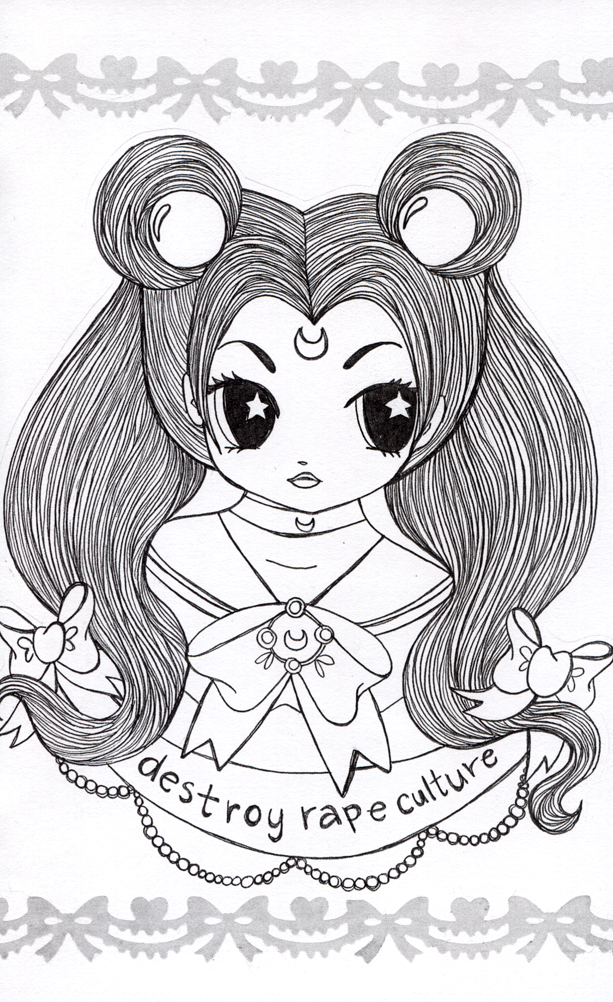
Destroy Rape Culture

Destroy Rape Culture, by Starchild Stela
In which the Sailor Senshi encourage you to smash the patriarchy.

Magical Beatdown

Magical Beatdown, by Jenn Woodall
In which a magical girl beats the everloving crap out of street harassment.
(This comic is brilliant and should win the next Nobel Prize for Literature. Sorry Murakami.)

How to Make a Magic Wand

How to Make a Magic Wand, written by Chris Eng and illustrated by Jenn Woodall
A field guide to utterly decimating the sexist assholes in your life like a badass mahō shōjo.

Lacrimancer

Lacrimancer, by Jade F. Lee
I’m digging that Revolutionary Girl Utena realness.

Louisa Roy Queen of Hearts

Queen of Hearts, by Louisa Roy
Such gorgeous art, such lovely writing, such interesting research, so Rose of Versailles.

This Tastes Funny

This Tastes Funny, an anthology by the Suddenly Sentai collective
Stories about food with shōnen manga stylings.

No Scope

No Scope, by Sara Goetter
And let us not forget that video games are part of the manga media mix too.
(Sara Goetter’s RPG-inspired original comics are amazeballs, by the way.)

The Enemies of Twenty Something Mega Man

The Enemies of Twenty-Something Mega Man, published by The Devastator (NSFW)
They also have a book about otaku, but it’s too close to home and it hurts.

This is the standard disclaimer that the work posted above is not universally representative and is subject to my own taste and resources. If I have misrepresented an artist, or if you are an artist who wants any links or images removed, please let me know.

Fan Comics at Anime Expo 2015

Nicolle Lamerichs, in a 2013 essay titled The Cultural Dynamic of Doujinshi and Cosplay: Local Anime Fandom in Japan, USA and Europe, writes:

I argue that anime fandom is not easily understood as a global phenomenon but rather is composed of different, heterogeneous values and communities. The local iterations of cosplay and doujinshi, which may seem homogeneous activities, are read as manifestations that are firmly anchored in particular traditions. (156)

Essentially, the fan practices and productions on display in anime conventions are different in different countries. Lamerichs readily points out that this has less to do with any sort of “national character” and more to do with the fact that “these fan cultures are individual events with their own ecologies” (158). Nevertheless, Lamerichs argues that, in comparison with Japan, Germany, and the Netherlands, American anime conventions exhibit “a very different tendency towards prints and hand-made drawings rather than full-fledged comics” (161).

Lamerichs is absolutely not wrong, but I would like to respond by positing that online communities primarily used for fannish artistic production and consumption, such as Tumblr, DeviantART, and Pixiv (along with many mirrors, offshoots, webcomic serialization platforms, and independently run artistic collectives), have put not just individuals but fannish cultural norms into closer contact with one another during the past several years. Among other things, this trend has led to an explosion of anime-inspired comics and fan comics at anime conventions in the United States.

I picked up a suitcase full of these comics at the Los Angeles Anime Expo this past 4th of July weekend, and I’d like to share some of them here in order to document this change. Independent artists had tables in the main Exhibition Hall and in the smaller Artist Alley section, but both areas are huge, and I’m not entirely certain I was able to cover the entire floor. Also, as much as I would have liked to buy everything I saw, my financial resources were limited. What I am posting here should therefore not be considered a representative sample. Furthermore, while I am focusing on fan comics based on well-known existing media properties, the reader should keep in mind that there was a great deal of original work available as well.

Without further ado, here are the scans I made of self-printed fan comics from Anime Expo 2015. Click on any of the thumbnails to see a larger image.

Ending to Naruto

The 100% True and #Confirmed Ending to Naruto by Kelly (on Tumblr)
based on the shōnen franchise Naruto

And Steven

…And☆Steven! by Mike Luckas (on Tumblr)
based on the Cartoon Network animated series Steven Universe

Tomoyo's Secret Diary

Tomoyo’s Secret Diary, edited by Yuj Lee (on Tumblr)
based on the shōjo manga and anime Cardcaptor Sakura

Pokémon Cross Breeds

Pokémon Cross Breeds, by Nathan Nguyen (on Tumblr)
based on the Pokémon series of video games

Artisan Ordinance

Artisan Ordinance, edited by MERODii (on DeviantART)
based on the video game Animal Crossing: New Leaf

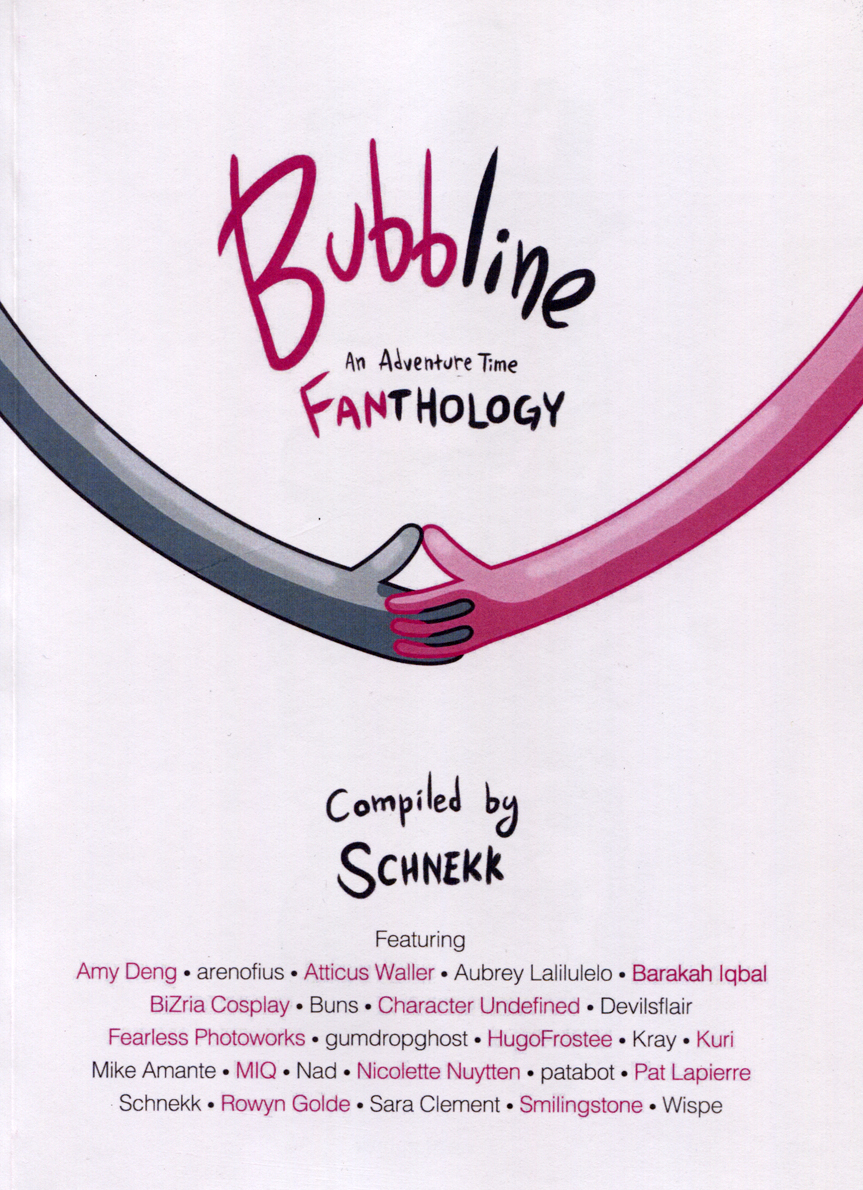
Bubbline

Bubbline, edited by Schnekk (on Tumblr)
based on the Cartoon Network animated series Adventure Time

Shimotsuma Zine

Shimotsuma Zine, edited by FANGRRLZ (on Tumblr)
based on the novel and film Kamikaze Girls

I Will Always Be Here

I Will Always Be Here, by Karen and Britney (on Tumblr)
based on the animated Disney film Big Hero 6

In addition, there were several cool fan comics and comic anthologies based on the Marvel cinematic universe drawn or edited by Krusca (on Tumblr), and I also came across a cool book based on the manga of CLAMP put together by Lärienne (on DeviantART), GYRHS (on DeviantART), and Samantha Gorel (on DeviantART).

All of these books are *amazing.*

If I have misidentified an artist or editor, or if you are an artist or editor and would like me to remove or update any links or images, please let me know! I have nothing but admiration and respect for people who self-publish their art and comics, and I don’t want to misrepresent or appropriate anyone’s work. Stay awesome!

Ground Zero, Nagasaki

Ground Zero Nagasaki

Title: Ground Zero, Nagasaki
Japanese Title: 爆心 (Bakushin)
Author: Seirai Yūichi (青来 有一)
Translator: Paul Warham
Publication Year: 2014 (America); 2006 (Japan)
Publisher: Columbia University Press
Pages: 182

Although Seirai is a relative newcomer to the Japanese literary scene, having won the Akutagawa Prize for his story collection Seisui (Holy Water) in 2001, he was born in 1958 and was 47 years old when Ground Zero, Nagasaki was first published in November 2006. Although its stories are all set in contemporary Japan, Ground Zero, Nagasaki is deeply engaged with themes of personal and historical legacy.

Each of the six stories in this collection is about the physical and emotional damage suffered by Christians living in Nagasaki in the wake of the atomic bombing. The memory of the atomic bomb is extremely subtle in most of the stories, but it’s never completely absent. Even more powerful than any real or imagined trauma generated by the bomb, however, are the moral dictates of Christianity, which demands that its adherents bear witness to suffering.

The second story, “Stone,” is narrated from the perspective of the brother of a Diet member who is being forced to resign from office because he hired his girlfriend as his secretary. While his brother is giving a talk to local business association at a hotel in Nagasaki, the narrator, a 45-year-old man who calls himself “Adam,” waits in the lobby, where he is approached by a female journalist named Shirotani. Adam is on the autism spectrum, and his conversation with Shirotani is almost frustratingly elliptic.

It gradually becomes clear that Adam’s mother is dying. She has sent Adam to intercept his brother in order to ask that the politician care for him, as he can’t live by himself. Shirotani, who has a brother like Adam, is sympathetic, but the author does not allow this story to become sentimental. Instead, the reader is hit with the full force of Adam’s sexual attraction as he fantasizes about the journalist: “If she wouldn’t marry me, at least I could carry her smell around with me. I would bury my face in her panties and inhale her woman’s scent to my heart’s content” (33). Adam’s mother has punished him for such thoughts in the past, asking him how he could dare to entertain such un-Christian notions “‘after our ancestors went to the stake with pure thoughts and prayers on their lips'” (32).

Adam’s brother Kutani is caught in a the grips of a similar moral vise. He entered politics for the most noble of reasons: to ensure that a doctrine of peace was represented at the highest levels of the Japanese government. The woman with whom he has cheated on his wife had come to him looking for a job after her husband’s family cast her out with her newborn son, who was born severely handicapped. Kutani explains to Adam that he initially wanted to help her as he wants to help all of his constituents, but that he couldn’t help falling in love with her. He says: “‘As long as I had her in my arms, nothing else mattered. Even if war had broken out and nuclear bombs were exploding all over the world, I probably wouldn’t have cared'” (41). His adherence to Christian doctrine, which has guided him along his path as a politician, allows no leeway for his identity as an individual. His affair with his secretary is merely an indication of a deeper emotional dissonance that has also estranged him from his mother and brother, who need him to be a person instead of a politician.

As Kutani struggles with his conscience in the penthouse suite of the hotel where he will offer his resignation, his brother is overwhelmed by feelings he doesn’t understand. After Adam leaves the hotel, he is afraid that his body will turn to stone in response to the emotional overload as it has in earlier catatonic episodes triggered by stressful situations. The story ends with Adam begging God to not leave him alone without a family and without ever having experienced intimacy, his longing for comfort inseparable from his sexual desire.

Another story that I found especially trenchant is “Shells,” which is also told from the perspective of a highly unreliable narrator. Six months ago, the narrator’s daughter Sayaka suddenly came down with a fever and ended up dying of a brain hemorrhage. Since then, he has become convinced that the ocean has been rising during the night, covering entire sections of the city and leaving behind cowrie shells and other assorted sea creatures in his highrise apartment. His delusions became so powerful and persistent that his wife has left him and his brother has placed him under outpatient psychiatric care.

While walking in his neighborhood one day, the narrator encounters an old man named Nagai who tells him that his late sister used to be friends of a sort with Sayaka. His sister had become senile, and the narrator’s daughter was the only one who would listen to her rambling stories. The narrator, overcome with gratitude, invites Nagai back to his apartment, where the old man tells him that his sister spent her entire life trying to forget the day of the atomic bomb, when she was forced to leave her siblings behind in a burning house as she fled with her mother. Nagai’s sister had once spoken to him about the sea of flames engulfing the city, saying, “‘I wish the sea would wash over it all,'” suggesting that she wished her memories would be washed away as well (146).

The narrator, who has his own fantasies of the sea, feels a connection with this woman, but he is terrified of losing his memories, specifically his memories of his daughter and the love he felt for her, which he describes as “the best and brightest, the truest feeling I have ever had” (117). He realizes that the shells that the ocean leaves behind for him every evening after the flood recedes are akin to physical manifestations of his memories, but this insight does not weaken his conviction that the city of Nagasaki sleeps under the waves every night. He tries to convince Nagai that his visions are real but fails. The story ends with his understanding that the saltwater coming in from the bay is not a purifying force like the Biblical deluge but rather indicative of a spiritual wasteland in which God allows the innocent to suffer and perish.

Obviously Ground Zero, Nagasaki is not light reading, and I found that I had to let a week or two pass between the stories, each of which stayed with me long after I had closed the book. Reading Seirai feels a lot like reading Ōe Kenzaburō, yet his style is pellucid where Ōe’s is confoundedly literary. Seirai’s narrators are not philosopher poets citing The Great European Male Thinkers in casual conversation, but this does not make them any less complex and compelling; their proximity to the mundane and mimetic “realness” serves to emphasize how the lasting reverberations of Nagasaki’s violent history have touched the lives of even the most unassuming of its citizens.

I would be remiss if I did not conclude this review by stating that Ground Zero, Nagasaki has the best book design I have seen in a long time. A faded image of the black circle on the cover, an inverse of the red rising sun of the Japanese flag, is on every page of the book, a reminder that the proverbial gross insult to human dignity in the room can never be ignored. Each chapter begins with a progressive series of diagrams illustrating how to fold an origami crane, indicating that somewhere inside this terrible mess is hope. These illustrations suggest that the reader, by sharing the experiences of these stories with the author, is in effect performing a symbolic act of prayer resembling the dedication of a chain of paper cranes to the atomic bomb victims. Kudos to designer Julia Kushnirsky!

Is Ground Zero, Nagasaki worth the $35 asking price for the hardcover? Yes, I think so.

Will the stories in this book be of interest to anyone outside of the academic field of Japanese literary studies? Absolutely. It’s not easy to read this book, but that’s a major part of what allows it to dig so deeply into the reader.

Review copy provided by Columbia University Press.

The Art Lover’s Guide to Japanese Museums

The Art Lover's Guide to Japanese Museums

Title: The Art Lover’s Guide to Japanese Museums
Author: Sophie Richard
Publication Year: 2014
Publisher: The Japan Society
Pages: 176

According to the good people at The Japan Society, art historian Sophie Richard’s The Art Lover’s Guide to Japanese Museums has been very popular, quickly selling out of its first print run. Between its convenience as a guide and its beauty as a physical object, it’s easy to understand why.

The Art Lover’s Guide to Japanese Museums is so titled because it’s aimed at serious art appreciators who are willing to go off the beaten path in order to visit smaller museums that offer a more personalized and intimate experience. Richard skips the large national institutions and instead highlights private or regional galleries that would be worthy of a day trip or that necessitate a willingness to venture off the beaten path in urban and suburban areas. Based on my personal experience with several of these museums, the trip will definitely be worth it.

The main body of the guide is divided into five sections: Tokyo, Around Tokyo, Kyoto Area, West, and East (with “West” designating the area from Osaka to Hiroshima and “East” designating the area from Nagoya to Aomori). 29 of the 52 museums profiled are in or around Tokyo. In some cases, a location “around Tokyo” might require a long train ride and an overnight stay, but most are well within the city limits or accessible by commuter rail.

Most of the entries are two pages long. Each opens with the museum’s address in English and Japanese and general information (hours, holidays, access, website). This is followed with three paragraphs of description. The content of varies but can include information about the museum’s history, the highlights of its collection, and the availability of English text or audio guides. The short “In the neighborhood” section at the end of every entry tempts the reader out into the open to take in the layout of the town, the local cuisine, nearby temples, and even other museums. Each entry also includes two or three full-color photographs of the museum space and representative works from its holdings. The occasional four-page entries are usually longer because of their inclusion of more pictures, all of which are gorgeous.

Even if you’re not planning on visiting Japan, browsing through The Art Lover’s Guide to Japanese Museums is still enjoyable, as Richard’s articulate prose guides the reader through the experience of visiting the galleries. For example, writing on the Chichu Art Museum designed by Andō Tadao, Richard offers this intriguing description:

The museum’s complex space includes passageways and stairs set at sharp angles and a courtyard with evergreen plants that contrast starkly with the grey concrete. The interior of the building is lit with natural light alone. At the heart of the museum, five monumental paintings by Claude Monet from the late Waterlilies series appear to float mysteriously in a serene space gently illuminated by the sun’s rays, which are diffused through channels in the ceiling. Security guards wearing futuristic white uniforms ask visitors to remove their shoes before entering the room, which adds to the compelling atmosphere.

As in the excerpt above, Richard does walkthroughs like Sherlock Holmes, albeit with less of an emphasis on dry facts and with more of an emphasis on atmosphere. If you’d prefer to travel from the comfort of your own sofa, Guide to Japanese Museums is a perfect companion.

Also included in the guide are a short “Introduction” in which the author explains her motivations for embarking on this project, an overview of “Museums in Japan,” a six-page essay on “Looking at Japanese art,” and a brief list of “Tips and advice.” These sections are useful regardless of whether you’re making plans to visit Japan or whether you’re already there. For instance, this is the first time I’ve heard of the Grutt Pass, a ¥2,000 booklet that provides one-time admission to several of the museums profiled in this guide.

I should add that Guide to Japanese Museums came with me across the North American continent twice during the past two months, and it’s still in pristine condition. The book is lightweight and flexible, and it can easily be slipped inside a backpack or a suitcase. If I couldn’t destroy it, it’s more than likely safe with you as well, so don’t feel as if you need to leave it on a shelf while you go and have adventures, whether those adventures are in Japan or at your local café.

Review copy provided by The Japan Society of the UK.

The Cultural Cross-Pollination of Shōjo Manga

Natasha Allegri Madoka PuppyCat

On January 18 of 2015, Ed Chavez, the Marketing Director at manga publisher Vertical, replied to a Twitter user’s question on ask.fm regarding whether manga is becoming a niche entertainment industry outside of Japan. Chavez’s response was a definite “maybe.” After stating that shōnen manga is selling just as well – if not better – than it always has, Chavez added the caveat that, “Unlike the 00’s, where a shojo boom introduced a whole new demographic to manga, there hasn’t been a culture shifting movement recently.” Johanna Draper Carlson, one of the most well-respected and prolific manga critics writing in English, responded to Chavez’s assessment on her blog Comics Worth Reading. She agreed with him, adding, “I find myself working harder to find series I want to follow. Many new releases seem to fall into pre-existing categories that have already demonstrated success: vampire romance, harem fantasy, adventure quests, and so on. It’s harder to find the kind of female-oriented story that [has always appealed] to me.” Meanwhile, the manga that stood at the top of the New York Times’s “Best Sellers” list for manga that week was the seventh volume of a series called Finder, a boys’ love story targeted at an over-18 female audience.

What we’re seeing here, from Chavez’s reference to a former boom in shōjo manga sales to evidence that even a title from a niche category for women can sell just as well as the latest volume of the shōnen juggernaut One Piece, is that girls and women in North America do care about manga, and that they are active participants in manga fandom cultures. What I’d like to do today is to provide a bit of background on how female readers were courted by manga publishers – specifically Tokyopop – and then to demonstrate how manga has influenced the women who grew up with it to reshape North American comics and animation with a shōjo flair.

I’d like to argue that, despite periods of relatively low sales in the United States, shōjo manga (and the animated adaptations of these manga) have had a strong cultural impact on recent generations of fans. During the past fifteen years, fan discussions and fannish artistic production have nourished diverse interests in Japanese cultural products, which are in turn beginning to exert a stronger influence on mainstream geek media. Using M. Alice LeGrow‘s graphic novel series Bizenghast and Natasha Allegri‘s animated webseries Bee and PuppyCat as case studies, I want to demonstrate how it is not only the visual styles and narrative tropes of shōjo manga that have increasingly begun to influence North American media, but the creative consumption patterns of shōjo fandom communities as well.

Tokyopop Smile Magazine July 2001

Before I talk about American interpretations of shōjo cultures, however, I’d like to skim through a bit of publishing history. In the mid-1990s, there was a Barnes-and-Noble-style big suburban box store called Media Play, which had an entire section devoted to manga and Japanese culture magazines. One of the most prominent of these magazines was fledgling publisher Tokyopop’s manga anthology MixxZine, which began serialization in 1997 and ran the manga version of Sailor Moon as well as the similarly themed fantasy shōjo series Magic Knight Rayearth and Card Captor Sakura. In 1999, the magazine changed its name to “Tokyopop” and began to target an older male audience by dropping its shōjo manga and focusing on shōnen and seinen titles. Tokyopop the magazine folded in 2000 but was survived by a publication called Smile, which was a bulky, 160-page monthly magazine that serialized only shōjo manga. In 2001, Media Play’s parent company was bought out by Best Buy. When Media Play stores were closed, Tokyopop lost a major venue for its magazines, and Smile folded in 2002.

Now that a large fanbase had been created, however, Tokyopop was able to launch a program it called “Global Manga,” which was kicked off by the 2002 “Rising Stars of Manga” talent competition. The winning entries were published in a volume of the same size and length of the publisher’s Japanese manga titles. There were eventually eight volumes of The Rising Stars of Manga, with the last appearing in the summer of 2008. During this time, certain winners were encouraged to submit proposals to Tokyopop, which published their work as OEL, or “original English language,” manga. By my count, about half of Tokyopop’s OEL manga were shōjo series. Examples include Peach Fuzz, Shutter Box, Fool’s Gold, and Sorcerers & Secretaries. Tokyopop promoted these titles with free “sampler” publications distributed by mail and at anime conventions, which were exploding in number and attendance in the United States and Canada during the 2000s. Although users of anime-related message boards and fannish social media sites debated the company’s use of the term “manga” to describe these graphic novels, Tokyopop was able to attract well-known American entertainment franchises to the medium, such as Star Trek, Battlestar Galactica, World of Warcraft, and for the girls, Jim Henson’s Labyrinth, featuring David Bowie’s Goblin King in all his spandex-clad glory.

Return to Labyrinth OEL Manga

One of the Tokyopop’s most popular OEL manga titles was M. Alice LeGrow’s eight-volume series Bizenghast, which, like Sailor Moon and Cardcaptor Sakura, is a shōjo story with shōnen elements. LeGrow’s story takes the adorable mascot creatures, monsters-of-the-week, cute costumes, adoring and beautiful young men, and powerful female villains of Japanese manga for girls and transplants them to the small Massachusetts community of Bizenghast, which becomes an Edgar Allan Poe-ified Gothic wonderland after dark. The art style combines the huge eyes and wide panels of fan-favorite shōjo manga like Fruits Basket and Fushigi Yûgi with steampunk Art Deco motifs and Edward Gorey-style line etchings. The artistic and narrative conventions of manga and the stylizations of Western fantasy are so delicately blended and intermixed that it’s impossible to tell whether Bizenghast is a manga with American influences or a graphic novel with Japanese influences.

Bizenghast Volume 1 Page 075

What I want to highlight is the way that the Tokyopop publications of each volume in the Bizenghast series included a section at the end for fan art and cosplay photos, thus encouraging and legitimizing reader participation in the way that shōjo magazines have done since the early twentieth century in Japan.

Bizenghast Fan Art Spread

Instead of eschewing or actively opposing fandom involvement, and specifically female fandom involvement, Tokyopop pursued it, allowing LeGrow to maintain her presence on the fannish artistic networking site deviantART, where she was able to interact with her fans. Due to the non-localized nature of the internet, LeGrow was able to build a fanbase that stretched around the globe, with Bizenghast being published in translation in Germany, Finland, Russia, and Hungary, as well as in several countries of the British Commonwealth, including Australia and New Zealand. In addition to assigning Bizenghast its own dedicated website, Tokyopop released a light novel adaptation, an art book, and even a coloring book based on the world of the manga. Although Tokyopop shut down its publishing operations in May 2011, it continued to offer certain titles through a print-on-demand service managed by the online anime retailer The Right Stuf. The initial line-up of these titles included the massively popular manga Hetalia Axis Powers and the eighth and concluding volume of Bizenghast. What I’d like to emphasize here is that, in its publication and promotion of Bizenghast as an OEL shōjo manga product, Tokyopop actively promoted the sort of interactive fan consumption utilized by Japanese shōjo manga publishers – and this encouragement paid off, quite literally.

Multiple market watchers have located the peak of United States manga sales in the mid-to-late 2000s. Even though Tokyopop ceased its manga magazines earlier in the decade, Viz Media stepped in with an English-language version of Shonen Jump, which was paired with a monthly sister magazine, Shojo Beat. Shojo Beat, which ran from June 2005 until July 2009, also styled itself as a lifestyle magazine, running articles about clothing, makeup, and real-life romantic concerns. Although Shojo Beat did not include OEL manga, manga publisher Yen Press’s publication Yen Plus did. From its launch in July 2008, the editors of Yen Plus solicited reader contributions, which resulted in both one-shot and continuing OEL manga appearing within the pages of the magazine.

In addition, Yen Press’s parent company Hachette began releasing manga adaptations of some of its biggest young adult properties, including Gossip Girl, Gail Carriger’s The Parasol Protectorate series, and, of course, Twilight. For our purposes, it’s interesting to note that these manga adaptations all had a strong shōjo feel, as did other franchise manga revisionings created by longstanding American comics publishers such as Marvel and Vertigo. What these publishers seemed to be jumping on was the idea that manga could reach an audience of young women (and young-at-heart women) who may have felt excluded from traditionally male-centered genres like action comics and science fiction. These female readers increasingly came equipped with access to online and in-person fandom networks, which could help ensure the longevity and profitability of any given franchise, as was famously the case with Star Trek and Harry Potter.

Twilight Manga

What we’re seeing, then, is the creation and growth of an audience for shōjo manga that began in the 1990s and has extended throughout the past two decades. So – has this changed anything? I’d like to argue that it has, and that we’re starting to see a definite shōjo influence on mainstream entertainment media in North America.

One of the most interesting incarnations of this trend is Cartoon Network’s animated television series Adventure Time, whose producers have actively scouted young talent from places like comic conventions and fannish art sharing websites such as Tumblr. A number of these artists are women from the generation that grew up reading and watching shōjo series such as Sailor Moon and Revolutionary Girl Utena, and easily identifiable references to these titles occasionally pop up in the show. Rebecca Sugar, a storyboard artist for Adventure Time, ended up being given a green light by Cartoon Network to create a magical boy show, Steven Universe, that features all manner of references to anime, manga, and video game culture. Natasha Allegri, another storyboard writer and character designer for Adventure Time, launched a Kickstarter project backed by Adventure Time‘s Studio Frederator for a magical girl animated series called Bee and PuppyCat, which received an overwhelming amount of support from both Adventure Time fans and the enormous shōjo manga fanbase on Tumblr.

Lady and Peebles

What’s really cool about these three properties is that they all have separate monthly comic book incarnations published by Boom! Studios. There’s a lot to be said about these comic books, but what I want to emphasize here is that each monthly issue features shorts and variant covers by young and upcoming artists. The comic book version of Bee and PuppyCat is especially notable in that most of its contributing artists are female, and many of them include obvious stylistic and topical references to elements of Japanese popular culture such as Studio Ghibli character stylizations, magical girl henshin transformation sequences, and role-playing video games. Although Natasha Allegri has stated in multiple interviews (here’s one) that she’s a fan of manga such as Sailor Moon and Takahashi Rumiko’s supernatural romance InuYasha, and even though the influence of these titles is quite clear in her work, Bee and PuppyCat has not been promoted as a type of OEL anime but rather as just another cool new addition to the Studio Frederator lineup. In other words, the strong shōjo elements of the show and its comic book are presented as completely natural and naturalized to a North American audience.

I’m going to wrap things up by summarizing my main points. First, I think we can say that the iconography of shōjo manga and anime are entering American popular culture full force. Second, I believe that seeing better representation of diverse female characters in shōjo manga has encouraged more young women outside of Japan to seek careers in comics and animation. Third, although it’s difficult to make strong statements in the current market, I think it’s safe to say that the “reader participation” model employed by Japanese shōjo publishers has been fairly financially successful in the United States. Fourth and finally, I’m going to conclude that we will therefore see an even stronger embrace of shōjo-related narrative influences, art styles, and fandom cultures as the members of the Adventure Time and Bee and PuppyCat generation, who are currently in college, start coming out with their own work. It’s an exciting time to be a fan of shōjo manga, and I’m happy that young women and men are still as excited about shōjo-flavored comics and animation as I was when I first discovered Sailor Moon almost twenty years ago.

Bee and PuppyCat Comic Issue 06 Meredith McClaren

The above image is a scan of a page from Meredith McClaren‘s short comic in the sixth issue of the Bee and PuppyCat comic book series.

The Legend of Zelda: A Link to the Past

The Legend of Zelda A Link to the Past

Title: The Legend of Zelda: A Link to the Past
Japanese Title: ゼルダの伝説 (Zeruda no densetsu)
Artist: Ishinomori Shōtaro (石ノ森 章太郎)
Translator: Dan Owsen
Publication Year: 2015 (America, new edition); 1993 (America and Japan, original edition)
Publisher: Viz Media
Pages: 196

Full disclosure: I read this manga countless times as a kid, and the game it’s based on is one of the greatest loves of my life. This review is biased, because of course it is.

My own adoration aside, Viz Media’s new publication of manga giant Ishinomori Shintarō‘s adaptation of the 1991 Super Nintendo game The Legend of Zelda: A Link to the Past has been selling extremely well since it was released a month ago.

A Link to the Past on the NYT Bestseller List

This success makes perfect sense. Not only is The Legend of Zelda a major video game franchise with its own culture cachet, but Viz has also managed to put out a handsome publication, and manga’s story is easy to follow and immediately accessible to readers not familiar with the games.

The teenage orphan Link lives peacefully in a quiet village in “the pristine land of Hyrule” when, one stormy night, his uncle is summoned to the castle. Link is awoken by a voice claiming to be the princess Zelda, who telepathically tells him that she is being held prisoner in her own dungeons. Link, fearing shenanigans, rushes to the castle in the rain only to see his uncle put to death by a powerful wizard named Agahnim (whose dark skin and Orientalist stylings are how you know he’s a bad guy, yikes). Link manages to infiltrate the castle and rescue Zelda, only to have her immediately kidnapped once more by the wizard, who intends to use her to break the seal on an even greater evil. Before she’s spirited off to wherever princesses are stashed away in such situations, Zelda manages to tell Link that it’s his destiny to save Hyrule and that he must locate the legendary Master Sword, which is the only blade capable of defeating the powerful force controlling Agahnim. Off he goes, and adventure ensues.

Video game adaptations into other media tend to be hit or miss, but Ishinomori, genius that he is, pulls off his manga rendering of A Link to the Past flawlessly. Although Link is never really alone in the game (as he is always accompanied by you, the player), his quest is a lonely one, as he bears the sole responsibility for delivering the land from a terrible fate. Ishinomori especially excels at portraying Link’s smallness in a vast world filled with hostile creatures. The action sequences – and there are a lot of them – are nicely choreographed, with a smooth flow facilitated by expert paneling. This flow is so dependable that, when it’s interrupted, the reader is instantly made aware that Link has encountered a true threat, as he does in his final battle with Ganon, the story’s ultimate villain.

A Link to the Past Link vs Ganon

The manga is also populated by friendly characters who aid Link along his journey. The most striking of these fellow wayfarers is a bird-like “mystery knight” named Roam (a classic Ishinomori archetype in both personality and visual characterization). The inhabitants of Ganon’s dark world, a mirror reflection of Hyrule that changes the shape of people based on the truest form of their hearts, are also given small roles that help raise the stakes of Link’s battle. For example, immediately after Link is exiled to the dark world by Agahnim, he encounters a talking tree who explains to him that there are many other people who, for whatever reason, followed Ganon into the dark world only to become trapped there, doomed to wander as beasts or serve an evil master until a hero can purify the land. Such accounts add layers of depth to the story that aren’t to be found in the original game, in which the player progresses from objective to objective simply to experience the next challenge.

Despite the assistance of friends he encounters, Link is still one boy caught up in a legend much larger than his own life, a theme Ishinomori emphasizes with splash panels depicting Link as a faceless dot at one corner of a daunting landscape. In the game on which the manga is based, the enemy the player must engage most frequently is the environment itself, and the artist’s translation of this element into menacing backgrounds and elaborate framing devices is beautiful to behold. Ishinomori’s interpretation of Ganon’s castle, the revelation of which is a climactic moment, is especially awe-inspiring.

I would be remiss if I didn’t mention that there are also some fun Easter eggs for Zelda fans scattered throughout the manga. I don’t want to spoil all of them; but, to give an example, Link flies to the Desert Ruins in a winged hang glider. As the villager who provides him with this contraption recounts, “They say these miracle wings belonged to a powerful bird that carried the knights of Hyrule into battle!” In retrospect, this statement seems to refer to the events alluded to in Skyward Sword. And yet, considering that this was written more than ten years ago, one can’t help but wonder how much of the lore explored in more recent games was already in place as the earliest titles were being developed. Or, conversely, was this manga perhaps a guiding influence for subsequent world building?

This manga was originally serialized in the American gaming magazine Nintendo Power from January to December 1992. The following year, it was published as a full-color collected volume by Nintendo of America and in a black-and-white tankōbon by Shōgakukan in Japan. As such, it’s an interesting slice of both manga and video game history. Manga was still relatively unknown in the United States in 1992, and Viz Media only started publishing its groundbreaking Animerica magazine the following year. Meanwhile, Gail Tilden (the marketing manager at Nintendo of America) and the editors of Nintendo Power, the first publication of its kind, were responding to the sudden appearance of a rabid gaming public in the wake of U.S. release of Super Mario Bros. 3 in 1991. (More information about the early years of the magazine can be found in Jon Irwin‘s excellent Super Mario Bros. 2.) It’s extremely interesting that Nintendo was already attempting a manga/game media mix marketing strategy through the burgeoning medium of English-language video game journalism. It’s also interesting that Viz seems to be using a similar strategy – using the popularity of a gaming franchise to promote manga – with this new release.

Even if you don’t usually care for video games or manga, Ishinomori Shōtaro is a force of nature and a credit to the human race. Since it’s difficult to find his work in English translation, Viz’s new edition of A Link to the Past is a fantastic opportunity to see a master artist and storyteller at the top of his game.

A Link to the Past Link's Battle Against Trinexx