March Was Made of Yarn

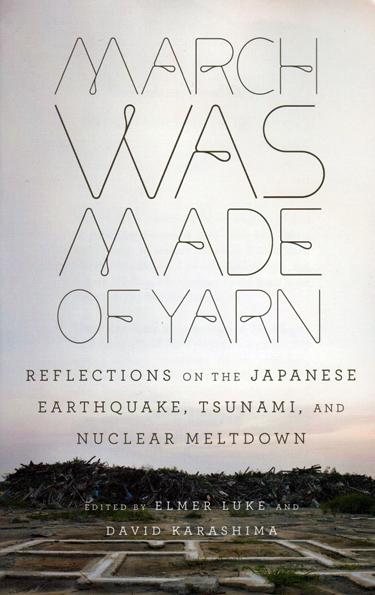
Title: March Was Made of Yarn: Reflections on
the Japanese Earthquake, Tsunami, and Nuclear Meltdown
Editors: Elmer Luke and David Karashima
Publication Year: 2012
Publisher: Vintage
Pages: 216

As the March 11 anniversary of the 2011 Tōhoku earthquake and tsunami draws closer, Japanese bookstores have begun to promote retrospective magazine-books. These publications are filled with huge glossy photographs of destruction, and the number of people killed is printed in bold characters across their covers. Although such disaster porn is disturbing, it helps to illustrate a definite aspect of the reality of what happened a year ago in Japan.

March Was Made of Yarn helps to illustrate another aspect of the reality of the earthquake, tsunami, and resulting nuclear crisis. If pictures and body counts inform the physical reality, then this collection of fiction and nonfiction offers insight into the emotional reality. Thankfully, March Was Made of Yarn is infinitely more gentle and subtle than sensationalist reporting and sentimental recollections of heroism and despair.

Even though all of the short pieces brought together by this collection address the events of last year in some fashion, many do so obliquely, and the themes of the pieces are universal. What is it like to live through a crisis? What is it like to know that other people are living through a crisis? What does it feel like to worry about the future? What does it feel like when science fiction becomes reality? What happens when you’re so sick with worry that you can’t fall asleep at night? What happens when words can no longer express truth or meaning?

March Was Made of Yarn features the work of internationally renowned Japanese writers such as Ogawa Yōko, Murakami Ryū, Kakuta Mitsuyo, Furukawa Hideo, and Tawada Yōko. These writers don’t cut corners in their craft simply because they happen to be responding to a topical issue; and, although none of them are writing “happy” stories or essays, their work is a pleasure to read. Kawakami Hiromi, who rewrote her debut story “Kami-sama” (translated as “God Bless You”) to address the incidents at the Fukushima reactor, reminds us that, even though we live in a world shadowed by the fear of radiation and environmental poisoning, we still need to eat, and we still want to go outside. The title story, Kawakami Mieko’s “March Yarn,” deals with the strange ways in which people process their memories and their understanding of their relationships with each other. Tanikawa Shuntarō’s poem “Words,” which opens the book, poses the question of how we can even write about things for which there are no words (yet still “Words put forth buds / From the earth beneath the rubble”). The translators who contributed to this volume are among the best in the field, and their skill illuminates the entirety of the collection.

March Was Made of Yarn isn’t just an excellent anthology of work related to the Tōhoku disasters; it’s an excellent Japanese literary anthology period. The range of authors represented by the book has the most even distribution of gender, generation, and genre I’ve ever encountered, and the English-language contributors, such as David Peace and John Burnham Schwartz, bring an added level of flavor and diversity. This collection is also accessible to casual readers, as few of the stories are any longer than twenty pages, and it has been beautifully published by Vintage. I don’t know how so many good things were able to come together to create this amazing book, but I am extraordinarily grateful that it exits.

March Was Made of Yarn should be available at all major bookstores in North America, Britain, Australia, and Japan, and it’s available on the Kindle Store as well.

If you don’t mind reading entirely in PDF digital format, please consider checking out Waseda University’s Japan Earthquake Charity Literature Project, which has some overlap with March Was Made of Yarn. It’s free to download and read the PDF versions of the stories and essays on the website, and the reader is encouraged to make a donation to disaster relief efforts afterwards.

Speculative Japan

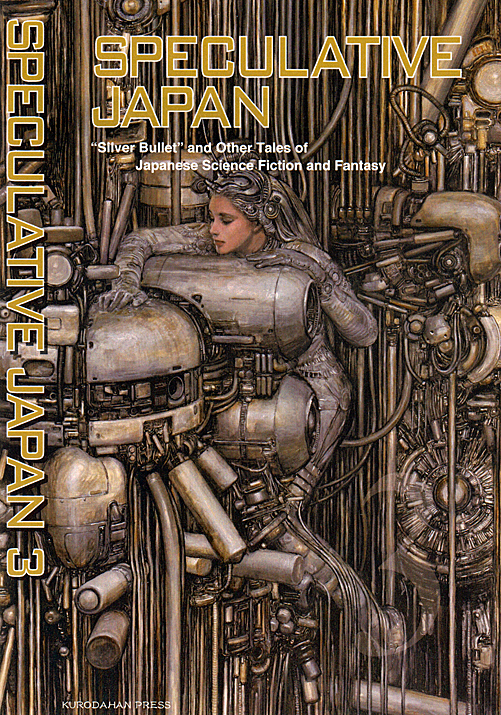
Title: Speculative Japan: Outstanding Tales of Japanese Science Fiction and Fantasy
Editors: Gene van Troyer and Grania Davis
Publication Year: 2007
Publisher: Kurodahan Press
Pages: 290

As a short story collection, Speculative Japan is a strange book. 200 of its 290 pages are comprised of short stories, and the other 90 pages are mainly short non-fiction essays about the book itself. These essays involve topics such as how the stories appearing in Speculative Japan came to be selected, edited, and translated. 20 of these 90 pages are author and translator biographies, and another 20 pages are filled by a translated essay by Shibano Takumi, the editor of the Japanese sci-fi magazine Uchūjin. For a reader who starts the book at the front cover and progresses in a linear fashion, Speculative Japan gets off to a somewhat rocky start with pages and pages of metatextual material.

Gene Von Troyer’s introduction jumps from topic to topic before finally summarizing Yamano Kōichi’s “three phases of Japanese science fiction” and settling into speculation concerning what makes Japanese science fiction “Japanese”:

We can’t say definitively, but can only point to trends and tendencies. Viewed through one facet of the jewel, we can say, as Tatsumi [Takayuki] does, that “what with the imperative of American democratization and the effect of indigenous adaptability, the postwar Japanese had simultaneously to transform and naturalize themselves as a new tribe of cyborgs” as reflected in the images from manga and anime. Japanese SF leans (or has leaned) more on robots and cyborgs than on stars and planets.

This generalization is certainly interesting, but I wonder if it’s really true. For example, the advertisements in the back of the book for Mayumura Taku’s Administrator (a collection of four short novels about “Terran colonies far from Earth”) and Night Voices, Night Journeys (the first of a series of collections of “Tales in the Cthulu Mythos from Japan”) seem oriented more towards “stars and planets” stories, and I can’t help but think of the “spaceships and galaxies” imagery of popular 1970s series such as Takemiya Keiko’s To Terra and Matsumoto Leiji’s Space Battleship Yamato, but perhaps it might simply be better to read Troyer’s introduction as an initial attempt to sketch a map of a huge and understudied body of literature.

In any case, the stories contained in Speculative Japan have less to do with either cyborgs or space than they do with hypothetical concepts. Toyota Artisune’s “Another Prince of Wales” concerns the question, “What if, in the future, war were a popular sport played on an international stage?” Yamano Kōichi’s “Where do the Birds Fly Now?” is an expansion of the question, “What if birds could fly between dimensions and take people with them?” Very few of these stories have serious, in-depth plots; but, then again, very few of these stories are more than twenty pages long. A reader familiar with the type of tightly plotted sci-fi stories published in Fantasy & Science Fiction Magazine is in for a surprise with Speculative Japan, which – as its title suggests – is more about “speculative fiction” than “science fiction.”

Five of the stories in the collection are recycled from the out-of-print The Best Japanese Science Fiction Stories. Of these five, Tsutsui Yasutaka’s Orwellian fable “Standing Woman” and Yano Tetsu’s “The Legend of the Paper Spaceship,” a lyric tale of a woman deep in the Japanese mountains who may or may not be an alien, are excellent and definitely worthy of republication. Making an appearance from the out-of-print Monkey Brain Sushi anthology is Ōhara Mariko’s “Girl,” a sex-saturated story of love and body modification in a decaying city on the eve of an apocalypse.

Three stories that have appeared for the first time in book form in Speculative Japan that really jumped out at me were Kajio Shinji’s “Reiko’s Universe Box,” Kawakami Hiromi’s “Mogera Wogura,” and Yoshimasu Gōzō’s “Adrenalin.” In “Reiko’s Universe Box,” a young woman copes with her negligent husband and failing marriage by becoming absorbed in a box containing an entire galaxy in miniature form. Like many of the stories in this collection, “Reiko’s Universe Box” is driven by strong elements of allegory, but its concept is delivered with cleverness, darkness, vivid description, and humor. When compared to the other stories in the collection, Kawakami’s “Mogera Wogura,” a description of a day in the life of a mole-like creature who lives among humans in contemporary Japan, is in a class of its own in terms of its gentle magical realism, its playfulness, and its removal from the themes and narrative style of more traditional science fiction and fantasy. “Adrenalin” is not a story but rather an abstract poem filled with evocative imagery conveyed through variations of a handful of short and catchy refrains, such as “To you, children of spirits, I send an immediate telegram / To drink milk / To memorize the names of flowers / Some day, I will return / That day, I will start fire.” I’m usually not a fan of Japanese poetry in translation, but I found myself captured and moved by Marilyn Mei-Ling Chin’s translation of Yoshimasu Gōzō’s verse. Each of these three selections stands on its own not simply as an illustration of a speculative concept but as a piece of writing that is fun to read, thought-provoking, and capable of multiple interpretations.

Of the collection’s fifteen stories, four were written in the sixties, eight were written in the seventies, and another was written in 1981. These thirteen stories, written during the period between 1962 and 1981, are all by men. The two more recent stories (published in 1985 and 2002) were written by female authors, but one can still say that this collection is mostly representative of science fiction written by men in the sixties and seventies. In the author biography section at the end of the book, the editors attempt to canonize many of the male authors (“without a doubt a Grand Master of Japanese science fiction and fantasy,” “one of the three pillars of Japanese SF,” “often referred to as ‘The King of Japanese SF,'” and so on), but I wonder if perhaps there wasn’t a hint of personal politics at play in the selection of authors. This suspicion seems to be corroborated by the collection’s metatextual essays, which detail the personal relationships between the authors and their translators.

Speculative Japan sometimes reads like a sci-fi literary fanzine in which the editors and regular contributors are just as concerned about themselves and their relationships with each other as they are with the fiction itself, and the essays in Speculative Japan demonstrate a certain geeky fixation on metatextual marginalia. If you happen to be outside of the small circle of authors, translators, and editors who all know each other and worked together on this collection, you might find these essays confusing and off-putting. If you’re already used to the style of the front (and back) material included in SF-themed literary magazines and fanzines, though, you’ll more than likely be able to see past (or even appreciate) the many pages of essays included in Speculative Japan.

The actual stories in the collection are interesting and well worth reading, and a few of them are truly excellent. Still, I want more work that doesn’t belong to a set clique of authors, more contemporary work, and more work by women. To be honest, I found Speculative Japan somewhat disappointing as a compilation. That being said, I am intrigued enough by the stories themselves to consider giving Speculative Japan 2 a shot in the near future.

The Girl Who Leapt Through Time

Title: The Girl Who Leapt Through Time
Japanese Title: 時をかける少女 (Toki o kakeru shōjo)
Author: Tsutsui Yasutaka (筒井 康隆)
Translator: David Karashima
Publication Year: 2011 (Britain); 1967 (Japan)
Publisher: Alma Books
Pages: 170

Three things are generally true of Tsutsui Yasutaka’s writing: it’s easy to read, it’s creative and fun, and it’s usually more about the concept than the characters. The Girl Who Leapt Through Time is no exception. The story is short, it’s entertaining, and the idea of time travel is more fleshed out than the characters.

Junior high school student Kazuko hears a crash in her school’s science lab while helping her friends Goro and Kazuo clean up after class. When she enters the room to investigate, she smells lavender and passes out. The next morning, she and Goro are run down by a bus while rushing to school. Right before the bus strikes them, however, Kazuko opens her eyes and finds herself back in bed. She discovers that she has somehow jumped back in time to the morning of the previous day. Kazuko tells Kazuo and Goro about her strange experience, and they suggest that she talk to their science teacher, Mr. Fukushima, after school. Surprisingly enough, Mr. Fukushima listens sympathetically before explaining that Kazuko needs to jump back in time to the incident in the science lab in order to figure out what happened. She does so and meets Kazuo, who explains everything to her before erasing her memory and returning to where he originally came from.

And that is the story. Nothing else really happens. Kazuo’s debriefing is interesting, but there is no on-screen adventuring or experimentation on the part of Kazuko. There is no narrative tension, just a bit of simple mystery solving. None of the characters really stand out. Kazuko is frightened and dependent on the help of others, Goro is childish and petty, and Kazuo drifts along without contributing anything until the last three or four chapters. The two other named characters, Mr. Fukushima and Kazuko’s friend Mariko, barely have any lines at all. Director Hosoda Mamoru’s 2006 animated adaptation is much richer in terms of storytelling and character development. Still, The Girl Who Leapt Through Time is a quick and easy read that should appeal to a younger audience.

A bit more interesting than the main novella is the shorter work “The Stuff Nightmares Are Made Of,” which is also included in the book. In this story, junior high school student Masako tries to get to the bottom of her fear of heights, which is somehow connected to the discomfort she feels around Prajna masks. Masako’s close friend Bunichi passes along what his therapist uncle tells him about the psychology of fear, and Masako uses this information to help not only herself but also her five-year-old brother Yoshio, who suffers from night terrors. The relationship between Masako and Yoshio is charming and sweet, as is the budding romance between Masako and Bunichi.

If I had to guess, I would say that the two stories in The Girl Who Leapt Through Time are meant for kids who are a bit younger than their protagonists, despite the adult woman adorning the book’s cover. They’re both entertaining, simple stories for the age seven to twelve crowd. If you’re an adult reader in North America who can’t seem to find a copy of this British publication, though, you’re not missing much. The movie is definitely better.

The Best Japanese Science Fiction Stories

Title: The Best Japanese Science Fiction Stories
Editors: John L. Apostolou and Martin H. Greenburg
Publication Year: 1997
Publisher: Barricade Books
Pages: 176

In the introduction of The Best Japanese Science Fiction Stories, editor John Apostolou informs the reader that, prior to the publication of this collection, it was very difficult to find Japanese science fiction in English translation. Translations of a few Abe Kōbō novels (such as The Ark Sakura and Inter Ice Age 4) had been published by Knopf, but the majority of translations of science fiction stories (such Arai Motoko’s A Ship to the Stars and Takachiho Haruka’s The Adventures of Dirty Pair) were only available from the Kodansha English Library, which was (and still is) virtually impossible to find outside of Japan. The purpose of The Best Japanese Science Fiction Stories, then, was to collect translations of short stories by major Japanese sci-fi authors such as Hoshi Shinichi, Hanmura Ryō, and Komatsu Sakyō.

Most of the thirteen stories in this collection are less than ten pages long. Some (like Abe Kōbō’s “The Flood” and Komatsu Sakyō’s “The Savage Mouth”) read like modern parables of the nastier aspects of human nature, while some (like Hanmura Ryō’s “Tansu” and Kōno Tensei’s “Triceratops”) are more dark fantasy than science fiction. Others, however, are examples of speculative fiction at its best. One of my favorite stories in the collection is Tsutsui Yasutaka’s “Standing Woman,” which is a window into a dystopian future in which anyone caught grumbling about the wrong thing – whether it’s high prices at the supermarket or too much overtime at work – is punished by being “vegetized” and planted next to a sidewalk or park bench. The story that closes the collection, Yano Tetsu’s “The Legend of the Paper Spaceship,” comes as close as a twenty-page short story can get to being a masterpiece of science fiction. It features a mysterious woman, a psychic son, an isolated village in the country, and strange legends that all come together to suggest secrets and cosmic mythologies that are illuminated just enough to capture the reader’s imagination.

Although the translation is a bit wonky in places (particularly in Kita Morio’s “The Empty Field”), I really enjoyed reading all of the stories in The Best Japanese Science Fiction Stories, and the foreword and introduction provided interesting glimpses into the process of how these stories were translated. If I am allowed one complaint, however, it would be that there are no female writers represented by this collection. I would recommend that anyone looking for an overview of the many female sci-fi writers in Japan should check out Kotani Mari’s essay “Alien Spaces and Alien Bodies in Japanese Women’s Science Fiction” in the essay collection Robot Ghosts and Wired Dreams. (If you can read Japanese, Kotani’s monograph Technogynesis is also fun and informative.) In any case, The Best Japanese Science Fiction Stories served its purpose by making me want to read more Japanese science fiction short stories, and from here I’m planning on moving on to Speculative Japan and Speculative Japan 2.

The Bamboo Sword

Title: The Bamboo Sword and Other Samurai Tales
Japanese Title: 藤沢周平短編集 (Fujisawa Shūhei tampenshū)
Author: Fujisawa Shūhei (藤沢 周平)
Translator: Gavin Frew
Publication Year: 2005 (America); 1976-1988 (Japan)
Publisher: Kodansha International
Pages: 253

The single sentence of text on the back side of this book’s dust jacket reads: “Evocative, exciting, and tender, these charming tales open a window onto life in Japan as it was four hundred years ago.” Although I am generally wary of the unironic use of the word “charming,” I have to agree that it’s the word that best describes The Bamboo Sword. These stories are charming. They’re light-hearted and don’t take themselves too seriously. Men are masculine, women are feminine, ideals like honor and virtue hold true, and the good guys always win in the end.

If I had to guess, I might say that the target audience for these stories are oyaji, older middle-aged men who are generally considered to just about the least cool people in Japan (unless they happen to be Kitano Takeshi). Oyaji are the workhorses of the Japanese economy but never get enough respect. They enjoy the simple pleasures of life, such as drinking and enka, and all they need is a little love to help them maintain their daily struggles for the sake of their families and their country. They can come off as grumpy sons of bitches, but really they’re all good people deep inside. I say that oyaji are the target audience for The Bamboo Sword because the protagonist of each of the book’s eight stories is an Edo-period oyaji. These (mostly) samurai protagonists are down on their luck, especially since there’s not much fighting to be done in the Edo period, but they shine when given a chance to prove themselves.

The stories in The Bamboo Sword tend to alternate between domestic pieces and action pieces. A good example of one of the domestic stories is “Out of Luck,” in which an out-of-work rake named Sanjiro seduces a girl and then dumps her. The girl’s dad tracks down Sanjiro, hauls him out of the bar he frequents with his friends, and forces him to come home and marry his daughter. The father is a rice merchant, and employs Sanjiro as his apprentice. Sanjiro hates the strict training, but his new father-in-law cheerfully chases him down every time he tries to escape. In the end, Sanjiro falls in love with his wife, takes over the family business, and wonders how he could have ever enjoyed the pathetic lifestyle he used to live before his father-in-law beat some sense into him.

My favorite action story is called “The Runaway Stallion,” which is about a samurai named Tsubuki Jubei who inadvertently becomes involved in a political plot. Jubei’s old rival, who has since become a Vice Councilor, volunteers Jubei as a bodyguard for a courier delivering extremely sensitive information. Jubei and the courier are ambushed, and Jubei, who had become more interested in drinking and grumping around than training as he got older, is almost killed. Jubei realizes that he really needs to get his act together and goes back to his old fencing teacher, begging him to whip him into shape. Thus begins a training montage, over the course of which Jubei stops a runaway horse with his bare hands and learns more about the political plot that almost got him killed. It turns out that the Vice Councilor is not such a good person and wants Jubei dead for his own petty reasons. By the end of the story, though, Jubei defeats his enemy and proves himself to be a badass. The woman who is living with him as a maid singlehandedly stops an assassin and is also a badass. If there were a dog in the story, you can bet that the dog would secretly be a badass too. It’s just that kind of story.

The Bamboo Sword is very light reading. Its stories are indeed “charming.” There is some tension between classes, some tension between political ideologies and social realities, and some classic samurai-style tension between giri and ninjō, but the main conflict in the book is between the protagonists’ alcoholic tendencies and their desire to be awesome. It’s not difficult to read these characters as the fictional embodiments of wish-fulfilling fantasies on the part of an older generation of salaryman corporate warriors. In short, The Bamboo Sword is like chick lit for old dudes. Even if its system of values is a bit stodgy, it’s still a lot of fun.

Nemuri

Title: ねむり (Nemuri)
Author: Murakami Haruki (村上 春樹)
Illustrations: Kat Menschik
Publication Year: 2010
Publisher: Shinchōsha
Pages: 95

Every once in awhile, someone will ask me for advice on how to start reading literature in Japanese.

…Okay, I’m just kidding. No one has ever asked me that.

But I wish someone would, because then I could tell them about how Murakami Haruki is one of the easiest Japanese writers to read in the original Japanese language. His critics have said of him that reading his writing is like reading American English translated into Japanese. I think that’s supposed to be a bad thing; but, if you’re a reader of American English without a lot of experience reading Japanese, that sort of “translated” style is a godsend. Murakami’s sentences are relatively short and don’t have an unmanageable number of clauses, his paragraphs begin and end in reasonable places, the reader can easily differentiate between subject and object, his usage of idiom is generally familiar to someone who speaks English, and – best of all – he doesn’t use all sorts of crazy, high-level kanji.

This is not to say that Murakami’s style or stories are childish and simplistic. Rather, Murakami has a unique style, and that style is very accessible to people used to reading American English. Murakami’s system of allusive references should also be familiar to anyone who has grown up outside of Japan and has a passing familiarity with cultural figures from John Lennon to John Irving. I don’t mean to suggest that Murakami’s writing is some sort of hodgepodge amalgamation of Western culture, though, as his imagery and analogies and narrative structures are definitely his own.

Another nice thing about Murakami Haruki is that he has written a ton of short stories. These short stories have been collected into small, inexpensive books like Barn Burning and The Second Bakery Attack, but single stories are occasionally published individually in larger hardcover editions. “Nemuri” (translated as “Sleep” in The Elephant Vanishes) is one of those stories. It was originally published in 1989 in the collection TV People; but, when the German publisher DuMont issued an edition of the story with illustrations by Kat Menschik, Murakami edited and updated the story so that a similar art book quality edition could be published in Japan. Such an edition was published, obviously, and it’s gorgeous.

The story itself is interesting as well. The female first-person narrator once experienced a bout of insomnia in college, but she got over it and went on to marry a dentist and become a housewife. After having a kid and living with her family for several years, the protagonist’s life has fallen into a pattern of comfortable routine. One night, however, she experiences a terrifying case of sleep paralysis and wakes up to find that she is no longer has any physical urge to sleep. She tries to go back to bed, but she is simply not tired. She therefore pours herself a glass of brandy and begins reading Anna Karenina. The next night, she’s still not tired, so she continues not to sleep while staying up all night reading. Two nights turn into two weeks, and the narrator’s thoughts range from her daily life to the value of literature to how sleep works to the nature of life itself. Eventually, her musings on life turn into musings on death, and the narrative tension mounts until the story reaches and strange and disturbing conclusion.

Despite its unaffected language and seemingly flat surface, Nemuri possesses a very literary flavor and rewards slow and careful reading. Kat Menschik’s surreal and striking illustrations, which are loosely based on the text, offer another layer of possible meaning and interpretation. If you’re looking for a good place to start reading Japanese literature, then, I would venture that Nemuri is as good of a place to start as any. The Japanese characters are clear and sharp and large enough to read easily, the textual layout isn’t too dense on the page, and there are enough chapter breaks and illustrations so that even the slowest reader will feel as if she is making good progress through the book. The meta-textual elements implicit in the discussions of Anna Karenina are oddly motivating for the reader as a reader, and the story itself is fantastic and compelling. The whole package is just about perfect. Even if you’ve already read the story in TV People, it’s still worth picking up a copy of Nemuri if you see it on your next trip to a Japanese bookstore.

Digital Geishas and Talking Frogs

Title: Digitial Geishas and Talking Frogs:
The Best 21st Century Short Stories from Japan
Editor: Helen Mitsios
Publication Year: 2011
Publisher: Cheng & Tsui
Pages: 240

Digitial Geishas starts off slow. Pico Iyer’s introduction to the collection is breezy (“When guidance comes in this anthology, it comes only from a six-foot tall frog; many characters in these tales are weirdly passive, just killing time until a tsunami, a pregnancy or two dangerously seductive girls appear on the horizon to shake them out of their stupor”) and even more disconnected and fragmented than the travel writer’s usual style. The opening piece, “The Floating Forest,” is boring, even though it’s written by Kirino Natsuo, a writer of psychological thrillers whose work is usually anything but boring. I suppose Kirino’s story about a daughter of a famous writer is meant to establish a theme of breaking away from the past and emerging into a new century, but it’s still rambling and tedious. The next story, Toshiyuki Horie’s “The Bonfire,” is like one last look back over our shoulders at “old Japan” and the remnants of its traditions of “pure” literature.

And then things start to get interesting.

“Ikebukuro West Gate Park” is a selection from Ishida Ira’s series of novels by the same name (which have been translated into French), and it’s awesome. The story is reminiscent of the anime series Durarara!! in its colorful urban setting, its cast of interesting and multifaceted characters, and its use of social networking and bizarre crime as plot devices. This story has everything – youth culture, counter-culture, underground culture, and literary culture – and its English translation is worth the price of the entire book just by itself.

The stories that follow it are equally fascinating. Murakami Haruki’s “Super-Frog Saves Tokyo” is a perfect example of the author’s trademark magical realism, Shimada Masahiko’s “The Diary of a Mummy” chronicles suicide through starvation from a first-person perspective, Ogawa Yōko’s “The Sea” is all sorts of strange and creepy and touching and brilliant, and Tsujihara Noboru’s “My Slightly Crooked Brooch,” in which a woman consents to her husband’s affair, is a lovely tale of obsession with the perfect twist ending.

Overall, I really enjoyed reading the stories in Digital Geishas, which showcases a fairly wide range of authors, who are all (with the possible exception of Kirino) flattered by the editor’s choice of their work. Although the subject matter of the stories contained within this volume is broad, the general tone of the anthology is far more literary than its title suggests. Finally, Helen Mitsios has done an excellent job not only with the selection of stories but also with the way they flow from one to another, and the individual translations have been edited to maintain a cohesive yet unobtrusive “house style” that still manages to show off the individual writing style of each author. In short, Digital Geishas contains a good batch of stories that have benefited from solid editing. This book is a wonderful follow-up to Mitsio’s earlier compilation, New Japanese Voices.

Review copy provided by Cheng & Tsui.

Summer, Fireworks, and My Corpse

Title: Summer, Fireworks, and My Corpse
Japanese Title: 夏と花火と私の死体 (Natsu to hanabi to watshi no shitai)
Author: Otsuichi (乙一)
Translator: Nathan Collins
Publication Year: 2010 (America); 1996, 2001 (Japan)
Publisher: Haikasoru
Pages: 350

I don’t know why I haven’t reviewed anything by Otsuichi yet. Tokyopop has released two collections of his short stories (Calling You in 2007 and GOTH in 2008), and Haikasoru released the collection ZOO, which is a major bestseller in Japan and ended up getting its own film adaptation, around this time last year. It might be that I haven’t reviewed his work before now because, even though his stories are fun and creative, they tend to be hit or miss. Also, they fall squarely into the genre of horror, which has gradually eroded away into “Dark Fantasy” or “Thriller” in the American market (the back cover of my paperback copy of Stephen King’s most recent novel, which involves murder, rape, cannibalism, and mass asphyxiation, tells me that it is “Fiction”). However, the majority of Otsuichi’s stories are pure shock horror of the type that might be found in magazines like Black Static or Macabre Cadaver, which might explain the “hit or miss” factor and also makes them difficult to review. If you like horror, you’ll like Otsuichi. If you don’t like horror, why would you want to read him?

The three stories in Summer, Fireworks, and My Corpse are still horror, but I feel like two of them are fleshed-out enough (what a lovely analogy for horror fiction) to appeal to a wider audience. The title story, which is seventy pages long, tells the story of a murder from the perspective of the dead person, who is surprisingly nonchalant about the whole thing. Being dead, however, she’s able to follow the thoughts and movements of her best friend, who inadvertently killed her, and her friend’s older brother, a budding sociopath who helps his sister hide the body. The pair isn’t exactly professional in their cover-up operation, so there are a lot of delightfully suspenseful moments in which they are almost, almost found out. The surprise ending is morbid but equally playful. The setting of the story, the forest surrounding a Shintō shrine, is used to full advantage. I think those small forests are the closest thing to a Shakespearean green world in contemporary Japanese fiction; every time one pops up in a story, you know that something weird and exciting is going to happen. (Another good example might be found in the manga Tenken, which is absolutely brilliant and should be read by everyone.) Not just the suspense and the setting but everything about the story is well executed, and it’s hard to believe that Otsuichi made his literary debut with it while still in high school.

The following story, “Yuko” (優子), is the usual Otsuichi fare. It’s short, grisly, and doesn’t make a whole lot of sense. If you’re the sort of manga fan or Lolita fashionista who’s into the mock horror and period trappings of titles like Yuki Kaori’s Godchild, though, you’ll dig the gothic atmosphere and the creepy, creepy doll parts.

And then there’s the two hundred page novella Black Fairy Tale (暗黒童話), which was published five years after the other two stories in a separate volume. For me, this story is the best part of the collection. The narrative switches between a traditionally styled fairy tale and a more modern one, which is itself told from several points of view. The main point of view is that of a high school student named Nami, who loses her memory along with her left eye in a freak accident. She receives an eye transplant and gradually realizes that she can see the memories of the eye’s former owner if exposed to certain triggers. The blurb on the book’s cover makes it seem like this element of the story is its primary source of horror, in an I see dead people sort of way; but, as Nami has lost her own memories, she can only live her life though borrowed memories, and she becomes emotionally attached to the scenes of someone else’s life that she sees through the transplanted eye, which belonged to a college student named Kazuya. Since Nami has effectively become a different person than she was before her accident, her school friends and family distance themselves from her, so she drops out of school and uses the savings left behind by her former self to travel to Kazuya’s hometown, a backwater village called Kaede. As with the shrine forest of Summer, Otsuichi makes good use of his setting in this small mountain town, perfectly capturing both the charm and the pathos of rural Japan.

Black Fairy Tale is more than a travel novel, however. Of course Nami wants to visit the places and meet the people she has seen through the eye’s memories, but she also knows that its former owner was murdered for seeing something he shouldn’t have. The reader knows this too, as the narrative shifts between Nami’s story and that of a man who has the ability to keep living things alive, no matter what he does to them. He uses this ability to experiment on the human bodies he keeps in his basement, which are somehow able to maintain their lives and their consciousness despite the terrible things that have been done to them. Nami knows that, if she finds the house whose basement she has glimpsed through her transplanted eye, she will be able to rescue the people there and also avenge Kazuya. There is obviously a great deal of suspense in Black Fairy Tale, but it’s handled in a more sophisticated and effective way than it is in Summer. The character development is much stronger, as well. The separate narrative threads are woven skillfully throughout the story, and the story’s various themes and systems of visual imagery mirror each other artfully. Black Fairy Tale is undoubtedly a horror story, but it’s also put together in a fairly literary way, and it appealed to me and stayed with me in a way that Otsuichi’s previously translated work has not.

In other words, the collection Summer, Fireworks, and My Corpse should be fun for both fans of horror and fans of fiction in general, and I don’t feel bad about recommending it to anyone. My only regret is that I didn’t write about it in time for Halloween…

The Stories of Ibis

Title: The Stories of Ibis
Japanese Title: アイの物語 (Ai no monogatari)
Author: Yamamoto Hiroshi (山本 弘)
Translator: Takami Nieda
Publication Year: 2010 (America); 2006 (Japan)
Publisher: Haikasoru
Pages: 423

After reading Melinda Beasi’s essay Twilight and the Plight of the Female Fan, I reached a strange epiphany. It’s okay if I don’t like Twilight! It’s okay if I don’t like Black Bird! It’s okay that I am never, ever going to enjoy reading manga like DearS and My-HiME! I am simply not the intended audience – and that’s okay. The point of Beasi’s essay is that fans should not judge other fans for being fans, even if they don’t personally enjoy the work that has inspired fannish behavior. Beasi has made this argument elsewhere, concerning shōjo manga and again concerning the Twilight fandom, and I agree with her. My own personal problem, however, is exactly the opposite. I do not get upset when people denigrate my interests; what upsets me is when I’m derided for not liking something that someone else feels I should.

One of my weak points in this regard is young adult fiction. I used to love it, but I’m almost ten years past sixteen and am beginning to find myself growing impatient with the tropes of both American and Japanese novels written for teenagers. Certainly, not every book written for a younger audience can be The Golden Compass or Harry Potter and the Chamber of Secrets, but I still hold everything else to the same standard. This applies to Japanese light novels as well. Books like Nishizaki Megumi’s adaptation of Hot Gimmick and Coda Gakuto’s Missing series make me grind my teeth in frustration. Thankfully, there are young adult novels in Japan that are every bit as good as anything found in the West, and The Stories of Ibis is one of them.

The Stories of Ibis is pure science fiction directed at a presumably teenage audience, and it can boast everything that is fun about young adult fiction. The prose is clear and concise while still being creative. The narrative is very forward-driven without neglecting character development. Stereotypes are clearly referenced but then played with and expanded upon. Finally, the overall mood of the book is refreshingly positive. As science fiction goes, The Stories of Ibis is overwhelmingly utopian, but there are still lots of quests and uncertainties to keep the reader engaged.

As the title suggests, The Stories of Ibis is a collection of six short stories and two longer stories connected both by theme and by a frame narrative. The theme is the reality of virtual reality and, by extension, the power of fiction. Ibis, a humanoid robot blessed with artificial intelligence, tells these stories to the narrator of the frame story, one of the last human beings on earth. In the narrator’s world, humans fear and distrust robots, and the narrator travels from outpost to outpost, spreading tales of humanity’s glory before the rise of artificial intelligence. The narrator is wounded in an encounter with Ibis, who had been searching for him, so she reads him fiction as he recovers. In between stories (in short segments marked as “Intermission”), Ibis and the narrator discuss the stories, and their relationship gradually changes and deepens.

The first six stories are short, with each barely thirty pages in length. Only one of them is hard science fiction, and only one is strongly anime-flavored. The other four are set in more or less the present day and the present reality. All six deal with artificial intelligence or the reality of a virtual, fantasy world in some way. They’re all enjoyable; but, in my mind, the standout is the first story, in which people who only know each other through a Star Trek themed role playing site try to save one of their online friends from committing suicide in real life. The seventh and eighth stories are considerably longer than the first six, spanning one hundred pages each. I read a short review in Neo magazine that claimed that the two final stories made the book feel unbalanced, but I have to disagree. The final two stories are like a main course after an appetizer, and they are both excellent. Yamamoto reels his readers in with the first six stories and then lands us with the final two.

“The Day Shion Came” is about a nursing robot that whose programming has been implanted with a kernel of artificial intelligence. The robot is given over to a young human nurse to train as the two go through their rounds at a senior care facility. Certain A.I. clichés apply to this story, but they are not the ones you would suspect, and they are challenged and reworked in surprising ways. If there is a literary genre of magical realism, then “The Day Shion Came” might be termed science fictional realism, as everything about it is simultaneously fantastic and mundane. The final story is the story of Ibis herself, who draws together all of the “Intermission” segments by explaining the history of the frame narrator’s world. A remarkable feature of this story is the language that the A.I. entities use to communicate with each other. It’s both interesting and intelligent, but never overused or explicated at length. I won’t attempt to describe it here, but let it suffice to say that I have no idea how the translator was able to handle it so successfully. I tip my hat in admiration of her efforts.

In the final evaluation, The Stories of Ibis is a wonderful book for both young adult readers and adult readers who enjoy good young adult fiction. It’s neither too sci-fi nor too “Japanese” to put off people who aren’t fans of either “genre,” but I think it will still appeal to fans who are familiar with the tropes presented. In other words, like any good young adult novel, The Stories of Ibis attains the perfect balance of intelligence, accessibility, and creativity – and you don’t even have to feel embarrassed for enjoying it.

Lala Pipo

Title: Lala Pipo
Japanese Title: ララピポ
Author: Okuda Hideo (奥田英郎)
Translator: Marc Adler
Publication Year: 2008 (America); 2005 (Japan)
Publisher: Vertical
Pages: 284

Lala Pipo is absolutely and utterly tasteless. If banality could have a nadir, Lala Pipo would be hovering somewhere just above it. Never have I read such a book that delights so much in its own complete lack of decency.

This is a good thing, obviously.

This collection of six stories starts off with the tale of a social dropout who stands on a chair to listen through the ceiling to his upstairs neighbor having sex. His biggest problem, namely, how to clean up the come that invariably winds up on his bedroom floor, is soon eclipsed by his overwhelming desire for bugging equipment from Akihabara. Everything goes downhill from there into even greater depths of depravity. I have no idea how the author manages it. I bow in awe before his mastery of the literary art form.

All levity aside, though, Lala Pipo is actually quite brilliant. As the back cover of the book tells us, its six stories are loosely connected. What it does not tell us is how. Sure, they’re all set in the same location – in the swollen and festering underbelly of Shibuya. Sure, they all end in the same way – with abrupt and heartbreaking and hilarious tragedy. And sure, they all share the same theme – laziness and poor judgment leading to bad things happening to not-so-good people. But the main connection between the stories is that an extremely minor character of one story always becomes the protagonist of the next. Although this may sound like a cheesy gimmick, it’s remarkably well played. In fact, it’s so well played that I hesitate to spoil it by describing the stories in any detail.

I must make an exception for the third story, “Light My Fire,” which stars an aging housewife whose boredom has lead her to a career in milf-themed pornography. This woman lives in a house of amazing filth and decrepitude, which she deals with by dusting cockroaches under the bedding and spraying cleaning solution up the stairs towards the second floor. Since she has grown tired of picking up after her husband, she has him sleep on the kitchen floor, where he can easily pick up after himself – or not. When she’s not forcing herself on her agent in a love hotel or idly masturbating on the sofa in front of the television, she amuses herself by reading her neighbor’s mail, which she surreptitiously opens using the steam from a tea kettle. Her neighbor starts to receive anonymous hate mail from someone who is annoyed by her dog, so she decides to play a prank on her neighbor by signing the name of her best friend to the letters. As the letters become progressively more deranged, however, even our resourceful heroine begins to harbor worries. Underneath the sordidness of stringy mucus and crusty vibrators runs a strong narrative propelled forward by several mysteries. Who is sending the letters? How long will the housewife be able to continue her career in pornography? Why is her house so filthy? What has she got up there on the second floor? Like all of the stories in this collection, “Light My Fire” is skillfully set up to draw the reader into the narrative despite the disgusting characters who people it.

Some people might dismiss Okuda’s work, filled as it is with engorged members and spoiled schoolgirls, as being blatantly misogynistic. To those people I give a gold star and a pat on the back, because yes, Okuda is openly misogynistic. He is also openly misanthropic in general, but that’s no reason to not read and enjoy Lala Pipo. Even now, almost two decades after the economic bubble burst, an outdated public discourse regarding home, family, and work is still going strong. People like sociologist Mary Brinton are still analyzing how ideas like “women need to be housewives and mothers” and “men need to find full-time employment at a company” are created and perpetuated through the education system and in the labor market. Buzzwords like “equality” and “flexibility” often emerge in organizational mission statements, but the underlying structures have yet to undergo the necessary evolution. Lala Pipo takes all of that cultural garbage and swiftly trashes it. The men in these stories are not productive and industrious. The women in these stories are not nurturing and self-sacrificing. Authority lies in the hands of the people who absolutely should not wield it, and society as a whole is portrayed as rotting solipsistically away. Okuda Hideo is a popular writer, and he’s a fun writer, but he’s dealing with some pretty heavy stuff here. If nothing else, Lala Pipo is a welcome break from the home drama and flower imagery of more “literary” Japanese writers.

To those of you who read In the Pool (translated by Giles Murray and released by Stone Bridge Press in 2006) and weren’t impressed – I wasn’t impressed either, but Lala Pipo is much, much better. To those of you who read In the Pool and thought it was awesome, Lala Pipo is more of the same but much, much better. Just so you know.