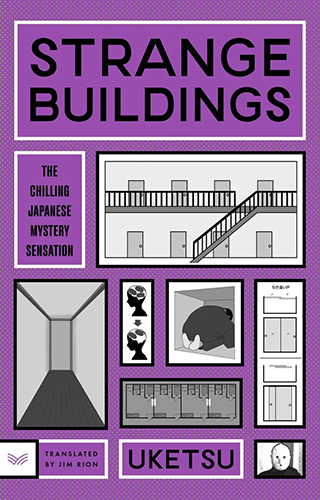
Strange Buildings, the 2023 follow-up to Uketsu’s smash hit Strange Houses, collects eleven illustrated stories about horror-themed architectural riddles followed by a lengthy exposition that reveals how these mysterious places are connected.
One of my favorite stories is “The Mousetrap House,” in which the wealthy heir to a large construction firm builds a luxurious mansion in order to kill a disabled elderly woman. If he puts a steep stairway next to the bathroom, he reasons, the woman will eventually lose her footing and tumble down the stairs.
When this eventuality fails to come to pass, he bullies his daughter into creating exactly the right set of conditions to make it happen. This horrible story is recounted decades later by the girl’s childhood friend, who was there on the night the old woman finally fell to her death.
I also enjoyed “The Watermill in the Woods,” which is presented as an old travelogue that recounts a curious building in the woods that’s nowhere near water. Its mechanical wheel instead powers the movement of an interior wall, but why would anyone need that?
This question is answered in the story “The House Where It Happened,” in which the frame narrator (who is styled as Uketsu himself) visits the old watermill in its current form as a remodeled modern house. When the village residents illuminate the shadows of the area’s history, the sinister purpose of the watermill becomes clear.
As in Uketsu’s other books, the overarching conspiracy is extremely silly. I don’t consider this a flaw, as there’s a certain sense of satisfaction in how delightfully outlandish the scenario is.
It should probably be said, however, that Uketsu is playing with acute cases of human misery as if they were Lego blocks. If one were to stage a gendered critique of this book, for instance, the ground is fertile. Still, I think it’s probably fair not to expect nuanced character portrayals from the weird architecture guy.
I enjoyed Strange Buildings, and I flew through this book as quickly as I could turn the pages. Jim Rion’s translation is compulsively readable, and I appreciate how Rion’s minor reconfigurations smooth over the “info dump” awkwardness of the original Japanese.
If you’ve never read Uketsu, Strange Buildings is a great introduction to the writer. If you’re already a fan, this is four hundred pages of the same, and it’s fantastic. Uketsu has found his niche, and it gives me joy to know that he’s out in the world being strange and living his best life.
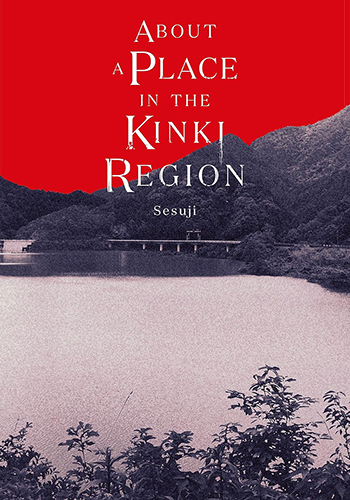
About a Place in the Kinki Region, originally published in 2023, is a horror novel assembled from roughly two dozen short stories presented in various formats, from magazine articles to interviews to YouTube video transcripts to reproductions of forum posts. These materials have been collected by the pseudonymous author, Sesuji, with minimal editorial comment, supposedly in an effort to locate someone who has mysteriously disappeared.
I should probably note here at the beginning that the actual author, an online horror writer who has published under the name Sesuji, is male. The diegetic character Sesuji is female, and it’s the character I’ll be referring to in this review.
Sesuji, a freelance writer living in Tokyo, has been contacted by her friend Ozawa, a junior editor at a publisher that produces a magazine devoted to the paranormal. Though the magazine has stopped putting out regular issues, it occasionally releases special issues, and Ozawa has been tasked with publishing one of these special issues on a very low budget. After combing through the magazine’s archives, he decides to create a collection of older articles that all pertain to a certain place in the Kinki region, the geographic area surrounding Osaka and extending south into the heavily forested Kii Peninsula.
This “certain place” is the location of numerous spooky legends and strange sightings, most of which can be categorized according to several distinct themes. There’s a ghost called Mashiro-san that calls out to children from the mountain forest, as well as a creepy playground game of the same name. There are abandoned buildings tagged with unsettling sticker graffiti, an alarming number of suicides, and perhaps even a creepy New Age cult as well.
Various sources suggest that the more supernatural incidents might be the work of a god whose shrine has fallen into disrepair due to rural depopulation, but it gradually becomes apparent that something much weirder is going on. In order to get to the bottom of the mystery, Ozawa visited the place himself to investigate, but now he’s gone missing. Sesuji therefore asks the reader: Is it possible that you could examine the material he collected and help her find him?
About a Place in the Kinki Region begins as a relatively straightforward collection of articles but eventually starts to experiment with its format in interesting ways. A standout piece is a short story called “Waiting.” This story is first presented as it was published in a magazine and then followed by its original rough draft, which contains a number of odd details that aren’t strictly relevant to the plot but may present clues regrading Ozawa’s disappearance.
Partially due to the author’s experiments with format, and partially due to the sheer variation of situations and narrators, nothing about this book feels repetitive. The careful sense of pacing creates a subtle sense of structure and generates narrative tension, gradually revealing the stakes of the story while pulling the reader into the mystery at hand.
I’m a big fan of “archival horror” narrative podcasts like Archive 81 and The Magnus Archives. I love how these stories simulate the experience of research while conveying the joy of discovering an intriguing rabbit hole. About a Place in the Kinki Region is a fantastic expression of this genre, inspiring the reader to dig ever deeper for a long-buried truth hidden within layers of secrets.
In addition, I enjoyed being an armchair tourist in this “certain place,” which is gifted with natural beauty and an intriguing local culture. If any vengeful revenants or neglected god-demons are searching for someone to spirit away to a mountain forest on the Kii Peninsula, I volunteer myself. I hear the evening twilight is especially magical… and even the ghosts have good internet access, apparently.
The translator, Michael Blaskowsky, has done an excellent job creating a distinct set of narrative voices across a range of tones and styles, from campy to lyrical to journalistic to point-blank horror. The book’s designer and editor at Yen Press, Andy Swist and Emma McClain, have done a marvelous job as well, engineering an unobtrusive flow of stories while occasionally adding small creative touches. I apologize for spoiling the surprise, but the book includes a secret set of illustrations in a semi-hidden section in the back, and it’s extremely cursed.
It’s also worth mentioning that About a Place in the Kinki Region was adapted into a movie released in August 2025 (here’s a mirror of the region-locked trailer on Reddit), but I haven’t yet seen any information about a global release outside of the film festival circuit, unfortunately.
In the years following the pandemic, I’ve encountered a number of “textual found footage” horror novels by Japanese authors capitalizing on the recent boom in YouTube creepypasta videos. Many of these books are very silly, but About a Place in the Kinki Region is surprisingly well-structured and entertaining. I’m happy this book been published in translation, and I hope my fellow archive horror fans enjoy its collection of unsettling little treasures as much as I do.
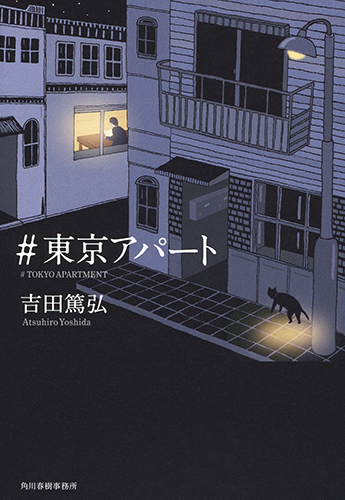
Atsuhiro Yoshida’s 2025 short fiction collection #Tokyo Apartment brings together 21 stand-alone stories about people living in and around Tokyo. The characters are usually living on their own, almost always in retro buildings removed from the city center. There’s very little wealth or glamor in these stories, but their protagonists nevertheless manage to become swept up in the magic of a densely populated megacity.
A representative story is Tokage-shiki gomuin kaisha (“Lizard-style rubber stamp company”), whose narrator recalls a time when he lived in a building that was once famous for being the largest apartment complex in Japan. The building had multiple floors of businesses, and the narrator worked at one of them as an apprentice to an artisan who took commissions for document signature seals. While dining at his favorite pubs in the same building, the narrator grew friendly with a woman who also worked there. He courted her by sending letters to her apartment – which was naturally in the same building. This story perfectly captures the flavor of the comfortably chaotic retro spaces of the old business/residential complexes of West Tokyo.
Not all of the stories are so cozy, however. Sutorei kuriketto (“Stray cricket”) is about a young man with no money, no friends, and no real prospects for finding a decent job. For the time being, he washes dishes in a small diner. He doesn’t have much room in his life for hobbies, but every night he brings back scrabs of cabbage to feed to a cricket that has entered his tiny apartment through a ventilation shaft. While listening to the cricket chirp in the darkness, the narrator is inspired to help the tiny creature find its way back outside. He might have nowhere to go in his own life, but at least the cricket can be happy and free.
Many of the stories end on a more ambiguous note. In Heya o kimeta hi (“The day we decided on an apartment”), two single fathers become online friends as they swap stories and advice with one another. In time, they become real-life friends and begin sharing childcare responsibilities. They mutually arrive at the conclusion that their lives would be easier if they lived in the same apartment building, so they hire a realtor to find a suitable property. There’s something about this sort of housing decision that feels final, however, and this causes the two dads to wonder if they’re really ready to take such a momentous step into the beginning of middle age.
For the most part, the stories in #Tokyo Apartment are fairly mundane, but there are occasional touches of magical realism. In Yūrei no denwa (“Ghost telephone”), the character Moriizumi returns from Yoshida’s novel Goodnight, Tokyo. Moriizumi manages a service that helps people dispose of their old telephones, which often have too much sentimental value to throw away. In a conversation with a crow who makes nightly visits to her balcony, Moriizumi reflects on how analog technology can feel haunted by the ghosts of people with whom our connections have faded. The crow, who is a connoisseur of the unused objects people dispose of on their balconies, agrees with Moriizumi but prefers to focus on making new connections.
A word I often see in reviews of Atsuhiro Yoshida’s writing is yomi-yasui, or “easy to read.” Yoshida has spent more than a decade carefully cultivating a light and precise writing style, and #Tokyo Apartment is indeed a relaxed and chill reading experience. It’s entertaining to encounter such a wide range of variations on the theme of “apartments in Tokyo,” especially since the narrative voices of these stories are so distinct – which is no mean feat when accomplished within the simplicity of the author’s characteristic style.
As an aside, I might recommend the stories of #Tokyo Apartment to people studying Japanese language. Any one of them might be good for inclusion on the syllabus of an upper-level Japanese language class. In particular, the first and final stories of the collection are short, amusing, and easy to understand from context clues, and I imagine that either of them would be a nice treat for anyone just starting to read Japanese fiction.
In the woods, there is a castle. The castle was once the residence of the landowning family that ruled the area. During the war, it was the headquarters of a resistance movement. Now it sits empty and abandoned. The castle is so deep in the woods that most people couldn’t find it if they tried. No one tries, however, as the woods are filled with child-snatching imps. Strange noises come from the woods, and occasionally strange people as well.
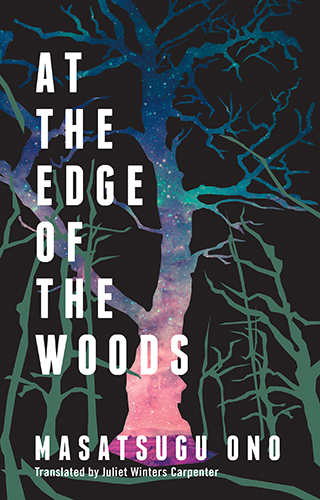
Masatsugu Ono’s At the Edge of the Woods is a novel about dread and anxiety. There’s no plot, nor is there any sort of story. Instead, Ono presents four episodes in the life of a father left alone with his young son while his wife is away. There’s no chronological order to the four chapters, which all occur at roughly the same time, and there’s no meaningful change in the personalities of the characters. Rather, the story development involves the slow intensification of an atmosphere of foreboding.
The nameless father who serves as the narrator is Japanese, as is his wife, who is pregnant with their second child. The wife has flown back to Japan to visit her parents, leaving her husband and son in an unspecified European country that reads as Germany-coded. The family has taken up residence at the eponymous edge of a vast forest in a rural area dotted with small towns.
The country is now at peace, but its neighbors are not so lucky. Long lines of refugees stream across the borders, seemingly unhindered by local authorities. It’s entirely possible that some of these refugees have camped out in the woods next to the narrator’s house, but it’s difficult to say for sure. It’s equally difficult to specify the origin of the odd sounds constantly emerging in the forest.
Characters drift in and out of the narrative, leaving behind very little of themselves save for strong emotional impressions. The disabled daughter of a bakery owner has good intentions but struggles to make herself understood. The postal worker who delivers the mail relates grotesque stories to the father, who suspects the man might be reading and discarding his wife’s letters. A neighboring farmer has always been kind to the narrator’s family, but his son reports that he once saw the man tie a dog in a burlap sack and beat the poor creature to death.
Perhaps the most striking of these characters is an elderly woman that the narrator’s son invites into the house. She appears seemingly from nowhere, and she vanishes just as mysteriously. While she’s in the house, though, she becomes a living symbol of the narrator’s anxieties regarding his ill-fitting role as the solitary caretaker of a young child in a foreign land:
Overcome, the old woman buried her face in her hands. She trembled violently, and a sob escaped her. I looked up. The kitchen windows were all closed. And yet in the air there hovered the sour smell of decayed leaves from deep in the woods, leaves that would never dry out. Steam rose from the old woman. The steam was not from her tea. A puddle spread at her feet. (20)
In his “Introduction” to The Oxford Book of Gothic Tales, Chris Baldick neatly summarizes the genre as an expression of the fear that the horrors of prior eras will not remain comfortably in the past. At the Edge of the Woods presents the readers with a range of Gothic tropes to heighten the sense of uneasy suspicion that, even in the most progressive of European countries, there is no escape from misery and cruelty. While the back-cover copy of At the Edge of the Woods calls the novel “an allegory for climate catastrophe,” this feels like a bit of an interpretive reach. Instead, Ono seems to be suggesting more broadly that, even in our bright society sustained by futuristic technologies, we’re never that far away from the edge of a large and unknowable forest.
At the Edge of the Woods can be difficult to read, and it’s probably not for everyone. Speaking personally, though, I love this book, and I’ve read it on the winter solstice every year since it was published in 2022. Ono’s writing is gorgeously atmospheric, and the legendary Juliet Winters Carpenter has done a dazzling job with the translation. If you appreciate the sort of quiet, eerie, and darkly suggestive Japanese Gothic writing typified by Yoko Ogawa’s short story collections Revenge and The Diving Pool, I’d recommend At the Edge of the Woods as the next step on a shadowed path into the liminal spaces in the penumbra of modern civilization.
The Woman Dies presents 52 pieces of flash fiction by Aoko Matsuda, the author of the short story collection Where the Wild Ladies Are. Each of Matsuda’s small but sparkling stories responds to various aspects of pop culture in clever and surprising ways.
Characteristic of Matsuda’s idiosyncratic approach to the flotsam of contemporary culture is “Hawai’i,” which imagines a heaven for clothes that were thrown away because they did not spark joy. The heaven enjoyed by an unworn sweater sounds like a lovely time of relaxing by the pool while, in the sky, “not far from the rainbow, the pair of skinny jeans owned in similar shades was paragliding together with the dress once worn to a friend’s wedding and never again.”
At the same time, the over-the-top language Matsuda uses to describe this paradise hints at how ridiculous it is to ascribe any sort of teleological meaning to consumerist excess. Still, if this is the world we find ourselves in, why not imagine a heaven where even a discarded sweater is allowed to have a happy ending?
While the topics covered in The Woman Dies are varied, many of the stories playfully confront gender issues in popular media. One of the more intriguing of such stories is “The Android Whose Name Was Boy,” which Matsuda writes “evolved from my thoughts about Neon Genesis Evangelion,” a classic sci-fi anime from 1995 that does indeed inspire thoughts about gender.
The eponymous android, whose name is in fact “Boy,” begins its life by setting out on an adventure. Over the course of the five-page story, it does its best to disrupt narrative conventions regarding young male characters. Challenging and unending though this task might be, “the android whose name is Boy, developed to heal the wounds of those hurt by boys hurt in the past, is on the move once more.”
While “The Android Whose Name Was Boy” is open to a diversity of interpretations, other stories in the collection are overtly feminist. In “The Purest Woman in the Kingdom,” a prince takes it upon himself to seek out a woman who has never been touched by a man. After a great deal of searching, he finally finds and marries one such woman. On their wedding night, she karate chops him into oblivion. This woman has never been touched by a man; and, thanks to her training and skill in martial arts, she never will be. Absolute queen behavior.
Most of the stories in The Woman Dies are relatively lighthearted, but “The Masculine Touch” (by far my favorite piece in the collection) is out for blood. This story flips the script on gender, casting male writers as delicate greenhouse flowers who need to be supported because sometimes – every so often – their work has cultural and economic value. Matsuda doesn’t pull her punches:
The more radical of the male novelists wrote articles about this turn of events for male magazines, declaring this the beginning of the Male Era. They bolstered their arguments with examples of the other times when the masculine touch had effected changes like this one, thus arguing for men’s continued progress in all areas of society.
“The Masculine Touch” responds to a painfully specific way of talking about female writers and artists in Japan, and I imagine that people in other contexts can relate to frustrations regarding how the publishing industry fetishizes “queer writers,” or “writers of color,” or any number of people whose humanity is compressed into marketing-friendly categories.
Unfortunately, other pieces in the collection lack this specificity. Though we’re all familiar with the trope of fridging female characters, the title story, “The Woman Dies,” is a bit too broad to resonate. Though it’s easy to sympathize with the sentiment underlying “The Woman Dies,” readers may find themselves simply shrugging and moving on. Flash fiction tends to be hit or miss, but this collection offers an array of stories to choose from, and it achieves an admirable balance between heavy hitters and palette cleansers.
The Woman Dies is remarkably cohesive as a collection. There’s a lovely rhythm and flow to the stories, and it’s just as entertaining to read the book in one sitting as it is to dip in and out at your leisure. Matsuda’s writing is sharp and self-aware, and she uses brevity as a weapon to puncture the absurdities of gender, media, and modern life. It’s a pleasure to read her work in Polly Barton’s translation, which is quick and lively and showcases an incredible range of tone and style that’s pure literary pop.
Retrograde collects five short stories and one novella written by a young Osamu Dazai and gorgeously translated by Leo Elizabeth Takada.
The novella, Das Gemeine, follows a 25yo student studying French literature who aspires to become a writer himself. While hovering around an amazake stand in Ueno Park and hoping to catch the attention of the young woman who works there, the narrator meets another student, a violinist who barely attends class at all. The violinist’s friend, himself a painter, warns the narrator not to believe any of the violinist’s tall tales about his supposed talent.
The three young men decide to start a literary journal together (along with their pathetically unattractive acquaintance Osamu Dazai), but petty personality conflicts crash the project before it can get off the ground. Feeling hopelessly at a loss in letters and in love, the narrator meets a sad fate that may not have been entirely an accident.
One of the many myths surrounding Osamu Dazai (the author, not the character) is that he considered himself to be a failure rejected by the mainstream literary establishment. For better or worse, I can relate. I know from personal experience that, as an outsider, you often find yourself placing your work in the hands of upstart editors organizing projects that may, in all likelihood, never see the light of day. More often than not, things fall apart precisely because the creative team had big dreams but no practical skills to realize their ambitions.
I myself am something of a coward who immediately walks away from that sort of unpleasantness, but my familiarity with creative collaboration mishaps makes me respect the truth of the story Dazai tells in Das Gemeine, which is remarkably well-observed. The characters in this novella are deeply frustrating and more than a little cringe, but they’re 100% real – this is exactly what it’s like to work with creatives in their twenties who build castles in the air but haven’t yet developed the artistic discipline to commit their visions to paper. Bless their hearts.
The five shorter stories in the collection read like something that the narrator of Das Gemeine might actually have written. A 25yo man dies tragically and is mourned by his beautiful wife. A college student sits for the final exam of a French literature class he never attended. A high school student obnoxiously flirts with café waitresses but swiftly loses a fight with a grown man who’s not interested in his sophomoric bullshit. A teenage boy experiences a sexual awakening when the circus comes to town. Each of these stories is only a few pages long, and their unguarded sincerity contributes to their charm.
The closing story, “Blossom-Leaves and the Spirit Whistle,” is about two sisters in love with an idealized version of a man who only exists on paper until the strength of their shared storytelling summons his ghost to appear under their window… perhaps. I appreciate this story’s clever touch of Todorovian fantasy, and I’m always here for unapologetic gothic pathos. This aesthetically luxurious story is classic Dazai, in that it’s exactly the sort of work that’s contributed to his popularity among generations of students. I myself am not immune, of course, and this is by far my favorite piece in the collection.
In their “Translator’s Afterword,” Takada describes Dazai’s writing style as “a casual conversation with someone familiar,” and they explain that they want their translation to feel as if they’re “doing this just for you,” the reader. Takada gets the tone exactly right, rendering Dazai’s straightforward prose into an invitation to sympathize with the writer and his characters even despite their naked sincerity. I’ve never responded to overly “literary” renditions of Dazai’s prose, but I found myself flying through this translation. It’s fantastic.
I also want to highlight the care and attention that One Peace Books has put into the layout and typeset of this book, giving the words on the page exactly the room they need to breathe. Retrograde is a lovely object to hold in your hands, so much so that it might even spark the same youthful enthusiasm for literature that Dazai so aptly captures in his early fiction.
Much love to Leo Elizabeth Takada and One Peace Books for breathing fresh life into these classic stories from the 1930s. Retrograde is an admirable achievement, and I hope it brings the work of a fascinating author to new readers.
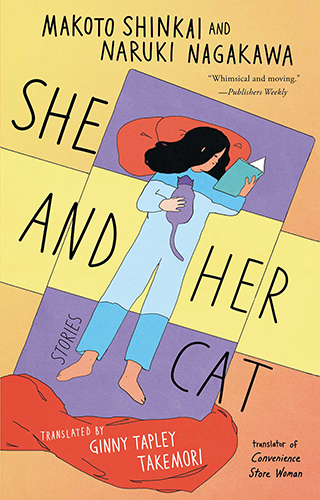
She and Her Cat collects four interlinked short stories about women and their cats. Though these stories are bittersweet, their gentleness is a source of comfort and encouragement.
The stories in She and Her Cat were written by Naruki Nakagawa, who’s mainly known as a screenwriter for science fiction anime from the mid 2000s, and the concept is based on the 1999 short indie film (which you can watch on YouTube here) created by the international superstar anime director Makoto Shinkai. I think it’s fair to say that the original short film is a representative example of the iyashikei “comfort” genre of anime, which Patrick Lum describes as “designed to be as comfy and mellow as can be.” This book, which Nakagawa wrote in his late forties, similarly uses young female characters to create a sense of living in a world where a brighter future is always possible.
The first story is a direct adaptation of Shinkai’s original short animation. A young office worker named Miyu brings home a kitten who’s been left outside in the rain in a disintegrating cardboard box. Miyu is growing apart from both her boyfriend and her best friend, and she feels as though she’s no longer able to understand the nuances of other people’s feelings. Thankfully, her new cat Shiro loves her unconditionally, and he’ll always be there for her.
The second story is about an art student who can’t find the motivation to apply to a university-level Fine Arts program, and the third is about an aspiring manga artist who was unable to make her debut and became a hikikomori after the death of her writer, who also happened to be her childhood friend. Both women find the courage to pull themselves out of their depression and take the first few steps forward – with the help of their cats, of course.
In the last story, a childless middle-aged woman finds herself alone after caring for her husband’s parents only to be left by her husband himself. As she gets older, so too does the boss of the neighborhood stray cats, and she ends up adopting him. Around the same time, her nephew has a quiet breakdown at his first job out of college, and the woman ends up sheltering him too. In return, he eagerly learns the non-corporate life skills she shares, and he naturally begins to help her manage the household. While it’s always rewarding to nurture a mutually loving and beneficial relationship with a cat, this story reminds the reader that kindness can exist between humans as well.
The narrative viewpoint of these stories alternates between the cats and their human companions. When the cats aren’t expressing their undying love for the human ladies in their lives, they’re off on their own adventures in the neighborhood, doing as cats do. Even more than the human characters, the cats have strong personalities and know what they’re about.
Comforting Japanese books about cats are currently enjoying a small cultural moment, and She and Her Cat is among the best of them. As you might expect from a book written by a professional screenwriter, each “scene” is fairly short, which makes for a quick and engaging read. Nagakawa maintains the distinctive narrative voice associated with Makoto Shinkai’s films, and Ginny Tapley Takemori conveys this straightforward gentleness perfectly in translation. In the English edition, each story is prefaced by a gorgeous full-page illustration by Rohan Eason, which only adds to the book’s charm. Exactly like the creatures it celebrates, She and Her Cat is light, nimble, and filled with character.
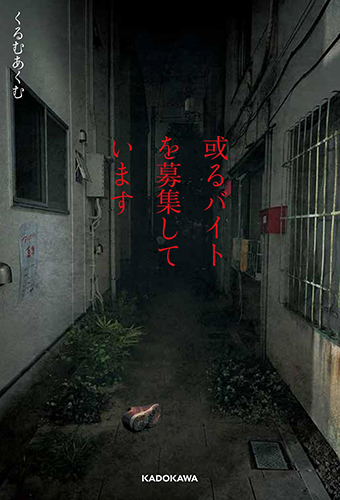
Aru baito o boshū shite imasu (或るバイトを募集しています) is a collection of eight short horror stories conveyed in the form of documentary-style found footage. Each story is prefaced by a listing for a part-time job that seems a little strange, or perhaps too good to be true.
The most representative of these jobs is a request to make an offering of flowers at a certain empty lot between midnight and 1:00am every night. An aspiring comedian who needs the money and keeps late hours takes the job and carries it out faithfully. He never sees anything strange, but something about the job still feels off.
When he does research about the location, he can’t find anything out of the ordinary. Another entertainment industry professional explains that the job is probably a strategy to lower the land value. The comedian’s employer wants to buy the land and assumes they’ll be able to get it at a steep discount if it becomes known in the neighborhood as a “stigmatized property” (as explained by Business Insider here).
The comedian does his best not to think about it too hard. When he finally gets a gig and fails to make his nightly offering, he leaves the studio only to find that an unknown number has called several times. When he checks his voicemail, a mysterious woman speaks to him through static, saying, “The flowers from yesterday have withered. Why didn’t you come tonight? Can I still stay here? Can I still stay here? Can I still stay here?”
Slightly outdated media and technology are a recurring theme in the collection, and this isn’t the only story about creepy messages left on an answering machine. Other stories revolve around physical media like VHS tapes, DVDs, and handwritten letters. When it comes to creepy found objects, I get the sense that there’s a certain air of uncleanliness that clings to the physical media of a prior century.
Along with the spookiness of the stories, I enjoyed the rationalizations for why each strange job might exist. If I had to guess, I’d say that this collection is partially inspired by the recent discourse surrounding yami baito, or “shady part-time jobs” (which the BBC did a podcast about here). In real life, yami baito involves organized crime organizations using aboveground job postings on social media to recruit young people for illegal activities such as cash withdrawal fraud and stripping copper wiring from abandoned houses. Still, it’s not too difficult to imagine an entirely different shadow world seeking to prey on the living with the offer of easy money.
More than social commentary, however, Aru baito dwells in the realm of internet creepypasta. The collection’s author, Kurumu Akumu, has spent the past several years sharing short and spooky stories on various platforms, including YouTube (here), Note (here), and Twitter (here). Aru baito reflects the found footage nature of creepypasta by presenting its stories in a variety of formats, such as interviews, screenshots of text conversations, blog comments, and so on. The unusual formatting is a lot of fun, making the book feel like a file folder of cursed printouts.
Kurumu Akumu’s work reminds me of the mockumentary-style horror of Uketsu’s Strange Pictures, but Aru baito has no connecting narrative, nor does it make any attempt at portraying psychological realism. Instead, the reader feels as if they’re encountering real urban legends in the wild, and the lack of context heightens the eerie feeling of looking at something that shouldn’t be seen. Aru baito is an unsettling collection that blends the horror of cursed analog media with the eerie plausibility of urban legends, leaving readers with the lingering sense that some part-time jobs are better left unfilled.
Michi Ichiho’s Tsumidemic (ツミデミック), which won the prestigious Naoki Prize for popular fiction in 2024, collects six stories about the atmospheric strangeness of the Coronavirus pandemic. While everyone’s attention was focused elsewhere, Ichiho wonders, what sort of intriguingly antisocial behavior might have been enabled by isolation?
The opening story, Chigau hane no tori (違う羽の鳥), has all the grim fascination of a viral urban legend. Yūto moved to Tokyo only to drop out of college, and now he works as a barker for a bar in Shinjuku. Unfortunately, business isn’t going well due to the pandemic. During another eerily quiet night, Yūto sees someone he knew back from middle school in Osaka, Nagisa Inoue. This is a shock, as Nagisa is supposed to have committed suicide by jumping onto the train tracks. As she and Yūto get drinks together, Nagisa explains her devious plot to flee from the grasp of her overbearing mother, which was far from a victimless crime. Yūto is no saint himself, and he inadvertently reveals why he immediately recognized someone he never talked to when they were classmates.
Romansu (ロマンス☆) is about a bored housewife named Yuri who develops a serious online gambling addiction of an unusual nature. Yuri hasn’t been able to find a new job since she left her previous position to give birth to her daughter, and the pandemic isn’t helping. She channels her frustration into a food delivery app called Miideri, which she treats like a gacha game. Will the person who makes her next delivery be one of the handsome men rumored to be employed by the service? While gambling on the slim possibility that a prince will arrive at her door bearing a bag from McDonald’s, Yuri attracts the unwanted attention of an unhinged delivery driver who has read exactly the wrong message into her frequent orders.
Rinkō (憐光) is narrated by the ghost of a high school student named Yui who, strangely enough, can’t recall how she died. Having materialized back into the world fifteen years after her death, Yui finds herself confused and alienated by the loneliness of the Tokyo streets and train stations during the pandemic. She therefore returns home to her mother’s house in the country. Her arrival coincides with a memorial visit from her friend Tsubasa, who is accompanied by their old homeroom teacher, Sugita. As Yui eavesdrops on their conversation, she learns that she died after mysteriously falling into a river during a rainstorm. Sugita knows what Yui was doing and where she was going, and Tsubasa wants him to know that she knows, too.
The collection takes a slightly more positive turn in the fourth story, Tokubetsu enkosha (特別縁故者), in which Kyōichi, the unemployed and impecunious father of a young son, attempts to weasel himself into the good graces of an elderly man whom he suspects is a money hoarder. Kyōichi, an affable himbo who has no business scamming anyone out of money, volunteers for the daily task of picking up a takeout lunch from one of the many bentō stores in the neighborhood. The old man knows exactly why Kyōichi approached him, and he resents him for not pursuing his ambition to enter the food service industry. Harsh words are exchanged; but, when push comes to shove, even a relationship built on ulterior motives is better than living alone as an elderly shut-in during a pandemic.
Shukufuku no uta (祝福の歌) is about a happily married middle-aged man facing a new direction in his life. Despite being a high school student, his daughter is pregnant, and she intends to keep the baby. Meanwhile, the man’s mother seems to be entering the permanent brain fog of senile dementia. His daughter, who has been gossiping with the other mothers in her grandmother’s apartment building, gets the sense that there’s something else going on. With any luck, it’s a problem that can actually be solved.
Sazanami Drive (さざなみドライブ) follows the IRL meetup of five people who connected on Twitter after their lives were disrupted by the pandemic. As they drive out to the country in a minivan, they share their stories of abandonment and alienation. Little do they know that one of their number has a secret agenda. He’ll do whatever it takes to disrupt the group’s grim plan for the trip – and hopefully save their lives in the process.
As indicated by the book’s title, the two themes guiding this collection are “crime” and “the pandemic.” Each of the characters is hiding something, and the reader never knows where anyone’s true intentions lie. Michi Ichiho, who began her writing career as an author of BL romance novels, isn’t unduly focused on creating mimetic fiction, and the scenarios are improbable at best. Still, the twist at the end of each story is a lot of fun, and the fantastical plot elements accurately convey the feeling of just how weird and unreal everything felt during the pandemic.
It appears that the English-language publication rights for this collection are currently up for grabs (more info here). Tsumidemic is a fast-paced and emotionally cathartic book, and it would benefit from a tone-sensitive translation that renders Ichiho’s dialogue-filled writing into snappy, Stephen King style prose. I hope someone picks it up.
Hiromi Kawakami’s Under the Eye of the Big Bird is a book about the quiet end of the world. Despite its postapocalyptic setting, the story is gentle. The author’s background as a biology teacher shines through her writing as she imagines the diverse forms that humans and their societies might take in the far distant future.
Under the Eye of the Big Bird is structured as a collection of fourteen stand-alone stories that gradually form a larger narrative, and the reader is encouraged to put together a history from bits and pieces of individual lives. We never see the full picture, however, and I imagine that assembling a concrete timeline would take careful detective work.
This isn’t a plot-driven story that can have “spoilers,” necessarily, but any description of the book’s premise is going to contain analysis and speculation. Under the Eye of the Big Bird is one of the most intriguing works of speculative fiction that I’ve read in years, and this is partially due to its fragmented structure. You may want to venture into the collection on your own before reading any reviews, this one included.
.
Still with me? Let’s go!
Over the millennia, the number of people on the planet has steadily decreased, and the last remaining humans live in isolated settlements of various sizes. In order to ensure harmony, the settlements are discretely managed by “watchers” who have been cloned and genetically engineered to fulfil their duty. Unlike regular humans, watchers grow up in small communities with “mothers” that are all physical manifestations of the same AI.
Everyone takes this arrangement for granted, but their “normal” is not the same as ours. Whether a story is told from a first-person or third-person point of view, the reader can only see the world from a limited perspective. It can be difficult to understand what’s going on at first, but the opportunity to surf successive waves of strangeness is a major part of this book’s charm.
My favorite story is “Testimony,” which is delivered as a statement to a watcher by one of the new phenotypes of humans to emerge from centuries of genetic isolation. A small number of people are born with the ability to photosynthesize, and the joy they take from the sunlight and changing seasons affects their behavior in surprising ways. If enlightenment exists, these people have attained it; and honestly, it sounds really nice.
Not all of the future human phenotypes are so peaceful or self-assured, however, and other stories have a bit more conflict. Still, with one notable exception, there’s no violence in this book. If there are wars and explosions, they happen entirely offscreen. Like the watchers and mothers, it’s the reader’s job simply to observe the biology, ecology, and culture of the future.
On the front cover of the American edition, Kawakami is billed as the author of People from My Neighborhood, a loosely connected series of magical realist flash fiction that’s an excellent comparison for Under the Eye of the Big Bird. To me, Under the Eye of the Big Bird also feels like a natural development of Kawakami’s debut short story, Kamisama, in which the narrator has a lovely afternoon picnic with a literal bear. The bear, being a bear, is clearly nonhuman, but no one seems to be bothered by this. The same casual acceptance of difference pervades Under the Eye of the Big Bird, which invites the reader to imagine the mundane everyday reality of the final days of the human race.
I’ll admit that I felt the chilling touch of existential dread at a few points during the book; but, as in any encounter with real difference, this initial sense of discomfort is important. The gentle strangeness of Under the Eye of the Big Bird encourages the reader to confront their biases, and it also lends weight to the narrative theme of human extinction. Instead of presenting the apocalypse as a standard dystopian superhero story, Kawakami allows the reader to take all the time and space they need to consider whether it would really be so horrible if the people we currently think of as “human” were to slowly disappear from the earth.
Under the Eye of the Big Bird is a book about the end of the world, but it’s also one of the kindest and most hopeful works of speculative fiction I’ve had the pleasure to read. Reading this book for the first time was a unique experience, but the impact of its stories linger even after their novelty fades.




 Contemporary Japanese Literature