The Guest Cat

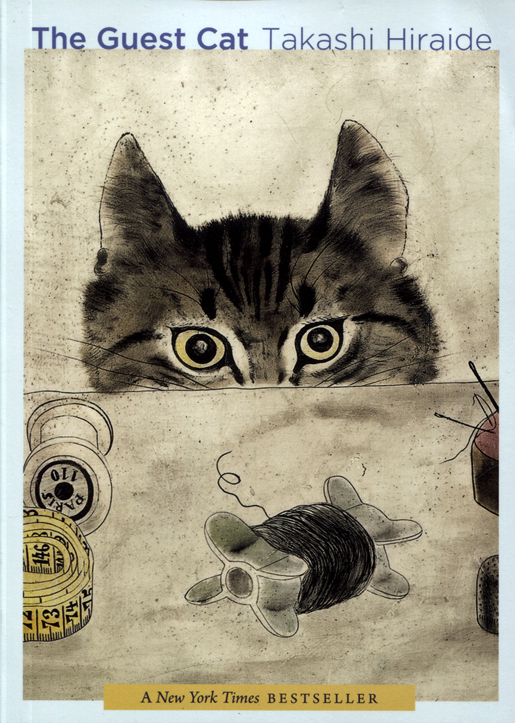
The Guest Cat

Title: The Gust Cat
Japanese Title: 猫の客 (Neko no kyaku)
Author: Hirade Takashi (平出 隆)
Translator: Eric Selland
Publication Year: 2014 (America); 2001 (Japan)
Publisher: New Directions
Pages: 140

The Guest Cat is set in 1988 in a residential neighborhood not too far away from Shinjuku Station, where the young narrator lives with his wife in a rented house located on the property of an old estate. The narrator’s house faces a narrow side street that he calls “Lightning Alley” because of its sharp, zig-zagging turns. A young housewife and her son live in a house next door that shares the shade of an ancient zelkova tree with the narrator’s house. A cat wanders into the housewife’s garden, and her son becomes enamored with the creature. Despite the protests of the woman living in the main house of the larger estate, who claims that the neighborhood cats ruin her garden and track dirt inside her house, the boy is allowed to keep the small white-mottled cat, which is promptly given the name Chibi, meaning “little one.”

The novel moves elliptically through several stories, gradually passing from point to point by way of meandering descriptions of the outside alley, the estate garden, and the narrator’s house in relation to the space and weather outside. The narrator has just worked up the courage to quit his job as a literary editor in order to pursue his own writing projects, but he only has enough money to help his wife maintain the household for about a year and a half. The narrator’s close friend dies from cancer, and the narrator worries about his own health as the Shōwa emperor grows ever weaker on his deathbed. The woman who owns the estate lives alone save for her aging husband, and she’s not too young herself; it’s uncertain what will happen to the property when she passes away, as land prices have risen exorbitantly in the bubble economy. Most importantly, Chibi develops new mannerisms and behaviors as she becomes more familiar with the narrator and his wife, who in turn grow and change through their interactions with her. The chapters are short (between three to six pages), each focusing less on any sort of ongoing plot and more on brief and vibrant observations on how the world appears differently when it’s centered around a cat instead of around other human beings.

The style of the novel is naturalistic in its minute attention to the detail of mundane life and reminds me of nothing so much as the short fiction of Shiga Naoya or the realistic fiction of Akutagawa Ryūnosuke (of the kind collected in Mandarins), in which the discomfort caused by writer-narrator’s cold is made palpable by a catalog of what can only be noticed when one is confined to bed but cannot sleep, such as how a lizard crawls into a sliver of shade on the bedroom windowsill to escape the sun, or how Chibi admires herself in the mirror before leaping from the mirror stand onto the top shelf of the closet. As one imperial era transitions into another, the narrator and his wife experience major changes in their life, including a particularly traumatic event involving Chibi whose full impact does not become clear until the very last page of the story. Throughout everything, Hiraide focuses on brief moments and small sensory details such as the pleasant chilliness of a breeze or the pattern of light and shadow cast by the sun shining through tree leaves. While it is possible to glean several layers of meaning from each episode (one scene involving a praying mantis eating a locust particularly rewards analysis), it’s also well within the reader’s right to simply allow herself to be carried by the relaxed current of vivid impressions.

I’ve recently started reading about the Deep Ecology movement, which is above all concerned with animal rights, as well as how respect for these rights can shape the nature of the relationship between human and non-human animals. I’ve become a fan of Marc Bekoff’s blog Animal Emotions, which comments on current events and summarizes scientific research in order to build a case for a more inclusive and compassionate understanding of animal psychology. It’s been interesting to read Bekoff’s work alongside The Guest Cat, in which different characters betray vastly different attitudes towards animals through their interactions with Chibi. I was especially intrigued by the shifting tides of the narrator’s wife, who claims not to be a cat person:

As she finished the poor sparrow’s burial my wife repeated her earlier declaration – “I won’t hold Chibi,” she said. “It’s more gratifying to let animals do whatever they like.”

As April came around, gossamer-winged butterflies covered the garden, dancing just above its surface and coloring it a blue-gray. It seemed impossible for anyone walking in the garden to avoid stepping on them.

What’s interesting about animals, my wife explained, is that even though a cat may be a cat, in the end, each individual has its own character.

“For me, Chibi is a friend with whom I share an understanding, and who just happens to have taken on the form of a cat.”

Even though the narrator’s wife is attached to Chibi, she respects the cat’s autonomy and individual character, thus abstaining from direct interaction. The narrator, on the other hand, becomes fiercely jealous of the cat’s affections at a certain point, and it becomes increasingly apparent that Chibi’s primary caretaker, the housewife next door, also possesses strong emotions concerning the cat.

Although other readers may interpret this autobiographical novel differently, to me, the primary dramatic effect of The Guest Cat is not so much a result of its human characters and the socioeconomic environment they occupy, but rather a process arising from the ideas and emotions animals inspire in humans as they become attached to individual creatures and are refracted into the wider world.

The Guest Cat is equally capable of acting either as a quick pleasure read for cat lovers or as a starting point for applied literary ecocriticism. Either way, it’s a neat little book!

Ring

Ring

Title: Ring
Japanese Title: リング (Ringu)
Author: Suzuki Kōji (鈴木 光司)
Translators: Robert B. Rohmer and Glynne Walley
Publication Year: 2004 (America); 1991 (Japan)
Publisher: Vertical
Pages: 282

In Nakata Hideo’s 1998 film adaptation of Ring, the point-of-view character for most of the story is female. This is an effective casting choice, as cinematic audiences are primed to experience danger and vulnerability through female protagonists in horror films. Suzuki Kōji’s original novel is less about thrills and chills than it is about hardcore investigative journalism, however, and its hero, Asakawa Kazuyuki, is male. The female lead in the Ring film’s husband, Takayama Ryūji, is Asakawa’s friend in the novel, which sees the two men travel across Japan in an attempt to save Asakawa’s wife and child from a deadly curse apparently connected to a mysterious bootleg videotape.

In the opening pages of the book, two creepy things happen: a teenage girl dies suddenly in her family’s apartment in Yokohama, and a boy on a motorcycle falls down dead on the road in front of a taxi. A month later, the taxi driver reports the latter incident to a random passenger, who happens to be the journalist Asakawa, whose niece happens to be the teenage girl involved in the former incident. Asakawa, upon realizing that these deaths, as well as two others, all happened at the exact same time on the exact same day, tracks down the connection between the teenagers to a cabin in the woods near the seaside resort of Atami, which is a two-hour train ride southwest of Tokyo. It is there that he encounters an unmarked videotape upon which a surreal series of images has been recorded. White letters at the end of the sequence warn that the viewer will die in a week unless a certain “charm” is performed, but the four dead teenagers recorded over the actions needed to perform this charm as a prank.

In order to figure out the charm before his time is up, Asakawa enlists his college professor friend Ryūji to help him figure out as much information concerning the origins of the tape as possible. What follows is a surprisingly unsuspenseful series of adventures in which the two men eat things, drink things, and leisurely chat with all manner of people as they gradually puzzle out the life story of Yamamura Sadako, the beautiful young woman whom they believe to be responsible for the cursed videotape. Although Ring is structured around a quest for Sadako, the novel, unlike the film adaptation, is a man’s world. The primary female characters are offstage and only glimpsed through the recollections of various male characters, who are far more interested in localized histories of science and medicine than they are in the supernatural.

The reviews excerpted on the back of the novel promise that it is “very frightening” and “an engine of disquiet” and “shocking” and “so creepy your hair will literally stand on end;” but, to be honest, I don’t think the book is that scary, and the fright factor is only a marginal portion of what it has to offer a reader. Instead, Ring unfolds as a mystery in which clues must be painstakingly tracked down one at a time as the principal players struggle to draw connections between them. It’s the search for these bits of information, as well as the thrill of hard-won eureka moments, that will keep the reader entertained, and the paranormal elements are for the most part examined in a rational and pseudo-scientific manner. The true horror of Ring does not lie in its ghosts or shocking imagery, but rather in the absolute inability of human beings to comprehend the vast and menacing world that lies outside the realm of our control.

Ring is set in the same decade in which it was written, and the condominium high-rises, mass media publications, and corporate culture of the late 1980s saturate the background of the novel. The primitive fear of disease still haunts the advanced society that provides the backdrop of Ring, however; and, although the science and technology of the age strive to contain natural forces, some things cannot be controlled. The author is able to accentuate this anxiety by continually linking the actions of Sadako’s curse with images of the natural world at its most hostile and overwhelming. For example, one of the greatest of natural forces, the sea, is a constant presence in Ring, and it only appears under the cover of darkness and in contrast to human constructions, a juxtaposition which creates an impression of a dark, brooding malice lurking beyond the boundaries of civilization. The novel opens with an image of the highly developed industrial area which lines the bay fronting the city of Yokohama:

Off to the south the oily surface of the ocean reflected the glittering lights of a factory. A maze of pipes and conduits crawled along the factory walls like blood vessels on muscle tissue. Countless lights played over the front wall of the factory like insects that glow in the dark… The factory cast a wordless shadow on the black sea beyond.

Suzuki equates the factory with humanity as he compares its bulk to a human body, endowing it with “blood vessels” and “muscle tissue.” The multitudinous lights of Yokohama at night also metaphorically dot the surface of the factory, but none of this light has any effect on the “black sea beyond.” Instead, the factory as a symbol of humanity and its ingenuity merely “cast[s] a wordless shadow” over the silent ocean, which almost seems to mock its presence.

Even with our incredible advances in technology, contemporary societies still have trouble coping with the facets of existence that lie beyond the explanations offered by science and ordinary experience. We are all insignificant and ephemeral points of light flickering on and off somewhere in a dark, callous, and unfathomably large universe. While the film and graphic novel adaptations of Ring delight in the uncanny horror of the female demonic, the horror of the original novel is more Lovecraftian. The protagonists of Ring are ultimately punished by the narrative not because they don’t strive tirelessly for information, but rather because they believe the achievement of knowledge has the capacity to help them in any way.

A reader should not come to Ring expecting the same sort of jump-horror at which its cinematic adaptations excel; there are no creepy little girls stuffed in closets or climbing out of television sets. Suzuki’s novel instead rewards intellectual engagement and curiosity, which it subtly mocks and discredits in the most terrifying of ways.

In the Miso Soup

In The Miso Soup

Title: In the Miso Soup
Japanese Title: イン ザ・ミソスープ (In za miso sūpu)
Author: Murakami Ryū (村上 龍)
Translator: Ralph McCarthy
Publication Year: 2003 (America); 1997 (Japan)
Publisher: Penguin
Pages: 217

In the Miso Soup was serialized during 1997 in the Yomiuri Shimbun, the newspaper with the highest circulation in Japan (and perhaps in the world), and it won the 1998 Yomiuri Prize for Literature, an extremely prestigious award given to superlative works of writers who have already established themselves as leaders in their fields. The novel’s North American and Japanese publishers have marketed it as a “psycho thriller,” and its extreme and violent content will more than likely shock anyone who isn’t familiar with Murakami’s oeuvre, especially his other suspense novels from the 1990s, such as Piercing (1994) and Audition (1997).

The twenty-year-old protagonist of the novel, Kenji, is a high school graduate from Shizuoka Prefecture who makes his living by acting as a guide of Shinjuku’s Kabukichō neighborhood, which is internationally famous for its nightlife. Kenji specializes in sex tours for foreigners, who learn about his services through Tokyo Pink Guide, a publication helmed by a man named Yokoyama, who believes it is his calling in life to bring the people of the world together through something all human beings have in common. On the morning of December 29, Kenji is contacted by an American named Frank, who claims to be a distributer of Toyota car parts and meets Kenji while clutching a copy of Pink Guide in his meaty hands.

If you mention In the Miso Soup to anyone who’s read the novel, the conversation will instantly turn to how delightfully creepy Frank is. Frank is a pathological liar, for starters. If one of the bizarre things Frank says is challenged in any way, he becomes suddenly and irrationally furious, his expression transforming into a mask of rage that Kenji soon comes to refer to as “the face.” The skin on Frank’s neck and hands is loose and seems artificial, and a sex worker who services Frank at a peep show says that there is something inexplicably wrong with his penis as well. To make matters even more upsetting, the body of a high school junior named Takahashi Akiko had been found dismembered and distributed across Kabukichō early in the morning of the 27th; and, after Frank goes on a rant about killing homeless people during his first night out with Kenji, the charred corpse of a homeless man is found in Shinjuku Central Park the next morning. By the end of the first of the novel’s three chapters, both Kenji and the reader are supplied with ample evidence to suspect that there is something not quite right with Frank.

Although Kenji is understandably apprehensive about spending more time with Frank, he is even more worried about what Frank might do in retaliation if he were to break their agreement and stand him up. He thus goes out for a second night on the town with Frank, who now makes very little effort to appear normal. After an episode of highly concentrated weirdness at an underground shot bar, Kenji and Frank go to an omiai club, a bar where people hoping to hook up with a stranger can meet. The girls who enter the club are given numbers and chosen by the men, who must pay a cover charge to enter. If a girl is chosen, she will share a table and drinks with the man who selects her. If they hit it off, they can then proceed to a nearby love hotels, and it is understood that money will more than likely change hands after the encounter. It’s not quite prostitution, but the women do have a financial interest in convincing the men to leave the club with them, and they will put everything they have into flirting and appearing attractive. What could be a quirky comedy of errors in another novel becomes an absurdist drama in the bizarro realm of In the Miso Soup, and Frank puts an end to the staged and artificial interactions of the club’s patrons with a lengthy orgy of meticulously narrated ultraviolence. Although Kenji is clearly traumatized by this turn of events, he also takes tentative steps towards an acceptance of what has happened to the other people at the club, who have upset his fundamental faith in humanity with their superficiality:

They were like automatons programmed to portray certain stereotypes, these people. The truth is it bugged the hell out of me just to be around them, and I’d begun to wonder if they weren’t all filled with sawdust and scraps of vinyl, like stuffed animals, rather than flesh and blood. Even when I saw their throats slit and the gore oozing out, it hadn’t seemed real to me. I remembered thinking, as I watched the blood drip down from Lady #5’s throat, that it looked like soy sauce. Imitation human beings, that’s what they were.

Murakami therefore configures Frank’s dispassionate killing spree into a sort of social critique, a theme that comes to fore in the novel’s third chapter. After the bloodbath at the omiai club (which Kenji refers to as “The Great Omiai Pub Massacre,” as if it had happened years ago), Frank shanghaies Kenji into spending the night with him in the abandoned medical facility in which he has ensconced himself. While Kenji shivers in the darkness of the unheated building, Frank regales him with stories from his childhood in America. As might be imagined, Frank’s childhood is dysfunctional and disturbing enough to make Stephen King proud (Frank even grew up in Maine!), as it includes the creepiness of small towns, the killing of small animals, murder, institutionalization, and extreme body horror courtesy of American mental health practices. Frank is obviously a sociopath, and he has already been established as a pathological liar, so it’s not entirely certain that he’s telling the truth, but he does seem to be telling Kenji his life story for a reason. Frank is almost like an overweight Tyler Durden as he explains that society needs terror, discord, and disruption in order to evolve:

“I see myself as being like a virus. Did you know that only a tiny minority of viruses cause illness in humans? No one knows how many viruses there are, but their real role, when you get right down to it, is to aid in mutations, to create diversity among life forms. I’ve read a lot of books on the subject – when you don’t need much sleep you have a lot of time to read – and I can tell you that if it weren’t for viruses, mankind would never have evolved on this planet. Some viruses get right inside the DNA and change your genetic code, did you know that? And no one can say for sure that HIV, for example, won’t one day prove to have been re-writing our genetic code in a way that’s essential to our survival as a race. I’m a man who consciously commits murders and scares the hell out of people and makes them reconsider everything, so I’m definitely malignant, yet I think I play a necessary role in this world.

I won’t spoil what happens to Frank, Kenji, and Kenji’s girlfriend Jun at the end of the novel, as the suspense regarding the fate of the trio lends an air of immediacy to Frank’s metaphysical speculations and the moral decisions Kenji begins to make concerning Frank. Let it suffice to say that the shock horror of the first two-thirds of the novel are compounded by the social horror of its final chapter. In the Miso Soup is a short book and a blisteringly quick read, but it stays with the reader long after it draws to its conclusion on New Year’s Eve, at which point its seemingly nonsensical title takes on chilling connotations. In the Miso Soup is a sublime dose of nihilism and ultraviolence that illuminates the seedy side of Tokyo in its blindingly dark shadow that is sure to please fans of Japanese horror and readers of extreme literature.

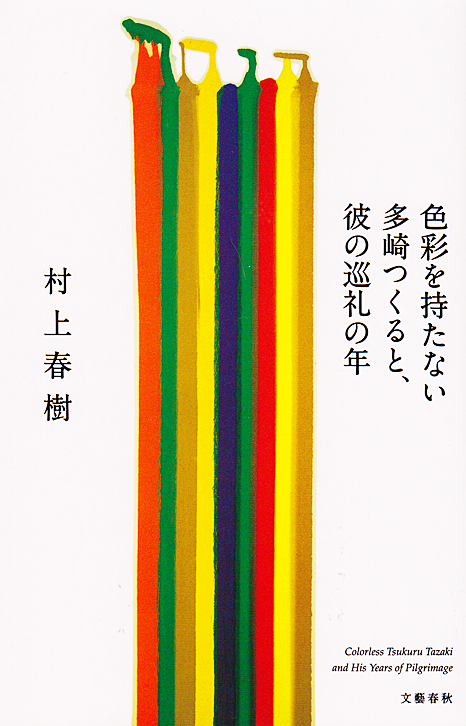
Colorless Tsukuru Tazaki and His Years of Pilgrimage

Tsukuru Tazaki

Title: Colorless Tsukuru Tazaki and His Years of Pilgrimage
Japanese Title: 色彩を持たない多崎つくると、彼の巡礼の年
(Shikisai o motanai Tazaki Tsukuru to kare no junrei no toshi)
Author: Murakami Haruki (村上 春樹)
Publisher: Bungei Shunjū
Publication Year: 2013
Pages: 370

From July to January of his second year of college, Tazaki Tsukuru was absorbed by thoughts of death. His four best friends from high school suddenly stopped talking to him, and he had no idea why. Sixteen years later, the 36-year-old Tsukuru is employed a railroad company, where he works on the design and construction of train stations. He’s single, but he has kindled a romance with a businesswoman named Sara, of whom he is quite enamored. Sara reciprocates Tsukuru’s affections, but she senses that something is holding him back from being in a fully committed relationship. She thus gives Tsukuru an ultimatum: Get rid of your emotional baggage, or I will never sleep with you again. Sara’s Lysistrata-like threat compels Tsukuru to embark on a pilgrimage that takes him across and beyond Japan to track down his friends from high school in order to figure out what happened between them and what went wrong.

Tsukuru’s friends are an interesting group, and each of them goes by a color-based nickname. Oumi Yoshio, or Ao (Blue), has an outgoing personality, and he was the captain of his rugby team in high school. As an adult, he works as a salesman at a Lexus dealership. Akamatsu Kei, or Aka (Red), is fiercely intelligent and analytical, and everyone thought he would become a university professor after he graduated from college. Instead he entered the corporate world and quickly dropped out in order to launch a consulting firm that holds management training seminars. Kurono Eri, or Kuro (Black), is quick-witted and clever and was known for her sarcastic sense humor in high school. Kuro became a potter and fell in love with a foreign student who had come to Japan to study pottery, and she now lives with him and their two daughters in Finland. Shire Yuzuki, or Shiro (White), looked like a model and had gorgeous long black hair, but she hated attention and found joy in playing piano. Unfortunately, she failed to become a concert pianist and so ended up as a private piano teacher, but her ultimate fate was even more tragic. The easygoing and unflaggingly polite Tsukuru acted as the “colorless” background against which these four could shine, and he was the invisible glue that held the group together.

The forward momentum of the first 150 pages of the novel is driven by the mystery of why Tsukuru got dumped by his friends. The first member of the former group that Tsukuru tracks down, Ao, reveals the bare facts of the answer, but this answer creates even more questions, since Tsukuru has no memory of what he was accused of doing. Moreover, what Tsukuru was accused of doing is extremely upsetting, not only to him and the other characters in the novel but to the reader as well. The accusation, as well as Tsukuru’s responsibility in the matter and the obligation his friends felt in responding to the situation, are heart-breaking and profound, and the practical and emotional complications are quite distressing. I’m sure that, when the novel is translated into English, Murakami is going to catch a lot of flak for writing such a scenario, but what he describes is extraordinarily relevant to contemporary societal debates, and the sensitivity with which his third-person narrator describes the fallout of what happened from multiple perspectives is one of the novel’s best features.

Another interesting component of the novel is the wealth of detail given to the description of each character and the interior spaces he or she occupies. The personality of each character is conveyed by his or her words, of course; but, since the narrator’s point of view is fairly limited to Tsukuru, the reader only knows what Tsukuru is doing or thinking at any given moment. The reader is thus encouraged to tease out the finer details of character through the narrator’s meticulous descriptions of clothing, hairstyle, accessories, and interior decoration. Tanaka Yasuo was strongly criticized for his endless litanies of product brand names in his novel Nantonaku, Crystal, and I imagine that it’s possible to levy the same sort of complaint against Tsukuru Tazaki, as the writing comes off as more than a bit Nantonaku-ish at times. That being said, Murakami’s method of character analysis through the intense reflection on taste and setting strikes me as less vapid and materialistic than it does as vaguely Homeric. How does the reader know that Achilles is a badass? By reading detailed descriptions of his armor. How does the reader know that Aka is a badass? By reading detailed descriptions of how he has set up his corporate office.

Aside from the brilliance of its characters, the novel also has some genuinely creepy moments to offer the reader. Many of these moments are encapsulated by Tsukuru’s relationship with his college friend Haida (whose name contains the character for “ash,” or “grey”). Haida tells Tsukuru a story about how his father once met a jazz musician named Midorigawa (whose name contains the word “green”) while working at an isolated inn in the mountains, and how Midorigawa possessed a strange ability that he may have passed on to Haida’s father. It’s a weird story, and Haida’s intentions in telling it to Tsukuru are unclear, but shortly thereafter Haida does something bizarre in an uncomfortable scene involving sleep paralysis before disappearing from Tsukuru’s life without a trace. Such scenes and stories-within-stories are not “softly haunting,” or “elegiac,” or anything fancy like that; they are genuinely creepy and upsetting. Furthermore, Haida is not the only source of surreal urban folklore in the novel – the story a subway station employee tells Tsukuru about something he found in one of the station’s bathrooms is particularly delightful.

As is the case with most Murakami novels, the deeper psychological and supernatural elements of the plot are never fully explained, but I found Tsukuru’s journey to be rewarding in and of itself, and I enjoyed reading the novel. Tsukuru Tazaki is evocative of the pains of youth and what it’s like to reconnect with people years after you’ve graduated from high school. In many ways, Murakami’s latest book feels like an answer to Norwegian Wood, the 1987 novel that first boosted the author into international literary stardom. Whereas Norwegian Wood is permeated by a nostalgic longing for the perceived potential for individual dignity made possible by a vanished youth in a vanished era, Tsukuru Tazaki is concerned with a more pragmatic strain of existentialism that seeks to justify the manner in which the passing years inevitably drain color from one’s life. If Tsukuru is indeed on a pilgrimage, it’s less of a pilgrimage to find his friends or to figure out the truth but rather an experiential process of recreating the story of his adolescence as a narrative that can properly function as a suitable prequel to a middle-aged adult life that is less of an anticlimactic ending and more of a canvas that is still waiting to be filled with color.

The Goddess Chronicle

The Goddess Chronicle

Title: The Goddess Chronicle
Japanese Title: 女神記 (Joshinki)
Author: Kirino Natsuo (桐野 夏生)
Translator: Rebecca Copeland
Publication Year: 2013 (America); 2008 (Japan)
Publisher: Canongate
Pages: 309

The protagonist of The Goddess Chronicle, Namima (“Woman-Amid-the-Waves”) lives on a small and richly vegetated island called Umihebi (“the island of sea snakes”). Umihebi is located somewhere in the island chain south of the kingdom of Yamato (i.e., Japan), and it is known throughout the Ryūkyū seas as a place where the gods come and go. The cape at the north end of the island is sacred and marked by a huge black boulder called “The Warning,” beyond which no one but the high priestess of the island may walk. On the eastern side of the island is the Kyoido (“Pure Well”), and on the western side is the Amiido (“Well of Darkness”), and only adult women are allowed to approach them. Between these landmarks grow plantain trees, banyan trees, pandan trees, and all manner of flowers. The water surrounding the island is filled with fish and sea snakes, which the island men take on their boats to trade with the people of other islands.

Namima’s grandmother, Mikura-sama, is Umihebi’s high priestess. She embodies the energies of light and life and protects the island from harm as she prays for prosperity. Because light and dark alternate, Mikura-sama’s daughter is dark, while Mikura-sama’s oldest granddaughter Kamikuu is light, thus entitling her to become the island’s next high priestess. If Kamikuu is light, then her sister Namima is dark; and so, if Kamikuu is to become then next high priestess of light and life, then Namima must become her dark counterpart, an outcast warden of darkness and death. While Kamikuu is fated to live at the top of a hill and be provided with generous quantities of nutrient-rich food as she prays to the gods and generates offspring from the seed of the young men on the island, Namima is fated to live in the shadow of a cliff, eating dregs and shunning the company of all save the corpses of the island’s dead, which she must watch decay in order to ensure that their souls pass on safely. Although Mikura-sama explains this to Kamikuu, the kind-hearted Kamikuu does not have the heart to tell her sister, so the teenaged Namima is outraged when she is hauled kicking and screaning down to a cave by the shore to take the place of Mikura-sama’s dark counterpart, who has vanished. Namima is immediately visited by her lover Mahito, the son of a family ostracized because of its matriarch’s inability to produce a female child, and the two escape the island on a small boat. Namima dies at sea, and that’s when the book really begins.

Namima, who dies with deep regret in her heart, is not allowed to move on to the world beyond death but instead finds herself in the underworld, a dark and formless landscape of unhappy souls presided over by Izanami, who is both a creator goddess and a goddess of death. Having died while giving birth to a fire god, Izanami found herself in the underworld. Her consort, Izanaki, came to retrieve her, but he was so appalled by the pollution and impurity of the underworld that he fled from his former lover and symbolically sealed the entrance to the underworld with a giant boulder. In her rage, Izanami vowed to end the lives of a thousand humans every day. In response, Izanaki vowed to erect a thousand birthing huts so that the human population would never decline.

Izanami, who has spent aeons under the earth, sees a kindred spirit in Namima and therefore draws Namima’s soul to her to act as an attendant and companion. The Goddess Chronicle is an account of how Namima rails against and finally settles into this role as she comes to understand and sympathize with Izanami’s suffering and the burden that the goddess has assumed. Over the course of her story, Namima returns to Umihebi as a tiger wasp and sees the religious and human drama of the island through the eyes of an outsider. Izanaki himself eventually enters the story and makes his own trip to Umihebi, so the reader sees the island from yet another perspective that further emphasizes how terrifying yet compelling its religious landscape and rituals are. The experiences both Namima and Izanaki have on Umihebi cause them to return to Izanami for closure and salvation.

In the end, however, there is no redemption for Izanami herself; there is only eternal hatred. I don’t want to give away certain plot developments; but, in light of these developments, it seems as if there would be so many other paths open to the goddess at the end of the novel. Moreover, although Namima can leave at any time, she decides to stay with Izanami, not as her friend or equal, but rather as the priestess of her pain. The novel ends with these lines, spoken by Namima:

I, who was once a priestess of the darkness, feel that serving here at Izanami’s side I am able to accomplish what I was unable to finish on earth. For, as I said earlier, Izanami is without a doubt a woman among women. The trials that she has borne are the trails all women must face. Revere the goddess! In the darkness of the underground palace, I secretly sing her praises.

I’m not sure if that’s a happy ending or not. So all women are united in a shared oppositional relationship to men? All women are united in their hatred, and in the fact that their destinies are shaped by the carelessness of men? Why do women have to harbor so much hatred? Why can’t men just be normal people instead of the shapers of the destinies of women? Why does there need to be an dualistic and antagonistic relationship between Woman and Man on such a deep mythical level?

In other mythological revisionist novels written from a feminist perspective, such as Margaret Atwood’s Penelopiad and Ursula Leguin’s Lavinia, there are layers of depth and meaning and subtle characterization added to mythological personages who were relatively flat in the original sources. In The Goddess Chronicle, the gods remain flat, and the human characters aren’t granted much depth either. The story told by the novel is fascinating, and the writing and translation are beautiful, but in the end there is almost no resolution or character development. Perhaps the point of the story isn’t to give human characteristics to nonhuman entities, however, but rather to provide the reader with an entryway into the conceptual geography of the existential questions religion and myth seek to address. In this latter purpose, The Goddess Chronicle succeeds spectacularly.

Kirino Natsuo is an extremely dark writer; and, while she never offers any feminist solutions to the problems she raises, she excels in bringing the reader’s attention to the sexism and hypocrisy that exist in mainstream narratives about women. By showing the reader the other side of the story, Kirino deftly illustrates the anger of the otherwise voiceless women who have been left out of most stories, but it is ultimately up to the reader to find hope in the situation and to figure out how to use her or his newfound anger to change the world for the better. In The Goddess Chronicle, Kirino encourages the reader to see one of the keystone tales of Japanese mythology from the perspective of darkness, and the perspective of those not showered with glory, and the perspective of those left behind. Such a perspective can be upsetting and frustrating, but it’s also an invitation to the reader to formulate her or his own interpretations, as well as her or his own ideas concerning the further adventures of these characters and their relevance to the modern world.

The Inugami Clan

The Inugami Clan

Title: The Inugami Clan
Japanese Title: 犬神家の一族 (Inugamike no ichizoku)
Author: Yokomizo Seishi (横溝 正史)
Translator: Yumiko Yamazaki
Publication Year: 2003 (America); 1951 (Japan)
Publisher: Stone Bridge Press
Pages: 309

Reading The Inugami Clan reminded me of sitting in my local public library as a kid in the early nineties and reading crime novels with yellowed pages and crappy covers that were always on the verge of falling off.

This novel is pure pulp. The sentences are short and declarative. The chapters are only a few pages long and always end with cliffhangers. The murders are fantastically improbable. The beautiful young female victim is always fainting. The ugly older women are pure evil. The men regularly walk around with assault weapons. The sexuality on display isn’t overt, but it’s always kinky. Someone gets murdered every five chapters. Even the paper Stone Bridge Press used for its publication of this translation has a deliciously pulpy smell. The pulp dial on this book goes up to eleven.

In other words, The Inugami Clan is both ridiculous and ridiculously entertaining.

The primary point-of-view character of the novel is Detective Kindaichi Kōsuke, an eccentric private investigator of strange appearance and stranger personal habits. (“Physically, he is a stammering, inconsequential fellow with nothing to recommend him, but his remarkable faculty for reasoning and deduction has been attested to,” the narrator says.) Because of the detective’s fame, he has been summoned to the Nasu Lake region (in Tochigi prefecture) by Wakabayashi Toyoichirō, a lawyer associated with the estate of the recently deceased Inugami Sahei, a local silk magnate. Before the lawyer arrives in Kindaich’s hotel room, however, the detective witnesses a beautiful woman going down with a sinking boat on the lake beside the hotel. This woman is Nonomiya Tamayo, who stands to inherit the entire Inugami fortune. Even though Tamayo is saved, Kindaichi returns to the hotel to find Wakabayashi dead from ingesting a poison that had been applied to the filter of one of his cigarettes. Someone is obviously out for blood, and it’s up to Kindaichi to figure out what’s going on before anyone else is killed.

Not that Kindaichi succeeds, of course. The detective’s “razor-sharp deduction skills” are no match for a long-held grudge, and the novel has plenty of time for an additional assortment of gruesome deaths. The Inugami family motto is “yoki koto kiku,” an expression that means “tidings of good fortune” but is also synonymous with the words “axe, koto, chrysanthemum” ( 斧・琴・菊 ), which is as good a set-up as any for a series of themed murders. The “axe” murder happens early on, and the reader is given the pleasure of anticipating what the “koto” and “chrysanthemum” murders will look like. It would be a shame if Kindaichi were to solve the case before the killer could complete the set, right?

Instead of pulling a “just add Sherlock” instant deduction, Kindaichi spends most of his time accompanying the family’s other lawyer, Furudate Kyōzō, to various formal meetings of the Inugami clan, which are full of drama.

It turns out that Inugami Sahei was a bit of an asshole. The man had three consorts who all lived with him, and each of these consorts bore him a daughter, each of whom in turn bore a son. Since none of these consorts was Sahei’s official wife, none of these grandsons is his official heir; and, in his will, Sahei leaves his entire fortune to Nonomiya Tamayo, provided that Tamayo marries one of his grandsons. Tamayo is the granddaughter of Nonomiya Daini, the head priest of Nasu Shrine, who took in Sahei when he was young and starving. Sahei had a very close relationship with Daini, and he had an even closer relationship with Daini’s wife, and he apparently loved Tamayo as if she were his own granddaughter. Sahei also had an (even more) illegitimate son with a much younger woman named Aonuma Kikuno (who apparently looked just like Tamayo); and, if Tamayo for some reason won’t marry one of Sahei’s other sons, then the majority of the fortune goes to this son, a man named Aonuma Shizukuma. Since both Aonuma Shizukuma and Inugami Kiyo, the oldest of Sahei’s grandsons, had problems with repatriation after the war ended, however, there are plenty of opportunities for confused identities.

As things stand, everyone has a motive to kill everyone else. It’s almost as if Sahei were trying to punish his three daughters for something – but for what? It quickly turns out that the Inugami clan is about as dysfunctional as families get, and there are plenty of family secrets for Kindaichi to uncover before he can figure out who’s trying to kill off everyone associated with Sahei’s will.

Even though most of action of the novel is generated by Sahei’s three grandsons, the three older Inugami daughters really steal the show. Inugami Matsuko, the reigning matriarch of the clan, is an especially powerful and compelling character. I can’t write too much about her without giving away the story, but let it suffice to say that she is awesome, and the social conflicts and historical crises that she represents add a layer of depth and thematic richness to the novel that it would otherwise have lacked had she been just another ugly and bitter old woman in a pulp mystery about silly murders.

I read The Inugami Clan while re-reading John Dower’s Embracing Defeat, and I found that Dower’s description of the political confusion and cultural liberation of the immediate postwar period in Japan resonated perfectly with the themes and atmosphere of Yokomizo’s novel. Dower’s chapter “Cultures of Defeat” (especially its sections on “Kasutori Culture” and the “Decadence and Authenticity”) was especially interesting in its discussions of postwar pulp magazines, the sexualization of literature, and the re-emergence of “erotic grotesque nonsense” as a mode of storytelling. As is the case with any good pulp novel, The Inugami Clan has its fair share of plot holes and obvious exaggerations, but an understanding of the book’s historical and cultural background goes a long way toward making these plot holes and exaggerations make sense. If you’re interested in classic Japanese mystery fiction, Sari Kawana’s Murder Most Modern: Detective Fiction & Japanese Culture, which was published back in 2008 by University of Minnesota Press, is an excellent cross-cultural study that’s a lot of fun to read (and, for an academic book, it’s actually fairly affordable). Even without all of the secondary literature, though, The Inugami Clan is a lot of fun to read. The novel is currently out of print, but it’s totally worth the effort to track down a copy.

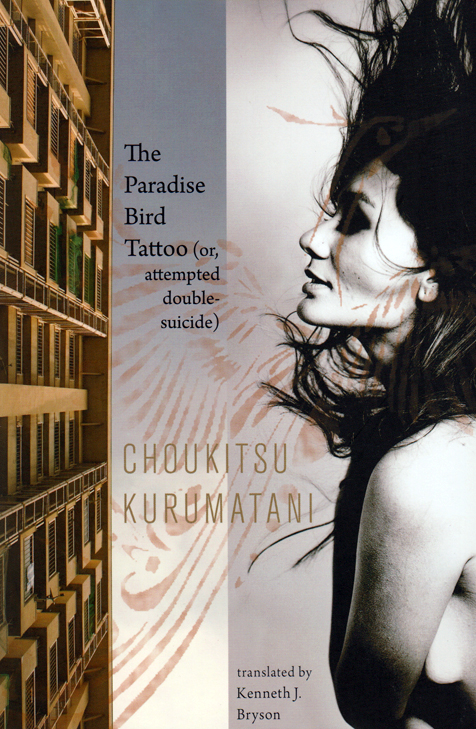
The Paradise Bird Tattoo

The Paradise Bird Tattoo

Title: The Paradise Bird Tattoo (or, Attempted Double-Suicide)
Japanese Title: 赤目四十八瀧心中未遂 (Akame Shijūyataki shinjū misui)
Author: Kurumatani Chōkitsu (車谷長吉)
Translator: Kenneth J. Bryson
Publication Year: 2010 (America), 1998 (Japan)
Publisher: Counterpoint
Pages: 225

I’m not going to lie – the first twenty pages of this book didn’t make me want to continue reading. The narrator of The Paradise Bird Tattoo, Ikushima Yoichi, is a graduate of an elite university who dropped out of society for reasons unknown, and he has all the charm of a thirty-three year old Holden Caulfield, which is to say not very much charm at all. Life sucks, he can’t get his shit together, he has no money, he goes from train station to train station with no rhyme or reason, people are disgusting, nobody likes him, he wants to assault salesgirls with scissors, and he might as well jump off a cliff.

On page twenty-one, Ikushima sits down for coffee with the woman who has agreed to temporarily employ and house him at the request of one of the narrator’s old friends. This woman, whom Ikushima refers to as “Seiko Nēsan,” owns a pub called Igaya in the Higashi-Naniwachō district of Amagasaki, an industrial suburb of Osaka located west of the Yodo River. As Seiko Nēsan tells Ikushima about how she used to be a pan-pan girl during the American occupation, the story begins to shift away from the narrator’s existential crisis and outwards to the other people who occupy the seedy little neighborhood where Ikushima now lives in a cheap backstreet apartment building.

Down the hallway is a room for by a prostitute for couplings that are oddly accompanied by what sounds like religious chanting. Across the hallway is a gruff tattoo artist named Horimayu who occasionally bursts into Ikushima’s apartment. An elementary school aged boy named Shimpei wanders around mostly unsupervised and alternately befriends and bullies Ikushima. A woman named Yi Mun-hyong, who goes by Ayako, lives in an apartment on the first floor and attracts Ikushima’s attention before entering into sexually charged yet emotionally complicated relationship with him.

As a an employee of Seiko Nēsan, Ikushima’s job is to sit in his apartment all day and skewer raw offal meat to be served later in her pub. Ikushima does so without complaining or seeking any sort of meaningful connection to the world around him, but he still ends up unwittingly getting pulled into the lives of the other people in the apartment complex and becomes trapped in relationships that he doesn’t fully understand. Seiko Nēsan asks him to retrieve a large amount of cash from the phone book in a public telephone booth, Horimayu pressures him into holding onto a mysterious sealed box, and Ayako enters his apartment one evening to have her way with him. By the second half of the book, Ikushima is way over his head into affairs about which he knows nothing.

The Paradise Bird Tattoo is a slow burning novel fueled mainly by the grungy atmosphere of the greater Osaka area of the late seventies. Ikushima’s narration contains details about his life in Amagasaki that make the book a pleasure to read. There’s a small sundries store in the same alley as Ikushima’s apartment that he doesn’t shop at because it’s too creepy for him, and the lady who runs it always gives him the evil eye from inside the store when she sees him. A group of cab drivers who spend most of the day gambling park their cars in an alley, but a woman whose house fronts the alley calls the police and has them tow all of the cars. Shimpei finds a toad and keeps it as a pet in one of the apartment drainage pipes until it dies. Seiko Nēsan comes over on a rainy day to have a beer, and she sings old Osaka folk songs rife with double entendre.

Kenneth Bryson’s tone and word choice captures the grittiness of the narrator’s style and attitude:

All I did day after day was cut up beef and pork organs and stick them on skewers. Sooner or later they would wind up in someone’s mouth, be digested inside his organs, and vanish into the toilet as excrement. I wasn’t sure what happened after that, but I assumed the reside would eventually be washed out into the ocean. It was just the same with the glamorous goods lining the shelves in the department stores and supermarkets; someday they would all become rubbish or shit. This was the essence of all human activity; this was why I could tell Seiko Nēsan in all honesty that I had no need for pleasurable pursuits.

The Paradise Bird Tattoo is a walk through the lives of people who live on the margins of society in a neighborhood that is as dangerous and desperate as those who inhabit it. Although the narrator can be a bit of a bore sometimes, the mindset that has led to his decision to abandon a middle class life is fascinating, as are the experiences he describes to the reader in full dirty detail.

The Lord of the Sands of Time

Title: The Lord of the Sands of Time
Japanese Title: 時砂の王 (Tokisuna no Ō)
Author: Ogawa Issui (小川一水)
Translator: Jim Hubbert
Publication Year: 2009 (United States); 2007 (Japan)
Publisher: Haikasoru
Pages: 196

Sometimes you get to the end of a book and wonder what just happened.

The Lord of the Sands of Time was like that for me.

Allow me to spoil the ending:

The weakness of the aliens attacking the earth is salt water.

There is also time travel involved. Androids with highly advanced artificial intelligence are sent back in time to fight seemingly mindless mechanical extraterrestrials who for some reason are bent on wiping out the human race, and it takes the best among the androids several sweeps of human history to figure out that sea water kills the aliens.

I’ll be the first to admit that premise of the novel is kind of silly, but it’s still an engrossing tale of adventure across alternate histories.

The Lord of the Sands of Time is about Orville, an android who was created on Triton, one of the last outposts of human civilization in the year 2598. Orville is one of many Messengers, who were engineered with the purpose of going back in time and saving the humanity from destruction at the metallic tentacles of an alien force from beyond the solar system, which is collectively referred to as ET.

The novel begins in Japan in the year 248, a destination at which Orville has arrived after many timestreams of trial and error. With the cooperation of Himiko, the ruler of the Kingdom of Wa, Orville tries once again to rally the human race against the ET, but the situation is dire. The ET have already overwhelmed the Asian mainland, and many of Orville’s Messenger comrades have fallen over the course of their long journey. Even worse, the ET are also capable of time travel; and, unlike the Messengers, they have the capacity to attack from space.

Every alternate chapter tells a segment of Orville’s backstory. The Messengers first came to Earth in the twenty-second century, but humanity was too busy bickering with itself to launch an effective resistance against the ET. After failing to rescue humanity in that timestream, the Messengers try again, transporting themselves to the eve of the second World War. Once again, however, humanity is too busy bickering with itself to fight the ET. The Messengers thus try again, and again, and again, their numbers decreasing as the ET use their own version of time travel to thwart them.

Although it first appears that the humans of Himiko’s timestream will also fall victim to internecine warfare and thus prove incapable of marshaling a united front against the ET, Himiko is strong willed and politically savvy enough to keep the peoples of the Japanese archipelago from killing themselves long enough to realize the full extent of the threat the ET pose. Even though Orville lends Himiko his superhuman strength and knowledge of technological advances, the outcome of this timestream seems bleak as well, and the fight will be a close one.

For the first half of the novel, tension builds steadily as Himiko deals with political machinations and Orville comes into his own as a character. The descriptions of Japan in the late Yayoi period are just as fascinating as the descriptions of the doomed yet utopian society on Triton, and Himiko’s growth as a ruler is just as compelling as Orville’s blooming love affair with Sayaka, a human woman in the Triton Defense Force, as he learns about what he is trying to protect.

Unfortunately, things begin to fall apart in the last quarter of the novel. As the narrative rushes toward its conclusion, world building and character development are neglected in favor of battle scenes. In the midst of this fighting, Orville trips and falls into bed with Himiko. This is not quite as epic as it could be. In two short paragraphs, Orville tells Himiko about Sayaka, Himiko calls Orville by his first name, Orville cries, and Himiko hugs him. There’s a page break, and then the narrative is back to talk of fighting and armies.

“From that night on, Miyo [Himiko’s personal name] and Orville shared the same bed” is about the extent of the romance between them, but Himiko undergoes a startling personality shift after she begins sleeping with Orville. She becomes a background character in her own story and spends most of her time panicked and helpless. The following “newsflash,” which has been making the rounds on Tumblr recently, states:

If a strong, independent female character falls in love, it does not automatically mean that she has lost her values or that she’s become less strong and independent, and does not necessarily change her story into an anti-feminist one. The idea that all women should fall in love and get married IS sexist, but a woman actually falling in love and getting married of her own free will is NOT sexist. Thank you and good day.

Sometimes, however, a female protagonist will fall love with a male protagonist and suddenly cease to be a protagonist at all, and that’s what happens in The Lord of the Sands of Time. Himiko is barely even fully conscious throughout the final quarter of the novel, and Orville is too busy kicking ass and taking names off camera to have any real input in the story. With the two main characters out of the picture, the novel gears up for its big reveals – what the motive of the ET is, how time travel works and doesn’t work, how the ET will be defeated – but these big reveals are rushed don’t really make any sense. The weakness of the aliens is water, the power of love plays a role in this discovery, and the aliens don’t have any real motive for attacking the earth. The time travel mechanics are especially disappointing. To be fair, time travel never makes sense, but it’s as if the author got around all the problems implicit in time travel by simply pretending that they don’t exist.

The last sixty pages of The Lord of the Sands of Time thus pass by in a flurry of tropes and battle scenes that might have worked better if they were filmed instead of written. In the novel’s defense, though, the buildup to these last sixty pages is strong enough to carry the reader all the way to the end. Sure, the love story between Orville and Himiko/Miyo never goes anywhere, and sure, this flaccid non-relationship diverts the narrative focus away from the relationships between Orville and the other Messengers (which are infinitely more interesting), but the reader is still curious to see how it all ends (and don’t worry, I didn’t spoil everything).

The Lord of the Sands of Time is not high art or epic romance, but it’s a fun novel, especially if you have a soft spot for science fiction. Jim Hubbert’s translation doesn’t call attention to itself and allows Ogawa’s prose to flow quickly and seamlessly. (In fact, I’m so impressed by the eighties American sci-fi feel of Hubbert’s translation that I’ve already ordered a copy of his other translation for Haikasoru, Hayashi Jyōji’s The Ouroboros Wave.) As much as I make fun of science fiction tropes, I can’t get enough of them, and The Lord of the Sands of Time fully satisfied my holiday craving for a sci-fi novel of manageable length to chill out with over a relaxed weekend.

Rivalry

Title: Rivalry: A Geisha’s Tale
Japanese: 腕くらべ (Ude kurabe)
Author: Nagai Kafū (永井 荷風)
Translator: Stephen Snyder
Publication Year: 2007 (America); 1917 (Japan)
Publisher: Columbia University Press
Pages: 165

Nagai Kafū is a fascinating person and an incredible writer, but, without access to the resources of a university library, it’s almost impossible to find his work in translation. Thankfully, Columbia University Press has recently released a paperback edition of Stephen Synder’s excellent translation of one of the writer’s most popular novels. Rivalry is full of rich detail and beautifully drawn characters, as well as compelling melodrama that draws the characters and setting together into a highly entertaining story.

The narrative perspective of Rivalry is split between multiple characters, but the protagonist of the story is Komayo, an aging geisha (she’s 25 years old) who married and left Tokyo to live with her husband’s family in the country. When her husband dies three years into the marriage, Komayo finds herself increasingly alienated by his family and thus returns to Tokyo, where she resumes her life as a geisha. Komayo is beautiful and highly talented in a number of traditional arts, and her goal is to secure a patron, or danna, who will buy out her contract with the house that currently employs her and help support her as she begins a career as an artist and proprietor of her own establishment in the “flower and willow world” of professional entertainers.

At the beginning of the novel, the top candidate for Komayo’s danna is a wealthy “man of affairs” named Yoshioka, who had known Komayo in his student days. Yoshioka wants to rise in the world, and he sees his patronage of the highly desirable Komayo as a means to do so. Komayo enters into a financial and sexual relationship with Yoshioka but also falls in love with Segawa, a Kabuki actor specializing in female roles. When Yoshioka learns of this relationship, his pride is so affronted that he begins to scheme at how to get back at Komayo. Meanwhile, how long can Komayo’s relationship with a fellow performer actually last?

Oh, the drama!

Rivalry is like Gossip Girl with geisha, and it is immensely entertaining to watch these beautiful people fall in and out of love and squabble with each other. The trappings of the world they occupy are just as glamorous as they are, and the reader is often given the opportunity to pass judgment on characters based on their outfits. For example, this is Komayo at the beginning of the novel:

Her hair was done in a low shimada style with an openwork, silver-covered comb and a jade hairpin. She had changed into a kimono of light crepe with a fine stripe. The effect was quite refined, but perhaps fearing that it would seem too old for her, she had added a half collar with elaborate embroidery. Her obi was made of crepe in the old-fashioned Kaga style, lined with black satin, and it was held together with a sash of light blue crepe dyed in a bold pattern. The cord word over the obi was a deep celadon green decorated in front with a large pearl. (10-11)

Obviously, such an elegant and tasteful woman should hold our sympathies. Here is Segawa at the end of the novel:

He sat casually with his legs folded to one side, as a woman would, showing a bit of the material of his underkimono, a yellow brown fabric dyed with a pattern of wheels rolling through waves that could only be a specific order from the Erien. His obi, narrow in the old style and tightly bound, was made of satin decorated with a single stripe and marked at one end with the name of the maker embroidered in red. It was most likely the work of the Hiranoya in Hama-chō. On most men, this costume would have been terribly gaudy, but for an onnagata it seemed positively inspired. (136)

What a rake! But what woman wouldn’t fall for such a handsome devil?

Komayo and her relationship with Segawa take center stage, but other characters flit in and out of the story. One of my favorite of these characters is Kikuchiyo, a geisha who is more Western than Japanese. Her sensuality isn’t expressed by her art but directly connected to her concupiscent physicality. Interestingly enough, Kikuchiyo’s ambition is to become a stage actress in the new Western-style theater productions. Also amusing are Kurayama Nansō and Yamai Kaname. Both are writers; but, while Nansō writes Edo-style novels and lives in a beautiful old Japanese house with a traditional garden, Yamai writes modern confessional novels and lives like a vagrant. The two men are friends, and their commentary and ramblings through the glitzy Asakusa neighborhood help to create critical distance from the main story while establishing the world of professional entertainers in a wider context.

It’s difficult to separate any story of geisha from discussions of sexual slavery and sexual politics. I won’t give my own opinions here, but Rivalry itself has more than enough to say concerning the paid relations between women and men, which it views from both a male and a female perspective.

For a man, the patronage of a geisha is apparently about ownership and practicality. This is how Yoshioka sees Komayo in a particularly intimate moment:

He wanted to see every detail of her expression, every inch of her body as she writhed with pleasure. He wanted to see her beg him to stop. Among all his experiences, this was the richest; among all the postures and poses he had seen in erotic prints, these were the most exotic – and he wanted to study them with his eyes wide open. (22)

This is how Yoshioka justifies his dalliance with geisha in his student days:

Rather than suppress his sexual desire only to risk shaming himself by falling under the spell of a maid or some other amateur, it was far safer to spend the money to buy a woman properly when needed. To pay for a woman and have her without undue worry to relieve his sexual tension and then pass his examinations with high marks – this was combing duty with pleasure and, he though, killing two birds with one stone. For a young man of the modern age, in whom there was no trace of the Confucian values that had shaped earlier generations, the only thing that mattered was success, reaching his goal, and he’d had neither the inclination nor the leisure to question the means that got him there. (36)

For the geisha herself, relationships with men are mostly based on practicality and careful planning, and geisha understand what they must tolerate in order to become financially self-sufficient. Here, Komayo and Hanasuke (another geisha in Komayo’s house) discuss whether Komayo should take on another steady client:

Hanasuke’s attitude was that men were fine when things were going well, but once they had a change of heart, they could be terribly cruel. This sentiment fitted nicely with Komayo’s long-standing theory that men were fickle by nature, and from that time the two women began to compare notes more frequently. Ultimately, they decided that the best plan was to put away as much as they possibly could while they still had earning power and thereby accumulate the resources that would allow them to live comfortably, perhaps running a small business of some sort, and have nothing further to do with men. (52)

Having taken on this client, a physically imposing man from Yokohama who made his fortune in the import business, Komayo must then deal with him:

The sea monster was silent, his eyes, dim with saké, passing back and forth between the enticing scene of the bed and the melancholy figure of the woman seated with her back to the lamp. Like a gourmet before an array of delicacies, he seemed unsure where to begin; but he was in no hurry, choosing instead to study the prospects carefully, determined, when the time came, to lick the carcass down to the marrow, according to some private design of his own. For her part, Komayo recoiled from those piercing eyes, and yet she knew there was no use objecting at this point. As long as she was in no real danger, no matter what happened she would quickly close her eyes and try to bring things to a conclusion as quickly as possible. (60)

Although the novel gradually shifts to the perspective of its male characters as its female characters become more embittered against each other, the author never lets his readers forget that the women who operate within the confines of the glamorous world of geisha are real human beings who are just as rational and aware of their social and economic circumstances as the men who enter into relationships with them. There is also much more variety in the female characters of Rivalry than in the novel’s male characters, and Kafū uses the attitudes and behavior of these women to subtly illustrate generation gaps and shifts cultural ideology between various understandings of “traditional” and “modern.”

Rivalry is an accessible novel that rewards multiple readings. It’s exciting and scandalous and sexy enough to read for pleasure, but it’s also intricate and detailed enough to be used in a classroom. The themes of the novel are timeless and universal, but Kafū is also able to open a window onto a different time and place with his incredible prose.

Stephen Synder’s translation of Kafū’s novel is excellent. As the above passages detailing the clothing of Komayo and Segawa demonstrate, Synder is superbly skilled at rendering even the most Japanese of descriptions and settings into natural and readable English. The one word left in italics is danna, but the translator’s six-page introduction at the beginning of the novel explains the meaning and context of this term as it relates to the pleasure districts of Tokyo during the Taishō era. Synder’s translation is an enormous improvement over the translation by Kurt Meissner and Ralph Friedrich published by Tuttle, which is currently available on the Kindle store. Even though Columbia University Press’s physical publication of Snyder’s translation is gorgeous, I wish they would release a digital edition as well.

Review copy provided by Columbia University Press

The Briefcase

Title: The Briefcase
Japanese Title: センセイの鞄 (Sensei no kaban)
Author: Kawami Hiromi (川上 弘美)
Translator: Allison Markin Powell
Year Published: 2012 (America); 2001 (Japan)
Publisher: Counterpoint
Pages: 176

Kawakami Hiromi’s novel Manazuru, translated by Michael Emmerich and published in 2010 by Counterpoint, is a strange, dreamlike story told from the perspective of an otherworldly and unreliable narrator. Manazuru is about pain and bitterness, and broken hearts and broken families.

Kawakami’s newest novel in translation, The Briefcase, is a far cry from the atmospheric surrealism of Manazuru. Its narrator, Ōmachi Tsukiko, is a single woman in her late thirties who is firmly grounded in reality. The Briefcase is about her daily life and centers around her encounters with her former Classics teacher, Matsumoto Harutsuna, whom she still refers to as “Sensei.” Two decades after graduating from high school, Tsukiko meets Sensei by chance at a neighborhood bar, and the two strike up an easy friendship. Each of the ten-page chapters in The Briefcase details an episode in this friendship, such as a trip to an outdoor market or a mushroom hunting excursion with the owner of the bar Tsukiko and Sensei frequent. Seasons change, but not much else does. Nothing particularly dramatic or unexpected happens throughout the large majority of The Briefcase, and the novel’s close attention to detail provides much of its charm.

Although it doesn’t become apparent until a little more than halfway through the novel, Tsukiko gradually develops romantic feelings for Sensei. I would love to say something along the lines of “despite the significant age difference, the relationship between Tsukiko and Sensei blossoms beautifully;” but, in reality, it’s quite awkward. Not only is the situation itself awkward, but both Tsukiko and Sensei are awkward people. They’re not charmingly awkward, or amusingly awkward, or so awkward that want to hug them – they’re just awkward. Still, the gentle progression of their relationship is entertaining in its earnestness, and Kawakami describes it from Tsukiko’s perspective with commensurate delicacy:

At some point, sitting beside Sensei, I began to notice the heat that radiated from his body. Through his starched shirt, there came a sense of Sensei. A feeling of nostalgia. This sense of Sensei retained the shape of him. It was dignified, yet tender, like Sensei. Even now, I could never quite get a holf on this sense – I would try to capture it, but the sense escaped me. Just when I thought it was gone, though, it would cozy back up to me.

The quiet normalcy of The Briefcase is satisfying in and of itself, yet there are some disturbing undercurrents running through the novel. Why is Tsukiko alone? Why is Sensei alone? What happened to him? Why does he always carry around his briefcase? These uncertainties serve to make the story more intriguing, however, and don’t escalate into a full-blown crisis until the very end of the novel, when Tsukiko undergoes a startlingly surreal experience. During two of the final chapters of the novel, Tsukiko’s feelings for Sensei, as well as her fear of his rejection, are explored in a strange sequence titled “The Tidal Flat – Dream,” which may or may not have actually happen. This chapter is a unexpected break from the regular mundane atmosphere of The Briefcase, but it pulls the novel together thematically in a creative and unexpected way.

Allison Markin Powell, who also translated Dazai Osamu’s Schoolgirl, deftly conveys the lightness and humor occasional strangeness of Kawakami’s prose. Although Powell’s English is flawless (with the possible exception of a few out-of-place Britishisms), her style of translation leaves the reader with no doubt as to the Japanese setting of the novel. Passages like…

“Yes, today is a tomobiki day. But tomorrow is a red-letter day, a konoe-tora!”

…and…

Daikon, tsumire, and beef tendons, please, Sensei ordered. Not to be outdone, I followed with Chikuwabu, konnyaku noodles, and I’ll also have some daikon. The young man next to us asked for kombu and hanpen.

…are not uncommon. It’s an interesting style of translation that emphasizes the novel’s focus on peaceful daily life in a richly detailed environment, and it’s fun to read. The culturally specific words scattered throughout the text can be largely ignored if you’re not feeling up for a hyperlinked adventure on Google, though, so they shouldn’t be distracting for the reader.

The Briefcase is a gentle and quiet novel that’s enjoyable both for its story and for its atmosphere, and it’s much more accessible than Manazuru (which is not to say that Manazuru is bad, just very weird). It’s literature that doesn’t take itself too seriously, and I very much enjoyed reading it.