The Inugami Clan

The Inugami Clan

Title: The Inugami Clan
Japanese Title: 犬神家の一族 (Inugamike no ichizoku)
Author: Yokomizo Seishi (横溝 正史)
Translator: Yumiko Yamazaki
Publication Year: 2003 (America); 1951 (Japan)
Publisher: Stone Bridge Press
Pages: 309

Reading The Inugami Clan reminded me of sitting in my local public library as a kid in the early nineties and reading crime novels with yellowed pages and crappy covers that were always on the verge of falling off.

This novel is pure pulp. The sentences are short and declarative. The chapters are only a few pages long and always end with cliffhangers. The murders are fantastically improbable. The beautiful young female victim is always fainting. The ugly older women are pure evil. The men regularly walk around with assault weapons. The sexuality on display isn’t overt, but it’s always kinky. Someone gets murdered every five chapters. Even the paper Stone Bridge Press used for its publication of this translation has a deliciously pulpy smell. The pulp dial on this book goes up to eleven.

In other words, The Inugami Clan is both ridiculous and ridiculously entertaining.

The primary point-of-view character of the novel is Detective Kindaichi Kōsuke, an eccentric private investigator of strange appearance and stranger personal habits. (“Physically, he is a stammering, inconsequential fellow with nothing to recommend him, but his remarkable faculty for reasoning and deduction has been attested to,” the narrator says.) Because of the detective’s fame, he has been summoned to the Nasu Lake region (in Tochigi prefecture) by Wakabayashi Toyoichirō, a lawyer associated with the estate of the recently deceased Inugami Sahei, a local silk magnate. Before the lawyer arrives in Kindaich’s hotel room, however, the detective witnesses a beautiful woman going down with a sinking boat on the lake beside the hotel. This woman is Nonomiya Tamayo, who stands to inherit the entire Inugami fortune. Even though Tamayo is saved, Kindaichi returns to the hotel to find Wakabayashi dead from ingesting a poison that had been applied to the filter of one of his cigarettes. Someone is obviously out for blood, and it’s up to Kindaichi to figure out what’s going on before anyone else is killed.

Not that Kindaichi succeeds, of course. The detective’s “razor-sharp deduction skills” are no match for a long-held grudge, and the novel has plenty of time for an additional assortment of gruesome deaths. The Inugami family motto is “yoki koto kiku,” an expression that means “tidings of good fortune” but is also synonymous with the words “axe, koto, chrysanthemum” ( 斧・琴・菊 ), which is as good a set-up as any for a series of themed murders. The “axe” murder happens early on, and the reader is given the pleasure of anticipating what the “koto” and “chrysanthemum” murders will look like. It would be a shame if Kindaichi were to solve the case before the killer could complete the set, right?

Instead of pulling a “just add Sherlock” instant deduction, Kindaichi spends most of his time accompanying the family’s other lawyer, Furudate Kyōzō, to various formal meetings of the Inugami clan, which are full of drama.

It turns out that Inugami Sahei was a bit of an asshole. The man had three consorts who all lived with him, and each of these consorts bore him a daughter, each of whom in turn bore a son. Since none of these consorts was Sahei’s official wife, none of these grandsons is his official heir; and, in his will, Sahei leaves his entire fortune to Nonomiya Tamayo, provided that Tamayo marries one of his grandsons. Tamayo is the granddaughter of Nonomiya Daini, the head priest of Nasu Shrine, who took in Sahei when he was young and starving. Sahei had a very close relationship with Daini, and he had an even closer relationship with Daini’s wife, and he apparently loved Tamayo as if she were his own granddaughter. Sahei also had an (even more) illegitimate son with a much younger woman named Aonuma Kikuno (who apparently looked just like Tamayo); and, if Tamayo for some reason won’t marry one of Sahei’s other sons, then the majority of the fortune goes to this son, a man named Aonuma Shizukuma. Since both Aonuma Shizukuma and Inugami Kiyo, the oldest of Sahei’s grandsons, had problems with repatriation after the war ended, however, there are plenty of opportunities for confused identities.

As things stand, everyone has a motive to kill everyone else. It’s almost as if Sahei were trying to punish his three daughters for something – but for what? It quickly turns out that the Inugami clan is about as dysfunctional as families get, and there are plenty of family secrets for Kindaichi to uncover before he can figure out who’s trying to kill off everyone associated with Sahei’s will.

Even though most of action of the novel is generated by Sahei’s three grandsons, the three older Inugami daughters really steal the show. Inugami Matsuko, the reigning matriarch of the clan, is an especially powerful and compelling character. I can’t write too much about her without giving away the story, but let it suffice to say that she is awesome, and the social conflicts and historical crises that she represents add a layer of depth and thematic richness to the novel that it would otherwise have lacked had she been just another ugly and bitter old woman in a pulp mystery about silly murders.

I read The Inugami Clan while re-reading John Dower’s Embracing Defeat, and I found that Dower’s description of the political confusion and cultural liberation of the immediate postwar period in Japan resonated perfectly with the themes and atmosphere of Yokomizo’s novel. Dower’s chapter “Cultures of Defeat” (especially its sections on “Kasutori Culture” and the “Decadence and Authenticity”) was especially interesting in its discussions of postwar pulp magazines, the sexualization of literature, and the re-emergence of “erotic grotesque nonsense” as a mode of storytelling. As is the case with any good pulp novel, The Inugami Clan has its fair share of plot holes and obvious exaggerations, but an understanding of the book’s historical and cultural background goes a long way toward making these plot holes and exaggerations make sense. If you’re interested in classic Japanese mystery fiction, Sari Kawana’s Murder Most Modern: Detective Fiction & Japanese Culture, which was published back in 2008 by University of Minnesota Press, is an excellent cross-cultural study that’s a lot of fun to read (and, for an academic book, it’s actually fairly affordable). Even without all of the secondary literature, though, The Inugami Clan is a lot of fun to read. The novel is currently out of print, but it’s totally worth the effort to track down a copy.

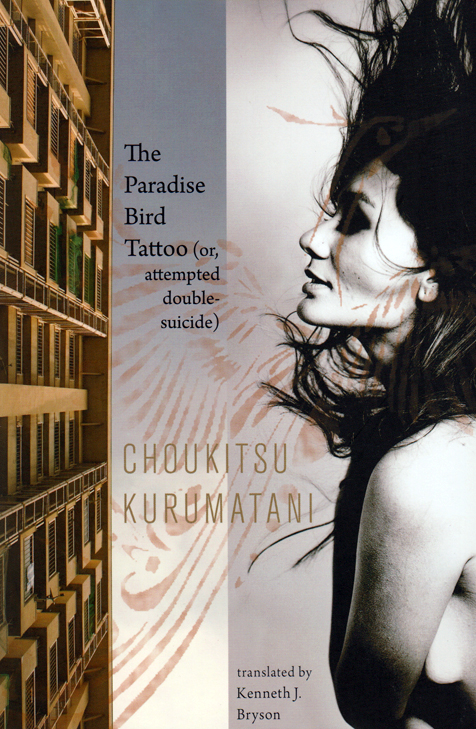
The Paradise Bird Tattoo

The Paradise Bird Tattoo

Title: The Paradise Bird Tattoo (or, Attempted Double-Suicide)
Japanese Title: 赤目四十八瀧心中未遂 (Akame Shijūyataki shinjū misui)
Author: Kurumatani Chōkitsu (車谷長吉)
Translator: Kenneth J. Bryson
Publication Year: 2010 (America), 1998 (Japan)
Publisher: Counterpoint
Pages: 225

I’m not going to lie – the first twenty pages of this book didn’t make me want to continue reading. The narrator of The Paradise Bird Tattoo, Ikushima Yoichi, is a graduate of an elite university who dropped out of society for reasons unknown, and he has all the charm of a thirty-three year old Holden Caulfield, which is to say not very much charm at all. Life sucks, he can’t get his shit together, he has no money, he goes from train station to train station with no rhyme or reason, people are disgusting, nobody likes him, he wants to assault salesgirls with scissors, and he might as well jump off a cliff.

On page twenty-one, Ikushima sits down for coffee with the woman who has agreed to temporarily employ and house him at the request of one of the narrator’s old friends. This woman, whom Ikushima refers to as “Seiko Nēsan,” owns a pub called Igaya in the Higashi-Naniwachō district of Amagasaki, an industrial suburb of Osaka located west of the Yodo River. As Seiko Nēsan tells Ikushima about how she used to be a pan-pan girl during the American occupation, the story begins to shift away from the narrator’s existential crisis and outwards to the other people who occupy the seedy little neighborhood where Ikushima now lives in a cheap backstreet apartment building.

Down the hallway is a room for by a prostitute for couplings that are oddly accompanied by what sounds like religious chanting. Across the hallway is a gruff tattoo artist named Horimayu who occasionally bursts into Ikushima’s apartment. An elementary school aged boy named Shimpei wanders around mostly unsupervised and alternately befriends and bullies Ikushima. A woman named Yi Mun-hyong, who goes by Ayako, lives in an apartment on the first floor and attracts Ikushima’s attention before entering into sexually charged yet emotionally complicated relationship with him.

As a an employee of Seiko Nēsan, Ikushima’s job is to sit in his apartment all day and skewer raw offal meat to be served later in her pub. Ikushima does so without complaining or seeking any sort of meaningful connection to the world around him, but he still ends up unwittingly getting pulled into the lives of the other people in the apartment complex and becomes trapped in relationships that he doesn’t fully understand. Seiko Nēsan asks him to retrieve a large amount of cash from the phone book in a public telephone booth, Horimayu pressures him into holding onto a mysterious sealed box, and Ayako enters his apartment one evening to have her way with him. By the second half of the book, Ikushima is way over his head into affairs about which he knows nothing.

The Paradise Bird Tattoo is a slow burning novel fueled mainly by the grungy atmosphere of the greater Osaka area of the late seventies. Ikushima’s narration contains details about his life in Amagasaki that make the book a pleasure to read. There’s a small sundries store in the same alley as Ikushima’s apartment that he doesn’t shop at because it’s too creepy for him, and the lady who runs it always gives him the evil eye from inside the store when she sees him. A group of cab drivers who spend most of the day gambling park their cars in an alley, but a woman whose house fronts the alley calls the police and has them tow all of the cars. Shimpei finds a toad and keeps it as a pet in one of the apartment drainage pipes until it dies. Seiko Nēsan comes over on a rainy day to have a beer, and she sings old Osaka folk songs rife with double entendre.

Kenneth Bryson’s tone and word choice captures the grittiness of the narrator’s style and attitude:

All I did day after day was cut up beef and pork organs and stick them on skewers. Sooner or later they would wind up in someone’s mouth, be digested inside his organs, and vanish into the toilet as excrement. I wasn’t sure what happened after that, but I assumed the reside would eventually be washed out into the ocean. It was just the same with the glamorous goods lining the shelves in the department stores and supermarkets; someday they would all become rubbish or shit. This was the essence of all human activity; this was why I could tell Seiko Nēsan in all honesty that I had no need for pleasurable pursuits.

The Paradise Bird Tattoo is a walk through the lives of people who live on the margins of society in a neighborhood that is as dangerous and desperate as those who inhabit it. Although the narrator can be a bit of a bore sometimes, the mindset that has led to his decision to abandon a middle class life is fascinating, as are the experiences he describes to the reader in full dirty detail.

The Lord of the Sands of Time

Title: The Lord of the Sands of Time
Japanese Title: 時砂の王 (Tokisuna no Ō)
Author: Ogawa Issui (小川一水)
Translator: Jim Hubbert
Publication Year: 2009 (United States); 2007 (Japan)
Publisher: Haikasoru
Pages: 196

Sometimes you get to the end of a book and wonder what just happened.

The Lord of the Sands of Time was like that for me.

Allow me to spoil the ending:

The weakness of the aliens attacking the earth is salt water.

There is also time travel involved. Androids with highly advanced artificial intelligence are sent back in time to fight seemingly mindless mechanical extraterrestrials who for some reason are bent on wiping out the human race, and it takes the best among the androids several sweeps of human history to figure out that sea water kills the aliens.

I’ll be the first to admit that premise of the novel is kind of silly, but it’s still an engrossing tale of adventure across alternate histories.

The Lord of the Sands of Time is about Orville, an android who was created on Triton, one of the last outposts of human civilization in the year 2598. Orville is one of many Messengers, who were engineered with the purpose of going back in time and saving the humanity from destruction at the metallic tentacles of an alien force from beyond the solar system, which is collectively referred to as ET.

The novel begins in Japan in the year 248, a destination at which Orville has arrived after many timestreams of trial and error. With the cooperation of Himiko, the ruler of the Kingdom of Wa, Orville tries once again to rally the human race against the ET, but the situation is dire. The ET have already overwhelmed the Asian mainland, and many of Orville’s Messenger comrades have fallen over the course of their long journey. Even worse, the ET are also capable of time travel; and, unlike the Messengers, they have the capacity to attack from space.

Every alternate chapter tells a segment of Orville’s backstory. The Messengers first came to Earth in the twenty-second century, but humanity was too busy bickering with itself to launch an effective resistance against the ET. After failing to rescue humanity in that timestream, the Messengers try again, transporting themselves to the eve of the second World War. Once again, however, humanity is too busy bickering with itself to fight the ET. The Messengers thus try again, and again, and again, their numbers decreasing as the ET use their own version of time travel to thwart them.

Although it first appears that the humans of Himiko’s timestream will also fall victim to internecine warfare and thus prove incapable of marshaling a united front against the ET, Himiko is strong willed and politically savvy enough to keep the peoples of the Japanese archipelago from killing themselves long enough to realize the full extent of the threat the ET pose. Even though Orville lends Himiko his superhuman strength and knowledge of technological advances, the outcome of this timestream seems bleak as well, and the fight will be a close one.

For the first half of the novel, tension builds steadily as Himiko deals with political machinations and Orville comes into his own as a character. The descriptions of Japan in the late Yayoi period are just as fascinating as the descriptions of the doomed yet utopian society on Triton, and Himiko’s growth as a ruler is just as compelling as Orville’s blooming love affair with Sayaka, a human woman in the Triton Defense Force, as he learns about what he is trying to protect.

Unfortunately, things begin to fall apart in the last quarter of the novel. As the narrative rushes toward its conclusion, world building and character development are neglected in favor of battle scenes. In the midst of this fighting, Orville trips and falls into bed with Himiko. This is not quite as epic as it could be. In two short paragraphs, Orville tells Himiko about Sayaka, Himiko calls Orville by his first name, Orville cries, and Himiko hugs him. There’s a page break, and then the narrative is back to talk of fighting and armies.

“From that night on, Miyo [Himiko’s personal name] and Orville shared the same bed” is about the extent of the romance between them, but Himiko undergoes a startling personality shift after she begins sleeping with Orville. She becomes a background character in her own story and spends most of her time panicked and helpless. The following “newsflash,” which has been making the rounds on Tumblr recently, states:

If a strong, independent female character falls in love, it does not automatically mean that she has lost her values or that she’s become less strong and independent, and does not necessarily change her story into an anti-feminist one. The idea that all women should fall in love and get married IS sexist, but a woman actually falling in love and getting married of her own free will is NOT sexist. Thank you and good day.

Sometimes, however, a female protagonist will fall love with a male protagonist and suddenly cease to be a protagonist at all, and that’s what happens in The Lord of the Sands of Time. Himiko is barely even fully conscious throughout the final quarter of the novel, and Orville is too busy kicking ass and taking names off camera to have any real input in the story. With the two main characters out of the picture, the novel gears up for its big reveals – what the motive of the ET is, how time travel works and doesn’t work, how the ET will be defeated – but these big reveals are rushed don’t really make any sense. The weakness of the aliens is water, the power of love plays a role in this discovery, and the aliens don’t have any real motive for attacking the earth. The time travel mechanics are especially disappointing. To be fair, time travel never makes sense, but it’s as if the author got around all the problems implicit in time travel by simply pretending that they don’t exist.

The last sixty pages of The Lord of the Sands of Time thus pass by in a flurry of tropes and battle scenes that might have worked better if they were filmed instead of written. In the novel’s defense, though, the buildup to these last sixty pages is strong enough to carry the reader all the way to the end. Sure, the love story between Orville and Himiko/Miyo never goes anywhere, and sure, this flaccid non-relationship diverts the narrative focus away from the relationships between Orville and the other Messengers (which are infinitely more interesting), but the reader is still curious to see how it all ends (and don’t worry, I didn’t spoil everything).

The Lord of the Sands of Time is not high art or epic romance, but it’s a fun novel, especially if you have a soft spot for science fiction. Jim Hubbert’s translation doesn’t call attention to itself and allows Ogawa’s prose to flow quickly and seamlessly. (In fact, I’m so impressed by the eighties American sci-fi feel of Hubbert’s translation that I’ve already ordered a copy of his other translation for Haikasoru, Hayashi Jyōji’s The Ouroboros Wave.) As much as I make fun of science fiction tropes, I can’t get enough of them, and The Lord of the Sands of Time fully satisfied my holiday craving for a sci-fi novel of manageable length to chill out with over a relaxed weekend.

Rivalry

Title: Rivalry: A Geisha’s Tale
Japanese: 腕くらべ (Ude kurabe)
Author: Nagai Kafū (永井 荷風)
Translator: Stephen Snyder
Publication Year: 2007 (America); 1917 (Japan)
Publisher: Columbia University Press
Pages: 165

Nagai Kafū is a fascinating person and an incredible writer, but, without access to the resources of a university library, it’s almost impossible to find his work in translation. Thankfully, Columbia University Press has recently released a paperback edition of Stephen Synder’s excellent translation of one of the writer’s most popular novels. Rivalry is full of rich detail and beautifully drawn characters, as well as compelling melodrama that draws the characters and setting together into a highly entertaining story.

The narrative perspective of Rivalry is split between multiple characters, but the protagonist of the story is Komayo, an aging geisha (she’s 25 years old) who married and left Tokyo to live with her husband’s family in the country. When her husband dies three years into the marriage, Komayo finds herself increasingly alienated by his family and thus returns to Tokyo, where she resumes her life as a geisha. Komayo is beautiful and highly talented in a number of traditional arts, and her goal is to secure a patron, or danna, who will buy out her contract with the house that currently employs her and help support her as she begins a career as an artist and proprietor of her own establishment in the “flower and willow world” of professional entertainers.

At the beginning of the novel, the top candidate for Komayo’s danna is a wealthy “man of affairs” named Yoshioka, who had known Komayo in his student days. Yoshioka wants to rise in the world, and he sees his patronage of the highly desirable Komayo as a means to do so. Komayo enters into a financial and sexual relationship with Yoshioka but also falls in love with Segawa, a Kabuki actor specializing in female roles. When Yoshioka learns of this relationship, his pride is so affronted that he begins to scheme at how to get back at Komayo. Meanwhile, how long can Komayo’s relationship with a fellow performer actually last?

Oh, the drama!

Rivalry is like Gossip Girl with geisha, and it is immensely entertaining to watch these beautiful people fall in and out of love and squabble with each other. The trappings of the world they occupy are just as glamorous as they are, and the reader is often given the opportunity to pass judgment on characters based on their outfits. For example, this is Komayo at the beginning of the novel:

Her hair was done in a low shimada style with an openwork, silver-covered comb and a jade hairpin. She had changed into a kimono of light crepe with a fine stripe. The effect was quite refined, but perhaps fearing that it would seem too old for her, she had added a half collar with elaborate embroidery. Her obi was made of crepe in the old-fashioned Kaga style, lined with black satin, and it was held together with a sash of light blue crepe dyed in a bold pattern. The cord word over the obi was a deep celadon green decorated in front with a large pearl. (10-11)

Obviously, such an elegant and tasteful woman should hold our sympathies. Here is Segawa at the end of the novel:

He sat casually with his legs folded to one side, as a woman would, showing a bit of the material of his underkimono, a yellow brown fabric dyed with a pattern of wheels rolling through waves that could only be a specific order from the Erien. His obi, narrow in the old style and tightly bound, was made of satin decorated with a single stripe and marked at one end with the name of the maker embroidered in red. It was most likely the work of the Hiranoya in Hama-chō. On most men, this costume would have been terribly gaudy, but for an onnagata it seemed positively inspired. (136)

What a rake! But what woman wouldn’t fall for such a handsome devil?

Komayo and her relationship with Segawa take center stage, but other characters flit in and out of the story. One of my favorite of these characters is Kikuchiyo, a geisha who is more Western than Japanese. Her sensuality isn’t expressed by her art but directly connected to her concupiscent physicality. Interestingly enough, Kikuchiyo’s ambition is to become a stage actress in the new Western-style theater productions. Also amusing are Kurayama Nansō and Yamai Kaname. Both are writers; but, while Nansō writes Edo-style novels and lives in a beautiful old Japanese house with a traditional garden, Yamai writes modern confessional novels and lives like a vagrant. The two men are friends, and their commentary and ramblings through the glitzy Asakusa neighborhood help to create critical distance from the main story while establishing the world of professional entertainers in a wider context.

It’s difficult to separate any story of geisha from discussions of sexual slavery and sexual politics. I won’t give my own opinions here, but Rivalry itself has more than enough to say concerning the paid relations between women and men, which it views from both a male and a female perspective.

For a man, the patronage of a geisha is apparently about ownership and practicality. This is how Yoshioka sees Komayo in a particularly intimate moment:

He wanted to see every detail of her expression, every inch of her body as she writhed with pleasure. He wanted to see her beg him to stop. Among all his experiences, this was the richest; among all the postures and poses he had seen in erotic prints, these were the most exotic – and he wanted to study them with his eyes wide open. (22)

This is how Yoshioka justifies his dalliance with geisha in his student days:

Rather than suppress his sexual desire only to risk shaming himself by falling under the spell of a maid or some other amateur, it was far safer to spend the money to buy a woman properly when needed. To pay for a woman and have her without undue worry to relieve his sexual tension and then pass his examinations with high marks – this was combing duty with pleasure and, he though, killing two birds with one stone. For a young man of the modern age, in whom there was no trace of the Confucian values that had shaped earlier generations, the only thing that mattered was success, reaching his goal, and he’d had neither the inclination nor the leisure to question the means that got him there. (36)

For the geisha herself, relationships with men are mostly based on practicality and careful planning, and geisha understand what they must tolerate in order to become financially self-sufficient. Here, Komayo and Hanasuke (another geisha in Komayo’s house) discuss whether Komayo should take on another steady client:

Hanasuke’s attitude was that men were fine when things were going well, but once they had a change of heart, they could be terribly cruel. This sentiment fitted nicely with Komayo’s long-standing theory that men were fickle by nature, and from that time the two women began to compare notes more frequently. Ultimately, they decided that the best plan was to put away as much as they possibly could while they still had earning power and thereby accumulate the resources that would allow them to live comfortably, perhaps running a small business of some sort, and have nothing further to do with men. (52)

Having taken on this client, a physically imposing man from Yokohama who made his fortune in the import business, Komayo must then deal with him:

The sea monster was silent, his eyes, dim with saké, passing back and forth between the enticing scene of the bed and the melancholy figure of the woman seated with her back to the lamp. Like a gourmet before an array of delicacies, he seemed unsure where to begin; but he was in no hurry, choosing instead to study the prospects carefully, determined, when the time came, to lick the carcass down to the marrow, according to some private design of his own. For her part, Komayo recoiled from those piercing eyes, and yet she knew there was no use objecting at this point. As long as she was in no real danger, no matter what happened she would quickly close her eyes and try to bring things to a conclusion as quickly as possible. (60)

Although the novel gradually shifts to the perspective of its male characters as its female characters become more embittered against each other, the author never lets his readers forget that the women who operate within the confines of the glamorous world of geisha are real human beings who are just as rational and aware of their social and economic circumstances as the men who enter into relationships with them. There is also much more variety in the female characters of Rivalry than in the novel’s male characters, and Kafū uses the attitudes and behavior of these women to subtly illustrate generation gaps and shifts cultural ideology between various understandings of “traditional” and “modern.”

Rivalry is an accessible novel that rewards multiple readings. It’s exciting and scandalous and sexy enough to read for pleasure, but it’s also intricate and detailed enough to be used in a classroom. The themes of the novel are timeless and universal, but Kafū is also able to open a window onto a different time and place with his incredible prose.

Stephen Synder’s translation of Kafū’s novel is excellent. As the above passages detailing the clothing of Komayo and Segawa demonstrate, Synder is superbly skilled at rendering even the most Japanese of descriptions and settings into natural and readable English. The one word left in italics is danna, but the translator’s six-page introduction at the beginning of the novel explains the meaning and context of this term as it relates to the pleasure districts of Tokyo during the Taishō era. Synder’s translation is an enormous improvement over the translation by Kurt Meissner and Ralph Friedrich published by Tuttle, which is currently available on the Kindle store. Even though Columbia University Press’s physical publication of Snyder’s translation is gorgeous, I wish they would release a digital edition as well.

Review copy provided by Columbia University Press

The Briefcase

Title: The Briefcase
Japanese Title: センセイの鞄 (Sensei no kaban)
Author: Kawami Hiromi (川上 弘美)
Translator: Allison Markin Powell
Year Published: 2012 (America); 2001 (Japan)
Publisher: Counterpoint
Pages: 176

Kawakami Hiromi’s novel Manazuru, translated by Michael Emmerich and published in 2010 by Counterpoint, is a strange, dreamlike story told from the perspective of an otherworldly and unreliable narrator. Manazuru is about pain and bitterness, and broken hearts and broken families.

Kawakami’s newest novel in translation, The Briefcase, is a far cry from the atmospheric surrealism of Manazuru. Its narrator, Ōmachi Tsukiko, is a single woman in her late thirties who is firmly grounded in reality. The Briefcase is about her daily life and centers around her encounters with her former Classics teacher, Matsumoto Harutsuna, whom she still refers to as “Sensei.” Two decades after graduating from high school, Tsukiko meets Sensei by chance at a neighborhood bar, and the two strike up an easy friendship. Each of the ten-page chapters in The Briefcase details an episode in this friendship, such as a trip to an outdoor market or a mushroom hunting excursion with the owner of the bar Tsukiko and Sensei frequent. Seasons change, but not much else does. Nothing particularly dramatic or unexpected happens throughout the large majority of The Briefcase, and the novel’s close attention to detail provides much of its charm.

Although it doesn’t become apparent until a little more than halfway through the novel, Tsukiko gradually develops romantic feelings for Sensei. I would love to say something along the lines of “despite the significant age difference, the relationship between Tsukiko and Sensei blossoms beautifully;” but, in reality, it’s quite awkward. Not only is the situation itself awkward, but both Tsukiko and Sensei are awkward people. They’re not charmingly awkward, or amusingly awkward, or so awkward that want to hug them – they’re just awkward. Still, the gentle progression of their relationship is entertaining in its earnestness, and Kawakami describes it from Tsukiko’s perspective with commensurate delicacy:

At some point, sitting beside Sensei, I began to notice the heat that radiated from his body. Through his starched shirt, there came a sense of Sensei. A feeling of nostalgia. This sense of Sensei retained the shape of him. It was dignified, yet tender, like Sensei. Even now, I could never quite get a holf on this sense – I would try to capture it, but the sense escaped me. Just when I thought it was gone, though, it would cozy back up to me.

The quiet normalcy of The Briefcase is satisfying in and of itself, yet there are some disturbing undercurrents running through the novel. Why is Tsukiko alone? Why is Sensei alone? What happened to him? Why does he always carry around his briefcase? These uncertainties serve to make the story more intriguing, however, and don’t escalate into a full-blown crisis until the very end of the novel, when Tsukiko undergoes a startlingly surreal experience. During two of the final chapters of the novel, Tsukiko’s feelings for Sensei, as well as her fear of his rejection, are explored in a strange sequence titled “The Tidal Flat – Dream,” which may or may not have actually happen. This chapter is a unexpected break from the regular mundane atmosphere of The Briefcase, but it pulls the novel together thematically in a creative and unexpected way.

Allison Markin Powell, who also translated Dazai Osamu’s Schoolgirl, deftly conveys the lightness and humor occasional strangeness of Kawakami’s prose. Although Powell’s English is flawless (with the possible exception of a few out-of-place Britishisms), her style of translation leaves the reader with no doubt as to the Japanese setting of the novel. Passages like…

“Yes, today is a tomobiki day. But tomorrow is a red-letter day, a konoe-tora!”

…and…

Daikon, tsumire, and beef tendons, please, Sensei ordered. Not to be outdone, I followed with Chikuwabu, konnyaku noodles, and I’ll also have some daikon. The young man next to us asked for kombu and hanpen.

…are not uncommon. It’s an interesting style of translation that emphasizes the novel’s focus on peaceful daily life in a richly detailed environment, and it’s fun to read. The culturally specific words scattered throughout the text can be largely ignored if you’re not feeling up for a hyperlinked adventure on Google, though, so they shouldn’t be distracting for the reader.

The Briefcase is a gentle and quiet novel that’s enjoyable both for its story and for its atmosphere, and it’s much more accessible than Manazuru (which is not to say that Manazuru is bad, just very weird). It’s literature that doesn’t take itself too seriously, and I very much enjoyed reading it.

Villain

Title: Villain
Japanese Title: 悪人 (Akunin)
Author: Yoshida Shūichi (吉田 修一)
Translator: Philip Gabriel
Year Published: 2010 (Britain); 2007 (Japan)
Publisher: Pantheon Books
Pages: 296

Yoshida Shūichi’s Villain is not a classy novel. It’s got sex scenes, murder scenes, chase scenes, masturbation scenes, scenes of mothers abandoning their children, scenes of fathers crying over their dead daughters in the rain, scenes of catty girls, and scenes of men and women being obnoxious to each other. It’s got poison love, pathetic love, tragic love, and codependent love built on unfulfilled ideals. It’s the most unapologetically pulpy book I’ve read recently, and I very much enjoyed reading it.

Villain is the story of the murder of Ishibashi Yoshino, a graduate of a junior college who worked as an insurance saleswoman and lived in her company’s dorms in Fukuoka City. Yoshino had been involved in online dating and had occasionally taken on clients as an amateur prostitute. When her dead body is found dumped alongside a highway running between Fukuoka and Saga prefectures, an investigation opens in search of the person who strangled her and left her on the side of the mountain underneath a lonely highway pass.

The novel is less concerned with the police and their investigation than it is with the social and emotional ripples that spread from Yoshino’s death. Villain jumps between the various people who end up becoming involved, no matter how tangentially. There is Yoshino’s friend Sari, a virgin who tells lies about having dated a certain boy in high school. Yoshino’s friend Mako is chubby and good-natured and profoundly gullible. Yoshino had lied to her friends that she was dating a business major and named Masuo Keigo, a playboy who has dropped out of college in all but name. Yoshino’s dad is a deadbeat who runs a barbershop outside of JR Kurume Station that is slowly going out of business. Shimizu Yuichi is a construction worker from Nagasaki who drives a flashy car and was one of Yoshino’s johns. Yuichi has a grandmother named Fusae, who is hassled by thugs, and an uncle named Norio, who is also Yuichi’s tough-guy boss. Yuichi ends up running away with a woman named Mitsuyo, who has reached thirty without marrying and works a crappy job in a crappy department store in a crappy suburb. There are also a handful of other characters who only appear briefly, such as Keigo’s dippy friend Koki and Mitsuyo’s spinster sister Tamayo.

The thread connecting these characters is that they are all pathetic sadsacks who are weak, petty, stupid, gross, and despicable. The forward momentum of Villain isn’t created by plot or mystery but rather by the reader’s compulsion to see just how nasty the novel’s characters can become. Over the course of the book, the author delves deeper and deeper into the individual, familial, and social dysfunction that makes up the world in which Ishibashi Yoshino lived. Villain is like a long, glorious train wreck in which terrible personalities are compounded by idiotic lies that are in turn compounded by bad decisions. The sheer maliciousness of this novel must be read to be believed.

The Japanese setting of the story, and in particular the geography of the Kansai area, constitutes a significant portion of its meaning and appeal, and I’m sure that an astute observer can find all manner of trenchant social commentary embedded in the novel. In the end, though, Villain is an engaging psychological thriller. It doesn’t take itself too seriously, and it’s great guilty pleasure reading for people who find the more unpleasant side of human nature amusing rather than upsetting.

1Q84

Title: 1Q84
Author: Murakami Haruki (村上 春樹)
Translators: Jay Rubin and Philip Gabriel
Publication Year: 2011 (America); 2009-2010 (Japan)
Publisher: Knopf
Pages: 944

This review contains mild spoilers. Some might argue that warning for spoilers is missing the point, but I think that gradually figuring out what’s going on in this novel is one of the main pleasures of reading it. With that in mind, allow me to summarize the conclusion of my review for anyone trying to decide whether or not to start reading: 1Q84 is an engrossing book, and you more than likely won’t be able to separate yourself from it once you begin. It might be a good idea to save it for when you anticipate having lots of time on your hands. However, if you’ve read Murakami’s work before and don’t particularly like it, this book won’t turn you into a fan. The novel contains several graphic depictions of rape and child abuse. If you imagine that such descriptions might function as triggers, consider yourself warned for both the novel and this review.

IQ84 is about Kawana Tengo, a would-be writer who pays the bills by working as a math teacher at a cram school, and Aomame Masami, a semi-professional assassin who pays the bills by working as a personal trainer at a private gym. Tengo’s story kicks off when his literary agent, an eccentric editor named Komatsu Yuji, drafts him into rewriting a fantasy novella called “Air Chrysalis” written by a seventeen-year-old named Fukada Eriko. Fuka-Eri, as she calls herself, is a beautiful yet incommunicative girl who claims to have actually experienced the things she’s written about. When Tengo meets Fuka-Eri’s guardian, a retired academic named Ebisuno, the man explains that the girl’s biological father had founded a politically radical farming commune called Sakigake that has since reshaped itself into a religious compound closed to the outside world. Unfortunately for Tengo, when Fuka-Eri’s novella is published and becomes a bestseller, Sakigake takes notice. Meanwhile, Aomame works with an older woman referred to as “the Dowager,” who runs a battered women’s shelter called The Willow House. When no other recourse can free the women who take refuge there, the Dowager calls on Aomame to assassinate the men who have made their lives hell. The Dowager ends up rescuing a girl who has been horribly abused by the leader of Sakigake, and she requests that Aomame perform a job so dangerous that it may well be her last – the assassination of this powerful religious figure.

Alternate chapters are told from Aomame and Tengo’s perspectives, and their stories gradually become interwoven even though they never meet or interact with each other. They knew each other briefly as children, however, and it turns out that their bond runs deeper than mere casual coincidence. As the novel progresses, other characters with connections to Aomane and Tengo are introduced, such as Tengo’s strict and conservative father, Aomame’s gentle but romantically unlucky childhood friend Yasuda Kyoko, the Dowager’s personal bodyguard Tamaru Kenichi, an under-the-law private investigator named Ushikawa Toshiharu, and a diabolically relentless NHK fee collector. All of these secondary characters are interesting enough to be the protagonists of their own novels, and their stories and conflicts and motivations are just as engaging as those of Tengo and Aomame.

The novel is divided into three books, which are each characterized by distinctive plot developments and themes.

In the first book, Tengo meets Fuka-Eri. As he edits her novella, he learns more about and is drawn into the strange world she represents. Meanwhile, Aomame accidentally travels from 1984 into an alternate reality (in which two moons hang in the sky) that she calls 1Q84. As she attempts to figure out what happened to her, the reader learns about her daily life and her relationship with the Dowager. This first book is overtly political in its attitude concerning such issues as protest movements, new religions, publicly sanctioned sexism, and the business of literary publishing.

In the second book, both Tengo and Aomame are plunged headlong into the strange business with the Sakigake group. Even as the two characters are thrust forward into an uncertain future, the reader learns more about their pasts and the experiences they had as children. The second book seems primarily concerned with the unknowability of large swaths of reality and the challenges facing moral judgment and action in the face of absurdity. In my mind, this was the most “Murakami-esque” section of the book in that it revisited many of the themes and narrative devices present in the writer’s earlier work.

The third book concerns the aftermath of Aomame’s involvement in the Sakigake affair. Aomame has gone into hiding, and Tengo leaves Tokyo to tend to his catatonic father. Despite their adverse circumstances, the two have begun searching for each other. A chillingly aggressive NHK fee collector threatens Tengo’s neighborhood, and the private investigator Ushikawa stakes out Tengo’s apartment as Fuka-Eri comes and goes. The themes of the third book are fate and love or, more appropriately, the denial of coincidence and the belief that even the most tenuous bonds between people can be extraordinarily powerful. Because of its sentimentality, and because of the way in which the multiple pieces of the complicated plot all begin to fit together, I almost felt as if I were reading a Stephen King novel at certain points towards the end of 1Q84.

“Reading a Stephen King” novel is not necessarily a bad thing, however. One of the aspects of King’s writing that I admire most is his ability to get into the heads of even the most loathsome characters, and one of the most surprising and interesting developments of the third book is that the reader is now offered chapters from Ushikawa’s perspective. While Tengo and Aomame are being irrationally idealistic and swooning over their memories of each other, Ushikawa adds humor, realism, and a sense of tragedy to the novel’s conclusion. As he describes himself:

Maybe I am just an ugly, middle-aged, outdated man, Ushikawa thought. Nope, no maybes about it. I am, without a doubt, one ugly, middle-aged, outdated man. But I do have a couple of talents nobody else has. And as long as I have these talents, no matter what weird world I find myself in, I’ll survive.

But will he really survive if the happiness of the protagonists depends on him not surviving? Ushikawa keeps the novel from becoming too cut-and-dry towards its inevitable conclusion, and I felt that his sections allowed the reader to see the world of 1Q84 from the perspective of a true outsider.

Although 1Q84 is set in a time when most people went about their lives without knowing that computers existed, the novel clearly reflects the concerns of the digital age. Like George Orwell’s 1984, 1Q84 handles issues of identity formation and information control in a world that is unstable and confusing under its placid surface. Cult leaders, lines of power, rapidly shifting worldviews, and the creation and co-existence of multiple histories all factor into the novel, which ultimately questions what sort of agency an individual can have in an environment silently controlled by invisible systems. The subjective viewpoints of Aomame, Tengo, and Ushikawa allow the reader to approach this problem from different angles, and Murakami himself never seems to align his novel with any one political or philosophical perspective. Like Orwell, Murakami also exploits the dark humor implicit in any dystopian situation. For example, the NHK fee collector, who might be seen as a direct allegorical representative of Japanese postwar social control, is just as comic as he is frightening. When he positions himself outside of a victim’s door and starts ranting, his diatribes are gleefully malicious:

“Miss Takai, let’s not play hide and seek anymore, okay? I’m not doing this because I like to. Even I have a busy schedule. Miss Takai, I know you watch TV. And everyone who watches TV, without exception, has to pay the NHK subscription fee. You may not like it, but that’s the law. Not paying the fee is the same as stealing, Miss Takai, you don’t want to be treated as a thief because of something as petty as this, do you? This is a fancy building you live in, and I don’t think you will have any trouble paying the fee. Right? Hearing me proclaim this to the world can’t be much fun for you.”

And so on, and so on and so on, for pages. This character frightens and upsets the characters whenever he appears; but, as a reader, I couldn’t wait for him to show up again. Since he appears so often and at such length, I get the feeling that Murakami enjoyed writing the character as much as I enjoyed reading him.

Like most Murakami novels, 1Q84 is fairly dude-centric. The Aomame chapters alleviate the dudeliness to a certain extent; but, as Aomame is almost continually thinking about how in love with Tengo she is, the sex she wants to have with random men, and the sex she has had with other women, it’s difficult to completely separate her from her role as a female sex object and the object of Tengo’s sexual energy. Aomame may be a hard-boiled ninja assassin, but the reader is constantly reminded that she has a vagina. Then again, we hear a great deal about Tengo’s penis and scrotum, so the repeated descriptions of Aomame’s breasts and public hair may simply be par for the course in 1Q84. This is not to say that Aomame isn’t a fascinating character, but the way the author treats her is markedly different than the way he treats the Dowager (who is old, and thus not a sexual being) and Tamaru (who is gay, and thus not a sexual being).

1Q84 contains descriptions of underage rape and incest, which the text pardons and eroticizes. When Aomame is alone with the Leader of Sakigake, who is clearly guilty of child abuse, it turns out that he is not such a bad guy after all. Furthermore, he explains that, due to the workings of mysterious otherworldly beings known as “the Little People,” his body is sometimes completely paralyzed, at which point the pre-pubescent girls who attend him have sex with him. He can’t move or speak during these times; he can only ejaculate. The sexual activity is spiritual, and it is initiated by the girls. When he penetrated his ten-year-old daughter, the same thing happened: she had sex with him, and the bodies of both parties were controlled by the Little People. The reader finds out several chapters later that he is not lying, as an event occurs in which Tengo finds himself physically paralyzed and, as part of some ritual, mounted by Fuka-Eri (who at seventeen has never had her period and never developed sexually or mentally).

I’m not upset by the deviant sexual lives of fictional characters, and this is one of the more interesting and original plot devices I’ve encountered in serious literary fiction (although I can’t claim to have never seen it before in fan fiction). Still, I found the erotic descriptions of the young girls in question to be off-putting. For example, Tengo thinks Fuka-Eri’s hairless vagina is so beautiful and her lovely ears look just like her vagina and, as he thinks about the flat-chested ten-year-old Aomame while having sex with the childlike Fuka-Eri, he comes so hard and feels so good. It’s kind of gross.

There is a fair amount of sex and sexuality in 1Q84, and these themes are narrated from a perspective that is subtly yet undeniably male. To draw a parallel with a series I happened to be reading at the same time as 1Q84, in A Song of Fire and Ice, the narrative tone changes when the author switches between the perspectives of different characters. In 1Q84, it absolutely does not. The limited third-person narrator of the novel is definitely a heterosexual man, and this does not change when he narrates the story from the perspective of a female character or describes the rape of a young girl. However, I don’t think this type of narration ruins the story, and it’s quite interesting when accepted for what it is.

Issues of sex and gender aside, there’s a lot going on in this novel. The descriptions of Tokyo are wonderful. The descriptions of the suburbs and countryside surrounding Tokyo are also wonderful. The secondary characters are sympathetic and vividly portrayed. I loved Komatsu, and Ushikawa, and Professor Ebisuno, and Aomame’s friends Tamaki and Ayumi. The Dowager and Tamaru are a novel unto themselves. The allusions and parallels to political revolutionaries and religious cults in postwar and contemporary Japan are striking. The novel’s challenge to conventional notions of reality are intriguing. The connections between Murakami’s 1Q84 and Orwell’s 1984 (and in particular the transformation of “Big Brother” into “the Little People”) are fascinating.

As I mentioned at the beginning of this review, if you’re not a fan of Murakami’s writing, 1Q84 won’t change your opinion. The Murakami tropes established by his earlier novels – disappearing women, unsolvable mysteries, perpetually loose plot threads, passive protagonists, close descriptions of genitalia, endless references to jazz records, men cooking alone in sad bachelor kitchens – all appear in force in this novel, which is more of the same, except further up and further in.

If you haven’t read 1Q84 yet, then you definitely have something to look forward to. It’s an incredible novel that will give you the sort of reading experience that the word “spellbound” was created for. This a book that will make you wish your two-hour jog on the treadmill, your fourteen-hour plane ride, or your week-long illness were actually longer. Since 1Q84 will consume your life until you’re done with it, it might be good to save it for an occasion when you can take some time off so that real life doesn’t get in the way of this book.

By the way, the cover image I used for this review was designed by Cory Schmitz.

Loups-Garous

Title: Loups-Garous
Japanese Title: ルー=ガルー (Rū=Garū)
Author: Kyōgoku Natsuhiko (京極 夏彦)
Translator: Anne Ishii
Year Published: 2010 (America); 2001 (Japan)
Publisher: Haikasoru
Pages: 450

Spoiler: There are no actual werewolves in this book.

The real shape-shifter is Loups-Garous itself, which wears multiple skins. The novel is a murder mystery and a sci-fi suspense thriller. It is a police procedural, a cyberpunk dystopia, and a high school drama. It can also be read as a series of philosophical musings on technology, authority, and human nature.

Loups-Garous is set in the not-too-distant future (the 2030s are referred to as if they were the 1990s) of Japan, in which many of the laws and social conventions concerning food, housing, education, communication, and privacy are no longer what they once were. For example, although minors are assigned guardians who may or may not be their parents, they are apparently not required to cohabitate with these adults. Furthermore, children learn from computer modules instead of from teachers, and their only physical contact with other people is through periodically scheduled meetings with selected peer groups and guidance counselors. The younger generation has gradually come to interact with the world almost exclusively through computerized devices called “moniters,” which range in size from wristband models to screens the size of bedroom walls. Cities are divided into carefully controlled zones, all food is artificial, and the movements and consumption patterns of every individual are recorded through omnipresent video cameras maintained in both public and private spaces by the corporation that controls the country.

Despite the fact that this micro-management of individual lives is supposed to keep people safe, a series of connected murders has broken out in an otherwise peaceful residential district. A possibly related set of school absences draws three high school girls, Hazuki, Mio, and Ayumi, to meet together in person. Meanwhile, the girls’ guidance counselor, Shizue, is pulled into a police investigation of several students who may be either suspects or victims. As Hazuki and Shizue are pulled deeper into the circumstances surrounding the murders, the grimy foundations of their seemingly utopian society are revealed, as is a major government conspiracy.

The cyberpunk gothic noir setup of Loups-Garous attracted me to the novel and kept me reading, but I will admit that I ultimately did not enjoy the experience. None of the plot devices are particularly original, the themes are spread too thin, and the pacing is uneven. Long passages of exposition and dialog are broken by fights and chase scenes in a way that seems random and frenetic, and the last fifty pages of the novel read like the two minutes of downhill careen that follow a very long and very slow slog up the first hill of a roller coaster ride. Furthermore, the big surprises at the end, such as the identity of the killer, have almost no foreshadowing. To give an example, there’s a giant mecha at the end of the novel. It comes out of nowhere. The lack of suspenseful buildup leading to its appearance is so total that mentioning it doesn’t even feel like a spoiler.

I also found the main characters infuriating. I understand that these characters, who have grown up in a world in which there is very little interpersonal interaction, are supposed to be socially maladjusted, but that doesn’t make their antisocial awkwardness any easier to read. To bring up a topical analogy, Sherlock Holmes is interesting (and bearable) as a character because he is juxtaposed against foils such as John Watson and Inspector Lestrade. These foils don’t just help to demonstrate what is so unique and fascinating about Holmes; they also serve to drive the story forward by providing a means to address the more commonplace concerns that exist for a reader who lives in a world governed more by social and accidental systems of cause and effect than by pure logic. A story with two Sherlocks and no Watson wouldn’t be nearly as readable. Loups-Garous has five Sherlocks and no Watson, and it’s painful to watch these characters bicker with each other endlessly. Besides being socially maladjusted, each of them is idiosyncratic in her own way (“I’m a genius, so I don’t have a sense of aesthetics.”), and the weird gaps in their knowledge of the world mean that each of them will often say things that can come off as inane to the reader (“You think you can actually eat animals? That’s stupid.”).

Speaking of the characters’ knowledge of their world, the author’s construction of the novel’s setting felt uneven to me. Specifically, the story is supposed to be set in a time in which people who were adults in the twentieth century still hold active positions of power, yet the main characters act completely ignorant of the history, economic systems, and technologies that existed before their own lifetimes (even though the reader is left to assume that such information is freely and easily available, such as in the form of entertainment media). For example, when the self-proclaimed genius Mio explains the concept of a “telephone” to Hazuki, Hazuki is completely flabbergasted over the fact that such a thing could ever exist, and Mio herself admits that she doesn’t know what language the word “telephone” comes from. There is thus a deep contradiction in the novel’s construction of its setting (which is either super-futuristic or not really futuristic at all) that prevents the reader from really understanding the novel’s worldview or becoming absorbed in its atmosphere.

Finally, perhaps partially as a result of the awkwardness of the characters and setting, the long philosophical passages that fill the novel are written in a style that is somewhat confusing. For example, a chain of logic might be set up like this:

“It goes without saying that scissors are good for cutting paper. Similarly, the best accounting software can’t make music. Computers are nothing more than calculators. It’s a system built to do the math necessary to accomplish a task. If humans were able to do several calculations at once there’d be no need for computers. No matter how grand the calculation, nothing but cutlery can cut paper.”

Or a theme of the novel might be expressed in a meaningless repetition of chichés and platitudes:

“The adults don’t know anything.” Don’t they? It wasn’t just the adults. Kids wouldn’t know anything about other people either. No one wanted to know and no one wanted to be known. So no one knew anything about anyone else. They weren’t bothered by not knowing. They weren’t bothered by not being known. Moreover… They actually hated being known.

Unfortunately, Loups-Garous is filled with many such pseudo-philosophical soliloquies, which detract from what little plot, character development, and world building the novel is able to offer.

In the end, I feel that Loups-Garous is a waste of a good premise that could have been vastly improved with either more judicious editing of the original text or more creative license on the part of the translator. I hate to bash anything published by Haikasoru, a press that has almost consistently put out quality material, but Loups-Garous weighs in towards the lower end of the publisher’s catalog (along with Mardock Scramble, another title that, like Loups-Garous, has an animated adaptation).

If you’re interested in the dystopian sci-fi premise of the novel, you might be better off watching either Fractale (streaming on Hulu) or No.6 (streaming on Crunchyroll), two anime that share similar themes but are much more intelligent and stylish in their execution of these themes. Also, while I was reading Loups-Garous, I kept wishing that I was reading Margaret Atwood’s Oryx and Crake instead. The story and premise of Oryx and Crake are similar to those of Loups-Garous, but the readability and literary flair of Atwood’s novel are much higher. Even though I didn’t like this novel, Kyōgoku Natsuhiko is a very interesting writer, and I definitely recommend his Summer of the Ubume. With so much other excellent reading and viewing material, why would you want to waste time on Loups-Garous? The novel wears many skins, but it doesn’t wear any one of them particularly well.

Schoolgirl

Title: Schoolgirl
Japanese Title: 女生徒 (Joseito)
Author: Dazai Osamu (太宰 治)
Translator: Allison Markin Powell
Year Published: 2011 (America); 1939 (Japan)
Publisher: One Peace Books
Pages: 94

At the beginning of an essay on Yoshimoto Banana, Ann Sherif quotes the Japanese psychiatrist Machizawa Shizuo as saying that he despairs of the darkness in Japanese literature, as people come into his office clutching books by Dazai Osamu and saying, “This is exactly how I feel. I’m sorry that I was born.”

Dazai’s work is pretty dark. However, for all the young men who have lived “lives full of shame” (a sentiment expressed in the opening line of No Longer Human, generally considered to be Dazai’s defining work) there are apparently hordes of schoolgirls who visit the author’s grave on the anniversary of his death to offer flowers and prayers. I never really understood why this would be so (most of Dazai’s narrators are abusive pigs); but, having read Schoolgirl, I think I’m starting to get it.

Schoolgirl is an uninterrupted stream-of-consciousness monologue by a bourgeois high school student who has lost her father and lives alone with her mother. The girl rambles from topic to topic, stating strong feelings in one paragraph (I hate my mom!) and then contradicting them in the next (I actually love my mom!). She talks about her best friend (whom she hates – or not), the other women she sees on the bus (whom she hates – or not), the people who come over for dinner (whom she hates – or not), and the prospect of getting married (which she hates – or not). She also meanders through mundane topics such as her dogs, movies she likes, her teacher, and the garden around her house. More than anything else, though, she subject she repeatedly returns to is that of her feelings regarding herself. The narrator of Schoolgirl describes herself with the self-loathing characteristic of all Dazai narrators:

In my heart, I worry about Mother and want to be a good daughter, but my words and actions are nothing more than that of a spoiled child. And lately, there hadn’t been a single redeeming quality about this childlike me. Only impurity and shamefulness. I go about saying how pained and tormented, how lonely and sad I feel, but what do I really mean by that? If I were to speak the truth, I would die.

Her descriptions of herself tend to be a bit dramatic, but I guess she is a teenage girl. In fact, Dazai uses the narrator’s identity as a teenage girl in order to make general third-person and first-person-plural statements about young people. Sometimes these statements are a bit strange for the narrator herself to make (such as when she says, “What a girl likes and what she hates seems rather arbitrary to me”). Generally, though, Dazai uses the relatively marginal social position of the teenage girl to make rebellious manifestos of the My Generation variety. Where the narrator’s “girliness” really takes off, however, is in her flights of fancy. For example:

Mother used this parasol long ago, when she first got married. I felt quite proud for finding this interesting umbrella. When I carried this one, it made me feel like strolling through the streets of Paris. I thought that a dreamy antique parasol like this would go into style when this war ends. It would look great with a bonnet-style hat. Wearing a long pink-hemmed kimono with a wide open collar, with black lace gloves and a beautiful violet tucked into that large, wide-brimmed hat. And when everything was lush and green I’d go to lunch in a Parisian restaurant. Resting my cheek lightly in my hand, I’d wistfully gaze at the passerby outside and then, someone would gently tap me on the shoulder. Suddenly there would be music, the rose waltz. Oh, how amusing. In reality, it was just an odd, tattered umbrella with a spindly handle.

Another flight of fancy I enjoyed was the narrator’s description of her “Rococo cooking,” which is enjoyable and meaningful for her but apparently not fully appreciated by all of the ugly, stupid, and boring adults in her life. As insecure as the narrator is in her identity and her relationship to other people, however, she can always find refuge in her fantasies of luxury and glamour of an ahistorical European origin. “I’m Cinderella without her prince,” the narrator says at the end of the novella. “Do you know where to find me in Tokyo?”

Despite her petulant grumpiness, the narrator of Schoolgirl reminds me less of the tortured youths of novels like No Longer Human and The Setting Sun and more of the narrative voice of the Gothic Lolita poster child Ryūgasaki Momoko from Takemoto Nobara’s 2002 novel Kamikaze Girls. In fact, reading Schoolgirl felt a bit like reading one of the longer essays (perhaps by someone like Miyavi) from the Gothic & Lolita Bible. In Schoolgirl, as in Lolita fashion cultures, a certain world weariness and disgust towards adult society is mixed with a self-consciously artificial desire to maintain one’s innocence and emotional purity through a beautiful and delicate fantasy enacted through clothing, cooking, visual imagery, and music.

Of course, the Gothic Lolita mindset inspired in part by the narrative style of Schoolgirl is only one facet of the novella, which glitters like a diamond from any way you choose look at it. Schoolgirl might be used to demonstrate how premodern poetic nature imagery made its way its modern literature, or how the early Shōwa period was not all about fascism and conquest, or how “modern girls” viewed the West as a site of cultural maturity and longing, or how the complexities of the mother-daughter relationship shape the development of teenage girls – or even how male authors use transgender narration to escape the confines of literary conventions. Despite its relative brevity, Schoolgirl is fascinating and can be approached from a variety of angles by a wide range of readers. I can’t think of a single person to whom I wouldn’t recommend this novella.

Schoolgirl is published by One Peace Books, a small indie press that readers of contemporary Japanese literature in translation should keep an eye on. One Peace has published translations of two amazing manga, Tenken and Breathe Deeply, that should already be on the radar of serious and mature manga fans. They’ve also published two illustrated children’s books and a handful of inspirational books, such as Treedom and Shift. If the high publishing quality of Schoolgirl (and the small number of their other titles I have in my possession) is any indication, One Peace Books puts a great deal of attention and care into their non-conventional yet highly interesting catalog. Go check them out!

Review copy of Schoolgirl provided by One Peace Books.

Snow Country

Title: Snow Country
Japanese Title: 雪国 (Yukiguni)
Author: Kawabata Yasunari (川端 康成)
Translator: Edward G. Seidensticker
Publication Year: 1956 (America); 1947 (Japan)
Publisher: Vintage International
Pages: 175

Snow Country won the Nobel Prize for Literature in 1968, a year which serves as a convenient temporal marker for the changing perception of Japan in the collective consciousness of the Western world. The postwar American occupation of Japan had ended fifteen years prior, and many of the American G.I. officers returned home from the country with the knowledge and motivation to create Japanese Studies departments in American universities like Columbia and Harvard. With their classes and translations came a new respect for the Japan of the twentieth century among academic circles. Meanwhile, Japan itself had risen from the ashes of wartime devastation and had begun to enter an era of double-digit GNP growth. The city of Tokyo had hosted the Summer Olympics in 1964; and, with the ultra-modern Tokyo Dome stadium and high speed bullet train between Tokyo and Kyoto, Japan was able to prove itself the technological and economic equal of any country in the world. The Nobel Committee thus awarded its literary prize to Kawabata for reasons that were partially political, as they would to many candidates over the following four decades. As with these other laureates, however, Kawabata did not win the world’s foremost award for literary distinction for political reasons alone.

According to academic lore, Kawabata’s candidacy was largely a result of Edward Seidensticker’s translation of Snow Country. Snow Country is an aesthetically magnificent book, and Seidensticker was able to do justice to Kawabata’s subtle and poetically resonant prose with his English translation. We are of course lucky that Seidensticker’s translation is so masterful; but, even if it had been merely adequate, the relatively early introduction of a translation into English would still have gained Kawabata a prominent position in the field of international literature. American and European prose writers and poets had cultivated a love affair with haiku and the Japanese aesthetic principals often associated with Zen Buddhism, and Snow Country delivered such “Japanese” sensibilities by the bucket load. In many contemporary reviews of the novel, Kawabata’s prose is repeatedly praised as being delicate and “haiku-like.”

As a prominent member of a literary group called the “New Sensationalist School” (新感覚派), Kawabata was interested in representing the various sensory stimuli of modern life in his writing. Earlier in his career, this interest lead to novels such as The Scarlet Gang of Asakusa, a loosely-structured work that pulls together various bits of urban ephemera, such as newspaper articles, playbills, advertising posters, and overheard conversations. In Snow Country, however, Kawabata turns his keen gaze on a small mountain village in the “snow country” of Niigata prefecture, a region on the west side of the Japan Alps that is referred to as such due to its heavy winter precipitation. Along with luxuriant snowfall, the words “snow country” conjure up images of ski vacations, deliciously warm hot springs, high-quality saké brewed with snowmelt runoff waters, and small, traditional inns catering to all of the fall and winter tourists. To men of a certain generation, the snow country is also associated with the geisha who service these tourists. Unlike the artistically skilled geisha of urban areas such as Kyoto, these “hot springs geisha” are known for using their minimal training in music and dance as a cover for more intimate performances.

Snow Country is about a man named Shimamura who travels to the snow country to meet a hot springs geisha named Komako. The novel begins during Shimamura’s second trip to Niigata as his train emerges from a mountain tunnel into the open air:

The train came out of the long tunnel into the snow country. The earth lay white under the night sky.

This is one of the most famous opening passages in Japanese literature. In the original language, when Shimamura’s train emerges from the long tunnel, he crosses a kokkyō (国境), or a border between countries, and, as he does so, “the bottom of the night becomes white” (yoru no soko ga shiroku natta). It is such terse and powerful descriptions that American critics have described as “haiku-like,” thus connecting Kawabata with premodern poets such as Bashō and Issa.

As I mentioned earlier, however, Kawabata’s New Sensationalist School was interested in describing the sensations of the modern era – thus the emphasis on “New.” Premodern poetry was no longer enough to describe the modern landscape, even in a place like the snow country. The New Sensationalists thus incorporated the methods of photography and cinematography into their writing. For example, while Shimamura is still on the train going deeper into the snow country, he watches the image of a woman reflected on the surface of his window.

In the depths of the mirror the evening landscape moved by, the mirror and the reflected figures like motion pictures superimposed one on the other. The figures and the background were unrelated, and yet the figures, transparent and intangible, and the background, dim in the gathering darkness, melted together into a sort of symbolic world not of this world. Particularly when a light out in the mountains shone in the center of the girl’s face, Shimamura felt his chest rise at the inexpressible beauty of it.

Not only is Kawabata referencing movies directly both in his description of the scene and in his play on light and mirrors and unreal images, but he’s also obliquely referencing the modern state of being overwhelmed with sensory input. On another level, by having Shimamura watch himself watching the reflection of a woman instead of directly addressing her, Kawabata hints at the fractured nature of the modern self, which, despite having finally developed a modern ego, is now mediated through various technologies. It would take some time to fully unpack this passage, but what I am trying to get at is that, instead of thinking of Kawabata as the successor to some mystical Zen poetic tradition, it’s useful to understand the author as looking through the modern lens of a camera, both in his still frames and in his tracking shots.

If a haiku is supposed to capture the “thusness” of a single moment, for instance, Kawabata instead uses his descriptive passages in the way that a movie director might use an establishing shot, namely, to suggest things about his characters that can’t otherwise be established in the absence of devices like narratorial exposition. In showing the reader an image of the house where the geisha Komako lives, Kawabata is essentially showing us Komako herself:

To the right was a small field, and to the left persimmon trees stood along the wall that marked off the neighboring plot. There seemed to be a flower garden in front of the house, and red carp were swimming in the little lotus pond. The ice had been broken away and lay piled along the bank. The house was old and decayed, like the pitted trunk of a persimmon. There were patches of snow on the roof, the rafters of which sagged to draw a wavy line at the eaves.

What the reader is supposed to understand from this description, especially as it is combined with Komako’s behavior and dialog, is that, although Komako tries to be bright and cheerful, there is something about her that is wasted and neglected as a hot springs geisha out in the rural snow country. Such a passage might indeed be “haiku-like” – but, then again, it is also intensely cinematic.

In Snow Country, Kawabata is writing about “traditional” Japan using “traditional” nature imagery, but he is also fully aware of the modern world and its literary devices, which include notions of dramatic structure, character psychology, and withholding information from the reader in order to force her to draw her own connections. It goes without saying that Kawabata was familiar with the canon of premodern Buddhist poetry, but he was equally familiar with the great novels of English, French, and Russian literature, as well as the cinematic auteurs of the early twentieth century.

It is also interesting to note that the majority of Snow Country was serialized between 1937 and 1941, a period of time in which writers, artists, and other intellectuals were indiscriminately jailed if they expressed even a hint of dissatisfaction with the fascist regime. By writing about geisha in the snow country, Kawabata could escape the attention of government censors. Yet, by not writing about the war – not a single mention of the Japanese state and its military action appears in the novel – Kawabata is, in a sense, resisting it by turning his back on it. Furthermore, when Japan does appear by association in the novel, it is not a healthy country. Shimamura, the modern dilettante who writes essays about Western ballet (which he has never actually seen), possess both wealth and power but refuses to do anything useful with it. Komako, an intelligent and essentially kind-hearted young woman with a glimmer of undeveloped talent, is pushed from male patron to male patron while rotting away in the heart of “traditional” Japan. Although Snow Country is unarguably an extraordinarily beautiful novel, its themes of waste and the contrast between hardship and indolence can be seen as a veiled commentary on the state of the nation during the opening years of the Pacific War, which director Toyoda Shirō subtly yet unmistakably drew out in his 1957 film version of the novel.

I think Snow Country is a fascinating novel. To dismiss it as a vaguely misogynistic, somehow Zen-like pastiche of auto-Orientalizing imagery is to do it a disservice. After all, Kawabata won the Nobel Prize for a reason. Snow Country is a pleasure to read, and it’s a pleasure to think about and discuss, which is probably the reason it’s assigned so often in “world literature” classes. As with all modern and contemporary Japanese literature, however, I have to insist that Snow Country be read as “literature” before it is read as “Japanese.”