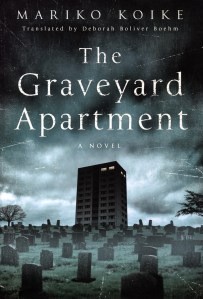
The Graveyard Apartment

the-graveyard-apartment

Title: The Graveyard Apartment
Japanese Title: 墓地を見おろす家 (Bochi o miorosu ie)
Author: Koike Mariko (小池 真理子)
Translator: Deborah Boliver Boehm
Publication Year: 2016 (America); 1988 (Japan)
Publisher: Thomas Dunne Books
Pages: 325

Kano Misao and her husband Teppei have found the perfect apartment. It’s quiet and spacious with southern exposure, and it’s in a new, modern building. Sure, this building happens to be right next door to a graveyard, but it’s the 1980s, and the pleasant proximity to an open green space outweighs any sort of silly superstitious stigma. The only problem is that strange things always seem to be happening in the basement. It might be that the building is haunted, but why? And what would the ghosts want from Misao and Teppei?

Like many other haunted house stories, The Graveyard Apartment is, at its heart, a family drama. Misao and Teppei are happy together with their five-year-old daughter Tamao and their dog Cookie, but the bright little family is trailed by the dark shadow of Teppei’s first wife Reiko, who was driven to suicide by her husband’s affair with Misao. When the stress of the paranormal activity in their new apartment places stress on Misao and Teppei’s relationship, the fault lines of their marriage begin to crack. The novel opens inauspiciously with the death of Tamao’s pet bird Pyoko, who the girl claims now visits her in dreams. Misao and Teppei’s disagreement over how to handle their daughter’s insistence on the reality of the supernatural is the first of many arguments, which gradually escalate over the course of the story.

The Graveyard Apartment is not The Shining, however, and the ghosts troubling the family are not manifestations of buried psychosexual traumas – they are, most assuredly, actual vengeful spirits. The horror of the novel derives from the fact that, despite the lingering guilt over Reiko’s suicide, the malice of the building’s ghosts could not be directed at a more normal and easygoing family. If a sweet young mother and fledgling illustrator like Misao can find herself trapped in a claustrophobic basement while unknown things approach unseen in the darkness, it could happen to anyone.

It turns out that the apartment building is a remnant of a failed development project from the 1960s that would have resulted in an underground shopping plaza connecting the basements of several office and residence buildings to the local train station. The neighborhood temple resisted this development and refused to sell or subdivide its land, however, and so the tunnel under the graveyard was left unfinished, with the Kanos’ building the only part of the project that came to fruition. The link between the temple graveyard and the ghosts in the basement is extremely tenuous (especially since the point of Buddhist funerary rites is to pacify angry spirits), but the haunting can be more easily understood as the consequences of the era high economic growth, which has finally started to claim victims as the bubble economy begins to collapse in on itself.
The Kanos were led to believe that they could have it all – Teppei could divorce his old-fashioned wife and marry for love, Misao could have both a child and a freelance career in a creative field, and they could find a reasonably priced apartment in a convenient location to house their happy family. It had to be too good to be true, right?

Originally published in 1988, The Graveyard Apartment is a reflection of the anxieties concerning the optimistic consumerism of the 1980s, in which an ideal middle-class lifestyle was widely considered to be glossy and attainable as the magazines Misao illustrates. Although the real threat to families ended up being overinflated property values, Koike’s ghosts are creepy enough on their own even without any sort of economic allegory, and the end of the novel is genuinely disturbing. The Graveyard Apartment is a satisfying slow burn of a haunted house story perfectly suited to its setting in Tokyo, and I highly recommend it to my fellow fans of horror fiction.

( Review copy provided by Thomas Dunne Books. )

Now You’re One of Us

now-youre-one-of-us

Title: Now You’re One of Us
Japanese Title: 暗鬼 (Anki)
Author: Nonami Asa (乃南 アサ)
Translators: Michael Volek and Mitsuko Volek
Publication Year: 2007 (America); 1993 (Japan)
Publisher: Vertical
Pages: 239

A few months ago, 26-year-old Noriko married into the Shito family, who operate a grocery and rice trading business in the Koganei suburb of Tokyo. Noriko’s husband Kazuhito, whom she became acquainted with through the auspices of a matchmaker, is handsome and loving, and his mother Kimie wants nothing more than for Noriko to be happy. The Shito house is large and surrounded by gardens, and the extended family of eight people all lives there comfortably. Noriko’s new life seems almost too good to be true.

It turns out that this perfect family is indeed too good to be true. The first indication that something is amiss appears three months into Noriko’s marriage, when one of the Shito family’s tenants tries to warn her about something but is immediately silenced by Kimie. When this man is killed in a mysterious explosion a week later, the Shito family denies any knowledge of the incident and sends Noriko to the funeral by herself.

Although she tries to suppress her gut instincts, Noriko finds herself bothered by the uncanniness of the Shito family. Everyone is too kind and too friendly, which renders it even more perturbing that the family never receives visitors or attends community events. In addition, the Shitos seem to have far too much money coming in from the family business, the Ichifuji Rice Mill, which primarily operates as a general store. Noriko isn’t allowed into certain areas of the manor, including the greenhouse, and she suspects that the family is meeting together late at night while she’s sleeping.

Noriko has no evidence to support her suspicions, however, and she’s hesitant to leave the comfortable household in the upscale suburb of Tokyo and return to her family in rural Yamanashi prefecture. After all, Noriko is well aware of just how lucky she is to have been given the opportunity to enter into such an advantageous marriage. When she meets her high school friend Tomomi in the city and hints at her concerns regarding the Shito family, Tomomi is thoroughly creeped out, but Noriko chalks up her friend’s response to jealousy.

Nevertheless, Noriko can’t shake her feeling that something is wrong with the Shito family. When she eventually confronts her husband Kazuhito, things become very strange very quickly, and the story shifts from a mystery centered around the death of the tenant to a terrifying account of gaslighting, a form of mental manipulation in which someone’s perception of reality is repeatedly denied while what they know to be true is replaced by false information. The members of the Shito family work together as a collective to destroy Noriko’s sense of identity, alternating between befuddlement that her memories do not align with theirs and outright bullying and abuse. By the end of the book, Noriko’s “pride was tattered, and all of her values smashed to bits. Everything – her confidence and will, and her reasons for being who she was – had vanished like dust into a breeze” (215).

Generally speaking, the accusation that a person not in a position of power has deliberately fabricated falsehoods serves to silence voices that offer contradictory evidence against a normative position, and it’s easy to read Noriko’s trials as an allegory of how the social institution of marriage is almost cult-like in the control it exerts over young women’s psyches and sense of self-worth. Moreover, the Suburban Gothic of the Shito family intersects with the repressed trauma of the Pacific War, and the bizarre history of the clan is braided into the strands of Japan’s history as a national polity.

Now You’re One of Us is a truly disturbing piece of feminist horror. The novel is also genuinely compelling, and it’s almost impossible for me to put down once I start reading, no matter how many times I return to it. Nonami Asa has been hailed as one of contemporary Japan’s finest writers of mystery and horror, and Now You’re One of Us showcases the author at the top of her game. By the time the reader understands what it means to be “one of us,” it’s too late to turn away, and the experience of surviving this book will stay with you long after its bone-chilling ending.

Under the Midnight Sun

under-the-midnight-sun

Title: Under the Midnight Sun
Japanese Title: 白夜行 (Byakuyakō)
Author: Higashino Keigo (東野 圭吾)
Translators: Alexander O. Smith and Joseph Reeder
Publisher: Minotaur Books (a division of St. Martin’s Press)
Publication Year: 2016 (America); 1999 (Japan)
Pages: 560

This guest review is written by Tyran Grillo (@TyranGrillo on Twitter).

Although Naoko was the first novel by Keigo Higashino to appear in English, it wasn’t until The Devotion of Suspect X that an energetic following of the author grew among Anglophone readers. Subsequent novels by Japan’s salaryman-turned-mystery writer, however, left fans hungry for something different, as the clothes of his popular Detective Galileo were beginning to wear thin. Enter the gruffer Sasagaki, whose investigation of a 1973 murder in Osaka starts him on a 20-year chase after the truth. The circumstances surrounding said murder play on the classic locked room scenario, as the body of a man is discovered by children playing in an abandoned building.

Our body of interest was once the property of Yosuke Kirihara. The owner of a pawn shop, the unfortunate Yosuke has left behind a son, Ryo, and a wife, Yaeko. Sasagaki immediately suspects the latter, due to a seeming lack of emotion toward her spouse’s death. Ryo, for his part, is broken by the loss, and offers little in the way of helpful information. Even as Sasagaki fears for the boy’s future, he cannot help but marvel at Yaeko’s performance. As he watches her late husband’s funeral procession from a respectable distance, he thinks to himself, “The strange attraction of a woman in mourning…. If she’s trying to play the part of the beautiful young widow, she’s doing a knockout job.” Such statements may be common hardboiled fare but here set the tone for an unnecessarily chauvinistic slog of a novel. Sasagaki’s suspicions turn to Fumiyo Nishimoto, the last person to have seen Yosuke alive, and her daughter Yukiho is described in such perverse terms that it’s all this reader could do not to gag on their persistence.

Yukiho and Ryo, in the wake of a tragedy that has affected them both, become our main protagonists. We follow their diverging paths out of the nostalgic ignorance of the 1970s into adulthood. Along the way, Higashino introduces us to a chain of new characters, some of whom feel unnecessary as false witnesses. Each subsequent chapter throws new names into the mix to throw us off the scent. Ryo goes on to become a bootleg video game manufacturer, while Yukiho goes on to become a male fantasy of femininity.

Therein lies a fundamental problem of the narrative. Like all of the women in Higashino’s testosterone zone, she is little more than the sum of her apparently siren-esque charms, which Yukiho hones in service of being what she is called from the start: a “perfect lady.” On the surface, one might read this as a noble critique of the ways in which women are expected to live up to idealized images of beauty, but assertions of this point reach a level of absurdity that make the story nearly impossible to finish. For while Yukiho’s beauty is doubtless the very epitome of feminine perfection, she is also described as having “thorns in her eyes,” and, as our omniscient narrator so dutifully explains, a “true lady would never have eyes like that.” In other words, a “true lady” cannot be prone to dark thoughts or ever have an off day; she must maintain a perfect and consistent exterior, if only to please the men around her.

Higashino’s descriptions of the mature Yukiho are striking in their blatant vacillation between praise and condemnation, not to mention their occasional slip into racial stereotypes. To give an example: “Yukiho looked down at the table. She had long eyelashes. Some of the people in the club said she looked like one of those French porcelain dolls. The comparison was admittedly apt, with the exception of her Asian eyes.” When a younger detective by the name of Imaeda picks up where Sasagaki left off years ago, his first look at Yukiho reminds him of the “women he’d seen in old foreign films” and makes him wonder “where she got her seemingly natural elegance and grace. What had polished her to gleam so brightly?” More than overstating Yukiho’s beauty, such language elevates it to farce, so that the woman herself no longer functions as a human character.

When Yukiho finally marries, her husband Makoto cheats on her by falling for a temp who works at his company. Not only does this downplay Yukiho’s tireless attempts to live up to perfection, it undermines her intelligence in choosing a suitable life partner, a point further stressed when we learn that Makoto, who admits to having an inferiority complex around his savvy wife, has beaten her in a drunken rage that he conveniently forgets. In addition to being entirely out of her husband’s character, this disclosure comes across as a desperate attempt to elicit pity for a woman of whom by this point we have no idea what to think.

Anytime a female character is described, the reader can be sure to learn a lot about her body, and Yukiho is no exception. Rather than add to knowledge of her character, as his visualizations of men do, Higashino indulges in details that have no bearing on her psychological profile. In an awkward scene of lovemaking between Yukiho and her husband, for instance, we get this: “Her breasts were soft and bigger than you might think to look at them.” Does this detail matter? Only to a voyeuristic narrator who takes pleasure in it.

Yukiho is animalized, as when she is compared to a cat for her “feline eyes.” When she later becomes a suspect, she is variously likened to a “black rose,” an “evil flower,” and ultimately an “artificial flower,” as if the combination of intelligence and femininity were a surefire recipe for malice. Although one might argue that Higashino is simply playing with the femme fatale trope like so many before him, it is far too convenient that Yukiho’s beauty, which for most of the novel has been seen as a divine gift inherent to her every fiber, suddenly ceases to be real once it’s revealed as a mask hiding an actual human being. Such classical sexism precludes any progressive tendencies that might be attributed to Under the Midnight Sun.

The issue of its depictions of female characters aside, problems abound in the novel’s structure and pacing. Aside from being too long for its own good – there is, for example, a full page of unnecessary dialogue between Yukiho’s college classmate and a future boyfriend about how wet one gets by either walking or running in the rain – it pads out a foreseeable conclusion with unrealistic conceits. The result is a novel whose flaws are, like Yukiho’s much-discussed features, bigger than you might think to look at them.

In addition, Detective Sasagaki is a rather uninteresting lighthouse decorating a coastline of possible perpetrators. We understand that he is skillful at his job, but his obsessive interest in this case feels somewhat out of place, given what we know about him. Then again, mistakes have been made on both sides of the equals sign that would have brought his suspicions to a verdict much sooner, and perhaps subconscious awareness of this drives him to overcompensate for the embarrassment of what ends up being a simple explanation. As in any mystery of this length, it’s the actions of investigators who unwittingly build a complex wall around the truth that allow murderers to get away with what they do for so long. As the story progresses, the plot becomes so unbelievable that it feels like a letdown when one reaches the tail end of its denouement.

Ironically, the novel’s meandering tendency is also its greatest strength, and the clearest justification of its author’s fame. Higashino makes it easy to keep track of an ever-growing cast of characters – almost to a fault, because many revelations, at least to this reader, were clear from many pages away. Above all, the book provides a fascinating cross-section of late twentieth-century Japan, tracing trends in manga, television shows, video games, and other popular arenas of technological production through a key transitional period in the nation’s history. Higashino juggles multiple arcs and implications with ease, and the reverse engineering required to put them all together will satisfy even some avid mystery fans, to be sure.

As a published translator of Japanese fiction myself, I feel compelled to note that none of my criticisms are the fault of Alexander O. Smith and Joseph Reeder, who have done an admirable job rendering Higashino’s often-terse and idiomatic prose into fluent English. The novel reads smoothly, handles cultural differences with tact, and evokes the original’s grittiness with clarity. If anything, it was the quality of their work that kept me engaged.

In the end, Under the Midnight Sun is a lackluster story with little payoff. As for the back cover copy’s comparisons of this book to Les Misérables and Crime and Punishment, I can only say these constitute a deception as criminal as the novel they are describing.

Under the Midnight Sun will be released on November 8, 2016. Review copy provided by St. Martin’s Press.

* * * * *

Tyran Grillo is a Ph.D. candidate at Cornell University, where his research focuses on the (mis)representation of animals in contemporary Japanese literature. He has translated nine books from Japanese into English, five of which have been published. The most recent of these is the science fiction masterpiece Mr. Turtle by Kitano Yūsaku. Tyran is also an avid blogger, having to date written over one million words of criticism on music, books, and film at ecmreviews.com.

Strangers

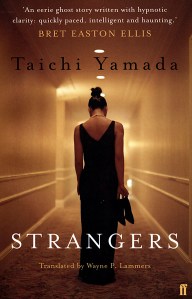
Strangers

Title: Strangers
Japanese Title: 偉人たちとの夏 (Ijintachi to no natsu)
Author: Yamada Taichi (山田 太一)
Translator: Wayne P. Lammers
Publication Year: 2003 (America); 1987 (Japan)
Publisher: Vertical
Pages: 203

A 48-year-old television script writer named Harada is having a tough time of it. Having divorced his wife, he now lives by himself in a small apartment in a mostly empty building. A drama series he was supposed to work on has been canceled, and a friend and colleague has announced his intentions to pursue Harada’s ex-wife. After Harada’s friend informs him that they can no longer work together, he wanders in a haze until one day he decides to return to the Asakusa neighborhood of Tokyo where he grew up. On a whim he enters a rakugo performance, where he catches sight of a man who looks just like his late father. When the man goes out for a cigarette, Harada follows him and ends up being invited to the man’s home, where a woman who looks exactly like his late mother is waiting for them.

Around the same time, Harada has a strange encounter with a woman in her thirties whom he has nodded to a few times in the lobby of his building. Late one evening she shows up at his apartment with a bottle of champagne, remarking on how it’s eerie that the two of them are the only humans in the building. Because he’s still reeling from the emotional impact of his friend’s pronouncement regarding his wife, Harada tells her that he’s busy. When he calls her a week later, however, she gladly comes over. She makes romantic overtures and says she’ll sleep with him on the condition that he promises not to look at a mysterious wound on her chest. Is she just shy, or is something more sinister going on?

Harada’s ghost parents are charming and hospitable, so he continues visiting them. Harada’s father, a sushi chef, exhibits the charming gruffness and bluster of a stereotypical tradesman from the Shitamachi “old Tokyo” area in east Tokyo, and his mother is a sweet and gentle woman who loves her husband and son despite their flaws and amuses herself by playing old-fashioned games with hanafuda cards. Unlike Harada’s barren neighborhood in Shinjuku, Asakusa is full of warmth, and returning to his parents feels like stepping back into an idealized past in the postwar era.

Harada feels more alive than he has in years, but the people around him keep remarking on how terrible he looks. His new girlfriend seems especially concerned, and the intensity of her emotions is almost frightening. What does she want from him? What do his deceased parents want from him? Will he live long enough to find out?

Although Strangers plays with an interesting set of themes, the novel feels somewhat shallow. Harada is introspective but never arrives at any striking realizations about himself, and he’s too self-absorbed to make any serious attempts to understand the behavior of the people around him. Unfortunately, this Harada’s position as the point-of-view character renders the other characters as nothing more than stereotypes. Why do Harada’s parents return to the world of the living to see him? Because all parents love their children, of course. Why does Harada’s ex-wife pick fights with him? Because all women are crazy, of course. Why doesn’t Harada’s college-age son want to talk to him? Because all young people are ungrateful and temperamental, of course.

To me, Harada came off as an embodiment of male entitlement, and the books ends with his preconceptions justified and his place in the world reaffirmed. His seeming inability to change himself as the world changes around him is presented in a romantic light, as are the noble struggles of middle aged dudes everywhere. I didn’t find this story particularly engaging, but perhaps I’m simply not the intended audience.

Strangers is neither grisly nor subversive enough to inspire chills, but as a ghost story it offers an interesting theory on how different parts of Tokyo are haunted.

Asura Girl

Ashura Girl

Title: Asura Girl
Japanese Title: 阿修羅ガール (Ashura Gāru)
Author: Maijō Ōtarō (舞城 王太郎)
Translator: Stephen Snyder
Publication Year: 2014 (America); 2003 (Japan)
Publisher: Haikasoru
Pages: 214

Asura Girl is narrated by Aiko, a seventeen-year-old student who just so happens to be a total badass of the sort we all wish we could have been in high school. She does what she wants, doesn’t apologize for anything, and isn’t interested in your shit. Sure, she’s a little messed up in the head, but what teenager isn’t?

If Aiko’s life were nothing more than maintaining her self-respect while dealing with bullying and subpar sex, she’d be okay, but there’s a serial killer on the loose. When a boy disappears almost immediately after she left him in a love hotel, she takes steps to lure the murderer to her, because she is pissed off and ready to lay down the law. She is inspired by her enviable collection of DVDs of American movies, especially after she picks up on a parallel between the abduction of her single-serving boytoy and the abduction in The Big Lebowski.

That’s right, The Big Lebowski – a perennial favorite of seventeen-year-old girls everywhere.

Asura Girl was written by a thirty-year-old man, and it shows. Aiko is more or less a cross between Uma Thurman, Samuel L. Jackson, and a basement-dwelling neckbeard. It makes very little sense to try to understand her as anything other than a construct. There is no sensitive or nuanced portrayal of girlhood in this novel, but that’s okay. Sometimes you’re just looking for a hardcore metal portrayal of a manic pixie murder girl.

To give you a sense of what this means, this is how Aiko interacts with her crush:

Still, it did sound a little like he was more worried about Maki than me, so as he was taking off his shoes in the doorway I kicked him – my patented Aiko whip kick, a roundhouse to the upper body that I learned from my brother. My bare foot struck his arm – chiban! – and he bent double, letting out a little yelp. Humpf. Drop dead. No, on second thought that might cause trouble. (53)

The boy is okay with it, because of course he is. Aiko is less of a girl power icon than she is a fantasy girlfriend for the author, but her ridiculous character is a perfect for this novel’s ridiculous story.

The family of one of the serial killer’s victims set up a website asking for help, a plea that went nowhere fast but still managed to inspire a great deal of internet discussion and speculation that coalesced into a vigilante group calling itself “Voice of Heaven.” The Voice of Heaven has convinced itself that the serial killer is a middle school boy, and so its members begin to engage in “middling,” or ganging up on middle school kids and beating the shit out of them. A grisly confirmation of a new murder sparks widespread riots, in the midst of which Aiko receives an unlikely visitor.

A hundred pages into the novel, there’s a vertiginous narrative shift as Aiko undergoes a near-death experience, and her already unstable imagination goes completely off the rails.

I don’t want to spoil what happens here, but it is insane.

When Aiko returns from her epic vision quest ninety pages later, she has learned nothing. Regardless, she understands that she’s been given a new lease on life to make a fresh set of terrible decisions, and she fully intends to make those decisions as terrible as possible.

And then there’s this weird bit at the end about making a sacred Buddhist statue of the warrior-god Asura out of human corpses. Should the reader understand these human corpses as literal, or are they the cast-off shells of Aiko’s identity as she constantly reinvents herself yet always stays essentially the same? Why choose when you can have both??

I just, what is this novel, what is it even.

Asura Girl is not for everyone, and I can imagine wide swaths of readers being confused and offended by it. But! If your heart went a little doki-doki when your eyes passed over the words “The Big Lebowski,” and if you always thought Reservoir Dogs could have used more Japanese schoolgirls, then Asura Girl is probably for you.

You know who you are.

Last Winter, We Parted

Last Winter We Parted

Title: Last Winter, We Parted
Japanese Title: 去年の冬、きみと別れ (Kyonen no fuyu, kimi to wakare)
Author: Nakamura Fuminori (中村 文則)
Translator: Allison Markin Powell
Publication Year: 2014 (America); 2013 (Japan)
Publisher: Soho Press
Pages: 216

A 35-year-old photographer named Kiharazaka Yūdai is charged with the murder of two young women who acted as his models. Although his work was highly regarded, he had lived mainly off the inheritance from his maternal grandfather, who had distanced himself from his daughter to such an extent that Yūdai and his sister Akari ended up growing up in an orphanage after being abandoned by their parents. He is currently being held in prison in solitary confinement, where he’s waiting to appeal his death sentence.

The narrator, an unnamed writer who is working with his editor to put out a book about Kiharazaka, visits him in prison and then begins exchanging letters. He also meets with Akari and a salaryman named Katani, who had been Kiharazaka’s only friend. Both of them believe he’s innocent, and both want to know why the narrator cares so much about him.

It turns out that both Kiharazaka and the narrator were involved with a group that had formed around a man named Suzuki, a creator of full-size silicon sex dolls. When the narrator approaches Suzuki about Kiharazaka, the craftsman talks at length about his clients and the uncanniness of his art. He also discusses the similarities between his work and Kiharazaka’s photography, bringing up Akutagawa Ryūnosuke’s short story Hell Screen as a means of explaining the relationship between beauty and suffering. Suzuki doesn’t doubt that Kiharazaka murdered his photographic subjects by setting them and his studios on fire, but he suspects that there was something that drove the man’s madness other than the desire to lift himself out of an artistic slump.

There is in fact more going on, but it’s the reader who has to play detective. Interspersed between the short passages charting the narrator’s descent into an unhealthy relationship with the Kiharazaka siblings are various documents presented as numbered “archives.” Some are letters from Kiharazaka to his sister and to the narrator, while others are diary entries and Twitter feeds, and some are more difficult to classify. The relationships between the characters are not what they initially seem, with names being nothing more than empty signifiers of fractured identities, and the reader is forced to fit all of the clues together herself if she wants to understand what really happened between this small group of irreparably damaged people.

Last Winter, We Parted is misogynistic in that female characters seem to only be there to be photographed and/or fucked before being burned alive, but that comes with the territory. Let’s be real here, this is a crime novel written by a man who won the Ōe Prize, what were you expecting.

Standard literary sexism aside, Last Winter, We Parted is a small book of eerie beauty. Despite its gory subject matter, the prose is as light as falling ash. Allison Markin Powell’s translation is, as always, wonderful. This is the first book by Nakamura Fuminori I’ve read, but I’m definitely hooked on his writing.

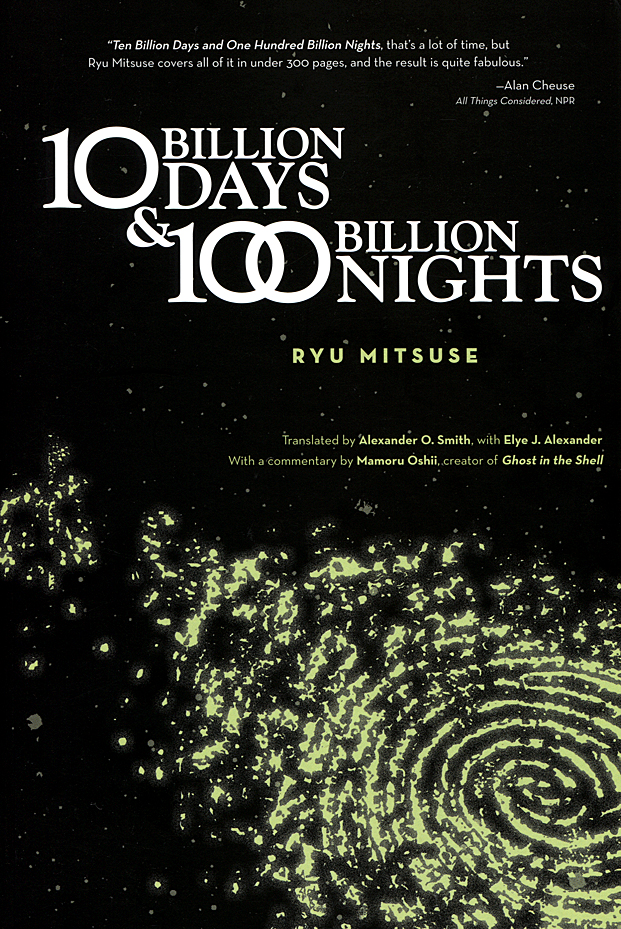
10 Billion Days & 100 Billion Nights

10 Billion Days & 100 Billion Nights

Title: 10 Billion Days & 100 Billion Nights
Japanese Title: 百億の昼と千億の夜 (Hyakuoku no hiru to senoku no yoru)
Author: Mitsuse Ryū (光瀬 龍)
Translators: Alexander O. Smith and Elye J. Alexander
Publication Year: 2011 (America); 1967 (Japan)
Publisher: Haikasoru
Pages: 284

According to a 2006 poll published in Hayakawa SF Magazine, 10 Billion Days & 100 Billion Nights ranked at the top of the list of science fiction novels originally published in Japanese. I can’t say for certain whether 10 Billion Days is the “greatest” Japanese science fiction novel of all time (or what that would even mean), but it certainly is epic. The writing (and translation) are beautiful, and there are some interesting ideas floating around as well.

Also, 10 Billion Days has an entire chapter devoted to a cyborg deathmatch between Buddha and Jesus. It’s awesome.

This review will contain spoilers. The concept of “spoilers” doesn’t really apply to this novel, as its narrative tension is generated more by speculation and atmosphere than it is by plot, but be warned. If you’d like the point of the review here at the beginning, here you go: I love this book and you should totally read it. It’s not perfect, and it will try (and reward!) your patience, but it will stay in your memory for years. The short commentary by Oshii Mamoru (the director of the landmark animated sci-fi film Ghost in the Shell) is of interest as well, especially to fans of Japanese pop culture.

The premise of 10 Billion Days is that all life on earth has been painstakingly curated by an extraterrestrial (and possibly extradimensional) entity that may not be benevolent. Some characters are aiding it, some characters are opposing it, and some characters are merely trying to understand it. What is clear is that our world is very small and unimportant on the sort of cosmic scale suggested by the novel’s title.

After a prologue that sets the tone by emphasizing the eternal passage of time across aeons, the novel opens with a dramatic description of the struggles of the first fish to walk on land. At the end of the chapter, it is revealed that this creature is being monitored and gradually enhanced by highly advanced technology.

The next chapter skips to Plato, who is seeking the mysteries of Atlantis. What he finds is that the gods are real, and frighteningly so. The next chapter focuses on Siddhārtha, and the next on Jesus of Nazareth. Both God and the Buddha realms are real, but these early seekers of truth can only see a fraction of the picture and describe it in terms they can understand.

The first half of the book is dedicated to creating an air of mystery and adventure. For example, when Plato arrives at the village where the last descendants of the people who fled Atlantis live, this is how Mitsuse sets the scene:

Far across the sea of burnt yellow sand, the fading sun had set halfway, sending its rays upward to paint the high clouds blood red. Crimson spread out across the darkening sky even as night seeped from the eastern horizon toward the vault of heaven, reddish-gray melding with crimson blue. The wind was completely still, and the twilight pooled like heavy oil upon the sand. There was not a sound. Plato wondered what the people who lived inside the stone houses of the village must be doing for such silence to reign – not a single spoken word, no faint echo of evening song. All was filled with the barren quiet of the sand sea and the silence that comes with the death of something long forgotten, unchanged for thousands of years. (49)

This passage is interesting not only for its lovely imagery but also because of its treatment of one of the main themes of the novel, which is that all civilizations will eventually fade into shadows of their former selves. This theme is visually translated at key points in the story, in which the spotlessly clean metal of a future space city is just as desolate as an ancient desert.

The second half of the novel tessellates to the year 3905, in which the entire planet has become a wasteland. Just as the cyborg fish of the first chapter cautiously made its way onto land, cyborg Siddhārtha (yes, really!) emerges from the ocean into the ruins of Tokyo, where cyborg Plato (who is now calling himself Orionae) fills him in on the situation. As the two are talking, they are accosted by Jesus, who also turns out to be a cyborg – a dirty cyborg with rotting teeth a gross clothes. So a cyborg zombie, then. And then they fight! I promise this is just as ridiculous as it sounds. There are some great lines during this section, such as…

Siddhārtha gingerly extended his tri-D antenna from the crack in the wall, searching for his foe. (181)

…and…

Glumly, Jesus admitted to himself that his attack had probably failed to destroy his enemy. (194)

Just roll with it, okay?

Siddhārtha and Orionae (in other words, Buddha and Plato) are joined by a non-organic lifeform in the shape of an adolescent girl, who is called “Asura” after the eternally warring god-kings of the Hindu and Buddhist faiths. Asura had earlier revealed herself to Siddhārtha, claiming she is fighting the entity that Jesus understands to be God, and at the end of the novel she takes him and Orionae on a journey through space to meet and hopefully defeat this being. What follows is a series of battles and revelations that progressively mount in scope and impact throughout the last eighty pages of the book. Like the beginning of the universe itself, this novel is a massive explosion.

10 Billion Days is not a perfect book, and at times it moves through complicated and nuanced religious and philosophical topics quickly and with an absolute minimum of narrative grounding. I will also admit that I find the actual story unsatisfying. However, the strength of 10 Billion Days lies in the questions it raises in the mind of the reader. These questions are almost classically existential. In an uncaring and absurd universe, how can an individual find meaning and hope?

The weekly speculative fiction magazine Strange Horizons will be hosting a roundtable discussion of 10 Billion Days in October, and I’m honored to be one of the participants. I have strong feelings and opinions about this novel, and I’m looking forward to learning what the other discussants think. There’s a lot going on in this book; and, if nothing else, it’s a fantastic conversation starter.

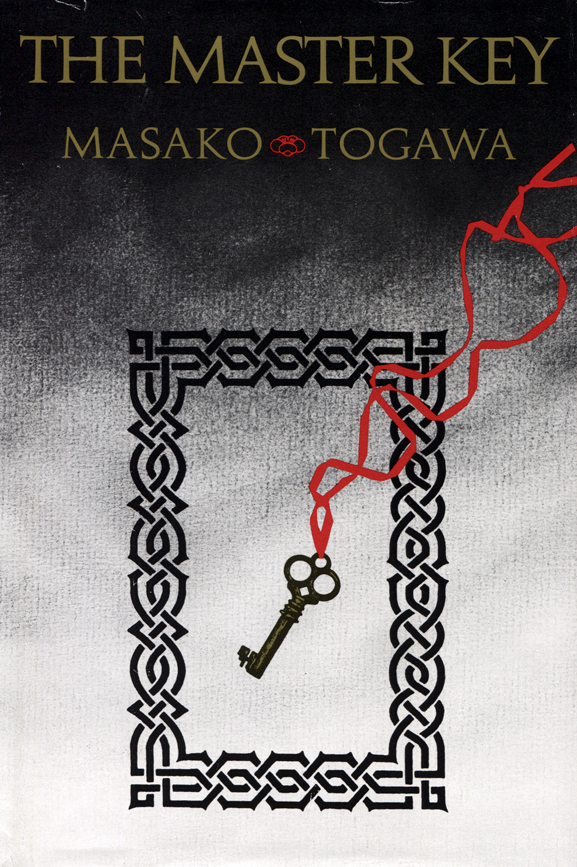
The Master Key

The Master Key

Title: The Master Key
Japanese Title: 大いなる幻影 (Ōinaru gen’ei)
Author: Togawa Masako (戸川 昌子)
Translator: Simon Grove
Publication Year: 1985 (United States); 1962 (Japan)
Publisher: Dodd, Mead & Company
Pages: 198

The Master Key, first published in 1962 and set in the late 1950s, is an interesting window into a period of postwar Japan that we don’t often see represented in Japanese fiction in translation. The story takes place entirely within the closed world of the K Apartments for Ladies, a large, multi-story building located in southeast Ikebukuro and registered as a charitable trust with “rents pegged at wartime levels.”

On its surface, the story is about a 1951 kidnapping of a young boy who is the son of a Japanese woman and an American military officer. Seven years later, when the K Apartments building is lifted and moved to a different location in a grand public works experiment, the body of a child is discovered buried underneath a shared bathing area in the basement. Right around the time the child disappeared, a man dressed as a woman was struck by a van in an intersection near the apartment building, and it’s revealed to the reader early in the novel that this man disguised himself as a woman to help one of the tenants dispose of the body that would later be found in the building’s basement. Who in the apartment buried the body, and what relation does this have to the kidnapping incident?

About twenty pages into The Master Key, however, it becomes clear that the mystery portion of the story is going to take a backseat to an extended exploration of the inner worlds contained within the K Apartments for Ladies and the psychological dysfunctions of its aging tenants.

Ishiyama Noriko, who has been diagnosed with “nervous pains,” has removed herself from the rest of the world and lives in a dark apartment stuffed with other people’s trash, which she occasionally boils and eats to sustain herself. Yatabe Suwa, a former concert violinist who now gives music lessons to children, is haunted by the loss of potential represented by the theft of a violin from her own teacher, even though it’s possible that she herself may have more to do with this incident than she likes to admit. Kimura Yoneko retired from her position as a schoolteacher years ago and spends her days writing letters to her former students, and she is not above checking into the affairs of the other tenants as well. Santo Haru is obsessed with a religious cult, and she is in the palm of its leader, who frequents her apartment to hold prayer meetings centered around the trances of its vestal priestess.

The plot is complicated and circuitous but is centered around the use and whereabouts of the master key of the title, which various tenants use to sneak into one another’s rooms in order to discover the secrets of others while concealing their own. At the end of the novel, it’s revealed that there is a mastermind orchestrating all of their movements, someone who has been spying on everyone for years and has manipulated the women around her for her own amusement. As someone who had essentially done the same thing to these characters through the process of reading this novel, I felt somewhat guilty, but not enough to lessen my enjoyment of how neatly all of the different plot threads are eventually tied together.

I will openly admit that I love stories about women being unpleasant and irrational and absolutely human. All of the female characters in this story are a little pathetic and a little demonic in that they have no power outside the K Apartments but all manner of strange little powers within their closed world. I’m sure this can be read as a metaphor for something, but it need not be, as the haunted and uncanny environment the characters shape through their bizarre actions is absolutely fascinating in and of itself.

For people with more background on Japanese history and urban space, the story’s setting in Ikebukuro is of special interest. In the immediate postwar period, Ikebukuro famously functioned as a heterotopia in which diverse groups of people came together and the norms of mainstream society didn’t necessarily apply. There is all manner of hidden “national polity” history in Ikebukuro, where the family-state of Japan has buried countless failed narratives under highways and skyscrapers. The Master Key thus serves as an excellent example of postwar Tokyo gothic (as similarly exemplified by Kyōgoku Natsuhiko’s The Summer of the Ubume). A reader doesn’t need historical knowledge to appreciate the story, but a bit of research into the setting has the potential to deepen the experience of reading this novel, which has sub-basements under sub-basements under sub-basements.

The Master Key is long out of print but still cheaply available through a number of online used book services. If you have access to your local or university library’s Interlibrary Loan program, it’s well worth requesting this book. It’s a quick read, and it packs a huge impact. To my fellow horror and mystery lovers especially, I highly recommend tracking down a copy of this short, satisfying, and creepy little novel.

Vibrator

Vibrator

Title: Vibrator
Japanese Title: ヴァイブレータ (Vaiburēta)
Author: Akasaka Mari (赤坂 真理)
Translator: Michael Emmerich
Publication Year: 2005 (America); 1998 (Japan)
Publisher: Soft Skull Press
Pages: 155

Vibrator is not an easy book to read.

In the first twenty pages, the 31-year-old bulimic narrator describes her strategies for throwing up after meals. Apparently, the trick is to not allow the food to digest. Soda water helps too, it seems. Alcohol complicates matters, but it’s difficult to give up entirely, because it makes the voices go away.

As you might imagine, the narrator of Vibrator has Issues. The first third of the novel is occupied by her nerve-wracking, stream-of-consciousness jabber. What’s perhaps most disturbing about the narrator’s ranting is not that it so accurately reflects narratives of self-hatred and self-doubt, but that the circumstances she describes make her anxieties and self-destructive behavior seem entirely justified. Being an independent woman in a man’s world is hard, and the narrator knows that her beauty will fade as she grows older, thus depriving her of her only advantage over her male colleagues. Moreover, as a female journalist, the narrator is placed in situations in which she must comment not as a professional but as a representative member of her gender, which she finds banal and insulting. To anyone – male or female – who’s ever resented her job or lamented her relative lack of professional success, the narrator’s complaints will be painfully familiar.

One snowy night, after buying a liquid dinner in a Family Mart on her way home, the narrator almost runs headlong into a tracker-trailer on the edge of the convenience store parking lot. The driver, a twenty-something named Okabe, invites her into the cab. The narrator wants to spend more time observing the white world generated by the snow flurry, and she feels as if she has nothing to lose, so she accepts his offer. They talk while drinking, and before long they’re on the road to the northern Tōhoku region. Sex is involved, but more interesting than the smut is the intimacy of Okabe’s story about dropping out of high school to become a low-ranking member of a yakuza clan.

Vibrator is not quite a love story. At the end of the book, there’s no indication that the sudden relationship between the narrator and Okabe will amount to anything beyond the single ride they share. Still, it’s lovely to witness the garbled voices in the narrator’s head slowly fade as she is calmed by vibrations of the truck’s engine (the “vibrator” of the title) and Okabe’s placid self-assurance. Even if the narrator is unable to achieve any deep or permanent connection with Okabe, her escape from her own head and engagement with the landscapes flashing past the truck’s windows is satisfying and meaningful.

Vibrator may not an easy book to read, but it’s certainly worth reading, if only to witness the skill with which the translator, Michael Emmerich, has rendered its narrator’s many voices.

If you live in the United States, Hiroki Ryūichi’s 2003 cinematic adaptation of Vibrator is streaming on Netflix. The film features gorgeous long shots of the Japanese countryside, and the director effectively removes the characters from the narrator’s incessant stream-of-consciousness commentary, which creates an entirely different atmosphere for the story. Tom Mes highly recommends this movie, and it’s a beautiful interpretation of the novel.

Parade

Parade Novel

Title: Parade
Japanese Title: パレード (Parēdo)
Author: Yoshida Shūichi (吉田 修一)
Translator: Philip Gabriel
Year Published: 2014 (America); 2002 (Japan)
Publisher: Vintage Books
Pages: 230

Do you remember how, maybe around ten years ago, writers like Nick Hornby and Chuck Palahniuk were really cool? You’d read something like Bret Easton Ellis’s American Psycho or Don DeLillo’s Cosmopolis and go, Wow, that’s brilliant! And do you know how now, when you try to pick up one of those writers again, you’re too jaded by movie adaptations trying to make hard-line masculinity and sexual violence seem edgy to really appreciate what the writers were trying to say about urban culture and the weird bonds that form between people and what happens when you’re no longer young and suddenly running out of opportunities to make a fresh start? Have you ever thought it would be kind of awesome to re-experience the excitement of those stories without the nagging annoyance of an ever-present undercurrent of misogyny?

If so, then you need to read Parade. It’s by far the most enjoyable novel I’ve encountered this year. When I first sat down with it, I thought I would read twenty pages and then call it a day; but then, the next thing I knew, I was ninety pages in and terrified that I wouldn’t be able to stop. The novel’s five chapters are recounted by five different characters, each of whom is crazier than the last. I loved all of them, and I had to pace my progress through the book so that I could spend more time in their presence. Like its narrators, Parade is young, and it’s fun, and it’s clever, and it’s psychologically unbalanced (in a good way).

The story is about four people in their twenties who have no idea what they’re doing with their lives. Almost by accident, they’ve found themselves living together in a two-bedroom apartment, where they’ve established an easy and comfortable social space that one of them likens to an internet chat room. In short, each of them is free to be as dysfunctional as he or she wishes without incurring the judgment of the others, and they get along well.

Sugimoto Ryōsuke is a sophomore in college who adores a protective upperclassman and has found himself in a Sedgwickian love triangle with his friend’s girlfriend. When he’s not stalking this girl (with her tacit approval), he’s aimlessly driving around Tokyo in a derelict Nissan March that he’s named Momoko. Ōkochi Kotomi is twenty-three, unemployed, and may or may not be dating an up-and-coming young actor. She spends all day inside the apartment watching tv and waiting for her maybe-boyfriend to call. Sōma Mirai is only a year older than Kotomi but manages a branch of a boutique that sells clothes and accessories imported from places like India and Bali. She’s also an unrepentant alcoholic who frequents gay bars and stays up all night working on digital illustrations based on close-up photographs of male bodies. Ihara Naoki, the apartment’s last remaining original tenant, is pushing thirty and seems the most normal of the group. He works at a small but successful film licensing company and goes on jogs late in the evening while listening to classical music. Every so often Naoki’s nutty ex-girlfriend Misaki appears without warning, has a few drinks, and spends the night on the apartment couch.

One night, Mirai picks up an eighteen-year-old high school dropout named Kokubo Satoru on one of her pub crawls through Shinjuku. Satoru, who does speed in public restrooms and trolls for clients in parks, has no fixed residence and somehow ends up squatting in the shared apartment. His entry into the lives of the four tenants coincides with a string of assaults in the neighborhood that become increasingly violent over the course of the novel. Meanwhile, the unit next door – Apartment 402 – is fairly obviously serving as the headquarters for some sort of shady operation orbited by creepy old men and weeping teenage girls. Despite all this, Ryōsuke, Kotomi, Mirai, Naoki, and even Satoru continue to drift through life largely untroubled by anything that happens outside the confines of their apartment.

For the reader, there is a certain Gothic appeal in unearthing the secrets hidden under the placid comradery characterizing this pseudo-family, but the lack of concern on the part of the people in question drains most of the shock from each revelation. So Ryōsuke is stalking his older male buddy’s girlfriend because he has a weird father complex? It happens. Kotomi is obsessed with an actor not because of lust or emotional emptiness but because of a half-hearted sense of guilt over something that happened when she was a high school student? Whatever, it’s no big deal. By the time the reader uncovers the more sordid secrets of Parade‘s narrators, they’re become more amusing than upsetting; and, if nothing else, knowledge of these secrets only serves to render the continued companionship of the apartment’s tenants all the more touching.

I understand how some people might interpret Parade as a horror story, but it’s really more like an American sitcom about comically mismatched roommates. “Comically mismatched” happens to mean “weaving in and out of the borderlands of sanity” in this case, but the novel still has the potential to generate a lot of warm fuzzy feelings, at least in readers with a healthy tolerance for black humor and antisocial behavior.

Philip Gabriel’s translation is eminently readable, capturing the grit and immediacy of the narrators’ different styles without resorting to easily dated slang or stereotypes regarding urban speech patterns. Yoshida is a popular writer with a distinctive literary voice, which I feel comes across much more clearly in Parade than in Gabriel’s earlier translation of the author’s 2007 novel Villain. That being said, both books are a lot of fun, and I’m looking forward to more of Yoshida’s work appearing in English.

Isao Yukisada, who won a Japanese Academy Prize for his 2005 adaptation of Katayama Kyōichi’s bestselling romance Socrates in Love, directed a movie version of Parade. The film was well-received at the 2010 Berlin International Film Festival, winning a FIPRESCI Award and going on to screenings at festivals all over Europe and North America. I had a chance to catch the movie at a showing during that year’s Philadelphia Film Festival, and it was really good. I highly recommend Yoshida’s original novel, of course; but, if you get an opportunity to see Isao’s cinematic adaptation, go for it!

A review copy of Parade was kindly provided by Vintage Books.

Parade Movie Poster