A Quiet Life

Title: A Quiet Life
Japanese Title: 静かな生活 (Shizuka na seikatsu)
Author: Ōe Kenzaburō (大江健三郎)
Translator: Kunioki Yanagishita and William Wetherall
Publication Year: 1990 (Japan); 1996 (America)
Publisher: Grove Press
Pages: 240

About a month ago, a friend for whom I have a great deal of respect said that she doesn’t like Ōe Kenzaburō’s A Quiet Life. She argued, essentially, that the novel has no forward momentum and that she couldn’t bring herself to care about the characters, especially the narrator, whom she considered silly and a bit too passive. These are all genuinely valid criticisms; but, since I happen to rather like the novel (and since I haven’t read anything else that has caught my attention recently), I thought I might defend it a bit. Of course, a book that labels itself with the title “A Quiet Life” isn’t for everyone, but I feel like there’s so much interesting stuff going on in the novel that the lives of the characters are anything but quiet.

First of all, let me say that this novel does not fit neatly into Ōe’s other work. There is very little here that is overtly political (like Hiroshima Notes), very little having to do with Pacific War era ideological confusion in the forests of Shizuoka (like in the stories of Teach Us to Outgrow Our Madness), and exactly zero sleeping around with your former lover while your wife is in the hospital after having just delivered a baby that you are plotting to kill (à la A Personal Matter). Ōe’s oeuvre tends to be a bit intense, so I really appreciated reading something a bit more…quiet.

Also, there’s a really cool film adaptation directed by Itami Jūzō, the guy who directed Tampopo (1985) and A Taxing Woman (1987). It turns out that Itami was Ōe’s brother-in-law, oddly enough. But I digress.

A Quiet Life is about the author’s family. Ōe refers to everyone by nicknames, but the essential family structure is the same. A genius writer living in the suburbs of Tokyo tries to commit suicide, so his exasperated wife, who catches him in the act, persuades him to accept a year-long writer-in-residence position at a university in California. The couple leaves behind their three children, and the narrator, Ma-chan, is one of these children. She is twenty years old, writing her college graduation thesis on the interwar French writer Louis-Ferdinand Céline, and responsible for the care of her quick-witted younger brother O-chan and her mentally-handicapped older brother Eeyore. While O-chan comes and goes like the wind, Eeyore requires a bit more attention, especially as Ma-chan comes to suspect that he feels abandoned by their parents. A Quiet Life follows Ma-chan and Eeyore through the summer after their parents leave, with Eeyore attending music composition lessons, Ma-chan working on her thesis, the pair attending a funeral in their father’s home village in Shizuoka, and other various aspects of the family’s daily life. This daily life is spiced with such incidents as Eeyore’s capture of a neighborhood pervert, the composition teacher’s ventures into socialist activism, and Eeyore’s swimming lessons, conducted by a handsome young instructor for whom Ma-chan quickly develops a crush.

Throughout the novel run Ma-chan’s thoughts and commentary on a variety of works of film and fiction, including Andrei Tarcovsky’s Stalker, the religious poetry of William Blake, and Michael Ende’s novel The Neverending Story, not to mention a forty-page rumination on Céline. I enjoyed these discussions, which were more often than not carried out in the form of lively conversations between Ma-chan and Eeyore’s music composition teacher, but I imagine how this sort of intratextual literary criticism might derail the forward momentum of the story for people who simply don’t care for that sort of thing in their fiction.

In my opinion, however, the main point of the novel isn’t its plot or its intellectual discussions, but rather the development of the relationship between Ma-chan and Eeyore. The two are obviously close; but, when Ma-chan assumes the role of Eeyore’s primary caregiver and babysitter, she finds herself repeatedly frustrated with her brother. She suspects that Eeyore himself might be the neighborhood pervert, for example, and occasionally resents him for claiming the bulk of her parents’ attention and preventing her from getting closer to boys like the swimming instructor (who actually turns out to be a creep). Eeyore, despite his idiosyncrasies, has his heart in the right place and in fact turns out to be perhaps the most interesting character to come out of Ōe’s work. Ōe’s portrayal of him, both through his words and actions and through his sister’s perception of him, is both complex and sympathetic. Ma-chan may be passive (or she may simply be a normal if somewhat oversensitive twenty-year-old college student), but Eeyore is anything but, and he emerges as the real star of the novel.

At a meta-textual level, I found not only Ōe’s portrayal of Eeyore but also his decision to use the voice of a semi-adult woman (modeled after his own daughter) for his narrator to be quite interesting. Is it realistic? Is it convincing? Why in the world would he choose to employ such a narrator? Regardless, Ma-chan is much more than the typical shōjo heroine, and A Quiet Life is much more than the typical home drama. The translation is smooth, and the narrative flows fairly quickly, jumping effortlessly from one tableau to the next. Although A Personal Matter will probably continue to hold the place of honor in the work of this Nobel Prize winning author, I feel like A Quiet Life is a close second.

The Makioka Sisters

Title: The Makioka Sisters
Japanese Title: 細雪 (Sasameyuki)
Author: Tanizaki Jun’ichirō (谷崎潤一郎)
Translator: Edward G. Seidensticker
Publication Year: 1948 (Japan); 1957 (America)
Publisher: Vintage International
Pages: 530

In his introduction to Shimazaki Tōson’s The Broken Commandment (破壊), translator Kenneth Strong lists Tanizaki’s The Makioka Sisters as one of the five most famous works of Japanese literature in the West (along with Kawabata’s Snow Country, Sōseki’s Kokoro, Abe’s Woman of the Dunes, and Mishima’s Temple of the Golden Pavilion). Strong wrote this essay in 1972, and, since then, I would say that Naomi has replaced The Makioka Sisters as the Tanizaki text that is most frequently taught. The formation of national identity in the pre-war period is a hot topic in Japan-focused scholarship these days, especially when the evils of modernity are represented by a sexy young woman. Regardless, The Makioka Sisters is still an excellent novel.

As the English title suggests, the novel is about four sisters who live in a suburb of Osaka. Tsuruko and Sachiko, the two older sisters, are married, but the two younger sisters, Yukiko and Taeko, are not, and therein lies the main conflict of the novel. Eldest sister Tsuruko moves to Tokyo after her husband gets transferred, so the task of marrying off third sister Yukiko falls to second sister Sachiko and her (Tanizaki stand-in) husband Teinosuke, who remain in Osaka. The problem is that they can’t find a suitable husband for the shy traditional beauty, who has entered her thirties under the shadow of rebellious youngest sister Taeko, who cares nothing for the family’s reputation.

After Tsuruko and her family move to Tokyo, they all but disappear from the story, which is fine, since the author has more than enough material to work with concerning the three sisters who stay behind. Each of the three is an interesting and fully developed personality in her own right, and they have plenty of floods, illnesses, and secret love affairs to keep them busy. Taeko especially falls into the role of Tanizaki’s trademark femme fatale, with her modern clothing, flirtatious attitude, lies, ridiculous expenditures, and so on. Although the reader can’t help but share her sisters’ attitude of frustration towards her, Taeko adds spice to the novel and generally drives the plot forward.

Not that the novel has much of a plot. Nothing grand happens, no one important dies, no major secrets are revealed, and all conflicts are eventually resolved to everyone’s satisfaction. Instead of focusing on dramatic action, Tanizaki has instead created a world within his novel and invited the reader to visit it for five hundred pages. Although I wasn’t able to read the book for long stretches at a time, I was happy with its length and would have even been happy if it were longer. Even though the story takes place during the opening years of the Pacific War, the characters occupy a comfortable environment rich with detail, culture, and tradition. In other words, this is a novel not to be enjoyed for its forward impetus but rather for its description of a family outing to Kyoto to see the cherry blossoms. Any fan of traditional Japanese culture, and especially the tension between tradition and the modern lifestyle, should enjoy this novel – there’s a reason why an earlier generation of Japan scholars considered The Makioka Sisters to be one the defining works of modern Japanese literature.

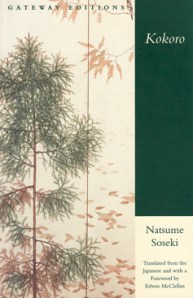
Kokoro

Kokoro

Title: Kokoro
Japanese Title: こゝろ
Author: Natsume Sōseki (夏目漱石)
Translator: Edwin McClellan
Publication Year: 1957 (America); 1914 (Japan)
Publisher: Regency Publishing
Pages: 248

When I first started studying Japanese literature in college, Natsume Sōseki’s Kokoro was one of the first modern novels I read. I remember being disappointed and a bit confused by it, however. Sōseki is one of the major figures in the Japanese literary canon, if not in fact the major figure. His early novel Botchan (坊っちゃん, 1905, recently translated by Joel Cohn) has been required reading for generations of Japanese schoolchildren, and his portrait used to grace the one thousand yen bill. A quick search on Google will turn up numerous syllabi for courses in Japanese literature that all begin with Kokoro. In short, this novel is kind of a big deal.

So why then, when I first read it, was I so disappointed? In short, I couldn’t help thinking, “Is this it?” Kokoro contains few lyrical passages, few descriptions of landscape, season, architecture, interior, or dress. Perhaps as a result, there is also no overt or sustained system of imagery. No light, no sound, no water, no heat. Of course I am exaggerating a bit (there are two memorable passages that occur in a tree nursery and by the seashore, respectively), but this novel boasts none of the opulent attention to detail that, in my mind at least, characterizes a great deal of Japanese literature.

There is also very little plot. The novel is divided into three sections. The first, “Sensei and I,” details the meeting and deepening friendship between an unnamed narrator (“Watakushi”) and an older man who he calls “Sensei.” In the second section, “My Parents and I,” the narrator has graduated from college in Tokyo and returns to his home in the countryside to be with his dying father. The third section, “Sensei and His Testament,” consists of a letter that Sensei has sent the protagonist explaining his past, his melancholy, and his decision to commit suicide after the death of the Meiji emperor. Kokoro ends with the conclusion of Sensei’s letter, and the reader is given no indication as to whether the narrator of the first two sections is able to make it to Tokyo in time to save Sensei or whether his father dies during his absence.

Although every single character in the novel is otherwise fully fleshed out as a believable human being, none of them seem to reflect archetypes familiar to a Western reader. In fact, Kokoro offers very little in terms of allusions and therefore might tend to come off as a bit shallow and one dimensional. Sure, there are some topical references to the death of the Meiji Emperor and the death of General Nogi, who committed suicide to “follow his master” out of an anachronistic sense of honor, but I wonder how deeply the reader is supposed to consider these references. The theme of the passing of an age is intriguing, but far from fully developed in the novel.

So why this novel one of the great classics of Japanese literature? Although I was frustrated the first time I read it, I think I am finally beginning to understand its appeal. Much of the literary writing in the Meiji period (1868-1912), such as Tayama Katai’s “The Quilt” (布団, 1907) and Shimazaki Tōson’s Broken Commandment (破壊, 1906), was concerned with the literary philosophy of Naturalism, which in Japan took the form of an attempt to realistically depict the psychology of a modern individual. The narrative style of such works was often stilted and noticeably stylized (despite their claims of realism). To me, Kokoro is an amazing work in that the narrative style actually feels quite “natural” in a Western way; at no point is the reader made aware of the fact that he or she is reading a novel. In other words, Sōseki was able to take the Japanese language and the concept of Japanese literature and do with them something that no one had done before.

What will appeal to the reader, then, are passages that a first time reader (such as myself in college) might not notice simply because they are so natural. When the narrator returns to his parents’ home, for example, he remarks that coming home from school is nice for the first week or two, but then the novelty wears off both for the student, who misses his friends, and for the parents, who begin to nag him. I couldn’t help smiling a bit when I read this. Moreover, the tragic past revealed by Sensei is his letter is believable but also, perhaps because it is so low-key, quite heart-wrenching. I feel that takes a master writer to avoid melodrama when working with such material, and Sōseki handles his subject matter beautifully.

All in all, Kokoro is worth reading not merely because it is a monument of Japanese literature but because of the sheer quality of the writing (and McClellan’s excellent translation). In any case, I found it very satisfying, and I’m glad I re-read it.

The Housekeeper and the Professor

The Housekeeper and the Professor

Title: The Housekeeper and the Professor
Japanese Title: 博士の愛した数式
Author: Ogawa Yōko (小川洋子)
Translator: Stephen Snyder
Publication Year: 2009 (America); 2003 (Japan)
Publisher: Picador
Pages: 180

Yay! I’m so happy! Finally, another Ogawa Yōko translation! Ogawa Yōko is one of the most interesting writers working in Japan right now, and her popularity only increases with each passing year. A recent search on Amazon.fr yielded more than a dozen translations of Ogawa’s work into French, and I understand that there are just as many translations of her books into German. I feel a little jealous, but, in any case, it’s better to have two books in English than none at all. Ogawa’s prose is hyper-intelligent yet subtle, and her narratives are very Raymond Carver: very simple at first glance, but oh what wonders lurk under the surface. As he did in The Diving Pool, veteran translator Stephen Snyder renders Ogawa’s Japanese into lucid yet multilayered English.

I consider The Housekeeper and the Professor to be close to the perfect “Japanese” novel. There is a bit of drama, but it is notable only for its understatement, and there is almost no plot to speak of; the novel simply ends when one of the main characters dies. The character development is what keeps the narrative going; and, in fact, it’s actually hard to put down. Quite simply, a single mother, who works as a housekeeper to make ends meet, is given an assignment by her agency to take care of a retired math professor, who lives in a small house by himself at the edge of his family’s property. The catch is that the professor’s short-term memory only lasts for eighty minutes. Despite this, the housekeeper manages to establish a good relationship with the professor, whose abbreviated life is enriched by his two great passions, math and baseball. When the professor learns that his housekeeper has a son who must wait for her return from work alone at home, he insists that she brings the boy with her to his house. The professor bonds with the housekeeper’s son over their mutual interest in baseball, and both the boy and his mother come to share an appreciation for numbers and equations with the professor. And that’s it, at least on the surface.

Under the surface, there are a significant number of interesting yet unstated relationships that will intrigue the reader, as well as an implicit question concerning the constantly developing meaning of family in postmodern society. The professor’s mini-lectures on prime numbers, amicable numbers, perfect numbers, and so on are actually quite interesting, as is the way that the old man uses number games to deal with the stress and awkwardness caused by his memory disorder. Just as the housekeeper and her son come to place a great value on these numbers and number games, the reader cannot help but start to see numbers as protagonists of sorts, or at least as oblique symbols concerning the relationship of human beings to one another. Really, like The Diving Pool before it, The Housekeeper and the Professor is good literature and a good read, and Picador has ensured that the paperback as a physical object is quite beautiful as well. I can’t recommend this book enough. Go get it! And, if you haven’t read The Diving Pool yet, go get that one, too!

Kafka on the Shore

kafka-on-the-shore

Title: Kafka on the Shore
Japanese Title: 海辺のカフカ
Author: Murakami Haruki (村上春樹)
Translator: Philip Gabriel
Publication Year: 2005 (America); 2002 (Japan)
Publisher: Vintage International
Pages: 467

Kafka on the Shore is another Murakami novel about disappearing women. That, and penises – or, to be faithful to Gabriel’s translation, cocks. The “Kafka” of the title, “the world’s toughest fifteen year old,” gets a handjob from his (maybe) sister, has sex with his (maybe) mother, and fondles himself (maybe) half a dozen times in between. There are a lot of pages in this book, but there are a lot of cocks, too. Be forewarned.

If you can get past all that, Kafka on the Shore is an utterly charming book. In 2005, when Gabriel’s bestselling translation of the book was released in America, Kafka on the Shore was given a place on the New York Times’s “Ten Best Books of the Year” list and received the World Fantasy Award. I can’t help but wonder how much of this attention was simply a manifestation of the guilt and embarrassment of the American publishing industry, which failed to recognize Murakami’s genius as displayed in such monumental novels as The Wind-Up Bird Chronicle (ねじまき鳥クロニクル, 1995); but, in any case, a lot of people found this book to be utterly charming.

The plot of the novel is long and convoluted, and I see no need to go into it. I would much rather talk about what exactly I found charming about the novel. What I enjoyed the most were the parallel plot lines. Every odd-numbered chapter focuses on the fifteen-year-old runaway Kafka, and every even-number chapter focuses on the sexagenarian Nakata, a likable man who has been rendered mentally deficient by a strange incident in his childhood. Although the two plot lines never meet in anything but the most indirect and metaphysical way, Murakami handles the structure just as skillfully as he did in his earlier novel Hard-Boiled Wonderland and the End of the World (世界の終りとハードボイルド・ワンダーランド, 1985), and I found the experience of following the two stories to be very enjoyable.

The overall atmosphere of the novel was also quite enjoyable. Over the course of his career, Murakami has become more skillful at depicting the small details of everyday life in contemporary Japan, and the attention to setting in Kafka on the Shore should dispel any lingering doubts as to Murakami’s status as a “literary” writer. Particularly enjoyable were the early Nakata chapters, in which the fuzzy-headed old man wanders around Tokyo’s Nakano Ward looking for a lost cat. Nakata apparently has the ability to talk to cats, so he is employed in his neighborhood as a finder of missing pets. Following the details of his life through his muddled but quaint way of looking at the world is, as I have said before, utterly charming. Kafka’s experiences at a small, private library in Takamatsu are rendered in loving detail and will probably send bibliophiles directly to the internet, where they will compare prices on plane tickets to Shikoku. As a side note, the Komura Library described in the novel actually exists and is apparently every bit as pleasant and charming as Murakami makes it out to be.

I hope that I have been able to convince you that this novel is “utterly charming.” Indeed, despite some bizarre cameo appearances by Colonel Sanders and Johnnie Walker, Kafka on the Shore is not as dark as many of Murakami’s other novels and actually manages to break out of the Murakami cycle of privileging the world inside one’s own head above living in the real world. Miss Saeki, the disappearing woman of Kafka on the Shore, is elegantly mysterious and achingly eloquent concerning love, life, childhood, and memory. Her final fate is one of the many mysteries the reader must solve on his or her own, as, like the other supernatural elements in the novel, Murakami never quite satisfactorily explains it. Thankfully, this is another one of the charming points of Kafka on the Shore.

Dance Dance Dance

dance-dance-dance

Title: Dance Dance Dance
Japanese Title: ダンス・ダンス・ダンス
Author: Murakami Haruki (村上春樹)
Translator: Alfred Birnbaum
Publication Year: 1994 (America); 1988 (Japan)
Publisher: Vintage International
Pages: 393

One of my favorite passages in Dance Dance Dance is the ending of one of the last chapters in the novel:

When I was little, I had this science book. There was a section on “What would happen to the world if there was no friction?” Answer: “Everything on earth would fly into space from the centrifugal force of revolution.” That was my mood.

Indeed, that is the mood of this entire novel, which is perhaps the strangest, most nihilistic, and most off-center Murakami novel I’ve read.

Dance Dance Dance is the sequel to Murakami’s popular 1982 novel A Wild Sheep Chase (羊をめぐる冒険). It concerns the unnamed narrator’s quest to return to the Dolphin Hotel and rescue his former girlfriend Kiki, who had disappeared at the end of A Wild Sheep Chase. Upon returning to Sapporo, the narrator finds that the old, run-down, mystery-haunted Dolphin Hotel of his memory has disappeared, and the Sheep Professor is nowhere to be found. A large, modern, high-class resort hotel, also called “The Dolphin Hotel,” has gone up in the same neighborhood, but the managers and staff claim to know nothing of the former hotel. One receptionist, however, responds the inquiries of narrator by telling him about a cold, pitch-black phantom floor at which the hotel’s elevator sometimes stops. In order to recover Kiki, and, in doing so, save the part of himself that had been damaged by the events in A Wild Sheep Chase, Murakami’s protagonist attempts to pursue these mysteries, albeit in a somewhat half-hearted way.

Of course, this being Murakami, there are many side stories that need to be explored along the way. The narrator catches a glimpse of Kiki acting in a bit part in a high-school romance movie alongside an actor named Gotanda, who had been an acquaintance of the narrator in high school. This connection leads our protagonist to a series of misadventures with his former classmate, who has been accused of killing a call girl rented out by a mysterious organization. Also, during his first stay at the new Dolphin Hotel, the narrator encounters and befriends a thirteen-year-old girl named Yuki, who has for all intents and purposes been abandoned by her famous artist mother and her famous novelist father, who have their own ties to shady organizations. Yuki is charmingly cynical, one of her best lines being, “I don’t give a damn what people say. They can be reptile food for all I care,” and she leads the narrator all over Tokyo, Yokohama, Enoshima, and Hawaii.

Do these plot points ever come together? Are the mysteries presented by the novel ever solved? If you’re familiar with Murakami’s fiction, you can probably guess the answer.

Even though this novel is dark and rambling and bears very little thematic resemblance to A Wild Sheep Chase, it should be an interesting and enjoyable read for Murakami fans. Although Dance Dance Dance is only a loose sequel to A Wild Sheep Chase, there are many things that don’t make sense without knowledge of the events of the previous novel. That being said, I also don’t think Dance Dance Dance should be read immediately after A Wild Sheep Chase, as it isn’t so much a sequel as an appropriation of characters and places for the purpose of creating an entirely different story. Alfred Birnbaum is, as always, a fantastic translator, and his rendition of Murakami’s prose makes this novel a fun, if somewhat gloomy, read.

Masks

masks

Title: Masks
Japanese Title: 女面 (Onnamen)
Author: Enchi Fumiko (円地 文子)
Translator: Juliet Winters Carpenter
Publication Year: 1983 (America); 1958 (Japan)
Publisher: Vintage
Pages: 141

Juliet Winters Carpenter, the translator of Enchi Fumiko’s novel Masks, is one of the most eloquent translators of Japanese literature alive today. Carpenter has translated everything from Tawara Machi’s groundbreaking collection of tanka poetry, Salad Anniversary (Sarada kinenbi, 1987) to Asa Nonami’s hard-boiled police thriller The Hunter (Kohoeru kiba, 1996). My advice to all lovers of Japanese literature would be: if Juliet Winters Carpenter has translated it, you need to read it!

Enchi Fumiko is one of the most highly regarded writers of literary fiction in Japan. Her father was a scholar of classical Japanese literature, and Enchi grew up devouring the books in his library, from the medieval Tales of Moonlight and Rain to the stories of Edgar Allen Poe. Her pen name, Fumiko, means “child of letters” or “child of literature.” When she grew up, she undertook the translation of the monumental eleventh-century novel The Tale of Genji. She is famous for incorporating allusions to classical literature into her own fiction, which was highly praised by writers like Tanizaki Jun’ichirō and Mishima Yukio.

Enchi’s work is known for its tightly woven plots, subtle writing, strong visual imagery, and masterful use of symbolism. An Enchi novel is like a structuralist literary critic’s dream come true. There is an incredible amount of information packed within each paragraph, and her novels and stories have inspired a wealth of interpretations. Enchi is an intellectual of the highest magnitude yet also possesses the ability to imbue her fiction with great emotional weight.

Although Enchi is primarily known in Japan for her novel The Waiting Years (Onnazaka, 1939), for which she won the prestigious Noma Literary Prize, Masks has its own spooky charms. Although the work’s title refers to the masks of Noh drama, particularly the “madwoman” masks that lend their names to the chapter titles, the novel draws many of its themes and allusions from the Tale of Genji. The parallels Enchi draws between The Tale of Genji and the cultural climate of postwar Japan are fascinating. Not only does the author create distinct connections between her characters and the characters of the Heian romance, but she also makes use of themes such as spirit possession and romantic substitution to subvert the gendered expectations of the patriarchal and misogynistic societies that hold sway in both The Tale of Genji and postwar Japan.

Although Masks is primarily narrated from the point of view of a male college professor named Ibuki, who is cast in the role of Genji, its true hero is an older woman named Mieko, a powerful Rokujō-like figure with a painful past and veiled intentions. As Mieko’s daughter-in-law and protégée, Yasuko, explains to Ibuki,

Believe me, she is a woman of far greater complexity than you – or anyone – realize. The secrets inside her mind are like flowers in a garden at nighttime, filling the darkness with perfume. Oh, she has extraordinary charm. Next to that secret charm of hers, her talent as a poet is really only a sort of costume.

Masks centers around Mieko’s attempt to use this “secret charm” of hers in order to set into motion a deep and complex scheme of revenge, creation, and rebirth. What Mieko is able to accomplish by the end of the novel is both terrible and beautiful. If nothing else, the events that occur during the final dramatic quickening of the work are thought-provoking and will force the reader to consider multiple ethical questions.

Masks is perhaps one of the best introductions to Japanese literature, and more specifically Japanese women’s literature, ever published in translation. No matter where your literary interests lie, this is a novel you need to experience.

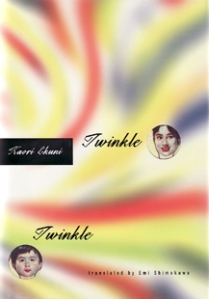
Twinkle Twinkle

twinkle-twinkle

Title: Twinkle Twinkle
Japanese Title: きらきらひかる
Author: Ekuni Kaori (江国香織)
Translator: Emi Shimokawa
Publication Year: 2003 (America); 1991 (Japan)
Pages: 171

About thirty pages into Twinkle Twinkle, I thought to myself, “Are all contemporary Japanese books written by women this depressing?” It’s an interesting literary trend. In America, writers like Kim Edwards (The Memory Keeper’s Daughter, 2005) and Sue Monk Kidd (The Secret Life of Bees, 2004) craft literary paeans to female sisterhood, hope, and endurance, while contemporary Japanese female authors seem to be losing the struggle to gaman, or to deal with the hardships presented to them by Japanese society until they are able to claim some immaterial reward in the far-off future. In short, the new breed of Japanese women writers seems to be cracking under the strain of contemporary Japanese society, which has been slow to acknowledge new gender roles, even as the economic structures that have supported these gender roles have crumbled. Ekuni Kaori’s novel Twinkle Twinkle perspicuously demonstrates the effects of this societal paradox.

Twinkle Twinkle follows the fortunes of the newlywed couple Shoko and Mutsuki. Mutsuki is gay and quite in love with his boyfriend. Shoko is highly emotionally unstable and is quite open about the fact that she doesn’t want to be in a romantic relationship with anyone. Although the pair lives together, and although they are quite affectionate towards one another, their marriage is nothing more than a legal convenience. In fact, the only reason they agreed to marry in the first place was to escape from the pressure imposed upon them by their parents. Through the first months of their married life, Shoko and Mutsuki make friends and lose friends, battle their respective families, and learn how to live with one another in the strange situation they’ve created.

Because Shoko and Mutsuki take turns narrating the chapters, the reader is able to gain a very interesting perspective into their relationship and their individual personalities. I found myself becoming frustrated with the characters and sympathizing with them in turn. Mutsuki is kind, but passive and somewhat clueless. Shoko displays the classic symptoms of borderline personality disorder, which occasionally devolves into depression and alcoholism, but she is honest, true to her herself, and genuinely means well in her interactions with others. Both of the two main characters, as well as the cast of supporting characters, are expertly realized, and I felt that I came to know them quite well over the course of the novel, as if perhaps they were friends of mine in real life.

This is both a good thing and a bad thing. Yes, the characters occasionally have fun and enjoy each other’s company, but the challenges they face are quite real, extremely frustrating, and never entirely resolved. Although the novel has something of a happy ending, I found myself fearing for the fate Shoko and Mutsuki several years down the road. Also, I found it hard to accept Shoko’s extreme behavior at times, and the all too accurate portray of her emotional instability was difficult to deal with. The hardheadedness of her traditional Japanese parents was even worse.

Overall, though, I think Twinkle Twinkle provides a welcome antidote to the bubblegum fluff of shōjo manga, “light novels,” and the works of novelists like Yoshimoto Banana. Don’t let the bright cover of this book fool you – Ekuni’s novel contains more insight into the dark side of contemporary Japanese society than you may find comfortable.

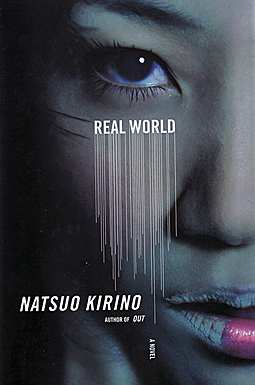
Real World

real-world3

Tile: Real World
Japanese Title: リアル ワールド (Riaru wārudo
Author: Kirino Natsuo (桐野夏生)
Translator: Philip Gabriel
Publication Year: 2008 (America); 2003 (Japan)
Pages: 208

Having already reviewed Rebecca Copeland’s translation of Grotesque, I thought it wouldn’t hurt to go ahead and write an entry for Philip Gabriel’s new translation of Kirino Natsuo’s novel Real World. Real World is not as long or as grand of a story as Grotesque; and, as a result, it is much less intense. I would argue, however, that this is not necessarily a bad thing. Grotesque is extremely graphic and upsetting for hundreds of pages. Real World is about 250 pages shorter, less graphic, and less upsetting. That being said, it is an extraordinarily dark novel, and just as heartbreaking as Out and Grotesque.

Fans of fragmented narratives will appreciate the structure of Real World, which is divided into eight different chapters, each narrated by a different character. The characters in question are Worm, an underachieving student at an elite high school who “snaps” and murders his mother, and a group of four high school girls who help him run from the law. Of these five characters, Worm is the least interesting. Yuzan is a lesbian from the wrong side of the tracks who has tried to find love in Tokyo but failed, leaving her disillusioned with life. Kirarin is a perfect princess in school but leads a shady side life of compensated dating in Tokyo. Terauchi is smart kid with a bright future, but she has been deeply scarred by her mother’s extramarital affair. The “main” narrator, who narrates the first and last of the eight chapters, is Ninna Hori. Ninna is perhaps the most normal of the five, but she too is more than a little jaded with the social roles she is expected to fill, and her comments about herself and her friends are full of insight. She is also the only character left to pick up the pieces at the end of the novel.

I found Real World to be not only an engrossing read but also a refreshing look into Japanese youth culture, which is so often glimpsed through rose-tinted anime sunglasses in America. Being a high school student is no more glamorous in Japan than it is in America, and Japanese students have just as many problems as America students (and perhaps more). Moreover, Japan is not just a country of cherry blossoms and vermillion torii gates but also of ugly convenience stores and crappy train station cram schools. Kirino’s novel is superlatively anti-romantic. Please don’t let the topic of high school students allow you to think for a moment that Real World is a novel for kids; it doesn’t get much more “adult” than this. Each narrative voice is realistic, mature, and fully-realized, and, even though the subject matter is undeniably gloomy, the quality of Kirino’s writing (and Gabriel’s translation) makes this book and extremely interesting and enjoyable read.

The Story of a Single Woman

the-story-of-a-single-woman1

Title: The Story of a Single Woman
Japanese Title: 或る一人の女の話
Author: Uno Chiyo (宇野千代)
Translator: Rebecca Copeland
Publication Year: 1992 (America); 1971 (Japan)
Pages: 132

Translator Rebecca Copeland aptly remarks in her introduction to The Story of a Single Woman that this novella “is the Uno Chiyo story, the story she has told countless times before in earlier works.” Indeed, this semi-confessional narrative of love pursued against overwhelming societal resistance runs not just through Uno’s oeuvre but through the work of pre-bubble women writers in general, at least as it is portrayed in anthologies like Noriko Mizuta Lippet and Kyoko Iriye Selden’s Japanese Women Writers: Twentieth Century Short Fiction. What is special about The Story of a Single Woman, however, is how Uno is able to recount her narrative in a dashing and gallant narrative voice with a minimum of self-pity.

The novella’s heroine, Kazue, is born and grows up in a tiny mountain village named Takamori (not to be confused with the city on the island of Kyūshū) in the early twentieth century. Her mother dies when she is still an infant, and her father, a sake brewer of some renown, quickly remarries himself to a young woman. Oddly enough, it is not Kazue’s stepmother who harasses the child, but rather her father, who controls the family with an iron will and forces everyone to behave with perfect decorum, even as his fortunes decline. At the behest of her father, Kazue is married off to one of her cousins while still in her early teens; but, because her young husband is not yet interested in girls, Kazue walks back home and never looks back. When her father dies, she takes a job as a teacher in a larger town. Perhaps her newfound independence goes to her head, because she soon starts visiting a young male teacher at his residence, unchaperoned. The malicious gossip created by this affair forces Kazue to resign her job. She retaliates by moving to the newly colonized state of Korea to launch a career as a journalist.

This is merely the start of Kazue’s amorous adventures. Throughout the novel, she is brave and cheerful and never defeated, even though her many lovers, who also must yield to the social constraints of the time, abandon her one after the other. Scattered throughout the account of Kazue’s attempts to establish herself as a serious author while following her heart from one relationship to the next are vivid and lovely descriptions of life in the Japanese countryside and cities that would be forever shattered by the Pacific War and its legacy.

Overall, The Story of a Single Woman is a quick and enjoyable read. Even though its tone carries the somewhat Victorian literary flavor of the immediate postwar period, it manages to be quite erotic at times. Very occasionally, it’s also laugh-out-loud funny. What I found interesting about this book is that, although the real-life Uno Chiyo is infamous as a femme fatale, her literary avatar Kazue comes across mainly as a brave young woman who cannot help but suffer from her insistence on playing a man’s game in a man’s world. Although this story doesn’t have a happy ending (although I should add that it doesn’t have a sad ending, either), it is remarkably true to life and even a little uplifting in its honesty.