Idol, Burning

Rin Usami’s Idol, Burning is only 115 pages long, but this masterfully translated literary novella paints a vibrant portrait of a young woman’s search for community in online fandom.

School has always been tough for Akari, whose dyslexia makes writing Chinese characters by hand extremely difficult. Akari has no problem typing, however, and she pours all of her energy into a fanblog devoted to her oshi Masaki, an actor and member of a popular boy band. During the summer, Akari works as many shifts as she can pick up at her part-time job so that she can buy Masaki’s merch and attend his concerts.

Akari’s world begins to fall apart when Masaki punches an overeager fan, thus becoming the target of intense social media discourse. Akari, who has found friendship and personal fulfilment in her fandom, can’t help but take this abuse personally. To make matters worse, when she returns to high school, she’s informed that she’s failed her junior year.

Usami is unflinching in her portrayal of online cultures, and she’s refreshingly honest about the adverse effects that flamewars can have on vulnerable people seeking support in fandom communities. Akari is never presented as pathological, and the members of her family offer support despite not really understanding the life she leads online. If there’s a villain in this story, it’s the Japanese education system, which refuses to accommodate Akari’s learning style while constantly pressuring her to “try harder.”  

Usami’s writing shines during the quiet scenes of loneliness Akari experiences as she watches her communities crumble apart in real time. While it’s easy to mock the intensity of pop star fandom, Akari’s story helps the reader to understand how the power of a dream can keep a teenager moving forward, especially when they feel that their paths are limited in the offline world. Akari is a beautifully unique and well-realized character, but her failed attempts to find meaning and belonging carry much broader implications concerning how Japanese society views difference and disability.    

The English translation of the book includes short essays by the author and her translator Asa Yoneda, as well as short statements from the cover designer (surrealist photographer Delaney Allen) and the illustrator (comic artist Leslie Hung). The novel’s story stands on its own, but it’s a pleasure to read about the inspirations of the writers and artists who brought it to life.

ハンチバック

Saō Ichikawa’s ハンチバック (Hunchback), which won the prestigious Akutagawa Prize for emerging writers, is about a woman with a congenital spinal condition who lives in a group home and posts her secret desires and frustrations on Twitter. It’s an amazing story and a brilliant piece of writing.

The protagonist, Shaka Izawa, has been provided for by her wealthy parents. Although she doesn’t need the money, Shaka works as a freelance writer, mainly penning reviews for stores and restaurants she’ll never be able to visit in person. She also writes explicit erotica, a selection of which opens the novella.

Hunchback is written in a playful and accessible style, but it asks serious questions about disability. Why shouldn’t Shaka create erotica? Why shouldn’t she experience desire? Why shouldn’t she have sex? These questions become less abstract when one of Shaka’s caretakers discovers her secret writing account, and she presents him with a proposition – she’ll pay him to have sex with her.

I was so intrigued by Shaka’s story that I read Hunchback (which is ninety pages long) in one sitting. Ichikawa’s description of the daily life of someone with severe mobility impairments is honest yet compassionate, and her anger at Japanese society’s ingrained ableism is powerful and resonant.

The Forest Brims Over

Maru Ayase’s short magical realist novel The Forest Brims Over is about a young woman named Rui whose husband is a famous writer. Fed up with the words her husband puts in her mouth in his fiction, Rui swallows a handful of seeds that sprout from her body, gradually turning her into a forest.

Despite its fantastic premise, the story is firmly grounded in the psychological realism of the authors and editors who treat women as nothing more than literary symbols to be exploited for sales and awards. In the first four chapters, Rui’s transformation inspires significant shifts in the lives of the people in her husband’s literary circle. In the fifth and final chapter, we finally get to see Rui’s own perspective, and it’s brilliant.

I sympathize with Rui, whose every word is stolen from her by the literary professionals who conspire to confine her existence to a page of pulped paper. If Rui can’t speak in the language of the cultural elite, she’ll find another way of expressing herself, and the vast and mysterious array of life she produces is infinitely more vibrant than her husband’s formulaic literary fiction.

Rui’s husband may have the privilege of publishing award-winning books made of dead wood, but she is the roots and the leaves and the flowers and the wind. The Forest Brims Over is much more subtle and nuanced than perhaps I’m making it seem, but I personally found it joyful and liberating to be reminded that there’s much more room to grow outside the walls built by literary gatekeepers.

Cannibals

Shinya Tanaka’s prizewinning novella Cannibals is a harrowing story of how poverty enables a cycle of abuse and assault. The writing and translation are beautiful, but the book is often difficult to read.

In the brutally hot summer of 1988, a 17-year-old boy named Toma is forced to confront the blood he’s inherited from his father, who beats his stepmother and sleeps with various women in their working-class neighborhood along the banks of a polluted river.

To his disgust, Toma realizes that he, too, receives gratification from physical violence, and he struggles to process what this means. Meanwhile, tensions at home threaten to reach a breaking point when Toma’s stepmother confides that she intends to leave his father.

The neighborhood river is never far from the story, and Tanaka’s virtuoso description of its eventual flood is incredible; the violence of the rushing waters is a necessary cleansing and catharsis.

The damage caused by the flood also serves to deny any complacency with violence that the reader may have developed through identification with the narrator. Still, I can’t help but feel that perhaps the author may have taken this violence too far for my own taste, especially as a reader who tends to be critical of how visceral depictions of assault often obfuscate thematic resonance through shock.

Cannibals is a prime example of what feminist scholar Chizuko Ueno has termed “men’s literature” (as opposed to the more commonly used expression “women’s literature”), which delves into specifically gendered issues that may not by sympathetic to a wider audience. The problem I once had with books like Cannibals is that there were so many of them in translation, especially in relation to the exclusion of similarly disturbing stories written by women. Now that there’s a greater diversity of Japanese fiction in English translation, it’s easier to read something like Cannibals on its own terms instead of seeing the explicit misogyny of the characters as a reflection of the implicit sexism of the publishing industry.

In the end, I think Cannibals might be better suited to a college-level literature class than pleasure reading, at least for most people. Without the context of the masculinity narrative of the 1980s that Tanaka is pushing back against in a frankly heroic style, there’s a danger of Cannibals coming off as almost voyeuristic of working-class poverty and sexual violence. Regardless, I appreciate this novella, and I’m grateful it’s been skillfully translated and lovingly published in a beautiful paperback edition with a striking cover design.

Tokyo Express

Seichō Matsumoto’s Tokyo Express is a slim mystery novel from 1958 whose crime is largely dependent on train schedules. Although two apparent victims of suicide appear to have traveled together to a lonely seaside town, were they in fact being pursued…?

The officer assigned to the case, a young detective named Mihara, suspects the involvement of the president of an industrial manufacturer with close ties to the government. Mihara assumes that his prime suspect, an affable middle-aged gentleman named Yasuda, was attempting to cover up an illegal collusion.

As Mihara pursues various train schedules across the Japanese archipelago, he learns that Yasuda’s elaborate system of alibis checks out. But, if Yasuda didn’t murder the two victims, who could have been helping him?

For me, there were far too many timetables in Tokyo Express, and I found myself skimming to avoid getting bogged down in the numbers. No one in the story has much of a personality, and Mihara is mostly a cipher for the reader. Despite the plot’s emphasis on travel, the locations that Mihara visits don’t really have a sense of place or setting.

I’m given to understand that there are many mystery fans who appreciate this style of writing, namely, just the facts with little by way of atmospheric description. If you’re looking for a puzzle box in book form, Tokyo Express has a lot of fun moving parts to play with. If you read mysteries more for the story, however, it might be better to take a pass on this particular ride.

The Hunting Gun

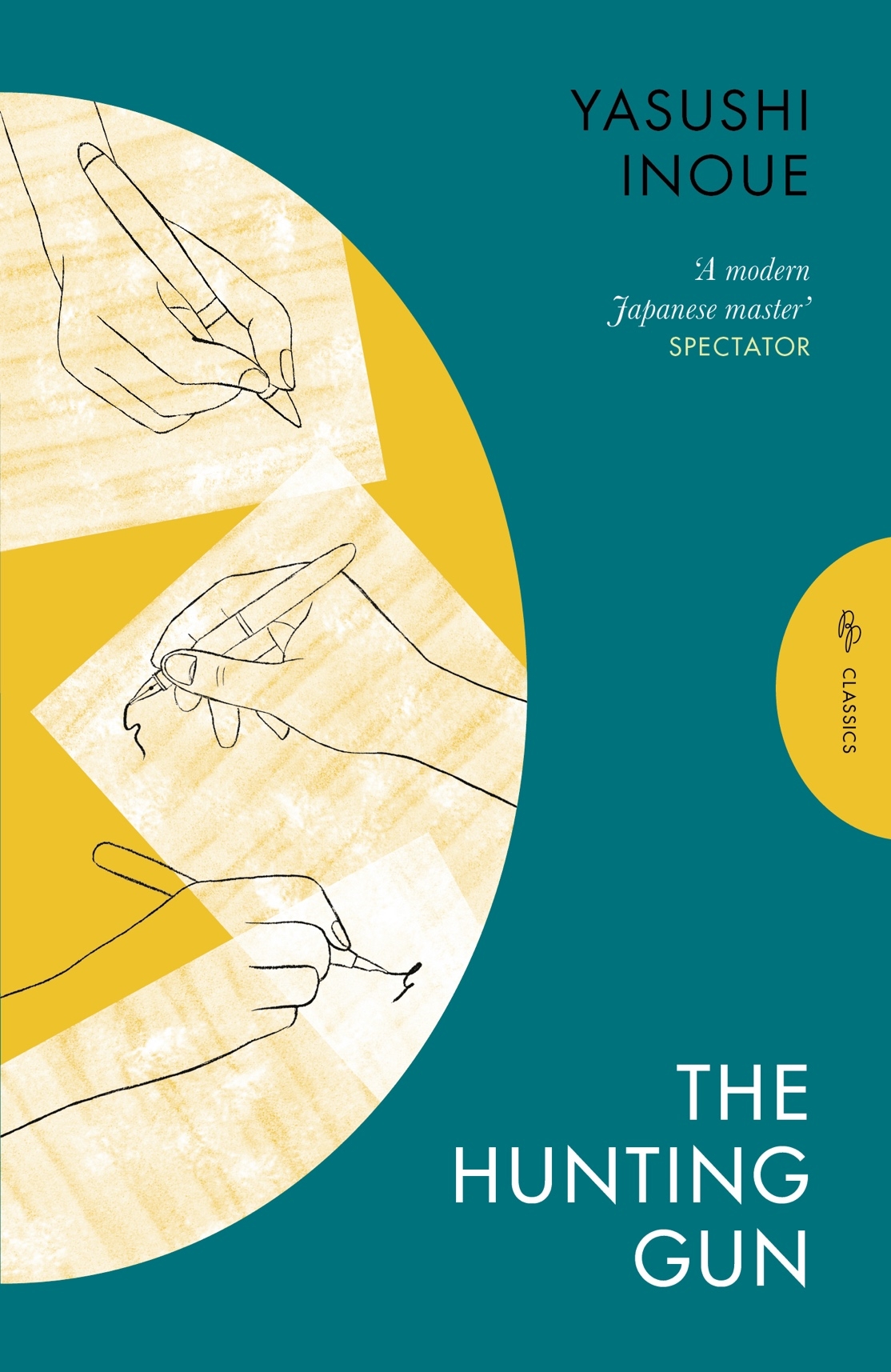
Yasushi Inoue’s epistolary novella The Hunting Gun tells the story of a man’s extramarital affair through three letters: one from his daughter, one from his wife, and one from the woman he loved. The man himself is largely unimportant and provides little more than the frame story. Instead, the three female characters take center stage as they describe the complexities and compromises of their lives and emotions.

My favorite character is the man’s wife, a cultured intellectual who always knew her husband was having an affair. One of the primary reasons she stayed in the marriage was her affection for his mistress, who happens to be her beautiful and elegant older cousin Saiko. Once Saiko passes away after a long illness, the wife unapologetically ditches the husband to pursue her art (and, presumably, her younger lovers) in a villa in the mountains. Good for her.

The Hunting Gun was originally published in 1949, but it reads like the literature of the Victorian era. The eloquence of the three women’s letters is striking, as are the emotional contortions employed by the characters to avoid upsetting the status quo. The choices the three women make are almost comically irrational and counterproductive, but I couldn’t help sympathizing with them.

Michael Emmerich’s 2014 translation has an expansive sense of flow that stands in pleasing contrast to the style of earlier translations. Emmerich’s translation reminds me of nothing so much as the fluent but subtle monologues of Jane Austen (albeit with more than a hint of Brontë melodrama). There are other ways to read this classic of Japanese literature, but I’m grateful for the updated translation provided by Pushkin Press’s handsome stand-alone edition.

A Perfect Day to Be Alone

Nanae Aoyama’s novella A Perfect Day to Be Alone chronicles a year in the life of a young woman named Chizu who moves in with an elderly relative named Ginko after her mother accepts a teaching position in China.

Aoyama deftly captures the reality of a relationship between a flighty 20-year-old girl and a mature 71-year-old woman. There are no heart-to-heart talks or life lessons, just a lot of sitting around and chatting about nothing in particular.

Chizu breaks up with one boyfriend and starts a casual relationship with another, but this relationship goes nowhere. The same could be said of Chizu’s job at a kiosk at a suburban train station. Aside from a vague desire to save money, Chizu has no goals or ambitions.

Rather, the story is completely interstitial, a chapter between chapters of Chizu’s life. A Perfect Day to Be Alone brought me back into my own 20-year-old headspace with an immediacy that would be difficult to achieve through a story with more of a plot.

Nothing happens in A Perfect Day to Be Alone, but I enjoyed getting to know Chizu and Ginko, whose characters are sketched out and then defined with subtle touches. I appreciate the opportunity to spend time in their company, which is supremely chill and relaxing.