Kieli: The Dead Sleep in the Wilderness

Title: Kieli: The Dead Sleep in the Wilderness
Japanese Title: キーリ ― 死者たちは荒野に眠る
(Kiiri: Shishatachi wa kōya ni nemuru)
Author: Kabei Yukako (壁井 ゆかこ)
Illustrator: Taue Shunsuke (田上 俊介)
Translator: Alethea Nibley and Athena Nibley
Publication Year: 2009 (America); 2003 (Japan)
Publisher: Yen Press
Pages: 228

Kieli is one of those hauntingly pretty girls whose special blood and pure heart allow her to see things unnoticed by others. Harvey is one of those chiseled copper-haired boys who is seventeen and has been seventeen for a long time. When their paths cross seemingly at random, Harvey finds himself charmed by Kieli, and Kieli finds herself dazzled by Harvey… Stop me if you’ve heard this story before.

What’s special about this novel isn’t its love story, however, but rather its setting. In her “Afterword,” the author says, “Wasted planets, steampunk, old-fashioned radios, rusty machines, old oil. It would make me as happy as I could be if all of you who like dilapidated things and react to that kind of vocabulary like this book.” I hope the author is indeed as happy as she can be, since her book is perfect for anyone who enjoys the atmosphere conjured by such words. Kieli is set on a dying planet where society still functions to a certain degree as life crumbles to dust in stages. This decay pervades every corner of the novel:

The next morning, when Kieli opened her eyes she was lying on a sofa with broken springs in the waiting room, wrapped in her coat and a dusty old blanket.

The clinic had completely fallen to ruin. Yellow sand and dust had settled below the crisp, clear, cold morning air, and the once clean, white paint on the walls had faded to yellow and peeled off in places, showing the concrete wall underneath.

Kieli spent a while walking through the deserted house, looking for Harvey, the floor creaking with every step she made. When she went up to the second floor, the plants that decorated the balcony had withered to nothing, and only the cracked pots remained under the nebulous morning light.

Everything in Kieli’s world is slowly falling apart. Isolated cities are separated by vast stretches of desert, small villages that serve as way stations along the side of railway lines are slowly shrinking in population, and the wasteland outside habited areas is still littered with the detritus for a war over natural resources that petered out a hundred years ago. Kieli is strangely suited to life in this world, as she possess the unusual ability to see and interact with the ghosts of the dead, who are seemingly more numerous than actual living people. Through the mischief of her dead roommate, Kieli encounters Harvey, who used to be a soldier in the war. Harvey is a creation known an as Undying, a class of artificial beings powered by mechanical cores of pure energy. Aside from his bad attitude, Harvey seems mostly harmless until he unwittingly drags Kieli into a conspiracy concerning the Church that governs Kieli’s world. The two are accompanied by the ghost of an older man known as the Corporal, who resides in the shell of an old radio and provides both insight and comic relief. In an environment where everything is dead or dying, Kieli and Harvey shine brightly as they find adventure and new life in each other’s company.

Since Kieli is a light novel, it receives the full graphic treatment, with eight full-color anime-style illustrations at the front of the book and a number of black-and-white illustrations scattered throughout the book’s chapters. The tropes of the novel are not specific to Japanese popular media, and they should appeal to a wider audience for young adult fiction. Kieli is an orphan who lives in a boarding school, where she is misunderstood and unappreciated by her peers. Harvey is an angsty, brooding badass who has a soft side that he keeps hidden in order to survive in a harsh world. The spirit of the Corporal residing in Harvey’s radio is a grumpy old man who cheerfully dispenses humorous complaints. The Church is mysterious and sinister, and its agents are genuinely frightening.

A shortcoming of many light novels published in translation is that their language is more manga-like than literature-like, by which I mean that its primary purpose is to shoot the reader forward as quickly as possible through a series of increasingly improbable events. Kieli occasionally suffers from this style of narration, but it usually allows the reader time to linger over events and absorb the story’s atmosphere. The translation of Kabei’s prose is lucid and engaging, inviting the reader to enter Kieli’s world without fussing over translation notes and awkwardly translated dialog. Occasionally a character will bow to another character, but the novel otherwise has very little “cultural odor.” Because of the quality of the translation, I found myself reading not just for the story but also for the pleasure of reading such straightforward and well edited language. I also feel the same way about the translation of the Spice and Wolf light novels, and I can’t help but offer my most profound thanks to the editorial staff at Yen Press for doing such an excellent job with their releases.

Kieli ends with a bit of a cliffhanger, but its sequels have already been published by Yen Press, which seems to be keeping up a steady release schedule. I don’t know why I waited so long to start reading this series, because it’s really quite good. I can’t wait to read the next volume!

Book Girl and the Suicidal Mime

Title: Book Girl and the Suicidal Mime
Japanese Title: “文学少女”と死にたがりの道化 (“Bungaku Shōjo” to shinitagari no piero)
Author: Nomura Mizuki (野村 美月)
Illustrator: Takeoka Miho (竹岡 美穂)
Translator: Karen McGillicuddy
Publication Year: 2010 (America); 2006 (Japan)
Publisher: Yen Press
Pages: 183

Oh, Yen Press. Oh, how I love you; oh, how I hate you.

I love the money and effort you put into publishing your books. I love that you took a chance on titles like Black Butler and succeeded remarkably. I love that you turned garbage like Maximum Ride and Cirque du Freak into readable and artistically beautiful graphic novels. I love that you found room in your capitalistic heart for series like Bunny Drop and One Fine Day. I love how you don’t put Japanese manga-ka on a pedestal but instead give equal attention to Korean and American artists. I hate that you stopped publishing the paper-and-ink version of your monthly magazine. I hate that I can only access the digital version from your website even after I pay for it. I hate that you sent cease-and-desist orders to scanlation sites but then decided to launch your digital titles exclusively on the most expensive e-reader on the market.

I am similarly conflicted about the light novels Yen Press has released. I enjoyed Spice & Wolf, even if it was a bit bland (the most interesting bits were the watered-down speculations on preindustrial economies, if that gives you any idea how clumsy the characterization was). Kieli had an intriguing premise and was set in a fun dystopic fantasy world but was riddled with stereotypes and awkward dialog. Worst of all, the nails-on-a-chalkboard banality of The Melancholy of Haruhi Suzumiya made me despite not only Tanigawa Nagaru but the entire genre of light novels. So, when Nomura Mizuki’s Book Girl and the Suicidal Mime was released last July, I decided to give it a pass. I felt justified in my decision after reading the opening epigraph:

Mine has been a life of shame. I’m like the one black sheep born into a pure white flock. Unable to enjoy the things my peers enjoyed, unable to grieve the things they grieved, unable to eat the things they ate – being born an ignoble black sheep, I didn’t understand the things my friends found pleasant, such as love, kindness, and

Actually, let’s just leave it at that. There’s no need to copy the full paragraph. Glistening tears leaving black ebony trails of eyeliner down a tragic alabaster face – you get the picture. Maybe I would be more patient with such things if I were seventeen; but I’m ten years past seventeen and not quite as intrigued by alienated narcissism as perhaps I once was, regardless if said narcissism is a deliberate homage to Dazai Osamu. And so it was that Book Girl fell off my radar.

What made me leave my desk and walk straight to Borders to pick up a copy was Erica Friedman’s glowing review of the second book in the series, Book Girl and the Famished Spirit, over on Okazu. If the series is that good, why shouldn’t I read it immediately? And so I did. Suicidal Mime was short and engaging enough for me to read from cover to cover the very evening I bought it, and I did indeed enjoy the experience.

The “book girl” of the title is Amano Tohko, who seems to be an ordinary high school student save for the fact that, instead of food, she consumes the written word. She is the president of her prestigious high school’s book club, the only other member being Inoue Konoha, whom Tohko has drafted to write short, impromptu snacks for her. Tohko’s secret is that she quite literally eats paper with stories written on it, and Konoha’s secret is that he once wrote a bestselling novel under the name of his former girlfriend, who had committed suicide by jumping off the roof of her middle school in front of him. Konoha is taciturn but good-natured, and Tohko is brash but unflaggingly cheerful. The dynamic between these two characters is typical (one might almost say stereotypical) of the genre of Japanese high school comedy, but it’s entertaining nonetheless.

The book is plot-driven instead of character-driven, though, and the plot is set in motion with the introduction of Takeda Chia, who asks Konoha to write a series of love letters for her. The recipient of these letters is Kataoka Shuji, an upperclassman on the archery team. As Konoha soon discovers, however, Shuji doesn’t exist. Or, at least, not anymore – he supposedly committed suicide ten years ago, but a letter found inside an old copy of Dazai Osamu’s No Longer Human hints that there might have been more to his death than suicide. The story is thus propelled by three intertwined mysteries. Who was Kataoka Shuji? How did he die? What stake does Chia have in the matter? Playing the role of Sherlock, Tohko knows more than she lets on but sends Konoha on several fetch quests to discover concrete clues.

These clues seem unconnected at first; and, unfortunately, they tend to remain unconnected towards the end of the book, when everything wraps up so quickly that I was left wondering what had just happened. It turns out that Dazai Osamu is not the only sociopath in the story; literally everyone is a black sheep who has lived a life of shame. This sudden plot development boggled my mind, and I ended up not really caring about any of the inexplicably psychologically damaged characters. Perhaps this makes me a sociopath, but, in my defense, the characterization is rather weak. For example, Tohko is introduced to the reader in this way:

Tohko was perched on a metal folding chair, her knees pulled up to her chest. It wasn’t a very modest way for her to sit. Her pleated skirt was almost wide open – but not quite. If she moved her legs even slightly she would be flashing me.

This is how Chia is introduced:

A girl was splayed out on the floor, her skirt flipped up in her fall, exposing her bear-print underwear for all to see. It occurred to me that my little sister had the exact same pair of underwear, but she was only just starting elementary school.

In other words, the characterization depends fairly heavily on anime tropes, which are emphasized and reinforced by the illustrations:

To make a short story even shorter, then, Book Girl and the Suicidal Meme is a plot-driven novel with a ridiculous and poorly paced plot populated by characters that are little more than amalgamations of tropes culled from the otaku database. Despite this (or perhaps because of this), the book is a fun read. It’s short, and it moves quickly. It doesn’t take itself too seriously, and I imagine how it would be perfect for a younger audience. If nothing else, Tohko’s synaesthetic responses to literature are kind of cute:

“Mmmm, so good. Fitzgerald has a really snazzy flavor. I feel as if flamboyance, glory, and passion are dancing a waltz in my mouth, like I’m eating glittering caviar with champagne at a party. When I bite into it, its delicate skin pops, and a fragment of liquid spills into my mouth.”

As you can probably tell from the above passage, the touch of the translator is feather-light, so reading Book Girl feels really no different than reading “normal” (ie, contemporary American) young adult fiction, save for the eight full-color pages of illustration at the beginning. At $8.99, the book is priced like normal young adult fiction as well, so it’s well worth picking up and breezing through for anyone interested in light novels, young adult fiction, or anime and manga in general. I’m definitely going to order the second volume of the series before my next plane ride. The Famished Spirit is about sixty pages longer than The Suicidal Mime, so hopefully there will be more room for plot and character development.

Another mystery-flavored light novel I read recently was the first volume of Sakuraba Kazuki’s Gosick series, which is published by Tokyopop and still (as of this writing) available at a discount through Right Stuf. Like Book Girl (and many of Doyle’s original stories), Gosick employs a Todorovian element of fantasy in that the reader never quite knows if the cause of the story’s improbable events is supernatural in origin. The innocence of the beautiful young female Holmes-equivalent can be grating at times (as is that of Tohko), and there were times I suspected that her “astronomical genius” was only given to her by the author to make her a more desirable prize for the male reader-stand-in protagonist; but, if you can get around that, the first volume of Gosick is an enjoyable mystery novel. The Gosick anime series is currently streaming on Crunchyroll, and it’s worth briefly checking out if only for its gorgeous Mucha-inspired art nouveau opening sequence.

Zaregoto, Book 1: The Kubikiri Cycle

Title: Zaregoto, Book 1: The Kubikiri Cycle
Japanese Title: クビキリサイクル 青色サヴァンと戯言遣い
(Kubikiri cycle: Aoiro savant to zaregoto-zukai)
Author: NISIOISIN (西尾 維新)
Translator: Greg Moore
Publication Year: 2008 (America); 2002 (Japan)
Publisher: Del Rey
Pages: 332

I am not a big fan of NISIOISIN (who I am going to refer to as “Nisio” for my own convenience). I didn’t get a terribly good impression of him from what I had read of his work before, which was limited to Death Note: Another Note, a collection of three short stories based on the manga xxxHOLiC (you can find my review of that one here), and the short story “Magical Girl Risuka” in the second English edition of the literary magazine Faust. Judging from these stories, Nisio is obsessed with the concept of genius. Of course, genius and its practical applications are fascinating, which is why characters like Sherlock Holmes and Tony Stark are so appealing. Nisio’s problem, however, is that he amps the asshole factor of Holmes and Stark all the way up to eleven and turns it directly towards the reader. When I read his work, I feel like he’s attacking me personally for being so stupid and incompetent, unlike his collection of beautiful geniuses. I think there’s perhaps an element of tsundere at play here, and perhaps it’s my fault for not being Nisio’s target audience, but there’s an even more annoying problem with his recurring descriptions of genius. I am going to call this problem the Hannibal Lecter paradox. Sure, it’s easy to say that a character has an IQ of 250, but it’s a bit tricky to write such a character if the author himself falls within a more normal range of intelligence, and most authors – including Nisio – fail.

I myself may not be the sharpest tool in the shed; but, if someone is going to tell me (or at least my reader-vehicle protagonist) that I’m stupid, I would at least prefer for that person to be interesting and intelligent, not a poorly-written, bloated mass of anime clichés. Zaregoto, Book 1: The Kubikiri Cycle is filled with many such bloated masses; but somehow, it works. In the same way that one angry bird is annoying, yet hundreds of angry birds are epic, Zaregoto is so ridiculously cliché that somehow it ends up being awe-inspiring. Are you ready to play cliché bingo? Let’s go!

Mild-mannered and unassuming teenage male protagonist who has secret depths of inner strength, Ii-chan, is friends with a beautiful teenage girl who is such a genius that she has trouble taking care of herself. She is a super-elite international computer hacker who builds her own super-amazing hardware and software and prefers the virtual world to the real world, you see. Anyway, this beautiful girl genius, Kunagisa Tomo, is invited to a small island inhabited by an outcast daughter of a very rich family. This outcast rich girl, Akagami Iria, is herself young, beautiful, and a genius. Since she either can’t or chooses not to leave her island, she invites all sorts of other geniuses to come to her. It just so happens that all of the other geniuses who visit her are also young, female, and beautiful. All of these gorgeous geniuses are cared for by Akagami’s (young and beautiful) trio of maids, who are sisters and hyper-talented at martial arts, among many other things. Everything is going well on Wet Crow’s Feather Island as the geniuses compare the sizes of their respective penis envy by taking turns telling Ii-chan what a stupid idiot he is, but suddenly! Someone is murdered! And we don’t know who did it! And then the prime suspect herself is murdered! In a locked room!

It gets worse from there, but I imagine my point has already been made. My mind boggles at how Nisio was able to hit so many of the high-profile mystery and anime stereotypes all at once. I kept reading just to see what would come out the bag next, and I was never disappointed. What is even more interesting about the book, however, are its logic puzzles. I’m not sure whether our narrator Ii-chan is deliberately unreliable or just an idiot; but, in either case, Sherlock Holmes he is not. He almost never notices anything for himself, and other characters are constantly pointing things out to him. What Ii-chan is good at doing, however, is taking all of this information, putting it together, and analyzing it. Along the way, he explains classic logic flaws and paradigms to the reader, which is fun in a Michael Crichton “this is how science works” sort of way.

None of this helps him solve the mystery, however, because the mystery itself is beyond ridiculous. Let it suffice to say that several people on the island are in the habit of amusing themselves by switching identities. And by “several people,” I mean “almost everyone.” (I kept expecting Ii-chan to pull off his pants and surprise everyone by being a beautiful girl genius himself, but alas, it didn’t happen.) There is no way that the reader can figure any of this out, so one must simply follow the twists and turns of the story developments and its various revelations along with the narrator. The dénouement of the mystery is so convoluted that it ceases to make any sense whatsoever about halfway through, but the identity of the killer at the core of the tangles of plot thread is actually quite interesting, especially as a conclusion to Nisio’s fetishistic focus on genius.

I will be honest. I bought Zaregoto because it was on sale for three dollars at an anime convention, and I read it because my plane back home from said convention was delayed for a few hours. Under those circumstances, which allowed me to read the book all the way through in one sitting while fueled by sleep deprivation and gallons of cheap coffee, I enjoyed it immensely. The translation is smooth and polished, and the illustrations by take are a very nice touch. This novel is the first in a nine-volume series, and it thus leaves certain plotlines open, like Ii-chan’s past and his budding romantic relationship with Kunagisa. The second volume of the series was released in English translation earlier this summer, but I’m not sure if I enjoyed the first volume enough to seek it out. But if I find it on sale for three dollars at another anime convention, I will definitely grab it.

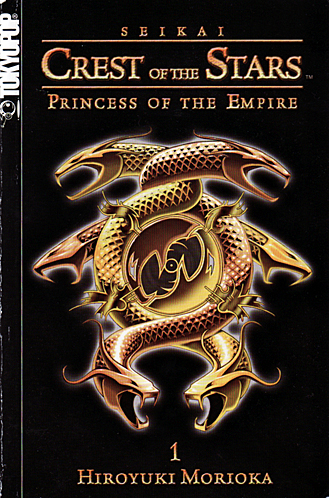
Crest of the Stars

Title: Crest of the Stars: Princess of the Empire
Japanese Title: 星界の紋章:帝国の王女 (Seikai no monshō: Teikoku no ōjo)
Author: Morioka Hiroyuki (森岡浩之)
Translator: Sue Shambaugh
Publication Year: 1996 (Japan); 2006 (America)
Publisher: Tokyopop
Pages: 212

I am a great lover of books, and I spend a great deal of my time reading. I genuinely enjoy almost everything I read, no matter what the genre, and rarely do I dismiss something as absolutely not worth reading. It is very easy for me to explain why I like a particular book, or what is valuable about a particular work, but I think that sometimes it’s important to also discuss what is mediocre, and what can be done better.

Morioka Hiroyuki’s Crest of the Stars series was recently held up to me as a paragon of Japanese science fiction. I wasn’t impressed with the translation of the first book in the series, Princess of the Empire, when it was released in the fall of 2006, but I decided to try it again. The series is massively popular in Japan, and it has quite a dedicated fan base in America as well. I have heard it described as a masterpiece of Tolkienesque proportions in several reviews; and, in my mind, there is no higher praise. Perhaps I had misjudged it four years ago.

Unfortunately, upon re-reading the book, that turned out not to be the case. Princess of the Empire starts off with a wonderful prologue, which briefly introduces the main character of the series in an interesting and beautifully described setting before launching into a short but fascinating account of the space journeys that led to the present moment. This history is then interrupted by action! intrigue! betrayal! and emotion! Unfortunately, this prologue is only sixteen pages long. What follows is 161 pages of utter garbage.

The teenage hero of the series, Jinto, arrives at a spaceport, where he is met by a beautiful blue-haired space elf named Lafiel. Lafiel takes Jinto to a space elf ship which will transport him to the space elf academy (Jinto, although genetically human, is politically an honorary space elf). The ship is attacked by a human group that seeks to oppose the space elf empire, and only Jinto and Lafiel escape. The ship is destroyed, and the unlikely pair (well, actually, very likely, considering that there are no other characters) is stranded on a small backwards planet. The end. Oh, and if you guessed that Lafiel is the princess of the space elf empire, you win a cookie.

You might be thinking, well, if Morioka spins 161 pages out of relatively nothing, then he must be a fairly talented writer with an eye for detail and a talent for dialog. Wrong. The Crest of the Stars series is known for its world building, and what Morioka has given us is 161 pages of almost unmitigated world building. The space elves are called Abh, they have a space empire, they have strange breeding practices, and they are genetically engineered to be beautiful, blue-haired, and psychic. That’s right, they are psychic space elves – which would perhaps be forgivable if there were more to them. Unfortunately, Morioka’s world building reads like a world history textbook written for fourth graders. Even when delivered in speech, the tone of this information is uniformly dry, essentialist, and uninteresting. Population statistics and general government details are provided, but nothing is said about culture, religion, art, lifestyles, political factions, diversity, philosophy, attitudes towards technology – or anything that the reader might actually care about. The clunky constructed language that annoyingly pervades the text is substituted for any real imagination. The almost complete lack of any visual imagery makes the book seem almost sterile, which I don’t think is a deliberate choice on the part of the author, whose writing is incessantly puerile:

Sure, Jinto had experience interacting with girls – he’d made a point on Delktou, in his own way. However, older women were still a complete mystery to him – especially gorgeous older women who were commanders of interstellar battleships. He couldn’t get his heart to stop racing.

In other words, instead of building a fictional world gradually while pulling his readers deeper into said world through plot thickening and character development, making them increasingly curious about the universe in which the characters live as they become increasingly attached to the characters themselves, Morioka completely forgoes plot and character development in order to construct his setting, which quite frankly feels like a cliché mix of Star Wars empire-and-princess driven space opera and Star Trek alien-culture-of-the-week episodic exploration adventure. The fact that the Abh are long-lived, pointy-eared, and dismissive of humans does not make Crest of the Stars Tolkienesque, unfortunately. In his postscript, Morioka states that he hopes “to make shameless sci-fi fans groan.” I’m pretty sure “groan” is the operative word here, since even Troy Denning’s novels set in the Star Wars universe are better written. Alas.

Princess of the Empire is everything I hate about the genre of young adult fiction, which tends to presume that its readers can’t handle complex plots, three-dimensional characters, figurative language, or middle school vocabulary. It could be argued that Japanese light novels are an entirely separate medium than young adult fiction; but still, there are infinitely better light novels out there. One of my personal favorites is Ono Fuyumi’s The Twelve Kingdoms series. A translation of the fourth installment, Skies of Dawn, was recently released a week or two ago, and I am happy to report that the series is only getting better with each successive book.

If it’s Japanese science fiction you’re looking for, then popular mainstream writers from Abe Kōbō to Ōe Kenzaburō to Miyabe Miyuki have successfully tried their hands at hard science fiction at one point or another. If you’re looking for the epic adventure and unparallel world building of Frank Herbert (or China Miéville), then check out Murakami Haruki’s Hard-Boiled Wonderland and the End of the World, which benefits from one of the most artistic and creative translations I have ever read. If you’re more in the mood for the intellectual short fiction of someone like Ray Bradbury (or Tim Pratt), then check out Tsutsui Yasutaka’s collection The Salmonella Beings from Planet Porno. If you’re in the market for lighter fare, I have been especially impressed by several of the translations I have read from an upcoming press called Haikasoru, which is an arm of Viz Media, an established publisher of manga intended for a slightly more mature audience than that targeted by Tokyopop.

In any case, to return to Princess of the Empire, it’s a morass of weak writing and tired stereotypes. Perhaps the Crest of the Stars series deepens in the second and third books, which are also available from Tokyopop, but I would rather spend my time reading all the cool new stuff that seems to be coming out almost every month. For those who want to know what all the fuss is about but don’t have the stomach to brave the light novels, there is always the Crest of the Stars manga trilogy (also published by Tokyopop). The manga are just as mediocre as the books – but at least the female characters provide the service of bending over to reveal themselves every few pages. Which, I suppose, is always a welcome distraction from heavy-handed world building and the overuse of a constructed language.

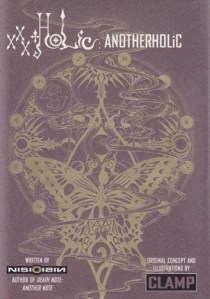
xxxHOLiC: ANOTHERHOLiC

xxxHOLiC

Title: xxxHOLiC: ANOTHERHOLiC: Landolt-Ring Aerosol
Japanese Title: xxxHOLiC アナザーホリック ランドルト環エアロゾル
Author: NISIOISIN (西尾維新)
Translator: Andrew Cunningham
Publication Year: 2008 (America); 2006 (Japan)
Publisher: Del Rey Books
Pages: 203

Given my fondness for the supernatural genre, it is no surprise that I love CLAMP’s manga xxxHOLiC. It took me awhile to pick up the first volume, however, because the concept seemed so cliché and gimmicky: an excitable high school boy who can see spirits works at the shop of a witch who promises to eventually cure him in a story featuring numerous plot crossovers from the simultaneously running epic manga (I believe there are currently twenty-seven volumes of it) Tsubasa: Reservoir Chronicles. I was tempted, however, by the Japanese tankobon, which Kodansha has published in beautiful editions, and ended up becoming addicted to the series. Not only is the artwork gorgeous in the style of early twentieth century Japanese lithographs (or Edward Gorey drawings), but the manga is dark and engaging in a deliciously creepy way. Besides, I am in love with Yūko, the hedonistic yet wise ‘Dimensional Witch’ who employs Watanuki, the hapless protagonist.

I had known about NISIOISIN’s novelization of xxxHOLiC for some time, but, unimpressed by his work in the two translated volumes of the short fiction anthology Faust, I never bothered to pick it up (ditto with his novelization of Death Note). Upon accidentally running across the book in a local bookstore, however, I was seduced by the beautiful gold-foil embossed cover and the chapter heading illustrations provided by CLAMP. Perhaps I should give it a chance, just like I did the original manga. Perhaps there is more to NISIOISIN than meets the eye.

Nope. Wrong. In short, this is a waste of a hardcover book. All of the subtle black humor and eeriness of the original manga turns to dust in the hands of the novelist. To back up a bit, it is perhaps a stretch to call ANOTHERHOLiC a novelization. The book is made up of three episodic short stories featuring the characters from xxxHOLiC. The first story, “Outerholic,” is a prose adaptation of an episode in the first volume of the manga and thus retains a modicum of the charm of the original. The second two stories are, as far as I can tell, NISIOISIN’s original creations. And they suffer for it.

Why do I hate NISIOISIN so much? Because I think he hates me, his reader. In all sincerity, what he has written is so full of bitterness that it left me feeling defensive. I’m not the sort of person who feels the need to evaluate whether NISIOISIN was true to the original characters, but I definitely got the feeling that he does not like them. Watanuki comes off as juvenile and whiny, Yūko is petty and self-important, and the writer even extends harsh editorial judgment towards his own original characters. If the writer’s unrelenting antagonistic attitude were not enough to turn me off to this book, I’m sure the sloppy writing would have pushed me over the edge. NISIOISIN’s prose is rife with sentence fragments and ellipses, which might have some sort of dramatic effect if they didn’t appear multiple times on every page. On a broader scale, NISIOISIN relies not on foreshadowing, atmosphere, or suggestion to create a sense of mystery but rather on withholding information from the reader in a taunting way that almost resembles bullying. The last story forgoes any plot at all in favor of a long and tediously sophomoric pseudo-philosophical conversation. Moreover, things like the frequent otaku references to anime like Azumanga Daioh, combined with Yūko’s debate with Watanuki over the meaning of moe, left my head spinning.

According to the author biography in the back of the book, NISIOISIN was born in 1981, which would make him 27 or 28 this year. Although his accomplishments are nothing to sneeze at, ANOTHERHOLiC made me feel like he really needs to get a life and grow up. When I first started reading this book, I was considering buying the translation of the first volume of the author’s Zaregoto: The Kubikiri Cycle, but now I’m not sure I want to read anything written by him ever again. In any case, despite Del Rey’s lovely publishing job, ANOTHERHOLiC is not worth the money, even for fans of CLAMP’s original manga.

I should mention, however, that I don’t think the failure of this book is the fault of the translator, Andrew Cunningham. Cunningham does a wonderful job of rendering NISIOISIN’s numerous idiotic puns into English, and in fact the most enjoyable part of the whole thing were the translator’s footnotes. I can only hope that Cunningham will apply his considerable talent to other authors in the future.

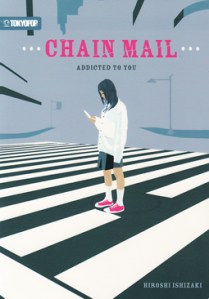
Chain Mail: Addicted to You

chain-mail

Title: Chain Mail: Addicted to You
Japanese Title: チェーン・メール―ずっとあなたとつながっていたい
Author: Ishizaki Hiroshi (石崎洋司)
Translator: Richard Kim
Publication Year: 2007 (America); 2003 (Japan)
Publisher: Tokyopop
Pages:209

Okay, I’ll admit it: when I came back home from Japan this past summer, I got really into Stephenie Meyer’s Twilight series. I know that many people like to complain about how the books are poorly written, misogynistic, heterocentric, painfully conservative, blah, blah, blah (I’m surprised no one has ever called them “phallogocentric” – that’s my personal favorite). First of all, the Twilight books are not poorly written; anyone who’s actually seen “poorly written” can attest to that fact. Second, I like to turn my feminist switch off when I read sparkly teenage vampire romance novels.

In any case, the Twilight series alerted me to the existence of the American genre of young adult fiction in a way that Harry Potter never did. (I think this is partially because I wouldn’t be caught dead reading “young adult fiction” when I was actually a “young adult,” but kids were a lot cooler seven or eight years ago.) I went to my local Borders and started doing market research, finding that, indeed, young adult fiction is a thriving genre, even though the vast majority of it is absolute crap. Perhaps the only good thing about the sudden popularity of the genre is that manga publishers like Tokyopop have started translating and publishing Japanese light novels.

A light novel is the Japanese equivalent of young adult fiction. These short, middle-school reading level books read like the plot of a manga, are often illustrated by noted manga artists, and are generally serialized like manga. Many popular anime, such as Slayers (スレイヤーズ) and The Melancholy of Haruhi Suzumiya (涼宮ハルヒの憂鬱) are adaptations of even more popular light novel series. Just as is the case with America, most light novels are absolute crap, and you will find a good selection of these less-than-stellar light novel series in Tokyopop’s catalog. Thankfully, the company has chosen to publish a few good light novels, even if they don’t have brand-name recognition.

One of my favorite offerings from Tokyopop is Ishizaki Hiroshi’s Chain Mail. Ishizaki has penned the text of several manga, most notably Miss Black Witch’s Halloween (黒魔女さんのハロウィーン), but he is also quite famous in Japan as an author of realistic fiction for young women. Although the plot of Chain Mail is somewhat far-fetched, this novel focuses on the development of its characters and their daily life as high school students in Tokyo.

What attracted me to this novel was its narrative structure. The narrative is divided between three narrators: Mai, Sawako, and Mayumi. These three girls, who may or may not know each other in real life, play a game in which they collaborate on a murder-mystery novel via posts made to an online message board on their cell phones (the internet is widely available on Japanese cell phones and has been for years). Thus, the narrative switches between the main story and the story that the girls are writing. Each girl is in charge of a certain character in the online story, and things get interesting when the events that happen to the characters in real life start to mirror the events they write into the story. There is never a hint of anything supernatural, but the blurred identities and real-life mysteries are quite uncanny.

Although only one of the three characters can be called sympathetic, I did feel a great deal of sympathy for each of them. Ishizaki doesn’t pull punches in his characterization and shows each of the three girls at her weakest moments. These three girls, who have been damaged by their families and the pressures forced on them at school, seek real friendship and connection through a cell phone game that had initially been created as a joke. Is the story pathetic? You bet. But it’s also touching and exciting, with lots of Nietzsche and Shibuya thrown in for good measure.

I would highly recommend Chain Mail to anyone interested in young adult literature, contemporary Japanese popular culture, or even Japanese literature in general. It’s a fascinating book, even if it doesn’t have pictures. Other fiction I would recommend from Tokyopop includes the Twelve Kingdoms series (by Ono Fuyumi), Kino’s Journey (by Sigsawa Keiichi) and anything written by Otsuichi, like Calling You or Goth. Tokyopop has recently taken down the “novels” section of its website, which makes me worry that the company doesn’t see a future for them, but I will go ahead and provide a link to their light novel catalog:

Tokyopop Catalog