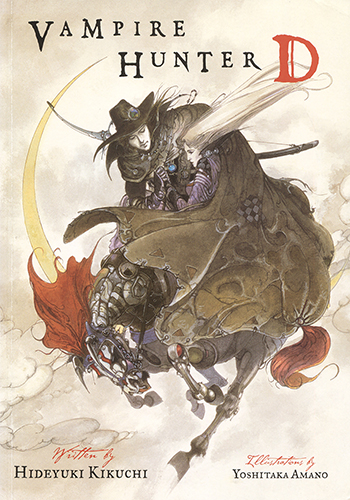
Vampire Hunter D

Vampire Hunter D is the first in a (still-ongoing) series of science fantasy novels written by Hideyuki Kikuchi and illustrated by the legendary Yoshitaka Amano. This first volume was published in 1983; and, in 1985, it was adapted into a film-length, direct-to-video animation that became a cult classic in the 1990s, when circles of genre fiction fans discovered ultraviolent sci-fi anime like Akira and Ghost in the Shell.   

I will admit that I was never able to get into the anime, whose art style doesn’t appeal to me personally, but I recently became interested in the novel series after rereading Gene Wolfe’s The Book of the New Sun. Wolfe’s tetralogy is perhaps the defining work of the “dying earth” genre of speculative fiction, in which human civilization has decayed to a medieval level after a global disaster in the far future.

Vampire Hunter D is set roughly ten thousand years in the future, when what remains of humankind lives in isolated settlements supported by barely-functional robots and occasionally policed by traveling bounty hunters sent from the Capital, which is filled with ruins but nevertheless seems to be the last city of any size. The story takes place on the Frontier, which has a pseudo-American “Weird West” sort of atmosphere that will perhaps be familiar to fans of Stephen King’s Dark Tower series.

Lurking above the ranches and saloons and cowboys are the remnants of a European-style aristocracy, who live in gigantic castles fortified by hypermodern surveillance technology. The Nobility, as they’re called, are immortal. Through various genetic alterations, they’ve come to resemble mythical vampires, and they’re proud to refer to themselves as such. Though the scattered Nobility are capable of artificially manufacturing their own nutrition, they have grown cruel and proud, and some terrorize humans for sport.

Doris Lang, a seventeen-year-old girl who manages her late father’s ranch outside of a small and dusty town on the Frontier, has fallen victim to the attention of the local vampire lord, Count Magnus Lee. Knowing that it’s only a matter of days before she’s either taken by the vampire or exiled by her fellow townspeople, Doris stands on the highway and waylays travelers in hopes of finding a professional hunter who specializes in handling monstrous mutants.

In a brilliant stroke of luck, the first hunter Doris encounters is one of the greatest, a vampire hunter who goes simply by the initial “D.” Though he appears to be a beautiful young man, D is a mixed-species dhampir who possesses the superhuman powers of vampires without most of their weaknesses. For his own mysterious reasons, D consents to be “hired” by Doris for no other payment than room and board.

The ancient Count Magnus, who is backed by his beautiful but deadly daughter Larmica, will not be easy to defeat. To make matters even more complicated, vampires are the least of the dangers threatening the humans who live on the Frontier, and D will also have to contend with werewolves, witches, outlaws, and lynch mobs if he hopes to keep Doris safe. There are eight chapters in Vampire Hunter D, and each presents its own unique set of villains. All of these threats eventually converge into a perfect storm of danger; but, in the end, it all comes down to a battle between D and the vampire lord.    

There’s a great deal of action in Vampire Hunter D, all of which is translated in a quick and punchy style by Kevin Leahy. There’s a somewhat shonen manga style to the action scenes, in which each of the characters performs a series of special attacks that have a rock-paper-scissors way of canceling one another out. I’m not generally a fan of action scenes in prose fiction, but Kikuchi’s sense of pacing is excellent, as is the creativity devoted to D’s opponents.

I’m also impressed by how lowkey horny this book is. Stories about vampires are infamously erotic, but Vampire Hunter D has a more universal Frank Frazetta style of sexualization. Gender, age, and even species don’t matter; everyone gets the same “Vaseline on the camera lens” treatment. As with the monster-of-the-week action scenes, I found this 1980s pulp fiction style of writing to be extremely charming.

It’s perhaps because of the nostalgic charm that I didn’t mind the story’s relative lack of psychological depth or complexity. Though she’s capable of defending herself against lesser monsters, Doris is a classic damsel in distress, and D remains mysterious from start to finish. D’s opponents seem to be evil simply because they’re evil, and even Count Magnus doesn’t have a personality that goes deeper than the usual vampire tropes. His daughter Larmica is granted a modicum of character development, but this is sadly limited. Still, the gothic expressions of the “dying world” setting are fantastic, and I appreciate that the world itself has far more character than the actors who drive the plot. 

I’m given to understand that, as a series, Vampire Hunter D leaves behind its formulaic action-oriented structure after the first few volumes. I read the first volume around the time it was originally published in English translation in 2005 and didn’t think much of it, but I find it far more compelling now that I’m older and have a better understanding of the story’s genre tropes, as well as how Hideyuki Kikuchi fits into a timeline of Japanese dark fantasy that’s recently come to wider international attention with the 2022 video game Elden Ring.

Dark Horse Books has published the first thirty books in translation, which are currently being collected into ten omnibus volumes. The first novel stands alone, and it’s a relatively quick read. I’d definitely recommend Vampire Hunter D to dark fantasy genre fans, as well as to anyone curious about the roots of JRPG video game tropes and imagery.

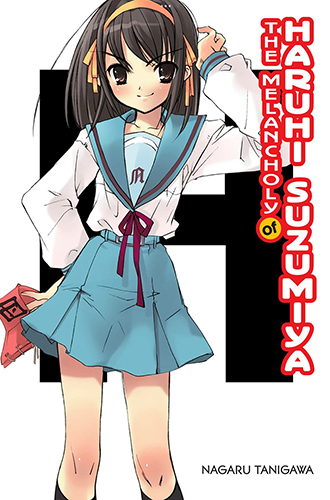
The Melancholy of Haruhi Suzumiya

The Melancholy of Haruhi Suzumiya, originally published in 2003, is a sci-fi romantic comedy about a quirky afterschool club. It’s also one of the most influential light novels from the heyday of otaku culture. Although I can’t say that all of its humor has aged well, it’s a quick and fun read, and there’s a good reason why it’s still in print.

Kyon is an average high school boy who’s assigned to the same homeroom as Haruhi Suzumiya, a beautiful girl who has a reputation for being weird. True to everyone’s expectations, she marches into the first day of class and introduces herself with the declaration that she’s not interested in speaking to anyone who isn’t an alien, an esper, or a time traveler. When Kyon tries to strike up a conversation with Haruhi, he gets roped into joining the SOS Brigade, an afterschool club that Haruhi has created to research supernatural phenomena.

The plot twist is that, with the exception of Kyon, every member of the SOS Brigade is indeed an alien, an esper, or a time traveler. They gradually reveal themselves to Kyon, insisting that they’re posing as high school students in order to observe Haruhi, who unknowingly has extraordinary powers capable of restructuring the universe. If Haruhi becomes bored with the current universe, it’s not beyond the realm of possibility that she might inadvertently destroy it. It’s therefore imperative that Haruhi remains entertained and blissfully unaware of her power.

As you might imagine, this scenario has a number of unsettling implications. Is everyone in the story merely a figment of Haruhi’s imagination? Does anyone in the universe she created have free will? If Haruhi created “this” universe, what happened to the universe where aliens, espers, and time travelers don’t exist?

The Melancholy of Haruhi Suzumiya goes right to the edge of these darker implications but ultimately backs off in favor of light comedy and mild teenage romance, a tonal balance that undoubtedly contributed to its popularity.

This light novel was adapted into an anime that aired in the Winter 2006/07 season. I admit that I’ve never watched it from start to finish, but the show was ubiquitous in Japanese pop culture fandom communities for years. The ending theme, “Hare Hare Yukai,” became a meme that spawned countless flash mobs of cosplayers recreating the iconic dance at anime conventions.

Due to its prominent place in mid-2000s otaku culture, I was considering including The Melancholy of Haruhi Suzumiya on the syllabus of a college class about Japanese science fiction and fantasy. I think it would be a good choice, but I’m still undecided. My hesitation is mainly due to the fact that one of the early chapters includes light elements of goofy sexual comedy that made sense in the cultural atmosphere at the time but might read a bit differently today.

To give an example, in order to blackmail the members of the computer club into giving her a PC, Haruhi takes someone’s hand and places it on the breast of one of the female SOS Brigade members before asking Kyon to take a photo. To me, this scene reads as the sort of stupid but harmless fantasy that might appeal to the book’s target readership of teenage boys, but I understand how it might be interpreted as sexual harassment (because, undeniably, it is).

Still, light novels are filled with this sort of thing, and I tend to think that The Melancholy of Haruhi Suzumiya is on the “unproblematic” end of the spectrum. To be fair, it’s not anything worse than what’s in most Haruki Murakami novels.

I don’t read many light novels these days, but I enjoyed The Melancholy of Haruhi Suzumiya. The pace is brisk, the writing is snappy, and the story offers a nice treatment of its speculative worldbuilding without getting too deeply into the weeds of hard science fiction. Looking back on this book from twenty years in the future, I found myself waning a bit nostalgic for an earlier (and, I think, more lighthearted) era of otaku culture. The Melancholy of Haruhi Suzumiya is an interesting cultural artifact, but it’s also a fun story that I’d recommend to anyone who hasn’t yet encountered its particular flavor of high school comedy.

The God of Nishi-Yuigahama Station

Takeshi Murase’s linked short story collection The God of Nishi-Yuigahama Station is about four people who lost members of their family in a tragic train derailment. For a year after the accident, the ghost train still makes its fatal run at midnight, giving those who grieve its passengers an opportunity to speak to the loved ones they lost.

The God of Nishi-Yuigahama Station is meant to make the reader cry, and it does so primarily through its improbably melodramatic situations. This short book is relatively light reading, and the level of catharsis it allows you to experience will depend on your tolerance for sentimentality.

Still, as far as this type of fiction goes, I enjoyed The God of Nishi-Yuigahama Station much more than similar titles (such as Toshikazu Kawaguchi’s Before the Coffee Gets Cold). Murase’s stories are grounded in the social realities of contemporary Japan, and the characters are messy and complicated enough to be interesting.

My favorite story is “To My Father, I Say,” which is about a young man named Sakamoto who leaves his rural hometown to work at a large finance corporation after graduating from a prestigious university in Tokyo. Sakamoto is forced to attend mandatory drinking sessions after work, and he’s bullied by his supervisor. He’s tired all the time, and his relationship with his girlfriend has gone stale. Meanwhile, he’s ignoring the calls from his father, who comes from a humble background.

Sakamoto finally snaps and quits his job, but he can’t bring himself to tell his family as his living conditions grow more precarious. Thankfully, he gets a second chance to talk to his father on the ghost train, which is the exact opportunity he needs to reevaluate his life and goals.     

Like a lot of contemporary Japanese popular fiction aimed at young adults in their twenties, The God of Nishi-Yuigahama Station is brutally honest about the emotional damage caused by bullying, which can extend far beyond grade school. Like other authors, Murase doesn’t shy away from stating that the main problem lies with the people who tolerate this behavior, while the solution is for one brave person to step up and offer support to the target.

This is an important and wholesome message, of course, but it’s a little depressing to me that this support can only exist in the form of a magical ghost train. Then again, the purpose of The God of Nishi-Yuigahama Station is not to offer deep insights and critique, but rather to make the reader cry and feel gratitude for their own family and friends. And who knows? This might just be the support you need.

Overlord: The Undead King

Overlord, Volume 1: The Undead King
Japanese Title: オーバーロード 1 不死者の王 (Ōbārōdo 1: Fushisha no ō)
Author: Kugane Maruyama (丸山くがね)
Translator: Emily Balistrieri
Illustrator: so-bin (@soubin)
Publication Year: 2012 (Japan); 2016 (United States)
Publisher: Yen Press
Pages: 246

Overlord is about a normal man from near-future Japan who becomes trapped in an MMORPG. It’s a typical isekai story, but there’s a twist. Instead of valiant hero who must learn to fight monsters, the protagonist is the monster, and his goal is nothing less than to take over the world.

The premise of Overlord is fairly standard. An MMORPG called Yggdrasil that was developed to take advantage of an immersive “neuro-nano interface” is scheduled to go offline after a successful twelve-year run, but a max-level player and guild master who calls himself Momonga (after a supremely adorable species of flying squirrel) decides to stay logged in until the last second. Momonga is not forced out of the system but remains inside the virtual world, and he quickly realizes that he’s unable to leave. He has no friends or family outside of Yggdrasil, so this is not as distressing for him as it could be. Nevertheless, he decides to “take over the world” in an attempt to find other players who may have become similarly trapped inside the game.

I’m not sure I can recommend Overlord to someone looking for a more literary type of fantasy. To begin with, there’s a fair amount of geeky talk concerning game mechanics like quickcasting and debuffer immunities, especially early in the novel. Overlord assumes that its reader is already familiar with MMORPG culture and the conventions of the isekai genre. If none of this is new to you, however, the way the novel fast travels through issues that aren’t pertinent to the immediate plot (such as “where am I” and “how did I get here”) is a welcome change of pace.

This novel is an unabashed power fantasy. Not only is Momonga inhumanly strong on his own terms, he now possesses all of the magical treasures left behind by his guildmates. On top of that, all of the powerful level bosses in the dungeon formerly occupied by his guild are tripping over themselves to swear allegiance to him. Momonga can heal the sick, raise the dead, summon dragons, and make all of his subordinates (male and female) swoon at his very presence.

There’s a bit of boob grabbing and panty wetting, but it’s very silly and feels perfunctory, almost as if it’s something that the author felt he needed to check off a list. For the most part, Momonga is a decent person who’s not particularly interested in romancing the (dubiously?) sentient NPCs who were originally created by his friends. He’s a “demon king” in title and appearance only – although he doesn’t hesitate to kill an entire battalion of mercenary soldiers who attack a civilian village later in the novel.

The real power fantasy explored by Overlord has very little to do with swords and sorcery, however. Rather, the novel is essentially a story about what it means to be a good boss. All of the fantasy-themed gaming business aside, what Momonga needs to figure out is how to become an effective leader who is able to work efficiently while maintaining the respect of his subordinates. The decisions he makes concerning matters such as when to intimidate people and when to let things slide are interesting, and they form the core of the story, whose conflicts have fairly low stakes – at least in the opening volume.

The Overlord light novel franchise has sold millions of copies in Japan. It was also adapted into an anime series in 2015, with its third season airing in 2018. The illustrator, @soubin, has a massive following on social media, not in the least because of his stylish fan art for anime like Neon Genesis Evangelion and Attack on Titan. The first volume of Overlord was originally serialized online, and it reads a bit like fanfiction with the serial numbers filed off. If you enjoy this type of writing, Kugane Maruyama’s novel is a decadent treat.

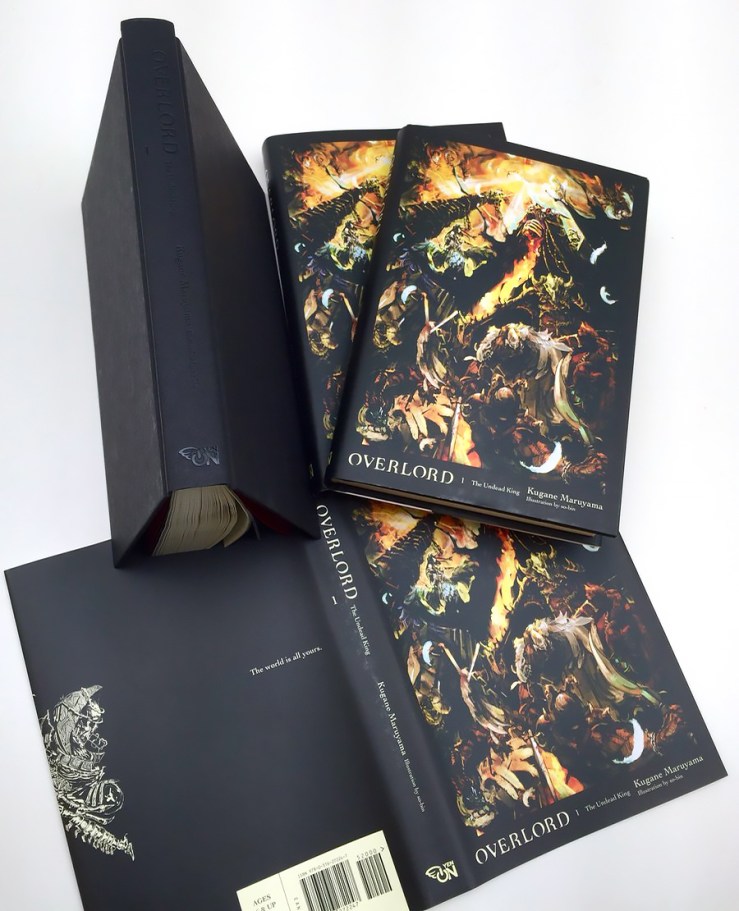
I should add that I’m extremely impressed by the quality of the hardcover edition of this book. Yen Press always does a fantastic job with its physical publications, but Overlord is something special. There’s a beautiful pull-out map at the beginning, character profiles at the end, and a full-color illustration on the cover page of every chapter. I have to admit that I’m not sure why Overlord has been singled out for this sort of “collector’s edition” treatment – aside from its massive popularity, of course – but I’m not complaining. Yen Press has currently published twelve volumes in the series, and each is as devilishly handsome as the last.

(Image from the Yen Press official Twitter account)

The Ancient Magus’ Bride: The Golden Yarn

The Ancient Magus’ Bride: The Golden Yarn
Japanese Title: 魔法使いの嫁 金糸篇 (Mahōtsukai no yome: Kinshi hen)
Editorial Supervisor: Kore Yamazaki (ヤマザキコレ)
Translator: Andrew Cunningham
Publication Year: 2017 (Japan); 2018 (United States)
Publisher: Seven Seas
Pages: 349

The Golden Yarn collects eight short stories set in the world of The Ancient Magus’ Bride, an urban fantasy manga series that was adapted into a three-part anime OVA in 2016 and a television series that aired in 2017. Even though I’m only a casual fan of the franchise, I still found this collection delightful. Each of the stories stands on its own, and the book is accessible even to people entirely unfamiliar with the manga or its animated adaptations.

The first story, “Frozen Flowers,” is by Kore Yamazaki, the artist who created the Ancient Magus’ Bride manga. Like the other stories in The Golden Yarn, “Frozen Flowers” offers a glimpse into the world of the series without assuming any prior knowledge. In this story, a centaur named Hazel visits his aunt Marie, who was born with two feet instead of four. Marie looks like a normal human, but she has the heart and mind of a centaur, and she wants nothing more than to run under the open sky with the rest of her herd. Because of her appearance, however, she’s ostracized by her fellow centaurs and lives alone in an isolated area in rural England. It’s difficult for Hazel to understand why Marie doesn’t try to pass as human, but he still accepts her and offers her his friendship and kindness.

“Frozen Flowers” introduces the main theme of The Ancient Magus’ Bride, which is the various relationships people negotiate with difference. Some of these relationships are healthy and affirming, as in “Frozen Flowers,” while others are toxic and exploitative.

There’s a strong current of horror running through the stories in The Golden Yarn. It’s most present in Jun’ichi Fujisaku’s “The Man Who Hungered for Trees,” in which the assistant to a genius video game programmer uncovers the sinister roots of his supervisor’s talent. The programmer makes small blood sacrifices to the spirits of marijuana bushes in exchange for energy and inspiration, but the plants are hungry for larger prey. As you might imagine, this doesn’t end well for anyone involved.

All of the stories in The Golden Yarn were contributed by authors associated with various light novel series. I was especially impressed with “The Sun and the Dead Alchemist,” which was written by Kiyomune Miwa, the author of the steampunk zombie-hunting series Kabaneri of the Iron Fortress (which was adapted into an anime in 2016). Miwa haunts similar grounds in this story, which describes the bittersweet romance between a necromancer and a young woman whom she inadvertently destroys with her magic.

An interesting aspect of this collection for me, as an American, was the opportunity to look at Europe and America from an outside perspective. For example, the venerable Yuu Godai, the author of the long-running Guin Saga series of dystopian fantasy novels, contributed a piece called “Jack Flash and the Rainbow Egg,” which is about a fairy who lives in New York but is obsessed with Japanese popular culture and sets up a detective agency to earn human money in order to buy dōjinshi. Godai’s energetic adventure story is a fun take on American culture, but what I found even more intriguing than a New York run by magical secret societies is the fantasy of twenty-first century Great Britain as a mystical land of rolling green fields, garden cottages, and magical creatures. I suppose The Golden Yarn is sort of like Harry Potter without the overt allusions to class conflicts and real-world fascism, but none of the stories shy away from the darker side of human nature.

Seven Seas has also published a companion volume, The Ancient Magus’ Bride: The Silver Yarn. Aside from the second half of “Jack Flash and the Rainbow Egg,” The Silver Yarn can be read independently, and its stories are just as engaging as those in The Golden Yarn. I can happily recommend both of these short story collections to any fan of historical fantasy and contemporary urban fantasy regardless of their level of familiarity with the Ancient Magus’ Bride franchise. Although there’s no explicit mention of sexuality, some of the stories are quite violent and disturbing, and the books are best suited to older teens and adults.

Log Horizon: The Beginning of Another World

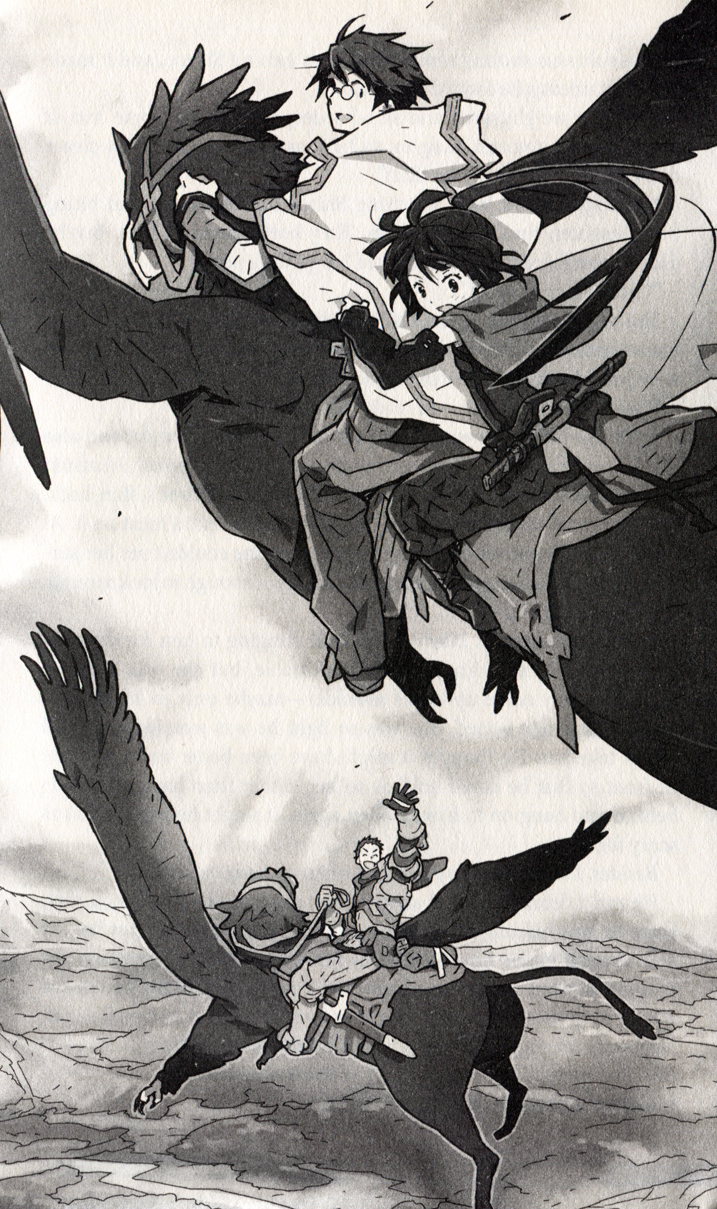
Log Horizon Volume 1 Cover

Title: Log Horizon: The Beginning of Another World
Japanese Title: ログ・ホライズン: 異世界のはじまり (Rogu Horaizun: Isekai no hajimari)
Author: Tōno Mamare (橙乃 ままれ)
Illustrator: Hara Kazuhiro (ハラ カズヒロ)
Translator: Taylor Engel
Publication Year: 2015 (America); 2011 (Japan)
Publisher: Yen On
Pages: 215

This guest review is written by Jeremy Anderson (@GameNightJeremy on Twitter).

Log Horizon: The Beginning of Another World is a light novel about people who become trapped in a fantasy video game world and must figure out what to make of themselves in this new environment as they navigate its dangers.

The plot is as follows: A young, intelligent, and socially awkward man named Shiroe finds himself physically inside a world roughly identical in form to the world of an online game he’s been playing for years, and he doesn’t know how to escape. He locates his friends, rambunctious but solid Naotsugu and quiet but reliable Akatsuki, and together they begin to explore the reality in which they’ve become trapped.

Log Horizon distinguishes itself from other entries in the “video game world” trope by changing the stakes. Other such stories, such as the light novel series Sword Art Online, tend to include comatose people who need to be woken up, a situation often nested with some hidden or overt moral about the importance of rejoining the real world. While Log Horizon‘s protagonist Shiroe ponders the possibility that everyone is comatose, he dismisses it as unlikely and doesn’t consider actively seeking an exit to be a productive use of time. Instead, the story is about taking life on its own terms and living life right now, where you are.

Log Horizon starts a little slow but builds on what it’s laid down early on to do more interesting things as it rolls along. I can tell you why I found it to start a little slow: I’m a gamer, and I’m already familiar with gaming terminology. Log Horizon devotes its first chapter to bringing readers up to date on this terminology. If you know what a guild is, how chat and friending functions work, what XP and HP mean, what a level cap is, what an MMORPG is, and so on and so forth, you may find yourself rolling your eyes and saying, “Yeah I get it.”

To me, this slow start is forgivable for two reasons. First, because I understand that not everyone is a gamer, and it’s better that I spend two seconds rolling my eyes than that another reader give up on the story because the writer never explained important terms. Second, because even within the first chapter the revelations about the way this MMO reality and the human-world reality interact are fascinating. That clash of worlds – the logical-but-unintuitive way new rules form from the known systems – is one of the main attractions of setting the story in a video game world. Log Horizon provides a number of clever details regarding world-building, and the protagonist spends a lot of time thinking about those details and responding to them.

In essence, the “video game world” trope provides an excuse to follow a set of strictures that will be easy for some to understand intuitively, and that will be easy to explain to the rest. The other value of setting the story in a video game world (instead of, say, Narnia) is that it allows our hero Shiroe to start off as intimately familiar with how the new world works. After all, he’s been playing the game for years, and he can approach the situation of becoming trapped within it with the calm and rational mind that distinguishes him as a player.

Whereas Sword Art Online explains the mystery behind how its characters have entered the game world almost immediately, Log Horizon doesn’t explain how this happened, might never explain how this happened, and tells the story in a way that makes this lack of information surprisingly acceptable. The story is about what the characters make of their situation, not how they got there.

The conflict in Log Horizon is a struggle for the soul – both the individual souls of the adventurers (Shiroe in particular), and the soul of the community. One of the most illuminating moments in the story is when Shiroe notes that the true threat to players in the game world is social. Thirty thousand people have been uprooted from their lives and transplanted into a new world, which does not have any government or laws. By the end of the novel, the reader sees how ugly this scenario becomes, with a major in-game city resembling a town run by a villain in a spaghetti western. In addition, Shiroe expresses concerns about sexism, such as the legitimate worry that female players, who form a distinct minority, will be harassed more than male players.

As fun as the fight scenes can be in Log Horizon, the novel’s most impressive moments aren’t when a dude is being cut in half or a building explodes; they’re when a man decides to stand up for someone he’s never met, because he knows he and his friends are best suited to get the job done. When his friends, new and old, push him to live more fully. When three people realize they’re the first ever to see the sunrise from a certain previously-unexplored hill. The fundamental question in Log Horizon is not, “How do we escape this false reality so we can get back to living our lives?” It’s a much simpler, broader, and deeper, “How do we live well?”

Log Horizon‘s story isn’t revolutionary in its interpretations of the “video game world” trope or the broader “team fantasy adventure” genre, but it does tell a story that is unique enough to keep the reader interested from cover to cover as it continues to chip away at the limitless edge of narrative possibility.

The story is also available in manga and anime formats.

. . .

Jeremy Anderson is a writer and game designer best known for the Shadowrift card game, and a consumer of far more comics and anime than anyone should have access to. He is currently on the design staff of Rise of the Eagle Princess, a JRPG set in a fantasy world based on the Mongolian empire.

Log Horizon Volume 1 Page 153

All You Need Is Kill

All You Need Is Kill

Title: All You Need Is Kill
Japanese Title: オール・ユー・ニード・イズ・キル (Ōru yū nīdo izu kiru)
Author: Sakurazaka Hiroshi (桜坂 洋)
Translator: Joseph Reeder with Alexander O. Smith
Publication Year: 2009 (America); 2004 (Japan)
Publisher: Haikasoru
Pages: 200

Although I read and very much enjoyed Sakurazaka Hiroshi’s virtual reality gaming novel Slum Online, I was not interested in All You Need Is Kill, even after watching Emily Blunt do endless sexy pushups in Edge of Tomorrow. I have trouble with prison stories, and army stories are like prison stories except worse.

After hearing Akiko Hirao give a paper titled “All You Need Is Kill: Deciphering the Game Elements in the Novel and Film” at the Japanese and Korean Mediascapes conference at the University of Oregon this summer, however, I knew I had to give the book a shot. Drawing on Henry Jenkins’s essay Game Design as Narrative Architecture, Hirao outlined how the structure of the novel’s narrative evokes the experience of playing a video game but ultimately bows to the demands of fiction as a storytelling medium.

The main protagonist of All You Need Is Kill is Kiriya Keiji, a recent high school graduate who enrolled in the United Defense Force after he was romantically rejected by an older woman. Since he has no other ambitions, he decides to prove himself by joining humanity’s fight against alien invaders called Mimics. After spending six months training to fight in a special armored exoskeleton called a Jacket, Keiji is deployed to the Flower Line Base at the southern tip of the Bōsō peninsula (in Chiba Prefecture, on the east side of Tokyo Bay). The novel opens with Keiji’s swift death in his first battle and continues when he wakes up alive and unharmed – but with all of his memories – that same morning. After falling in battle three more times, Keiji realizes that he is caught in a time loop that is reset by his death. He decides that the only way out is to not die, but that’s easier said than done.

I found Keiji to be a bit generic. Even though I just finished reading All You Need Is Kill, I couldn’t tell you exactly how old Keiji is, or where he grew up, or what his relationship with his parents was like, or whether he had any friends, or what his interests and hobbies are. For the first one hundred pages of the novel, all the reader gets is Keiji the soldier in a time loop. He is bitter, introverted, and fairly introspective, but he seems to act as more of a substitute for the reader than as a character in his own right. Keiji is a video game protagonist, and his musings are the musings of a video game character on the game world he occupies:

At the end of the day, every man has to wipe his own ass. There’s no one to make your decisions for you, either. And whatever situation you’re in, that’s just another factor in your decision. Which isn’t to say that everyone gets the same range of choices as everyone else. If there’s no one guy out there with an ace in the hole, there’s sure to be another who’s been dealt a handful of shit. Sometimes you run into a dead end. But you walked each step of the road that led you there on your own. (54)

As the passage above illustrates, the language used by Keiji and his fellow soldiers is rough; but, as far as military diction goes, it’s fairly tame. There’s “fucking” but no “cunting” or “cock-sucking,” for example. I feel like an especially good opportunity was missed in the author’s failure to assign a creative and obscene nickname for the Mimics. The banter between the soldiers is stale, and Keiji doesn’t take advantage of his consecutive time loops to come up with good one-liners to use against his superior officers or the jerks who try to pick fights with him in the cafeteria, which for some reason is actually referred to as a “cafeteria” instead of a “mess hall,” “cookhouse,” “DFAC,” or any number of other military slang terms. The blandness of the language is indicative of how uninterested the novel is in building a world beyond Keiji’s limited range of experience.

This all changes in the novel’s third chapter, which takes the American Major Rita Vrataski as its point-of-view character. The nineteen-year-old Rita became the Mimic-destroying “Full Metal Bitch” after being caught in a time loop of her own; and, unlike Keiji, she actually has a personality. Rita verbally spars with a war photographer named Ralph Murdoch, lets down her guard down around an engineer named Shasta Rayelle, and remembers her childhood in Pittsfield, Illinois, offering glimpses not just into her inner world but out onto the wider world as well. In her paper, Hirao referred to Rita as an NPC (“non-player character” in a game), and this description is apt, as it is through Rita that the player/reader learns more about the nature of the conflict that drives the novel. What are the Mimics? Where do they come from? How can they best be fought? What’s up with this time loop business anyway? Rita doesn’t have all the answers, but she’s got some pretty good guesses.

Rita also has some cool passages in her section, such as when Shasta says…

“America’s at war, and we still find the time to turn out terrible movies.”

Rita couldn’t argue with that. The UDF existed to protect a world obsessed with creating worthless piles of crap, Rita thought. (130)

Preach it, sisters.

The fourth and final section of the novel switches back to Keiji’s perspective, which is a shame, because at the end of the story he becomes the video game hero he was meant to be, which is to say that he is awarded his own tragic backstory. If you’ve ever played any video game ever, you can probably guess how this happens: A woman has to get fridged, and it has to be the woman Keiji falls in love with despite the fact that she doesn’t have a great deal of choice in the matter. It’s a really stupid ending. To make matters worse, the author is too lazy to expand on any of the implications of this ending beyond the fact that Keiji becomes the warrior he never wanted to be. He is a troubled teenager, hear his angst.

In his Afterword, the author explains how is inspiration for All You Need Is Kill did indeed come from a life spent playing video games, writing,

I’m just an ordinary guy, and I’m proud of it. I’m here because I put in the time. I have the blisters on my fingers to prove it. It had nothing to do with coincidence, luck, or the activation of my […] powers. I reset the game hundreds of times until my special attack finally went off perfectly. Victory was inevitable. (199)

The Afterword contains one of the more interesting passages in the entire book, as Sakurazaka is fairly negative both towards video games and the people who play them. Okay buddy, whatever.

If you’re curious about what a video game with all of its gameplay mechanics intact would look like in novel form, look no farther. I thought Slum Online was much more entertaining and skillfully constructed in its representation of what it means to be a video game protagonist, but All You Need Is Kill has the advantage of being short and fast-paced. Also, it’s got forty gorgeous pages full of Rita Vrataski, which is not enough but better than nothing.

I want to give a big thanks to Akiko Hirao for her wonderful and insightful paper on this novel, and I hope to encounter more of her work soon!

Vampire Knight: Fleeting Dreams

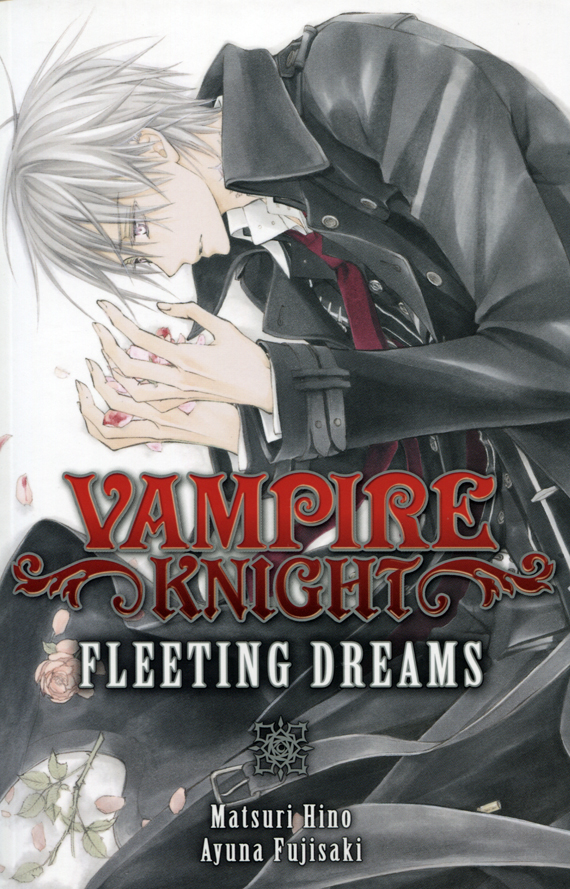
Vampire Knight Fleeting Dreams

Title: Vampire Knight: Fleeting Dreams
Japanese Title: ヴァンパイア騎士 煌銀の夢 (Vanpaia naito: Fureiru no yume)
Author: Fujisaki Ayuna (藤咲 あゆな)
Original Story: Hino Matsuri (樋野 まつり)
Translator: Su Mon Han
Publication Year: 2014 (America); 2013 (Japan)
Publisher: Viz Media
Pages: 273

Yesterday I blew through this book in one sitting, and I was like, “Why am I reading this garbage?”

Today I’m sitting in front of my computer, and I’m like, “Why am I reviewing this garbage?”

Vampire Knight: Fleeting Dreams is like a McDonald’s Oreo McFlurry: it’s cheap, it has absolutely no substance, it’s terrible for you, and yet it’s bizarrely compelling.

If you’ve never heard of Hino Matsuri’s Vampire Knight, it’s a shōjo manga supernatural soap opera starring Kurosu Yūki (Yuki Cross in the translation), a high school girl who is the object of the obsessive romantic interest of both Kiryū Zero, a vampire hunter who was bitten and turned as an adolescent, and Kuran Kaname, an older (much older) Pureblood vampire who has known Yūki since she was a small child. While Zero and Kaname glower and brood, Yūki is the embodiment of pure-hearted sweetness. She’s clumsy, she’s stupid, she’s ineffectual, and everyone adores her. Many necks are bitten.

Sexuality is the big theme in the first half of the nineteen-volume manga series, while the intersection of politics and bioethics is the major concern of the latter half (in which everyone is still sexy, of course). Although things happen to Yūki, and although the reader learns more about her background, her character doesn’t really change over the course of the story; and, at the end of the manga, she is just as trusting and cheerful and willing to sacrifice herself for others as she was at the beginning. In essence, although she’s surrounded by adults, she herself never really grows up. It’s from this characterization that the third major theme of the series arises, namely, the preservation of innocence.

What’s really interesting to me about Vampire Knight is that the fantasy the reader is most expected to identify with is not related to being the object of sexual desire or being physically young and healthy forever; rather, the fantasy of Vampire Knight; is all about being protected. Unlike the Twilight novels, in which Bella begins as Sleeping Beauty and ends up as Jean Grey, Yūki does not become a symbol of love or immortality. Instead, the reader comes to associate her with being shielded. Yūki fails at everything she does, but she is always given a second chance, and then a third, and then a fourth. She experiences hardship, certainly, but nothing is ever her fault. Although Yūki’s complete lack of development can be frustrating to the reader, one might say that her true talent lies in not being tainted by the evils of the adult world.

Vampire Knight: Fleeting Dreams is a collection of six short stories written by Fujisaki Ayuna, one of the scriptwriters for the Vampire Knight anime series. Although the book does contain a dozen illustrations by Hino Matsuri, the smoldering eyes and parted lips of the manga are largely (but not entirely) absent, as are all but the briefest references to the political games and secret technologies that dominate the latter volumes of the series. What Fleeting Dreams focuses on is the fantasy of being protected and sheltered, whether it’s Yūki finally succeeding in her studies after being assigned a private tutor, Zero becoming a temporary bodyguard for a female vampire named Shien, or the human students of Yūki’s high school finding a sense of community through a school festival.

My favorite story in the collection is “A Maiden’s Melancholy” (Otome no yūutsu: Aru hi no Howaito Ririi), which is narrated by Zero’s horse, White Lily. Describing herself as “the maiden of the snowy white blossoms,” White Lily is devoted to Zero and will allow no other rider to approach her, a temperament that has resulted in her being labeled as “difficult.” One day, when Headmaster Cross (Yūki’s adoptive father) proposes that White Lily be “matched” with a stallion named Black Sword, she becomes enraged but is unable to communicate her displeasure to Zero, who doesn’t oppose the arrangement. It turns out that the only person who is able to understand White Lily’s feelings is Yūki, who reassures the horse that Zero and Headmaster Cross would never do anything to make her unhappy. What I like about this story is that it highlights Yūki’s narratively underutilized ability to protect those around her because of her empathy, not in spite of it.

Of course, I also enjoyed the fact that the narrator of “A Maiden’s Melancholy” is a horse who proclaims her love for Zero in twenty-point font. It’s a ridiculous situation, and the writer plays it for all it’s worth. To be honest, everything in Fleeting Dreams is way over the top, and its dark heart pumps purple prose. The text is double-spaced and sits in the center of enormous margins, so not even the layout editor is trying to trick you into thinking it’s serious. Although the stories are intended for an audience that has already completed the manga (or Ayuna’s previous three-part novelization of the manga), you really don’t have to have read even a single volume of the series to appreciate the appeal; Fleeting Dreams is like the best (and worst) fanfiction in that the source text almost doesn’t matter.

If you don’t go into this book expecting camp, or if you don’t enjoy campy romance fiction to begin with, I guarantee that you will dislike Fleeting Dreams. As I wrote at the beginning of this review, it’s garbage. Regardless, I’m overjoyed that Viz Media has published it in lovely physical and digital editions, because it’s always good to see more light novels for girls in English. Yen Press has the boys spoiled for choice, and we really need some pointy boy bits (look at those fingers on Hino’s cover illustration!) to balance out all the bouncing breasts currently on offer. Bring on the trashy young adult chick lit!

Attack on Titan: Before the Fall

Attack on Titan Before the Fall

Title: Attack on Titan: Before the Fall
Japanese Title: 進撃の巨人 Before the fall (Shingeki no kyojin: Before the fall)
Creator: Isayama Hajime (諫山 創)
Author: Suzukaze Ryō (涼風 涼)
Illustrator: Thores Shibamoto (THORES 柴本)
Translator: Ko Ransom
Publication Year: 2014 (America); 2011 (Japan)
Publisher: Vertical
Pages: 199

The year 743. Mankind was facing extinction at the hands of the Titans that had suddenly appeared at the center stage of history. Where had they come from, and what was their purpose? Some said that they were natural disasters, while others insisted that they were divine retribution. Either way, mankind had been reduced to a simple, clueless prey whose total population had plummeted to 500,000.

I am heavily invested in the Attack on Titan franchise, and I enjoyed this book. If you are as invested as I am, then you will more than likely enjoy this book as much as I did. In fact, you’ve probably already read it.

If you have no idea what the Attack on Titan franchise is, this book is not a good introduction. Give the opening episode of the anime a shot! It’s worth your time, I promise.

This review is for people who have some experience with Attack on Titan and are wondering if the first volume of the Before the Fall light novel series is any good. I think it is! Despite being a bit shallow, it’s a fun read.

The story is set before Isayama Hajime’s original Attack on Titan manga, when the human race has only been living within a massive walled city-state for a few generations. The action of this novel occurs before the events of the Attack on Titan: Before the Fall manga, which adapts the events described in the second and third books in the Before the Fall light novel series.

The first novel in the trilogy is an account of the development of the Three Dimensional Maneuver Gear that allows human beings to fight the giant murderous creatures roaming outside the city walls. This equipment, along with the swords that accompany it, are the work of a young engineer named Angel Aaltonen, who is aided in his efforts by his bright assistant Corina Ilmari and his older colleague Xenophon Harkimo, who specializes in gunpowder and chemical flares. Jorge Piquer, the leader of the Survey Corps military unit specializing in missions outside the walls, is interested in this equipment, hoping that it will allow a human to finally bring down one of the Titans, which are considered immortal. Titans are not the only enemies Angel and Jorge will face, however, as there is considerable political pressure to seal the gate leading outside the wall and thus disband the Survey Corps.

Attack on Titan: Before the Fall is a light novel, and it reads like one. Paragraphs and sentences are short, and the writing is simple and straightforward. There’s also not a great deal of complexity in terms of characterization or character motivations. The reader is assumed to be familiar with the world in which the story is set, so the book doesn’t offer much world building, and nothing is learned that isn’t already covered in the first season of the anime series. As a result of this “lightness,” most of the plot developments in the novel seem too easy. For example, Angel’s inventions are made possible by the discovery of two materials in the lands enclosed by the walls: Iron Bamboo, which is strong and durable despite being light and flexible, and Iceburst Stone, which provides an endless supply of steam energy under certain conditions. Both of these materials are impossibly convenient, and Angel’s team experiences almost no hardship in learning to manipulate them.

What the book can offer the reader are finely crafted action sequences which work well without a visual element, which is no mean feat. Although someone who hasn’t seen the animated adaptation of Isayama’s manga may be confused regarding how large the Titans are relative to humans and what sort of movement the Maneuver Gear allows, a reader already familiar with the visual stylizations of Attack on Titan will be treated to several tense battles. The universe created by Isayama is like Westeros in that important characters can die horribly at any point in the story, so the suspense generated by these fight scenes is gripping.

Suzukaze Ryō’s vision of the world of Attack on Titan is interesting and entertaining, even if it discloses no major revelations. The light novel style of writing makes the book a quick read, and the action scenes are fast paced and attention grabbing.

If you’re not into the animu and mangos, feel free to give this novelization a pass; but, if you’re intrigued by walled cities, government conspiracies, and postapocalyptic struggles against an incomprehensible enemy, you should totally check out Justin Cronin’s The Passage, which is the perfect blend of Attack on Titan madness and highly accessible Stephen King-style storytelling.

Sword Art Online: Aincrad

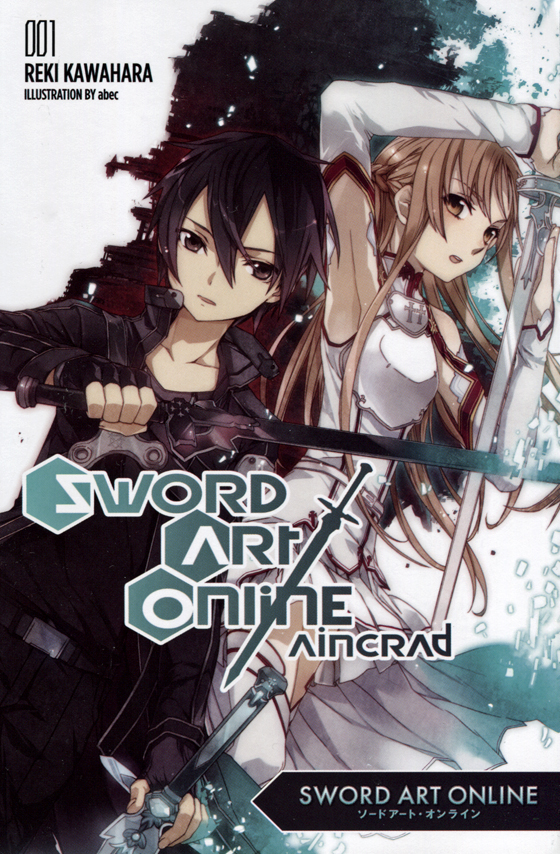
Sword Art Online: Aincrad

Title: Sword Art Online: Aincrad
Japanese Title: ソードアート・オンライン: アインクラッド
(Sōdo Āto Onrain: Ainkuraddo)
Author: Kawahara Reki (川原 礫)
Translator: Stephen Paul
Illustrations: abec
Publication Year: 2014 (America); 2009 (Japan)
Publisher: Yen Press
Pages: 248

Before I begin this review, I feel I should admit that I only made it through five episodes of the Sword Art Online animated series. The show involves an inordinate amount of yelling and boob grabbing, and watching it gave me a headache. Despite the fact that I am quickly becoming an old woman who has lost her patience with screaming teenagers and fan service, the show was fairly popular in both Japan, where more than 35,000 DVDs have been sold (in a market in which few titles break the ten thousand mark), and in America, where it was hailed as one of the smartest shows to come out in 2012. The Sword Art Online anime is based on a light novel series, which achieved bestseller status in the year the anime was televised. Sword Art Online: Aincrad is a translation of the first novel in the series, which is currently on its fourteenth volume.

Sword Art Online: Aincrad takes place in the fantasy world of Aincrad, an enormous castle with one hundred floors that serves as the setting of an immersive virtual reality MMORPG game called Sword Art Online (SAO). Released in 2022, SAO is the first game of its kind in that players are able to fully enter the virtual world through special hardware called NerveGear, which intercepts all brain activity and leaves the player’s physical body in a dormant state. As might be imagined, the game completely sells out on the day of its release.

As the new players orient themselves on the first floor of Aincrad, however, they receive a nasty surprise. Kayaba Akihiko, the game’s executive producer and head programmer, appears in the sky above the Town of Beginnings and announces that players will not be able to log out of the game until the final boss monster on the top floor of Aincrad is defeated. If someone from outside the game attempts to remove or unplug a player’s NerveGear helmet, the player will die. Even more troubling, if a player dies in the game, his NerveGear will send an electric shock to his brain that will result in death. It is thus in the best interests of the roughly ten thousand players trapped within Aincrad to master SAO and beat the game as quickly as possible. Unfortunately, it’s not easy to progress through the game, especially since its high stakes discourage risk taking, and the players have already been in Aincrad for two years when the main story begins.

The novel is narrated from the perspective of a teenager named Kirigaya Kazuto, who goes by the name Kirito in SAO. Kirito was one of the game’s one thousand beta players and, although he was only fourteen years old when he first entered Aincrad, he is already a veteran gamer. He is thus quite adept at the game mechanics and has managed to develop an ability called “Extra Skill Dual Blades,” which is unique to him as a player. Although Kirito wants to be able to return to the real world, he declines to work with the player guilds that have sprung up as collaborative efforts to progress through the game, instead fighting and gaining experience on his own. He gradually warms to a slightly older teenager named Yūki Asuna, who serves as a sub-leader of the Knights of the Blood guild and is popularly known as “Asuna the Flash” because of her high speed statistic. The trust and friendship between Kirito and Asuna gradually deepens over the first half of the novel, which is ultimately less sci-fi suspense or action adventure than it is a fantasy-themed love story.

Although there is plenty of action in Sword Art Online: Aincrad, world building is neglected in favor of establishing a romantic relationship between Kirito and Asuna. The reader is told that Algade, the city on the 50th floor of Aincrad, is reminiscent of Akihabara, and that Collinia, the city on the 75th floor, looks like ancient Roman city, but that’s about all there is in the way of description. What, specifically, does it mean that these cities “look like” other places – what are their styles of architecture, how are their streets laid out, do they any public monuments? How big are these cities? How big is each floor of the castle beyond the cities? What sort of trees and other plants grow on each floor? Are there pets or other domesticated animals? What sort of monsters do the players fight? What do the dungeons look like? We know the players can eat in the game, but what do they eat? We know there are healing potions, but what do they taste like? When magical crystals are used as items, what does it feel like? Can the players smell things? Can they feel temperature and humidity? Are certain textures pixelated or repetitive, and if so do the players notice? The reader is provided with few details that might serve to make the world of the novel more (or less) real.

Some visual detail is provided by eight color illustrations at the beginning of the book and ten black-and-white illustrations interspersed unevenly throughout the chapters, but these illustrations have a strong emphasis on character design. The illustrator abec, whose special skill seems to be depicting the springy softness of braless breasts through school uniforms (the link to his blog is not work safe, by the way), seems to be especially enamored of Asuna, who gets a full two illustrations in nothing but her underwear, one of which is overlaid with text in which she asks Kirito/the reader not to look at her. Even without such illustrations, the novel feels more than a bit like an extended romantic fantasy for straight adolescent males. It goes out of its way to objectify Asuna, devoting an undue amount of text on when and how many times and under what circumstances its male protagonist is able to hook up with her. Although Asuna is supposed to be an exceptionally skilled player, her strength and abilities are only shown in relation to male characters, such as when she fights beside or cooks for Kirito. As Asuna is the only female character in the novel, Sword Art Online: Aincrad doesn’t even make it past the first portion of the Bechdel test (there are other female players in the game, but Kirito is not interested in them, stating simply that they’re unattractive and thus unworthy of attention).

Aside from its casual sexism, the narrative emphasis on Kirito’s pursuit of Asuna results in missed opportunities with other male characters as well. For example, the least utilized but perhaps most interesting character in the novel is Heathcliff, the leader of the Knights of the Blood. Why is this older man playing the game (which is something I wanted to know more about even after learning his real-life identity), and why does he act as he does? Where does his strength of character come from, and how does he honestly feel about the deaths of the players under his command? What are his motivations, and what is he escaping from in the world outside the game? Who is caring for his physical body? Unfortunately, all such questions are ignored in favor of Heathcliff acting as a vaguely defined father figure who prevents Kirito’s immediate access to Asuna.

Another potentially interesting male character is Kuradeel, a member of the Knights of the Blood who is eventually revealed to be a former member of a guild called Laughing Coffin, whose members specialize in killing other players. I am always interested in PvP (player versus player) mechanics in MMORPGs, and I’m doubly interested in what rationale might lie behind PvP conflicts in a game that can easily result in real-world death. About two-thirds of the way through the book Kuradeel snaps and allows the reader a fleeting glimpse into the depths exposed by his ebbing sanity, which would be an excellent chance to explore the negative psychological effects that would doubtlessly be engendered by the situation in which the players find themselves. But alas, Kuradeel’s role in the story is merely to act as a barrier to Asuna, and the section in which he traps Kirito and then delivers his limited exposition is only fourteen pages long. The male characters who don’t come between Kirito and Asuna, such as Kirito’s friend Klein and the shopkeeper Agil, have few speaking parts and no backstory at all.

My favorite part of Sword Art Online: Aincrad is a quiet twenty-page segment towards the end of the book that serves as a bridge into the power metal chorus of the finale. After Kirito and Asuna finally get together, they run away from the whole business of dungeons and guild politics to go on a honeymoon of sorts to the 22nd floor of Aincrad, a sparsely populated wilderness distinguished by its lakes. Between bouts of dialog that feels lifted from shōjo manga targeted at the elementary school crowd, the lovers encounter a middle-aged man named Nishida, a technician employed by Tohto Broadband, the network management company responsible for the internet access lines leading to SAO’s servers. While testing the game’s connections on its launch day, Nishida was trapped along with the players, and now he spends his time fishing. By chatting with Nishida, Kirito and Asuna are able to reflect on what their time in SAO has meant to them and why exactly they still want to leave. These conversations are also the only point in the novel at which the reader is able to pick up hints concerning what the lives of players not directly involved in Kirito’s personal drama might be like. This is as close as Sword Art Online: Aincrad gets to addressing what could have been its most interesting theme, namely, whether there is any quantifiable difference between lived experience in the real world and lived experience in a virtual world. As a sixteen-year-old boy and reader stand-in character, however, Kirito is not the least bit concerned with such matters, and the novel quickly makes an awkward leap back into fighting and yelling territory.

Although I can’t make any judgments about the anime, I can say with relative certainty that the first volume of the Sword Art Online novel series is little more than an extended romantic fantasy for straight adolescent males. In other words, if you’re a straight adolescent male and you want the girl of your dreams to fall in madly love with you because of how awesome you are at level grinding, then this book was written for you. Enjoy yourself!

If you are not in the target demographic for the series, however, you might want to give the novel a pass. Although I am given to understand that more female characters are introduced as the series progresses, there is also a fair amount of damseling. In the second volume, for example, Asuna is apparently stripped of her powers, kidnapped by a male villain, and threatened with sexualized violence in order to provide Kirito with renewed narrative impetus. That sort of ridiculous bullshit aside, however, Sword Art Online: Aincrad is a fairly entertaining read that draws the reader in with a well-blended mixture of sci-fi and fantasy elements and a compelling series of crises. Chapters are short, about ten pages on average, and the translation is smooth and meets the high standard of quality one would expect from the team at Yen Press. Whether the admittedly enjoyable “lightness” of this light novel can counterbalance the nagging sexism is up to the individual reader, however.

A good distaff counterpart to the “virtual world romance” scenario presented in Sword Art Online: Aincrad is Vivian Vande Velde’s 2002 Heir Apparent. In this short young adult novel, a teenage girl finds herself trapped in a virtual reality game with strong RPG elements, which she must escape through her own cunning and the help of the handsome teenage game developer. Since the game resets every time its player-character dies, the reader is also able to enjoy a type of The Edge of Tomorrow scenario, only with fewer explosions and sexy pushups and more political maneuvering and backstabbing. Deadly Pink, Velde’s 2012 follow-up to Heir Apparent, focuses on the love between sisters instead of romance and manages to be smart and funny while treading carefully around some surprisingly dark themes. While much of the intended appeal of Sword Art Online: Aincrad may not be of interest outside of the novel’s target demographic, I can wholeheartedly recommend Heir Apparent and Deadly Pink to any reader interested in young adult fiction and themes relating to the pleasures and perils of virtual worlds.